In‑depth explainer on TokenBrice, covering his DeFi research, Pharos stablecoin analytics, DeFi Scan decentralization ratings, livestream education, governance debates, and how his work shapes risk transparency and infrastructure across the onchain ecosystem.
"The Best Tool To Research And Compare Stablecoins, And Why"
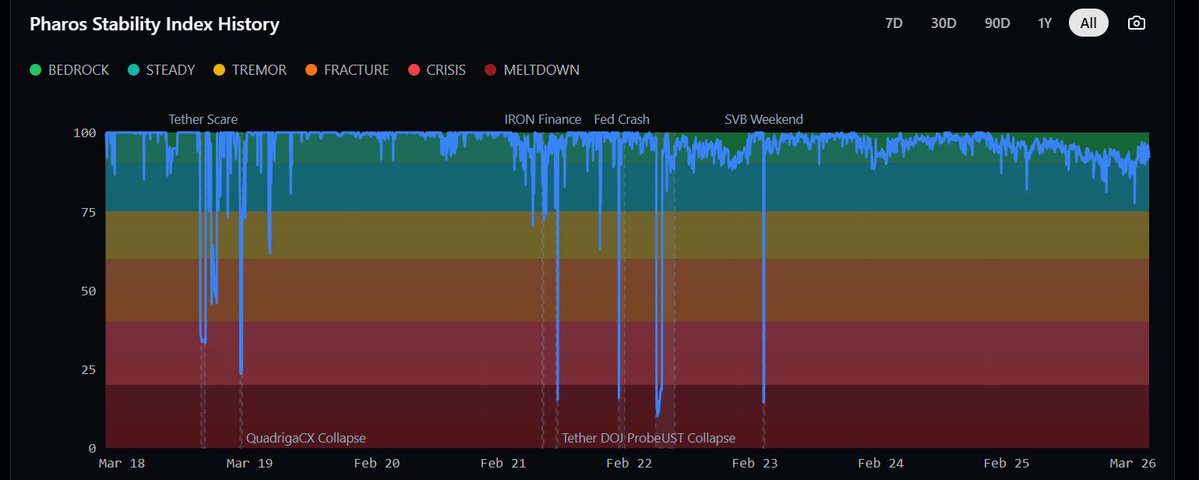
A new article by DAdvisoor about Pharos, the comprehensive stablecoin dashboard by TokenBrice2026-03
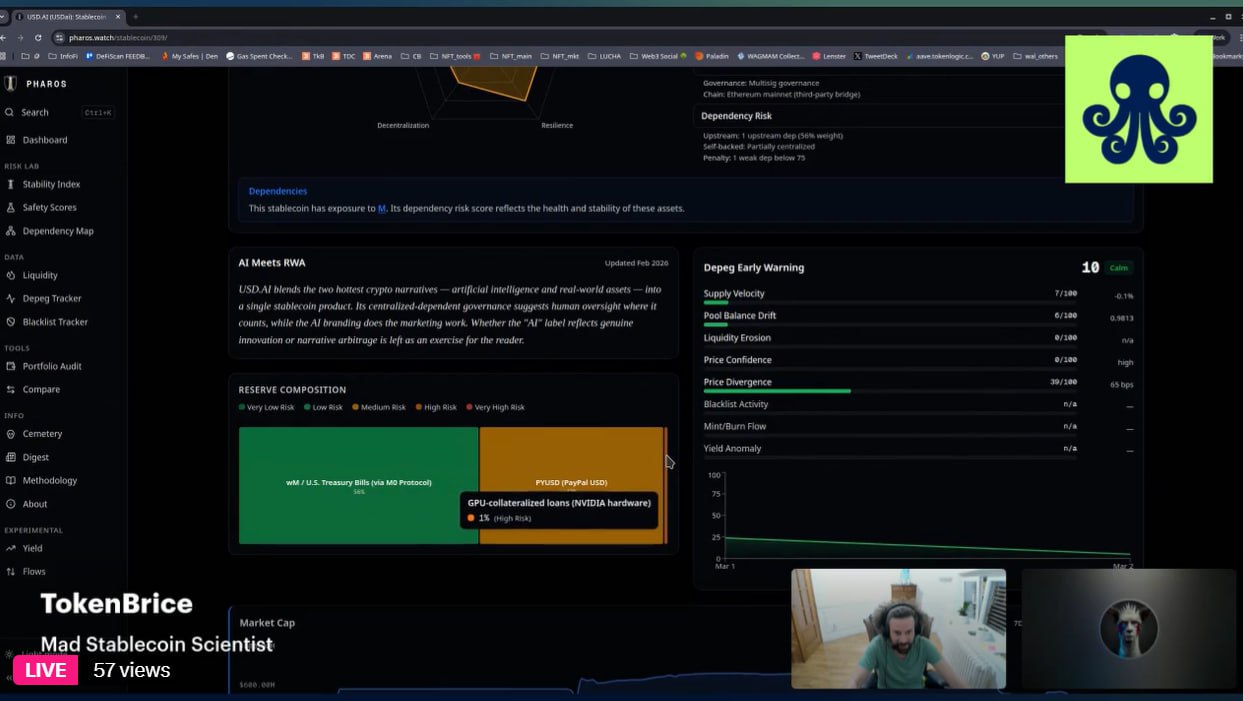
How Stable Is Your Stablecoin?
With the new tool by TokenBrice, Pharos Watch - you can check that, and a lot more!
Live now!2026-03
"How Stable Is Your Stablecoin?"
DAdvisoor will be going live with the Mad Stablecoin Scientist, TokenBrice, about his new creation - Pharos Watch, the new stablecoin dashboard!
Enjoy!2026-03
A new stablecoin analytics dashboard is revealed by TokenBrice, aka the "Mad stablecoin scientist"2026-02

"Stable or Not?" - Stable Talk with Pharos Ep.2
Live now with TokenBrice and DAdvisoor2026-05
"No T-bills, No CEXes, No Compromises - Introducing Polaris"
Going live in an hour with TokenBrice and 0xluude to talk about Polaris, the self scaling stablecoin operating system!
Join us at 22:30 UTC2026-01
TokenBrice: Architecting Transparency in DeFi, Stablecoins, and Onchain Risk
TokenBrice is a pseudonymous DeFi researcher, writer, and builder known for “brutally honest” long‑form analyses of protocols, stablecoins, and liquidity systems, and for creating tools like Pharos and DeFi Scan that turn complex onchain risk into intelligible signals for users and builders. Operating at the intersection of research, product design, and media, he has become a central reference point for stablecoin analytics, decentralization assessment, and the emerging “infrastructure layer” of DeFi thought.
Origins and Role in the DeFi Ecosystem
The public persona of TokenBrice emerges first and foremost through his writing, which is collected on the TokenBrice website under the tagline “Brutally Honest DeFi.” That self‑description is not mere branding: it reflects a consistent approach of engaging critically with protocol design, liquidity incentives, and governance trade‑offs rather than marketing narratives. The essays range from deep dives into protocol tokenomics to broader reflections on how decentralized finance as a whole is evolving, often anticipating patterns—such as the rise of protocol‑owned liquidity or lending aggregation—before they are widely recognized. This kind of long‑form, thesis‑driven analysis has helped position TokenBrice as a bridge between highly technical onchain reality and the more narrative‑driven worlds of crypto media and governance debate.
The early work on the site demonstrates a clear interest in how incentives shape onchain markets, with detailed case studies comparing DEX designs and curve‑style emissions systems. Over time, that focus expands to capture stablecoin dynamics, pegged‑asset swaps, and the ways in which liquidity incentives can either reinforce or undermine the stability of assets that aim to hold a fixed value. By combining protocol‑level analysis with attention to user behavior and governance, his writing sits somewhere between research and editorial commentary, offering both empirical observations and normative judgments about what constitutes “genuine DeFi.” This hybrid role is part of what makes TokenBrice an influential figure for builders, DAO contributors, and more advanced users who want a critical, technically grounded perspective rather than promotional content.
In parallel with the written work, TokenBrice increasingly appears in live media formats: panel discussions, livestreams, and specialized shows focused on DeFi infrastructure. He is a recurring voice on Leviathan News, participating both in broad panels—such as discussions on how DAOs and tokenomics can be designed to work together—and in protocol‑specific segments like appearances with teams from Curve or Altitude Finance. These forums tend to center on the structural questions that matter for long‑term DeFi resilience: how emissions shape protocol moats, how governance power concentrates, and how to make token models sustainable beyond the initial “liquidity mining” era. As a result, TokenBrice’s role is not confined to analysis after the fact; he is also part of real‑time, public sense‑making as new mechanisms are deployed and contested.
That dual presence—long‑form written analysis and real‑time media commentary—has made TokenBrice a kind of reference point for a particular strand of DeFi culture: one that is skeptical of centralized shortcuts, wary of opaque risk, and committed to building open tools that help the broader ecosystem self‑police. This ethos is especially visible in his involvement with The DeFi Collective and its flagship product, DeFi Scan, which explicitly frames decentralization assessment as a public good rather than a proprietary service. Alongside Pharos, his stablecoin analytics dashboard, these initiatives define a coherent agenda: to turn foundational infrastructure—stablecoins, governance, decentralization, and lending—into domains where rigorous, open, and repeatable evaluation is possible.

"The Best Tool To Research And Compare Stablecoins, And Why" A new article by DAdvisoor about Pharos, the comprehensive stablecoin dashboard by TokenBrice


Thanks for this article. Going to read it, thanks.
Readers click TokenBrice most when he holds formal governance power with accountability stakes — the 'benevolent temporary dictator' GHO repeg role drew 247 clicks while pure educational content rarely broke 50, revealing that his audience treats him as a governance actor to track, not just an analyst to learn from.↗
Writing, Research, and DeFi Thought Leadership
The centerpiece of TokenBrice’s influence remains his written work, which has consistently focused on the fundamental mechanics of DeFi rather than on passing narratives. The articles tend to be long, structured, and highly specific, often zeroing in on a single mechanism—such as a DEX’s emissions schedule or a lending aggregator’s routing logic—and tracing its implications across liquidity, governance, and user incentives. For example, in his cross‑analysis of Curve and Velodrome, he contrasts two implementations of the same basic “vote‑escrowed emissions” model and explains how their different design choices yield distinct equilibria in terms of bribing markets, governance capture, and the sustainability of liquidity incentives. By examining the concrete mechanics rather than the marketing framing, he offers readers a template for analyzing any future protocol that adopts similar tokenomics.
Another recurring theme in his writing is the “cycle of aggregation,” particularly as it applies to lending markets. In an essay on lending aggregation, he argues that aggregators are no longer merely helpful tools for retail users but have become market infrastructure, determining how capital flows between protocols and who captures the spread between different lending and borrowing venues. This perspective emphasizes that once aggregators reach sufficient scale and reliability, they can shift the balance of power from individual money markets toward meta‑layers that coordinate liquidity across chains and platforms. The implication is that builders and DAOs need to treat these aggregators as critical partners or competitive threats, depending on their design, because they can reshape how yields are formed and how risk is distributed in the ecosystem.
TokenBrice’s writing also often doubles as a form of governance intervention. In pieces such as his reflections on GHO and Aave’s liquidity committee, he engages directly with the challenges of managing a protocol‑issued stablecoin through a mix of governance, incentives, and short‑term crisis interventions. Although the full article is not captured in the available sources, contemporaneous commentary notes that he served as a kind of “benevolent temporary dictator” in efforts to restore GHO’s peg, promising and then delivering a target price recovery. This episode illustrates a broader tension that frequently appears in his work: the need, in some circumstances, for decisive, centralized action to resolve acute crises, contrasted with the longer‑term imperative to build systems that do not depend on such benevolent dictators.
Particularly important is the way his essays connect protocol‑level mechanics to the broader narrative of “genuine DeFi.” In his talks and writings associated with The DeFi Collective, he argues that DeFi should not be understood simply as any financial product deployed on a blockchain, but rather as a continuum of decentralization along multiple dimensions. This framing resists both maximalist claims—where every onchain primitive is declared “decentralized” by default—and cynical dismissals that treat all DeFi as centralized in practice. Instead, he promotes a more nuanced, evidence‑driven approach, where specific contracts, upgrade paths, governance structures, and collateral dependencies are examined in detail.
This emphasis on nuance is also visible in his critiques of “DeFi newspeak,” such as the tendency to label heavily permissioned, upgradeable, or externally custodied systems as decentralized without disclosing meaningful trade‑offs. By insisting on clear definitions and measurable criteria, his writing operates as a counterweight to narrative inflation. It draws attention, for example, to the difference between an asset that is fully backed by onchain collateral and governed by transparent DAO processes, and one that relies on off‑chain reserves, centralized custodians, or opaque risk management practices, even if both are marketed as DeFi‑native stablecoins. In this sense, the essays are not just commentary but also methodological interventions, advocating for specific ways of thinking and talking about risk.
The influence of this approach extends beyond individual articles, because it feeds into the design of the tools he later builds. Pharos, his stablecoin analytics dashboard, and DeFi Scan, his decentralization assessment platform, can be understood as attempts to encode this analytical style—systematic, multi‑dimensional, and skeptical of marketing—into reusable, public infrastructure. The written work therefore provides both the theoretical background and the interpretive layer that helps users understand what the scores, grades, and alerts produced by those tools actually mean.
Pharos: Research‑Grade Stablecoin Intelligence
Pharos is arguably the flagship product most closely associated with TokenBrice’s persona as the “mad stablecoin scientist.” It is presented as a free, open, research‑grade stablecoin intelligence platform that monitors hundreds of stablecoins across chains, peg types, and governance models. According to its documentation, Pharos tracks more than 150 stablecoins—156 at one point in time—covering 18 different peg currencies and a wide range of backing types, from fiat‑backed centralized tokens to crypto‑collateralized and algorithmic designs. This breadth is crucial, because it enables comparative analysis not only within the largest dollar‑pegged assets but also across more exotic or niche instruments that might otherwise escape serious scrutiny.
At its core, Pharos focuses on quantifying three broad dimensions of stablecoin behavior: peg stability, safety, and liquidity. Peg stability refers to how closely and consistently a token’s market price tracks its intended reference asset, using data from multiple exchanges and timeframes to detect deviations, volatility spikes, and patterns such as “soft depegs” that recover quickly versus more persistent divergences. Safety encompasses a composite risk score that integrates factors such as collateral composition, backing transparency, governance structures, and smart contract risk. Liquidity measurements, meanwhile, capture onchain depth across DEXs and other venues, which is critical for understanding not just whether a token trades near its peg, but whether large holders can exit without excessive slippage during stress events.
One of the distinctive features of Pharos is its emphasis on real‑time monitoring and early warning signals. The platform computes composite risk scores and peg‑stability grades, and it can trigger alerts when a stablecoin begins to drift from its peg or when liquidity conditions deteriorate. In addition, Pharos publishes a daily AI‑generated digest summarizing key developments in the stablecoin market, such as supply changes, depeg incidents, or notable shifts in yields and collateral dependencies. This combination of structured metrics and narrative summaries makes the data accessible both to highly technical users and to a broader audience who may not want to parse raw onchain feeds themselves.
An especially important component of Pharos is its dependency map, which visualizes collateral relationships between stablecoins as a force‑directed graph. Many stablecoins hold other stablecoins as collateral or are deeply intertwined through liquidity pools, lending markets, and yield‑bearing wrappers. By mapping these relationships, Pharos helps users see potential contagion paths: for example, if a smaller experimental stablecoin relies heavily on USDC for backing, a problem with USDC’s reserves, blacklisting policies, or onchain liquidity could propagate to that derivative asset. Conversely, the map can reveal clusters of more independent designs, such as over‑collateralized crypto‑backed stablecoins that minimize exposure to centralized custodians and off‑chain risk.
Pharos also includes a comparison tool that allows users to select up to five stablecoins and compare them side by side across dimensions such as supply, price history, peg stability, safety grades, liquidity depth, early warning scores, and mint/burn flows. The interface presents both a multi‑series chart, showing metrics like supply or price over time, and a radar chart that overlays the different safety profiles. This is particularly powerful for use cases like treasury management, where DAOs must decide how to allocate reserves between assets such as USDC, other centralized tokens, and more decentralized but potentially volatile alternatives. Rather than relying on generic reputational assessments, decision‑makers can inspect empirical time series and risk scores.
The dashboard’s comprehensiveness has made it a natural focal point for media content and education. The “Stable Talks with Pharos” livestream series, co‑hosted by DAdvisoor and TokenBrice, builds entire episodes around the data and insights surfaced by Pharos. Each installment explores current trends in the stablecoin market, reviews specific assets and incidents, and uses Pharos metrics to ground discussions about peg resilience, liquidity, and systemic risk. These shows make the analytic power of Pharos legible to a wider audience while also stress‑testing the tool in public, as hosts and guests probe its assumptions and use its outputs to interpret live market events.
The broader context for Pharos’s emergence is the rapid growth and increasing systemic importance of stablecoins in crypto and beyond. A working paper from the Bank for International Settlements, for instance, documents how stablecoin market capitalization has risen significantly since the second half of 2023, with particular surges in early and late 2024 and into 2025, and how stablecoin flows can even influence short‑term U.S. Treasury bill yields by compressing yields when inflows are large. As stablecoins like USDC become critical bridges between onchain finance and traditional money markets, the lack of robust, open information infrastructure becomes a serious risk. Pharos is explicitly positioned as an attempt to remedy this “embarrassingly thin” information layer around assets that already serve as the backbone of DeFi.
Crucially, Pharos is not limited to tracking well‑known centralized stablecoins. It also covers smaller, more experimental designs, including those that may adopt novel mechanisms such as bonding curves, synthetic exposures, or algorithmic supply changes. This allows users to evaluate, for example, whether an exotic stablecoin offering unusually high yield is maintaining its peg, how deep its onchain liquidity is, and whether its collateral dependencies introduce toxic forms of concentration or circularity. In an environment where new stablecoins can appear rapidly and attract capital through aggressive incentives, such comparative intelligence is indispensable.
The ethos of Pharos—open, research‑grade, and free to use—aligns closely with TokenBrice’s broader stance on DeFi as a transparent, self‑policing ecosystem. Rather than selling bespoke risk reports or paywalled analytics, Pharos presents stablecoin risk as a public good, inviting others to build on its data and to critique its methodology. In effect, it brings the kind of detailed, protocol‑specific analysis seen in his essays into a structured, software‑driven form that can scale across hundreds of tokens and multiple chains.

How Stable Is Your Stablecoin? With the new tool by TokenBrice, Pharos Watch - you can check that, and a lot more! Live now!


Beautiful, really good tool for all these stables out there
- 01GHO repeg governance role↗
Being appointed as a named, accountable leader of the GHO Liquidity Committee gave readers a specific person to follow for outcome updates — success or failure had a face attached.
- 02Stablecoin analytics tooling↗
Multiple headlines around Pharos and Pharos Watch drew repeated engagement as readers wanted a single dashboard to compare stablecoin health, validating demand for non-opinionated data surfaces in DeFi.
- 03GHO committee farewell and DeFi newspeak↗
The reflective exit post resonated because it named institutional capture dynamics inside Aave governance, giving readers a critical frame for how DeFi committees actually function.
- 04Lending aggregation as infrastructure↗
The framing shift — aggregators are no longer tools, they are market infrastructure — gave readers a novel risk lens for a category they previously treated as neutral middleware.
- 05Curve vs Velodrome tokenomics comparison↗
Direct head-to-head tokenomics analysis of two major DEXes served readers actively allocating or farming across both ecosystems.
- 06DeFi Collective and DeFi Scan↗
The decentralization rating tool and its charity auction mechanic pulled in readers curious about accountability infrastructure for the broader DeFi ecosystem.
DeFi Scan and the Evaluation of Decentralization
If Pharos is TokenBrice’s answer to the question “How stable is your stablecoin?,” then DeFi Scan is his attempt to address an equally critical question: “How decentralized is your DeFi protocol?”. In public talks and documentation associated with The DeFi Collective, he describes DeFi Scan as a framework and toolset for systematically assessing the decentralization of DeFi protocols across multiple dimensions, using onchain data and transparent criteria. The goal is not to produce a binary yes‑or‑no answer but to situate protocols along a spectrum of decentralization for each relevant aspect of their design.
The DeFi Scan framework, as explained in a conference presentation, evaluates protocols across five main dimensions: the underlying chain, upgradeability, autonomy, exit windows, and accessibility. The chain dimension examines the decentralization of the base layer itself, including aspects like validator concentration or censorship resistance. Upgradeability considers who can modify contract code, how quickly, and under what controls; for instance, whether upgrades are controlled by a multisig, a DAO vote, or immutable code. Autonomy refers to how dependent the system is on off‑chain actors or centralized oracles, and whether it can continue to function if specific parties disappear. Exit windows capture the ability of users to withdraw collateral or unwind positions if governance or admins behave maliciously, including timelocks and emergency escape hatches. Accessibility, finally, looks at whether the protocol can be used permissionlessly or whether key actions are gated, whitelisted, or subject to discretionary approvals.
An important aspect of DeFi Scan is that it imposes basic prerequisites for protocols to be even considered within the framework. In TokenBrice’s description, a protocol must be onchain, must not involve centralized custody, must have public documentation, must have its code verified, and must be open source or at least “source available.” If these conditions are not met, the protocol is not treated as genuinely DeFi for the purposes of decentralization assessment. This threshold reflects a deliberate narrowing of scope: DeFi Scan is not attempting to rate every blockchain‑adjacent financial product, but rather to set a bar for what qualifies as sufficiently transparent and non‑custodial to merit deeper evaluation.
The associated tools include what he calls a “permission scanner,” which allows users to input any contract address and obtain an analysis of who can update what, which roles have which powers, and how these relate to upgradeability and governance mechanisms. This kind of tooling makes it possible to detect, for example, whether a supposedly decentralized protocol still has a single admin key that can pause or redirect funds, or whether there are guarded functions that could be used to change core parameters without a public vote. By automating these checks, DeFi Scan lowers the barrier for users and auditors to understand the real distribution of power within a protocol.
For each evaluated item, DeFi Scan maintains an exhaustive checklist, breaking down the five main dimensions into specific criteria and assigning scores that place protocols into low, medium, or high categories depending on how much control remains with the core team or other centralized actors. These scores are then surfaced on the DeFi Scan website as rankings and detailed profiles for each protocol. The aim is to create a shared reference point that users, DAOs, and regulators can consult when evaluating where to allocate capital or which protocols to integrate.
The context for this work is a growing recognition that decentralization is not a binary property but a multi‑dimensional gradient, and that many protocols marketed as DeFi retain significant centralized control, especially over upgrades and emergency powers. By making these trade‑offs visible, DeFi Scan aspires to encourage more honest disclosures from teams and to pressure projects toward more robust decentralization over time. In a Gitcoin “sensemaking report” on DeFi transparency, DeFi Scan is described as a contribution to industry self‑policing and a step toward shared standards for what counts as meaningful decentralization.
It is significant that funding for DeFi Scan has been partially supported through community initiatives and auctions. For instance, a one‑on‑one DeFi masterclass with TokenBrice was auctioned on Paddle Battle, with proceeds earmarked for DeFi Scan as a decentralization rating public good. This choice of funding mechanism is itself consistent with the ethos of shared responsibility and community governance. Rather than relying solely on private investors, the project uses auctions and donations to align its incentives with those of the broader DeFi ecosystem, reinforcing the tool’s independence and public‑good character.
DeFi Scan also intersects conceptually with Pharos, because both tools deal with systemic risk and user trust, albeit from different angles. While Pharos maps how stablecoin collateral dependencies can create hidden channels of contagion in assets like USDC and its derivatives, DeFi Scan reveals how governance and upgradeability structures can concentrate power or create single points of failure in protocols that rely on those assets. Together, they outline a more comprehensive view of onchain risk: one that spans both the assets in which users denominate their wealth and the protocols through which they deploy it.
Media, Livestreams, and Community Education
Beyond tools and essays, much of TokenBrice’s contemporary influence flows through live and recorded media. In particular, he has embraced livestream formats—on platforms like YouTube, X (Twitter), and community media outlets—to unpack complex topics in collaborative, conversational settings. These appearances serve both as educational content for a broader audience and as venues where new ideas are tested and refined in public.
One of the most prominent examples is “Stable Talks with Pharos,” a recurring show produced in collaboration with DAdvisoor. Episodes feature the two hosts discussing the latest stablecoin news, trends, reviews, and risk events, using Pharos as the primary data source. The show’s format blends structured segments—such as deep dives into individual stablecoins or thematic discussions of topics like collateral diversification—with live Q&A and real‑time analysis of pegging incidents and liquidity shifts. In some episodes, they explicitly brand the program as a “stablecoin report” style show, underscoring its role as a recurring market intelligence briefing built on top of Pharos’s dashboard. These livestreams help make research‑grade analytics accessible and engaging, translating raw numbers into narratives that users can follow.
The Stable Talks series also highlights the importance of collaboration in DeFi media. DAdvisoor, whose own work includes articles like “The Best Tool To Research And Compare Stablecoins, And Why,” is both a commentator and a power user of Pharos, offering an external perspective on the tool’s strengths and limitations. By inviting such collaborators into the conversation, TokenBrice ensures that Pharos is not presented as a black box but as a resource to be interrogated, improved, and contextualized. For audiences, this dynamic reinforces the message that understanding stablecoins is not a matter of passively consuming data but of actively questioning and interpreting it.
In addition to Pharos‑centric content, TokenBrice has launched and participated in other livestream formats. The “Spotlight” show, for example, is his own streaming initiative, with early episodes focusing on projects like Twyne, a credit‑delegation layer. The show format allows him to probe builders about their design decisions, risk assumptions, and go‑to‑market strategies, again emphasizing mechanism design and long‑term sustainability rather than pure hype. By consistently steering conversations toward governance, decentralization, and risk, he helps establish expectations for what a serious protocol interview should cover.
Leviathan News is another important platform where TokenBrice’s voice is regularly heard. He appears there both as a guest and as a kind of recurring expert commentator, joining episodes on themes like DAOs and tokenomics, lending aggregation, and protocol‑specific updates such as appearances with Curve’s Ivan or with teams from Altitude Finance. In one segment about lending, for instance, he emphasizes that aggregators have moved from being optional helpers to core market infrastructure, shaping who captures yields and how capital flows between money markets. Other Leviathan panels see him in dialogue with DAO contributors and tokenomics experts about how to align incentives and governance for long‑term protocol health. These conversations help build shared vocabulary and frameworks among builders and community members.
TokenBrice has also participated in live Spaces and panel discussions about DeFi Scan, explaining its methodology and making the case for more rigorous decentralization assessment. By presenting DeFi Scan’s criteria and tooling in public forums, he invites community scrutiny and commentary, which is crucial for a framework that aspires to be an industry standard rather than a proprietary rating system. In several of these appearances, the language of “self‑policing” recurs, underscoring the belief that DeFi must develop its own robust norms and tools to avoid over‑reliance on external, centralized gatekeepers.
Livestreams, auctions, and interactive formats also create opportunities for community participation beyond passive viewership. The earlier‑mentioned auction for a one‑on‑one DeFi masterclass with TokenBrice, conducted via Paddle Battle, is an example of how media presence can be leveraged to fund public‑good projects like DeFi Scan. Bidders were not only purchasing a consultation; they were also contributing to the development of shared infrastructure for decentralization assessment. Relatedly, other auction events—such as competitive bidding for visibility or for charity in DeFi circles—have featured playful rivalries, with handles like 0x47FA outbidding TokenBrice in the final minutes of a contest. These episodes illustrate how onchain auctions, far from being purely financial mechanisms, can serve as social and cultural events that strengthen community ties.
In aggregate, this media activity positions TokenBrice not only as a researcher and builder but also as a teacher and curator. Whether discussing Pharos metrics for USDC and other leading stablecoins, exploring experimental tokens such as SQUID as case studies in risk, or unpacking novel architectures like Polaris’s “self‑scaling stablecoin operating system,” he uses livestreams to give context, raise questions, and model analytical thinking. For a crypto news audience, these shows are valuable not just for their content but for the norms they implicitly promote: skepticism of opaque claims, respect for empirical data, and a willingness to confront hard questions about risk and centralization.

"How Stable Is Your Stablecoin?" DAdvisoor will be going live with the Mad Stablecoin Scientist, TokenBrice, about his new creation - Pharos Watch, the new stablecoin dashboard! Enjoy!

A stablecoin dashboard like Pharos Watch could bring much-needed transparency. On-chain data shows stablecoin reserves are often unaudited and opaque. We'll want to monitor metrics like collateralization ratios, redemption volumes, and real-time asset backing. Sudden shifts in these metrics can signal potential de-pegging risks.
GHO stablecoin launched by Aave DAO
DeFi Collective launched with DeFi Scan decentralization ratings
TokenBrice appointed lead of GHO Liquidity Committee
GHO reaches $0.985 repeg target set by committee
TokenBrice publishes farewell to GHO Liquidity Committee
Pharos stablecoin analytics dashboard publicly revealed
Stable Talks with Pharos show launched with DAdvisoor
Spotlight! streaming show launched; Episode 1 features Twyne credit delegation
Perspectives on Stablecoins, Risk, and Onchain Finance
Stablecoins sit at the heart of TokenBrice’s recent work, both as the subject matter of Pharos and as a recurring theme in his media and research. His perspective on them is shaped by an awareness of their dual nature: they are simultaneously the most successful product DeFi has produced in terms of adoption and utility, and a major source of hidden risk due to their complex backing structures, collateral dependencies, and governance arrangements. On his site, he notes that by metrics such as circulating supply, transaction volume, and real‑world utility, stablecoins are the backbone of crypto, with over 300 billion dollars in supply and hundreds of billions in daily settlement volume acting as the bridge between onchain finance and the broader economy. Yet he also laments that the information infrastructure surrounding these assets remains “embarrassingly thin.”
Centralized dollar stablecoins like USDC and USDT are a particular focus, not least because of their size and their central role as collateral for other tokens. In a widely cited tweet, TokenBrice asks how many blacklisted or destroyed USDT or USDC tokens exist, and extends the question to other custodial assets like PAXG and XAUT, before pondering how many “dead stablecoins” there might be. The tweet highlights his concern with censorship and counterparty risk: the fact that issuers can freeze or burn tokens at will, often in response to regulatory pressure or legal actions, means that users’ onchain balances are not purely under their own control. This is a key reason why Pharos tracks not only peg stability but also governance and safety dimensions, including the ability of issuers to blacklist addresses or intervene in circulating supply.
At the same time, TokenBrice is not naïve about the challenges of building fully decentralized alternatives. Crypto‑collateralized and algorithmic stablecoins have a mixed track record, with some designs collapsing under stress and others maintaining more robust pegs but at the cost of capital inefficiency or complex risk profiles. His work acknowledges that centralized stablecoins currently offer unmatched liquidity and convenience, which is why they dominate as base assets in DEX pools, lending markets, and cross‑chain bridges. The problem, in his view, is not their existence per se but the lack of transparency and the systemic concentration of risk in a small number of custodians and reserve assets, such as short‑term U.S. Treasuries.
This perspective aligns with broader macro‑financial research that he cites or engages with. The BIS working paper on stablecoins, for instance, shows that large inflows into stablecoins can compress three‑month Treasury bill yields by up to four basis points within ten days, indicating that stablecoin reserve management is now significant enough to affect traditional money markets. For a DeFi analyst like TokenBrice, this underscores the importance of treating stablecoins as systemically relevant infrastructure rather than simply as another category of crypto tokens. It also reinforces the case for tools like Pharos that make reserve compositions, peg behaviors, and collateral linkages visible to all.
In this context, experiments such as Polaris—the “self‑scaling stablecoin operating system” that eschews T‑bills and centralized exchanges—are of particular interest. In a recorded presentation, Polaris proposes a reserve‑centered DeFi architecture built on three pillars: a P‑asset that competes with Ethereum staking for long‑term ETH holders, scalable decentralized stablecoins built on that reserve layer, and a stewardship ecosystem that continuously distributes value for ecosystem expansion. The PUSD stablecoin within Polaris uses a medianizer of three oracles and leverages onchain minting and redemption volume to autonomously adjust parameters, rather than relying on discretionary human intervention. TokenBrice’s involvement in discussions and livestreams about Polaris reflects his interest in mechanisms that aim to combine decentralization with scalability, and his skepticism of designs that depend heavily on off‑chain assets or centralized venues.
These explorations extend to newer forms of pegged‑asset swaps and synthetic exposures, as described in his blog posts about innovations in pegged‑asset DEXs and their implications for the exchange landscape. By analyzing how different DEX designs handle assets that are supposed to trade at or near fixed ratios—such as stablecoin pairs or liquid staking derivatives—he sheds light on whether new mechanisms genuinely reduce slippage and improve capital efficiency, or whether they introduce new forms of correlated risk. Pharos’s liquidity and peg‑stability metrics provide empirical grounding for such assessments, allowing him to track whether novel pairs and pools behave as advertised.
For a crypto news audience, this body of work offers a framework for understanding both familiar names like USDC and more exotic tokens such as SQUID within a continuum of stablecoin and pegged‑asset risk. Even if SQUID or other experimental tokens are not themselves major stablecoins, the same questions apply: what backs the token, how transparent is that backing, how deep is its liquidity, how are oracles and governance structured, and how would stress propagate through its dependency network? By applying the Pharos mindset broadly, users can avoid being captivated by yields alone and instead anchor their decisions in a layered understanding of risk.
Lending, Liquidity, and the Cycle of Aggregation
Lending markets and liquidity flows are another area where TokenBrice has made distinctive contributions. His essay “The Cycle of Aggregation Spins On, Now With Lending” argues that lending aggregators—protocols that route deposits and borrows across multiple money markets—are becoming core market infrastructure in DeFi. In his view, the fragmentation of chains, liquidity, stablecoins, and lending protocols has created an environment where aggregators are necessary to make sense of the landscape and to optimize capital deployment. However, this necessity also grants aggregators significant power, as they determine which underlying markets receive flows and how yields are formed and distributed.
According to his analysis, aggregators exploit a “liquidity edge” that many protocols underestimate. By having a unified view of supply and demand across venues, aggregators can direct flows to wherever the most attractive risk‑adjusted yields are available, capturing spreads that would otherwise be left on the table. Over time, this can lead to a situation where aggregators, rather than individual lending protocols, define the competitive landscape: protocols that attract aggregator flows thrive, while those that do not become increasingly marginal. The implications for protocol strategy are significant. Instead of focusing solely on winning over end users, money markets must also court aggregators by offering clear risk profiles, reliable integrations, and perhaps revenue‑sharing arrangements.
This analysis dovetails with broader observations about fragmentation in DeFi. As noted in commentary and social media posts reacting to his work, the ecosystem now features fractured chains, fractured liquidity, fractured stablecoins, and a proliferation of lending protocols, all of which create niches for different kinds of aggregators. Lending aggregators, DEX aggregators, cross‑chain routers, and even governance meta‑protocols emerge as higher‑order layers that coordinate fragmented resources. TokenBrice’s argument is that these layers should be treated as critical infrastructure, subject to the same scrutiny and standards as the underlying protocols they route to.
His focus on aggregation also informs how he thinks about liquidity and auctions in DeFi. When liquidity and attention are fragmented, auctions become powerful tools for aggregating demand or capital for specific purposes, whether that is allocating block space, distributing protocol emissions, or fundraising for public goods such as DeFi Scan. The Paddle Battle auction for a one‑on‑one DeFi masterclass with him is a small but telling example: by concentrating bids over a set period, the auction not only raises funds but also generates social visibility and community engagement. The playful rivalry of being outbid in the final minutes by another address underscores how auction dynamics can create narratives and social capital around otherwise technical or financial events.
On Leviathan News segments focused on lending and aggregation, TokenBrice has elaborated on these themes, emphasizing that sophisticated users and DAOs must increasingly think in terms of meta‑infrastructure. For instance, a DAO treasury manager deciding whether to deploy stablecoins like USDC into a specific money market must consider not only the protocol’s own risk profile but also how lending aggregators might respond to changes in rates or risk parameters. If an aggregator routes a large share of deposits away in response to a parameter change, the DAO may see its yields or liquidity assumptions crumble quickly. This is another area where tools like Pharos and DeFi Scan can inform strategy by shedding light on both asset risk and protocol governance.
The cycle of aggregation also interacts with decentralization in subtle ways. Aggregators, by their nature, centralize decision‑making about where to route capital, even if the routing logic is encoded in smart contracts. If aggregators themselves are not robustly decentralized or if their governance is highly concentrated, they can become new choke points in the system. TokenBrice’s work suggests that applying DeFi Scan‑style scrutiny to aggregators is therefore essential: users need to know who can update routing logic, how quickly changes can be made, and what exit options exist if an aggregator behaves maliciously or incompetently. In other words, the questions he asks about lending markets and liquidity flows are inseparable from his broader concern with decentralization and risk transparency.
TokenBrice was explicitly appointed as a 'benevolent temporary dictator' for GHO — a single point of human governance authority over a major Aave stablecoin's liquidity strategy.
Projects TokenBrice advocates or co-builds (Pharos, Polaris, Twyne) layer on top of existing DeFi protocols, inheriting their smart-contract risk plus introducing new surfaces for credit delegation and stablecoin mechanics.
GHO's persistent depeg to well below $1 before the committee intervention illustrates how thin liquidity conditions can undermine even DAO-backed stablecoins without active management.
The farewell post explicitly critiques 'DeFi newspeak' inside Aave governance, suggesting that informal power dynamics and committee capture are unresolved structural risks in major DAOs.
TokenBrice's influence spans tooling, content, and governance; reputational risk from a single high-profile protocol failure (e.g., a Pharos-tracked stablecoin collapse) could undermine trust across all associated projects simultaneously.
- RegulatoryLow
TokenBrice's work is primarily analytical and tooling-oriented with no custodial or fiat on-ramp exposure, limiting direct regulatory surface area compared to stablecoin issuers he studies.
Critiques, Debates, and Influence on DeFi Discourse
An important part of TokenBrice’s public profile is his willingness to engage in pointed critiques of major protocols and token designs. These critiques are not purely adversarial; they often spark productive debates and clarifications from teams, thereby improving the ecosystem’s understanding of complex instruments. A notable example is his analysis of sdCRV, a token representing staked CRV within the Stake DAO ecosystem. In response to his criticism, a representative from Stake DAO, Hubert, published a detailed article explaining why Aave DAO chose sdCRV, addressing concerns about risk, incentives, and long‑term alignment. The exchange illustrates how critical analysis can provoke more transparent communication and better documentation from protocol teams.
Similarly, his cross‑analysis of Curve and Velodrome tokenomics challenged simplistic narratives about one model being inherently superior to another. By dissecting how emissions, lockups, bribes, and governance rights interact in each system, he showed that similar base logic can lead to very different equilibria depending on implementation details and ecosystem context. This kind of analysis invites protocol designers to think carefully about the second‑order effects of their choices and pushes the conversation beyond marketing slogans like “vote‑escrow 2.0.” It also equips voters and DAO participants with a richer understanding of what is at stake when they support or oppose tokenomic proposals.
His critical stance extends to the language used in DeFi discourse. In writings and talks such as “Farewell to the GHO Liquidity Committee and reflections on the rise of DeFi newspeak,” he warns against the use of comforting but vague terminology—like “decentralized,” “community‑owned,” or “algorithmic”—without clear definitions or hard constraints. By invoking “newspeak,” he suggests that some of this language can obscure rather than illuminate, making it harder for users to understand real risk. His insistence on concrete criteria—such as which keys can pause a protocol, how upgradeable the contracts are, and what exit windows exist—functions as an antidote to this obfuscation.
The GHO episode also reveals his sensitivity to the trade‑offs between short‑term crisis management and long‑term decentralization. As the temporary lead of a liquidity committee tasked with restoring GHO’s peg, he accepted a role that granted significant centralized influence over decisions such as liquidity incentives and peg‑support measures. By reportedly describing himself as a “benevolent temporary dictator” and committing publicly to specific peg‑recovery targets, he both acknowledged the concentration of power and set expectations for accountability. When GHO hit the promised target of around 0.985, the episode demonstrated that decisive, expert‑led interventions can be effective—but it also reinforced the need to eventually replace such arrangements with more robust, rules‑based mechanisms.
Such engagements shape the broader DeFi discourse by modeling a style of critique that is technically informed, publicly documented, and focused on mechanisms rather than personalities. Even playful mentions—such as a tongue‑in‑cheek headline about “Trump brokering historic peace between Mich and TokenBrice”—signal that disagreements, rivalries, and reconciliations are part of a vibrant public square rather than private backroom negotiations. For a crypto news audience, these narrative elements make the technical debates more accessible, but they rest on a foundation of substantive engagement with protocol design and governance.
TokenBrice’s influence is further amplified by his willingness to step into high‑signal panels and workshops, such as the Leviathan News “DAOs and Tokenomics” builder panel featuring participants like wagmialexander, twMatt, Amadeo Brands, and Joey Roth. These forums bring together practitioners with different perspectives and experiences, creating opportunities to refine ideas, identify blind spots, and build shared mental models. His contributions to such panels tend to emphasize the importance of aligning tokenomics with actual protocol value creation and of resisting purely speculative designs that cannot sustain themselves once emissions slow down.
In sum, the combination of tools (Pharos, DeFi Scan), essays, and public debates has made TokenBrice a key node in the network of DeFi thought leaders. His work shapes how many in the space think about stablecoins, decentralization, lending aggregation, and tokenomics, and his insistence on transparency, open methodology, and public scrutiny sets a standard that others increasingly feel pressure to meet.
Outlook and Conclusion
Taken together, the various strands of TokenBrice’s work—long‑form analysis, stablecoin intelligence, decentralization assessment, livestream education, and governance engagement—reflect a coherent vision of what mature DeFi should look like. In that vision, stablecoins like USDC and their decentralized competitors are monitored by open, research‑grade tools such as Pharos; protocol decentralization is assessed with transparent frameworks like DeFi Scan; lending and liquidity flows are understood in terms of meta‑infrastructure and aggregation; and public discourse is grounded in precise definitions and empirical evidence rather than marketing slogans.
The outlook for this agenda is shaped by several converging trends. First, stablecoins are becoming more deeply entangled with traditional finance, as evidenced by their growing influence on T‑bill markets and their role as settlement rails for both crypto‑native and off‑chain transactions. This raises the stakes for getting their risk management right, making tools like Pharos increasingly indispensable for regulators, institutions, and DAOs alike. Second, DeFi protocols face mounting pressure, from both users and regulators, to substantiate claims of decentralization with concrete evidence. Frameworks like DeFi Scan are likely to play a growing role in this environment, whether as industry‑driven standards or as reference points for external oversight.
Third, the continued fragmentation of chains, liquidity, and protocol designs will keep fueling the rise of aggregators and meta‑layers, making the kind of lending and liquidity analysis championed by TokenBrice ever more relevant. Understanding how capital flows through aggregators, auctions, and cross‑chain routers will be critical for both protocol resilience and user safety. Finally, the culture of DeFi media is evolving toward formats that reward depth and transparency. Livestreams like Stable Talks with Pharos, shows like Spotlight, and panels hosted by outlets such as Leviathan News provide venues where complex topics can be explored in real time, with data and code at hand rather than merely narratives.
For a crypto news audience, following TokenBrice’s work thus offers more than insight into a single personality. It provides a window into how DeFi can grow up: by building shared, open infrastructure for understanding risk; by insisting on honest language and measurable decentralization; by treating auctions, aggregators, and stablecoins as components of a single, interdependent system; and by turning research and education into public goods. Whether the token du jour is a blue‑chip stablecoin like USDC, an experimental project like SQUID, or a new algorithmic design like PUSD within Polaris, the frameworks and tools associated with TokenBrice’s work offer a consistent way to ask the right questions. As DeFi continues to evolve, that insistence on clarity, transparency, and rigor may prove to be one of the ecosystem’s most valuable assets.
Latest TokenBrice news
"The Best Tool To Research And Compare Stablecoins, And Why"
A new article by DAdvisoor about Pharos, the comprehensive stablecoin dashboard by TokenBrice
How Stable Is Your Stablecoin?
With the new tool by TokenBrice, Pharos Watch - you can check that, and a lot more!
Live now!
"How Stable Is Your Stablecoin?"
DAdvisoor will be going live with the Mad Stablecoin Scientist, TokenBrice, about his new creation - Pharos Watch, the new stablecoin dashboard!
Enjoy!
A new stablecoin analytics dashboard is revealed by TokenBrice, aka the "Mad stablecoin scientist"
"Stable or Not?" - Stable Talk with Pharos Ep.2
Live now with TokenBrice and DAdvisoor
"No T-bills, No CEXes, No Compromises - Introducing Polaris"
Going live in an hour with TokenBrice and 0xluude to talk about Polaris, the self scaling stablecoin operating system!
Join us at 22:30 UTCSources
- https://tokenbrice.xyz
- https://github.com/ethereum/ethereum-org-website/issues/17993
- https://x.com/TokenBrice/status/2021978581149323470
- https://www.youtube.com/watch?v=6WPl4BQx2To
- https://deficollective.org/media/
- https://www.youtube.com/watch?v=Fi7ToZVsI6M
- https://tokenbrice.xyz/lending-aggregation/
- https://www.youtube.com/watch?v=pMyw8K9mikU
- https://gov.gitcoin.co/t/gg24-sensemaking-report-defi-transparency-and-decentralization-assessment/22966
- https://www.youtube.com/watch?v=yxmDGIdBoPE
- https://tokenbrice.xyz/crv-vs-velo/
- https://x.com/0xmaggie5/status/1955453012492877927
- https://podcasts.apple.com/us/podcast/how-to-make-daos-tokenomics-work-together-a-special/id1680958836?i=1000669377454&l=ko
- https://medium.com/@hubert_56390/why-aave-dao-chose-sdcrv-e0b73dd67801
- https://www.judges.org/wp-content/uploads/2025/01/NJC-AR_2023-for-web.pdf
- https://tokenbrice.xyz/pharos/
- https://www.bis.org/publ/work1270.pdf
Community notes
Spot something off or out of date? Drop a note. Editors review topic notes daily and roll accepted fixes into the explainer — contributors are recognized in the monthly $SQUID drop.
Loading notes…