
Security risks in crypto span smart contract exploits, AI agent vulnerabilities, cross-chain bridge failures, and wallet infrastructure weaknesses — each layer growing more complex as the ecosystem expands.
+5 sources across the wider coverage universe
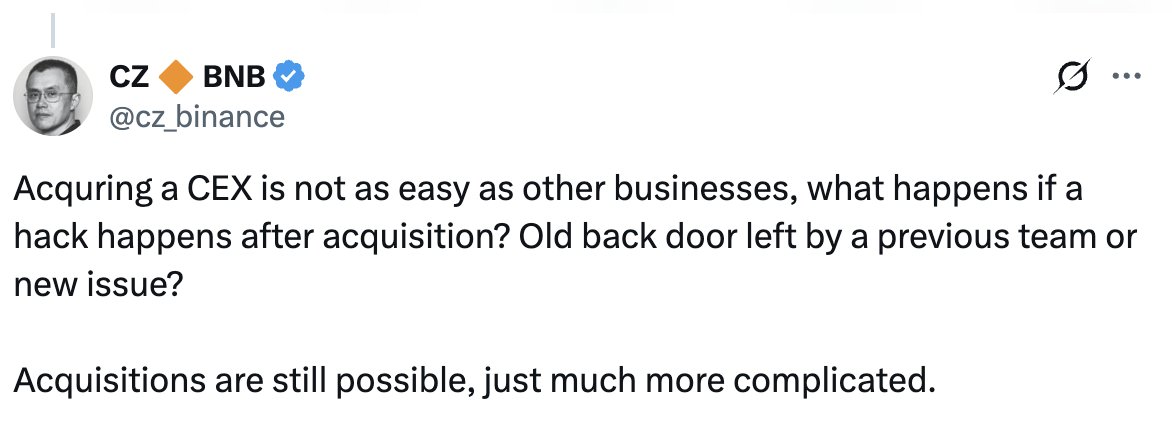 Binance founder CZ warns acquiring small crypto exchanges poses hidden security risks after BitMEX and BitMart shut down.2026-07
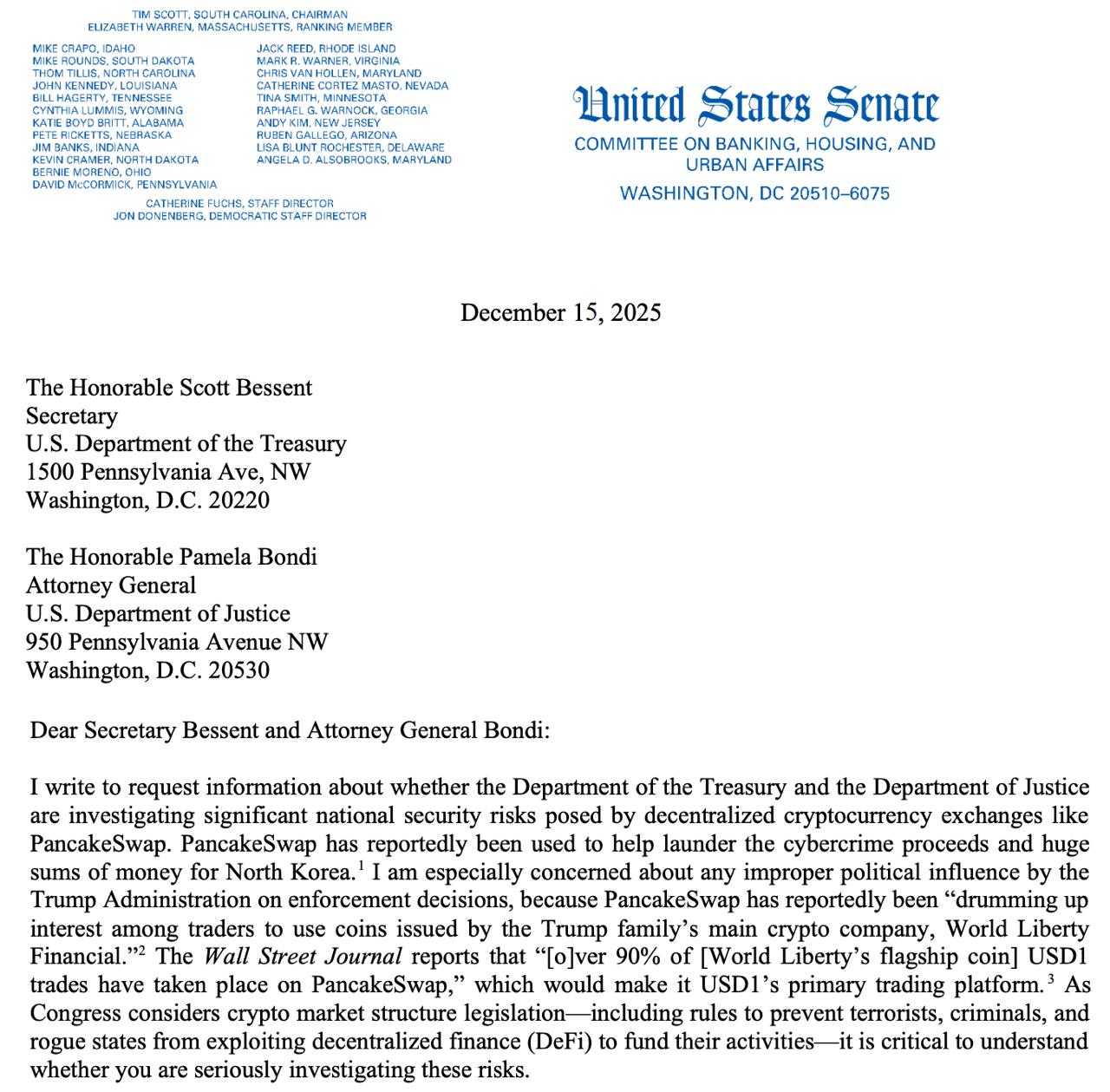 Elizabeth Warren Seeks DOJ and Treasury Review of National Security Risks Posed by DeFi Exchanges2025-12
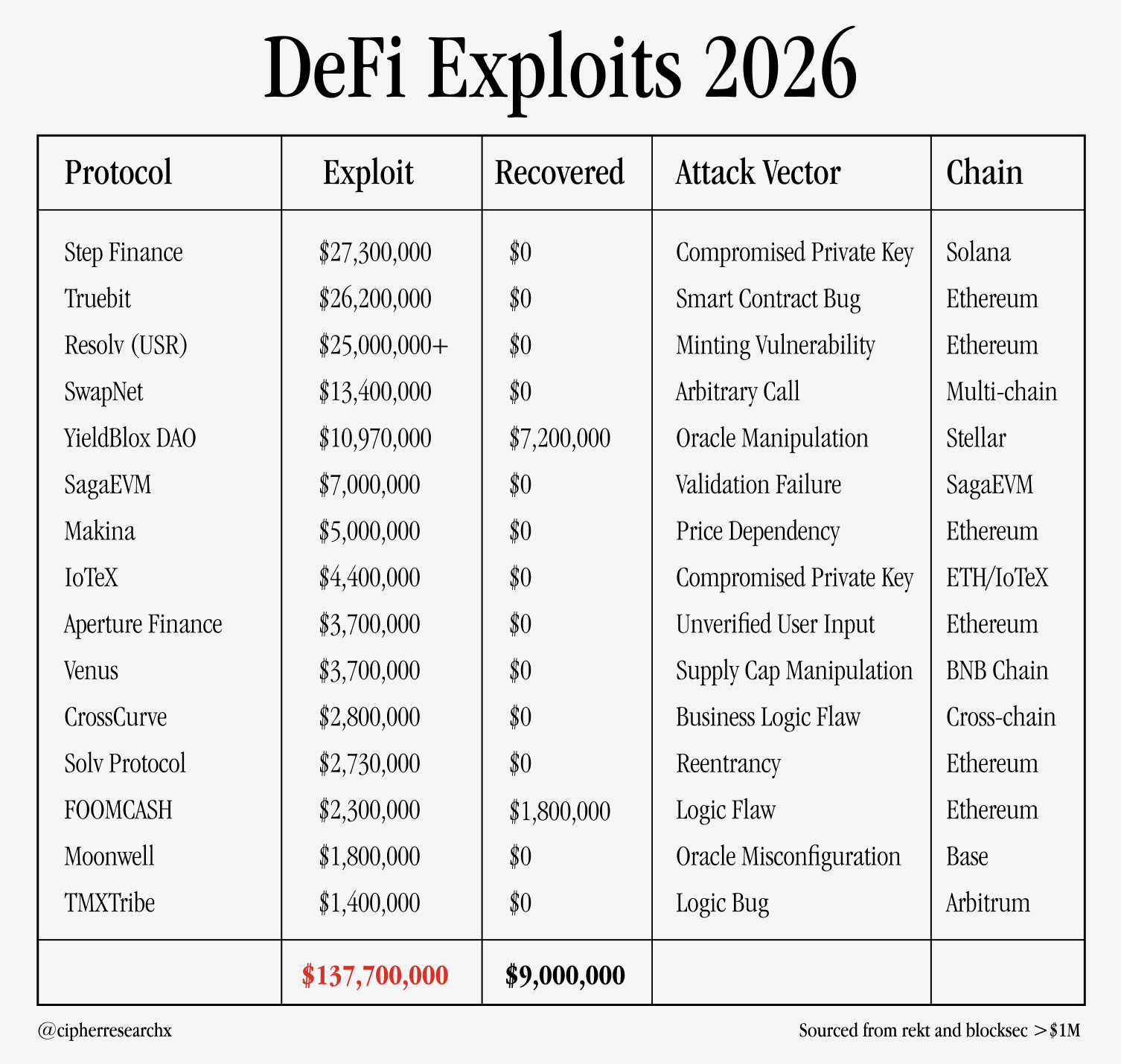 DeFi exploits surpass $137M in 2026 so far, with major incidents across Step Finance, Truebit and Resolv highlighting ongoing security risks2026-03
 Neutrl sunsets neutrl[.]fi domain, flags it as unsafe, and directs users to migrate to neutrl[.]finance to avoid potential security risks2026-04
 ALERT🚨:
Lista DAO pauses lending platform after abnormal price fluctuations in wstUSR collateral, launching investigation into potential security risks2026-03
ALERT🚨:
Lista DAO pauses lending platform after abnormal price fluctuations in wstUSR collateral, launching investigation into potential security risks2026-03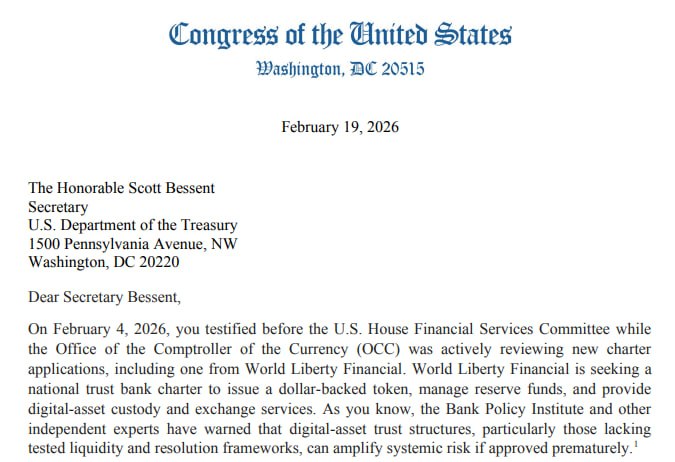 House Democrats demand a Treasury investigation into Trump family crypto firm World Liberty Financial over a $500 million stake by Emirati “Spy Sheikh” Sheikh Tahnoon bin Zayed and potential national security risks2026-02
Vulnerabilities that expose crypto users, protocols, and infrastructure to financial loss or data compromise — security risks in Web3 span smart contract bugs, custodial failures, AI agent exploits, and cross-chain attack surfaces that grow more complex with every new primitive.
What Makes Crypto Security Different
Traditional software security is hard. Crypto security is harder. The combination of immutable code, pseudonymous actors, real-time settlement, and composable protocols means that a single exploit can drain tens of millions of dollars within a single block — with no chargebacks, no fraud department, and often no legal recourse.
Security risk in crypto is not one problem but a stack of them: protocol-layer vulnerabilities, wallet and key management failures, infrastructure weaknesses, and an emerging class of threats introduced by AI-driven automation. Understanding each layer matters, because defenders and attackers both move quickly.

Binance founder CZ warns acquiring small crypto exchanges poses hidden security risks after BitMEX and BitMart shut down.
Smart Contract Exploits: The Original Threat
Smart contract vulnerabilities remain the most financially damaging category of crypto security risk. The attack vectors are well-documented — reentrancy, price oracle manipulation, flash loan attacks, integer overflow — yet they continue to cost the industry billions annually.
The $290 million Kelp DAO DeFi hack in 2025 is a recent example. The incident exposed what security researchers have long warned about: systemic risk in DeFi arises not just from individual contract bugs but from the composable nature of the ecosystem, where a vulnerability in one protocol propagates through every protocol that depends on it. Audits help but cannot guarantee safety, particularly when protocols integrate novel mechanisms post-audit or when economic attack vectors emerge that no static analysis tool would catch.
THORChain's recovery portal launch following a $10 million exploit illustrates another pattern: even protocols that survive an attack carry residual risk. The community must weigh whether patched code is truly safe or whether the underlying architecture contains deeper design flaws — a judgment call that reshapes user trust and TVL long after the initial incident.
Readers click 'security risk' stories not for the technical vulnerability itself but for the geopolitical actor behind it — North Korean infiltration, state-linked wallets, and nation-state regulatory pressure dominate the top clicks, revealing that crypto security anxiety is really anxiety about adversarial sovereign actors.
Bridge and Cross-Chain Risk
Moving assets between blockchains introduces a distinct category of risk. Bridges are high-value targets because they hold large custodied reserves, operate across security boundaries, and often rely on multisig schemes or validator sets that can be compromised.
Solv Protocol's decision to migrate $700 million in tokenized Bitcoin to Chainlink's CCIP protocol — specifically citing LayerZero security risks as the reason — illustrates how the choice of bridging infrastructure is itself a security decision with nine-figure consequences. The migration was described as cautious and phased, reflecting the reality that moving locked capital between cross-chain systems introduces its own transitional attack surface.
Omnichain architectures that promise "one address everywhere" carry similar tradeoffs. Unified address schemes simplify UX but concentrate risk: a single compromise of an account abstraction layer or address derivation mechanism could expose assets across every supported chain simultaneously.
Polygon's decision to cut block time to 1.75 seconds in pursuit of payments use cases demonstrates a related tension. Speed improvements that serve product goals can compress the window available for security checks, fraud detection, and node consensus — a real engineering tradeoff, not a hypothetical one.

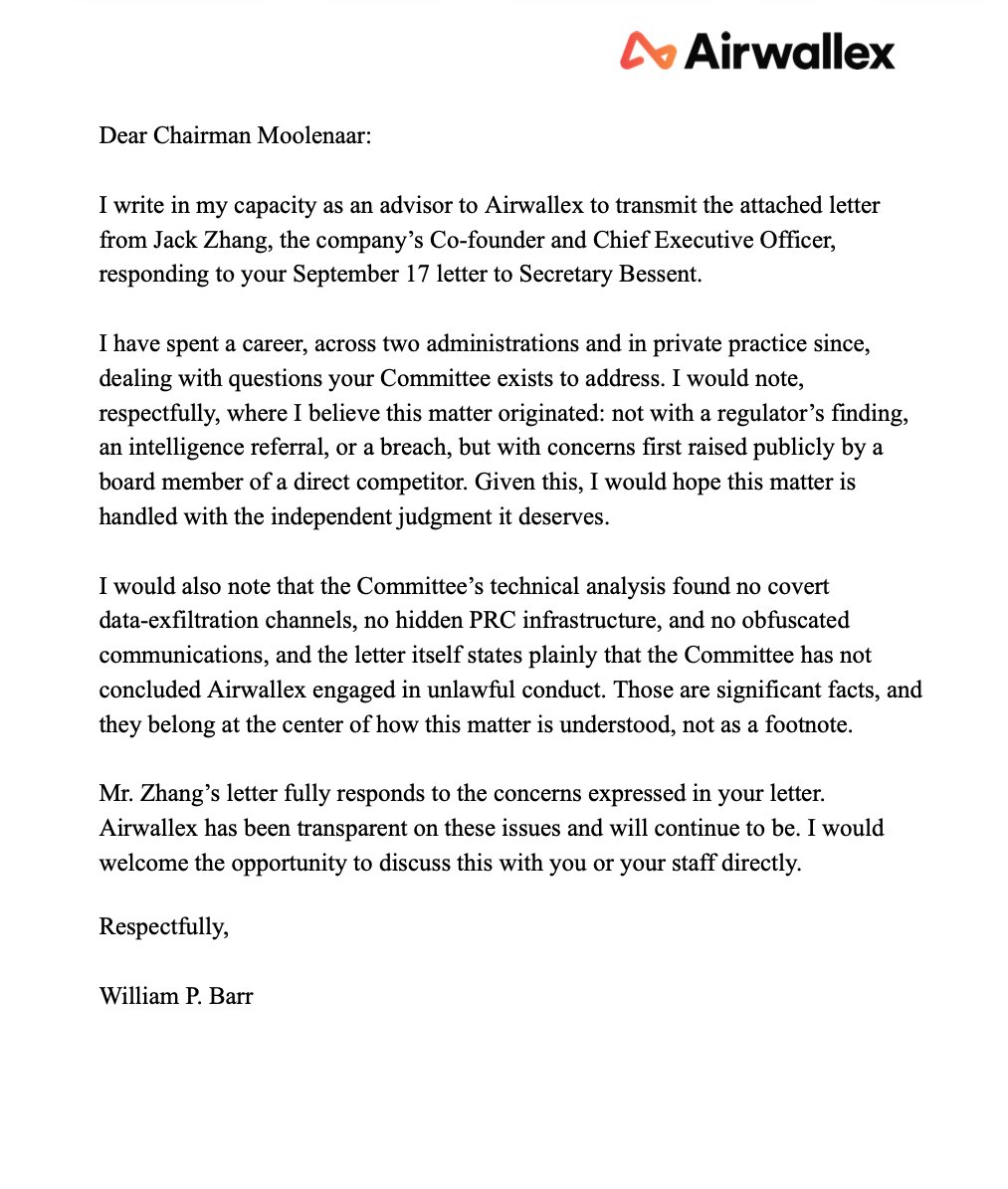
Airwallex CEO Jack Zhang denies China security risks, says claims came from Ramp investors.
AI Agents: The New Attack Surface
The deployment of AI agents capable of executing on-chain transactions autonomously has introduced a qualitatively new security risk category. Unlike static smart contracts, AI agents are dynamic, instruction-following systems whose behavior can be manipulated through their inputs.
Several threat vectors have emerged as the agent ecosystem has scaled:
Prompt injection. KyberSwap's MCP (Model Context Protocol) launch drew immediate security scrutiny, with researchers identifying prompt injection and privilege abuse as serious risks. An attacker who can inject instructions into an agent's context window can redirect its on-chain actions — spending funds, approving contracts, or exfiltrating credentials — without ever touching the underlying wallet keys directly.
Wallet authorization failures. Current wallet designs were not built with AI agents in mind. If an agent is compromised or behaves unexpectedly, internal configuration limits are often insufficient to stop unauthorized transactions. The Seal MPC prototype approach — shifting authorization logic outside the agent entirely — represents one architectural response. The core insight is that a compromised agent should not be able to authorize its own actions; external cryptographic authorization enforced by multi-party computation provides a harder security boundary.
Identity and reputation manipulation. The Ethereum Improvement Proposals EIP-8004 and EIP-8183, which define frameworks for AI agent identity and reputation on-chain, introduce novel attack surfaces. Inconsistencies in how agent identity is established can be exploited to impersonate trusted agents; reputation systems can be gamed through Sybil attacks or evaluator exploits; escrow mechanisms used to align agent incentives can become liveness traps if settlement conditions aren't met. These are not theoretical — they are design-level vulnerabilities in nascent standards that developers are actively debating.
Centralization risk in agent infrastructure. On Injective and similar networks where AI agents can now execute payments autonomously, the remaining security concerns are not just technical but structural: who controls the agent's model weights, who can update its instructions, and whether agent infrastructure introduces centralized failure points into otherwise decentralized protocols.
Wallet and Key Management Risk
Private key compromise remains the most direct path to total loss. Hardware wallets reduce this risk but do not eliminate it — and the Trezor/WalletConnect Pay pilot launching at WalletCon and EthCC serves as a reminder that even hardware wallet integrations carry risk at the interface layer between device and web application.
The broader landscape of "active wallet" applications — exemplified by Wire Wallet's launch — reflects an industry push toward wallets that do more: automatic transaction routing, in-app staking, direct payment flows. Each added capability is also an added attack surface. A wallet that can initiate transactions on your behalf in response to external triggers is categorically more dangerous to compromise than a passive key store.
X API credential exposure represents an underappreciated vector: third-party integrations that store API keys or OAuth tokens in ways that enable credential theft can give attackers posting access, data access, or — in the case of platforms that combine social and financial identity — downstream wallet access.

Elizabeth Warren Seeks DOJ and Treasury Review of National Security Risks Posed by DeFi Exchanges

What a load of shit, "...significant national security risks posed by decentralized cryptocurrency exchanges like PancakeSwap. PancakeSwap has reportedly been used to help launder the cybercrime proceeds and huge sums of money for North Korea. I am especially concerned about any improper political influence by the Trump Administration on enforcement decisions, because PancakeSwap has reportedly been “drumming up interest among traders to use coins issued by the Trump family’s main crypto company, World Liberty Financial.” The Wall Street Journal reports that over 90% of [World Liberty’s flagship coin] USD1 trades have taken place on PancakeSwap,” which would make it USD1’s primary trading platform."
Infrastructure and Sequencer Risk
Layer 2 networks and rollups have resolved many Ethereum scaling bottlenecks, but they introduce sequencer centralization as a persistent security risk. When a single entity controls transaction ordering, users are exposed to:
- Censorship: The sequencer can exclude transactions.
- MEV extraction: Privileged ordering enables front-running and sandwich attacks.
- Liveness failure: A sequencer outage halts the chain. Ronin's 10-hour downtime during its Ethereum L2 migration is a concrete example of what infrastructure failure looks like — and its history as the target of a $625 million bridge hack means that security credibility must be rebuilt, not assumed.
Caldera and similar "rollup-as-a-service" platforms that lower the bar for launching new chains face the same sequencer centralization critique at scale: easier chain launches multiply the number of sequencer risk surfaces across the ecosystem.
- 01North Korean infiltration of crypto
The combination of DPRK IT workers inside blockchain firms and allegations of NK-linked smart contract code touched readers' deepest fears about supply-chain compromise at the protocol level.
- 02National security regulatory pressure
Warren's DOJ/Treasury push, mixer crackdowns, and WLFI sanctions probes showed readers that DeFi's security debate had moved from hacker forums to Senate hearings.
- 03Upgradeable contract proxy pitfalls
Technical readers engaged with the concrete failure modes of upgradeable contracts — storage collisions, uninitialized proxies — because these are actionable audit targets.
- 04Quantum computing Bitcoin threat
Google's quantum milestone reframed a theoretical risk into a timed countdown, making RSA/ECDSA exposure feel imminent rather than hypothetical.
- 05Exchange and custody hack exposure
Phemex's $73M multi-chain hot wallet drain and Bybit's $1.5B theft illustrated that custodial risk remains the single largest realized loss vector for ordinary users.
- 06Political crypto ties as security vector
The WLFI Emirati stake and Trump token wallets linked to sanctioned entities collapsed the boundary between political risk and national security risk for readers.
Privacy, Regulatory, and Social Engineering Risk
Not all security risk is technical. The Zcash Foundation's ongoing work on privacy infrastructure exists in a context where regulatory pressure, chain analysis capabilities, and targeted attacks on privacy-preserving protocols are all active threats. Privacy coins and privacy-preserving smart contract systems face an adversarial environment that combines technical attack vectors with legal and reputational risks.
Social engineering — phishing, fake support channels, malicious airdrop claims — accounts for a significant share of individual losses. These attacks exploit human trust rather than code vulnerabilities, which means technical audits offer no defense.
Bitcoin miners pivoting to AI compute workloads face a different threat profile: physical infrastructure security at "Wild West" data center sites, power reliability, and the insider threat risks that come with managing high-value hardware in less-controlled environments.
How Risk Is Assessed and Mitigated
Audits remain the baseline expectation before any significant protocol launch, though their limitations are well understood. An audit is a point-in-time assessment of known vulnerability classes; it cannot anticipate novel economic attacks or interactions with future integrations.
Formal verification provides stronger guarantees for specific properties — proving mathematically that a contract cannot overflow, for example — but is expensive and cannot cover all possible behaviors.
Bug bounties create ongoing incentives for security researchers to report vulnerabilities responsibly rather than exploit them. The size of a bug bounty relative to the protocol's TVL is a rough signal of how seriously a team takes security.
Multi-party computation (MPC) is increasingly used for wallet and key management, distributing key shares across multiple parties so no single point of compromise is sufficient to sign a transaction.
Rate limiting and circuit breakers are protocol-level mechanisms that pause or limit activity when anomalous behavior is detected — buying time for human intervention before losses become catastrophic.
Security councils and timelocks allow governance processes to include mandatory waiting periods before upgrades take effect, giving the community and security researchers time to identify problems in proposed changes.
- 2023-01regulatory
Biden admin targets crypto mixers as money-laundering national security risk
- 2023-07regulatory
Elizabeth Warren requests DOJ/Treasury review of DeFi national security risks
- 2024-02milestone
CoinDesk investigation reveals DPRK IT workers inside 12+ blockchain firms
- 2025-01exploit
Phemex $73M hot-wallet hack across 16 chains — largest exchange exploit of 2025
- 2025-02exploit
Bybit $1.5B crypto theft; NFT and IDO platforms wound down
- 2025-06milestone
Google Quantum AI milestone: 2048-bit RSA crack timeline compressed to ~5 years
- 2026-04regulatory
Watchdog flags WLFI token sales to North Korean and Iranian wallets; regulators urged to probe
- 2026-06exploit
DeFi exploits surpass $137M YTD across Step Finance, Truebit, and Resolv
Outlook
The security risk landscape in crypto is expanding faster than the defensive tooling can adapt. AI agent infrastructure, cross-chain composability, and the drive toward real-time settlement are all introducing new attack surfaces simultaneously. The industry's response — MPC-based authorization, formal verification for agent identity standards, more sophisticated bridge security, hardware wallet integrations with DeFi — is real and ongoing, but it trails the attack surface.
The structural challenge is economic: the expected value of a successful exploit often exceeds the cost of executing it, which sustains a well-funded attacker ecosystem. Until that math changes — through better tooling, larger bug bounties, or legal deterrence — security risk will remain a defining constraint on crypto's mainstream adoption.
Latest Security Risk news
Binance founder CZ warns acquiring small crypto exchanges poses hidden security risks after BitMEX and BitMart shut down.Airwallex CEO Jack Zhang denies China security risks, says claims came from Ramp investors.Elizabeth Warren Seeks DOJ and Treasury Review of National Security Risks Posed by DeFi ExchangesDeFi exploits surpass $137M in 2026 so far, with major incidents across Step Finance, Truebit and Resolv highlighting ongoing security risksNeutrl sunsets neutrl[.]fi domain, flags it as unsafe, and directs users to migrate to neutrl[.]finance to avoid potential security risksALERT🚨:
Lista DAO pauses lending platform after abnormal price fluctuations in wstUSR collateral, launching investigation into potential security risksCommunity notes
Spot something off or out of date? Drop a note. Editors review topic notes daily and roll accepted fixes into the explainer — contributors are recognized in the monthly $SQUID drop.
Loading notes…
Help improve this topic
Have a story or tip about this topic? Submit it. See something missing? Leave a note. Editors review daily; accepted submissions and fixes count toward the monthly $SQUID drop.