
Smart contracts are self-executing blockchain programs that power DeFi, stablecoins like USDC, and NFTs — but their immutability makes security flaws catastrophic, with AI now accelerating both attacks and defenses.
+17 sources across the wider coverage universe
 TRON integrates with Hyperlane to unlock cross-chain messaging across 150+ blockchains, enabling developers to move assets, data, and smart contract logic beyond traditional bridges2026-04
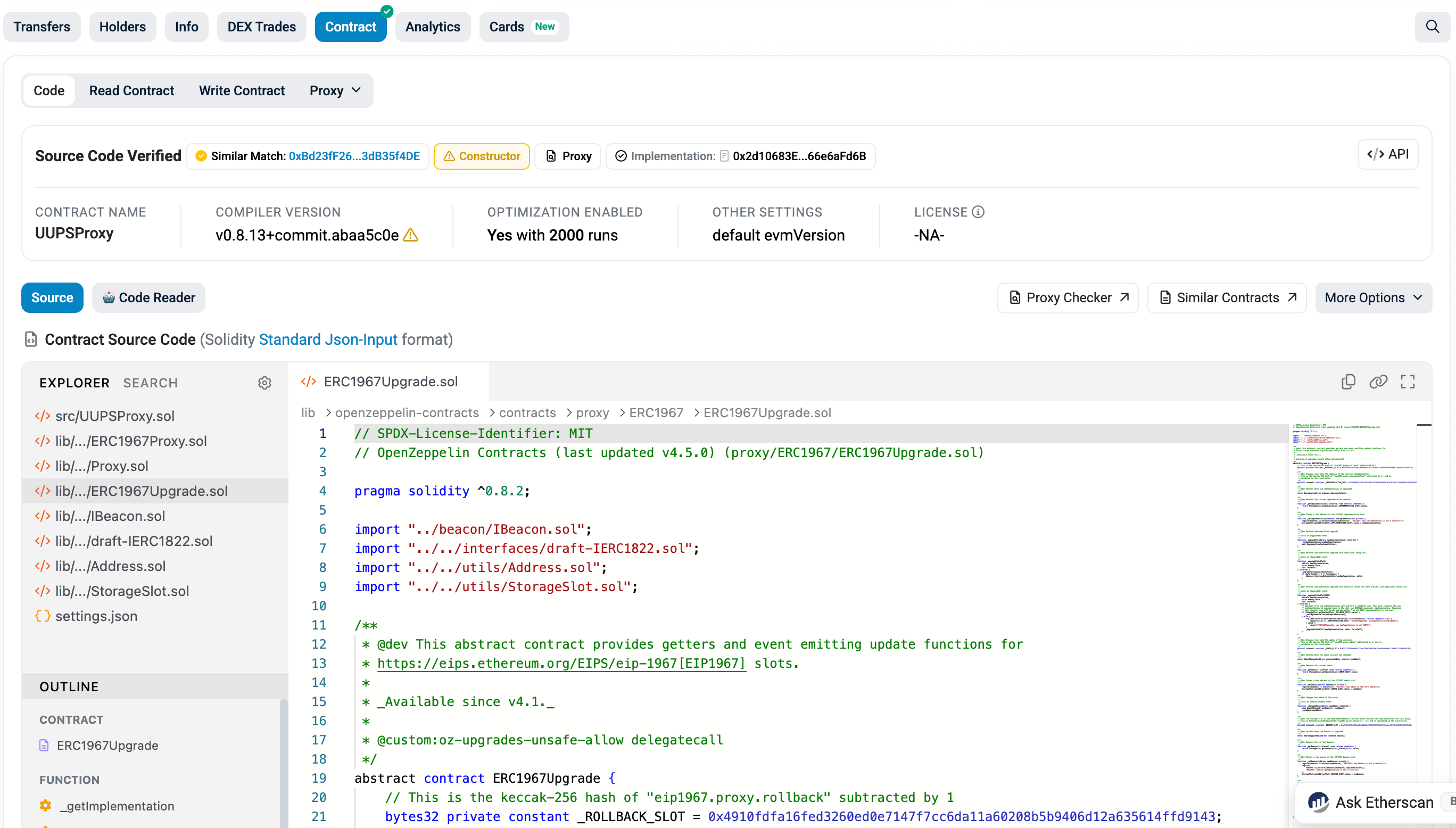 Etherscan rolls out contract tab revamp with IDE-style code browser and improved read/write tabs, making smart contract navigation faster and more intuitive for developers2026-04
 Kamino rolls out Whitelisted Reserves, enforcing smart contract-level controls to restrict lending vault allocations to verified markets and protect user funds from exploits2026-04
 User loses $1,000,000 after approval bug on Ekubo Protocol, sparking urgent calls to revoke token permissions and reassess smart contract risks2026-05
 Valantis Labs introduces Prime, a smart contract account layer connecting HyperCore and HyperEVM to unify trading, yield, and DeFi workflows2026-03
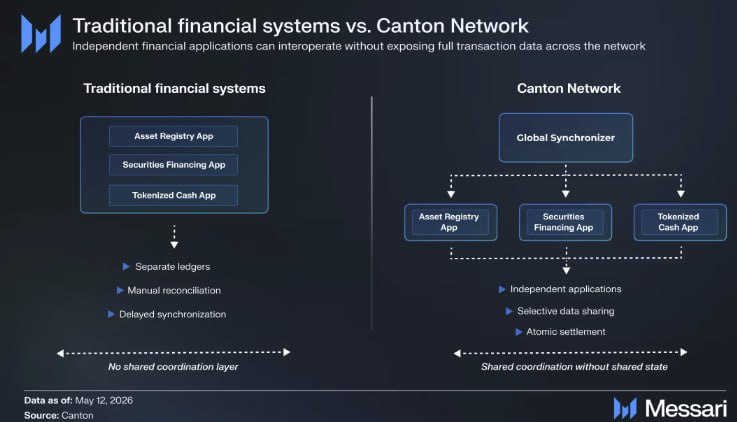 Canton Network is an institutional blockchain enabling privacy-preserving, interoperable smart contract apps for synchronized multi-party settlement of tokenized assets per Messari's latest research.2026-05
Self-executing programs that live on a blockchain, smart contracts encode the terms of an agreement directly in code — removing the need for intermediaries by guaranteeing that rules run exactly as written, every time, by anyone.
What They Are and How They Work
The term was coined by cryptographer Nick Szabo in 1994, but the concept became practical only when Ethereum launched in 2015 with a Turing-complete virtual machine capable of running arbitrary logic on a shared ledger. A smart contract is simply a program deployed to a specific blockchain address. Once deployed, it is typically immutable: no party can alter its logic. When a user or another contract sends a transaction that calls one of its functions, the code runs deterministically across every node in the network, and the outcome — a token transfer, a vote record, an NFT mint — is written into the chain's history.
The lifecycle has three phases:
1. Authoring. Developers write contract logic in a language suited to the target chain. Solidity and Vyper dominate the Ethereum ecosystem; Rust is common on Solana; Move has emerged as a notable challenger, designed with formal verification in mind and adopted by Aptos and Sui. 2. Deployment. The compiled bytecode is broadcast as a transaction. The deploying address pays a gas fee; the chain assigns the contract a permanent address. From that moment, the code is live and callable by anyone. 3. Execution. Users interact by sending transactions. The virtual machine executes the contract's instructions, modifies on-chain state atomically, and emits event logs that off-chain services can index.
A critical characteristic — one with profound security implications — is that immutability is a feature and a liability simultaneously. The same property that makes a contract trustworthy (no admin can secretly change the rules) also means bugs cannot be patched without deploying an entirely new contract and migrating users.

TRON integrates with Hyperlane to unlock cross-chain messaging across 150+ blockchains, enabling developers to move assets, data, and smart contract logic beyond traditional bridges

$86B+ of USDT and $25B TVL on TRON is the lever here, not the 150-chain badge; Hyperlane has already moved $10B+ since launch, so this can turn TRON from a self-contained settlement rail into inventory for Solana, Cosmos, and EVM apps that want cheap dollar liquidity. If Warp Routes start showing up in perps margin flows, exchange hot-wallet rebalancing, and merchant settlement, volume stops taking the dumb TRON -> CEX -> destination-chain detour. If that flow never shows up, the fragmentation problem is still there and this was just another interoperability press release.
Where Smart Contracts Power Finance
The most consequential application is decentralized finance (DeFi): lending protocols, automated market makers (AMMs), stablecoins, and derivatives exchanges are all smart-contract systems. USDC, the dollar-pegged stablecoin issued by Circle, is itself a smart contract — its balances, minting rights, and blacklisting capabilities are encoded in bytecode, not held in a bank's spreadsheet.
Lending markets like Aave and Compound use contracts to match depositors with borrowers, calculate interest in real time, and liquidate undercollateralized positions without a human ever touching the transaction. Uniswap's AMM replaced the traditional order book with a pricing formula executed on-chain. Bridges — infrastructure that moves assets between chains — rely on contracts on both ends to lock funds on the source chain and mint representations on the destination.
Beyond DeFi, smart contracts underpin:
- NFT standards (ERC-721, ERC-1155), which define ownership and transfer rules
- DAOs, where token-weighted governance votes execute treasury disbursements automatically
- Prediction markets and on-chain derivatives platforms
- Tokenized real-world assets, where ownership of bonds or real estate is represented by contract-issued tokens
- Prop trading infrastructure, such as Hypernova's onchain payout rails for funded traders — a model that introduces new smart contract and liquidity risks alongside its efficiency gains
Readers click smart contract stories not for technical curiosity but for accountability flashpoints — who goes to prison, who pays for bugs, and whether 'it's just code' holds up as a legal defense.
The Security Problem
No part of the blockchain stack attracts more adversarial attention than smart contracts. Immutability means a flaw shipped to mainnet stays exploitable until funds are drained or users manually withdraw. The combination of open-source code, transparent state, and large pools of locked capital creates an environment where a single logic error can be worth tens of millions of dollars to an attacker.
Common vulnerability classes include:
- Reentrancy. An external call made before state is updated allows a malicious contract to re-enter the same function recursively, draining funds. The 2016 DAO hack — the most famous smart contract exploit in history — was a reentrancy attack.
- Integer overflow/underflow. Before Solidity 0.8 introduced built-in overflow checks, arithmetic errors could wrap balances around to unexpected values.
- Oracle manipulation. Contracts that read price data from on-chain sources can be attacked by flash-loan-funded price manipulation.
- Access control failures. Functions that should be admin-only left unguarded.
- Immutable contracts without exit paths. When a deprecated contract cannot be upgraded and admin keys no longer exist, funds can become trapped — or extracted.
The last category is illustrated by two recent incidents. Aztec Connect's abandoned payment product from 2021 — an immutable rollup contract that was sunset in 2022 — was exploited, putting approximately $2.1 million at risk. Aztec Labs held no admin keys and had no ability to intervene. Separately, a white-hat hacker identified a faulty 2016 ICO smart contract still holding roughly $2 million and moved the funds to a safe harbor before a malicious actor could reach them. Both cases demonstrate that "abandoned" contracts are not neutral: they remain live attack surfaces for as long as they hold value.
Bridge contracts are disproportionately targeted because they aggregate liquidity from multiple chains. Axelar recently disclosed a $4.67 million exploit targeting assets bridged to Secret Network, with the vulnerability isolated to a Secret-side smart contract. Both bridge connections were disabled while the incident was investigated — illustrating how a flaw in one chain's contract can freeze cross-chain activity for all connected assets.
The audit ecosystem has grown substantially in response. Security firms like OpenZeppelin, Trail of Bits, and Certora have built formal verification tooling alongside manual code review. Protocols now routinely spend six figures on audits before launch, and bug bounty programs offer rewards in the millions for critical disclosures.
Yet the OpenZeppelin co-founder Manuel Aráoz recently stated publicly that he believes "all of DeFi is unsafe," citing AI coding agents reaching superhuman capability in vulnerability discovery and the inherently asymmetric nature of smart contract security: attackers need to find one flaw, defenders must eliminate every flaw. That asymmetry does not change with better tooling — it only shifts the arms race.
Polymarket launches $5M bug bounty on Cantina, exposing full-stack prediction market infra including smart contracts, oracles, and web app to security researchers

$5M on Cantina after running a $1M max on Immunefi for years — and after TrustSec publicly disclosed a bug they found with ctrl+F from an old audit that Polymarket chose not to fix for a $500 "good faith" payout. Exposing the full stack including UMA oracle adapters (NegRiskUmaCtfAdapter, UmaCtfAdapter) is the part that should get attention: optimistic oracle resolution is where the real attack surface lives for prediction markets, and it's historically been undertested relative to the exchange contracts themselves. Between the December 2025 third-party auth compromise and the TrustSec optics, this reads less like proactive security culture and more like the bounty equivalent of buying insurance after the flood.
How AI Is Changing Smart Contract Security
Artificial intelligence is now a force multiplier on both sides of the security equation.
On the defensive side, AI-powered audit tools are making contract reviews faster, cheaper, and more accessible. Static analysis agents can scan thousands of lines of Solidity in seconds, flagging patterns that match known vulnerability classes. This raises the baseline: developers who previously couldn't afford a formal audit now have automated pre-screening available before deployment.
On the offensive side, the same capabilities are available to attackers. AI agents can systematically search deployed contract bytecode for exploitable conditions, generate proof-of-concept exploit transactions, and simulate outcomes against forked mainnet state — all at a speed and scale no human researcher can match. Reports of attackers leveraging AI to discover vulnerabilities in live contracts have increased, introducing what some researchers describe as a new attack paradigm.
The tension is sharpest at the intersection of AI agents and on-chain action. Projects like Proof of Intelligence pit autonomous AI agents against each other in live DeFi environments, where they trade, scan contracts, and execute strategies without human approval. Agent Passport is building portable, verifiable on-chain identity for AI agents — enabling lending markets and smart contracts to assess an agent's history before extending credit. These use cases assume that the contracts the agents interact with are correct; they amplify the consequences when they are not.
AI is also being used to generate contract code directly. ChainGPT's integration with development environments promises smart contract generation from natural language prompts. The risk is that developers unfamiliar with Solidity's subtleties may deploy AI-generated code that passes surface-level review but contains logic errors — and immutability means there is no second chance.
- 01Criminal liability for code
The Tornado Cash verdict and the first-ever criminal conviction for a smart contract attack forced readers to confront whether writing or exploiting on-chain logic carries personal legal jeopardy.
- 02Protocol exploits and losses
A string of named hacks — Prisma, Nirvana Finance, Solv Protocol, Nemo Protocol, Ekubo — gave readers recurring proof that audit reputations do not guarantee safety.
- 03Vyper language survival
Vyper's funding crisis and declining adoption despite its security reputation hit a nerve because it surfaces the real tension between technically superior tooling and ecosystem momentum.
- 04White-hat bounty economics
A $3 million Immunefi single payout made readers weigh legitimate security research as a career path against the thin line separating researcher from exploiter.
- 05TradFi and institutions on-chain
Visa's Paymaster contract and Circle's BlackRock BUIDL off-ramp signaled that smart contracts are crossing from DeFi-native infrastructure into regulated financial plumbing.
- 06AI tools for contract analysis
ChatGPT bytecode auditing and the OpenAI-Paradigm EVMbench benchmark raised the question of whether AI closes the security gap faster than attackers can find new vectors.
Language and Platform Diversity
Ethereum's early dominance gave Solidity an enormous install base, but the language was designed quickly and carries technical debt. Vyper was developed as a simpler, more auditable alternative, but its adoption remains narrower.
Move has attracted serious attention as a language designed from the ground up with formal verification and resource safety in mind. Several major blockchain projects have adopted it. The Jito Labs CEO recently described Solana as "the clear leader for smart contract networks," citing rapid application revenue growth and ecosystem momentum. Solana uses a Rust-based model where programs are stateless and operate on separate data accounts — a different architecture from the EVM's storage-within-contract model, with its own security tradeoffs.
Platform-level evolution continues at the network layer, too. Base's second network upgrade, Beryl — scheduled for mainnet on June 25 — introduces B20, a native token standard built directly into the node software rather than implemented as a smart contract. Moving core functionality from application-layer contracts to protocol-layer code reduces attack surface: there is no contract bytecode to exploit, no storage slots to manipulate.
Litecoin is pursuing a different path. Lite Strategy has backed LitVM with $1 million to bring smart contract capability to Litecoin, a chain that has historically been a payment network rather than a programmable platform.
Etherscan rolls out contract tab revamp with IDE-style code browser and improved read/write tabs, making smart contract navigation faster and more intuitive for developers
Cross-file keyword search and file tree nav are a direct response to diamond proxies and upgradeable patterns making the old flat code view unusable — try reading a 30-file EIP-2535 diamond on legacy Etherscan without losing your mind. DethCode and Dedaub already solved this in standalone tools, so Etherscan is playing catch-up, but having it native in the explorer where 90%+ of devs land first still matters more than innovation points. One-click Remix open shaves real time off the copy-paste-import-compile loop for quick contract interactions, especially for security researchers triaging live exploits who can't afford a five-step workflow.
Complexity and the Risk of New Primitives
Each new smart contract primitive introduced to a protocol adds attack surface. Lighter's new atomic orders, which allow complex conditional trades to settle in a single transaction, illustrate this dynamic: the feature is genuinely useful, but the added code complexity and smart contract risk have raised fresh concerns among traders on the platform.
Privacy-preserving integrations compound the challenge. Unlink is routing capital through a privacy layer into Euler vaults — a setup where institutional lending and transaction privacy share a contract boundary. The opacity that protects user privacy also makes it harder for auditors and the broader community to monitor for anomalous behavior.
Institutional DeFi more broadly faces what some researchers describe as a "missing layer": a smart contract can execute perfectly and still act on data it cannot verify. Tokenized assets may sit on-chain, but the underlying data — creditworthiness, collateral values, legal ownership — often remains private, off-chain, and unverifiable by the contract itself. Solving this without reintroducing trusted intermediaries is an open problem.
- 2023-09launch
Holesky testnet launches for smart contract testing
- 2023-11regulatory
Shakeeb Ahmed pleads guilty in first U.S. criminal smart contract hack case
- 2023-12milestone
EVM deployment trends study reveals 2023 adoption patterns
- 2024-03regulatory
Shakeeb Ahmed sentenced to three years — first smart contract hacking conviction
- 2024-05regulatory
Alexey Pertsev convicted in Tornado Cash case, raising liability fears for smart contract devs
- 2024-07milestone
Immunefi pays $3M single bug bounty for critical smart contract vulnerability
- 2025-01exploit
Solv Protocol exploited for $2.7M via smart contract minting bug
- 2025-12milestone
Ethereum smart contract deployments hit record 9.1 million in Q4 2025
Auditing, Upgradability, and Responsible Design
Several design patterns have become standard practice for reducing risk:
- Proxy patterns. A proxy contract delegates calls to a logic contract, allowing the logic to be upgraded while the address and storage remain stable. The tradeoff is added complexity and the introduction of an admin key that can change behavior — which reintroduces trust.
- Timelocks. Governance changes are queued with a mandatory delay, giving users time to exit before a protocol change takes effect.
- Circuit breakers. Contracts can pause themselves if anomalous activity is detected — large outflows in a short window, for example.
- Formal verification. Mathematical proofs that contract behavior matches its specification, tools like Certora's Prover and K Framework.
- Bug bounties. Public programs offering rewards for responsible vulnerability disclosure before launch.
The Axelar and Aztec incidents both point to a less-discussed risk: the long tail of deployed contracts. Protocols frequently deprecate features while leaving old contracts live. Any value remaining in those contracts — even accidentally — remains exposed to anyone who can find an exploitable path.
Outlook
Smart contracts are infrastructure, not a trend — the question is no longer whether they will be used but where their limits are. The immediate frontier is the collision of AI capability with a security model built on human-speed auditing. AI-powered exploit discovery means the window between a vulnerability being discoverable and being exploited is shrinking.
Platform competition — Ethereum and its L2s, Solana, Move-based chains, and emerging platforms like LitVM — will continue to produce divergent programming models, each with distinct security properties. Network-layer integration of token standards (as Base is attempting with B20) may reduce some categories of contract risk by removing them from the application layer entirely.
The underlying challenge is structural: value locked in immutable code, accessible to anyone in the world, with no recovery mechanism when something goes wrong. That is the property that makes smart contracts powerful. It is also the property that keeps security researchers employed indefinitely.
Latest Smart Contract news
TRON integrates with Hyperlane to unlock cross-chain messaging across 150+ blockchains, enabling developers to move assets, data, and smart contract logic beyond traditional bridgesPolymarket launches $5M bug bounty on Cantina, exposing full-stack prediction market infra including smart contracts, oracles, and web app to security researchersEtherscan rolls out contract tab revamp with IDE-style code browser and improved read/write tabs, making smart contract navigation faster and more intuitive for developersKamino rolls out Whitelisted Reserves, enforcing smart contract-level controls to restrict lending vault allocations to verified markets and protect user funds from exploits LitVM LiteForge testnet launches, bringing EVM smart contracts, DeFi, and Web3 to Litecoin for the first time.
 Matterhorn and ASI Alliance launch Vibe-Audit to catch vulnerabilities in AI-generated smart contracts
Community notes
Spot something off or out of date? Drop a note. Editors review topic notes daily and roll accepted fixes into the explainer — contributors are recognized in the monthly $SQUID drop.
Loading notes…
Help improve this topic
Have a story or tip about this topic? Submit it. See something missing? Leave a note. Editors review daily; accepted submissions and fixes count toward the monthly $SQUID drop.