
Deep explainer on Raydium, Solana’s flagship AMM/DEX, covering its architecture, pools, CLMMs, tokenomics, launches, security history, regulation and competition, plus what traders, LPs and builders should watch next.
+3 sources across the wider coverage universe
 AllUnity expands MiCA-regulated euro stablecoin EURAU to Uniswap, Raydium, and Tempo via Flowdesk2026-04
 Raydium introduces Permissioned AMMs, enabling issuers to launch KYC-gated and regulated assets on Solana while retaining full control over participant access2026-07
 Raydium reveals plan to reimburse users after an exploit drained roughly $1.34M from five inactive liquidity pools tied to its retired AMM V3 program, which has been phased out since 20212026-06
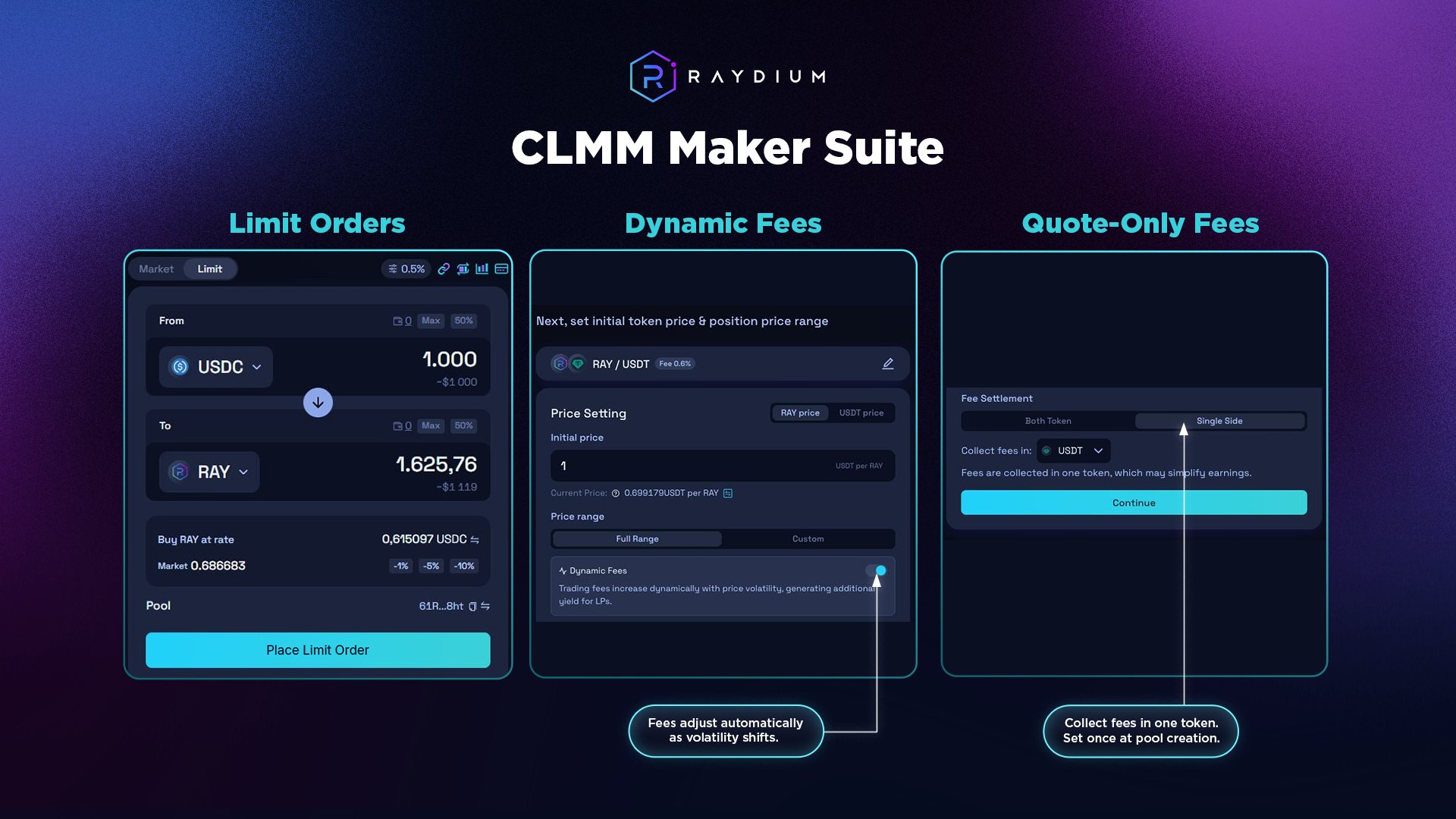 Raydium adds opt-in limit orders, dynamic fees, and quote-only fees for Solana CLMM pool creators2026-05
 PumpSwap rises to be Solana’s #2 AMM by volume in just a matter of days after its launch2025-03
 Whitehat discovers critical Raydium protocol vulnerability, receives $505,000 bounty2024-07
Raydium on Solana: An Evergreen Guide to the AMM, DEX, and Liquidity Hub
As Solana’s high‑throughput DeFi ecosystem has matured, Raydium has become one of its central liquidity venues, blending automated market maker (AMM) pools with advanced trading tools and token launch infrastructure. Built to exploit Solana’s low fees and fast finality, the protocol now anchors a large share of on‑chain trading, powers launches for everything from memecoins to regulated stablecoins, and continues to evolve through features like concentrated liquidity, fee‑sharing for launchpads, and institutional‑grade maker tooling, even as it faces intensifying competition and ongoing security scrutiny.
Raydium’s Role in the Solana DeFi Ecosystem
Origins and evolution on Solana
Raydium launched in February 2021 as one of the first major decentralized exchanges on Solana, positioning itself as a high‑speed AMM and DEX that integrates directly with the ecosystem’s order‑book infrastructure. In contrast to first‑generation Ethereum AMMs, which were constrained by high gas fees and relatively slow block times, Raydium was designed from the outset to take advantage of Solana’s throughput and sub‑second confirmation, allowing traders to swap with low fees and tight slippage while liquidity providers could compound fees more efficiently. The protocol initially routed liquidity to the Serum central limit order book, giving its pools access to a broader shared liquidity layer and enabling order‑book style price discovery alongside pool‑based swaps. As Solana’s DeFi stack evolved and Serum was effectively deprecated after the FTX collapse, Raydium shifted more of its focus to its own AMM and concentrated liquidity programs, but the core ambition of serving as a liquidity hub for the chain has remained constant.
Over time, Raydium expanded beyond simple constant‑product pools into a suite of on‑chain programs that now includes AMM v4, a constant‑product market maker (CPMM), concentrated liquidity market maker (CLMM) pools, farming contracts, and a LaunchLab program for token launches. This modular architecture has allowed the team and third‑party developers to iterate on new pool types and incentive schemes without disrupting existing liquidity, while still exposing all of that liquidity through a unified front end. In parallel, the RAY token was introduced to govern the protocol, incentivize liquidity, and offer staking rewards, gradually embedding Raydium deeper into the broader Solana token economy. As DeFi on Solana grew—driven by waves of NFT speculation, memecoin frenzies, and more recently the rise of on‑chain capital markets—Raydium’s volumes and total value locked reflected the network’s cycles of expansion and contraction.
The protocol’s prominence has also translated into off‑chain visibility. Coverage from both crypto‑native and mainstream fintech outlets increasingly treats Raydium as synonymous with Solana’s on‑chain trading infrastructure, particularly as Solana DEX volume has approached the symbolic milestone of one trillion dollars in cumulative trades across the network. RAY has been listed on major centralized platforms, including Coinbase, which recently enabled trading for New York residents, signaling that the token has cleared a variety of technical and compliance hurdles even as it remains a high‑risk crypto asset. At the same time, the protocol’s centrality has made it a target for attackers, leading to a series of security incidents and disclosures that now form an important part of any realistic assessment of Raydium’s place in the Solana DeFi stack.
Design philosophy: speed, composability, and order‑book heritage
From a design standpoint, Raydium has always leaned into Solana’s core strengths: high throughput, low latency, and low transaction costs. Traditional AMMs on Ethereum forced traders to tolerate relatively wide slippage and pay substantial gas for every interaction, which in practice meant that only larger trades or high‑yield farming strategies made economic sense for retail users during busy periods. By contrast, Solana’s architecture allows Raydium to process a far higher number of swaps per second with negligible per‑trade fees, enabling smaller, more frequent trades and making it viable to rebalance concentrated liquidity or adjust farming positions more actively. This environment has encouraged a style of on‑chain market making that looks more like centralized exchange behavior, with algorithms able to quote and re‑quote prices rapidly without being crippled by gas costs.
Raydium’s early integration with Serum’s central limit order book reinforced this hybrid CEX/DEX feel by allowing its AMM pools to post virtual orders into an order book shared with other Serum‑integrated venues. While Serum’s relevance has waned, the architectural lesson remains: Raydium is built to interoperate with other Solana protocols, serving as both a liquidity backend for external front ends and a surface for advanced execution strategies. Today, Raydium’s own CLMM pools and maker tools bring much of that order‑book sophistication on‑chain within its own program set, offering features such as limit orders implemented via concentrated liquidity and pool‑level controls over fee behavior. This emphasis on composability means that wallets, launchpads, trading bots, and new Solana protocols can route orders or bootstrap liquidity directly through Raydium’s contracts without asking permission, contributing to its reputation as a base layer for token liquidity on Solana.
At the user‑experience level, Raydium attempts to abstract away much of this complexity while still catering to professional market makers and project teams. Retail traders can simply connect a Solana wallet—such as Phantom or Solflare—and swap between SOL, USDC, RAY and thousands of other tokens via a familiar swap interface, while more sophisticated users can access CLMM positions, farms, and LaunchLab offerings from the same site. For projects, the appeal lies in being able to deploy pools, configure fees, and plug into a deep, existing user base, without needing to build an AMM from scratch. In that sense, Raydium’s philosophy mirrors that of many successful Ethereum DeFi primitives: minimize friction for the widest possible set of users, while exposing enough knobs and levers beneath the hood to attract professional liquidity providers and builders.
Positioning against Orca, Meteora, HumidiFi, and PumpSwap
Within Solana’s DEX landscape, Raydium occupies a distinctive niche. Comparative analyses often frame Raydium, Orca, and Meteora as representing integration, accessibility, and innovation respectively, emphasizing that Raydium’s core strength is its role as a liquidity hub that ties together token launches, farming, and a broad array of pools. Orca, by contrast, is widely regarded as the most user‑friendly spot DEX for casual traders, with a simplified interface and “whirlpool” concentrated liquidity product tuned for retail. Meteora focuses on more experimental liquidity models, such as adaptive pools that adjust parameters automatically, making it a magnet for sophisticated DeFi users looking to optimize capital efficiency. Amid these players, Raydium’s explicit branding as “the home of liquidity on Solana” captures its ambition to provide the default venue for tokens seeking deep, composable liquidity at launch and beyond.
The competitive field has grown more crowded. New entrants like HumidiFi have attracted attention by offering dark‑pool style trading on Solana, allowing large orders to be matched anonymously with reduced price impact, a model that appeals to whales and institutions wary of front‑running and information leakage. Recent coverage has noted that HumidiFi at one point surpassed both Meteora and Raydium by daily volume, with over a billion dollars in trades, underscoring how quickly liquidity can migrate in a permissionless ecosystem. At the same time, Pump.fun—which became the default memecoin launchpad on Solana—has begun rolling out its own AMM, PumpSwap, specifically to eliminate the friction of “graduating” successful memecoins from Pump.fun bonding curves into Raydium pools. PumpSwap’s rapid rise to the number‑two AMM by volume highlights the risk that Raydium could lose a critical stream of new token listings and associated trading fees if popular launch platforms internalize liquidity provision.
These shifts force Raydium to compete on more than just speed and depth. The protocol must now differentiate itself on tooling for teams, incentives for liquidity providers, and the ability to attract both long‑tail memecoins and higher‑quality projects seeking sustainable liquidity. Features such as the CLMM Maker Suite, which gives pool creators advanced control over fee structures and limit orders, and Fee Share, which allows launchpads and platforms to capture a portion of swap revenue from pools they deploy, can be seen in this light as strategic responses to competitive threats. In effect, Raydium is betting that by offering the richest toolset and most flexible economics to builders, it can remain the default liquidity backend even if front‑end launch platforms like Pump.fun or Metaplex increasingly operate their own AMMs or deploy pools programmatically.

AllUnity expands MiCA-regulated euro stablecoin EURAU to Uniswap, Raydium, and Tempo via Flowdesk
How Raydium Works: AMMs, Pools, and Trading
AMM fundamentals: constant product markets and liquidity pools
At its core, Raydium is an automated market maker, meaning that trades are executed not by matching buyers and sellers directly, but by routing orders against liquidity pools that hold reserves of token pairs. In the most common design, the pool maintains a constant product of its two token balances, expressed as \(x \cdot y = k\), where \(x\) and \(y\) are the quantities of each token and \(k\) is a constant. When a trader swaps one token for another, they add to one side of the pool and remove from the other, changing the ratio \(x/y\) and therefore the implicit price they receive; arbitrageurs step in to keep the pool price close to external markets. This mechanism allows continuous, permissionless price discovery as long as there is sufficient liquidity, without relying on order books or centralized market makers.
Liquidity providers, or LPs, supply equal values of both tokens in the pair—such as SOL and USDC—into the pool and in return receive LP tokens that track their pro‑rata share of the pool’s assets. Whenever trades occur, the protocol charges a small fee, typically expressed as a percentage of the traded amount, and distributes that fee proportionally among LPs while reserving a portion for the protocol treasury or other stakeholders. Over time, as long as trading volume is robust and prices do not move too aggressively, LPs can earn a steady stream of fee income that compensates them for the risk of providing liquidity. Because the model is entirely on‑chain and non‑custodial, LPs can add or remove liquidity at any time by burning or minting LP tokens, subject only to network congestion and program constraints.
However, the AMM model introduces a specific risk known as impermanent loss. This occurs when the price of the pooled tokens diverges from the price at which the LP initially deposited them, causing the LP’s position—if withdrawn at that moment—to be worth less than simply holding the tokens in a wallet. If price movements are large and fees are low, this divergence can outweigh the fee income earned from trading, leaving LPs with a net loss relative to a passive hold strategy. On Raydium, as on other AMMs, impermanent loss is especially relevant for volatile pairs involving new tokens, memecoins, or assets with small market capitalizations. The protocol attempts to mitigate this through features such as higher fees on volatile CLMM pools, farms that layer on additional token incentives, and tools that allow LPs to concentrate liquidity closer to the current price, but the risk can never be eliminated entirely.
Raydium’s pool types: AMM v4, CPMM, and CLMM
Raydium’s on‑chain architecture is organized around several distinct programs, each handling a different flavor of liquidity provisioning and trading. The AMM v4 and CPMM programs implement variations of the constant‑product market maker model, supporting standard “x·y = k” pools that are suitable for most spot trading pairs where prices can move freely. These pools offer the simplest LP experience: users deposit equal values of the two assets, receive fungible LP tokens in return, and earn a share of the fees from every swap that routes through the pool. Because they spread liquidity evenly across all possible prices, they are capital‑inefficient compared to more advanced designs, but they are also easier to reason about and require less active management.
The concentrated liquidity market maker (CLMM) program introduces a more sophisticated approach by allowing LPs to provide liquidity only within a specific price range. This model, inspired by Uniswap v3, dramatically increases capital efficiency by concentrating reserves where trading actually occurs, rather than wasting liquidity at prices far away from the current market. When users deposit into a CLMM pool on Raydium, they define a lower and upper bound for the price range in which their liquidity will be “active.” As long as the pool price stays within that band, traders who swap through the pool will pay fees to the LP; if the price moves outside the range, the LP’s position effectively becomes entirely one asset and stops earning fees until they adjust or close the position. Raydium represents each CLMM position as a non‑fungible token (NFT), reflecting the fact that each position has a unique price range, liquidity amount, and fee share.
This architecture enables a spectrum of strategies. Passive LPs can choose wide ranges that approximate the behavior of a traditional constant‑product pool, sacrificing some capital efficiency for simplicity and resilience to price swings. More active LPs, including professional market makers, can deploy multiple narrow positions at different price levels or dynamically adjust their ranges in response to market conditions, seeking to maximize fee income while limiting exposure to impermanent loss. Raydium’s CLMM implementation is tightly integrated with its farming and LaunchLab programs, so projects can direct incentives specifically to CLMM pools or even to particular ranges, nudging liquidity to cluster more tightly around anticipated trading zones. Internally, Raydium’s later‑generation AMM programs also incorporate more robust checks and “virtual supply” mechanisms for pool accounting, a design choice that played a role in insulating them from vulnerabilities that affected the deprecated AMM v3 program exploited in 2026.
Concentrated liquidity in practice: the user experience
For end users, interacting with Raydium’s CLMM pools is designed to be as straightforward as possible given the underlying complexity. Tutorials commonly walk users through a series of steps: navigating to the Raydium site, connecting a Solana wallet, selecting a token pair such as SOL–USDC, and then choosing the “Liquidity” interface that corresponds to the concentrated liquidity product. From there, users set the minimum and maximum price at which they are willing to provide liquidity, using sliders or input boxes; this defines the active range within which their position will generate fees. The interface then calculates the required amounts of each token based on the current pool price and the selected range, after which the user confirms the deposit transaction on their wallet.
Once the transaction is confirmed on‑chain, Raydium mints an NFT that represents the specific CLMM position and appears in the user’s wallet; this NFT functions as an “ownership key” for the underlying liquidity and accrued fees. The Raydium interface offers a portfolio view where users can monitor each position, see its current composition and fee earnings, and adjust the liquidity by adding or removing tokens. If an LP wants to change their price range, they generally need to close the existing position—by removing liquidity and burning the associated NFT—and then open a new position with the desired range. This workflow reflects the fact that the position’s range is part of its immutable identity, encoded into the NFT.
Raydium also integrates farming with CLMM positions, allowing users to stake their position NFTs into farms to earn additional token incentives on top of trading fees. In practice, this means that an LP can deploy liquidity into a CLMM pool, then navigate to a farming interface where they “stake” the position by authorizing another transaction; from that point on, they earn both swap fees and farming rewards until they choose to unstake. This dual‑yield structure can make concentrated liquidity strategies more attractive, particularly for new token launches where projects are willing to subsidize early liquidity. However, it also introduces extra risk, since rewards are often paid in volatile governance or incentive tokens whose value can fluctuate sharply, and staking contracts themselves can contain bugs or design flaws.
Fees, slippage, and the CLMM Maker Suite
Trading on Raydium involves a combination of base swap fees and, increasingly, pool‑specific behaviors configured through advanced tooling for pool creators. At a basic level, each swap incurs a fee that is split between liquidity providers and the protocol, with the exact percentages depending on the pool type and configuration. Higher fees generally compensate LPs for taking on more price risk or for providing liquidity to highly volatile pairs, while lower fees can attract more trading volume by reducing the cost to traders. Slippage—the difference between the expected and executed price of a trade—is determined by the pool’s depth and the AMM curve: shallow or narrowly ranged pools will exhibit more price impact for large orders, while deep, well‑distributed liquidity allows for larger trades with minimal slippage.
To give pool creators and market makers more granular control, Raydium has introduced a CLMM Maker Suite that layers more sophisticated features atop concentrated liquidity pools. One headline feature is support for opt‑in limit orders, which effectively allow users or market makers to place one‑sided liquidity at a specified price level, mimicking the behavior of limit orders on order‑book exchanges. When the market price reaches the level associated with that liquidity band, the position is filled, converting the deposited asset into the counter‑asset; once filled, it no longer behaves like a two‑sided LP position. This enables more precise entry and exit strategies without requiring users to monitor the market continuously or rely on off‑chain order‑matching infrastructure.
Another key component of the Maker Suite is dynamic fees, which adjust automatically in response to market conditions rather than remaining fixed. In times of high volatility, fees can be raised to compensate LPs for the increased risk of impermanent loss, while during periods of relative stability, fees can be lowered to encourage more trading and tighten spreads. Raydium also supports quote‑only fees, where pool creators can configure fees to accrue in a chosen quote asset, simplifying accounting and risk management for market makers who prefer to denominate their P&L in a stablecoin or base currency. Collectively, these features signal Raydium’s intention to cater not just to passive LPs and retail traders, but also to professional market makers and token teams that demand fine‑grained control over how their pools behave.
Liquidity provider economics and risk on Raydium
From an economic perspective, providing liquidity on Raydium is a trade‑off between fee income and exposure to price risk, magnified by the specific dynamics of Solana’s trading environment. LPs earn a share of all trading fees generated by the pools they participate in, proportional to their share of the pool’s liquidity, and in many cases can also earn additional token incentives through Raydium’s farming contracts. For example, a user who provides SOL–USDC liquidity to a popular pool might receive LP tokens that can then be staked to earn RAY, turbo‑charging the effective yield during promotional periods. In CLMM pools, the ability to concentrate liquidity near the current price means that the same amount of capital can generate more fees if trading volume is high and the price remains within the chosen range, but the LP must be more vigilant about adjusting ranges as markets move.
Impermanent loss remains the central risk. If a token’s price doubles relative to its pair asset, an LP will end up selling some of the appreciating asset into the pool—because the AMM must maintain the constant product—leaving them with more of the weaker asset and less of the stronger one compared to simply holding. In CLMM pools, this effect can be even more pronounced if the price moves rapidly through and beyond the LP’s range, effectively converting their position entirely into the underperforming asset right before the market reverses. For volatile memecoins or newly launched tokens, the combination of thin liquidity, aggressive price swings, and limited historical data can make the risk profile particularly challenging to manage.
Beyond price dynamics, LPs on Raydium must also consider protocol and ecosystem risks. Smart‑contract vulnerabilities, key compromises, and exploits—some of which Raydium itself has experienced—can lead to partial or total loss of funds, especially in pools tied to older or less‑maintained programs. Liquidity rugs, in which a project or anonymous deployer withdraws their liquidity from a pool and crashes the token’s price, are an ever‑present hazard in permissionless AMM environments. While Raydium provides tooling and interfaces, it does not and cannot centrally vet every token or pool deployed on its contracts. As a result, LPs and traders alike must undertake their own due diligence, assessing factors such as project reputation, pool ownership, contract addresses, and whether a pool sits on legacy or current program versions.
Readers clicked Raydium stories to track its structural displacement from the Solana memecoin liquidity throne — the PumpSwap competitive collapse drew more combined engagement than a $505k security bounty and a live exploit combined, revealing that readers understand market-share loss as a more immediate existential threat than code risk.
The RAY Token and Raydium’s Economic Model
Utility, governance, and incentives
RAY is the native utility and governance token of the Raydium protocol, designed to align the incentives of users, liquidity providers, and the team. Holders of RAY can typically stake their tokens to earn rewards, often funded by a portion of trading fees or dedicated emissions, and participate in governance processes that influence protocol parameters and future development. Governance rights may include voting on pool listings, incentive allocation, or upgrades to program logic, though in practice many decisions still flow through core contributors who coordinate implementation and risk management. By staking RAY, users signal long‑term commitment to the protocol and, in return, receive a share of the value generated by its activity.
In addition to governance and staking, RAY is used extensively as a reward token in Raydium’s farming programs, where LPs can stake their LP tokens or CLMM NFTs to earn RAY on top of trading fees. This model, familiar from the “liquidity mining” playbook of earlier DeFi cycles, bootstraps liquidity by subsidizing early participants who face the highest uncertainty about a pool’s longevity and profitability. On Raydium, token launches often feature RAY‑denominated incentives for key pools, creating a virtuous circle in which trading activity boosts protocol revenue, some of which can eventually be recycled into further incentives or treasury growth. In some cases, RAY may also be used to obtain fee discounts or preferential access to certain LaunchLab offerings, though these mechanics evolve over time as the protocol experiments with new token‑economic designs.
This multi‑role design, however, also exposes RAY to the familiar tensions of DeFi governance tokens. If RAY’s price is too volatile or generally trending downward, staking yields may not sufficiently compensate for the opportunity cost and risk of holding the token, leading to low governance participation and weaker alignment between users and the protocol. Conversely, if RAY rallies sharply on speculative demand unrelated to actual protocol cash flows, yield metrics may appear artificially attractive, drawing in short‑term farmers whose stakes can unwind rapidly when incentives decline. Raydium’s long‑term challenge is to ensure that RAY accrues value in a way that reflects the protocol’s sustainable revenue—through swap fees, fee‑sharing with launchpads, and other real‑yield sources—rather than relying primarily on emissions or short‑lived reward campaigns.
Market footprint, centralized listings, and regulatory scrutiny
The reach of the RAY token has expanded beyond Solana‑native DeFi into regulated centralized platforms, a trend that both increases accessibility and raises the stakes from a compliance perspective. Coinbase, one of the largest U.S. crypto exchanges, has made RAY available to New York residents on its website and mobile apps, indicating that the token has satisfied the exchange’s internal risk assessments and state‑level licensing requirements. RAY is also available on a variety of other centralized exchanges and brokerage platforms, including some mainstream fintech apps, placing it alongside more established assets like SOL and USDC in retail trading interfaces. This visibility has been highlighted in media coverage that groups RAY with other higher‑risk tokens newly accessible to U.S. users, noting that listing does not equate to endorsement and that regulatory scrutiny of such assets remains intense.
From Raydium’s perspective, broader listing footprint can be a double‑edged sword. On the one hand, it exposes RAY to a much larger pool of potential holders, some of whom may be motivated to learn about and use the underlying protocol, strengthening governance and deepening liquidity for the RAY token itself. On the other hand, it invites attention from regulators and consumer‑protection advocates who may question whether retail investors fully understand the risks associated with DeFi governance tokens, especially those linked to protocols that have experienced security incidents or that facilitate trading in highly speculative assets. Headlines warning New York residents about the risks of trading assets like RAY alongside others such as Aethir, PolySwarm, and Starknet capture this tension: the token is accessible, but not necessarily appropriate for all investors.
Market dynamics add another layer of complexity. Raydium’s token has shown sensitivity to news about its competitive position, such as coverage noting a sharp sell‑off after Pump.fun signaled its intention to rely on its own AMM pools rather than graduating liquidity to Raydium in the future. In effect, RAY becomes a proxy for investors’ expectations about the protocol’s future fee revenue, security posture, and ability to remain a central liquidity hub in the face of fragmentation. For participants in the Raydium ecosystem, monitoring both on‑chain metrics—such as trading volume, total value locked, and the uptake of new features—and off‑chain signals like exchange listings and media narratives is essential to understanding the token’s risk‑reward profile.
Fee Share and evolving revenue models
A notable development in Raydium’s economic model is the introduction of Fee Share, a feature that allows launchpads and platforms deploying liquidity on Raydium to earn ongoing revenue from swaps in their pools. Instead of all trading fees being split solely between LPs and the protocol, pool creators can configure a “creator fee” that routes a fraction of each swap’s fee stream back to a designated address associated with the project or platform. This effectively turns Raydium into a white‑label liquidity backend: third‑party front ends, launchpads, or token issuers can send users to pools hosted on Raydium’s contracts while still capturing a slice of the economic value their order flow generates over time.
This model is particularly relevant in the context of competition with platforms like Pump.fun, which historically relied on Raydium as a graduation venue for memecoins but has since moved toward operating its own AMM via PumpSwap. By enabling Fee Share, Raydium can make a compelling case to new or existing launch platforms: rather than bearing all the operational complexity of designing and securing AMM smart contracts, they can plug into Raydium’s infrastructure and its existing user base, while still participating in the revenue stream from their pools. For Raydium, this helps counter the risk of becoming a commoditized backend by aligning its incentives more directly with the platforms that control user acquisition and token launches.
Fee Share also has strategic implications for governance and protocol sustainability. In principle, governance could adjust the maximum or default ranges of creator fees, balancing the need to attract launch platforms against the risk of making swaps too expensive for end users. Over time, data on how Fee Share configurations affect pool volumes, LP retention, and project behavior could inform decisions about how to optimize protocol‑level fee splits for long‑term health. For projects, Fee Share introduces an ongoing revenue source that can fund development, marketing, or further liquidity incentives, reducing reliance on large, upfront token allocations or dilutive emissions. As with any change in fee architecture, however, the details matter: excessive layering of fees can quickly make a DEX uncompetitive compared to rivals, particularly in an environment like Solana where traders are accustomed to extremely low transaction costs.

OpenCover expands risk protection to Solana, covering eligible positions across Kamino, Raydium, Orca and Jupiter with Nexus Mutual underwriting
Launching and Trading Tokens on Raydium
LaunchLab and token launch workflows
Raydium’s LaunchLab program aims to streamline the process of bringing new tokens to market on Solana by integrating token launches, initial liquidity provisioning, and post‑launch trading within a single framework. For project teams, LaunchLab offers templates and contracts that help structure token sales, lock in liquidity commitments, and configure post‑listing pools and farms that incentivize early participation. While the specifics vary by launch, a typical workflow might involve setting up a sale where participants contribute SOL or a stablecoin such as USDC during a defined window, with a portion of the raised funds automatically paired with the project’s tokens to seed a Raydium pool at launch. This ensures that once trading begins, there is an immediate market for the token on a major DEX, with LP tokens often locked or vested to prevent instant liquidity rugs.
Coverage of token launches using Raydium infrastructure underscores how market participants evaluate these events. When the BANK token, aimed at the poker staking market, conducted a sale on Solana, analysts highlighted that pool depth on Raydium, observed slippage on early trades, and the alignment between on‑chain liquidity and the project’s stated tokenomics would be critical indicators of a healthy launch. The sale accepted SOL during a window that ran until early March, with no KYC requirement aside from exclusions for restricted jurisdictions, reflecting DeFi’s characteristic openness combined with some jurisdictional safeguards. Once the token listed, Raydium’s order flow and farm incentives played a key role in determining how quickly the market found an equilibrium price and whether liquidity remained stable beyond the initial hype phase.
LaunchLab also interacts closely with other Raydium features such as CLMM pools, Fee Share, and farming. Projects can choose to bootstrap liquidity in concentrated pools to achieve tighter spreads and deeper order books relative to their capital, at the cost of more complex LP management. They can set up farms that reward LPs with project tokens, RAY, or a combination, directing liquidity to specific pairs deemed strategically important, such as token–USDC or token–SOL. With the advent of Fee Share, launchpads that integrate LaunchLab can now structure revenue‑sharing agreements that persist long after the initial sale, providing ongoing funding for development and ecosystem growth. For traders and LPs, this means that each new launch on Raydium should be assessed not only on the basis of project fundamentals, but also on how its liquidity and incentive design interacts with the broader Raydium ecosystem.
Memecoins, Pump.fun, and the battle for launch flow
One of the defining narratives of Solana’s most recent cycle has been the explosion of memecoins, many of which initially launched via Pump.fun before “graduating” to deeper liquidity on Raydium. In this model, Pump.fun’s bonding‑curve contracts served as a kind of on‑chain incubator, allowing users to mint and trade new tokens with minimal friction, while Raydium provided the more traditional AMM pools that became the main venue once a token reached a certain size or level of community interest. This graduation process, however, involved operational friction: teams or community members needed to create Raydium pools, migrate liquidity, and set up farms, while traders had to update their routes and interfaces.
Recognizing both the friction and the revenue opportunity, Pump.fun introduced PumpSwap, a Solana‑based DEX designed to eliminate the need for memecoins to migrate liquidity to external venues like Raydium. PumpSwap’s tight integration with Pump.fun’s launch flow—where newly minted tokens can seamlessly transition into the AMM pools operated by the same platform—proved immediately attractive, helping it rapidly climb to the number‑two AMM on Solana by volume. For Raydium, this shift represented a significant competitive threat: if Pump.fun retained most of the memecoin launch and trading flow within its own ecosystem, Raydium would see a reduction in both listing activity and the high‑fee, high‑volume trading that these tokens typically generate. Market reaction, including a notable drop in RAY’s price following news that Pump.fun was testing its own AMM pools, reflects investor concerns that Raydium’s share of the launch market could erode.
In response, Raydium has doubled down on its value proposition to both projects and third‑party platforms. Fee Share explicitly targets launchpads and applications that might otherwise consider building or switching to their own AMMs, offering them a way to capture lifetime revenue from swaps without taking on smart‑contract risk or liquidity bootstrapping challenges. The CLMM Maker Suite, with its limit orders, dynamic fees, and quote‑only fee options, is aimed squarely at professional market makers who might be willing to support new tokens on Raydium if given the right tools and economics. Together, these features suggest a strategic bet that while some launch platforms will internalize their liquidity, others will prefer to leverage Raydium’s infrastructure to accelerate growth, especially if they can share in the upside. The memecoin segment, in particular, is likely to remain contested, with Raydium competing not only on technical features but also on how well it can integrate into the workflows and incentive structures of launch platforms and communities.
Stablecoins, USDC pairs, and on‑chain capital markets
Stablecoins form the backbone of trading on Raydium, with USDC‑denominated pairs serving as primary liquidity venues for many tokens. Examples such as SOL–USDC feature prominently in tutorials and documentation, reflecting their role as gateway markets for traders entering or exiting positions on Solana. By anchoring pools in a widely trusted stablecoin, Raydium reduces the cognitive load on users, who can reason about prices and portfolio allocation in terms of a familiar dollar‑pegged unit. Stablecoin liquidity also underpins Raydium’s appeal to projects that want their tokens to be accessible to a global user base without forcing traders to think in terms of SOL or other volatile assets.
Beyond USDC, Raydium has become a venue for experimentation with new forms of on‑chain capital markets. The protocol’s team has highlighted trading in tokens such as SPCX, where more than ten million dollars in volume have flowed through Raydium since launch, illustrating how tokenized exposures can trade around the clock on Solana even when traditional markets are closed. This 24/7, globally accessible trading environment is a key selling point for tokenized funds, synthetic assets, and other instruments that bridge traditional finance and DeFi. At the same time, Raydium has integrated liquidity for newer stablecoins such as EURAU, a euro‑denominated stablecoin launched by AllUnity and marketed as MiCA‑regulated, via partners like Flowdesk that provide market‑making and liquidity services. While specific details vary, these integrations show how Raydium is positioning itself to support a multi‑currency DeFi environment in which users can trade across dollar, euro, and other fiat‑linked assets on the same venue.
Wrapped or bridged assets further expand Raydium’s reach. For instance, markets have emerged where representations of assets such as XRP trade on Solana with Raydium providing liquidity, often via wrapped tokens or synthetic representations that track the underlying asset’s price. Tools like ChangeNOW facilitate swaps between Ripple’s XRP and Raydium’s RAY token, showing how users can move value between ecosystems and into the Raydium‑Solana environment without engaging directly with complex bridging interfaces. Each additional stablecoin or cross‑chain asset that gains liquid markets on Raydium deepens its role as a cross‑asset liquidity hub, while also increasing the importance of robust risk management, given the added layers of counterparty and bridge risk inherent in wrapped and synthetic assets.
Institutional and “Spotlight” launches: BANK, Metaplex, and beyond
Raydium’s infrastructure is increasingly being used not only for grassroots memecoin launches, but also for more structured token offerings that aim to tap institutional or semi‑institutional demand. The BANK token, designed to bring poker staking markets on‑chain, provides a case study: its sale on Solana used Raydium liquidity as a central reference point, with observers watching Raydium pool depth and slippage to gauge whether the on‑chain liquidity aligned with the project’s promises. The lack of KYC for most participants, aside from standard jurisdictional exclusions, highlighted the ongoing tension between DeFi’s open participation ethos and the need for investor protection in complex financial products. For projects in this category, Raydium offers both the flexibility to structure innovative token designs and the challenge of ensuring that on‑chain trading dynamics do not undermine their narratives.
At the same time, the broader Solana ecosystem is building higher‑level launch and distribution tools that plug into Raydium as a backend. Metaplex, known for its role in the Solana NFT ecosystem, has introduced agent‑based tooling that can programmatically launch tokens and direct liquidity to Raydium pools, potentially enabling a new wave of automated or AI‑driven token creation. Coverage has noted that while this makes it easier than ever to spin up new tokens and markets, it also amplifies the risk of liquidity rugs and low‑quality deployments, given that many such launches may occur with minimal human oversight or disclosure. Raydium, by design, cannot discriminate between “serious” and “frivolous” tokens at the smart‑contract level; its role is to provide neutral, permissionless liquidity infrastructure.
In response, curated programs and branding initiatives, such as “Spotlight” seasons of featured token launches, have emerged to signal higher‑quality or more carefully reviewed projects that use Raydium liquidity. These campaigns often combine LaunchLab mechanics, CLMM pools, and farms with additional marketing and community engagement, providing a kind of quasi‑underwriting function without the formal regulatory trappings of a securities offering. For users, the existence of such curated tracks underscores the need to distinguish between tokens that merely use Raydium as a technical backend and those that benefit from some level of due diligence or community vetting. For Raydium itself, the success of these programs will influence whether it is perceived primarily as a neutral infrastructure layer or as an ecosystem with its own implicit quality tiers.
- 01PumpSwap displacement of graduation flow↗
Pump.fun routing its own memecoin graduations to PumpSwap instead of Raydium directly eliminated Raydium's primary volume and fee source, making this a structural revenue story rather than ordinary competition.
- 02Whitehat bounty accountability↗
A $505,000 Immunefi payout for a critical vulnerability drew readers who wanted to see whether Raydium would handle disclosed security risk responsibly rather than suffer a damaging exploit.
- 03Dark pool volume migration↗
HumidiFi surpassing Raydium and Meteora with $1.1B in daily volume via dark pools showed traders actively migrating for privacy and efficiency, signaling that Raydium faces competitive erosion on multiple fronts simultaneously.
- 04Flash loan graduation griefing
A former Pump.fun employee using flash loans to fill bonding curves and block Raydium graduations exposed a systemic attack vector that harmed token creators and undermined confidence in the Pump.fun–Raydium pipeline.
- 05Legacy pool exploit and refund pledge↗
The $1.34M drain of deprecated AMM V3 pools tested whether Raydium would honor liabilities from retired code — a credibility question that readers tracked from exploit to reimbursement announcement.
- 06CLMM maker suite as competitive response↗
Limit orders, dynamic fees, and quote-only fees represent Raydium's attempt to retain sophisticated liquidity providers as memecoin volume migrates, signaling a strategic pivot toward professional market-making infrastructure.
Security, Exploits, and Risk Management
Program architecture and bug bounty strategy
Security is a critical dimension of any DeFi protocol, and Raydium’s history illustrates both the benefits and limits of current best practices. At the technical level, Raydium’s architecture is split across multiple Solana programs—covering AMMs, CLMMs, farms, and LaunchLab—which allows upgrades and audits to be targeted at specific components without affecting the entire system. Newer programs incorporate improved design patterns such as virtual supply mechanisms and more stringent account validation, which can mitigate classes of bugs related to token minting and pool accounting. By isolating different functionalities and progressively deprecating older programs as they fall out of use, the team aims to reduce systemic risk and make it easier to reason about the security properties of each module.
Alongside architecture, Raydium has invested in formal bug bounty programs to incentivize responsible disclosure of vulnerabilities. Through Immunefi, a leading Web3 bug bounty platform, Raydium advertises payouts of up to 505,000 dollars for critical findings, and total payouts to date in the multi‑million‑dollar range, with a median resolution time that indicates relatively prompt response to reports. This program encourages security researchers to scrutinize Raydium’s code and report exploitable issues before they can be abused in the wild, aligning the financial incentives of whitehat hackers with the safety of protocol users. Bounty tiers are typically calibrated to the severity and potential impact of vulnerabilities, with higher payouts reserved for bugs that could lead to large‑scale loss of user funds or protocol insolvency.
This bug bounty framework has already proven its value. In January 2024, a whitehat researcher using the handle @riproprip identified a critical vulnerability in the Raydium protocol and reported it via Immunefi, triggering a coordinated response that culminated in a successful fix and a 505,000‑dollar bounty payment. Immunefi later published a bug‑fix review explaining how the vulnerability was discovered, triaged, and remediated, providing a degree of transparency that helps build confidence in Raydium’s security processes. Although details of the vulnerability’s internal mechanics are technical, the key takeaway is that proactive security incentives and strong coordination allowed Raydium to address a potentially catastrophic bug before it caused user losses.
The December 2022 exploit and key‑compromise risks
Despite these precautions, Raydium has suffered real‑world exploits, each of which sheds light on different risk vectors. In December 2022, the protocol experienced an exploit resulting in approximately 4.4 million dollars in losses, traced not to a bug in the AMM logic but to a private‑key compromise. According to post‑incident analyses, malware—described as a trojan—was used to compromise a key associated with the protocol’s operations, enabling an attacker to manipulate administrative controls and drain liquidity from certain pools. This type of incident underscores that even formally verified smart contracts and well‑audited code cannot protect against failures in key management or operational security.
Key‑compromise exploits are particularly insidious because they can bypass on‑chain safeguards. If an attacker gains access to a private key that controls program upgrades, fee parameters, or treasury accounts, they can execute arbitrary actions that appear, from the blockchain’s perspective, indistinguishable from legitimate administrative operations. In Raydium’s case, the response involved rotating compromised keys, revoking permissions where possible, and strengthening internal security practices to reduce the blast radius of any future compromises. It also prompted renewed discussions in the DeFi community about multisignature arrangements, hardware security modules, and other techniques that can reduce reliance on single keys and individual machines.
For users, the December 2022 incident serves as a reminder that DeFi risk is not purely a matter of code correctness. Governance structures, key management, and the human processes around deploying and upgrading contracts are all part of the security surface. Protocols like Raydium that handle billions of dollars in trading volume and serve as backend infrastructure for other applications become high‑value targets, attracting increasingly sophisticated attackers. While bug bounties, audits, and architectural best practices can mitigate some threats, they cannot fully eliminate the possibility of another key compromise or operational failure. Users must therefore assume that even mature protocols carry residual risk and size their exposure accordingly.
The January 2024 critical vulnerability disclosure
The critical vulnerability discovered in January 2024 illustrates a different, more positive side of Raydium’s security journey. On January 10, 2024, a whitehat researcher reported a severe issue in the Raydium protocol via Immunefi, prompting a rapid response from the team. The vulnerability was serious enough that, had it been exploited, it could have led to substantial losses of user funds or destabilized core protocol mechanisms, justifying the maximum bug bounty payout of 505,000 dollars. Instead, the coordinated disclosure allowed Raydium to develop and deploy a fix, update documentation, and communicate the resolution to the community before any malicious exploitation occurred.
Immunefi’s subsequent bug‑fix review emphasized several best practices that were followed in this case: clear triage processes, effective communication between the researcher and the Raydium team, and thorough testing of the patch before deployment. The review also highlighted how the bug bounty structure helped align incentives, as the researcher could be rewarded generously without resorting to black‑hat exploitation or extortion. For Raydium, the episode served as both a stress test and a proof point for its security culture: the fact that a critical bug existed at all is concerning, but the way it was handled demonstrates a level of maturity that many younger protocols lack.
From an ecosystem perspective, the January 2024 disclosure reinforced the importance of ongoing, adversarial review of DeFi protocols, even those that have been live for years. The complexity of modern AMM, CLMM, and farming logic, combined with the intricacies of Solana’s account model and program interactions, makes it unrealistic to assume that any codebase is “done” from a security perspective. Instead, protocols like Raydium must treat security as an ongoing process, with continuous auditing, monitoring, and incentivized testing. Users and integrators should view active bug bounty programs and transparent post‑mortems as positive indicators, even when they reveal uncomfortable truths about vulnerabilities that existed in the past.
The June 2026 legacy AMM v3 exploit
In June 2026, Raydium was hit by another exploit, this time targeting a legacy component of its infrastructure rather than active pools. On‑chain investigators and security firms reported that an attacker managed to drain approximately 1.3 to 1.34 million dollars worth of assets from five legacy liquidity pools associated with Raydium’s deprecated AMM v3 program. The affected pools included pairs such as sollet USDT–RAY, sollet ETH–RAY, SRM–RAY, USDC–RAY, and RAY–SOL, all of which had been tied to an older design in which the AMM used deposited funds to place orders on the Serum order book rather than providing direct swap functionality. These pools had been phased out in 2021 and were no longer accessible via Raydium’s user interface, but residual liquidity remained on‑chain.
The vulnerability exploited a flaw in how the legacy program validated liquidity provider (LP) token mints. Specifically, the program relied on LP token supply for proportion checks but did not properly verify the LP mint address, allowing an attacker to create a counterfeit LP token mint and use it to bypass the intended checks. By minting fake LP tokens and presenting them to the program, the attacker could manipulate pool accounting and withdraw real assets—RAY, SOL, and USDC—from the affected pools. Estimates put the stolen assets at roughly 150,177 RAY, 5,603 SOL, and 893,700 USDC, with a combined value of around 1.3 million dollars at the time of the exploit. Subsequent tracing by firms like PeckShield showed that part of the stolen funds were bridged to Ethereum and laundered through privacy tools such as Tornado Cash and services like FixedFloat, complicating recovery efforts.
Raydium’s response stressed that the exploit was confined to deprecated infrastructure and that current users of Raydium’s active pools and interfaces were unaffected. The team noted that the legacy AMM v3 program had been designed for a different era of the protocol, used only to place orders on Serum, and that it had been removed from the main user pathways years earlier. Crucially, they emphasized that newer Raydium programs use virtual supply mechanisms and correctly verify LP mint addresses and related account information, preventing this class of vulnerability. To protect affected users, Raydium committed to fully reimbursing all losses from its treasury, ensuring that LPs who still had exposure to the legacy pools would be made whole. The team also launched a broader security review of all mainnet programs to identify any similar issues.
Lessons for users and integrators
Taken together, Raydium’s security history highlights several key lessons for users, developers, and institutional integrators. First, DeFi protocols are not static: code that was considered adequate in one era may become a liability as best practices evolve and dependencies like Serum fall out of use. The June 2026 exploit underscores the importance of actively managing deprecations, including encouraging users to withdraw from legacy pools and, where possible, disabling or sunsetting old programs at the smart‑contract level. Users should be wary of leaving funds in obscure or inactive pools, especially those tied to older program versions that no longer feature prominently in a protocol’s documentation or interface.
Second, security is multi‑layered and socio‑technical. Raydium’s December 2022 key‑compromise exploit, the January 2024 critical vulnerability disclosure, and the June 2026 legacy program exploit each involved different vectors—operational, logical, and architectural respectively. Robust defenses require not only audited code and bug bounties but also strong key management, segmented permissions, monitoring for suspicious on‑chain behavior, and clear communication channels with users when incidents occur. For integrators that rely on Raydium as a backend—for example, launchpads, wallets, and trading bots—this means risk assessments must consider both the current state of active programs and the protocol’s track record in handling past incidents.
Finally, the combination of Raydium’s central role in Solana DeFi and its openness as a permissionless platform means that users cannot outsource all risk management to the protocol. Liquidity rugs, poorly designed tokenomics, and even malicious token contracts can all interact with Raydium’s infrastructure in ways that harm traders and LPs without directly implicating Raydium’s core code. Due diligence—verifying contract addresses, understanding who controls pool ownership, evaluating the audit status of project contracts, and sizing exposure appropriately—is essential. Raydium’s continued investment in security tooling, bug bounties, and post‑mortem transparency can reduce systemic risk, but it cannot eliminate the inherent uncertainty of interacting with complex, composable smart‑contract systems.
Raydium reveals plan to reimburse users after an exploit drained roughly $1.34M from five inactive liquidity pools tied to its retired AMM V3 program, which has been phased out since 2021
Regulation, Market Structure, and Competitive Dynamics
Solana DEX volume and macro DeFi context
Raydium operates within the broader context of Solana’s rapid ascent as a leading blockchain for high‑throughput DeFi. As of recent analyses, Solana ranks among the top blockchains by market capitalization, and cumulative decentralized exchange trading volume on the network is on course to reach one trillion dollars. This surge in activity reflects a combination of factors: low transaction costs that make even small trades economically viable, a vibrant culture of experimentation with NFTs and memecoins, and the influx of both retail and institutional users seeking alternatives to congested Ethereum and its rollups. Raydium has been one of the main beneficiaries and enablers of this growth, providing the liquidity infrastructure through which a large share of tokens on Solana achieve price discovery and market depth.
At the same time, the macro environment for DeFi remains volatile. Regulatory scrutiny has intensified across major jurisdictions, centralized exchanges have faced enforcement actions and shifting compliance requirements, and narratives about “real‑world assets” and on‑chain capital markets have competed with more speculative trends like meme trading. Within this landscape, Solana’s DeFi stack—including Raydium—has become a testbed for what a high‑performance, retail‑friendly, yet increasingly institutionally relevant on‑chain trading environment might look like. Tokens like SPCX, which trade on Raydium and are marketed as part of on‑chain capital markets, exemplify the attempt to bridge traditional and decentralized finance by offering exposures that can be traded 24/7, with transparent on‑chain liquidity.
The approaching trillion‑dollar milestone for Solana DEX volume is symbolically significant because it underscores that on‑chain markets can rival or complement centralized venues in terms of throughput and depth, at least for certain asset classes. For Raydium, this means that its design, security posture, and economic model are no longer just matters of niche DeFi interest; they have implications for how a growing segment of global trading activity is conducted. As institutional players, market makers, and developers decide where to deploy capital and build products, the relative strengths and weaknesses of Raydium versus other Solana DEXs will influence not only protocol‑level metrics but also the evolution of the broader ecosystem.
RAY on regulated platforms and the compliance frontier
The listing of RAY on regulated platforms like Coinbase, including authorization for New York residents, highlights the increasingly porous boundary between DeFi governance tokens and the traditional financial system. To secure such listings, tokens generally must pass internal risk frameworks that consider factors such as decentralization, security track record, liquidity, and potential regulatory classification. While these assessments are not public and do not confer any formal regulatory approval, they signal that large, compliance‑conscious platforms view RAY as sufficiently robust and broadly accepted to merit inclusion in their offerings. For Raydium, this expands the potential holder base and can enhance the token’s liquidity, but it also raises expectations around governance transparency, security, and responsiveness to incidents.
Regulators, meanwhile, have shown increasing interest in how DeFi protocols interface with the real world. Euro‑denominated stablecoins like EURAU, which advertises MiCA‑compliant status and trades on platforms including Raydium, bring European regulatory frameworks into direct contact with on‑chain AMMs. Exchanges and liquidity venues that support such assets may face new reporting obligations or expectations around sanctions compliance, consumer disclosures, and risk management. Front‑end interfaces to Raydium may implement geofencing or other access controls to comply with local rules, even though the underlying smart contracts remain globally accessible. As more regulated instruments—whether stablecoins, tokenized securities, or other financial products—gain liquidity on Raydium, the protocol and its ecosystem will have to navigate the tension between permissionless infrastructure and jurisdiction‑specific compliance requirements.
Media coverage has also highlighted the risk of retail investors over‑interpreting the significance of centralized listings. Reports warning New Yorkers about the risks of trading newly listed assets like RAY alongside other complex tokens emphasize that inclusion on platforms like Coinbase or prominent fintech apps does not guarantee safety or suitability. For many retail users, however, the presence of a token in a trusted app can create a perception of implicit endorsement. This places additional responsibility on both Raydium’s community and centralized platforms to provide clear, accessible information about the token’s function, associated risks, and the history of the protocol it represents.
Competitive landscape: Orca, Meteora, HumidiFi, PumpSwap, and fragmentation
Raydium’s dominance as Solana’s primary liquidity hub is being challenged on multiple fronts. Orca continues to compete strongly in the retail trading segment, with a user‑friendly interface and concentrated liquidity pools tuned for ease of use. Meteora, positioned as an innovator in liquidity design, offers novel pool types and dynamic mechanisms that appeal to sophisticated DeFi users seeking to optimize capital efficiency. These platforms benefit from Solana’s broader growth and, in some cases, from integrations with aggregators and wallets that route order flow based on best price rather than protocol loyalty. In this environment, Raydium can no longer assume that new projects or traders will default to its pools; it must compete on execution quality, incentives, tooling, and brand.
The rise of HumidiFi and PumpSwap adds new dimensions to this competition. HumidiFi’s dark‑pool‑like model, which emphasizes private, low‑impact execution for large orders, addresses a segment of the market—whales and institutional traders—that may be less well served by public AMMs. PumpSwap, tightly integrated with Pump.fun’s memecoin launch engine, has quickly captured a large share of the hyper‑speculative, retail‑driven trading that previously funneled into Raydium. This fragmentation of order flow means that liquidity is increasingly dispersed across multiple venues, each optimized for different user segments and use cases. Aggregators and smart order routers can partially mitigate this by stitching together liquidity from multiple DEXs, but protocol‑level competition for primary listings, LP incentives, and maker relationships remains intense.
A simplified comparison of the major Solana DEX platforms can help situate Raydium’s position:
| Protocol | Core Strength | Signature Features | Typical Users |
|---|---|---|---|
| Raydium | Liquidity hub & integration | AMM/CLMM, LaunchLab, Maker Suite, Fee Share | Projects, market makers, active LPs |
| Orca | Retail accessibility | Simple UI, “Whirlpool” CLMM | Retail traders, casual LPs |
| Meteora | Innovation in liquidity | Adaptive/dynamic pools | DeFi power users, strategists |
| HumidiFi | Dark‑pool execution | Privacy, low‑impact large trades | Whales, institutions |
| PumpSwap | Memecoin launch integration | Tight Pump.fun integration, in‑house AMM | Memecoin traders, Pump.fun users |
Within this landscape, Raydium’s strategy appears to focus on doubling down on its identity as a liquidity backbone for the ecosystem. By offering advanced tools for pool creators, robust launch infrastructure, and revenue‑sharing mechanisms, it seeks to attract projects and platforms that value depth and composability over owning the entire vertical stack. Whether this strategy succeeds will depend on how effectively Raydium can retain key partners, respond to security incidents, and continue to innovate relative to both established competitors and new entrants.
Raydium AMM launches on Solana mainnet
Immunefi pays $505k whitehat bounty for critical Raydium vulnerability
PumpSwap launches; becomes Solana #2 AMM by volume within days
- 2025-03milestone
Pump.fun announces internal AMM testing; RAY drops 25%
Legacy AMM V3 pools exploited for $1.34M via LP mint validation flaw
Raydium pledges full reimbursement to exploit victims
Conclusion
Raydium has grown from an early Solana AMM experiment into one of the network’s most important liquidity venues, underpinning a significant share of on‑chain trading, token launches, and yield‑generating strategies. Its hybrid design—combining constant‑product AMMs, concentrated liquidity pools, farming, and launch infrastructure—has allowed it to serve diverse users ranging from retail traders swapping small amounts of SOL or USDC to professional market makers deploying sophisticated CLMM strategies. The RAY token ties this ecosystem together, functioning as a governance and incentive asset whose value reflects market expectations about Raydium’s ability to sustain and grow its role in Solana DeFi.
At the same time, Raydium’s history underscores the complexity and risk inherent in decentralized finance. Security incidents, including a key‑compromise exploit in 2022 and a legacy program exploit in 2026, revealed vulnerabilities in both operational practices and historical code, even as proactive bug bounty programs and critical vulnerability disclosures in 2024 demonstrated a growing maturity in how the protocol manages risk. Competitive pressures from Orca, Meteora, HumidiFi, and PumpSwap, alongside the rise of in‑house AMMs at launch platforms like Pump.fun, challenge Raydium’s position as the default liquidity hub and force continued innovation in features such as the CLMM Maker Suite and Fee Share.
For users, the implications are nuanced. Raydium remains a powerful and central tool in the Solana DeFi toolkit, offering deep liquidity, flexible launch options, and advanced market‑making capabilities. Yet it should be approached with an understanding of both its strengths and its risks: AMM dynamics and impermanent loss, smart‑contract and key‑management vulnerabilities, and the ever‑present possibility of liquidity rugs or poorly designed tokens leveraging its infrastructure. As with all DeFi protocols, careful position sizing, due diligence on specific pools and projects, and attention to both on‑chain data and off‑chain developments are essential for responsible participation.
A June 2026 exploit drained ~$1.34M from deprecated AMM V3 pools via an LP mint validation flaw; active pools were unaffected, but the incident confirms that legacy code surface risk persists even after formal deprecation.
PumpSwap captured the #2 Solana DEX position by volume within days of launch by redirecting memecoin graduation liquidity away from Raydium, while HumidiFi simultaneously surpassed Raydium in daily volume via dark pools.
RAY token fell 25% on Pump.fun's in-house AMM announcement, reflecting market consensus that the loss of memecoin graduation fees is a structural revenue threat, not a temporary dislocation.
A critical vulnerability existed in the live protocol and required a $505,000 Immunefi payout to a whitehat researcher; the Immunefi program remains active, implying the attack surface is material enough to warrant ongoing bounty investment.
RAY was flagged alongside high-risk assets in New York regulatory scrutiny via a Coinbase listing notice, and its availability on Robinhood and Revolut increases mainstream regulatory visibility as DeFi-to-retail distribution expands.
Raydium operates as a permissionless on-chain AMM with no reported admin key incidents or governance capture in the clicked coverage; pool creation is open and non-custodial.
Outlook
Looking ahead, Raydium’s trajectory will be shaped by how effectively it can adapt to a more crowded, regulated, and security‑conscious DeFi landscape. On the product side, continued refinement of concentrated liquidity tools, dynamic fee mechanisms, and launch infrastructure will be crucial to keeping Raydium attractive to both new projects and professional market makers. As on‑chain capital markets evolve—with tokenized funds, MiCA‑regulated euro stablecoins, and cross‑chain assets gaining traction—Raydium has an opportunity to entrench itself as a multi‑asset liquidity hub, provided it can maintain competitive execution quality and fee structures.
On the risk and governance fronts, the protocol’s ability to learn from past incidents, stay ahead of emerging vulnerabilities, and communicate transparently with its community will be critical to sustaining trust. Growing regulatory attention, exemplified by RAY’s inclusion on regulated platforms and the listing of compliant stablecoins, will likely impose new expectations around compliance‑aware front ends and user protection, even as the underlying contracts remain permissionless. In a Solana ecosystem where dark pools, memecoin‑centric AMMs, and innovative DEX designs are all competing for liquidity, Raydium’s future influence will depend on whether it can continue to serve as the connective tissue that links launches, trading, and yield, or whether liquidity fragments permanently across specialized venues. For now, Raydium remains a cornerstone of Solana DeFi, but one whose continued relevance will depend on constant iteration and careful stewardship.
Latest Raydium news
AllUnity expands MiCA-regulated euro stablecoin EURAU to Uniswap, Raydium, and Tempo via FlowdeskOpenCover expands risk protection to Solana, covering eligible positions across Kamino, Raydium, Orca and Jupiter with Nexus Mutual underwritingRaydium reveals plan to reimburse users after an exploit drained roughly $1.34M from five inactive liquidity pools tied to its retired AMM V3 program, which has been phased out since 2021Raydium introduces Permissioned AMMs, enabling issuers to launch KYC-gated and regulated assets on Solana while retaining full control over participant accessRaydium adds opt-in limit orders, dynamic fees, and quote-only fees for Solana CLMM pool creators HumidiFi becomes Solana’s top DEX with over $1.1B in daily volume, overtaking Meteora and Raydium as traders flock to dark pools for privacy and efficiency.
Sources
19 records from 12 domains
nansen.ai
thedefiant.io
x.com
- x.com· Raydium / status / 2062917932854988997
- x.com· SolanaCollectiv / status / 2057498528512115024
- x.com· 0xINFRA / status / 2064738005697384476
- x.com· immunefi / status / 1812919481032716408
- x.com· Raydium / status / 2066608816255570170
- x.com· Raydium
- x.com· CoinbaseMarkets / status / 2035027584220528971
crypto.news
coinlaunch.space
docs.raydium.io
youtube.com
changenow.io
immunefi.com
academy.pandatool.org
cryptoslate.com
fereai.xyz
Community notes
Spot something off or out of date? Drop a note. Editors review topic notes daily and roll accepted fixes into the explainer — contributors are recognized in the monthly $SQUID drop.
Loading notes…
Help improve this topic
Have a story or tip about this topic? Submit it. See something missing? Leave a note. Editors review daily; accepted submissions and fixes count toward the monthly $SQUID drop.