
Pump.fun is Solana's dominant memecoin launchpad, crossing $1B in revenue via bonding-curve token launches, now expanding multichain with a PUMP buyback model and facing scrutiny over content moderation failures.
+9 sources across the wider coverage universe
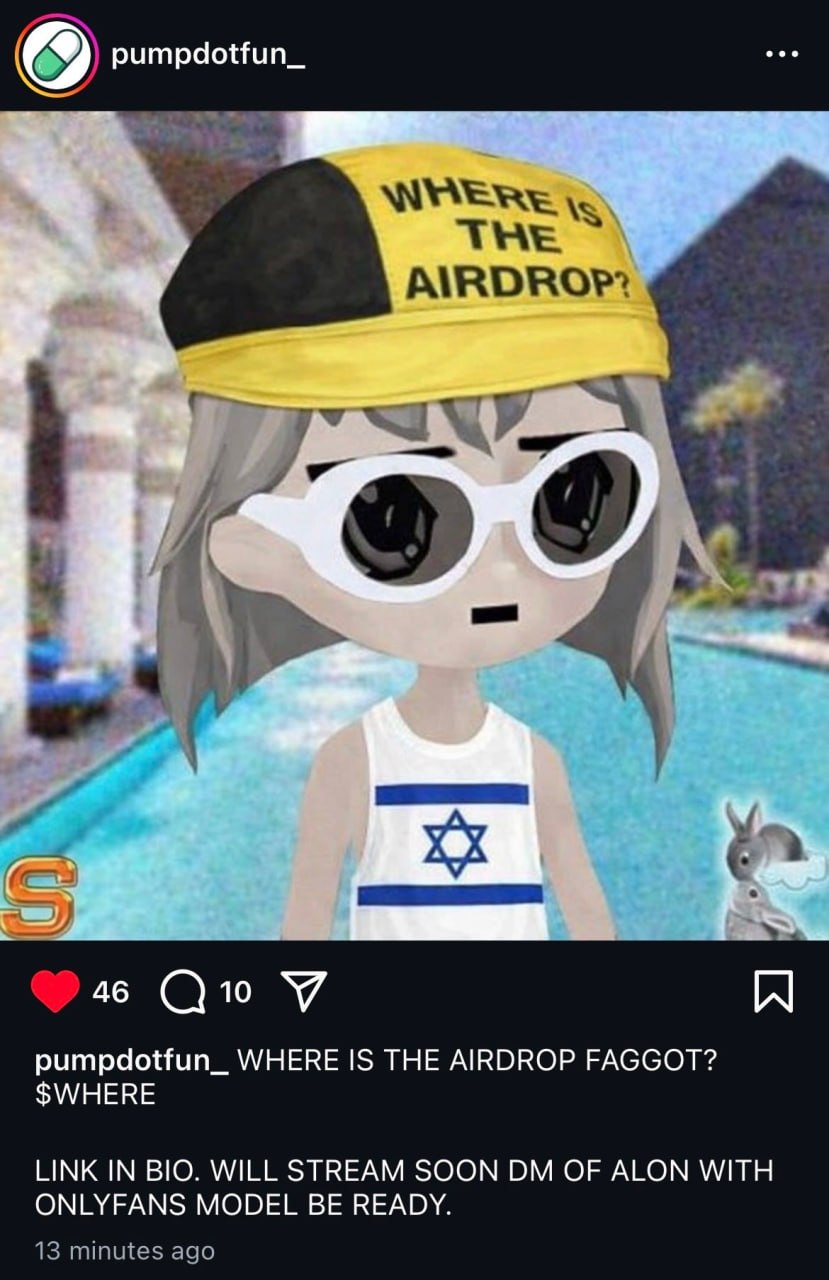 Pump.fun Instagram account hacked, platforms are safe as funds remain untouched2026-04
 Pump.fun announced deprecation of Tokenized Agent launch option effective immediately in response to community feedback about increased PVP competition. Existing tokens remain unaffected.2026-07
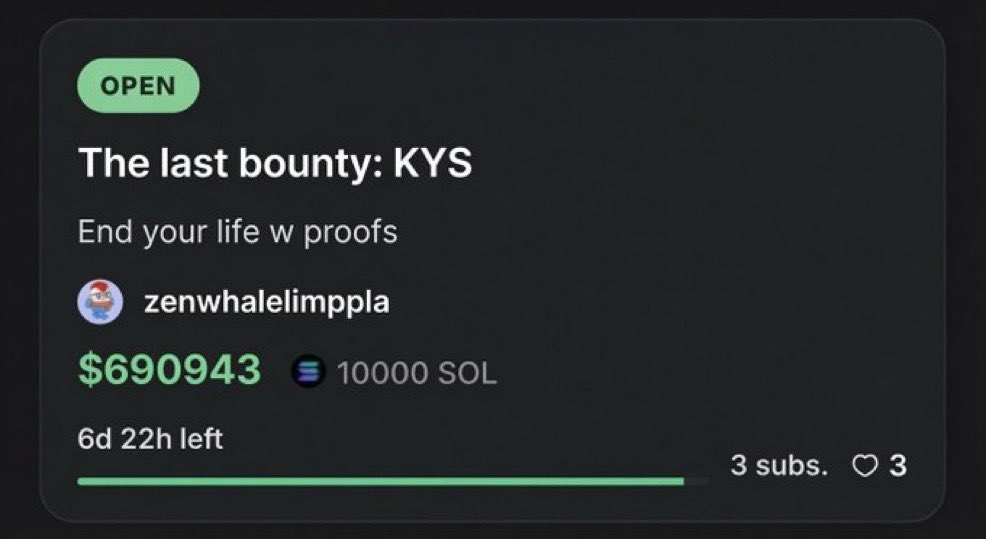 Pump.fun GO draws scrutiny as $690,000 suicide-related bounty raises moderation and safety concerns2026-06
 Pump.fun unveils BOOST mode, a new default launch mechanism that reinjects future liquidity into every bonded coin to reduce over $100M in annual migration losses2026-07
 Pump.fun brings one-wallet multichain trading to Ethereum, Base, and BNB without bridges or native gas2026-05
 Pump.fun adjusts from 100% revenue to PUMP buybacks to 50/50 distribution after burning 36% of circulating supply, with half now automated via smart contract2026-04
A Solana-native token launchpad that lets anyone deploy a memecoin in seconds, Pump.fun became the most revenue-productive application ever built on Solana — and one of the most controversial platforms in crypto.
What Pump.fun Is
Launched in January 2024 by an anonymous founding team (publicly identified only by the handle "Alon" for one co-founder), Pump.fun is a permissionless token-creation platform on Solana. Its core promise is radical simplicity: connect a wallet, fill in a name and ticker, upload an image, and a new SPL token is live within thirty seconds. No audits, no venture capital, no vesting schedules.
The platform does not list tokens directly on Solana's main decentralized exchanges. Instead, it runs each new token along an automated bonding curve — a mathematical price function that rises as buyers accumulate supply. When a token's market capitalization crosses roughly $69,000, Pump.fun automatically seeds a liquidity pool on Raydium, Solana's largest DEX, and burns the liquidity-provider tokens. At that point trading is fully open to the broader market.
This mechanism replaces the traditional fundraise-and-list model that previously defined crypto project launches, eliminating the information asymmetries of private presales. It also means that anyone who buys on the bonding curve takes on meaningful price risk before liquidity is deep enough to absorb large sells.

Pump.fun Instagram account hacked, platforms are safe as funds remain untouched
Revenue and Solana's Ecosystem Share
Pump.fun generates revenue through a transaction fee on every trade executed on its bonding curves — approximately 1% of transaction volume. The numbers that resulted were unprecedented for a single Solana application. By early 2025 the platform had crossed $500 million in cumulative revenue, and by mid-2025 it surpassed $1 billion, making it the first application on Solana to reach that milestone.
That concentration matters for the broader ecosystem. During Q1 2025, Pump.fun accounted for more than a third of all SOL-denominated fee revenue on Solana, even as the wider memecoin cycle showed signs of cooling. Solana validators, stakers, and infrastructure providers are meaningfully exposed to Pump.fun's activity volume — a structural dependency that cuts both ways.
Readers aren't clicking Pump.fun for DeFi mechanics — they click when recognizable real-world figures (politicians, convicted criminals, African heads of state) collide with the platform's chaos, revealing that Pump.fun's cultural gravity, not its tokenomics, is what makes it legible to a mainstream crypto audience.
The PUMP Token and Revenue Distribution
In late 2024 Pump.fun launched its own governance and utility token, PUMP, distributed to early platform users. The token gave the team a mechanism to return platform economics to holders and to create a feedback loop between platform health and token value.
The initial model directed 100% of platform revenue toward buying back PUMP on the open market. After the team burned approximately 36% of the circulating PUMP supply, the distribution was restructured to a 50/50 split: half of ongoing revenue continues to fund automated PUMP buybacks via a smart contract, and half flows to other uses including ecosystem development. The buyback component is trustless — the smart contract executes purchases without discretionary human intervention, addressing a common concern about teams controlling treasury flows.
Pump.fun laid off employees two months before token vesting. For one employee, the dismissal meant missing out on seven figures worth of PUMP tokens.
Multi-Chain Expansion
Through most of 2024, Pump.fun was synonymous with Solana. But by mid-2025 the team had registered subdomains for Ethereum, Base, BNB Chain, and Monad — and removed explicit "Solana" branding from its social profiles. The multi-chain move materialized as one-wallet multichain trading: users could trade tokens launched on Ethereum, Base, and BNB without needing native gas tokens on each chain or bridging assets manually. The platform handles cross-chain abstraction behind the scenes.
This repositions Pump.fun from a Solana-specific tool into a chain-agnostic memecoin infrastructure layer. It also intensifies competition with launchpads native to those chains. The platform simultaneously extended its token support to include assets launched on rival memecoin generators, as well as WBTC, USDC, and PUMP itself — moving closer to a full trading application rather than a pure launch tool.
Livestreaming and Pumpcade
One of Pump.fun's most distinctive features was the in-platform livestream integration, which allowed token creators to broadcast video directly within the Pump.fun interface. The combination of real-time audience interaction and live token trading was designed to accelerate community formation and price discovery.
The streaming feature spawned a separate venture: Pumpcade, a startup building real-time prediction markets layered on top of livestreams. Pump.fun invested $250,000 from its Pump Fund and led a $1 million seed round in Pumpcade, which lets viewers create and resolve prediction markets within seconds tied to live events. The The Collector Group, an early-adopter community, used Pump.fun livestreams to build a crypto-native trading card business, funding the operation through token trading fees rather than chasing one-time viral moments — an example of the platform enabling sustainable micro-businesses, not just speculation.

Arkham adds Pump.fun and FOMO usernames, letting users search trader profiles, identify linked wallets and track their trades and broader onchain activity

Controversies and Safety Concerns
The permissionless nature that makes Pump.fun powerful also makes it difficult to moderate. The platform's bounty feature — which allows users to post financial rewards for creators who complete on-camera challenges — drew significant backlash when those challenges escalated to self-harm stunts and humiliation acts. One widely-circulated case involved a user permanently tattooing a memecoin ticker on their forehead to claim a bounty.
More seriously, a $690,000 bounty tied to suicide-related content surfaced through the Pump.fun GO feature, prompting moderation and safety scrutiny from researchers and regulators. The incident highlighted the gap between the platform's technical permissionlessness and any duty of care toward participants.
The platform has also faced security incidents: its Instagram account was compromised in an external hack, though the team confirmed that on-chain funds and user assets were unaffected.
Legal pressure has accompanied the controversy. Co-founder Alon publicly acknowledged that the original creator fee model — designed to reward token creators financially — had failed to produce a healthy ecosystem, and announced a structural revamp that shifts revenue-sharing decisions toward traders rather than creators.
- 01Celebrity and political figures on-platform
The Barron Trump wallet speculation alone drove nearly 3,000 clicks — more than the next ten headlines combined — because fame launders speculation into mainstream news.
- 02Legal assault and regulatory exposure
A $5.5B RICO suit, a SDNY securities class action, Burwick Law IP-removal demands, and a judge allowing an amended insider-tilt lawsuit stacked up fast, making regulatory risk concrete rather than theoretical.
- 03PumpSwap DEX ambitions
Launching an in-house AMM that displaced Raydium and hit $10B volume in ten days reframed Pump.fun from a meme casino into a vertical infrastructure play.
- 04Fraud ecosystem scale and insider exploits
A 98% rug-pull rate, a serial rugger interview, a former employee's flash-loan frontrun, and a compromised wallet warning made the platform's internal fraud density impossible to ignore.
- 05Platform activity decline narrative
The 48% drop in daily launches from January's peak, co-founder admission that the creator-fee model failed, and struggling launches signaled that the meme supercycle was exhausting itself.
- 06PUMP token economics and fundraise
Revenue-sharing plans for PUMP holders, a reported $1B raise at $4B valuation, and the first buyback gave speculators a protocol-equity thesis to trade on.
Creator Economics and the Ecosystem Critique
A persistent criticism of Pump.fun is the unfavorable economics for most participants. Multiple independent analyses concluded that the majority of users who actively trade memecoin tokens on the platform lose money. The bonding curve structure, combined with the sheer volume of new token launches (at peak, tens of thousands of tokens were launched daily), creates a highly competitive and largely zero-sum environment for retail traders.
The creator fee controversy reflects a deeper tension. When token launchers earn fees regardless of whether buyers profit, incentives point toward volume rather than quality. Competitors have tried to differentiate on this axis: Blocmates-backed Futardio positioned itself as a permissionless alternative with built-in governance and treasury controls, arguing that "ownership coins" — where token holders retain structural rights over protocol assets — represent the next maturation of crypto capital formation beyond the pure speculative launch.
Pump.fun's response was its revamp toward trader-controlled revenue sharing, but the platform has not fundamentally changed the zero-sum nature of bonding curve trading.
Platform and Technical Development
The team has also focused on product performance alongside feature additions. Internal engineering work reduced the Pump.fun app startup time by roughly 50% after load times stretched into multiple seconds — a non-trivial friction point when the audience includes traders who prioritize speed above most other variables.
The app now supports assets beyond Pump.fun-native launches, including tokens from other launchpads, bridged assets like WBTC, and stablecoins. This breadth moves the product closer to a full memecoin trading terminal than a bare-bones launch tool.
At one point the team experimented with a rebrand away from the Pump.fun name entirely — briefly operating under the handle "dot" — before reverting to its established brand identity, reflecting the tension between escaping controversy associations and leveraging significant brand recognition.
- 2024-01launch
Pump.fun launches on Solana
- 2024-05exploit
STACCoverflow flash-loan frontrun attack (~$300k losses)
- 2024-06exploit
Jarett Dunn exploits Pump.fun; later pleads guilty
- 2024-10milestone
Pump.fun hits $100M revenue — fastest crypto app ever
- 2025-01milestone
Daily token launches peak at 95,578
- 2025-02governance
Daily launches plunge 48% to ~49,779; memecoin frenzy fades
- 2025-03launch
PumpSwap launches, replaces Raydium, hits $10B volume in 10 days
- 2025-04regulatory
$5.5B RICO lawsuit and SDNY securities class action filed
Outlook
Pump.fun enters its next phase as the dominant infrastructure layer for permissionless token launches but under mounting pressure from multiple directions: regulatory scrutiny of livestream content moderation failures, competitor launchpads offering structural alternatives, and the natural maturation of the memecoin cycle that drove its early explosive growth.
The multi-chain expansion is the clearest strategic signal about where the team sees its future: not as a Solana-specific application, but as chain-agnostic infrastructure for speculative token markets wherever those markets exist. Whether that expansion replicates Solana-era revenue at scale — or dilutes the concentration that made Pump.fun such a visible contributor to one chain's economics — will define its next chapter. The PUMP token's automated buyback mechanism creates a direct link between platform volume and token value, aligning holder incentives with growth, but also making both directly exposed to memecoin market cycles.
Latest Pump.fun news
Pump.fun Instagram account hacked, platforms are safe as funds remain untouchedPump.fun laid off employees two months before token vesting. For one employee, the dismissal meant missing out on seven figures worth of PUMP tokens.Arkham adds Pump.fun and FOMO usernames, letting users search trader profiles, identify linked wallets and track their trades and broader onchain activityPump.fun announced deprecation of Tokenized Agent launch option effective immediately in response to community feedback about increased PVP competition. Existing tokens remain unaffected.Pump.fun GO draws scrutiny as $690,000 suicide-related bounty raises moderation and safety concerns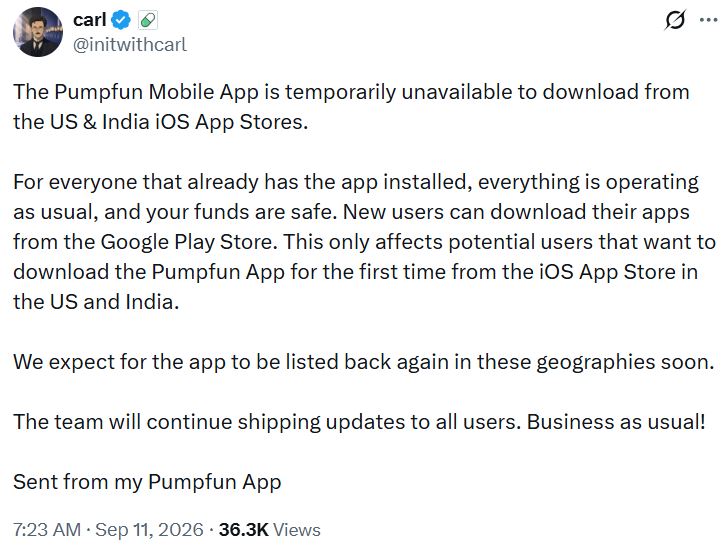 Pump.fun iOS app temporarily pulled from US and India App Stores, team says funds are safe
Community notes
Spot something off or out of date? Drop a note. Editors review topic notes daily and roll accepted fixes into the explainer — contributors are recognized in the monthly $SQUID drop.
Loading notes…
Help improve this topic
Have a story or tip about this topic? Submit it. See something missing? Leave a note. Editors review daily; accepted submissions and fixes count toward the monthly $SQUID drop.