
A neutral explainer on crypto launchpads: how IDOs, bonding curves, points and quests work, the rise of AI agent launchpads on Solana and Base, the infrastructure beneath them, and key risks.
+8 sources across the wider coverage universe
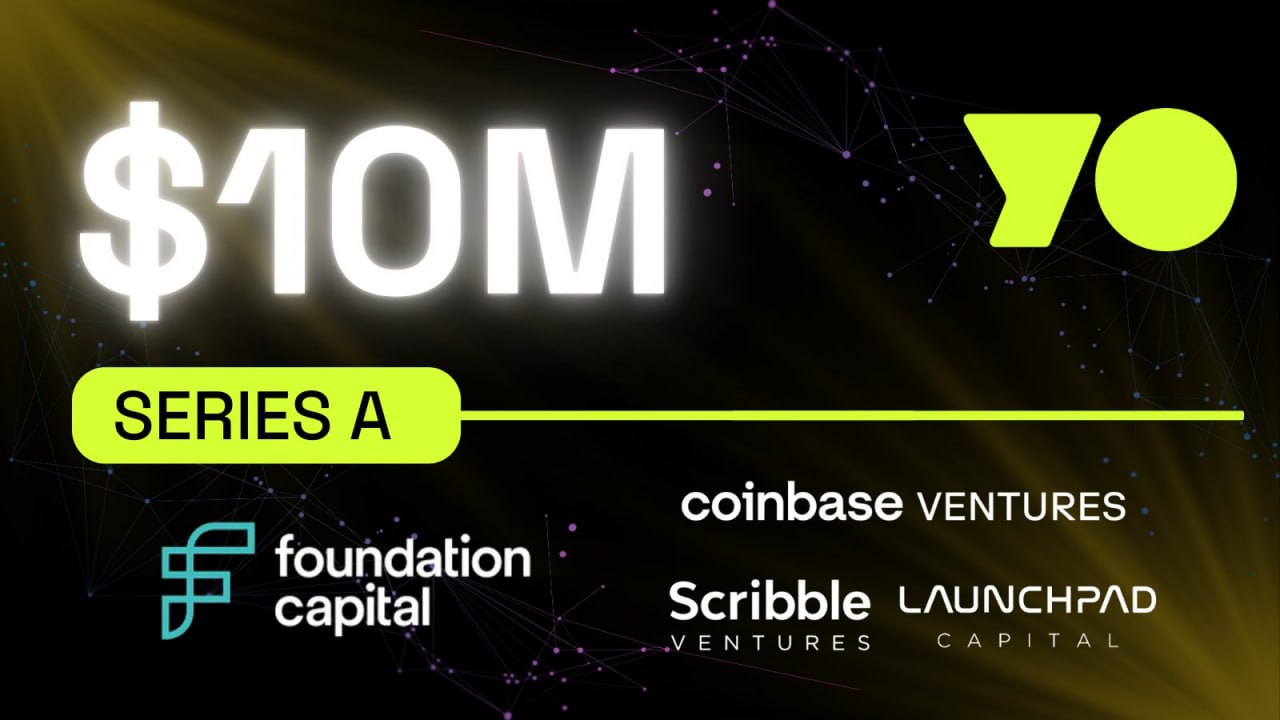 YO Labs raises $10M in Series A financing to scale cross-chain crypto yield optimization protocol. Venture capital firm Foundation Capital led the round, joined by Coinbase Ventures, Scribble Ventures, and Launchpad Capital.2025-12
 RISE Launchpad launches on Solana with permissionless token launches featuring built-in floor price protection and instant borrowing to cap downside risk while capturing unlimited upside potential2026-04
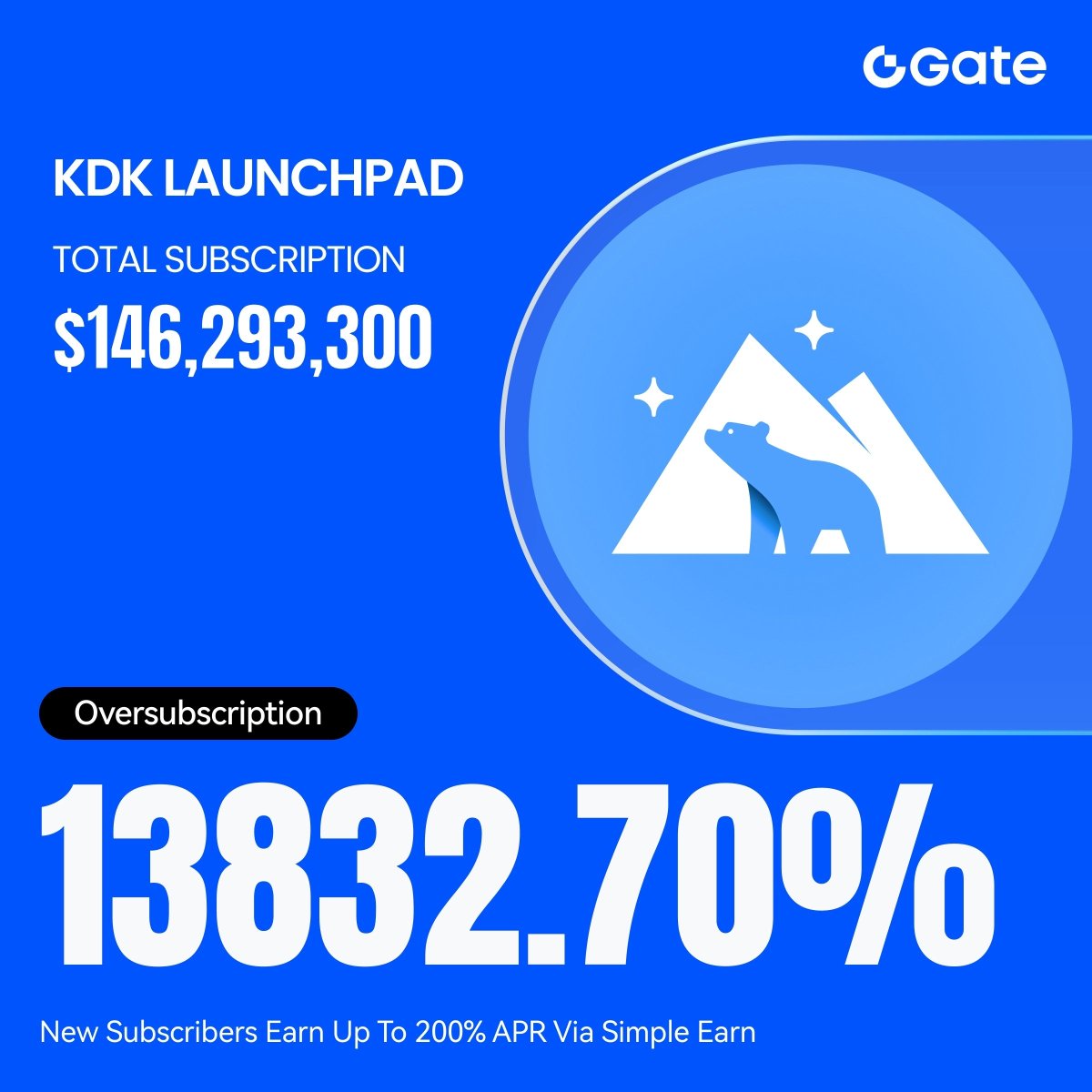 Kodiak's launchpad on Gate has concluded, $150M in subscriptions reported, 150x oversubbed. Live trading is expected to start December 23rd.2025-12
 Bitcoin Ordinals launchpad proposes BRC-69 standard to reduce costs by 90%2023-07
 CoinMarketCap has announced the launch of CMC Launch, a Pre-TGE project launchpad2025-05
 For $400, I built a token launchpad in 3 days (and so can you)2025-08
A launchpad is a platform that helps new crypto projects raise funds, distribute tokens, and bootstrap a community around a token before or at the moment it becomes publicly tradable. Over the past two market cycles the model has expanded well beyond simple fundraising into gaming, points programs, and the tokenization of autonomous AI software.
What a launchpad actually does
At its core, a launchpad coordinates the moment a token first reaches the market — the "launch" — and the supporting machinery around it: project curation, allocation rules, smart-contract deployment, and an initial pool of liquidity. Historically the dominant format was the Initial DEX Offering (IDO), in which a project sells tokens directly through a decentralized exchange rather than via a centralized intermediary, giving buyers tradable tokens and on-day-one liquidity (DEXTools, BlockchainX). This distinguishes the IDO from the older Initial Coin Offering (ICO), where tokens were sold directly to investors with no guarantee of an immediate trading venue.
A launchpad typically bundles several services that a small team could not easily assemble alone:
- Curation and vetting — reputable platforms review projects before listing, including smart-contract audits that check code for vulnerabilities and an analysis of the token supply schedule, or tokenomics (DEXTools).
- Allocation mechanics — rules that decide who can buy and how much. Tiered systems are common: Seedify, for example, uses a nine-tier structure in which higher tiers receive earlier access and larger allocation caps (CoinGabbar).
- Access flow — many sales open with a guaranteed round for qualified users, followed by a first-come, first-served (FCFS) round where remaining supply is raced for (CoinGabbar).
- Launch infrastructure — contract deployment, bonding curves, and the initial liquidity pool.

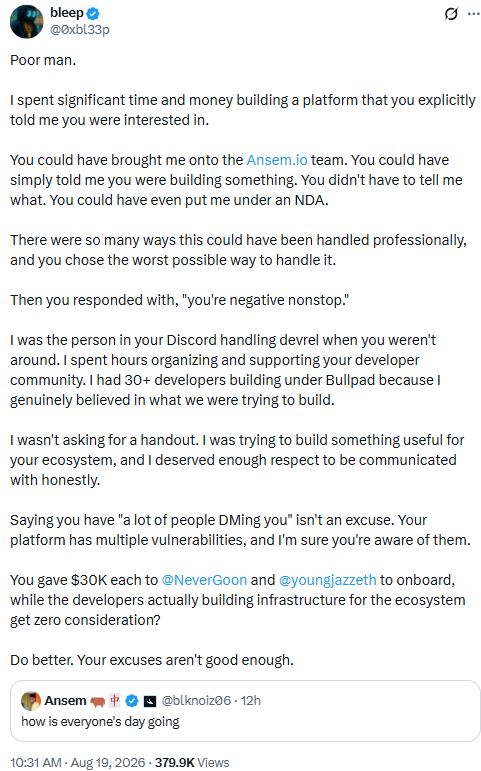
Solana developer Bleep accuses influencer Ansem of overlooking his launchpad work when Ansem launched Ansem.io around August 17 without compensation or credit.
How participation works
To join a sale, a user generally needs a Web3 wallet such as MetaMask or a WalletConnect-compatible app, and increasingly some form of identity verification. Know-Your-Customer (KYC) checks are now standard on many fundraising launchpads; Seedify, for instance, requires KYC for IDO participation (CoinGabbar). The wallet serves as both the identity and the settlement layer: it holds the stablecoins or native tokens used to buy in, signs the purchase transaction, and receives the new tokens.
Pricing is often governed by a bonding curve — a formula that sets token price as a function of how many have already been bought, so early buyers pay less and the price rises mechanically with demand. This is the mechanism behind the recurring "early-buyer advantage" framing seen across launch marketing, and it is now used in agent-token platforms as well as memecoin venues.
Readers click launchpad stories not for the mechanics of token distribution but for the tension between accessibility and risk — whether that's a developer building one for $400, a platform getting exploited for $7M, or a 150x oversubscribed sale — revealing that the launchpad narrative is fundamentally about who gets in, who gets hurt, and who controls the gates.
Points, quests, and the gamified launch
A major shift in the current cycle is the use of points systems to gate and reward access, replacing or supplementing pure capital tiers. Rather than ranking users only by how much token they stake, points-based launchpads reward activity — playing games, completing tasks, and participating in a community.
The clearest example is Yield Guild Games' YGG Play Launchpad, built around what the company calls "Casual Degen" gaming. Players discover titles, complete in-game quests, and earn YGG Play Points that determine leaderboard standing and eligibility for early access to new game tokens (YGG Play). The platform launched in October 2025 around LOL Land's $LOL token and has since added a roster of casual titles such as GIGACHADBAT, Waifu Sweeper, and Roots of Embervault (PlayToEarn, BitPinas). Daily quests ask players to take a specific in-game action — buy a bundle, beat a boss, make a trade — and credit points automatically at 00:00 UTC after completion. Players can now spend points on "Boosts" to secure larger token allocations, or redeem them directly for $YGG (blockchaingamer.biz).
This design reframes the launchpad as an ongoing engagement engine rather than a one-time sale. It is worth noting the trade-offs: quests that instruct players to "purchase" premium packs convert spending into points, and rewards are frequently described as uncertain or unproven. Participants should treat quest "rewards" as speculative and be cautious with any task that requests broad wallet permissions, since malicious approvals remain a common drain vector across Web3 gaming.
YO Labs raises $10M in Series A financing to scale cross-chain crypto yield optimization protocol. Venture capital firm Foundation Capital led the round, joined by Coinbase Ventures, Scribble Ventures, and Launchpad Capital.

"YO is our answer to the fragmentation and complexity of DeFi yield. On the surface, YO is intentionally simple: you deposit into a vault and immediately start earning. Under the surface, YO is a constantly running engine. It scans opportunities across chains and protocols, uses the Exponential risk framework to evaluate them, and allocates capital where it believes the best risk-adjusted yield lives at any given time. As markets move and strategies evolve, YO adjusts."
The AI agent launchpad
The newest and fastest-moving category fuses launchpads with AI agents — autonomous software programs that can transact, trade, or provide services on-chain. The premise of an agent launchpad is that the token is not merely a fundraising instrument but a claim on, or fuel for, a working piece of AI software.
This narrative began with Virtuals Protocol, which was the first launchpad to popularize AI-agent tokenization, letting creators launch, maintain, and train agents through the value accumulation of their tokens — establishing Virtuals as a leading agent distribution network on Base (ChainCatcher). On Solana, a retail-heavy ecosystem drove rapid agent growth, and a crowd of competing platforms followed. Virtuals later introduced Genesis Launches across both Base and Solana, explicitly designed to let community users participate early while deterring bots and snipers (ChainCatcher).
The scale claims around agents have become a core selling point. Marketing for one recent platform, Agent Launch, framed itself as "the first launchpad where every token is a working AI agent," citing more than 250,000 AI agents operating on-chain daily and a market it valued in the billions. These figures originate from project promotion and should be read as marketing rather than independently audited statistics.
Swarms illustrates how the agent-launchpad model is maturing into infrastructure. Swarms LaunchPad lets developers build agents with a Python/Rust SDK, tokenize them, and trade them on its own DEX, with creators earning from purchase fees, rental shares, or trading income (MEXC). Its "Frenzy Mode" API adds programmatic, high-volume agent deployment, a doubled launch fee, and a choice of USDC or SOL as the bonding-curve denomination (Phemex). The team reported that during its beta Swarms ranked among Solana's top four launchpads for several days, with over $5 million in trading volume and more than 7,000 traders — again, self-reported metrics (Solana Compass). A parallel effort on Base, the Swarms Launchpad, has been promoted as a venue for tokenizing agents on that chain.
- 01Bitcoin ordinals launchpad innovation
The BRC-69 cost-reduction proposal drew the most clicks because it promised a 90% fee cut on the hottest NFT primitive, making Bitcoin-native launches newly viable for retail creators.
- 02Launchpad exploit accountability
The Odin.fun $7M exploit on a Bitcoin memecoin launchpad pulled readers seeking to understand if the protocol or users bore the loss on an emerging chain.
- 03DIY permissionless token launches
The '$400 in 3 days' headline tapped builder curiosity about how low the floor for launching a legitimate launchpad actually is, with implicit concern about quality control.
- 04CEX launchpad legitimacy signals
CoinMarketCap's Pre-TGE launchpad and Kodiak's Gate launchpad with 150x oversubscription drew clicks from readers calibrating whether exchange-backed launches confer credibility or just hype.
- 05Downside protection mechanics
RISE Launchpad's built-in floor price protection and instant borrowing drew engagement from readers burned by post-launch dumps who want structural safeguards baked in.
- 06AI and niche vertical launchpads
Surge on Sui, Kaito Capital Launchpad, and SafuSkill all represent the emergent angle of purpose-built launchpads for specific asset classes, signaling fragmentation away from general-purpose IDO platforms.
Infrastructure underneath
Launchpads do not operate in isolation; they sit atop the broader infrastructure of the chains they deploy on. The viability of high-frequency, low-cost launches — especially memecoin and agent tokens minted in bulk — depends on cheap block space and fast finality. This is why Solana has become a dominant "launch center," and why the network's foundation has positioned it as core infrastructure for an "agentic internet," reporting that it has processed millions of on-chain agent payments with stablecoins emerging as the default settlement rail (CoinDesk).
That performance is itself the product of infrastructure investment by firms such as Jump Crypto, whose Firedancer validator client was built to raise Solana's throughput and resilience. The relationship is indirect but important: trading firms and infrastructure providers supply the validator software, market-making, and liquidity rails that make rapid-fire launchpad activity economically feasible. When evaluating any launchpad, the health and decentralization of its underlying chain are part of the risk picture.

RISE Launchpad launches on Solana with permissionless token launches featuring built-in floor price protection and instant borrowing to cap downside risk while capturing unlimited upside potential

Floor-backed bonding curves aren't new — Tuna did zero-loss exits with 60-min lockups back in December — but bolting a lending layer on top changes the game theory entirely. Instead of panic-redeeming at floor and draining the reserve pool, holders borrow against their floor collateral and stay exposed to upside, which in theory reduces cascading sell pressure at the exact moment it matters most. Smart mechanism design, but the second-order question nobody's asking: if a token trends toward floor and most holders have already borrowed against it, who's left to absorb the bad debt when those loans go underwater? With only ~13k followers at launch, the real stress test hasn't happened yet — floor protection is easy to promise when inflows exceed redemptions.
Risks and how to evaluate a launchpad
The launchpad model concentrates several well-known risks, and the gamified and AI-themed variants add new ones:
- Token performance — early access does not guarantee gains. Bonding curves reward the earliest buyers structurally, which can leave later participants exposed if demand fades after launch.
- Smart-contract and approval risk — quests or sales that request token approvals can be abused; reputable platforms publish audits, and users should verify them rather than trust marketing.
- Unproven rewards — points and quest rewards are often discretionary and may change or fail to materialize. Newsroom coverage of YGG Play quests repeatedly flags "uncertain" or "unproven" rewards.
- Narrative risk in AI tokens — many agent tokens are speculative bets on a fast-moving theme; "every token is a working agent" claims and large daily-agent counts come from project promotion and warrant scrutiny.
- Self-reported metrics — volume, trader counts, and ranking claims are frequently sourced from the launchpad itself rather than neutral analytics.
A practical checklist: confirm the project has a published audit, understand the exact allocation and vesting schedule, read the bonding-curve or sale mechanics before committing, use a fresh or limited wallet for quests, and treat any promised reward as conditional until it actually settles on-chain.
- 2023-07governance
BRC-69 standard proposed to cut Bitcoin Ordinals launchpad costs 90%
- 2024-01milestone
NFT trading volume down 93% from 2021 peak, launchpad model stress-tested
- 2024-08launch
RAAC Bots listed on MagicEden launchpad with free mint mechanics
- 2024-12milestone
Kodiak launchpad on Gate closes 150x oversubscribed at $150M
- 2025-01exploit
Odin.fun Bitcoin memecoin launchpad exploited for over $7M
- 2025-03launch
CoinMarketCap launches CMC Launch Pre-TGE launchpad platform
- 2025-04launch
Surge AI launchpad goes live on Sui with milestone-based funding model
- 2025-05launch
Kaito teases Capital Launchpad as FCFS alternative for community fundraising
Outlook
The launchpad has evolved from a fundraising desk into a general-purpose distribution layer for new crypto assets — tokens, game economies, and now autonomous agents. The near-term trajectory points toward deeper integration of points-based engagement, AI-driven curation and risk screening, and programmatic launch tooling like Swarms' Frenzy Mode, all riding on faster base-layer infrastructure. The open questions are durability and trust: whether gamified points and agent tokens build lasting value or simply accelerate churn, and whether curation and audits keep pace with the speed at which these platforms can now mint and list new assets. For readers, the constant is unchanged — the mechanics reward the earliest and most informed participants, which makes understanding the specific rules of each launchpad the single most valuable form of due diligence.
Latest Launchpad news
Solana developer Bleep accuses influencer Ansem of overlooking his launchpad work when Ansem launched Ansem.io around August 17 without compensation or credit.YO Labs raises $10M in Series A financing to scale cross-chain crypto yield optimization protocol. Venture capital firm Foundation Capital led the round, joined by Coinbase Ventures, Scribble Ventures, and Launchpad Capital.RISE Launchpad launches on Solana with permissionless token launches featuring built-in floor price protection and instant borrowing to cap downside risk while capturing unlimited upside potentialKodiak's launchpad on Gate has concluded, $150M in subscriptions reported, 150x oversubbed. Live trading is expected to start December 23rd. Surge, the first AI launchpad on Sui, aims to merge AI and crypto by funding transparent, milestone-based projects. It introduces post-VC fundraising and on-chain accountability to empower retail investors and builders alike.
 Kensei’s gamified and reputation-based memecoin launchpad is now live on Katana, with 200,000 in KAT rewards for memecoin creators
Community notes
Spot something off or out of date? Drop a note. Editors review topic notes daily and roll accepted fixes into the explainer — contributors are recognized in the monthly $SQUID drop.
Loading notes…
Help improve this topic
Have a story or tip about this topic? Submit it. See something missing? Leave a note. Editors review daily; accepted submissions and fixes count toward the monthly $SQUID drop.