
Jump Crypto, the digital-assets arm of Jump Trading Group, built Firedancer for Solana, backstopped a $320M bridge hack, and settled SEC charges over its role in the 2022 Terra/Luna collapse.
+4 sources across the wider coverage universe
 Jump Crypto is rolling out Firedancer cautiously across Solana, prioritizing stability and validator resilience as the network’s long-awaited second client nears adoption2026-05
 Arcium mainnet and ARX token go live on Solana after 1.6m+ confidential computations in alpha, backed by Jump Crypto and Anatoly Yakovenko2026-06
 Securitize, Jump Trading Group and Jupiter launch regulated onchain trading for tokenized equities2026-05
 Jump Trading slams $4B Terraform lawsuit as blame-shifting, denies secretly propping UST peg in 20212026-03
 Figure announces the on-chain public equity network (OPEN) running on Provenance blockchain. Figure stock will be the first public equity trading native on public blockchain; BitGo, Jump Trading Group sign on to support. Unlike other tokenization efforts, OPEN equities are blockchain registered, not a tokenized version of Depository Trust and Clearing Corporation (DTCC) securities.2026-01
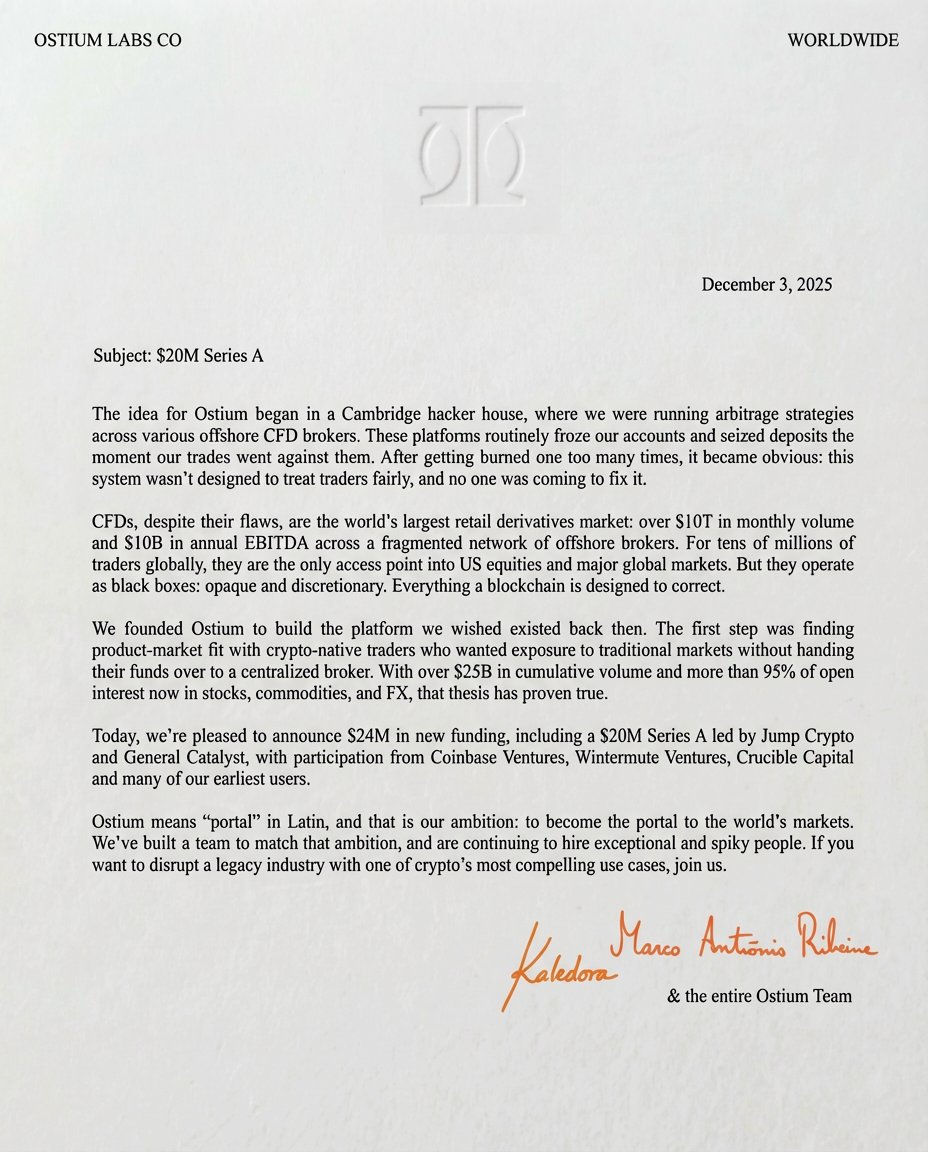 Harvard grads raise $20 million for Ostium, a platform focused on a derivative popular with crypto traders. The Series A round was led by marquee venture outfit General Catalyst and the crypto arm of the quantitative trading firm Jump Trading, Kaledora Kiernan-Linn, cofounder and CEO, told Fortune.2025-12
One of the most influential — and controversial — institutional actors in crypto infrastructure, Jump Crypto is the digital-assets division of Chicago-based trading giant Jump Trading Group, operating at the intersection of high-frequency market-making, blockchain infrastructure development, and venture investment.
What Is Jump Crypto?
Jump Trading Group was founded in 1999 by former Chicago derivatives pit traders and grew into one of the world's largest proprietary trading firms, with deep roots in equities, futures, and fixed-income markets. Its crypto division — publicly branded Jump Crypto — formally coalesced around 2021, though the firm had been active in digital-asset markets for years prior. Kanav Kariya, who joined Jump in 2017 as a software engineering intern, was named president of the crypto unit at age 25 in September 2021 and became the division's public face.
Jump Crypto distinguished itself from pure-play crypto venture funds by bringing the parent firm's quantitative trading infrastructure to bear. It acted simultaneously as a market maker (through affiliated entity Tai Mo Shan), venture investor, ecosystem builder, and protocol developer — a combination that gave it outsized influence, and eventually outsized exposure to industry catastrophes.

Jump Crypto is rolling out Firedancer cautiously across Solana, prioritizing stability and validator resilience as the network’s long-awaited second client nears adoption
The Terra/Luna Collapse and Its Aftermath
Jump Crypto's most significant reputational and legal crisis stems from its relationship with Terraform Labs, the Singapore-based company behind the Terra blockchain and its algorithmic stablecoin TerraUSD (UST).
When UST briefly lost its dollar peg in May 2021, Tai Mo Shan — Jump's offshore trading entity — stepped in to buy approximately $20 million in UST and help restore the peg. In exchange, the firm received LUNA tokens at a deeply discounted price. According to a subsequent SEC complaint, Tai Mo Shan ultimately made roughly $1.28 billion from these tokens. The SEC alleged that Jump and Terraform had misled investors by presenting the peg restoration as proof that UST's algorithmic mechanism worked, when in fact it had been propped up by a private arrangement with a single trading firm.
Terra's algorithmic design collapsed catastrophically in May 2022, erasing more than $40 billion in market value and triggering a contagion wave that contributed to the bankruptcies of Three Arrows Capital, Celsius, Voyager, and others. Do Kwon, Terraform's co-founder, was later arrested in Montenegro and extradited to face charges. Terraform Labs itself filed for bankruptcy in January 2024 and subsequently agreed to pay the SEC $4.47 billion in penalties — one of the largest enforcement actions in crypto history.
Jump's exposure did not end there. In December 2024, the SEC reached a $123 million settlement with Tai Mo Shan over its role in the UST peg-defense scheme and unregistered dealings in LUNA tokens (The Block). Separately, Terraform Labs' court-appointed bankruptcy administrator filed a $4 billion lawsuit against Jump Trading Group, co-founder William DiSomma, and Kanav Kariya, alleging that Jump profited while ordinary investors were left holding collapsing tokens (Protos). Jump has characterised the suit as an attempt to "pass the buck" for Terraform's own failures.
Readers aren't clicking Jump Crypto for its trading prowess or Solana engineering — they're clicking to trace the paper trail between a secretive market maker and the largest stablecoin collapse in crypto history, with every legal filing and deposition adding a new link in the accountability chain.
Wormhole: A $320 Million Crisis and Its Resolution
Before the Terra collapse, Jump Crypto had already demonstrated its willingness to deploy capital to defend ecosystem positions. In February 2022, Wormhole — a cross-chain bridge connecting Solana, Ethereum, and other networks, which Jump had backed and helped develop — suffered one of the largest exploits in DeFi history. An attacker exploited a vulnerability to mint 120,000 wrapped ETH (wETH) on Solana without locking the underlying collateral, stealing roughly $320 million.
Within hours, Jump replenished the stolen ETH from its own balance sheet, making Wormhole users whole and preventing cascading liquidations across Solana's DeFi ecosystem (CoinDesk). The move was widely interpreted as evidence of how deeply entangled Jump had become with Solana's financial stability.
In a lesser-known coda, Jump Crypto conducted a "counter-exploit" in February 2023, using technical mechanisms to recover approximately $140 million net from the original attacker's on-chain holdings (Blockworks).

Arcium mainnet and ARX token go live on Solana after 1.6m+ confidential computations in alpha, backed by Jump Crypto and Anatoly Yakovenko
Leadership Transition and Regulatory Scrutiny
By mid-2024, the accumulation of regulatory pressure had reshaped Jump's crypto leadership. Kanav Kariya publicly departed on June 24, 2024, citing the need for a new chapter after three years as president (The Block). His exit coincided with reports that the CFTC had launched an investigation into Jump Crypto's activities. Kariya later invoked the Fifth Amendment when questioned by regulators (Fortune).
Jump Trading Group did not publicly name a replacement president of the crypto unit. Oversight appeared to consolidate under the firm's broader executive committee, with the crypto division operating with a lower public profile than it had during the 2021–2022 bull market. Despite the turbulence, Jump has continued building infrastructure — most notably through its flagship engineering project, Firedancer.
Firedancer: Rebuilding Solana's Foundation
If any single technical contribution defines Jump Crypto's lasting positive legacy in the industry, it is Firedancer — a ground-up rewrite of Solana's validator client in C and C++.
Solana's original validator software, developed by Solana Labs (now Anza, as a spinout) and called Agave, has long been the network's sole validator implementation. A mature blockchain network typically runs multiple independent client implementations to reduce single-point-of-failure risk — Ethereum, for instance, has Lighthouse, Prysm, Teku, and others. Firedancer is Solana's first serious alternative client, written entirely independently of the Solana Labs codebase.
In benchmarks, Firedancer handled over 1 million transactions per second on commodity hardware — a figure that, if realised in production, would represent a step-change in blockchain throughput. Kevin Bowers, Chief Scientist of Jump Trading Group, has presented the theoretical basis for this performance publicly.
The mainnet rollout began cautiously in late 2025. By early 2026, Firedancer was producing live blocks on Solana mainnet, with the rollout expanding from a handful of validators to more than 20% of Solana's active validator set (CoinDesk). The team has prioritised stability and resilience over speed of adoption — a deliberate contrast to Solana's historical reputation for network outages.
Firedancer is also positioned to support Alpenglow, a proposed upgrade to Solana's consensus mechanism that would reduce finality to around 150 milliseconds and replace the bespoke Proof-of-History component that has long distinguished (and complicated) Solana's design.
Securitize, Jump Trading Group and Jupiter launch regulated onchain trading for tokenized equities
Jump's Ecosystem Investments and Market-Making Role
Beyond Firedancer and Wormhole, Jump has been a cornerstone liquidity provider and investor across the crypto ecosystem. Its market-making operation through Tai Mo Shan has historically supplied liquidity on centralised exchanges and DeFi protocols alike, with particular depth on Solana-native venues.
On the investment side, Jump has backed projects across Solana, Ethereum, and adjacent infrastructure, including early positions in a range of DeFi protocols and Web3 gaming platforms that use launchpad and points-based onboarding mechanics — structures that have become standard for bootstrapping token communities.
In May 2026, Jump Trading Group partnered with tokenization platform Securitize and Solana-native aggregator Jupiter to launch a regulated secondary market for tokenized equities on Solana (PR Newswire). Jump's role in the arrangement is to provide liquidity through a proprietary automated market maker (PropAMM) deployed on Solana, enabling tight spreads on Securitize's SEC-registered alternative trading system. This positions Jump as a market maker not just for crypto assets but for real-world assets — stocks and other securities — settling on a public blockchain.
Jump has also participated as a cornerstone investor in Solana-focused corporate treasury strategies. A $1.65 billion PIPE raise that formed the basis of Forward Industries (NASDAQ: FWDI), a publicly listed Solana treasury company, counted Jump Crypto, Galaxy Digital, and Multicoin Capital among its lead backers. As of early 2026, Forward held approximately 6.98 million SOL, though the position carried significant mark-to-market exposure given SOL price volatility.
- 01Jump's secret UST rescue role
Multiple high-click headlines exposed Jump secretly propping up the TerraUSD peg in 2021 while publicly denying it, making the firm central to crypto's most damaging collapse narrative.
- 02Predatory market-making terms
The top-clicked headline revealed Jump routinely demanded 5%+ of token supplies as market-making fees, exposing structural conflicts of interest with project founders and retail holders.
- 03CFTC and SEC regulatory reckoning
Readers tracked the progression from undisclosed CFTC investigation to Kanav Kariya invoking the Fifth Amendment and ultimately Tai Mo Shan's $123M SEC settlement, framing Jump as a firm in institutional free-fall.
- 04Leadership flight and Fifth Amendment
President Kariya's departure and his Fifth Amendment invocation during the SEC deposition signaled to readers that individual executives, not just the firm, faced serious personal legal exposure.
- 05Firedancer and Solana validator bet
Jump's deep technical commitment to Solana through Firedancer and the Frankendancer testnet gave readers a counternarrative — a firm simultaneously facing legal crisis while building core blockchain infrastructure.
- 06Wormhole spinoff and crypto retreat
Spinning off Wormhole as an independent entity while downsizing the crypto arm read to readers as a structured withdrawal — legacy asset preservation while shedding regulatory surface area.
Jump Crypto and Bitcoin
While Jump's deepest technical commitments are to Solana, the firm's trading operations span all major liquid digital assets, including Bitcoin. Jump has been active in Bitcoin derivatives and spot markets for years. More broadly, the firm's approach to infrastructure — investing in validator clients, bridge protocols, and settlement layers — reflects a view that Bitcoin's role as a reserve asset coexists with, rather than competes against, programmable-chain ecosystems where Jump's market-making and venture bets are concentrated.
Regulatory and Reputational Position
Jump Crypto's story illustrates the hazards that accompany deep integration with nascent financial ecosystems. The firm's involvement with Terraform Labs demonstrated how private arrangements between sophisticated institutions can shape public market narratives in ways that regulators now view as misleading. The $123 million SEC settlement, the pending $4 billion Terraform lawsuit, and the CFTC investigation have collectively established Jump as a test case for how regulators will treat institutional actors whose trading activity intersects with retail investor losses.
At the same time, the firm's willingness to absorb a $320 million loss to protect the Wormhole ecosystem, and its multi-year investment in Firedancer at a time when regulatory risk was mounting, complicates any simple characterisation. Jump has consistently behaved like a firm that views long-term ecosystem health — particularly Solana's — as aligned with its own commercial interests.
- 2021-06governance
Jump secretly intervenes to stabilize TerraUSD peg
- 2022-05exploit
Terra/LUNA ecosystem collapses; Jump's UST role later scrutinized
- 2023-06regulatory
CFTC launches undisclosed investigation into Jump Crypto
- 2023-09milestone
Frankendancer validator client goes live on Solana mainnet
- 2023-10regulatory
President Kanav Kariya departs amid CFTC investigation
- 2024-01governance
Wormhole spun off as independent entity; crypto arm downsized
- 2024-07regulatory
Kanav Kariya invokes Fifth Amendment in SEC deposition in Do Kwon case
- 2024-12regulatory
Tai Mo Shan pays $123M to settle SEC TerraUSD allegations
Outlook
Jump Crypto enters the second half of the 2020s in a quieter operational posture than its 2021–2022 peak, but its infrastructure footprint is arguably larger. Firedancer's growing share of Solana's validator set makes Jump structurally important to the network's stability and scalability in ways that go beyond any single investment or trade. The tokenized-equities venture with Securitize and Jupiter signals an ambition to extend that market-making playbook into regulated real-world assets — a bet that blockchain settlement infrastructure, specifically on Solana, is ready for institutional securities trading.
Legal exposure from the Terra era remains a material overhang. How the $4 billion Terraform lawsuit resolves will shape not just Jump's balance sheet but the broader precedent for what obligations institutional market participants have when they privately support retail-facing financial products. That outcome, whenever it arrives, will be one of the defining legal landmarks of the 2022 crypto crisis.
Latest Jump Crypto news
Jump Crypto is rolling out Firedancer cautiously across Solana, prioritizing stability and validator resilience as the network’s long-awaited second client nears adoptionArcium mainnet and ARX token go live on Solana after 1.6m+ confidential computations in alpha, backed by Jump Crypto and Anatoly YakovenkoSecuritize, Jump Trading Group and Jupiter launch regulated onchain trading for tokenized equitiesJump Trading slams $4B Terraform lawsuit as blame-shifting, denies secretly propping UST peg in 2021Figure announces the on-chain public equity network (OPEN) running on Provenance blockchain. Figure stock will be the first public equity trading native on public blockchain; BitGo, Jump Trading Group sign on to support. Unlike other tokenization efforts, OPEN equities are blockchain registered, not a tokenized version of Depository Trust and Clearing Corporation (DTCC) securities.Harvard grads raise $20 million for Ostium, a platform focused on a derivative popular with crypto traders. The Series A round was led by marquee venture outfit General Catalyst and the crypto arm of the quantitative trading firm Jump Trading, Kaledora Kiernan-Linn, cofounder and CEO, told Fortune.Community notes
Spot something off or out of date? Drop a note. Editors review topic notes daily and roll accepted fixes into the explainer — contributors are recognized in the monthly $SQUID drop.
Loading notes…
Help improve this topic
Have a story or tip about this topic? Submit it. See something missing? Leave a note. Editors review daily; accepted submissions and fixes count toward the monthly $SQUID drop.