
Deep dive into PUMP, the token behind Solana’s Pump.fun memecoin launchpad: bonding-curve mechanics, buyback-driven tokenomics, whale flows, lawsuits, revenue cycles and how social casino culture shapes its long-term outlook.
- x.com32
- theblock.co3
- cointelegraph.com3
- protos.com3
- leviathannews.substack.com3
- dlnews.com2
- blockworks.co2
+15 sources across the wider coverage universe
 Pump.fun adjusts from 100% revenue to PUMP buybacks to 50/50 distribution after burning 36% of circulating supply, with half now automated via smart contract2026-04
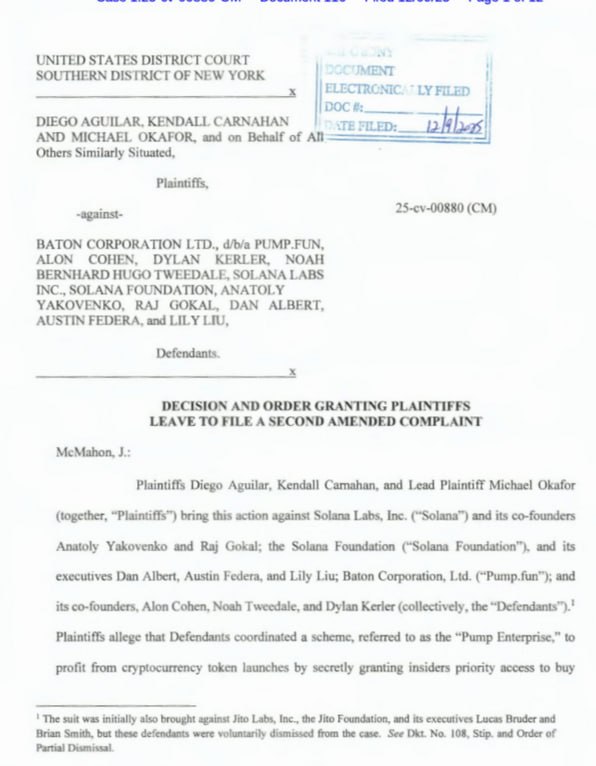 Judge Allows Amended Lawsuit Alleging Pump.fun Marketplace Was Tilted to Favor Insiders on Solana2025-12
 CT sniffs out supposedly Barron Trump’s pump.fun profile, he’s launched a few tokens to include “BARRON,” “Hunter the Snow Plow” and “Official President Otter.” There’s no official confirmation if this is his wallet, just speculation at this moment.2025-01
 Chainalysis report claims majority of ERC-20 tokens are susceptible to pump and dump schemes, but dumpers average a mere $2,672 per attack2024-02
 Ross Ulbricht’s wallet is losing millions on Pump Fun memecoins2025-01
- Pump.fun memecoins struggle to even launch.2024-08
PUMP: The Token Powering Solana’s Most Controversial Memecoin Machine
PUMP is the native token of Pump.fun, a Solana-based memecoin launchpad that combines a no‑code token factory, social casino‑style trading and an aggressive buyback‑and‑burn model that ties the token’s value directly to platform revenue and speculation. It sits at the intersection of memecoins, streaming culture and high‑stakes regulatory risk, making it one of the most closely watched – and hotly debated – assets in the current crypto cycle.
Background: Memecoins, Solana And The Rise Of Pump.fun
Memecoins began as tongue‑in‑cheek experiments on Bitcoin forums and early Ethereum, but they have evolved into a full‑blown market segment where narrative, virality and community often matter more than cash flows or code quality. In contrast to blue‑chip crypto assets that promise infrastructure or long‑term utility, memecoins tend to advertise nothing beyond jokes, internet culture and speculative upside, which gives them an inherently lottery‑like profile. They move in violent cycles: periods of intense retail FOMO, fueled by viral social media and influencer campaigns, are followed by long deserts of illiquidity and collapsed prices once attention shifts elsewhere. Over time, this “attention beta” has become the defining characteristic of the niche.
Solana emerged as the leading memecoin battleground in large part because its core design – high throughput, low fees and rapid time‑to‑finality – permits the sort of rapid‑fire experimentation that memecoin traders favor. Where Ethereum transaction costs can make small speculative bets uneconomical during high‑congestion periods, Solana’s fee structure allows users to spin up and trade countless tiny positions without prohibitive friction. That technical edge, combined with an active retail community and a growing DeFi stack, meant that when memecoin mania returned in 2024, Solana captured a disproportionate share of the flow. Within months of launching, Pump.fun alone accounted for roughly seventy‑one percent of all token launches on Solana, underscoring how quickly a single product could shape an entire ecosystem’s market microstructure.
Pump.fun itself is a Solana‑native application that allows anyone to create or trade meme tokens in seconds through a simplified interface, with no coding required. The core idea is to abstract away smart‑contract deployment, liquidity seeding and exchange listings into a single click, so that users can focus on branding, memes and community engagement rather than infrastructure. Behind this easy surface is a standardized mechanism: each new token uses a fixed‑supply design and is launched onto a bonding curve that immediately provides on‑chain liquidity and price discovery. This combination – no‑code tooling, instant tradability and social media‑friendly token pages – turned Pump.fun into the de facto entry point for retail participants chasing the latest Solana meme narratives.
The cultural impact has been significant enough that observers have described Pump.fun as “the epicenter” of the 2024–2025 memecoin wave, shifting attention away from large‑cap assets like Bitcoin and Ethereum toward ever more exotic Solana microcaps. The platform’s meteoric rise also reshaped order flow across the Solana ecosystem, with downstream effects on decentralized exchanges such as Raydium, on NFT trading, and on infrastructure providers like Jito Labs, which are now explicitly named in legal complaints tied to Pump.fun’s activities. From the beginning, then, PUMP as a token has been inseparable from a broader story about how crypto markets are becoming more gamified, more social and, in the eyes of critics, more casino‑like.
Memecoins As Culture And Product
Understanding PUMP requires understanding the memecoin as a hybrid of cultural artifact and financial product. Memecoins channel internet jokes, political commentary or celebrity fandom into on‑chain assets that can be bought and sold, which means they function simultaneously as in‑group badges and as chips in a speculative market. Pump.fun institutionalized this connection by turning meme creation into a productized funnel: creators can launch a token themed around virtually anything, then immediately broadcast its charts and buy buttons into existing social networks. The platform’s later move into livestreaming took this one step further, effectively merging live performance with capital formation.
As this model scaled, it intensified longstanding worries about market integrity. Analytics from Solidus Labs, a crypto compliance firm, estimate that roughly 98.6 percent of Pump.fun tokens exhibit characteristics associated with pump‑and‑dump schemes or rug pulls, while about ninety‑three percent of Raydium liquidity pools show similar red flags. Those findings reinforce the perception that memecoin trading, and Pump.fun by extension, behaves less like conventional investment and more like high‑risk gambling in a thinly regulated environment. That characterization lies at the heart of the class‑action lawsuits now targeting Pump.fun and related Solana entities, which explicitly describe the platform as an “illegal digital casino.”

Pump.fun laid off employees two months before token vesting. For one employee, the dismissal meant missing out on seven figures worth of PUMP tokens.
How Pump.fun Works Under The Hood
Pump.fun’s core innovation is to wrap a standardized financial primitive – the bonding curve – inside a user‑friendly, highly viral interface. When a user launches a new memecoin on the platform, they do not have to write or audit a smart contract; instead, Pump.fun automatically deploys a token with a fixed supply of approximately one billion units and binds it to a linear bonding curve that sits on Solana. The bonding curve functions as a single‑sided automated market maker: early buyers purchase tokens at low prices along the curve, with each additional buy nudging the price upward, while sellers can always cash out by selling back into the same curve, pushing the price down.
The crucial effect of this design is that newly created tokens are instantly tradable without the need to seed liquidity on an external decentralized exchange. This contrasts with traditional token launches, where developers must often provide liquidity on platforms like Raydium or Orca, risking capital and navigating complex interfaces. On Pump.fun, creators pay a minimal network cost – on the order of 0.01 SOL – to deploy, after which any interested trader can start buying and selling along the curve. Because the bonding curve is linear and fixed, the rules are predictable: early entries benefit from lower prices, and the protocol itself collects a fee on each transaction as compensation for providing the infrastructure.
At a certain threshold, successful tokens can “graduate” from the bonding curve onto a more conventional liquidity pool, typically via PumpSwap, Pump.fun’s own decentralized exchange layer. Graduation usually occurs when a token reaches a pre‑defined market capitalization or liquidity level, at which point part of the pooled SOL and tokens are migrated to an AMM pool where trading continues under the familiar constant‑product model. This graduation step incurs a small fixed fee, denominated in SOL, and PumpSwap trades are subject to a separate percentage fee. The result is a full launch lifecycle bundled into a single product: idea, token creation, initial pricing on a bonding curve, graduation to a DEX and, in some cases, eventual listings on centralized exchanges.
Trading Flow And Fee Structure
From a trader’s perspective, interacting with Pump.fun is meant to feel as simple as browsing and wagering on a social casino. Users connect a Solana wallet, such as Solflare, scroll through trending tokens or click links shared across social media, and then specify how much SOL they wish to allocate. The platform calculates how many memecoins that amount will buy on the current position of the curve, executes the trade and updates the token’s chart in real time. Selling works in reverse: traders choose how many tokens to unload, and the curve returns the corresponding amount of SOL at the prevailing price, minus fees.
The platform monetizes this flow mainly through protocol fees on each buy and sell transaction, as well as small fixed charges associated with token graduation and trading on PumpSwap. For trading on the bonding curve, Pump.fun charges around one percent per transaction, collected in SOL. When a token graduates, a set graduation fee is applied, and subsequent trades on PumpSwap incur an additional fee of around 0.3 percent. A portion of these fees is shared with token creators, who are typically entitled to a slice of trading fees generated by their token, creating a direct monetary incentive to promote and sustain activity. Over time, as Pump.fun shifted toward the PUMP token model, an increasing fraction of protocol revenue has been earmarked for buybacks and burns of the PUMP token rather than for internal treasury accumulation.
This architecture has important market implications. By removing the friction of liquidity provisioning and listings, Pump.fun dramatically increases the rate at which new tokens can be launched and traded, which in turn increases the volume of high‑risk opportunities available to retail traders. However, it also means there is little gatekeeping: many tokens are launched with no roadmap or intention beyond short‑term speculation, contributing to the extraordinarily high rate of apparent pump‑and‑dumps documented in compliance research. The platform sits, therefore, at the intersection of financial engineering and game design, with PUMP as the tokenized claim on that combined engine.
Readers don't click pump.fun stories for the tokenomics — they click to identify who is pulling the strings: the celebrity, the influencer, the insider, or the bot, because accountability is the scarce commodity in a platform where 98% of tokens are scams.
The PUMP Token: Design, Offering And Tokenomics
PUMP was conceived as the native token of the Pump.fun ecosystem, intended to capture value from the platform’s memecoin launch activity and, in the words of its pseudonymous co‑founder Alon, to “fuel” a broader ambition to challenge legacy social media platforms. The token has a maximum supply of one trillion units, providing a large numerical float that suits the memecoin aesthetic while still allowing for per‑unit prices that feel accessible to retail traders. PUMP’s fully diluted valuation at launch was set at approximately four billion dollars, placing it among the highest‑valued memecoin‑adjacent launches in 2025.
Sale Structure And Allocation
The PUMP capital raise was split between a substantial private sale and a high‑profile public initial coin offering (ICO). According to launch coverage, Pump.fun conducted a private round that raised around seven hundred million dollars before the public sale, primarily from early backers and strategic investors. The subsequent ICO offered 125 billion PUMP tokens, representing about 12.5 percent of the total supply, at a price of 0.004 dollars per token, implying a four‑billion‑dollar fully diluted valuation. The ICO was structured to sell a limited portion of the supply, with broader commentary indicating that roughly a third of the total supply was set aside for retail at this valuation, while around thirteen percent was allocated in the private sale, leaving the remainder for the team, investors and community incentives over time.
From a regulatory perspective, the sale was geofenced: Pump.fun stated that the ICO would not be available to investors in the United States or the United Kingdom, reflecting concerns about securities law exposure in those jurisdictions. Practically, however, such restrictions are difficult to enforce perfectly in on‑chain environments, and secondary markets quickly made PUMP accessible worldwide via centralized and decentralized venues. Major exchanges including Kraken, KuCoin, Bybit, Bitget, Gate and MEXC were announced as launch partners, ensuring that liquidity and price discovery began almost immediately once tokens became transferable.
To intensify initial demand and mitigate immediate flip risk, the ICO incorporated a transfer lock: tokens distributed in the public sale were subject to a seventy‑two‑hour period during which transfers were disabled. This design choice created a temporary scarcity effect and encouraged speculative trading of IOUs and derivatives on platforms such as Hyperliquid, where PUMP futures traded at a sizable premium – roughly forty to seventy‑five percent – above the ICO price before settling nearer to a 0.006 dollar level. That behavior showcased the high level of retail FOMO around the token and cemented PUMP’s status as a bellwether for broader Solana memecoin sentiment.
Revenue Capture, Buybacks And Burns
Where PUMP differs from many purely narrative memecoins is in its explicit link to protocol revenue. Even prior to the token’s launch, reporting indicated that Pump.fun was considering directing a substantial share of platform revenue to future PUMP holders as part of a planned one‑billion‑dollar token offering. As the tokenomics design solidified, the team leaned into an aggressive buyback‑and‑burn model: a large portion of Pump.fun’s fee revenue is regularly used to repurchase PUMP tokens on the open market and remove them from circulation. External analysis has documented days when PUMP buybacks consumed essentially one hundred percent or more of platform revenue, highlighting the intensity of this reflexive loop.
During a later phase branded “Project Ascend,” Pump.fun reportedly funneled approximately 98 percent of its weekly platform revenue into PUMP buybacks, at one point spending about 12.2 million dollars on repurchases over a short window. This ultra‑aggressive capital return contributed to a rapid reduction in circulating supply and a corresponding surge in token price, with PUMP’s market capitalization surpassing three billion dollars in the wake of the program. Subsequent communications and third‑party reporting indicate that Pump.fun later moderated this stance, directing roughly fifty percent of revenue toward automatic buyback‑and‑burn operations via smart contracts and retaining the remainder for other purposes. CoinMarketCap has cited figures suggesting that around 370 million dollars’ worth of PUMP tokens – equal to roughly thirty‑six percent of circulating supply at the time – had been burned as part of this program, and that half of all future revenue would be automatically deployed via buyback logic embedded in the protocol.
This structure gives PUMP a quasi‑equity flavor despite its lack of formal shareholder rights. Instead of paying explicit dividends, the protocol recycles cash flow into reducing token supply, which can, all else equal, increase the value of remaining tokens if demand holds constant or grows. The model also reinforces a powerful reflexivity: higher platform volume leads to more fee revenue, which leads to larger buybacks and burns, which can push up PUMP’s price, drawing more attention and potentially more activity back to Pump.fun. Conversely, a downturn in memecoin trading can depress revenue, sharply reduce buyback firepower and leave holders exposed to both price declines and a shrinking narrative premium.
Evolving Plans For Revenue Sharing
Alongside buybacks, Pump.fun has floated or been reported to be exploring more direct forms of revenue sharing with PUMP holders. Reporting by The Block, relayed via secondary coverage, has suggested that the team is considering distributing protocol revenue directly to PUMP holders, though at various points the details and timing of such a scheme have remained fluid and unconfirmed. This would move PUMP further toward the model of a fee‑sharing exchange token, akin to earlier generations of centralized exchange coins, while also raising additional regulatory questions about whether such distributions might cause PUMP to be treated as a security in key jurisdictions.
The team has also hinted at community allocation mechanisms such as airdrops to early Pump.fun users, though communications have sometimes been contradictory or delayed. At one point, official channels teased that an airdrop was “coming soon,” only for later public comments from co‑founder Alon Cohen to downplay the timing and indicate that no such distribution would occur in the immediate future. These shifting expectations have become part of the speculative calculus around the token, as traders attempt to anticipate whether additional supply shocks or reward events will occur and how they might interact with the ongoing buyback‑and‑burn program.
Revenue, Growth Cycles And Competitive Pressure
Pump.fun’s revenue trajectory illustrates the boom‑bust dynamics inherent in memecoin platforms. At its peak, the platform generated over 130 million dollars in monthly revenue in early 2025, buoyed by intense retail interest in Solana memecoins and by the introduction of livestreamed token launches that brought a new audience into the funnel. However, as broader memecoin mania faded and rival launchpads emerged to siphon off order flow, Pump.fun’s revenue fell sharply. By July of that year, CoinMarketCap data shows that monthly revenue had dropped to roughly 24.96 million dollars, representing an eighty percent decline from the January high and marking the lowest level in ten months.
This drawdown had multiple drivers. First, the sheer proliferation of new memecoins diluted attention; many traders were burned by rug pulls and pump‑and‑dump sequences and temporarily retreated from the segment. Second, competitors launched copycat products on Solana and other chains, replicating Pump.fun’s bonding‑curve mechanics and attempting to poach creators with different fee splits or incentive programs. Third, the broader crypto market cycled through phases of risk‑off sentiment, during which capital flowed back toward more established assets like SOL and BTC. For Pump.fun, whose business model depends on a continuous stream of speculative launches, any slowdown in retail appetite directly impacts top‑line revenue.
Project Ascend And Creator Fee Overhauls
In response to this downturn, Pump.fun introduced structural changes to its fee model under an initiative known as Project Ascend, which sought to re‑align incentives among the platform, creators and PUMP holders. Under earlier frameworks, creators often earned a relatively flat share of fees from their token’s trading activity, regardless of market capitalization, which could make it difficult for smaller projects to accumulate enough capital to build longer‑term communities. Project Ascend reportedly shifted this dynamic by tying creator fee percentages to the market capitalization of their tokens: smaller‑cap projects received a higher share of fees, giving them more resources to grow, while fees gradually scaled down as tokens became larger.
This redesign had several effects. It improved the earnings potential of highly active streamers and creators, helping to professionalize the “memecoin showrunner” role and attract more elaborate content to Pump.fun’s ecosystem. It also increased the platform’s own fee capture at scale, as successful tokens graduating to higher market caps contributed more net revenue that could be directed toward PUMP buybacks and other initiatives. Within weeks of Project Ascend’s rollout and the re‑introduction of livestreaming, the platform reportedly generated over 19 million dollars in creator fees in a single week, reclaimed a large share of the memecoin launch market and supported a rapid rebound in PUMP’s market capitalization.
Competitive Landscape And Market Share
Despite this resurgence, Pump.fun operates in a fiercely competitive environment. As its no‑code bonding curve model proved successful, rival launchpads emerged both on Solana and on other high‑throughput chains, offering variations on fee structures, creator reward schemes and community features. The race to onboard creators, in particular, has begun to resemble a platform war between streaming‑adjacent products, with metrics such as concurrent viewers, average watch time and creator payouts being positioned as key selling points. Pump.fun’s reported aspiration to “kill legacy social media platforms” and to compete with alternatives like Rumble or Kick underscores how it now views itself as more than a simple token factory.
Nonetheless, the company has faced periods in which it lost its status as the number‑one token issuer on Solana and experienced two consecutive quarters of negative growth, prompting critics to frame its PUMP ICO as a “last extraction event” to monetize remaining brand equity at a four‑billion‑dollar valuation. Those concerns are amplified by treasury movements documented on‑chain and by third‑party analytics: in one observed stretch, the Pump.fun team transferred a total of 480 million USDC, largely derived from ICO proceeds, to Kraken over only twelve days, raising questions about whether these funds might be used for liquidity management, operational costs, or off‑ramped by insiders. Such flows are not inherently improper, but they highlight the importance of transparency and assurance for a token whose value proposition rests on sharing in a platform’s economic success.
Expansion Of The App And Asset Support
To maintain relevance and expand its total addressable market, Pump.fun has extended its app beyond the narrow set of SOL‑paired memecoins it started with. Official updates describe a Pump.fun application that now supports tokens launched from other launchpads and integrates multiple assets such as wrapped Bitcoin (WBTC), USDC and PUMP itself as funding or trading currencies. This multi‑asset support allows users to participate in memecoin launches with a wider range of collateral and potentially expands the platform’s appeal to traders whose primary holdings are not in SOL. It also suggests a strategy of becoming an aggregator or frontend for fragmented liquidity and launch activity across Solana, rather than a closed, single‑source marketplace.
In parallel, the broader NFT and on‑chain art space has begun experimenting with Pump‑style mechanisms, with projects like fxHash 2.0 reportedly combining evolutionary NFTs with bonding and graduation frameworks reminiscent of Pump.fun’s to reinvigorate a sector that saw trading volumes collapse by over ninety percent from its 2021 peak. These experiments indicate that the bonding‑curve‑plus‑graduation paradigm may have uses beyond purely speculative memecoins, though whether PUMP will capture value from such adjacent innovations depends on how tightly they are integrated with Pump.fun’s own infrastructure.

Pump.fun adjusts from 100% revenue to PUMP buybacks to 50/50 distribution after burning 36% of circulating supply, with half now automated via smart contract
Market Structure Of PUMP: Whales, Liquidity And Volatility
From its inception, PUMP has traded more like a high‑beta meme asset than a conventional platform token. The token’s ICO sold out in under twelve minutes, raising around 500 million dollars from over 10,000 wallets and processing roughly 448 million dollars of that flow on Solana itself, with the remainder handled by centralized exchanges. That level of demand created immediate secondary market pressure: before the unlock period expired, PUMP derivatives on platforms like Hyperliquid were already trading substantially above the 0.004‑dollar ICO price, with intraday peaks near 0.007 dollars and a subsequent stabilization around 0.006. These early dynamics reinforced the perception that PUMP would be a battleground asset for traders seeking leverage to Solana’s memecoin boom.
Whale Behavior And Concentration Risks
On‑chain data and exchange transfer tracking reveal that PUMP’s holder base is significantly influenced by a small number of large actors. One widely noted address, tagged as wallet 6cmq4G, remained inactive for about a year before suddenly withdrawing roughly 621.81 million PUMP, valued around 1.28 million dollars at the time, from Binance in a single move. This awakening of a “sleeping whale” after a long period of silence sparked speculation about whether the owner intended to sell, accumulate off‑exchange, or deploy the tokens for governance or liquidity provision. Around the same period, on‑chain sleuths highlighted a cluster of eleven newly created wallets that collectively withdrew approximately 7.21 billion PUMP – roughly 14.56 million dollars’ worth – from Binance over ten days, suggesting coordinated accumulation by new large holders.
Additional whale activity has been traced in subsequent flows, including a wallet labeled “zt27jp” that withdrew nearly 947 million PUMP – close to 1.86 million dollars – over just two days, further concentrating supply in opaque hands. At the same time, some early private‑sale investors have begun to realize losses; one identified entity, tagged GpCfmw, reportedly sold 2.66 billion tokens at a realized loss of about 5.16 million dollars after eight months of holding, while still retaining roughly 2.09 billion PUMP worth around 3.55 million dollars, bringing its overall unrealized and realized loss to more than 10 million dollars. These flows underscore that PUMP is not only volatile but also highly path‑dependent, with fortunes made or lost depending on entry timing and the platform’s cyclical revenue dynamics.
High whale concentration has two opposing implications. On one hand, large holders who are aligned with the protocol’s long‑term success can act as de facto backstops, absorbing sell pressure during downturns and providing liquidity for market‑making. On the other hand, concentrated ownership increases the risk of sharp downdrafts if a whale decides to exit aggressively, especially in periods when organic retail demand is thin. The aggressive buyback‑and‑burn program may partially counteract this risk by continuously absorbing circulating supply, but it also means the token’s trajectory is tightly coupled to platform revenue, magnifying the impact of business‑cycle swings.
Links To The Broader Solana Memecoin Complex
PUMP trades within a broader Solana memecoin ecosystem where themes, rotations and cross‑asset narratives play a significant role. Coverage has suggested, for example, that the PUMP token sale could catalyze renewed interest in other Solana memecoins like BONK, potentially providing a “beta trade” for those who view PUMP as expensive at a four‑billion‑dollar valuation. Similarly, waves of enthusiasm around “Korea pumps” – where new CEX listings on Korean exchanges have triggered dramatic gains for tokens such as SYRUP, HYPER and MOODENG – illustrate how regional liquidity pockets and listing news can produce sudden repricing in related meme assets, often spilling over into PUMP’s own order books as traders rebalance exposure.
PUMP’s fate is therefore intertwined with the health of Solana’s broader speculative culture and with the price of SOL itself. Since Pump.fun’s fees are denominated mainly in SOL and other major assets like WBTC and USDC, a rising SOL price can boost the dollar value of protocol revenue even at constant transaction volume, which in turn increases the dollar value of buybacks. Conversely, a sustained SOL downturn can compress dollar revenues and reduce buyback effectiveness, even if on‑chain activity remains high. For investors, PUMP can be seen as a leveraged, higher‑variance play on Solana’s memecoin and creator economies, with both upside and downside amplified compared with holding SOL alone.
- 01celebrity & political pump.fun profiles
Speculation that figures like Barron Trump, Andrew Tate, and an African head of state used pump.fun made readers race to establish identity and complicity behind high-profile launches.
- 02rug pull & fraud scale↗
Solidus Labs and Chainalysis data quantifying the sheer breadth of fraud — 98% scam rate, 7 million tokens, yet dumpers averaging only $2,672 — gave readers hard numbers to anchor an otherwise anecdotal crisis.
- 03influencer pump-and-dump accountability↗
ZachXBT naming Ansem, and Burwick Law filing against named attorneys and platform operators, satisfied reader demand for specific individuals to be held responsible rather than vague systemic critique.
- 04platform health & memecoin cycle decline↗
Daily launches collapsing 48% and pump.fun revenue crashing 80% gave readers a macro signal about whether the memecoin supercycle was ending, not just individual tokens failing.
- 05PumpSwap launch & PUMP token economics↗
PumpSwap hitting $10B in ten days and news of revenue-sharing for PUMP holders shifted reader interest toward whether pump.fun could convert speculative heat into a durable protocol with token-holder value.
- 06platform exploits & insider manipulation
A former employee using flash loans to fill bonding curves and the first frontrunning sandwich bot exposed that even pump.fun's own mechanics were being gamed from the inside.
Legal, Regulatory And Compliance Landscape
The legal status of memecoins, and of platforms like Pump.fun and their native tokens, sits in a gray area that regulators are still attempting to navigate. In February 2025, the U.S. Securities and Exchange Commission’s Division of Corporation Finance issued a staff statement indicating that, in its view, memecoins – despite being volatile and risky – generally do not involve the offer and sale of securities under federal securities laws, provided they do not include features like profit‑sharing promises or centralized managerial efforts that would satisfy the Howey test. Although this statement is not binding law and leaves room for case‑by‑case analysis, it gave the memecoin sector a tentative sense of legitimacy and slowed expectations of an immediate crackdown on purely meme‑driven assets.
Pump.fun and PUMP, however, sit closer to the boundary between “harmless meme” and “regulated financial instrument.” Because PUMP is explicitly linked to protocol revenue via buybacks and potential future fee sharing, and because Pump.fun itself operates as a structured marketplace for speculative assets, plaintiffs and skeptics argue that the arrangement resembles an unregistered securities offering and an online gambling venue more than it does a decentralized, community‑owned meme experiment. This dispute has surfaced in multiple lawsuits that now threaten to reshape the legal environment for Solana‑based platforms.
Class Actions, RICO Claims And “Illegal Casino” Allegations
Two major legal actions have been consolidated in the Southern District of New York in a case now styled Aguilar v. Baton Corporation Ltd. d/b/a Pump.fun et al. The original complaints – including a case focused on a specific PNUT token and another broader meme‑coin class action – have been fused into a consolidated amended complaint that substantially expands both the list of defendants and the legal theories advanced. In addition to naming Pump.fun operators, the suit now targets Solana Labs and its co‑founders Anatoly Yakovenko and Raj Gokal, the Solana Foundation and several of its executives, Jito Labs and its leadership, and the Jito Foundation, alleging that all of these parties are part of a coordinated racketeering enterprise.
The complaint accuses Pump.fun and its affiliates of violating the Racketeer Influenced and Corrupt Organizations Act (RICO), of breaching New York’s consumer protection statutes, and of unjust enrichment. It characterizes Pump.fun’s operations as an “illegal digital casino” that uses the veneer of memecoin creation and trading to simulate gambling activities forbidden under state law, with insiders allegedly enjoying structural advantages at the expense of retail users. Plaintiffs also argue that pump‑spawned tokens should have been registered with the SEC as securities, and that failure to do so deprived investors of required disclosures and protections. A federal judge has permitted the filing of this amended complaint, allowing the case to proceed past its initial stages and signaling that at least some of the claims merit judicial consideration.
If these suits progress to discovery or settlement, they could have far‑reaching consequences. A finding that Pump.fun functions as an illegal casino might spur copycat suits against other gamified trading platforms, while a ruling that PUMP or Pump.fun’s meme tokens are unregistered securities would reverberate across the Solana ecosystem and beyond. Even absent a definitive ruling, the specter of RICO liability – which carries treble damages and severe reputational effects – poses a material overhang for PUMP’s valuation and for the willingness of institutional partners to engage with the platform.
Compliance Lessons From Pump‑And‑Dump Data
Independently of litigation, the compliance challenges documented by Solidus Labs underscore the scale of market‑abuse risk associated with Pump.fun‑style platforms. Their research indicates that roughly 98.7 percent of Pump.fun tokens and ninety‑three percent of Raydium pools display hallmarks of pump‑and‑dump schemes or rug pulls, ranging from rapid price spikes followed by steep collapses to liquidity withdrawals that leave buyers holding illiquid assets. These patterns are not unique to Pump.fun, but the platform’s standardized tooling and viral reach make it a central case study for regulators and compliance vendors seeking to adapt traditional market‑surveillance methods to on‑chain environments.
In response, compliance experts advocate for integrated monitoring tools that combine on‑chain activity, off‑chain social‑media signals and behavioral heuristics to flag suspicious launches and trading patterns in real time. For PUMP holders, the key takeaway is that the token’s fortunes are tethered to a platform operating under heightened scrutiny. Any regulatory move to impose stricter know‑your‑customer rules, to classify certain memecoins as securities, or to limit the kinds of leveraged or gamified trading experiences that Pump.fun facilitates could impair future growth, reduce revenue available for buybacks, or force costly compliance overhauls.
Livestreams, “Social Casino” Dynamics And Retail Psychology
One of Pump.fun’s most distinctive – and controversial – features is its integration of livestreaming into the memecoin launch process. Beginning in 2024, the platform allowed creators to broadcast their token launches live, turning what would otherwise be a simple on‑chain transaction into a shared spectacle. Livestreams could include commentary, challenges, stunts or interactive games, with viewers able to watch the bonding curve fill in real time and to participate by buying or selling into the action. This format blurred the boundary between entertainment, influencer marketing and high‑risk speculative trading.
Over time, some of these livestreams became increasingly extreme. Documented examples include developers engaging in dangerous stunts such as setting themselves on fire, stealing dogs, or locking themselves in cages while wearing masks and minimal clothing, all in an effort to attract viewers and drive token buys. The resulting clips spread widely on social media, boosting Pump.fun’s visibility but also raising serious concerns about safety, exploitation and the normalization of risky behavior as a marketing tactic. Eventually, Pump.fun announced that it was disabling livestream features, at least temporarily, citing the need to rework its infrastructure and implicitly acknowledging that things had “gotten too wild.”
Creator Economies And Reputational Risk
Even with streams paused and later re‑introduced in modified form, the creator economy around Pump.fun continues to shape how the platform is perceived. Some streamers and launch hosts have reported substantial earnings; for example, one creator known as Mango Girl claimed to have made around 30,000 dollars in ten days through Pump.fun‑related streaming, surprising interviewers from more traditional streaming platforms. These outsized returns attract aspiring creators who see Pump.fun as a way to monetize audiences more directly than on ad‑driven services like Twitch or YouTube, especially when combined with Project Ascend’s dynamic creator fee schedule.
At the same time, the environment has produced repeated scandals. In one widely discussed case, a Pump.fun streamer faced backlash after being accused of rug‑pulling her own token, prompting waves of criticism and fraud allegations on X (formerly Twitter). In response, she publicly denied having sold any tokens and pledged to donate seventy percent of her creator rewards to charity, using the remaining portion for token buybacks, in an attempt to restore trust. Episodes like this illustrate both the fragility of reputations in the memecoin streaming space and the difficulty of enforcing norms when financial incentives are tightly coupled to making launches as viral as possible.
Commentators such as Nick O’Neill, known for level‑headed analysis of creator platforms, have framed Pump.fun’s streaming ecosystem as a natural, if extreme, extension of the trend toward gamified finance and real‑time trading content. On this view, Pump.fun sits alongside Robinhood, TikTok trading streams and other social‑finance hybrids that turn market participation into performance art. The difference is that on Pump.fun, the line between show and product is especially thin: the token being sold is often created solely for the stream, with no underlying fundamentals beyond the narrative woven in real time by the host.
PUMP’s Entanglement With Attention Markets
For PUMP holders, livestreaming matters because it is one of the main engines driving users to launch and trade memecoins on Pump.fun, thereby generating fee revenue for the platform and buyback fuel for the token. Viral streams contribute directly to transaction counts and to the notional volume flowing through bonding curves and PumpSwap pools, which in turn feed into revenue statistics and token‑buyback schedules. When livestreaming was disabled, some observers noted a decline in platform buzz and questioned whether Pump.fun could sustain growth without its most distinctive marketing channel. The subsequent revival of streaming, combined with Project Ascend’s revamped creator incentives, coincided with PUMP’s surge past a three‑billion‑dollar market cap, suggesting that attention and revenue are tightly coupled.
Yet this entanglement also heightens PUMP’s exposure to reputational shocks. If future controversies, regulatory interventions or safety incidents force Pump.fun to curtail livestreaming again, the platform could see another downturn in activity similar to its earlier revenue crash. Moreover, as mainstream commentators, regulators and even other AI systems – such as Grok, which has publicly referenced past investigations into pump‑and‑dump schemes when asked to participate in giveaways – highlight the risks of such environments, the tolerance of larger partners and institutional participants for associating with PUMP may be tested. In that sense, PUMP’s value is a bet not only on a set of financial flows but also on society’s willingness to accept entertainment‑driven trading as a legitimate form of economic activity.

Judge Allows Amended Lawsuit Alleging Pump.fun Marketplace Was Tilted to Favor Insiders on Solana
Risk Framework: What Could Break For PUMP?
Any attempt to evaluate PUMP has to grapple with an unusually broad range of risks. At the business‑model level, PUMP’s economics depend heavily on the continued success of Pump.fun as a memecoin launchpad and social trading platform. Should memecoin trading volumes dry up for an extended period, whether because of changing investor preferences, regulatory crackdowns or a prolonged bear market, the platform’s fee revenue would decline, reducing the funds available for token buybacks and undermining a core pillar of PUMP’s value proposition. The revenue crash that saw monthly figures fall eighty percent from peak is a concrete demonstration of how quickly conditions can change.
There is also product‑market‑fit risk. Pump.fun rode the crest of a particular wave of speculative enthusiasm, but attention is fickle, and new forms of on‑chain gambling or entertainment may emerge that pull users away. The rise of alternative launchpads, copycat bonding‑curve platforms and hybrid NFT experiments demonstrates that the barrier to replicating Pump.fun’s mechanics is not insurmountable. If competitors manage to differentiate on aspects like compliance, creator support, cross‑chain reach or user experience, Pump.fun’s share of the memecoin market could erode over time, putting pressure on PUMP’s long‑term relevance.
Smart Contract, Platform And Chain‑Level Risks
Beyond business fundamentals, PUMP holders face the usual smart‑contract and infrastructure risks attached to any complex on‑chain system. Pump.fun’s contracts, PumpSwap pools and associated treasury management systems all represent potential attack surfaces; bugs or exploits in these components could lead to fund losses, disruptions in buyback programs or loss of user confidence. While Pump.fun has not been at the center of any widely reported catastrophic exploit to date, the sheer volume of assets flowing through the platform, especially during peak mania, makes it an attractive target for attackers.
Chain‑level risk is another consideration. Because Pump.fun and PUMP are tightly coupled to Solana, any sustained outage, consensus failure or security incident affecting the Solana network could impact the platform’s operation and, by extension, PUMP’s perceived reliability. Solana has previously experienced periods of network congestion and downtime, though it has also invested heavily in performance and stability improvements. For PUMP, such incidents can temporarily halt trading, disrupt revenue generation and undermine the narrative that Solana provides a superior environment for rapid, low‑fee speculative activity.
Regulatory, Legal And Reputational Overhangs
The ongoing class actions and regulatory ambiguity represent perhaps the most difficult risk category to price. If courts ultimately find that Pump.fun operated as an illegal casino or that PUMP and other tokens launched on the platform are unregistered securities, the consequences could include substantial financial penalties, mandated restitution to users, restrictions on future operations, or even criminal referrals. Such outcomes would likely depress PUMP’s value materially and could trigger delistings from major exchanges, reducing liquidity and widening spreads.
Even in the absence of adverse rulings, prolonged litigation can be costly and distracting for management, while casting a shadow over the platform’s reputation. Large centralized exchanges and institutional market‑makers may become more cautious about supporting PUMP if legal risk intensifies, potentially impacting order‑book depth and the availability of derivatives. Furthermore, public perception matters: narratives that paint Pump.fun as predatory or as a venue dominated by fraud – narratives supported by data like Solidus Labs’ finding that over ninety‑eight percent of its tokens show pump‑and‑dump traits – can influence user willingness to engage, especially in jurisdictions where regulators or media outlets take a skeptical view of crypto.
Scenario Analysis: Bull, Bear And Base Cases
In a bullish scenario, Pump.fun successfully navigates regulatory scrutiny, perhaps by implementing more robust compliance measures and user protections, and continues to innovate in creator tools and entertainment‑driven finance. Memecoin markets remain active, with Solana maintaining or expanding its role as a primary launchpad for speculative tokens, and Pump.fun’s share of that activity stabilizes or even grows through features like multi‑asset support and cross‑launchpad integration. Under these conditions, protocol revenue could stay strong or expand, sustaining substantial buybacks and burns and supporting PUMP’s valuation as a kind of high‑growth, high‑risk pseudo‑equity.
In a bearish scenario, memecoin trading enters a prolonged slump, competitor platforms and regulatory pressure erode Pump.fun’s user base, and litigation outcomes force costly settlements or operational changes. Revenue stagnates or shrinks, buybacks slow dramatically, and PUMP transitions from a reflexive growth story to an illiquid meme asset largely supported by nostalgic communities and speculative spikes. In between, a range of base‑case outcomes is possible, involving cycles of boom and bust as new attention waves periodically revive memecoin interest, interspersed with quieter periods where PUMP trades more as a macro bet on Solana’s broader ecosystem.
Pump.fun launches on Solana mainnet
Peak memecoin creation: 95,578 tokens launched in a single day
Daily token launches fall 48% to 49,779; memecoin frenzy cools
- 2025-03launch
PumpSwap DEX launches; hits $10B total volume within 10 days
PUMP token ICO raises $500M in 12 minutes, signaling peak retail FOMO
Wolf Popper & Burwick Law file consolidated class action with RICO allegations
Pump.fun burns 370M PUMP tokens (~36% of circulating supply)
Pump.fun revenue reported down 80% from peak as memecoin mania fades
How To Think About Valuing PUMP
Valuing PUMP is challenging because it inhabits a liminal space between a conventional platform token and a pure memecoin. On one side, its explicit tie to protocol revenue via buyback‑and‑burn mechanisms gives it a quasi‑equity character: holders effectively benefit when Pump.fun generates high fees and uses much of that cash flow to reduce supply. In principle, one could attempt to model expected future revenues under different activity scenarios, apply an appropriate discount rate and derive an implied fair value for the token based on projected buybacks and the resulting impact on free‑float supply.
On the other side, PUMP’s price is heavily influenced by narrative, reflexivity and market sentiment, just like other memecoins. Its valuation at a four‑billion‑dollar fully diluted level at ICO, and its rapid ascent to a multi‑billion‑dollar market capitalization shortly afterward, reflect not only anticipated cash flows but also the willingness of traders to pay a premium for exposure to what they view as the “index token” of Solana’s memecoin machine. In such environments, traditional discounted‑cash‑flow models tend to be fragile, as small changes in assumptions about user behavior, competition or regulatory outcomes can produce vastly different valuations.
Key Metrics And On‑Chain Indicators
Analysts attempting to track PUMP’s fundamental trajectory often focus on a few core metrics. First is platform revenue, measured in both SOL and dollar terms, since this determines the raw material for buybacks and, in future, any contemplated fee‑sharing distributions. Monthly and weekly revenue figures, such as the peak of over 130 million dollars and the later trough of about 25 million dollars, provide anchoring points for understanding the volatility of this income stream. Second is the proportion of revenue actually committed to buyback‑and‑burn operations; shifts from nearly one hundred percent, as in the Project Ascend phase, to fifty percent, as in later stabilized models, have direct implications for the pace at which circulating supply can shrink.
Another important dimension is supply distribution. Whale activity – such as large withdrawals from centralized exchanges, accumulation in newly created wallets, and the selling patterns of early private investors – can signal changing concentration levels and potential overhangs from unlocked tokens. Tracking these flows alongside exchange order‑book data and derivative funding rates can give a sense of whether PUMP’s market is becoming more or less balanced between large and small holders. Finally, qualitative indicators such as the vibrancy of Pump.fun’s launch ecosystem, the cadence and quality of livestreams, and the degree of competition from other platforms contribute to an overall assessment of whether PUMP’s narrative momentum is strengthening or fading.
Comparing PUMP To Other Platform Tokens
Relative valuation can also provide useful context. Historically, platform tokens such as Binance’s BNB or Uniswap’s UNI have derived value from fee discounts, governance rights and, in some cases, explicit fee‑sharing or burn mechanisms. PUMP shares some of these features – particularly the emphasis on buybacks and potential revenue distributions – but differs in its much narrower underlying product focus and its greater legal ambiguity. Unlike general‑purpose exchange tokens, which are tied to a broad range of trading pairs and user segments, PUMP is primarily linked to one highly cyclical niche: Solana memecoins and their associated entertainment content.
This specialization cuts both ways. It makes PUMP highly leveraged to a specific, fast‑moving trend that could continue to generate outsized profits if Pump.fun sustains its cultural relevance. But it also exposes PUMP to the risk that memecoin trading is a transient fad, with limited durable demand beyond the current cycle. For analysts and traders, then, PUMP is often framed as a barbell asset: deeply risky, but potentially rewarding for those who can correctly anticipate the direction of both the underlying business and the broader cultural currents that shape crypto markets.
Conclusion
PUMP and Pump.fun together illustrate how far crypto has traveled from its roots as a system for peer‑to‑peer digital cash and programmable finance. In the span of a few years, developers on Solana transformed a simple bonding‑curve primitive into an industrial‑scale memecoin factory, wrapped it in a social and streaming‑driven interface, and then launched a native token designed to siphon off a large share of that speculative activity into a reflexive buyback loop. The result is an asset that is at once a meme, a quasi‑equity claim on platform revenues, and a lightning rod for debates about gambling, regulation and the future of online entertainment.
The story of PUMP is therefore not just a story about one token or one company, but about the evolving relationship between financial markets and internet culture. Pump.fun’s bonding curves, livestreams and creator economies blur the line between trading and performance, between investment and play, in ways that both attract new participants and alarm critics. The platform’s legal challenges, its experiments with revenue‑sharing and its cycles of boom and bust will likely influence how regulators, competitors and users think about similar products for years to come. For now, PUMP remains a concentrated wager on the durability of memecoin mania, the resilience of Solana’s infrastructure and the market’s appetite for ever more gamified forms of speculation.
Outlook
Looking ahead, PUMP’s trajectory will hinge on three broad questions. First, can Pump.fun sustain or reinvent its product‑market fit as memecoin cycles wax and wane and as competitors adapt its core mechanics? The introduction of multi‑asset support, more sophisticated creator incentives and potential integrations with adjacent sectors like generative NFTs suggests that the team is actively searching for new growth vectors beyond simple token launches. Second, will regulators and courts ultimately view PUMP and Pump.fun as innovative expressions of digital culture or as thinly disguised casinos and unregistered securities markets? The outcome of the consolidated RICO and securities class actions, along with evolving guidance from agencies like the SEC, will play a decisive role in answering that question.
Third, how will the broader crypto market evolve in its relationship to entertainment‑driven finance? If retail investors continue to embrace livestreamed trading, social‑media‑driven memecoins and creator‑centered token economies, PUMP could remain at the center of a profitable, if volatile, niche, with its buyback‑and‑burn engine translating platform success into ongoing scarcity for token holders. If, instead, the pendulum swings back toward more utilitarian applications, or if public tolerance for casino‑like products erodes, Pump.fun may be forced to pivot or shrink, with PUMP trading more as a relic of a particular era in crypto history than as a live proxy for the frontier of on‑chain culture. In either case, understanding PUMP means understanding the interplay of code, culture and capital that increasingly defines digital asset markets.
Latest PUMP news
Pump.fun laid off employees two months before token vesting. For one employee, the dismissal meant missing out on seven figures worth of PUMP tokens.Pump.fun adjusts from 100% revenue to PUMP buybacks to 50/50 distribution after burning 36% of circulating supply, with half now automated via smart contractJudge Allows Amended Lawsuit Alleging Pump.fun Marketplace Was Tilted to Favor Insiders on Solana pump.fun moves another 75M USDC to Kraken, making it $480M total moved in just 12 days.
 A Pump.fun streamer is facing backlash after being accused of rug-pulling, sparking hate, criticism, and fraud allegations on X formerly called Twitter. In response, she pledged to donate 70% of creator rewards to charity and use the rest for token buybacks, while denying ever selling tokens.
 Nick O'Neill gives some very level head analysis of Pump.fun's streaming platform
Sources
19 records from 14 domains
pump.fun
findas.org
blockworks.com
wolfpopper.com
solflare.com
youtube.com
soliduslabs.com
binance.com
x.com
facebook.com
coinmarketcap.com
law360.com
tradingview.com
instagram.com
Community notes
Spot something off or out of date? Drop a note. Editors review topic notes daily and roll accepted fixes into the explainer — contributors are recognized in the monthly $SQUID drop.
Loading notes…
Help improve this topic
Have a story or tip about this topic? Submit it. See something missing? Leave a note. Editors review daily; accepted submissions and fixes count toward the monthly $SQUID drop.