
In-depth explainer on crypto liquidity pools, covering AMM mechanics, Curve and crvUSD, Ethereum-based pools, incentives and analytics, plus real-world exploits, Ponzi risks and tokenization trends shaping DeFi’s evolving liquidity backbone.
+9 sources across the wider coverage universe
 Mega IPO wave led by SpaceX threatens crypto rally as shared liquidity pool faces pressure from record capital demands across AI and tech giants2026-04
 Phoenix says atomic composability will let traders use spot assets, tokenized RWAs and shared collateral across spot and perps from a single on-chain liquidity pool2026-07
 Brazilian stock exchange B3 to launch its own tokenization platform and stablecoin. The stablecoin will facilitate tokenized asset transactions and is expected to be linked to the Brazilian real. The tokenization platform is set to allow assets to be tokenized and traded on the exchange, with Luiz Masagão ,B3’s vice president of products and clients, saying both systems will share the same liquidity pool..2025-12
 Yield Basis is launching IL-free, high-fee WETH–crvUSD “liquidity backbone” pools on Curve to give ETH LPs leveraged yield without impermanent loss.2026-01
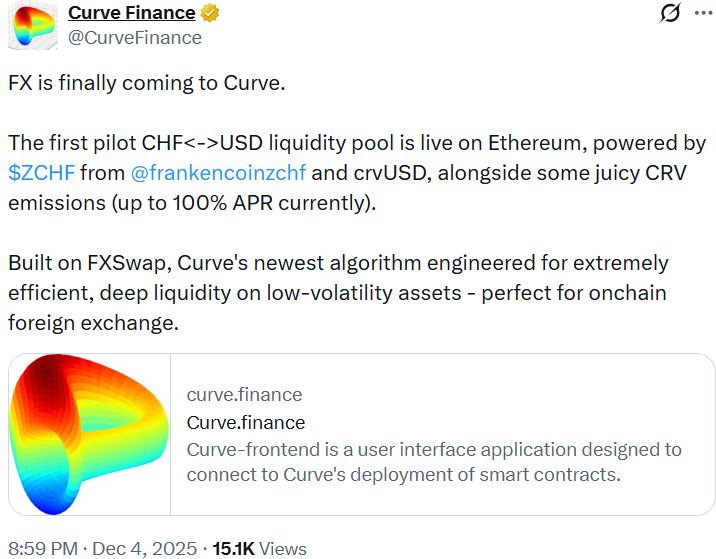 Curve debuts FXSwap via pilot CHF-USD liquidity pool on mainnet, powered by $ZCHF from Frankencoin and crvUSD, alongside some juicy CRV emissions.2025-12
 DeFi audits fail to prevent recent protocol exploits. Despite undergoing multiple audits, two DeFi protocols, Raft Finance and KyperSwap, experienced catastrophic exploits that resulted in the draining of funds. Raft Finance fell victim to an infinite mint bug, while KyperSwap had its liquidity pools drained.2023-11
Understanding Liquidity Pools in Crypto and DeFi
Liquidity pools are on-chain reserves of cryptoassets locked in smart contracts that allow users to swap, lend, or earn yield without relying on traditional order books or centralized market makers. By letting anyone deposit tokens and share in trading fees, liquidity pools have become the core plumbing of decentralized finance (DeFi), powering everything from simple token swaps to complex stablecoin, FX, and pre‑market tokenization platforms.
From Order Books to On‑Chain Liquidity Pools
In traditional finance and early crypto exchanges, trading relied on order books where buyers and sellers posted bids and asks, and professional market makers stood in the middle to provide liquidity. This model works efficiently only when there is a deep bench of active traders and market makers for each asset, which is rarely the case for long‑tail tokens or new markets. Thin order books lead to wide spreads, high slippage for larger orders, and frequent periods of illiquidity, especially during market stress. DeFi emerged in part to solve this coordination problem by automating liquidity provision through code and incentives rather than relying on a small set of intermediaries.
Automated market makers (AMMs) and their liquidity pools replaced the need to match buyers and sellers in real time with a continuously available pool of tokens held in smart contracts. Traders interact directly with these pools, swapping one asset for another based on deterministic pricing formulas rather than negotiating with counterparties. Because anyone can add assets to a pool and earn a share of the fees, the role of “market maker” is opened up to the entire ecosystem. This dramatically lowers the barrier to creating markets in new tokens but also pushes pricing and risk management responsibilities onto protocol designers and liquidity providers.
The notion of liquidity itself has expanded in this context. In DeFi, liquidity refers not only to the ease of buying or selling a token without moving the price too much, but also to the depth and resilience of the smart contracts, bridges, and incentives that keep these pools well funded. When commentators talk about bringing “all of our exchanges into a single, global liquidity pool,” they are invoking a vision where multiple venues and asset types plug into a common on‑chain liquidity backbone, allowing capital to flow seamlessly across markets. That narrative resonates with both crypto‑native builders and traditional institutions exploring tokenization.
Tokenization initiatives by major exchanges underscore this shift. The Brazilian stock exchange B3, for example, has outlined plans for a tokenization platform and a real‑linked stablecoin, with the goal of allowing tokenized assets to trade alongside equities using a shared liquidity pool system. In such designs, a regulated venue handles issuance and compliance, while the underlying trading rails begin to look more like DeFi: pools of tokenized securities and stablecoins, continuously rebalanced by AMMs. After tokenizing shares, participants naturally seek access to the deepest possible liquidity pool, whether that liquidity resides on a centralized order book, an on‑chain AMM, or some hybrid of both.
Stablecoins are a crucial bridge between legacy finance and on‑chain liquidity. PayPal’s PYUSD integration with Spark, for instance, aims to inject up to 1 billion dollars in PYUSD liquidity into DeFi through SparkLend’s roughly 8‑billion dollar reserve pool, allowing users to supply and borrow PYUSD in a regulated‑adjacent environment. Rather than relying purely on incentive farming, Spark’s model uses a large, diversified reserve pool to support liquidity for PYUSD and other stablecoins, signaling one potential path toward sustainable stablecoin adoption anchored in robust liquidity pools. Similar experiments suggest that as more real‑world payment and settlement systems connect to DeFi, the concept of a “liquidity pool” will increasingly span both crypto‑native and traditional assets.
At the macro level, analysts sometimes describe global capital markets themselves as sharing a “single liquidity pool,” where capital allocation between equities, bonds, real estate, and crypto responds to overall risk appetite. Commentary around a mega IPO wave led by companies such as SpaceX has emphasized that heavy issuance in traditional markets can draw liquidity away from risk assets like crypto. In this sense, DeFi liquidity pools sit within a broader hierarchy of liquidity, absorbing flows when conditions are favorable and losing depth when capital is pulled into other opportunities. Understanding the mechanics of on‑chain liquidity is therefore not just a technical curiosity but a key part of reading the broader crypto cycle.

Mega IPO wave led by SpaceX threatens crypto rally as shared liquidity pool faces pressure from record capital demands across AI and tech giants

Stablecoin float crossed $200B and kept growing through every tech IPO of 2024-2025, which kills the 'shared pool' thesis on contact. SpaceX at $400B pulls from Schwab brokerages, not from wallets stacking ETH or farming Hyperliquid points. Microcaps and altcoin rotations are where this hits — BTC ETF flows had zero correlation to NVDA's $4T run, but anything outside the majors competes with whatever Robinhood pushes that week.
What Is a Liquidity Pool?
At its core, a liquidity pool is a collection of crypto tokens locked inside a smart contract that users can trade against or borrow from according to predefined rules. Instead of matching each buyer with a specific seller, the protocol maintains a pool of two or more assets and quotes prices using an algorithmic formula. This structure ensures that, as long as the pool is funded, traders can execute swaps instantly at transparently computed prices. The smart contract enforces the rules for adding and removing liquidity, charging fees, and updating the pool’s balances.
The tokens in a liquidity pool are supplied by users known as liquidity providers, or LPs. LPs deposit assets—often in equal value proportions of two tokens—into the pool and receive in return a special receipt token commonly referred to as an LP token. This LP token represents their proportional share of the pool’s assets and the fees it generates. Whenever traders swap tokens through the pool, they pay a fee that is added to the pool’s reserves; LPs can later redeem their LP tokens for an increased share of the underlying assets, reflecting the accumulated fees. In this way, liquidity pools create a direct link between protocol usage and LP returns.
Several distinct roles coexist around a liquidity pool. Traders use the pool to swap one asset for another at on‑chain prices, paying fees to LPs. LPs commit capital and bear the price risk of the pool’s inventory in exchange for a share of those fees and, in many cases, additional token incentives. Protocols integrate pools into their own products, aggregating liquidity across multiple venues or building structured products on top of LP tokens. The interplay of these roles determines the health and utility of the pool: deep, actively used pools produce tighter spreads and more fees, while shallow or inactive pools may offer poor execution and low returns.
In the most common design, an LP provides two tokens in equal dollar value—for example, 50 percent ETH and 50 percent USDC—to an ETH/USDC pool. The contract mints LP tokens based on the LP’s share of total liquidity; if an LP contributes 10 percent of the pool’s value, they will own 10 percent of the LP tokens and be entitled to 10 percent of the fees. Some protocols also support single‑sided deposits or more complex compositions, but the underlying idea remains that liquidity is pooled collectively, and each LP’s claim is represented by a token that can often be moved and composed with other DeFi applications.
The composability of LP tokens is a defining feature. A Curve factory pool token, such as the USDT–crvUSD LP token, represents a share in a Curve liquidity pool where holders earn fees from users trading in the pool. That LP token can then be deposited into Curve’s gauge contracts to earn CRV governance token rewards on top of swap fees, and further into yield aggregators like Yearn vaults that automatically compound returns. Each layer adds potential yield but also additional smart contract and liquidity risk. The base reality, however, is unchanged: the LP token is a claim on a specific liquidity pool governed by its own rules and risk profile.
Compared with centralized exchanges, liquidity pools are typically non‑custodial. Users retain control over their wallets and can add or remove liquidity at will, subject to the constraints coded into the smart contract. The pool’s reserves and transaction history are transparently visible on‑chain, and anyone can verify the composition of liquidity or audit the contract code where it is open source. This transparency is a major advantage over opaque centralized venues but does not eliminate risk; bugs in smart contracts or governance processes can still lead to loss of funds, and users must rely on audits, reputation, and risk assessments rather than regulatory guarantees.
The table below summarizes the main participants in a typical liquidity pool ecosystem and their roles.
| Participant | Primary action in the pool | Main benefits | Key risks |
|---|---|---|---|
| Trader | Swaps one token for another via the pool | Instant execution, no order book needed | Price impact, slippage, volatile token prices |
| Liquidity provider | Deposits assets into the pool and receives LP tokens | Earns swap fees and incentives, yield on assets | Impermanent loss, smart contract and token risk |
| Protocol / DEX | Deploys and integrates pools into frontends and other products | Trading volume, fee share, ecosystem growth | Exploit risk, reputation damage, regulatory scrutiny |
This triad—traders, LPs, and protocols—forms the foundation of DeFi’s liquidity infrastructure. To see how their interaction sets prices and determines returns, we turn next to the mechanics of automated market makers.
Readers engage with liquidity pools as high-stakes yield positions to monitor, not mechanisms to learn — exploit coverage (audit-certified protocols still drained) and Curve-specific TVL velocity dominate clicks equally, revealing a reader base that is simultaneously tracking which pools are blowing up and which to enter next.
How Automated Market Maker Pools Work
Constant‑Product AMMs: The Uniswap Model
The most famous AMM design is the constant‑product market maker introduced by Uniswap, which underpins countless DEXs and copycats. In a basic two‑asset constant‑product pool, the reserves of tokens \(x\) and \(y\) are maintained such that their product remains constant, often written as \(x \cdot y = k\). When a trader swaps token \(x\) for token \(y\), the pool’s balance of \(x\) increases and balance of \(y\) decreases, and the smart contract adjusts the price so that the product does not change (neglecting fees). Prices are essentially a function of the ratio of reserves, with each trade nudging that ratio and hence the implied price.
Consider an ETH/USDC pool on Ethereum. Suppose the pool starts with 100 ETH and 150,000 USDC, implying a price of 1,500 USDC per ETH. A trader who wants to buy ETH with USDC sends USDC into the pool; the contract calculates how many ETH can be taken out while keeping the product of the reserves roughly constant. Because the trader is pulling ETH out of the pool, the ETH reserve falls and the USDC reserve rises, causing the implied ETH price to increase. The larger the trade relative to the pool’s size, the more the price moves, which we observe as price impact or slippage.
In this model, there is always a price at which a trade can occur, even if the pool is heavily skewed toward one asset. Arbitrageurs keep AMM prices aligned with external markets by trading against the pool whenever its price deviates, thereby earning profits while restoring equilibrium. This design eliminates the need for active centralized market makers and allows any pool with sufficient reserves to quote continuous prices. However, it also means that LPs effectively provide liquidity across a wide range of prices, exposing them to inventory risk as the market moves.
Constant‑product pools are ubiquitous not just on Uniswap but also on clones like PancakeSwap on BNB Chain. PancakeSwap Infinity, an enhanced version of the protocol, for example, encourages users to “launch your own liquidity pool with stablecoins or tightly pegged assets,” leveraging similar AMM mechanics while adding advanced routing and interfaces. The simplicity of the constant‑product formula makes it easy to reason about and implement, but it is not optimal for every asset pair, particularly when assets are meant to trade at a stable relative value.
The main limitations of constant‑product AMMs relate to capital efficiency and price stability. For assets that should trade very close to a fixed ratio, such as USDC and USDT, constant‑product pricing can cause unnecessary slippage because the curve remains relatively shallow even near the mid‑price. LPs also earn fees on liquidity deployed at far‑out price ranges that might never be used. These inefficiencies motivated new designs like stable‑swap and concentrated liquidity, which reshape how capital is distributed along the price curve.
Stable‑Swap and Curve‑Style Liquidity Pools
Curve Finance pioneered the stable‑swap invariant, which modifies the constant‑product formula to be much flatter around a target exchange rate, typically 1:1 for stablecoins. In a stable‑swap pool, the pricing function is designed so that small deviations from the peg—say, USDC trading at 0.999 versus USDT at 1.001—result in very low slippage, while bigger imbalances progressively steepen the curve. This yields tighter spreads and higher capital efficiency for correlated assets, making Curve pools the preferred venues for large stablecoin trades.
For example, a pool composed of USDT, USDC, and another stablecoin like MIM on Curve provides a base layer of liquidity for stablecoin swaps across the ecosystem. When unexpected liquidity withdrawals occur—such as a large LP pulling funds due to changing incentive strategies—these pools can become imbalanced, with one stablecoin trading at a discount relative to others. In response, teams may fund new Curve pools, seeding them with assets like MIM, USDT, and USDC to restore balance and ensure traders can move between stablecoins without excessive slippage. The health of these pools often directly impacts the perceived stability and usability of the stablecoins themselves.
Curve has also extended its model beyond stables into so‑called cryptoswap pools, where assets are not necessarily pegged to the same value. A ZCHF/CRVUSD pool on Curve, for instance, is described as a cryptoswap pool that contains non‑pegged assets, meaning liquidity providers are exposed to both the Swiss‑franc‑linked ZCHF and the dollar‑pegged crvUSD. While both tokens aim to track fiat values, they are subject to different collateral mechanisms and market dynamics, so the pool must balance the trade‑off between low slippage near the prevailing FX rate and sensitivity to larger market moves.
Curve’s FXSwap pilot on Ethereum takes this idea further by offering a CHF‑USD liquidity pool powered by ZCHF from Frankencoin and crvUSD, augmented with CRV emissions to attract LPs. Here, the AMM is effectively operating as an on‑chain foreign exchange desk, allowing users to move between CHF and USD exposures via tokenized representations. If such pools scale, they could provide an alternative to traditional FX venues, with transparent on‑chain liquidity and programmable incentives that reward active LP participation.
These innovations illustrate how liquidity pool design can be tailored to the characteristics of the underlying assets. Constant‑product pools work well for uncorrelated or highly volatile pairs, while stable‑swap and FX‑oriented pools shine when relative prices are expected to remain near a predictable band. For LPs, understanding which invariant governs a pool is crucial, because it affects the distribution of risk and potential impermanent loss.
Concentrated Liquidity and Capital Efficiency
Uniswap v3 introduced concentrated liquidity, a paradigm where LPs can specify the exact price ranges within which their capital is deployed. Instead of providing liquidity across the entire price spectrum from zero to infinity, as in earlier AMM versions, LPs allocate capital to chosen intervals—for example, between 1,500 and 2,000 USDC per ETH. Within that band, their liquidity is highly active, earning a larger share of fees per unit of capital; outside it, their position becomes effectively one‑sided, holding only one of the tokens.
This approach dramatically improves capital efficiency. A pool with concentrated liquidity can provide the same depth around the current price with far less total value locked (TVL) compared to a uniform liquidity distribution. This is particularly attractive for blue‑chip pairs like ETH/USDC, where prices tend to stay within certain ranges for extended periods. However, it also demands more active management from LPs, who must adjust their ranges as prices move to avoid being left out of the fee‑earning region or being stuck holding a single asset at the extremes.
Other protocols have begun adopting similar mechanics. Cross DeFi, for example, has launched an upgraded CROSS‑CROSSD liquidity pool that allows LPs to set custom price ranges akin to Uniswap v3, aiming to maximize capital efficiency and representing positions as dynamic NFTs. This mirrors Uniswap v3’s design where each LP position is a non‑fungible token encoding the owner’s chosen price range and liquidity amount. Such designs blur the line between traditional LP tokens and NFTs, adding new possibilities for position management, collateralization, and secondary trading of liquidity positions.
On Solana, Raydium has implemented concentrated liquidity market makers (CLMMs) alongside older AMM versions. When Raydium suffered an exploit on June 10, attackers targeted legacy AMM v3 pools that had not been used since 2021, exploiting a counterfeit LP token mint that bypassed old validation checks. Raydium’s concentrated liquidity pools and newer AMM versions remained unaffected, highlighting both the constant evolution of AMM architectures and the importance of retiring or securing deprecated contracts. Nonetheless, concentrated liquidity pools themselves carry significant complexity and are not inherently safer; their risk lies more in implementation details and LP strategy than in the basic concept.
Taken together, concentrated liquidity represents a shift from passive, all‑range LPing toward more active and professionalized strategies. While this can offer higher returns to sophisticated LPs, it also raises the bar for understanding and managing liquidity positions, especially when combined with volatile assets and leveraged yield strategies.
Specialized Pools: Lending, Pre‑Market Trading, and IL‑Free Designs
Liquidity pools are not limited to spot trading. Lending protocols like Spark use large reserve pools of stablecoins to facilitate borrowing and lending, with interest rates determined algorithmically based on utilization. In Spark’s integration with PayPal’s PYUSD, an approximately 8‑billion dollar stablecoin reserve pool supports the supply and borrowing of PYUSD, enabling users to earn yield or access credit while providing a deep base of liquidity for the stablecoin. Here the AMM concept is adapted to credit markets: instead of swapping tokens against a pricing curve, users interact with a pool that adjusts interest rates as utilization changes.
Pre‑market trading is another emerging use case. Everything.inc, for instance, has launched a unified pre‑market DeFi liquidity pool on Arbitrum for an EV/USDT pair, aiming to allow equal access to early price discovery before a token’s full launch. Rather than relying on private placements or off‑chain over‑the‑counter deals, the protocol uses an AMM pool to let participants buy and sell claims to future tokens, with the pool’s pricing dynamically reflecting demand. This approach could democratize access to pre‑IPO‑like opportunities but also concentrates risk in the design of the token redemption and disclosure mechanisms.
More experimental still are “impermanent loss‑free” pool designs. Yield Basis has announced plans for WETH–crvUSD “liquidity backbone” pools on Curve that are intended to be free from impermanent loss for long‑term ETH LPs. While technical details vary, such designs typically rely on hedging structures, options, or synthetic positions to offset the IL that would otherwise arise from price changes between ETH and the stablecoin. LPs may earn high fees from concentrated liquidity and boosted incentives while the protocol manages hedging in the background. These structures can be attractive, but they shift risk into more complex layers of derivatives and smart contracts that must be carefully evaluated.
Recovery pools represent yet another specialization. After a 2.6‑million dollar exploit, the Sui‑based Nemo Protocol issued NEOM debt tokens that victims can redeem via liquidity pools or hold for eventual recovery. In such setups, pools serve as markets for claims on future recoveries, allowing affected users to exit at a discount while speculators provide liquidity in anticipation of better recovery outcomes. This illustrates the flexibility of liquidity pools as general‑purpose mechanisms for price discovery and risk sharing, even outside traditional trading scenarios.
Despite this diversity, all these specialized pools share a common structure: aggregated capital, algorithmic rules for interaction, and tokenized claims for participants. Understanding the basic AMM mechanics therefore remains essential, even as new use cases proliferate.
Liquidity Provision, Incentives, and Returns
Becoming a Liquidity Provider
Providing liquidity begins with choosing a pool and depositing tokens into its smart contract. In a standard two‑asset AMM, the LP contributes equal dollar values of each token—say, ETH and USDC—to an ETH/USDC pool. The protocol mints LP tokens representing the LP’s proportional share of the pool’s reserves; if the pool holds 1,000 ETH and 1.5 million USDC and an LP deposits 100 ETH and 150,000 USDC, they will own roughly 10 percent of the pool. These LP tokens function as receipts and can be used later to withdraw the LP’s underlying assets plus accumulated fees.
In practice, this process is abstracted away behind DEX user interfaces, which calculate required token amounts and handle any necessary intermediate swaps. Once deposited, the LP’s assets are controlled by the smart contract, not by the DEX frontend or any centralized custodian. As long as the contract operates as intended, LPs can remove their liquidity at any time, though doing so when prices have moved significantly may result in impermanent loss relative to holding the tokens outside the pool.
Becoming an LP is conceptually appealing because it turns idle assets into fee‑earning positions. Each trade that passes through the pool pays a fee—commonly a fraction of a percent—that is added to the pool’s reserves. Over time, as trading volume accumulates, these fees can grow significantly, especially in heavily used pools. This fee income is the fundamental source of yield for LPs, distinct from speculative gains in the price of the tokens themselves. However, LPs must also consider the opportunity cost and risks of locking assets into a pool instead of holding or staking them elsewhere.
DeFi composability introduces additional layers. LP tokens can often be staked in separate reward contracts or deposited into yield aggregators. For example, a USDT–crvUSD LP token from a Curve factory pool entitles its holder to swap fees from that pool; the token can then be deposited into Curve’s gauge contracts to earn CRV rewards, and further into Yearn vaults that automatically harvest and reinvest those rewards for compounding. While this can boost yields, it also chains together multiple smart contracts, each with its own potential attack surface, and can complicate risk assessment.
For new LPs, the key is to understand that providing liquidity is an investment decision involving both expected fee income and exposure to price movements of the underlying tokens. The apparent simplicity of depositing into a pool masks a complex risk‑return profile that depends on pool design, asset volatility, fee levels, and the broader market environment.
Fees, Liquidity Mining, and Liquidity Incentives
Fees are the primary economic incentive for LPs. In most AMMs, each trade pays a fixed percentage fee—often 0.05 to 0.3 percent of the trade value—that is added to the pool’s reserves and distributed pro rata to LPs. High‑volume pools can therefore generate attractive returns even at modest fee rates, while low‑volume pools may offer low effective yields despite headline APRs that include temporary incentives.
Liquidity mining adds a second layer of incentives by distributing governance tokens or other rewards to LPs over time. Protocols use liquidity mining to bootstrap TVL, encourage trading in new markets, and decentralize token ownership. These rewards can dramatically increase reported APRs, but they are often time‑limited and denominated in volatile tokens whose value may decline. Chasing such yields requires careful assessment of token economics and vesting schedules as well as the underlying pool’s usage.
Concrete examples illustrate the range of incentive structures. The Dash liquidity pool on Maya Protocol has recently advertised an APR around 21 percent, with Dash holders earning a substantial share of the DEX’s swap revenue. When users swap through this DEX, a portion of fees flows to Dash LPs, creating a revenue‑sharing model where token holders benefit actively from on‑chain liquidity. While such returns can be attractive, they depend on sustained trading volume, stable protocol operation, and market demand for the underlying assets.
Curve’s incentive system adds further nuance. Many Curve pools, such as those involving stablecoins or crvUSD pairs, distribute CRV emissions to LPs in addition to swap fees, and external protocols sometimes add their own token rewards on top. The FXSwap pilot CHF‑USD pool, powered by ZCHF and crvUSD, offers not only low slippage FX trading but also CRV incentives to seed liquidity. Teams behind particular assets—such as MIM stablecoin or new WETH–crvUSD “liquidity backbone” pools promoted by Yield Basis—often lobby Curve governance for gauge allocations that direct emissions toward their pools, effectively subsidizing LPs with governance tokens. This creates a secondary market for “bribes” and voting power in ve‑style governance systems.
Meanwhile, Spark’s integration with PYUSD signals a different philosophy. By leveraging an 8‑billion dollar reserve pool of stablecoins and focusing on lending‑style interest rather than short‑term incentive programs, Spark and PayPal are positioning PYUSD liquidity as a long‑term infrastructure play rather than a yield‑farming opportunity. This highlights an emerging divide between protocols relying heavily on emissions to attract mercenary capital and those aiming for sustainable, usage‑driven liquidity models.
For LPs, these varying incentive structures can make headline APRs misleading. A high APR driven mostly by token emissions that are set to expire may collapse once incentives dry up, especially if the underlying pool sees little organic volume. Evaluating the balance between fee income and incentives is therefore essential for understanding the durability of LP returns.
Liquidity Pool Analytics and Performance Evaluation
Given the complexity of LP returns, analytics is increasingly central to liquidity provision. Liquidity pool analytics refers to the data and tools used to evaluate how a pool is performing, including metrics such as APR, TVL, trading volume, fee revenue, reward breakdown, and active liquidity ranges. Rather than focusing solely on raw APR, sophisticated LPs examine how much of that return comes from sustainable swap fees versus temporary rewards, how volatile the pool’s assets are, and how their position is performing relative to a simple buy‑and‑hold strategy.
Platforms like KyberEarn 2.0, for example, allow LPs to review metrics such as TVL, volume, fees, and position performance in a single interface. Similarly, Uniswap Analytics and third‑party dashboards such as DeFiLlama provide granular views into pool utilization, historical volume, and per‑LP returns. By comparing these metrics across pools, LPs can identify opportunities where fee income sufficiently compensates for risk and avoid pools where returns are largely illusory.
Key metrics play distinct roles. TVL indicates the depth of the pool and potential slippage for traders; extremely low TVL may mean high price impact and vulnerability to manipulation, while extremely high TVL in a low‑volume pool may dilute fees and reduce per‑LP returns. Volume, especially relative to TVL, gives a sense of how actively a pool is used; higher volume‑to‑TVL ratios tend to correlate with better fee yields. APR, broken down into base fees and reward emissions, helps LPs understand the sources of their yield. In concentrated liquidity pools, additional metrics like “active liquidity” and “position range” are critical, because only capital within the current price range earns fees.
Advanced analytics also incorporate impermanent loss modeling. Some dashboards estimate the IL experienced by LPs over time by comparing their pool position’s value against a hypothetical hold‑only baseline. Others integrate IL calculators that simulate potential outcomes across price scenarios, combining projected fee income with projected IL to assess whether a position is mathematically defensible. This aligns with guidance from educational resources, which emphasize modeling worst‑case IL scenarios and ensuring fee income and incentives provide sufficient compensation.
In short, liquidity pool analytics transforms LPing from a blind yield chase into a data‑driven strategy. For news audiences and practitioners alike, familiarity with these metrics is increasingly important for interpreting DeFi narratives and evaluating claims about “high APR” opportunities.
Impermanent Loss: Core Risk for LPs
Impermanent loss is one of the defining risks of providing liquidity to AMMs and a concept that every prospective LP must understand. Impermanent loss occurs when the price ratio between the assets in a pool changes compared to when the LP deposited them, and the automated rebalancing of the pool leads the LP to end up with a different mix of assets than they started with. When the LP later withdraws, the total value of their assets may be lower than if they had simply held the original tokens in their wallet, even after accounting for accrued fees.
To see why, consider again an ETH/USDC pool. An LP deposits 1 ETH at 1,500 USDC and 1,500 USDC, for a total of 3,000 dollars. Suppose the ETH price doubles to 3,000 USDC while the LP remains in the pool. Arbitrageurs will buy the underpriced ETH from the pool and sell it into the broader market until the pool’s price matches the new market price. As a result, the pool ends up with more USDC and less ETH than before. When the LP withdraws, they receive fewer than 1 ETH and more than 1,500 USDC, but the combined value is less than the 6,000 dollars they would have had by simply holding 1 ETH and 1,500 USDC outside the pool. The difference is the impermanent loss.
The loss is called “impermanent” because if prices were to revert to their original levels before the LP withdraws, the pool’s composition would re‑balance and the IL would shrink or disappear. In practice, however, market movements are often one‑way over relevant timeframes, and LPs eventually withdraw at new price ratios, realizing the loss. Impermanent loss is therefore better understood as a path‑dependent cost of providing inventory to an AMM that rebalances against market moves.
The magnitude of IL depends on the size of the price move and the AMM’s invariant. For a constant‑product AMM, the IL increases convexly with price divergence: small deviations cause minor loss, while large moves can erode a significant portion of the LP’s capital relative to holding. Stable‑swap pools tend to exhibit lower IL for small deviations around a peg but may still incur substantial IL if a stablecoin loses its peg. Concentrated liquidity adds further complexity: LPs may avoid some IL by setting tight ranges and actively managing positions, but they also risk ending up entirely in one asset if prices move beyond their range.
Importantly, impermanent loss is not necessarily fatal. LPs earn fees on every trade, and in high‑volume pools those fees can more than offset IL over time. The core question is whether expected fee income and incentives are sufficient compensation for the IL risk under plausible price scenarios. Educational resources often recommend using IL calculators to model scenarios such as one token doubling, tripling, or halving, then comparing estimated IL to expected fee earnings for a given holding period. If the fee income comfortably exceeds the worst plausible IL, the position may be worthwhile; if not, LPs may prefer to hold or pursue other strategies.
Efforts to mitigate or eliminate IL, such as Yield Basis’s proposed IL‑free WETH–crvUSD pools, generally rely on hedging IL through derivatives or structuring pools in ways that shift risk to other stakeholders. While promising, these designs require even deeper analysis, as they often embed counterparty, oracle, or complexity risk in place of straightforward IL. For now, impermanent loss remains a central trade‑off in most AMM‑based liquidity provision.
Phoenix says atomic composability will let traders use spot assets, tokenized RWAs and shared collateral across spot and perps from a single on-chain liquidity pool
Risks: Exploits, Rug Pulls, and Ponzi Schemes
Smart Contract Exploits Draining Liquidity Pools
Because liquidity pools hold large amounts of capital in publicly accessible contracts, they are prime targets for attackers. Many of the most prominent DeFi hacks have involved draining liquidity pools via smart contract vulnerabilities, governance flaws, or interactions with buggy token and bridge contracts.
Raydium’s June 10 exploit on Solana illustrates a classic smart contract vulnerability in legacy code. Attackers exploited five inactive AMM v3 pools that had not been used since 2021 by creating a counterfeit LP token mint that bypassed validation checks in outdated code. The pools failed to properly authenticate the LP token’s mint address, allowing the attacker to forge LP tokens, present them as genuine, and circumvent the proportionality checks normally required for withdrawals. By doing so, they withdrew significantly more assets than they had deposited, draining around 1.34 million dollars in Sollet USDT‑RAY, Sollet ETH‑RAY, SRM‑RAY, USDC‑RAY, and RAY‑SOL pools. Crucially, Raydium’s concentrated liquidity pools and newer AMM versions were not affected, highlighting the risks of leaving deprecated contracts with real assets in them.
On BNB Chain, the Mobius Token exploit provides another instructive case. According to a post‑mortem by Hacken, a proxy contract misconfiguration allowed the attacker to upgrade or manipulate the token’s logic in a way that drastically inflated the token supply. The attacker then swapped these inflated Mobius tokens into BUSD through a PancakeSwap pool, draining its liquidity. Here, the vulnerability lay in the token’s proxy architecture rather than the AMM itself, but the end result was similar: the liquidity pool functioned as the exit route for illicitly minted tokens.
Bridge exploits pose a related risk. THORChain recently highlighted a case where a third‑party Polkadot bridge, Hyperbridge, was exploited, allowing an attacker to mint one billion fake DOT tokens on Ethereum. The attacker then dumped these tokens into liquidity pools, removing over 240,000 dollars in ETH across multiple transactions. Again, the bridge failure upstream led to the poisoning of liquidity pools, which became vehicles for laundering the exploit and draining valuable assets. This underscores that LPs are exposed not only to the security of the AMM contract but also to the integrity of token contracts, bridges, and other protocols with which the pool interacts.
In each of these incidents, liquidity pool users bore direct losses, even when they had no role in the exploited code. Responses varied: Raydium pledged to compensate users who still had funds in the deprecated pools, using its treasury rather than passing losses to active users. Other projects have issued “debt tokens” redeemable against future recoveries, as Nemo Protocol did with NEOM on Sui. These episodes demonstrate both the systemic importance of liquidity pools and the need for thorough code audits, deprecation policies, and defense‑in‑depth strategies.
Economic Attacks and Toxic Liquidity
Not all threats to liquidity pools stem from code bugs. Economic attacks exploit the rules of the system, often combining thin liquidity, privileged token minting, and market psychology to siphon value from unsuspecting participants. One common pattern involves launching a new token with asymmetric or deceptive liquidity settings.
The launch of Kanye West’s YEEZY (or YZY) token offers a widely discussed example. Reports indicate that only YEEZY was added to the initial liquidity pool, with no USDC or other stablecoin counterpart, and that the developer retained the ability to add or remove liquidity at will. This setup allowed insiders to manipulate the pool’s effective price and liquidity, with some wallets reportedly netting around 1.5 million dollars amid trader enthusiasm. The arrangement resembled past rug pulls such as the LIBRA token case, where insiders dominated liquidity and ultimately withdrew it, leaving late buyers with illiquid holdings.
Similar dynamics have occurred with gaming and meme tokens on BNB Chain and other networks. The PLAY token exploit, for instance, drained its liquidity pool on BSC, putting a portion of the token’s supply at risk. In many such cases, a combination of admin privileges over the token contract, the ability to pause or alter trading, and concentrated control over LP tokens enables developers or attackers to effectively “pull the plug” on the pool. Even when no explicit exploit occurs, aggressive insider selling into shallow liquidity can crash prices and trap retail traders.
These economic attacks underline the importance of examining not just the AMM contract but also the token’s minting controls, ownership, and liquidity distribution. A pool seeded only with the project’s own token, or one where the team holds the majority of LP tokens, should raise red flags. Healthy pools typically feature meaningful contributions of neutral assets like USDC and a decentralized distribution of LP ownership, with mechanisms such as liquidity locking or burned LP tokens limiting the team’s ability to rug.
Ponzi Schemes Disguised as “Liquidity Pools”
Beyond on‑chain exploits and economic games, some outright Ponzi schemes have appropriated the language of “liquidity pools” to market fraudulent investments. These schemes often advertise fixed high returns from “AI‑driven liquidity pool trading” or similar buzzwords, but in reality funds are not deployed into verifiable on‑chain pools and instead are used to pay earlier investors or diverted for personal use.
The U.S. Department of Justice’s case against Goliath Ventures, involving defendant Christopher Alexander Delgado, illustrates how such schemes can be framed. Prosecutors allege that Delgado’s Ponzi scheme involved soliciting victims for crypto‑related investments and misusing the proceeds, leading to charges of wire fraud and money laundering. While the case materials focus on the specific facts rather than generic DeFi terminology, contemporary lawsuits in Florida and elsewhere reference “crypto liquidity pool Ponzi schemes,” where promoters promised high, low‑risk returns from purported pools that either did not exist or were controlled entirely off‑chain.
These schemes exploit the opacity of technical concepts for non‑expert investors. Unlike legitimate DeFi pools, where anyone can inspect the smart contract, verify reserves, and track on‑chain activity, Ponzi operators often provide only dashboards or spreadsheets with fabricated performance numbers. There may be no actual LP tokens, no verifiable AMM contracts, and no link to reputable DEXs. Instead, funds are commingled in centralized wallets controlled by the promoters.
Distinguishing genuine DeFi liquidity pools from Ponzi schemes requires insisting on verifiable on‑chain evidence. Investors should be able to see the pool contract on a blockchain explorer, confirm that deposits and withdrawals match claims, and track the flow of LP tokens. A lack of such transparency, combined with promises of guaranteed, unusually high returns with no mention of impermanent loss or market risk, is a classic red flag.
Regulatory and Legal Dimensions of Liquidity Pools
As liquidity pools increasingly handle assets that blur the line between crypto and traditional finance, regulatory scrutiny is intensifying. Tokenization initiatives like B3’s, which aim to let tokenized assets trade alongside equities using a liquidity pool system and a real‑linked stablecoin, must navigate securities laws, exchange regulations, and potentially new rules governing on‑chain market infrastructure. Questions arise over whether LP tokens in such pools might be treated as securities, how investor protections apply to LPs, and what disclosure obligations exist for protocols facilitating these markets.
Stablecoin‑focused initiatives like PayPal’s PYUSD integration with Spark also sit at the intersection of DeFi and regulation. While Spark’s reserve pools operate on decentralized rails, PYUSD itself is issued by a regulated entity, and its integration into lending and liquidity protocols raises questions about prudential oversight, reserve management, and consumer protection. Regulators may scrutinize whether platforms adequately disclose smart contract and counterparty risks to users who supply PYUSD liquidity.
At the enforcement end, cases such as Goliath Ventures and other alleged “liquidity pool” Ponzi schemes illustrate how regulators treat fraudulent use of DeFi terminology as part of broader investment fraud and money‑laundering investigations. As more retail investors interact with on‑chain pools, authorities are likely to increase their focus on misrepresentations in marketing materials, failure to disclose key risks like impermanent loss, and inadequate security practices that expose users to hacks.
Jurisdictions may also differ in their approach to DeFi governance tokens and fee‑sharing arrangements. Protocols that distribute revenue shares or governance tokens to LPs—such as Dash pools on Maya or CRV emissions on Curve—could face varying interpretations regarding whether these constitute dividend‑like payments or securities offerings. For now, most leading protocols have taken a cautious approach, but the legal landscape remains fluid.
Against this backdrop, participants in liquidity pools must consider not only technical and economic risks but also evolving regulatory frameworks. For news audiences, understanding these dimensions is crucial for interpreting enforcement actions, policy debates, and institutional adoption announcements.
- 01audit-certified pools still drained↗
The top headline (172 clicks) showed that multiple audits did not prevent KyberSwap and Raft Finance exploits, exposing the gap between audit assurance and actual security.
- 02Curve Finance pool dynamics↗
At least seven top-clicked stories centered on Curve-specific events — deUSD TVL records, OP incentive distributions, crvUSD pools, Vyper exploit fallout, and cross-chain expansion — making Curve the dominant reference protocol for engaged LP readers.
- 03LP incentive and yield races↗
Multiple headlines around gauge emissions, CRV rewards, Yield Basis IL-free pools, and Reserve Protocol yield distribution show readers actively tracking where incentivized yield is flowing next.
- 04overflow and math exploits↗
The Cetus AMM $200M drain via an overflow bug in liquidity calculation (92 clicks) illustrated that LP math vulnerabilities can be weaponized with minimal capital, pulling readers seeking to understand systemic exposure.
- 05rug pulls and insider LP setups
The BeraSwap rug warning and Kanye $YZY suspicious pool setup attracted readers pattern-matching new launches against known rug mechanics like $LIBRA.
- 06institutional and TradFi pool entry
B3 tokenization with a shared liquidity pool, PayPal PYUSD on Curve and Spark, and the IPO capital-drain angle drew readers watching legacy finance absorb or compete with DeFi liquidity infrastructure.
Liquidity Pools Beyond DeFi Natives
Tokenization, Capital Markets, and Shared Liquidity
Liquidity pools are increasingly seen as the foundational infrastructure for tokenized capital markets. When exchanges and fintechs speak about “after tokenizing the stocks, they will want to access the largest liquidity pool in the world,” they are envisioning a future where equity, debt, and other real‑world assets trade side by side with cryptoassets in shared on‑chain pools. This vision hinges on the ability of AMM‑like mechanisms to provide continuous liquidity for tokenized representations of traditionally illiquid or fragmented assets.
The Brazilian exchange B3’s plans are instructive. B3 aims to launch a tokenization platform and a stablecoin linked to the Brazilian real, enabling tokenized assets to trade on the exchange using a liquidity pool system. According to B3’s vice president of products and clients, both the tokenization platform and the stablecoin payments system are expected to share the same liquidity pool, integrating tokenized asset trading with payment rails. In effect, this imports DeFi’s pool model into a regulated exchange environment, with the potential to gradually blur boundaries between traditional and decentralized liquidity.
Pre‑market trading pools, like Everything.inc’s unified DeFi pre‑market pool on Arbitrum, push the concept further by creating on‑chain venues for trading exposure to future listings. Rather than waiting for centralized exchanges to open trading, participants can buy and sell pre‑launch tokens in AMM pools, with prices reflecting market appetite and expectations. While this democratizes access relative to traditional pre‑IPO allocations, it also amplifies the importance of robust disclosures and legal clarity around what rights these tokens confer.
Macro commentary about a “shared global liquidity pool” is not just rhetorical flourish. Capital is finite at any given time, and large funding waves—such as a mega IPO cycle dominated by AI and space‑related firms—can pull liquidity away from riskier segments, including DeFi pools. When crypto markets are underperforming relative to high‑profile equity offerings, LPs may withdraw capital from pools to chase other opportunities, reducing DeFi liquidity and increasing slippage for remaining traders. Understanding this macro competition for capital helps frame why DeFi TVL rises and falls in relation to broader market cycles.
Stablecoins, USDC, and FX‑Oriented Pools
Stablecoins play a central role in almost all these tokenization and liquidity narratives. Assets like USDC, USDT, crvUSD, PYUSD, and various fiat‑linked tokens form the base pairs for countless pools, allowing users to move between volatile assets and stable value within DeFi. For many traders, the relevant decision is not simply whether to hold ETH or BTC, but whether to provide ETH/stablecoin liquidity, park capital in a stablecoin pool, or exit to off‑chain fiat.
Multi‑stablecoin pools such as those on Curve provide essential arbitrage and peg‑stabilizing functions. When a stablecoin like MIM experiences large withdrawals or depegging concerns, liquidity in its key pools—often composed of MIM, USDT, and USDC—can become imbalanced, leading to steep discounts or premiums. Funding new Curve pools with fresh MIM, USDT, and USDC can help re‑anchor prices by deepening liquidity and providing arbitrageurs with room to trade. These dynamics illustrate how stablecoin issuers and DeFi protocols use liquidity pools as tools of monetary policy in miniature.
FX‑oriented pools, such as Curve’s ZCHF/CRVUSD cryptoswap pool and the CHF‑USD FXSwap pilot, extend the stablecoin concept across currencies. In these pools, LPs simultaneously take on FX and IL exposure; if CHF or USD‑linked tokens deviate from their intended pegs, or if underlying interest rate differentials cause persistent price movements, LPs can experience gains or losses beyond simple fee income. For traders, such pools provide a way to move between tokenized currency exposures without relying on banks or centralized FX brokers.
USDC remains one of the most widely used stablecoins in liquidity pools, serving as the canonical dollar reference on many chains. Its integration into CEXs, payment apps, and on‑chain protocols makes USDC/ETH and USDC/blue‑chip pools some of the deepest and most systemically important in DeFi. Other stablecoins like crvUSD aim to reduce dependence on external issuers and build endogenous liquidity within specific ecosystems, as seen in Curve’s growing suite of crvUSD pairs. The interplay between external and protocol‑native stablecoins will shape the architecture of future liquidity pools and their systemic risk profiles.
Cross‑Chain Liquidity and Recovery Mechanisms
As DeFi expands across multiple chains, liquidity is increasingly fragmented, and cross‑chain protocols aspire to stitch it back together. Projects like THORChain, for example, build cross‑chain liquidity layers that allow users to swap assets across blockchains using multichain liquidity pools. While powerful, this design adds complex attack surfaces: bridge contracts, chain‑specific risks, and cross‑chain messaging all become potential points of failure.
The Polkadot bridge exploit highlighted by THORChain, where Hyperbridge was compromised and one billion fake DOT were minted on Ethereum and sold into liquidity pools, exemplifies these challenges. Cross‑chain pools that accept wrapped or bridged assets must trust the security of upstream bridges, meaning LPs are indirectly exposed to the weakest link in a chain of contracts. When a bridge fails, pools can be flooded with worthless synthetic tokens that are eagerly sold for real assets, draining the pool’s value.
Recovery mechanisms like Nemo Protocol’s NEOM debt tokens show how liquidity pools can also aid in post‑exploit resolution. After a 2.6‑million dollar exploit, Nemo issued debt tokens granting victims claims on future recoveries and external loans, and created redemption pools where NEOM could be traded. These pools provided price discovery for claims and exit liquidity for users unwilling or unable to wait for full recovery. However, they also introduced speculative dynamics, as traders could buy distressed claims at a discount, hoping to profit from successful recovery efforts.
Such patterns suggest that liquidity pools are becoming general‑purpose mechanisms for managing not just trading but also risk redistribution after shocks. As cross‑chain complexity grows, both the opportunities and vulnerabilities associated with these pools are likely to increase.
Case Studies: Curve, Ethereum, and crvUSD
Curve as a Stablecoin and Crypto Liquidity Hub
Curve Finance has become synonymous with stablecoin and correlated‑asset liquidity in DeFi. Its focus on specialized invariants for low‑slippage trading of assets with similar prices, combined with deep liquidity and a robust incentive system, makes it a central hub for stablecoin swaps. On Ethereum and other chains, Curve hosts numerous pools that pair various stablecoins, liquid staking tokens, and synthetic assets, facilitating efficient arbitrage and capital flows across protocols.
Classic pools like the tri‑stablecoin “3pool” and its successors in other ecosystems have historically concentrated a significant portion of stablecoin liquidity, making them systemically important. When these pools become imbalanced—for example, during periods of stress for a particular stablecoin—ripple effects can spread throughout DeFi, affecting lending protocols, DEX pricing, and collateral valuations. The MIM liquidity imbalance episode, in which major deposits and withdrawals from Curve pools caused MIM to deviate from its peg, underscores this interconnectedness.
Beyond stables, Curve’s cryptoswap pools like ZCHF/CRVUSD and specialized FX pools like the CHF‑USD FXSwap pilot illustrate its evolution into a broader FX and interest‑rate platform. LPs in these pools must understand not only AMM mechanics but also the underlying monetary policies and risk frameworks of the represented currencies. CRV governance and gauge allocations incentivize liquidity in particular pools, aligning the protocol’s incentives with those of asset issuers and other DeFi projects.
Curve’s architecture is deeply composable. Protocols like Yearn integrate Curve LP tokens into vaults that optimize yield by automatically claiming and compounding CRV rewards. Lending platforms accept Curve LP tokens as collateral, and other protocols create structured products on top of them. This composability amplifies both the economic importance of Curve pools and the potential contagion risk if a major pool were to fail or be exploited.
crvUSD: A Native Stablecoin in Liquidity Architectures
crvUSD, Curve’s native over‑collateralized dollar stablecoin, is increasingly woven into the protocol’s liquidity architecture. Pools such as USDT–crvUSD and ZCHF–crvUSD pair crvUSD with widely used stablecoins or FX‑linked tokens, creating pathways for users to move into and out of crvUSD while earning fees. The USDT–crvUSD pool, for example, may be wrapped as an LP token that yields swap fees and CRV emissions, and then further deposited into Yearn or other yield strategies.
By promoting crvUSD as one leg of major liquidity pools, Curve seeks to bootstrap demand for its own stablecoin and internalize more of the stablecoin seigniorage and liquidity flows that previously accrued primarily to external issuers like USDC or USDT. This strategy also diversifies DeFi’s stablecoin base, potentially reducing systemic reliance on any single external issuer. However, it introduces new dependencies on crvUSD’s collateralization, peg mechanisms, and governance decisions.
Yield Basis’s proposed WETH–crvUSD “liquidity backbone” pools represent a further step in this direction. By pitching IL‑free pools with high fees and concentrated liquidity, targeting long‑term ETH LPs who want leveraged yield without traditional IL, Yield Basis aims to create core liquidity channels for WETH using crvUSD as the counter‑asset. These pools are expected to be governed by the YB DAO and integrated into Curve’s gauge system, allowing emissions voting to steer incentives. The degree to which such designs can truly eliminate IL without simply shifting risk elsewhere remains an open question, but their adoption would further embed crvUSD within DeFi’s liquidity infrastructure.
Ethereum as the Settlement Layer for Liquidity Pools
Ethereum remains the primary settlement layer for DeFi liquidity pools, hosting key protocols like Uniswap, Curve, Kyber, and many lending and derivatives platforms. Its robust security, large developer ecosystem, and deep pool of assets—especially blue‑chip tokens and major stablecoins—make Ethereum the natural home for systemically important liquidity pools. Many of the examples discussed, from Curve’s stablecoin and FX pools to Spark’s PYUSD reserve and Everything.inc’s pre‑market pool on Arbitrum, either live on Ethereum mainnet or rely on Ethereum‑derived environments.
At the same time, Ethereum’s blockspace constraints and historically high gas fees have pushed some liquidity to alternative L1s like Solana and BNB Chain, as well as to Ethereum layer‑two networks such as Arbitrum and Optimism. Raydium on Solana and PancakeSwap on BNB Chain, both of which have experienced notable exploits or token‑related incidents, illustrate the opportunities and risks of these ecosystems. While cheaper transactions enable more granular liquidity management and retail experimentation, they can also attract hastily written contracts and speculative tokens with limited oversight.
In this multi‑chain reality, Ethereum increasingly functions as a base settlement layer where core liquidity pools and governance tokens reside, while satellite chains host more experimental or niche pools. Cross‑chain bridges and messaging protocols connect these environments but also introduce new security assumptions. For LPs and traders, this means that evaluating a liquidity pool now involves considering not just the AMM design and token pair, but also the underlying chain’s security, the bridges involved, and the broader multi‑chain context.

Omnipair Dusk V2 aims to unify swaps, lending, and spot margin in one liquidity pool

Practical Guidance for Traders and Liquidity Providers
Choosing a Liquidity Pool
For traders, the primary concern in choosing a liquidity pool is execution quality, which depends on depth, slippage, and fees. Deep pools with high TVL and steady volume typically offer lower slippage and tighter effective spreads, while thin pools may impose steep price impact for even modest trades. Tools like DeFiLlama and DEX‑specific analytics dashboards help traders assess pool depth and historical volume before executing large transactions.
For LPs, the decision is more complex. It involves balancing potential fee income and incentives against impermanent loss, smart contract risk, and token‑specific risks. Analytics tools, such as Uniswap Analytics and KyberEarn 2.0, provide data on APR, TVL, volume, fees earned, reward breakdown, and active liquidity ranges. An LP evaluating an ETH/USDC concentrated liquidity pool might compare its volume‑to‑TVL ratio, historical fee yields, and volatility to those of a more conservative USDC/USDT stable‑swap pool, recognizing that the former offers higher potential fees but substantially greater IL risk.
Choosing pools on less established protocols or chains requires additional caution. Cross DeFi’s upgraded CROSS‑CROSSD pool, for example, promises advanced liquidity provision features reminiscent of Uniswap v3, but also carries the smart contract risks inherent in any new design. Similarly, newly launched pools like SODAX’s SODA/xSODA pair may advertise “lucrative rewards,” but LPs must evaluate whether the underlying token economics and demand can sustain such yields. High APR does not automatically translate to sustainable or risk‑adjusted returns.
Due Diligence and Security Hygiene
Effective due diligence starts with verifying the authenticity of the protocol and contracts. Users should cross‑check pool contract addresses on multiple sources, such as official documentation, reputable explorers, and established analytics platforms. They should confirm that the contracts are audited where possible and look for independent security analyses or post‑mortems, especially if the protocol has previously suffered exploits. Reading technical reviews, such as CertiK’s and Hacken’s analyses of liquidity pool designs and incidents, can help identify common failure patterns.
Managing wallet permissions is another critical aspect. Smart contracts typically require token approvals to move funds on a user’s behalf; over‑permissive approvals can be abused if a contract is compromised. Following the Raydium exploit, security experts recommended periodically revoking unused token approvals using tools like Revoke.cash and granting minimal necessary permissions instead of unlimited approvals. This reduces the potential blast radius if an approved contract is later found to be vulnerable.
Assessing token and governance risk is equally important. Users should examine whether token contracts are upgradeable, who controls admin keys, whether there are mechanisms for emergency pauses, and how decisions about protocol parameters are made. Cases like Kanye’s YEEZY liquidity setup, where insiders allegedly controlled liquidity in a way reminiscent of previous rug pulls, underscore the need to scrutinize team‑controlled privileges and LP token distribution. If a small group can mint tokens at will or withdraw the majority of liquidity, the pool may not be a safe venue.
Finally, basic operational hygiene—such as using hardware wallets for long‑term holdings, keeping only necessary balances in hot wallets, and monitoring official channels for alerts about exploits or protocol changes—helps mitigate exposure to unforeseen events. While no set of practices can eliminate all risk, disciplined security hygiene significantly improves resilience.
Managing Positions, Strategy, and Tax Considerations
Once liquidity is deployed, managing positions effectively is an ongoing task. In simple, volatile‑asset pools using constant‑product invariants, LPs may adopt a largely passive approach, periodically checking analytics dashboards to ensure returns remain satisfactory relative to holding. In concentrated liquidity pools, however, LPs must actively monitor whether their positions remain in range, adjusting price bands as market conditions change. Some LPs employ algorithmic strategies to rebalance ranges or harvest and re‑compound fees automatically, at the cost of additional contract interactions and gas fees.
Performance evaluation should be grounded in risk‑adjusted metrics. LPs can track the value of their LP tokens over time, comparing it to a hypothetical “HODL” portfolio of the underlying assets. Many analytics platforms now provide this comparison, as well as breakdowns of realized fees versus unrealized IL. If a position consistently underperforms the hold‑only baseline, LPs may choose to exit or adjust their strategy. Conversely, if fee income and incentives more than compensate for IL, the position may justify continued allocation.
Tax considerations add another layer of complexity. In many jurisdictions, each swap, deposit, or withdrawal may be considered a taxable event, and LP fees or incentive tokens may be treated as income. Complex LP strategies with frequent rebalancing or compounding can generate a large number of taxable events, complicating record‑keeping and potentially diminishing net returns after tax. LPs should consult local regulations and consider tools that help track taxable events associated with DeFi activity.
In special cases like recovery pools or debt tokens, such as Nemo Protocol’s NEOM, LPs and token holders must weigh the trade‑offs between exiting early at a discount through liquidity pools and holding claims to potential future recoveries. Liquidity pools in these contexts serve as markets for risk transfer, allowing users with different risk appetites and time horizons to trade past exploit exposure. Understanding where one stands on that spectrum is crucial for making informed decisions.
Curve Vyper compiler exploit drains multiple pools; emergency multisig kills gauges
KyberSwap liquidity pools drained despite multiple audits
Raft Finance infinite mint bug exploited, pool drained
- 2025-02launch
Berachain mainnet launches Proof-of-Liquidity, BGT distributed through DeFi pools
Cetus AMM overflow exploit drains $200M from Sui-based liquidity pools
Curve July roundup: crosschain boosts, TON launch, scrvUSD near 9% yield, $30M 3pool swap
Yield Basis launches IL-free WETH–crvUSD leveraged pools on Curve
Conclusion
Liquidity pools have reshaped crypto markets by replacing centralized order books and discretionary market makers with on‑chain reservoirs of capital governed by transparent, programmable rules. Through automated market makers, anyone can become a liquidity provider, traders can execute swaps instantly against pooled reserves, and protocols can build complex products on top of standardized primitives. This architecture has enabled the rapid growth of DeFi, supporting everything from simple token swaps to sophisticated stablecoin, FX, lending, and pre‑market trading platforms.
The design space for liquidity pools continues to expand. Constant‑product AMMs remain the workhorses for volatile pairs, while stable‑swap and FX pools, concentrated liquidity mechanisms, and specialized lending and recovery pools push the boundaries of capital efficiency and functionality. Tokenization initiatives and regulated institutions are increasingly exploring DeFi‑inspired liquidity systems, as illustrated by B3’s tokenization platform and PayPal’s PYUSD integration with Spark, suggesting that liquidity pools may become the foundational infrastructure for a broader range of assets.
Yet these opportunities are tightly coupled with significant risks. Impermanent loss remains a core challenge for LPs, especially in volatile‑asset pools, and requires careful modeling of return scenarios relative to simple holding. Smart contract exploits, bridge failures, proxy misconfigurations, and economic attacks have repeatedly drained liquidity pools, as seen in Raydium’s legacy AMM exploit, the Mobius token hack, and bridge‑related incidents where counterfeit tokens were dumped into pools. Meanwhile, Ponzi schemes and deceptive token launches leverage the language of “liquidity pools” to lure unwary investors, underscoring the need for rigorous due diligence and regulatory oversight.
For traders, LPs, builders, and observers, understanding liquidity pools is therefore indispensable. They are the beating heart of DeFi’s market structure, the arena where incentives, risk, and code meet. As institutional adoption grows and more real‑world assets find their way into tokenized, pool‑based systems, the line between DeFi infrastructure and mainstream market plumbing will blur further. Whether this evolution yields a more open, efficient financial system or a more complex and fragile one will depend on how thoughtfully the industry confronts the technical, economic, and legal challenges outlined here.
Outlook
Looking forward, liquidity pools are poised to evolve along several fronts. On the technical side, we can expect continued experimentation with capital‑efficient designs, including IL‑hedged or IL‑free pools, dynamic fee structures, and hybrid invariants that blend features of constant‑product and stable‑swap models. Cross‑chain routing and unified liquidity layers may reduce fragmentation across chains, while recovery pools and tokenized claims could become standard tools for handling post‑exploit remediation. As these innovations proliferate, the importance of robust audits, formal verification, and real‑time monitoring will only grow.
On the institutional and regulatory front, tokenization projects like B3’s and stablecoin integrations like PYUSD on Spark suggest that DeFi‑style liquidity pools will increasingly underlie regulated financial products. This will likely bring stricter compliance requirements, standardized risk disclosures, and perhaps new categories of regulated LP securities. At the same time, macro competition for capital—from mega IPO waves to AI and infrastructure investments—will continue to shape flows into and out of DeFi liquidity pools, influencing yields and stability.
For market participants, the most resilient approach is to treat liquidity pools as sophisticated market infrastructure rather than magic yield machines. Those who understand the mechanics of AMMs, the realities of impermanent loss, and the layered risks of smart contracts and tokenomics will be best positioned to navigate and benefit from the next generation of DeFi liquidity. As the industry pursues the idea of a “single global liquidity pool” spanning crypto and tokenized real‑world assets, the central challenge will be building systems that are not only efficient and composable, but also secure, transparent, and fair.
Latest Liquidity Pool news
Mega IPO wave led by SpaceX threatens crypto rally as shared liquidity pool faces pressure from record capital demands across AI and tech giantsPhoenix says atomic composability will let traders use spot assets, tokenized RWAs and shared collateral across spot and perps from a single on-chain liquidity poolOmnipair Dusk V2 aims to unify swaps, lending, and spot margin in one liquidity poolBrazilian stock exchange B3 to launch its own tokenization platform and stablecoin. The stablecoin will facilitate tokenized asset transactions and is expected to be linked to the Brazilian real. The tokenization platform is set to allow assets to be tokenized and traded on the exchange, with Luiz Masagão ,B3’s vice president of products and clients, saying both systems will share the same liquidity pool..Yield Basis is launching IL-free, high-fee WETH–crvUSD “liquidity backbone” pools on Curve to give ETH LPs leveraged yield without impermanent loss.Curve debuts FXSwap via pilot CHF-USD liquidity pool on mainnet, powered by $ZCHF from Frankencoin and crvUSD, alongside some juicy CRV emissions.Sources
19 records from 15 domains
youtube.com
conservingindiana.org
binance.com
developers.uniswap.org
curve.finance
yearn.fi
ccn.com
justice.gov
certik.com
blog.kyberswap.com
x.com
bitget.com
hackernoon.com
hackenproof.com
instagram.com
Community notes
Spot something off or out of date? Drop a note. Editors review topic notes daily and roll accepted fixes into the explainer — contributors are recognized in the monthly $SQUID drop.
Loading notes…
Help improve this topic
Have a story or tip about this topic? Submit it. See something missing? Leave a note. Editors review daily; accepted submissions and fixes count toward the monthly $SQUID drop.