
Crypto yield — earned via staking, lending, stablecoins, or structured strategies — is maturing from token-emission subsidies toward real economic return, with new products, cross-chain infrastructure, and tightening regulation reshaping the landscape in 2025.
- x.com159
- theblock.co28
- coindesk.com21
- news.curve.finance20
- cointelegraph.com7
- cryptoinamerica.com7
- sagix.io4
+57 sources across the wider coverage universe
 IXS selects BitGo to secure Bitcoin collateral for institutional yield products, enabling BTC-backed liquidity and RWA exposure through regulated, bankruptcy-remote infrastructure2026-04
 Figure and Hastra expand DeFi credit with auto loans, bringing tokenized consumer lending beyond home equity and testing real-world yield markets onchain2026-04
 Neutrl launches Credit Vault on Monad, offering delta-neutral yield strategies with AUSD deposits and layered returns from sNUSD and ecosystem incentives2026-04
 Fireblocks launches Earn, enabling institutions to generate yield on stablecoins via Aave and Morpho2026-04
 Avalanche gains Wall Street access as Bitwise Asset Management lists AVAX ETF on NYSE, unlocking institutional exposure and staking yields2026-04
 Brix raises $5.5M to bring institutional-grade emerging market yield onchain via MegaETH, backed by Circle Ventures and ConsenSys2026-04
In crypto, yield refers to the return earned by putting capital to work — whether by lending tokens, providing liquidity, staking network assets, or holding interest-bearing stablecoins. Unlike price appreciation, yield is income generated over time, expressed as an annualized percentage rate (APR or APY).
What Yield Means in a Blockchain Context
Traditional finance has always had a yield layer: savings accounts, bonds, dividends. Crypto recreates those mechanics on programmable rails — sometimes faithfully, sometimes with far more complexity and risk baked in. The fundamental logic is the same: a counterparty (a borrower, a protocol, a network) pays for access to your capital.
What makes crypto yield distinctive is the range of mechanisms that generate it and the transparency — or lack thereof — with which those mechanisms operate. A lending protocol's interest rate is visible onchain in real time. A stablecoin issuer's reserve income may not be. That asymmetry sits at the heart of most yield-related controversies in the industry.

Firelight partners with Veda to bring on-chain protection to yield vaults

The Main Sources of Yield
Staking and Proof-of-Stake Networks
Proof-of-stake blockchains pay validators — and, by extension, delegators — for securing the network. Ethereum's staking yield, currently in the low single-digit percentage range after The Merge, is funded by new token issuance and transaction tips. Liquid staking tokens such as stETH and rETH let holders earn that yield without locking assets.
Restaking protocols like EigenLayer extend this further: validators "restake" their existing collateral to secure additional middleware services and earn additional yield in return. This amplifies both rewards and slashing risk.
Bittensor's recent "Root Reborn" proposal takes a different angle entirely. Rather than distributing staking yield to token holders as passive income, it would redirect validator rewards into AI subnets — effectively treating yield as fuel for protocol development rather than investor return.
Bitcoin-Native Yield
Bitcoin has no native staking mechanism. Its proof-of-work design pays miners, not token holders. For years that meant BTC holders had limited options: lend through centralised platforms (several of which collapsed in 2022) or wrap BTC and use it in DeFi on other chains.
That's changing. The Stacks network, which settles on Bitcoin's base layer, is launching self-custodial BTC staking in Q3 2025, targeting institutions through partners such as UTXOmgmt. The model lets holders earn yield derived from Stacks block rewards while keeping BTC in self-custody — addressing a long-standing concern that Bitcoin yield required trusting a third party.
The philosophical debate is active. Strategy's Michael Saylor has argued publicly that Bitcoin does not need Ethereum-style yield and that layering yield mechanics onto BTC misunderstands its monetary properties. Meanwhile Capital B is building European Bitcoin credit products targeting double-digit yields with sub-10% volatility. BlackRock's Bitcoin ETF filing projecting a 15–25% yield range via options overlays signals that institutional appetite for BTC income is real regardless of the ideological dispute.
Stablecoin Yield
Stablecoins are the most widely used yield vehicle in crypto because they eliminate price volatility for the principal. Yield on stablecoins comes from two broad buckets, as outlined in BIS Bulletin 125:
- Reserve-based yields: the issuer invests reserves in short-term government securities and passes some or all of the interest to holders. These track central bank policy rates closely — they rose with rate hikes from 2022 onward and will compress as rates fall.
- Activity-based yields: returns generated by lending stablecoins to borrowers, providing liquidity on decentralised exchanges, or funding exchange operations. These are more volatile and depend on demand from traders and protocols.
USDC, issued by Circle, has historically kept reserve yield at the issuer level. Competing products — from Maker's DAI savings rate to Ethena's synthetic dollar — route more of the underlying return to token holders. The BIS notes this creates potential macro-financial implications as stablecoins grow: if they function as bank deposit substitutes paying market rates, they could affect how capital flows between traditional and decentralised finance.
Newer innovations are pushing stablecoin yield further. Zama, Morpho, and Steakhouse Financial launched the first confidential DeFi yield vault on Ethereum in mid-2025, using Zama's fully homomorphic encryption to let institutions earn yield on encrypted USDC (cUSDC) without revealing position sizes onchain. The vault, opening June 23, targets institutions that need both yield and position privacy — a combination that public blockchains have previously made impossible.
Lending and Borrowing Protocols
Onchain lending protocols — Aave, Compound, Morpho — pay lenders from borrower interest. Rates are determined algorithmically by utilisation: when most of a pool is borrowed, rates rise to attract more deposits and slow borrowing. When utilisation is low, rates fall.
The efficiency of these markets has improved significantly. Morpho's optimiser routes deposits more precisely between pools to maximise lender rates. Vault architectures let risk managers set parameters and earn fees for curating exposure — Maple Finance is building in this direction, offering dollar yield assets that combine treasury income, lending yield, and credit returns for institutions bringing capital onchain.
Leveraged and Structured Yield
More sophisticated yield strategies layer multiple mechanics together. AllezLabs' yield looping vault on Exponent Finance hit its $2 million cap in six days before expanding — the vault uses recursive lending (borrowing against deposited collateral to deposit more) to amplify a base lending rate. This is not free leverage: it multiplies liquidation risk alongside yield.
Cross-exchange funding rate arbitrage is a different structural approach. Boros facilitates this: when perpetual futures funding rates on centralised exchanges diverge, a trader can go long on one and short on another, collecting the spread as a near-fixed return. The strategy can generate yields around 30% APR in favourable conditions but requires active management and cross-exchange capital.
KuCoin Wealth recently launched a market-neutral quant fund applying institutional strategies — pairs trading, statistical arbitrage — to generate yield without directional market exposure. The product blurs the line between structured finance and crypto yield.
Readers chase yield at both extremes simultaneously — clicking into anomalously high numbers (76–94% on Rings, 40%+ on BOLD pools) while also tracking every force compressing or outlawing those yields, revealing they treat DeFi yield as a closing window rather than a durable asset class.
Risk Taxonomy
No yield discussion is honest without a parallel risk taxonomy.
Smart contract risk: Funds in onchain vaults or lending protocols can be lost to exploits. Audits reduce but don't eliminate this risk.
Liquidation risk: Leveraged yield strategies — looping vaults, collateralised borrowing — can face forced unwinding if asset prices fall or borrowing rates spike.
Counterparty risk: Centralised yield products (exchange earn accounts, yield-bearing stablecoins backed by opaque reserves) depend on the solvency and honesty of the issuer. The 2022 collapse of several centralised lending platforms — Celsius, BlockFi, Genesis — was a mass counterparty failure.
Regulatory risk: Australia's High Court unanimously ruled in 2025 that Block Earner's crypto yield product required a financial services licence under existing law, handing ASIC a significant victory. The case confirms that yield products marketed to retail investors attract securities and financial product regulation in major jurisdictions, regardless of whether they run on a blockchain. This is not an Australian-only outcome — similar logic applies in the US, EU, and UK.
Sustainability risk: DeFi protocols have a history of subsidising yields with token emissions that inflate the circulating supply and eventually compress the token price — meaning real returns are lower than the headline APR suggests. Distinguishing between yield backed by real economic activity (lending demand, network fees, reserve interest) and yield funded by inflation is the most important analytical task for any crypto yield investor.

Crypto investment firm RockawayX commits $150M to make yield the next major DeFi use case, backing projects that bring real-world yields onchain

Cross-Chain Yield and the Infrastructure Layer
Capital increasingly wants to earn yield wherever rates are highest, regardless of which chain holds the assets. Cross-chain intent protocols are emerging to reduce friction. Movement's integration of NEAR Intents allows partners offering yield products to accept deposits from any connected chain and settle them without the user managing bridges manually. The first production intent integration on Movement is live, with more announced.
This points toward a coming yield aggregation layer: users deposit once, infrastructure routes capital to the highest-returning venue, and returns flow back. The same logic underlies multi-chain vaults and yield optimisers that have become standard in DeFi.
- 01Anomalously high yield numbers
Headlines featuring specific outsized percentages (76% veUSD, 94% veETH, 60% gETH) drew the most clicks, showing readers are actively hunting for outlier yield opportunities they can act on immediately.
- 02Stablecoin yield competition
Multiple high-ranking headlines covered competing stablecoin yield instruments — sFRAX, USDe, BOLD, thUSD — reflecting reader interest in which stablecoin design wins the yield war.
- 03Regulatory yield ban threat
The CLARITY Act yield ban and Senate Banking Committee scrutiny of stablecoin yield programs generated strong engagement, suggesting readers view regulatory closure as an imminent risk to their positions.
- 04Yield compression and sustainability
Stories on ETH staking dropping from 5%+ to 3.5%, funding-rate slumps crushing USDe basis trades, and MakerDAO sustainability fears show readers tracking whether current yields can hold.
- 05Yield tokenization and TradFi access
Pendle's KYC-compliant TradFi push, TermMax fixed-rate composability, and Apollo's institutional mEVUSD attracted readers interested in yield becoming a structured, tradeable financial primitive.
- 06Protocol exploit via yield mechanics
The $3.73M stkGHO-to-USDC slippage loss on a vault operation attracted clicks because it exposed how yield-optimizing automation creates catastrophic single-transaction risk.
Institutional Yield Products
The mainstreaming of crypto yield for institutions is a 2024–2025 trend with significant momentum. Several dynamics are converging:
- Tokenised Treasury products allow institutions to hold yield-bearing onchain assets backed by government securities. BlackRock's BUIDL fund and competitors have accumulated billions in AUM.
- Structured yield ETFs: BlackRock's Bitcoin ETF filings exploring options overlays to generate 15–25% yield targets represent a traditional-finance wrapper around an inherently crypto strategy.
- Prime brokerage integration: Yield strategies like Boros funding arbitrage become more capital-efficient when combined with prime brokers that can provide leverage against collateral across venues — compressing the capital required to run the strategy.
- Compliance infrastructure: The "CLARITY Compliance" framework being developed lets asset managers holding liquid restaking positions report yield components to limited partners with auditable sourcing — breaking down staking rewards, restaking fees, and MEV into attributable lines. This kind of reporting infrastructure is a prerequisite for institutional adoption at scale.
Maple Finance frames this explicitly: as tokenisation brings more capital onchain, it argues the yield layer underneath must be backed by real economic activity — treasury income, lending demand, credit risk — rather than incentive emissions that eventually burn out.
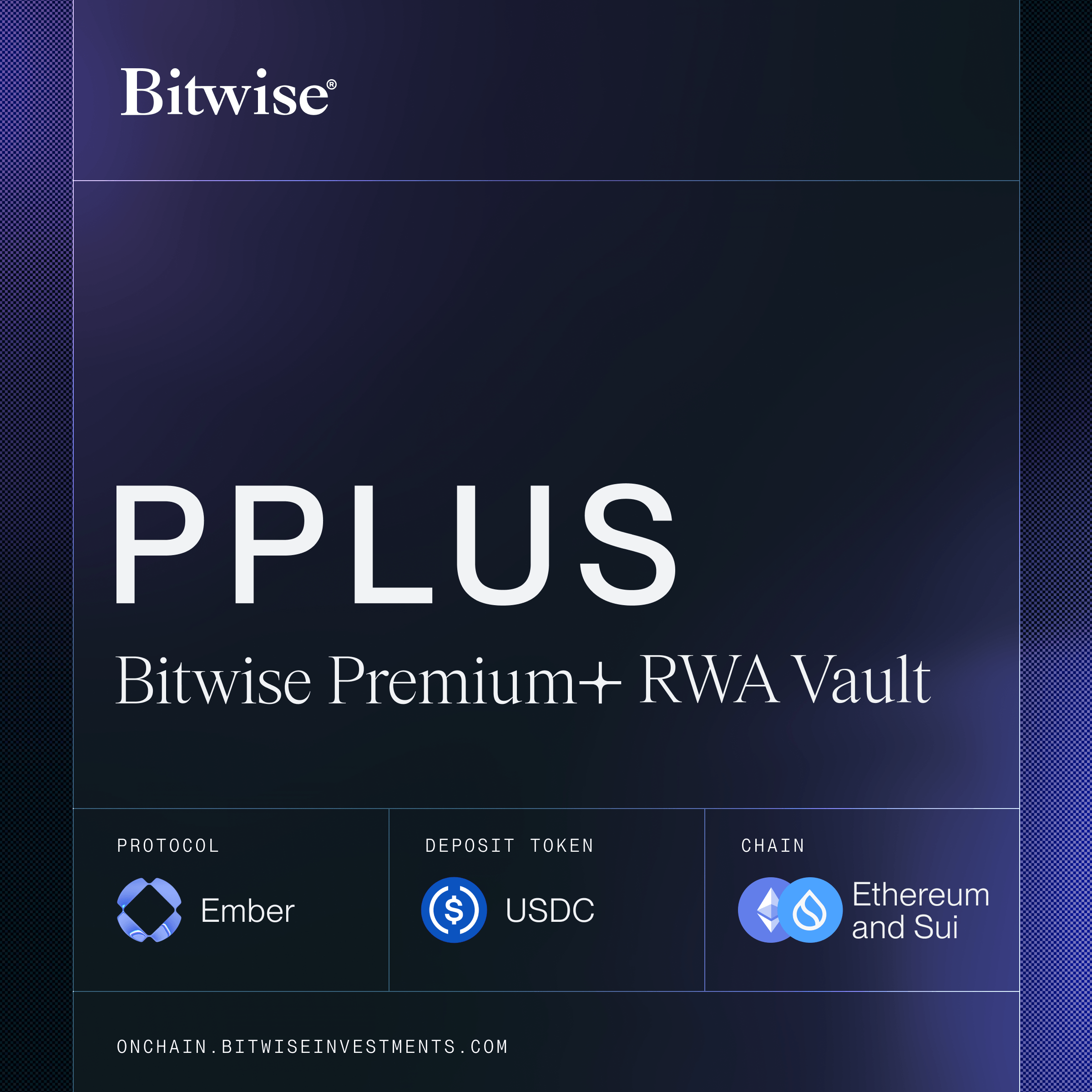
Bitwise launches PPLUS, a leveraged RWA vault on Ember Protocol targeting 10%+ yield for non-U.S. investors
The Yield Sustainability Question
The most persistent tension in crypto yield is between real yield and subsidised yield. Real yield comes from economic activity that would exist independently: borrowers paying interest because they need leverage, protocols collecting fees because users value the service, networks distributing transaction revenue to validators.
Subsidised yield comes from token emissions, point programs, and incentive campaigns — none of which are sustainable if the underlying demand doesn't materialise. The synthetic stablecoin sector has faced this criticism directly: several DeFi protocols have been accused of overpaying to sustain stablecoin flywheels through incentives rather than organic lending demand. Shifting those incentives toward lending markets, as some analysis has suggested, would force protocols to compete on genuine yield rather than subsidy.
The confidential vault approach from Zama and Morpho represents a different answer: rather than offering higher rates, offer a qualitatively different product — privacy-preserving yield — that has real institutional value regardless of the rate environment.
- 2023-08launch
Frax proposes sFRAX DSR-like yield instrument at ~10%
- 2024-06milestone
Ethereum staking yield drops from 5%+ to 3.5% amid low activity
- 2024-11launch
Ethena integrates into Spark Liquidity Layer, unlocking $1.1B for DeFi yields
- 2025-01milestone
Liquity V2 BOLD pools attract $10M in 24h at 40%+ USD yields
- 2025-03milestone
Pendle announces expansion to Solana, Hyperliquid, TON with KYC yield track
- 2025-04regulatory
Senate Banking Committee hearing scrutinizes stablecoin yield as deposit-flight risk
- 2025-05regulatory
CLARITY Act yield ban introduced, flagging Aave, Uniswap, dYdX as impacted
- 2025-06exploit
Yield protocol loses $3.73M via stkGHO-to-USDC vault slippage exploit
Outlook
Crypto yield is maturing along two parallel tracks. In DeFi, infrastructure is becoming more sophisticated — cross-chain intents, confidential vaults, looping strategies with professional risk management — while the distinction between real and subsidised yield is becoming more legible to participants. In traditional finance, wrappers that bring yield to institutions — ETFs with options overlays, tokenised treasuries, auditable staking products — are multiplying quickly.
The regulatory environment is tightening. The Block Earner ruling in Australia is a leading indicator: yield products that function as investments will be regulated as investments, and the fact that they run on a blockchain does not create an exemption. Projects building in this space in 2025 and beyond will need to account for this, whether through licensing, structuring products for sophisticated investors only, or operating in jurisdictions with explicit frameworks.
The underlying demand for yield is permanent. Capital seeks return; blockchains provide a new set of mechanisms for generating it. The cycle of innovation — new yield mechanisms, new risks, new regulatory responses — will continue, but the floor is now higher: real economic activity, not just token printing, increasingly has to underpin the return.
Latest Yield news
Firelight partners with Veda to bring on-chain protection to yield vaultsCrypto investment firm RockawayX commits $150M to make yield the next major DeFi use case, backing projects that bring real-world yields onchainBitwise launches PPLUS, a leveraged RWA vault on Ember Protocol targeting 10%+ yield for non-U.S. investors Plume launches nPRIME vault offering yield from Figure's $30 billion home equity lending market
 Leviathan News launches prediction markets, article summaries, daily yield board, and archive AI
Community notes
Spot something off or out of date? Drop a note. Editors review topic notes daily and roll accepted fixes into the explainer — contributors are recognized in the monthly $SQUID drop.
Loading notes…
Help improve this topic
Have a story or tip about this topic? Submit it. See something missing? Leave a note. Editors review daily; accepted submissions and fixes count toward the monthly $SQUID drop.