
Katana is an Ethereum layer-2 optimized for DeFi, where trading, lending, and perps are aligned rather than competing for liquidity, coordinated by a system that incentivizes the users who take part.
+9 sources across the wider coverage universe
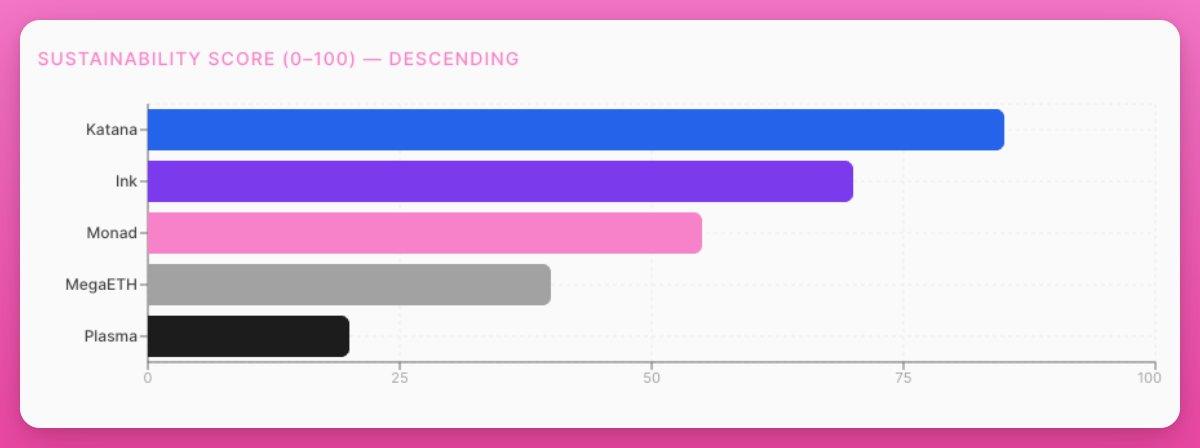 Katana’s Real-Yield DeFi Engine Gets High Marks in New Pink Brains Sustainability Review2026-04
 Katana acquires IDEX, launches native perps exchange as Polygon-incubated DeFi chain expands2026-03
 Katana launches KAT and its chain-wide ve(3,3) engine - stakers earn from the pools they vote to direct incentives to.
Early stakers get founding staker status.2026-03
Katana launches KAT and its chain-wide ve(3,3) engine - stakers earn from the pools they vote to direct incentives to.
Early stakers get founding staker status.2026-03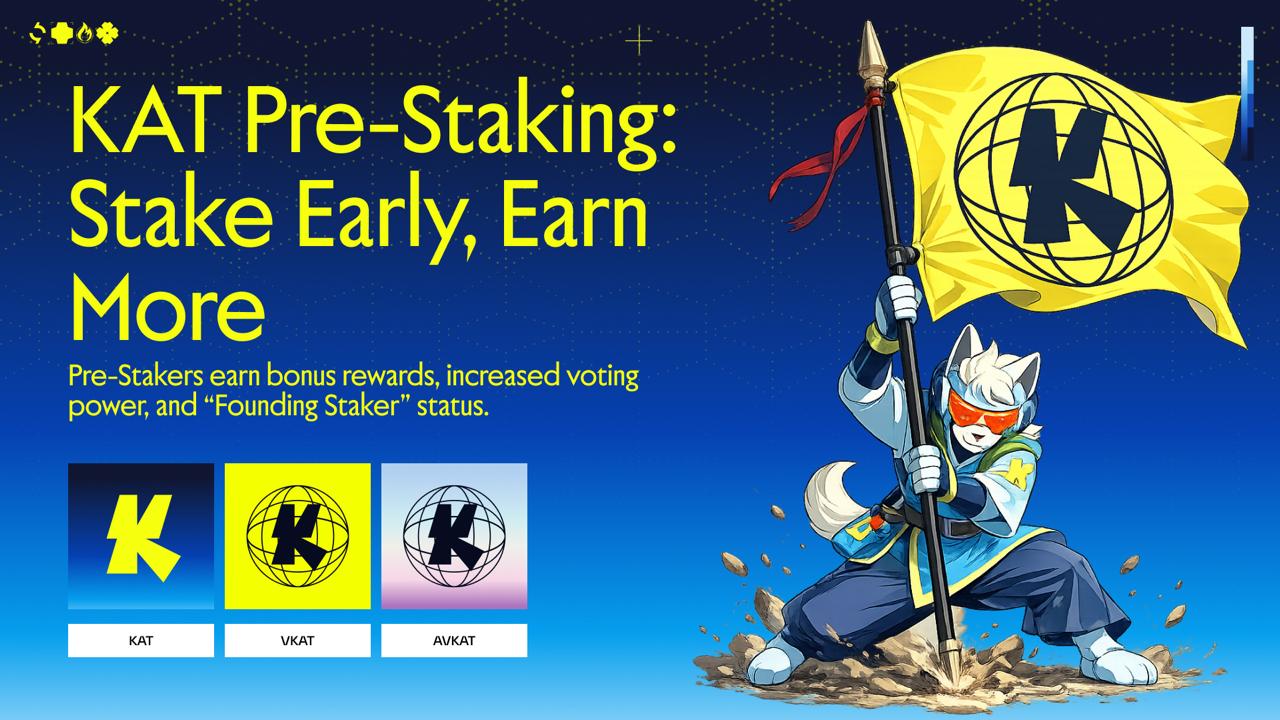 Katana KAT Pre-staking is live. vKAT pre-stakers can earn 3x voting power and rewards for the first 8 weeks. The chain-wide ve(3,3) economy is coming soon2026-03
 Yearn launches ySplitter, letting depositors earn vault yield in a different token via Katana integration2026-03
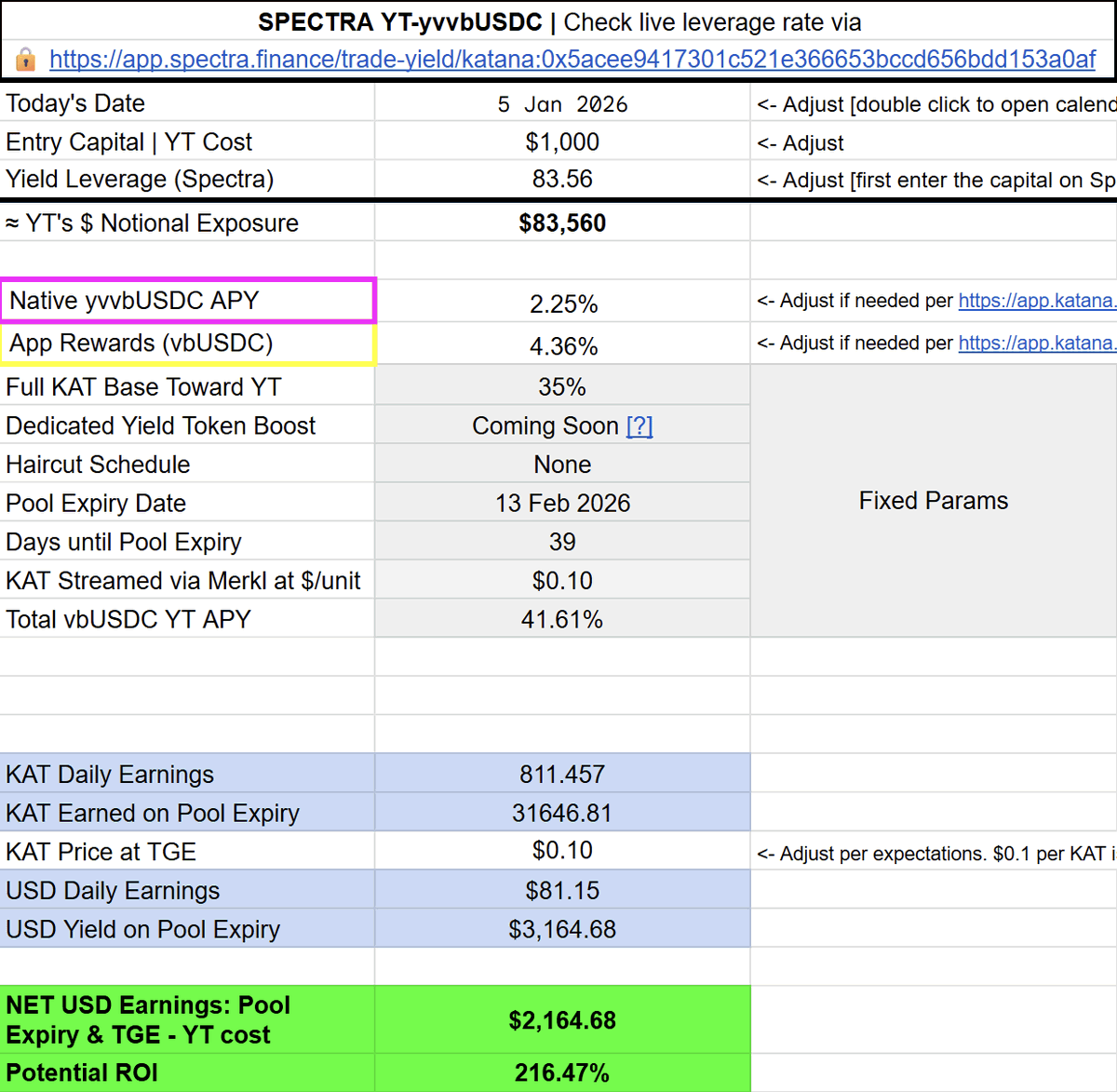 A new Katana Yield Token modeling tool is now available. The release comes ahead of Katana’s expected token generation event in the coming months.2026-01
A purpose-built Layer 2 blockchain for decentralized finance, Katana is designed so that every fee, token launch, and yield stream feeds back into the same economic flywheel rather than leaking value off-chain.
What Is Katana?
Katana is an Ethereum Layer 2 network built specifically for DeFi applications, incubated by the Polygon team and constructed on the Polygon CDK (Chain Development Kit). Where general-purpose chains treat DeFi as one use case among many, Katana inverts that: the chain's architecture, incentive structures, and native tooling are designed from scratch around trading, liquidity provision, and yield generation.
The project describes itself as a "full-stack" DeFi chain, meaning it does not merely provide a settlement layer and rely on third-party protocols for everything else. Instead, Katana ships an integrated set of primitives—spot markets, perpetuals, vaults, a token-launch standard, and a chain-level governance and incentive layer—that are meant to compound on each other rather than compete.
Katana’s Real-Yield DeFi Engine Gets High Marks in New Pink Brains Sustainability Review
A high score from Pink Brains? That’s like getting an A in from a strict lecturer..they must have been truly good
The KAT Token and ve(3,3) Governance
The native token, KAT, sits at the center of Katana's economic design. KAT is used for governance, fee distribution, and incentive direction across the chain. The model borrows from the ve(3,3) framework—pioneered by Solidly and extended by Velodrome and Aerodrome on other networks—in which holders lock tokens to receive vote-escrowed positions that direct emissions toward specific liquidity pools.
Locked KAT becomes vKAT, managed through the vKAT Armory, Katana's chain-level incentive coordination engine. Holders who stake and vote earn a share of protocol fees, while liquidity providers compete for directed emissions. The design attempts to align long-term holders with short-term liquidity providers by making fee capture conditional on participation, not passive holding.
Critics of ve(3,3) implementations elsewhere have flagged structural risks: token inflation from continuous emissions can dilute non-participants, and governance rigidity can make it hard to redirect incentives when market conditions shift. Katana's long-term sustainability depends on whether real fee revenue can outpace emissions—a question its real-yield framing directly addresses.
KAT's Token Generation Event (TGE) took place in early 2026, accompanied by a 25 million token prize pool distributed across early participants. By March 2026, KAT was transferable and the vKAT Armory was live.
Readers clicked Katana not as a speculative L2 bet but as a yield-infrastructure thesis — the ve(3,3) tokenomics, real-yield sustainability reviews, and Yearn integrations drew far more engagement than the mainnet launch itself, revealing that the audience is vetting whether Katana's incentive flywheel is structurally sound rather than just chasing KAT price.
Launch Standard and the Graduation Mechanism
One of Katana's more distinctive features is its on-chain launch standard: a structured process for bootstrapping new tokens that encodes economic rules before a project goes live.
Under the standard:
- A new token launch must hit a defined graduation threshold—a minimum liquidity or participation bar—before a full market is seeded.
- Once that threshold is crossed, liquidity locks automatically, preventing immediate rug-pull dynamics.
- Each token carries its own fee logic, configurable at launch, so revenue-sharing terms are visible to participants before they commit capital.
The graduation mechanism functions as a credibility filter. It raises the cost of launching tokens that lack genuine demand, because a project that cannot clear the threshold never graduates to a full market. From a user perspective, this means that tokens visible in Katana's markets have, at minimum, cleared a quantifiable bar—though it does not eliminate speculation risk.
This approach echoes pump.fun's graduation curve on Solana but adds more explicit fee governance and ties the launch outcome to chain-level liquidity infrastructure rather than routing volume off to an external DEX.

Katana acquires IDEX, launches native perps exchange as Polygon-incubated DeFi chain expands
Perpetuals: Acquiring IDEX and Building Native Perps
In a significant infrastructure move, Katana acquired IDEX—a decentralized exchange known for its hybrid order-book architecture—and used the acquisition to accelerate its native perpetuals exchange rollout.
Katana Perps launched in early 2026, with KAT perpetual futures going live on Coinbase Advanced on March 27, 2026, providing centralized-exchange liquidity for a token whose underlying chain runs a native perps market. The Korean exchanges Upbit and Bithumb listed KAT on KRW, BTC, and USDT pairs around the same period, broadening the token's market footprint beyond crypto-native audiences.
The strategic logic of building a native perps exchange rather than licensing one is that perps generate some of the highest fee revenue in DeFi. By owning the perps stack, Katana can route those fees back into the KAT flywheel—vKAT holders, liquidity vaults, and chain-level incentives—rather than paying them to a third-party protocol.
The IDEX acquisition was not without scrutiny. Questions surfaced around integration timing and how IDEX's existing user base and order-book infrastructure would map onto Katana's AMM-centric architecture. The chain's ability to sustain meaningful perps volume over time will depend on its capacity to attract and retain professional traders, which typically requires deep liquidity, competitive funding rates, and reliable execution.
Vaults, Yield, and the Real-Yield Thesis
Katana's yield infrastructure is built around vaults—structured liquidity positions that automate strategies on behalf of depositors. Rather than requiring users to actively manage LP positions, vaults handle rebalancing, fee compounding, and risk parameters.
The chain has published metrics suggesting strong capital efficiency: a reported $587 million in total value locked (TVL) at 98.3% utilization, meaning virtually all deposited capital is actively deployed rather than sitting idle. For context, most DeFi protocols see significant portions of deposited assets sitting undeployed in safety buffers or low-activity pools. A 98.3% utilization figure, if sustained, indicates that Katana's vault design is routing capital actively rather than conservatively.
A sustainability review by Pink Brains gave the real-yield model positive marks, focusing on whether Katana's fee revenue is sufficient to support yield without relying primarily on token inflation. Real yield in DeFi refers to returns denominated in productive assets (typically USDC or ETH) rather than newly minted governance tokens. Katana's treasury-level flows include USDC-denominated yield from trading fees, which it routes back to vKAT stakers and liquidity providers.
USDC plays an important role throughout: fee settlement, vault payouts, and earn programs structured with CEX partners (including integrations via the Jumper cross-chain aggregator) are denominated in stablecoins rather than KAT, which reduces the circular dependency that undermines many ve(3,3) systems where all rewards are paid in the same token being emitted.
Katana launches KAT and its chain-wide ve(3,3) engine - stakers earn from the pools they vote to direct incentives to. Early stakers get founding staker status.
SuperStake and Gamified Liquidity
Katana introduced SuperStake, a product that adds multiplier mechanics to staking positions. Users select a denomination, choose a multiplier level, and earn amplified yields—subject to "bomb" mechanics that can eliminate gains if certain conditions are met. The design borrows from structured product logic: higher potential return trades against a defined risk of loss.
SuperStake is aimed at users who want more active yield management without building custom strategies. It sits between passive vault deposits and active perpetuals trading on Katana's product spectrum.
- 01ve(3,3) chain-wide tokenomics
Multiple top-clicked headlines centered on how KAT stakers direct incentives and earn from voted pools, making the veTokenomics model the dominant reader interest across the dataset.
- 02Real-yield sustainability audit
The highest-clicked headline was a third-party sustainability review of Katana's yield engine, signaling readers are skeptical of incentive-driven yields and want independent validation.
- 03Yearn and DeFi blue-chip integrations
ySplitter, WETH/USDC vault donations, and Leviathan Livestream coverage of Katana-to-Yearn streams drew consistent clicks, showing readers track protocol-level composability as a legitimacy signal.
- 04DeFi Llama deep-dive research
Three separate DeFi Llama research pieces on Katana — including a 30-page report — each generated substantial clicks, indicating readers treat institutional-grade research as the credibility layer for this chain.
- 05KAT launch incentives and staking campaigns
The Binance Wallet Earn campaign (50M KAT), mainnet launch with $1B incentives, and pre-staking with 3x voting power drew engagement around the token distribution mechanics and founding-staker positioning.
- 06Protocol expansion: perps, NFTs, memecoins
IDEX acquisition for native perps, Kensei memecoin launchpad, and Warriors NFT whitelist showed readers tracking Katana's ecosystem breadth beyond core yield infrastructure.
Infrastructure and Cross-Chain Context
Katana runs on the Polygon CDK, a modular toolkit for building application-specific chains that settle to Ethereum and interoperate through Polygon's AggLayer—a shared liquidity and ZK-proof aggregation layer. This positions Katana within a growing ecosystem of purpose-built chains (sometimes called "appchains" or "rollups") that can share liquidity across AggLayer without routing through a central chain.
The cross-chain layer matters because DeFi liquidity is fragmented across dozens of networks. AggLayer integration gives Katana access to unified liquidity flows rather than requiring it to rebuild a full liquidity base from scratch. At the same time, as the Polygon team has noted, cross-chain bridges and aggregation layers introduce their own attack surfaces: the rsETH exploit that circulated in 2025 prompted renewed scrutiny of bridged asset risks, though Katana and Vaultbridge were reported to be unaffected.
G3 is listed as Katana's infrastructure partner, handling real-time on-chain finance infrastructure. Binance has been noted in the context of earn programs and market listings, though the precise nature of Katana's relationship with Binance has not been publicly detailed beyond exchange-level activity.
Economics and Alignment Mechanism
Katana's stated design goal is economic alignment across three stakeholders: applications built on the chain, users of those applications, and the chain's own activity metrics (fees, TVL, volume). Most L2s align validators and token holders but leave application developers and end users in a zero-sum relationship with the chain's fee structure.
Katana's approach attempts to solve this by making fee logic configurable at the token level, directing chain-level fees back to vKAT holders who govern where incentives flow, and designing launches so that liquidity stays on-chain rather than being extracted to external venues. Whether this tripartite alignment holds under competitive pressure—when another chain offers lower fees or higher incentives—is the central stress test for the model.
Record revenue figures reported as of early 2026 suggest the flywheel is generating meaningful activity in its early phase. The harder question is retention: whether the users and liquidity attracted by launch incentives remain after the initial emissions period tapers.
- 2025-01milestone
Katana DeFi L2 hints at community whitelist
- 2025-02launch
EtherFi Katana pre-deposit vaults go live (weETH)
- 2025-03milestone
Binance Wallet Earn campaign launches with 50M KAT rewards
- 2025-03launch
Katana mainnet launches with $1B KAT incentives
- 2025-03launch
KAT token and chain-wide ve(3,3) engine launched; founding staker status introduced
- 2025-04milestone
Katana acquires IDEX, launches native perps exchange
- 2025-04milestone
Yearn ySplitter integration goes live on Katana
- 2025-05governance
Pink Brains sustainability review published; DeFi Llama 30-page Katana research report released
Outlook
Katana enters its post-TGE phase with a live perps exchange, a functioning vault and staking economy, and a Polygon CDK integration that connects it to a growing cross-chain liquidity layer. Its near-term trajectory depends on three variables: whether native perps volume scales to support the real-yield thesis without heavy token incentives; whether the ve(3,3) governance model remains responsive enough to redirect emissions as market conditions change; and whether its launch standard attracts high-quality projects rather than becoming a venue for low-effort token launches that clear the graduation bar but lack durable demand.
The structural bet—that a DeFi-native chain with integrated tooling outperforms a general-purpose chain running third-party DeFi protocols—is plausible but unproven at scale. The next one to two years will test whether Katana's flywheel compounds or stalls once bootstrapping incentives normalize.
Latest Katana news
Katana’s Real-Yield DeFi Engine Gets High Marks in New Pink Brains Sustainability ReviewKatana acquires IDEX, launches native perps exchange as Polygon-incubated DeFi chain expandsKatana launches KAT and its chain-wide ve(3,3) engine - stakers earn from the pools they vote to direct incentives to.
Early stakers get founding staker status.Katana KAT Pre-staking is live. vKAT pre-stakers can earn 3x voting power and rewards for the first 8 weeks. The chain-wide ve(3,3) economy is coming soonYearn launches ySplitter, letting depositors earn vault yield in a different token via Katana integrationA new Katana Yield Token modeling tool is now available. The release comes ahead of Katana’s expected token generation event in the coming months.Community notes
Spot something off or out of date? Drop a note. Editors review topic notes daily and roll accepted fixes into the explainer — contributors are recognized in the monthly $SQUID drop.
Loading notes…
Help improve this topic
Have a story or tip about this topic? Submit it. See something missing? Leave a note. Editors review daily; accepted submissions and fixes count toward the monthly $SQUID drop.