
Comprehensive explainer on Layer 2 blockchains, covering how L2s scale Ethereum and Bitcoin, rollups, sequencers, stablecoin settlement, major networks like Arbitrum and Base, shutdown risks like Botanix/Zero, and emerging trends in interoperability and decentralization.
+9 sources across the wider coverage universe
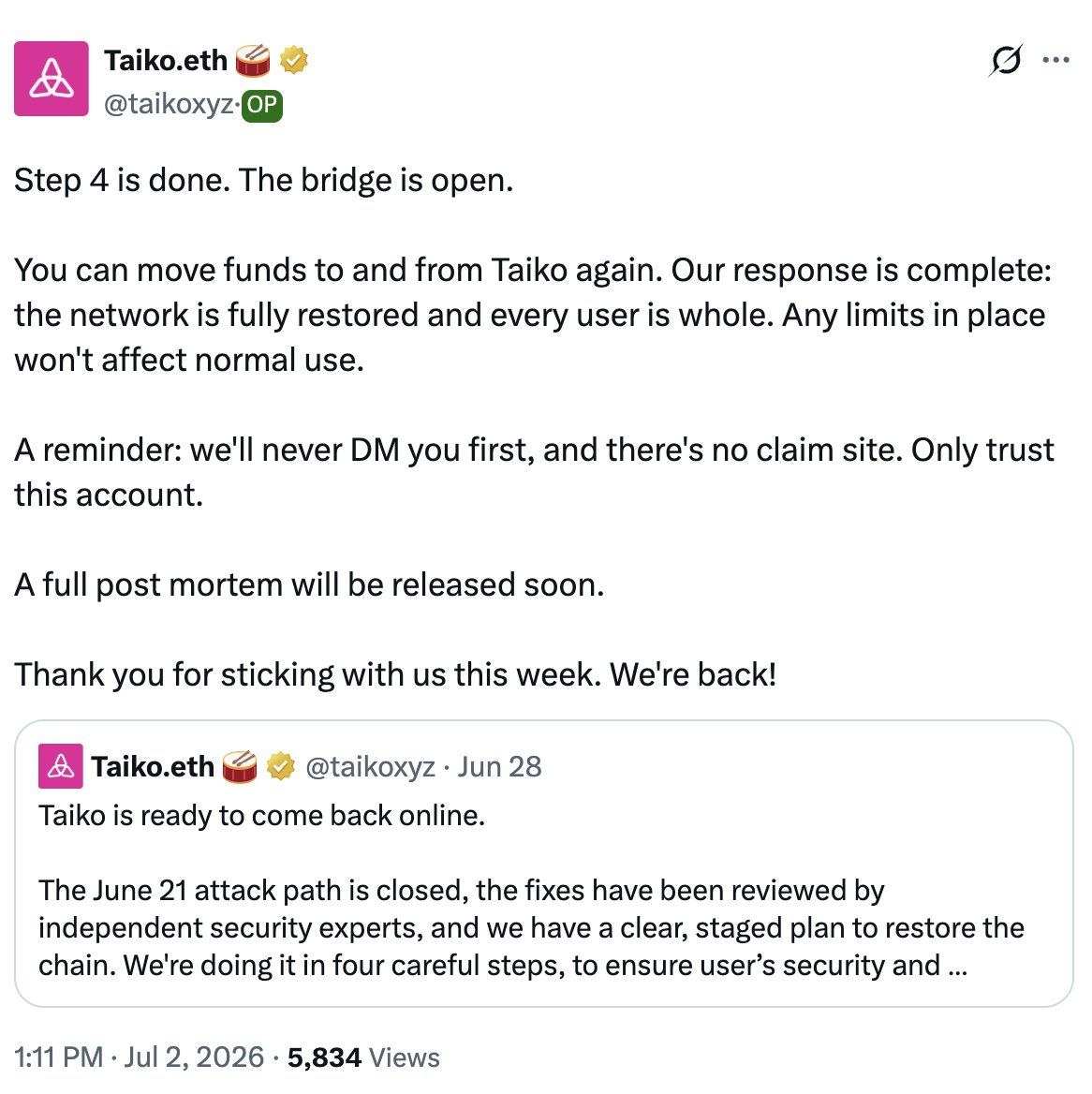 Ethereum Layer 2 Taiko finalizes post-exploit recovery with bridge reopening, confirming full network restoration as a detailed post-mortem nears release2026-07
 Index says Robinhood Chain is the first Layer 2 purpose-built for tokenized real-world assets, combining Robinhood's 28M users with institutional RWA infrastructure2026-07
 Bitcoin Layer 2 Stacks rolls out SIP-034 upgrade, improving throughput by resetting only exhausted limits and unlocking higher efficiency for DeFi workloads2026-03
 Layer 1 and Layer 2 tokens struggled in 2025 as users consolidated, MAUs fell, and revenues flowed to stablecoins and derivatives. Weak tokenomics and poor value capture left undifferentiated chains under pressure heading into 2026.2025-12
 Ethereum activated a planned fork raising its blob target to 14 and blob limit to 21, boosting data availability for Layer 2 rollups such as Base, Optimism, Arbitrum, and Mantle. On-chain data shows blob usage remains far below capacity.2026-01
 Krain announces transition to first AI-native Layer 2 blockchain.2026-04
Layer 2 Blockchains: How Second-Layer Networks Scale Crypto
In blockchain networks, a Layer 2 is an additional protocol or network built on top of a base Layer 1 blockchain, such as Bitcoin or Ethereum, that processes transactions off the main chain and then settles results back to it. By moving execution offchain while inheriting the security guarantees of the underlying base layer, Layer 2 systems aim to deliver higher throughput, lower fees, and new functionality without requiring a redesign or hard fork of the core protocol.
The Basics: What “Layer 2” Actually Means
The term “Layer 2” comes from the idea of stacking protocols: a foundational Layer 1 like Ethereum or Bitcoin provides core consensus and data availability, while additional layers are built on top to add features or scale capacity. In this model, the base layer is deliberately conservative, slow, and robust, while higher layers can innovate more quickly and take on different trade-offs. A Layer 2 is not a replacement for the base chain; instead it is best understood as a scaling and extension layer that still ultimately depends on the base chain for final settlement and security.
In most formal definitions, a Layer 2 is a protocol that executes transactions off the main chain, periodically compresses or aggregates them, and then submits proofs or summaries back to the Layer 1, which remains the arbiter of final validity. The key is that the Layer 2 inherits the security of the chain it is built on: users should be able to rely on the underlying Layer 1 for censorship resistance and final settlement, even if the Layer 2’s own operators misbehave or go offline. This is what distinguishes a true Layer 2 from a simple sidechain, where an independent validator set and separate security budget may introduce new trust assumptions beyond the base layer.
On Ethereum, Layer 2 scaling is most visible through rollups, which bundle many transactions together and post compressed data back to Ethereum, as well as through emerging application-specific networks that use shared “rollup stacks” such as the OP Stack. On Bitcoin, the term “Layer 2” covers a range of designs, including payment-channel networks, smart-contract layers anchored to Bitcoin, and experimental rollup-like systems that aim to introduce programmability without changing Bitcoin’s base protocol. In both ecosystems, the common thread is offloading day-to-day transaction processing while retaining final anchoring and verification on the base chain.
This layered architecture leads to a different mental model of what a blockchain is. Instead of a single monolithic network doing everything, the ecosystem becomes an interlocking stack: hard, slow, and globally shared consensus at the bottom; faster and more specialized execution layers above; and, on top of those, applications and user interfaces. For users, this shows up as “just another network” in their wallet; for builders and policymakers, it raises deeper questions about security inheritance, governance, and systemic risk.
A simple way to visualize the distinction between layers is to compare their roles and properties.
| Layer | Primary role | Typical characteristics | Security source | Example networks |
|---|---|---|---|---|
| Layer 1 | Global consensus and data availability | Lower throughput, higher fees, highly robust state | Native consensus (PoW/PoS) | Bitcoin, Ethereum |
| Layer 2 | Scalable execution and user experience | Higher throughput, lower fees, faster finality assumptions | Inherits from a specific Layer 1 plus additional assumptions | Arbitrum, Base (Ethereum); Stacks (Bitcoin, often classified as L2/sidechain) |
While categories are fuzzy at the edges, the conceptual split between a base consensus layer and higher execution layers underpins most contemporary blockchain scaling strategies.

Ethereum Layer 2 Taiko finalizes post-exploit recovery with bridge reopening, confirming full network restoration as a detailed post-mortem nears release
Why Blockchains Need Layer 2 Scaling
The push for Layer 2 exists because base layer blockchains face hard limits on how much they can scale without sacrificing decentralization or security. This is often framed as the “blockchain trilemma”: systems can optimize for two of scalability, decentralization, and security, but improving all three at once is difficult. Public chains like Bitcoin and Ethereum deliberately constrain block sizes and gas limits to keep it possible for many participants worldwide to run full nodes, validate history, and resist capture by large operators.
As demand for block space has grown—first with ICOs, then DeFi, NFTs, and now stablecoin payments—these fixed capacity constraints have translated into congestion and high transaction fees on popular Layer 1 chains. When many users and bots compete to get transactions confirmed quickly, fees can spike to levels that price out smaller users, especially for use cases such as gaming, microtransactions, or cross-border remittances. This is particularly acute on Ethereum, which serves as a central hub for smart contracts and DeFi, but the pattern is visible wherever onchain demand outstrips base layer throughput.
Bitcoin faces a similar, though differently shaped, challenge. Its conservative design, limited scripting language, and commitment to small blocks help maintain decentralization and resilience as a digital reserve asset, but they also mean that Bitcoin is not optimized for high-frequency retail payments or complex smart contracts. Bitcoin’s base layer is well suited for large, infrequent settlements and long-term storage, but less so for everyday microtransactions or algorithmically complex DeFi protocols.
There are only a few broad strategies to handle this tension. One is to scale the base layer itself through larger blocks, sharding, or more efficient consensus—but that can increase hardware requirements, centralize validation, or complicate protocol design. Another is to move more activity off the base chain while keeping it cryptographically connected, either through application-specific sidechains, custodial solutions, or more robust Layer 2 protocols that inherit security from the Layer 1. The industry has increasingly converged on this second path, particularly on Ethereum, viewing Layer 2s as the primary scalability lever while keeping the base protocol as simple and conservative as possible.
Stablecoins provide a concrete illustration of these constraints. Stablecoin transfers, especially for small-value payments or remittances, are extremely sensitive to fees and confirmation times. On congested Layer 1 networks, sending a few dollars of stablecoins can cost more than the payment itself in transaction fees, making the system functionally unusable for many users. Layer 2 stablecoin settlement addresses this by moving transaction execution offchain to secondary networks where fees are much lower and throughput is higher, while still relying on the base chain for security and finality.
In technical terms, modern Layer 2 designs separate execution—the process of running smart contracts and updating balances—from data availability and consensus, which remain anchored to the base chain. Transactions are processed in batches on the Layer 2, and only compressed representations of the relevant state transitions, along with cryptographic proofs or fraud-detection windows, are posted to the Layer 1. This architecture allows thousands of Layer 2 transactions to be represented by a single Layer 1 transaction, dramatically increasing effective throughput while retaining the ability to reconstruct history and resolve disputes using the base chain’s security guarantees.
Readers simultaneously chased brand-name institutional entrants (Sony, OKX, Franklin Templeton) and clicked hardest on existential critiques of L2 legitimacy — revealing an audience vetting whether the L2 boom is genuine scaling infrastructure or marketing-driven chain proliferation.
How Layer 2s Work Under the Hood
Although the term “Layer 2” is often used loosely in marketing, most designs fall into a small set of architectural patterns. These patterns reflect different choices about how to prove correctness, where to store data, and who is allowed to order transactions. Understanding them is essential for evaluating the security and risk profile of any given network.
Rollups: Ethereum’s Flagship Layer 2 Design
On Ethereum, rollups have emerged as the dominant Layer 2 scaling approach. A rollup is a protocol that executes transactions offchain, then posts both a compressed transaction batch and some form of proof or verification data back to Ethereum, which retains the ultimate authority to accept or reject these batches. In a typical rollup architecture, a sequencer or set of operators collects user transactions, orders them, executes smart contract logic, and periodically publishes the resulting state roots plus necessary calldata to a smart contract on Ethereum.
What distinguishes rollups from earlier sidechain-like solutions is that they keep enough data on Ethereum for anyone to reconstruct the Layer 2 state and, in principle, to continue operating the system even if the official sequencer disappears. In a genuine rollup, users are never wholly dependent on the Layer 2 operator’s honesty; instead, they can fall back to the Layer 1 for security, either by submitting fraud proofs (in optimistic rollups) or by relying on validity proofs (in zero-knowledge rollups) that do not require trust in the operator. This is what people mean when they say rollups “inherit Ethereum’s security.”
Rollups are generally divided into optimistic rollups and zero-knowledge (ZK) rollups. In an optimistic rollup, batches of transactions are assumed to be valid by default, but there is a challenge window during which anyone can submit a fraud proof if they believe the sequencer has published an incorrect state transition. If a fraud proof succeeds, the batch is rolled back and the cheating party can be penalized. This design is relatively simple to implement and compatible with existing EVM tooling, which is why major networks like Arbitrum, Optimism, and Base use optimistic rollup architectures.
Zero-knowledge rollups take the opposite approach. Instead of relying on a challenge period, they use validity proofs: the Layer 2 generates a succinct cryptographic proof that the state transition from the old state root to the new one is correct given the batch of transactions. Ethereum verifies this proof onchain, and if it checks out, the new state is accepted. The ZK-rollup model provides faster finality, since there is no need to wait for a fraud window, and can offer stronger privacy guarantees when combined with appropriate cryptographic techniques. However, generating and verifying these proofs is computationally intensive, and building fully EVM-compatible ZK-rollups has required significant engineering effort. Projects like Starknet and various zkEVMs exemplify this path, using advanced proof systems to move most computation offchain while keeping verification on Ethereum.
From a user’s perspective, both rollup types aim to provide a similar experience: cheaper and faster transactions than Ethereum mainnet, plus the ability to eventually withdraw assets back to Layer 1 even in adverse scenarios. The differences matter more for finality guarantees (how long you should wait before treating a transaction as irreversible), withdrawal times, and the underlying trust assumptions around the proof systems and sequencer operations. Over time, many expect the rollup landscape to converge on a mix of optimistic and ZK systems, each optimized for different workloads and latency tolerances.
Payment Channels and Early Layer 2 Experiments
Before rollups matured, one of the earliest Layer 2 ideas was the payment channel. In a simple payment channel, two parties lock funds into a multi-signature transaction on the base chain and then exchange signed messages representing updates to their balances, without broadcasting every intermediate transaction onchain. Only the final state is eventually settled on the base layer, unless a dispute arises, in which case either party can unilaterally close the channel using the most recent valid state they hold.
The Bitcoin Lightning Network is the most prominent implementation of this idea, generalizing simple two-party channels into a network where payments can be routed across multiple hops. This allows Bitcoin to support many more microtransactions than would be possible if every payment had to be confirmed directly onchain. However, payment channels come with limitations: liquidity must be locked in channels, routing can be complex, and the model is tailored to relatively simple payment flows rather than generalized smart contract execution.
On Ethereum and other smart-contract platforms, payment channels and channel-like constructions were an important stepping stone in the evolution of Layer 2 thinking, but they have been largely eclipsed by rollups for general-purpose computation. That said, channel-based designs remain highly relevant for streaming micropayments, subscription services, and use cases where ultra-low latency is more important than full onchain composability. In the broader taxonomy, they represent one end of the spectrum: minimal onchain data, strong liveness assumptions, and a focus on bilateral or small-group interactions.
Bitcoin Layer 2s: Extending a Minimal Base Layer
Bitcoin’s scripting constraints and conservative development culture have led to a different Layer 2 landscape, where the definition of “Layer 2” is sometimes contested. One widely used definition, articulated in educational resources such as those from Chainlink, is that a Bitcoin Layer 2 is any offchain network, system, or technology built on top of the Bitcoin blockchain that helps extend its capabilities, provided that it ultimately inherits Bitcoin’s security. In this view, a key requirement for a network to be considered a true Layer 2 is that transaction data is verified and confirmed by the Bitcoin blockchain rather than by a completely independent node set.
Bitcoin Layer 2 networks can introduce improvements such as greater transaction throughput, reduced fees, and programmability through smart contracts, all while using bitcoin as the native asset. Some of these systems look like payment-channel networks; others resemble sidechains with pegged BTC and their own smart contract environments; still others explore rollup-like structures or novel constructions such as BitVM to execute more complex logic anchored to Bitcoin. The overall goal is to unlock “DeFi on Bitcoin” and deeper liquidity use cases without requiring risky or contentious changes to Bitcoin’s base-layer consensus.
The Stacks ecosystem offers one example of a Bitcoin-connected smart contract layer that seeks to expand Bitcoin’s DeFi capacity. Stacks uses its own consensus mechanism while anchoring its state to the Bitcoin blockchain, enabling developers to build smart contracts that settle in BTC terms. A recent SIP-034 upgrade changed how the network manages transaction limits: rather than halting the entire system when one capacity limit is reached, the protocol now resets only the exhausted limit, allowing other parts of the system to continue operating. This design is reported to boost DeFi capacity by up to thirty-fold for certain workloads, by improving how resource limits are enforced and reset, and illustrates how Bitcoin-linked layers are evolving to handle more demanding use cases.
Not all Bitcoin Layer 2 experiments succeed. Botanix, a Polychain-backed Bitcoin Layer 2 aiming to bring an EVM-like environment to Bitcoin, recently announced it will gradually wind down operations. According to the team, growing market preference for Bitcoin as a reserve asset, combined with DeFi demand concentrating on more accessible Ethereum general-purpose Layer 2s, left the network’s fee revenue far below the level needed to cover infrastructure costs. Botanix advised all users to withdraw their bitcoin and other assets from the network before a specified deadline, disabling deposits while keeping withdrawals open for a time-limited wind-down period. This episode underscores that, beyond technical design, Layer 2 projects must solve for sustainable economics and sufficient user demand.
Data Availability, Validiums, and Shared Sequencers
A critical design dimension in Layer 2 systems is data availability: where and how the data needed to reconstruct the Layer 2 state is stored and published. Rollups keep enough data on the Layer 1 to allow anyone to reconstruct the state; other designs, sometimes called validiums, keep data offchain but provide validity proofs. This saves on base-layer fees but introduces new trust assumptions around data custodians. While these distinctions are often glossed over in marketing materials, they have deep implications for what guarantees users actually receive in extreme scenarios.
Beyond data, the sequencer—the entity or set of entities that orders transactions and decides which ones make it into each batch—has emerged as one of the most important components in Layer 2 design. Sequencers are responsible for sustaining network activity, and in emerging “shared sequencer” models, sequencer nodes can be selected via election algorithms or consensus protocols across many candidate nodes. Research published on Layer 2 expansion and shared sequencing models explores how decentralized sequencer sets could be structured, how nodes can be chosen, and how to ensure liveness and fairness even under adverse conditions.
Projects such as Espresso Systems are experimenting with shared sequencing layers that multiple rollups can plug into, using consensus protocols like HotShot and external data-availability layers such as EspressoDA. In early deployments, these systems often run with permissioned node sets on test or “Mainnet 0” environments, with around one hundred geographically distributed nodes participating in sequencing. The broader idea is that instead of each rollup operating its own centralized sequencer, many rollups could share a common decentralized sequencer set, gaining resilience and cross-rollup atomicity benefits. However, as of mid-2026, the overall picture is that shared sequencing exists and is advancing, but production cross-rollup usage remains limited, and most user-facing Layer 2s still run single-operator sequencers.
Special-Purpose and Application-Specific Layer 2s
While early Layer 2 discussions focused on generalized platforms capable of hosting any application, there is a growing trend toward application-specific Layer 2s tuned for particular verticals. In this model, a network optimizes its parameters, middleware, and governance for a narrow set of workloads, such as gaming, DeFi, AI, or privacy-preserving enterprise transactions, rather than trying to serve every possible use case.
On Ethereum, the OP Stack and similar modular rollup frameworks have made it easier for projects to launch their own branded Layer 2 networks that share a common codebase but customize key parameters. Gaming-focused networks have followed this path, with chains like Ronin migrating from independent sidechains to Ethereum Layer 2 status in order to benefit from the Ethereum security model and ecosystem tooling, while continuing to optimize for gaming user experience. DeFi-focused networks similarly tailor their infrastructure to high-throughput trading and liquidity management, as in the case of specialized rollups designed for decentralized exchanges and derivatives.
Some projects push specialization further into new domains. Krain, for example, has announced a transition from being primarily an AI app portal to becoming what it describes as the first AI-native Layer 2 blockchain, aiming to embed AI workloads and AI-governed logic more deeply into its protocol design. Others, such as Nightfall, position themselves as privacy-preserving Layer 2s for enterprise use, combining zero-knowledge proofs with Ethereum settlement to enable confidential yet verifiable transactions. In finance, initiatives like Inveniam’s NVNM Chain explore Layer 2 structures to provide verifiable audit trails and AI accountability for complex financial data.
This proliferation of special-purpose Layer 2s raises its own questions about network effects and fragmentation. While a specialized chain can deliver a highly optimized user experience for its target applications, it may also need to rely heavily on cross-chain bridges and interoperability frameworks to reach liquidity and composability in the broader ecosystem. This tension is increasingly visible in Ethereum’s Layer 2 environment, where dozens of networks compete for users, liquidity, and developer mindshare.
Index says Robinhood Chain is the first Layer 2 purpose-built for tokenized real-world assets, combining Robinhood's 28M users with institutional RWA infrastructure
Ethereum’s Layer 2 Ecosystem Today
Ethereum has embraced a “rollup-centric roadmap,” with Layer 2 networks expected to handle much of the transaction load while Ethereum itself focuses on being a highly secure, data-availability and settlement layer. This has given rise to a diverse Layer 2 landscape, ranging from large general-purpose rollups to app-specific chains built on shared stacks.
General-Purpose Rollup Platforms
Among Ethereum’s major general-purpose Layer 2s, Arbitrum stands out as a network that explicitly markets itself as a “finance-native blockchain platform” providing infrastructure for applications, tokenization, and dedicated blockchain environments. Built as an optimistic rollup, Arbitrum batches transactions offchain and posts them to Ethereum, offering lower gas fees and faster user experience while maintaining anchoring to Ethereum’s security. Its ecosystem has grown around DeFi protocols, gaming, and infrastructure providers that prefer Ethereum compatibility with better performance characteristics.
Optimism represents another flagship optimistic rollup, and its OP Stack has become a widely used framework for building new Layer 2s. While Optimism itself functions as a shared public rollup, the OP Stack is used by other networks—such as Base and migrating sidechains like Ronin—to launch their own chains that share core components but can make their own decisions about governance, fee structures, and application focus. This modularity is a key factor in the recent wave of Layer 2 launches: rather than building everything from scratch, projects can compose proven rollup technology with their own customizations.
The result is an expanding Layer 2 universe. Data aggregated by analytics platforms and referenced in recent reporting indicates that there are now more than twenty active Ethereum Layer 2 networks securing nearly forty billion dollars in total value, with liquidity distributed across networks such as Arbitrum, Base, and Optimism. While these figures fluctuate with markets and adoption cycles, they illustrate how much economic activity has moved from Ethereum mainnet to its scaling layers. However, they also highlight a central challenge: liquidity and user activity are increasingly split across multiple separate environments, complicating composability and user experience.
Base Chain and Coinbase’s Approach
Base is a prominent example of a Layer 2 launched by a major centralized exchange. Built on Ethereum using the OP Stack, Base is described as being “built on Ethereum with the same focus on security powering Coinbase products,” emphasizing that it aims to inherit Ethereum’s security while offering a gateway between the Coinbase user base and the broader onchain ecosystem. Base positions itself as interoperable across chains and ecosystems, aiming to let users and developers “move seamlessly across” different onchain environments, while using Ethereum and the OP Stack as its foundation.
Educational materials from institutional observers note that Layer 2 networks such as Base offer pathways to ease the computational burden on the Ethereum network. By executing transactions offchain and only settling proofs back to Ethereum, Base and its peers can significantly reduce gas costs and latency for end users, while still benefiting from Ethereum’s decentralized consensus and infrastructure. A notable design choice is that Base does not have a separate gas token; it uses ETH as its gas currency, aligning its incentives with Ethereum and avoiding some of the speculative dynamics around separate L2 tokens.
In practice, Base has become a hub for consumer-facing applications, stablecoin payments, and emerging retail activity, from NFT mints to social experiments. At the same time, its architecture reflects many of the centralization concerns that apply to other rollups: as of 2026, Base’s sequencer is operated solely by Coinbase, which constitutes a single point of failure and a potential bottleneck for censorship and robustness. The network has experienced outages, and while it reached “Stage 1” status in some risk frameworks after enabling permissionless fault proofs, the sequencer itself remains centralized, with no confirmed decentralization date as of mid-2026.
ZK-Rollups and Starknet
While optimistic rollups have dominated early adoption, zero-knowledge rollups represent the cutting edge of Ethereum Layer 2 technology. As Ethereum’s own documentation explains, ZK-rollups increase throughput on Ethereum mainnet by moving both computation and state storage offchain, while only posting succinct validity proofs and minimal essential data back to the base chain. Because each batch of transactions is accompanied by a cryptographic proof that it is valid, Ethereum can accept these state transitions without the need for lengthy challenge periods, enabling faster withdrawals and stronger guarantees that the Layer 2 operator cannot cheat without being detected.
Starknet is a leading ZK-rollup project that implements this model using STARK proofs, a type of zero-knowledge proof designed to be scalable and quantum-resistant. According to its technical materials, Starknet is a Layer 2 scaling solution built on top of Ethereum that leverages validity proofs to offload computation while relying on Ethereum for data availability and finality. Developers write smart contracts in its dedicated language, Cairo, which are then executed on the Layer 2 and proven correct to Ethereum using STARK-based proofs. This approach offers strong guarantees but also a distinct developer experience compared with EVM-equivalent rollups.
The ZK-rollup ecosystem is also experimenting with cross-chain and cross-asset innovations. One example, highlighted in recent coverage, is the launch of shielded Bitcoin representations—such as strkBTC on Starknet—that use zero-knowledge techniques to provide privacy-preserving Bitcoin exposure within a Layer 2 environment. While the precise mechanics vary, the general goal is to bridge BTC into a ZK-rollup in a way that preserves privacy and verifiability, enabling BTC-denominated DeFi and payments inside the Ethereum Layer 2 universe. These experiments illustrate how ZK-rollups can serve not only as scaling solutions, but also as platforms for new forms of cryptographic functionality.
Network Launches, Maturity, and Shutdowns
Like any emerging infrastructure, Ethereum Layer 2 networks go through life cycles that include testnets, guarded “beta” mainnets, full production launches, and, in some cases, wind-downs or migrations. The term mainnet generally refers to a system’s production network where real value is at stake, as opposed to testnets used for experimentation. Layer 2 projects often start with restricted mainnets—limited sets of whitelisted participants, centralized upgrade keys, or caps on total value—before gradually opening up as their technology and security assumptions mature.
The story of Zero Network shows that not all Layer 2s follow a simple growth curve. After operating for roughly a year and a half as an Ethereum Layer 2, Zero Network announced that it would shut down its standalone chain and pivot toward expanding its API and wallet products. As part of the wind-down process, the team permanently disabled bridging into Zero Network and urged all users holding ETH, tokens, or NFTs on the chain to bridge their assets out before a specified deadline, after which block production would stop and the network would effectively cease to exist. The project emphasised that all funds remained safe and fully accessible during the wind-down window, but the episode still required users to take action to avoid leaving assets stranded on an inactive chain.
Newer entrants like MegaETH illustrate the other end of the life cycle. Marketed as the “first real-time blockchain,” MegaETH aims to act as a real-time Ethereum Layer 2 capable of sub-millisecond transaction latency and over 100,000 transactions per second, effectively “streaming” transactions with extremely low delay. The project’s materials emphasize an architecture in which Ethereum is treated as a settlement and security layer, while the Layer 2 focuses on ultra-fast transaction processing, suggesting a future in which some Layer 2s become specialized “high-frequency” backends for trading, gaming, and other latency-sensitive applications. Whether such systems achieve broad adoption remains to be seen, but they show how Layer 2 innovation is moving beyond merely “cheaper Ethereum” into qualitatively new capabilities.
These contrasting trajectories—Zero Network’s wind-down and MegaETH’s ambitious launch—highlight that the Layer 2 landscape is dynamic. Projects must navigate technical complexity, security audits, user acquisition, and economic sustainability in a competitive environment. For users, the lesson is that Layer 2s are not interchangeable commodities; each has its own risk profile and life-cycle stage, which can have very real implications for asset safety and long-term reliability.
Fragmentation, Cross-Rollup UX, and the Ethereum Economic Zone
One of the unintended consequences of Ethereum’s Layer 2 proliferation is fragmentation. While Layer 2 networks have expanded the ecosystem’s capacity and dramatically reduced fees for many users, they have also split liquidity, infrastructure, and user activity across multiple separate environments. DeFi protocols, stablecoins, and NFT collections may deploy to several rollups, but liquidity is rarely perfectly balanced, leading to differing prices, yields, and risk profiles from one network to another. Users must often bridge assets between L2s to chase opportunities, paying additional fees and taking on bridge-related risks in the process.
To address these challenges, developers from projects such as Gnosis and Zisk, with backing from the Ethereum Foundation, have proposed an Ethereum Economic Zone (EEZ) framework aimed at unifying Ethereum’s fragmented Layer 2 ecosystem. According to public descriptions, the EEZ would allow rollups to interact seamlessly with each other and with Ethereum mainnet in a single transaction, enabling smart contracts on different rollups to execute synchronously across networks without relying on traditional token bridges. Instead of sending assets through separate bridging contracts, applications could share infrastructure across rollups while settling back to Ethereum, reducing duplication and the need for risky cross-chain transfers.
The EEZ concept targets a core trade-off in Ethereum’s scaling strategy: dozens of Layer 2 networks have improved throughput but split liquidity and user activity across siloed domains. By enabling synchronous cross-rollup execution, the proposed framework seeks to reclaim some of the composability that developers enjoy on a single-chain environment, without sacrificing the scalability gains of the multi-rollup design. Implementation details and timelines remain in flux, and the approach will need to reconcile technical, economic, and governance concerns. Nevertheless, the direction of travel is clear: as Layer 2s mature, attention is shifting from “how do we scale one chain?” to “how do we make many scaled chains work together as if they were one?”
Bitcoin’s Layer 2 Landscape
Bitcoin’s Layer 2 ecosystem differs significantly from Ethereum’s, reflecting Bitcoin’s role as a monetary asset and store of value, and its limited scripting capabilities. Yet it faces the same fundamental challenge: how to extend Bitcoin’s capabilities while preserving its base-layer security and conservative ethos.
Why Bitcoin Layer 2s Matter
Educational overviews describe a Bitcoin Layer 2 as any offchain network, system, or technology built on top of Bitcoin that helps extend its capabilities, as long as it inherits Bitcoin’s security. In this framing, Bitcoin Layer 2s aim to offload transaction processing and additional functionality away from the main chain, then periodically anchor or settle back to Bitcoin, which remains the ultimate source of truth. This allows Bitcoin to remain relatively simple and robust at the base layer while still supporting more complex or high-throughput activity elsewhere.
Bitcoin Layer 2s can introduce improvements such as greater transaction throughput, reduced fees, and enhanced programmability through smart contracts that are not possible or not practical on Bitcoin mainnet. Some designs focus on payments, enabling instant, low-fee bitcoin transfers suitable for retail transactions; others focus on smart contracts and DeFi, allowing bitcoin to be used as collateral or liquidity in lending, trading, and derivatives protocols. A key promise is deeper liquidity: by making bitcoin more usable across a range of DeFi applications, Layer 2s can improve liquidity and capital efficiency, unlocking yield opportunities and financial products for BTC holders.
A critical requirement in stricter definitions is that a Bitcoin Layer 2 must inherit the security of the Bitcoin blockchain. That means transaction data should be verified and ultimately confirmed by Bitcoin nodes, rather than relying solely on a separate validator set that could be corrupted independently. This is easy to satisfy for payment-channel networks that use Bitcoin script directly; for smart-contract layers and rollup-like systems, it is more complex, and some designs fall into a grey area between sidechain and Layer 2. This definitional debate matters because it speaks to the trust assumptions users must accept when they move BTC into such systems.
Stacks and Scaling Bitcoin for DeFi
Stacks is one of the longest-running attempts to build a smart-contract layer anchored to Bitcoin. Though not universally classified as a Layer 2 in the strictest sense—because it has its own consensus mechanism and token—it illustrates how Bitcoin-linked layers can expand DeFi capacity. Stacks absorbs computational and contract logic on its own network while writing information back to the Bitcoin blockchain, thereby leveraging Bitcoin’s security as a settlement layer while providing a richer execution environment.
Recent updates, such as the SIP-034 upgrade, show how these systems evolve to handle greater workloads. According to public communications, this upgrade introduces “smarter transaction processing” by changing how resource limits are enforced. Instead of halting the entire system when a single limit is reached, the network now resets only the exhausted limit while keeping other parts of the system operational, reducing the probability of full halts under heavy load. The Stacks team has claimed that this change boosts Bitcoin DeFi capacity by up to thirty times for certain workloads, particularly by allowing more parallel processing of transactions and smarter resource accounting.
While claims around exact capacity multipliers should be treated cautiously, the direction is clear: Bitcoin-linked smart-contract layers are actively working to increase throughput and efficiency for DeFi use cases. These improvements are crucial if Bitcoin is to compete with Ethereum and its rollups as a platform for lending, trading, and yield-bearing strategies, especially given Bitcoin’s dominant market capitalization but historically underutilized capital in DeFi.
Botanix, Experimental L2s, and the Risk of Early-Stage Bitcoin Scaling
The shutdown of Botanix provides a cautionary tale about the economics and adoption challenges facing Bitcoin Layer 2s. Botanix, a Polychain-backed project that positioned itself as a Bitcoin Layer 2, announced in 2026 that it would gradually wind down operations. In its announcement, the team cited growing market preference for Bitcoin as a reserve asset and the tendency for DeFi demand to concentrate on more accessible Ethereum general-purpose Layer 2s, which together left Botanix’s fee revenue far below the level needed to sustain its infrastructure.
To protect users, Botanix disabled new deposits into the network and advised all users with remaining assets to withdraw their bitcoin and tokens before a specified deadline, after which the network’s operation would fully cease. While the team stated that all funds would remain safe and fully accessible during the wind-down window, the episode highlighted the need for users to monitor project announcements and understand the offchain dependencies of any Layer 2 they use. Even if the base asset (BTC) remains secure, assets bridged into a Layer 2 can become illiquid or stranded if the network shuts down without adequate exit paths.
The broader Bitcoin Layer 2 space includes other experiments, such as BitVM-based rollup designs and sidechains with more expressive scripting, some of which have seen sharp token price volatility. These cases underline that while Bitcoin itself may be a relatively mature and widely held asset, many of the networks and tokens in its Layer 2 ecosystem are still early-stage, with risk profiles closer to startup ventures or altcoins than to “digital gold.” Users should distinguish clearly between Bitcoin’s base-layer assurances and the additional risks introduced by any specific Layer 2’s architecture, governance, and business model.
Bridging Bitcoin Into DeFi: SolvBTC and Liquidity Layers
Beyond native Layer 2 protocols, there is a growing class of liquidity layers that bring bitcoin into DeFi ecosystems via tokenized representations. SolvBTC, for example, is a liquid staking token developed by Solv Protocol that functions as a “universal Bitcoin reserve token” designed to integrate Bitcoin into DeFi ecosystems and unlock its liquidity.
According to documentation, SolvBTC is minted by depositing either native bitcoin or various wrapped bitcoin assets into Solv’s Staking Abstraction Layer (SAL), which manages staking and liquidity across multiple underlying platforms. The token maintains a one-to-one peg with bitcoin, aiming to give holders BTC-denominated exposure while also enabling them to earn yield and deploy SolvBTC in DeFi strategies across different blockchain ecosystems. By abstracting over multiple networks and wrapped assets, SolvBTC seeks to make it easier for BTC holders to move their capital between Ethereum DeFi, Bitcoin Layer 2s, and other platforms without repeatedly bridging in and out of distinct wrappers.
While this kind of abstraction can improve usability and capital efficiency, it also adds layers of smart contract and counterparty risk. Users are no longer just trusting the security of Bitcoin or a single Layer 2; they must also trust the protocol managing the peg, the underlying bridges and custodians, and the governance mechanisms that decide how the system responds to stress. These trade-offs are characteristic of modern crypto infrastructure: products that unlock convenience and yield tend to do so by aggregating and reconfiguring underlying risks that users should take time to understand.
Market Structure, Volatility, and User Considerations
The emerging Bitcoin Layer 2 landscape is a mix of highly experimental protocols, maturing systems like Lightning and Stacks, and financial-layer abstractions like SolvBTC. Many of these projects issue their own governance or utility tokens, which can exhibit extreme volatility. Episodes such as the sharp price drops observed in some BitVM-based Bitcoin Layer 2 tokens exemplify how quickly investor sentiment can turn, particularly in the absence of clear revenue models or sustained user growth.
At the same time, the Bitcoin community remains divided about the role of Layer 2s. Many long-term holders prioritize Bitcoin’s function as a censorship-resistant reserve asset and are skeptical of complex DeFi constructions, especially those that introduce custodial elements or rely on offchain governance. This cultural preference can limit adoption of more experimental Layer 2s and may have contributed to the difficulty projects like Botanix faced in attracting sticky liquidity and fee-paying users.
Over the medium term, it is plausible that a small number of robust and well-understood Bitcoin scaling solutions—such as Lightning for payments and one or two smart-contract layers—will accumulate most of the activity, while smaller and riskier experiments fade away. For users, the key is to recognize that participation in Bitcoin Layer 2s is not the same as holding BTC onchain; it involves additional layers of technical and economic risk that should be weighed against any promised benefits in terms of speed, yield, or functionality.
Bitcoin Layer 2 Stacks rolls out SIP-034 upgrade, improving throughput by resetting only exhausted limits and unlocking higher efficiency for DeFi workloads
What People Actually Use Layer 2 For
Layer 2 infrastructure can seem abstract, but its success or failure ultimately depends on concrete use cases. Today, the most important of these are stablecoin payments, DeFi, gaming and NFTs, and emerging verticals such as AI and enterprise data.
Stablecoin Payments and Remittances
Stablecoins have become one of the highest-volume use cases in crypto, and their migration to Layer 2 networks has been a major driver of Layer 2 adoption. Chainlink’s analysis of Layer 2 stablecoin settlement describes how executing and finalizing stablecoin transactions on secondary networks built on top of a base layer improves scalability. In this model, stablecoin transfers occur on the Layer 2, where fees are lower and throughput is higher, and the Layer 1 is used primarily as a security and settlement anchor rather than a day-to-day transaction rail.
Layer 2 stablecoin settlement involves processing and finalizing stablecoin transactions within a secondary blockchain framework and then committing the resulting state back to the primary base layer at intervals. This approach lowers fees and increases transaction speed while still inheriting the security of the base layer, because the critical data needed to verify balances and detect fraud is ultimately recorded on the Layer 1. In practical terms, this means users can send stablecoins for a fraction of the cost and with faster confirmation times compared with using the base chain directly, without resorting to fully custodial payment apps that sit entirely outside the blockchain’s security model.
Technical descriptions emphasize that Layer 2 networks solve structural limitations by separating transaction execution from data availability and consensus. Instead of forcing the base layer to process every individual stablecoin transfer, Layer 2 networks handle the computational heavy lifting offchain. They process thousands of transactions in a separate environment and then commit the finalized state back to the Layer 1 blockchain in compressed form. For cross-border remittances, merchant payments, and onchain foreign exchange, this shift is transformative: the economics of stablecoin payments start to resemble or undercut traditional payment networks, opening the door to wider real-world use.
Decentralized Finance and Trading
DeFi has been a central driver of Layer 2 usage on Ethereum and, to a lesser extent, on Bitcoin-linked smart contract layers. High-frequency trading, leveraged derivatives, and complex yield strategies involve many interactions with smart contracts, which become prohibitively expensive on congested Layer 1 networks. By moving this activity to rollups like Arbitrum, Optimism, Base, and zk-rollups, traders can execute trades, adjust positions, and rebalance portfolios at a fraction of the cost.
From a composability standpoint, Layer 2s are gradually reproducing the dense web of interlinked protocols that emerged on Ethereum mainnet in the first DeFi wave. Lending markets, decentralized exchanges, derivatives platforms, and collateralized stablecoins interact on the same Layer 2, enabling users to stack protocols and construct sophisticated strategies. However, this composability is often siloed by network: positions on Arbitrum are not automatically visible or fungible with positions on Base or Optimism, and bridging between them introduces both friction and risk.
Liquidity mining programs and token incentives have been widely used to bootstrap DeFi ecosystems on Layer 2s, but their long-term effectiveness in building sustainable activity is uncertain. As incentives ebb and flow, capital often migrates between networks in search of higher yields, leading to volatile total value locked (TVL) metrics and periods of sharp contraction. Over time, Layer 2 DeFi may need to rely less on raw liquidity incentives and more on durable competitive advantages, such as superior user experience, integrations with centralized exchanges, or specialized functionality that is hard to replicate elsewhere.
Gaming, NFTs, and Consumer Apps
Gaming and NFTs have also been major beneficiaries of Layer 2 scaling. The high gas costs and limited throughput of Ethereum mainnet made it difficult to support games where every in-game action or item transfer needed to be recorded onchain. By contrast, Layer 2 networks can process these interactions much more cheaply and quickly, enabling richer gameplay and more dynamic NFT ecosystems.
The Ronin network’s trajectory illustrates this shift. Originally launched as a dedicated gaming sidechain, Ronin suffered a high-profile hack that raised questions about its security model. In response, its developers embarked on a multi-year journey to harden security and eventually decided to migrate Ronin to an Ethereum Layer 2 built on the OP Stack. This migration reflects a broader pattern: gaming projects increasingly prefer to inherit Ethereum’s security and tooling via Layer 2 frameworks rather than maintaining completely separate sidechains with independent validator sets.
NFTs and consumer apps similarly benefit from the cost reductions of Layer 2. Minting, trading, and interacting with NFTs becomes feasible at much lower price points, opening up use cases such as in-game items, event tickets, and social collectibles that would be impractical on a congested Layer 1. Networks like Base have seen waves of social and meme-driven activity built on cheap, fast transactions, though these cycles often come with speculative excesses and sharp boom-bust dynamics.
AI, Enterprise, and Data-Rich Workloads
Beyond retail and DeFi, Layer 2s are increasingly being positioned as platforms for AI, enterprise data, and regulated financial applications. Projects like Krain have announced plans to become AI-native Layer 2 blockchains, arguing that specialized execution environments can better support AI inference, data marketplaces, and AI-governed applications than general-purpose Layer 1s. In these designs, the Layer 2 may integrate AI models directly into its protocol logic or provide optimized infrastructure for AI-related workloads, while relying on a base chain for security and settlement.
In the enterprise and finance space, initiatives such as NVNM Chain from Inveniam explore Layer 2 architectures to provide verifiable audit trails, AI accountability, and high-throughput processing of complex financial data. These systems aim to combine the transparency and immutability of public blockchains with the performance and privacy controls required in regulated industries. Meanwhile, privacy-focused Layer 2s like Nightfall seek to offer zero-knowledge-based confidentiality for enterprise transactions on Ethereum, allowing corporates to benefit from onchain settlement without revealing sensitive business information.
These vertical-specific efforts underscore a broader point: Layer 2 is not just about raw transaction throughput. It is also a design space for tailoring execution environments to particular needs—whether that is AI-heavy computation, structured financial data, or privacy-preserving business logic—while still anchoring to a widely trusted base chain. As interoperability frameworks like the Ethereum Economic Zone mature, it may become easier for these specialized Layer 2s to interoperate with general-purpose ecosystems, further blurring the lines between “infrastructure” and “application.”
User Experience: Wallets, Fees, and Bridges
For most users, interacting with a Layer 2 looks like using another blockchain in their wallet or dApp interface. They connect a wallet, select a network such as Arbitrum or Base, and send transactions that are processed offchain and then settled back to Ethereum. The main user-visible differences are lower fees, faster confirmation times, and the need to move assets between layers via bridges.
Bridging typically involves locking assets on the base layer and minting a corresponding representation on the Layer 2. When users withdraw, the reverse occurs: the Layer 2 tokens are burned or locked, and the original assets are released on the base chain. In optimistic rollups, this process often includes a challenge period, during which withdrawals can be contested if fraud is detected, leading to longer withdrawal times if users use only the canonical bridge. To mitigate this, third-party liquidity providers offer “fast exits,” fronting funds on the destination chain in exchange for a fee and later claiming the bridged assets when the canonical withdrawal completes.
Fees on Layer 2 are generally much lower than on the base layer but are not zero. Users pay for execution on the Layer 2 as well as the cost of posting data back to the base chain. When the base chain is congested, the cost of calldata can rise, pushing up Layer 2 fees as well. Nevertheless, for most everyday interactions, Layer 2s deliver order-of-magnitude savings compared with mainnet transactions, which is why they have become the default environment for many consumer and DeFi applications.
- 01Corporate brand L2 launches↗
Sony's Soneium, OKX's X Layer, Abstract, and Franklin Templeton on Arbitrum signaled mainstream capital entering L2 — readers tracked who was building what and why.
- 02Bitcoin L2 legitimacy debate↗
The 254-click headline directly challenged whether Bitcoin Layer 2 solutions meet true L2 criteria, contrasting them unfavorably with wrapped BTC on Ethereum — a credibility question readers clearly wanted answered.
- 03TVL milestones and Arbitrum dominance↗
Ethereum L2 TVL hitting a $47B all-time high with Arbitrum holding $19.3B gave readers a scoreboard for the scaling race.
- 04Airdrop and token launch tracking
Blast's airdrop, Taiko's genesis drop, and Superseed's $SUPR launch drew readers looking for participation windows and token catalysts.
- 05L2 fragmentation and value accrual failure↗
ZkLink Nova stitching five L2s together, Lemniscap's fragmentation research, and the 2025 headline showing L1/L2 tokens underperformed all pointed to the same structural problem: liquidity and fees dispersing without flowing back to token holders.
- 06Vitalik's rollup roadmap under scrutiny↗
Multiple Vitalik posts on stage 1/2 decentralization math and the community defense of the rollup-centric roadmap signaled ongoing disagreement inside Ethereum about whether the L2 strategy is working as intended.
Risks, Centralization, and How to Read a Layer 2’s Fine Print
Despite their benefits, Layer 2s introduce new layers of complexity and risk. Understanding these is crucial for users, developers, and institutions making decisions about where to deploy capital and applications.
Security Inheritance and Trust Assumptions
Many Layer 2 projects emphasize that they “inherit security” from their base layer, but the precise meaning of this claim varies. In a strict sense, inheriting security means that the safety of user funds does not depend on the honesty or liveness of the Layer 2 operator; instead, users can always fall back to the Layer 1 to exit or prove their balances, even if the Layer 2 becomes hostile or goes offline.
For rollups, Ethereum’s documentation and project materials describe how this is achieved by posting transaction data and proofs to Ethereum, which verifies or at least stores enough information for anyone to reconstruct the Layer 2 state. In a Bitcoin context, Chainlink’s educational resources emphasize that a Bitcoin Layer 2 must have its transactions ultimately verified and confirmed by the Bitcoin blockchain rather than by a separate, unanchored set of nodes. Systems that do not meet these criteria—because they rely on offchain data availability committees, centralized multisigs, or entirely separate validator sets—may still be valuable but do not inherit base-layer security in the full sense.
Sidechains, for example, rely on their own consensus mechanisms and security budgets. Users bridging assets to a sidechain are effectively trusting that sidechain’s validators not to collude or be compromised. If the sidechain fails or is attacked, there may be no way to recover assets on the base layer. Many networks calling themselves “Layer 2” in marketing materials fall somewhere on this spectrum, sometimes closer to sidechains or federated chains than to fully trust-minimized rollups. Reading the technical documentation and third-party analyses (such as security reviews and risk frameworks) is therefore essential to understand how much additional trust a given Layer 2 requires.
Sequencers, Censorship, and Decentralization Timelines
Even in designs that inherit base-layer security at the data and proof level, the sequencer often remains a centralization bottleneck. As noted earlier, the sequencer is the component that orders transactions, packages them into batches, and submits them to the Layer 1. If the sequencer is centralized, it can censor transactions, reorder them for maximal extractable value (MEV), or halt the network by going offline.
Recent technical analysis from infrastructure-focused teams emphasizes that, as of 2026, every major Ethereum Layer 2 still runs a centralized sequencer. Arbitrum operates a sequencer run by Offchain Labs; while it is working on permissionless fraud proofs under the BoLD framework and developing features like Censorship Timeout to reduce the impact of sequencer-driven censorship, there is no confirmed mainnet date for full sequencer decentralization. Optimism’s OP Mainnet runs a single centralized sequencer managed by the Optimism Foundation, and although integration with shared sequencing infrastructure such as Espresso and Flashbots is targeted for mainnet deployment in alignment with the Pectra upgrade cycle, the system remains fully centralized today.
Base’s sequencer is operated solely by Coinbase. It reached Stage 1 status in April 2025 by enabling permissionless fault proofs, a real milestone for security, but the sequencer itself remains centralized, and Base has no confirmed timeline for sequencer decentralization beyond general commitments to move in that direction. Across the ecosystem, third-party risk frameworks treat sequencer centralization as the primary remaining trust assumption for rollups, and informed assessments place the realistic production horizon for decentralized sequencing across major Layer 2s in the late-2026 to 2027 range at the earliest.
This state of affairs has drawn criticism from leading figures in the Ethereum community. Ethereum co-founder Vitalik Buterin, for example, argued in a 2025 talk that Layer 2 projects that are afraid to fully decentralize and that retain instant backdoors or retain too much centralized control should “just be centralized servers” rather than claiming to be decentralized infrastructures. His remarks reflect a growing impatience with projects that market themselves as trust-minimized while relying on opaque multisigs, upgrade keys, or sequencer controls that can override user expectations.
On the positive side, there is active progress on shared and decentralized sequencing. Espresso, for instance, is developing a shared sequencer network using HotShot consensus and EspressoDA, with an initial permissioned set of around one hundred geographically distributed nodes securing a “Mainnet 0” environment. While cross-rollup usage is still limited, these experiments indicate a path forward where multiple rollups can plug into a common, decentralized sequencer, reducing single-operator risks and potentially enabling stronger cross-rollup atomicity guarantees.
Governance, Tokens, and Incentive Design
Layer 2 governance structures and tokenomics significantly affect their long-term resilience and risk profile. Some networks have native tokens used for gas, staking, and governance, while others, like Base, deliberately avoid separate tokens and instead use ETH or BTC as their primary asset. Token-governed DAOs may promise decentralized control over upgrades and parameter changes, but they can also introduce governance capture, low voter participation, and incentive misalignments between token holders and users.
Projects with separate tokens often launch them to fund development and incentivize adoption, through mechanisms such as airdrops, liquidity mining, or sequencer revenue sharing. This can align early incentives but also encourages speculation and short-term behavior, especially if there is no clear path to sustainable fee revenue. The experiences of Botanix and Zero Network underscore that if Layer 2 revenue from transaction fees and ecosystem usage does not grow to match infrastructure costs, even technically sound networks may be forced to shut down or pivot.
Governance designs also intersect with security. Many Layer 2s retain admin keys or upgradeable contracts controlled by a small group—whether a foundation, company, or multisig committee—which can modify critical parts of the system. While such controls may be necessary during early stages to respond quickly to bugs or attacks, they represent central points of failure. Over time, projects will be judged not only on their technical architectures but also on how credibly they decentralize governance and constrain their own ability to unilaterally change rules that affect user funds.
Lessons From Layer 2 Shutdowns
The wind-downs of Zero Network and Botanix show that Layer 2 risk is not limited to spectacular hacks or protocol failures; business and strategic decisions can be just as consequential. In Zero Network’s case, the team decided to cease block production and focus on other products, while giving users several weeks to bridge out their assets before the network shut down permanently. Deposits were disabled to prevent new users from entering a system that was being decommissioned, and public communications emphasized that funds remained safe and fully accessible until the cutoff date.
Similarly, Botanix’s decision to wind down operations and disable deposit functionality while encouraging users to withdraw before a set deadline reflected a recognition that the project’s economics were unsustainable in the current market environment. Both examples illustrate what an orderly Layer 2 shutdown can look like, but they also highlight user obligations: anyone who fails to act within the specified windows may end up with assets stranded on a chain that no longer progresses or is no longer widely supported. Recovering such assets may require custom scripts, third-party rescue tools, or, in some cases, may be effectively impossible.
These experiences suggest that “protocol risk” for Layer 2s encompasses not only technical bugs and security exploits, but also governance decisions, business viability, and ecosystem competition. Users and developers should factor in a Layer 2’s financial sustainability, its backing organizations, and its roadmap maturity when deciding how much value to park there. The existence of credible exit paths—such as canonical bridges to robust Layer 1s and support from major infrastructure providers—can mitigate shutdown risk but do not eliminate it entirely.
Regulatory, Compliance, and Jurisdictional Questions
Layer 2s also raise open regulatory questions. Because sequencers and Layer 2 operators often have identifiable controlling entities and operate key infrastructure components, they may be viewed by regulators as akin to payment processors, clearing agencies, or other financial intermediaries, especially when handling large volumes of stablecoin transfers or securities-like tokens. This is in contrast to more diffuse base-layer mining or staking networks, where control is more widely distributed.
Some enterprise-oriented Layer 2s explicitly build in compliance features, such as whitelisting, identity verification, and selective disclosure capabilities, to meet regulatory expectations. Privacy-preserving Layer 2s like Nightfall attempt to square the circle by allowing confidential transactions that can still be audited under appropriate legal processes. Stablecoin issuers must decide which Layer 2s to support officially, assessing not only technical security but also regulatory clarity and jurisdictional exposure.
As Layer 2 adoption grows, regulators may begin to differentiate between base-layer protocols and higher-layer infrastructures in their guidance, potentially subjecting Layer 2 sequencer operators, governance bodies, or bridge maintainers to more explicit oversight. How this plays out will materially affect which Layer 2 designs are viable for institutional adoption and how much decentralization they can maintain while complying with applicable laws.
How to Think About Layer 2 as an Investor or Builder
The complexity and diversity of Layer 2s can be intimidating, but a few conceptual frameworks can help users, developers, and institutions navigate the landscape.
For everyday users and traders, the central question is risk versus reward. Layer 2s offer markedly lower fees and faster transactions, which can make the difference between profitable and unprofitable participation in DeFi, NFT drops, or payments. At the same time, users should evaluate each Layer 2’s security architecture, decentralization roadmap, and governance model. Is it a true rollup that posts data and proofs to a widely trusted Layer 1, or does it rely on offchain committees and upgradeable contracts controlled by a small group? Are there credible exit mechanisms if the sequencer halts or the project winds down? Resources from Ethereum.org, educational hubs like Chainlink’s, and independent analytics platforms can help answer these questions.
Developers and protocol teams choosing where to launch face a different trade-off set. Deploying on a large general-purpose Layer 2 like Arbitrum, Base, Optimism, or Starknet offers immediate access to an existing user base and infrastructure, but also places them in a crowded environment with many competing applications. Building an app-specific Layer 2 using frameworks like the OP Stack or ZK-rollup kits offers greater control over fees, governance, and user experience, but requires solving for bootstrapping, liquidity, and long-term maintenance. Developers must also plan for the possibility that their host Layer 2 may change direction or even shut down, as Zero Network did, and should architect their contracts and data in ways that facilitate migration if necessary.
Institutions and enterprises, meanwhile, are exploring Layer 2s as a way to access public blockchain security while meeting performance and compliance requirements. Some choose to build private or permissioned rollups anchored to Ethereum, with restricted user access and enhanced data controls, while others experiment with public Layer 2s that offer enterprise-focused features. In all cases, they need to assess counterparties carefully: who runs the sequencer, what is the governance structure, how robust is the underlying technology, and what regulatory obligations might arise from using or operating parts of the stack? The lessons from Botanix and Zero Network demonstrate that even well-funded projects can change course or wind down when economics no longer make sense.
Across all these perspectives, the main takeaway is that Layer 2s are not monolithic upgrades to Layer 1s, but rather a layered, evolving ecosystem with its own internal diversity and risk spectrum. Success depends not just on protocol design, but on governance, economics, interoperability, and the broader behavior of users and regulators.
Arbitrum One mainnet launch
Optimism mainnet opens to public
Base (Coinbase L2) mainnet launch
- 2024-02launch
Fraxtal L2 mainnet launch
- 2024-06milestone
Blast token airdrop and mainnet settlement
Ethereum L2 aggregate TVL hits $47B all-time high
- 2024-11milestone
Celo completes migration to Ethereum L2
- 2025-12milestone
L1/L2 tokens end year underperforming stablecoins and derivatives
Outlook
Layer 2 networks have moved from speculative concepts to central pillars of the crypto infrastructure stack. On Ethereum, rollups now handle a significant share of transaction volume, with dozens of networks competing to provide the best mix of fees, functionality, and ecosystem support. On Bitcoin, experimental Layer 2s are probing how far the asset’s utility can be extended without compromising its base-layer simplicity and security. At the same time, the recent wind-downs of Botanix and Zero Network remind the market that the Layer 2 space remains experimental, and not all projects will survive competition or reach sustainable business models.
We are entering a period where the focus shifts from raw scalability to quality of scalability. Sequencer decentralization, shared sequencing, and frameworks like the Ethereum Economic Zone aim to preserve censorship resistance and composability in a multi-rollup world. Real-time Layer 2s such as MegaETH push latency and throughput frontiers, while AI-native and enterprise-focused Layer 2s explore how to tailor execution environments to specialized workloads. Meanwhile, Bitcoin Layer 2s and liquidity tokens like SolvBTC experiment with bringing the world’s largest cryptoasset more fully into the DeFi economy.
For users, builders, and institutions, the challenge is to harness these opportunities without losing sight of the underlying risks. Layer 2s promise a future where blockchains can support global-scale applications without sacrificing decentralization, but whether they deliver on that promise will depend as much on governance and economics as on cryptography and code. Careful attention to how each Layer 2 inherits security, decentralizes control, manages liquidity, and plans for interoperability will be essential as the ecosystem matures and consolidates in the years ahead.
Latest Layer 2 news
Ethereum Layer 2 Taiko finalizes post-exploit recovery with bridge reopening, confirming full network restoration as a detailed post-mortem nears releaseIndex says Robinhood Chain is the first Layer 2 purpose-built for tokenized real-world assets, combining Robinhood's 28M users with institutional RWA infrastructureBitcoin Layer 2 Stacks rolls out SIP-034 upgrade, improving throughput by resetting only exhausted limits and unlocking higher efficiency for DeFi workloadsLayer 1 and Layer 2 tokens struggled in 2025 as users consolidated, MAUs fell, and revenues flowed to stablecoins and derivatives. Weak tokenomics and poor value capture left undifferentiated chains under pressure heading into 2026.Ethereum activated a planned fork raising its blob target to 14 and blob limit to 21, boosting data availability for Layer 2 rollups such as Base, Optimism, Arbitrum, and Mantle. On-chain data shows blob usage remains far below capacity.Krain announces transition to first AI-native Layer 2 blockchain.Sources
20 records from 16 domains
investopedia.com
starknet.io
chain.link
arbitrum.io
base.org
sciencedirect.com
x.com
appstarsapplications.com
ethereum.org
cryptopotato.com
megaeth.com
orochi.network
tradingview.com
facebook.com
iq.wiki
globalxetfs.com
Community notes
Spot something off or out of date? Drop a note. Editors review topic notes daily and roll accepted fixes into the explainer — contributors are recognized in the monthly $SQUID drop.
Loading notes…
Help improve this topic
Have a story or tip about this topic? Submit it. See something missing? Leave a note. Editors review daily; accepted submissions and fixes count toward the monthly $SQUID drop.