
In-depth explainer on Arbitrum, Ethereum’s finance-native Layer 2: how the tech works, Arbitrum One vs Nova, Stylus, chains, ARB and DAO governance, stablecoins and DeFi markets, institutional tokenization, and where it sits among rival L2s.
+16 sources across the wider coverage universe
 Arbitrum pitches programmable economy vision, positioning its platform as core infrastructure for enterprises to build scalable, composable markets with $15B+ secured onchain2026-04
 Syndicate brings SyndDB TEE verification onchain with Arbitrum Stylus, cutting minutes to under 1 second2026-05
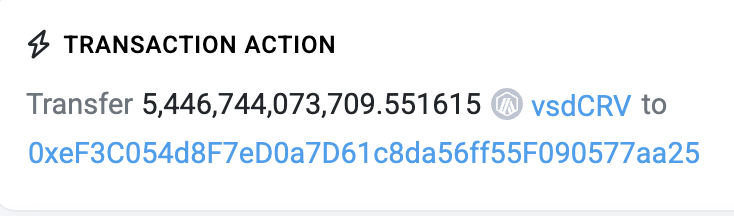 StakeDAO’s deployer private key was compromised on Arbitrum after an attacker minted 5.4T vsdCRV tokens and began swapping the funds into ETH2026-05
 Lawyer behind Arbitrum asset seizure case now targets Tether in bid to recover $344M in OFAC-frozen USDT linked to Iran’s Revolutionary Guard2026-05
 Whitehat hacker returns $190K out for $209K to Renegade protocol after exploiting flawed Arbitrum dark pool contract, keeping 10% bounty to avoid legal action2026-05
 Mastercard plans onchain settlement for 6 stablecoins across Ethereum, Solana, Base, Polygon, Arbitrum and XRPL2026-06
Arbitrum: A Comprehensive Guide to Ethereum’s Finance-Native Layer 2
Arbitrum is a family of Ethereum layer-2 (L2) networks designed to make onchain transactions cheaper and faster while still inheriting Ethereum’s security guarantees. It has evolved into a finance‑native platform for decentralized applications, asset tokenization, and dedicated blockchain environments that together power what many describe as the emerging programmable economy.
Arbitrum sits at the intersection of Ethereum, DeFi, and institutional finance, and is increasingly used as infrastructure for markets that run entirely in software. It uses optimistic rollup and AnyTrust technologies to process most computation off-chain while posting compressed data back to Ethereum, substantially reducing gas fees relative to mainnet transactions. Over time, the ecosystem has grown from a single general‑purpose rollup (Arbitrum One) into a broader platform that includes the ultra‑low‑cost Arbitrum Nova, a framework for launching custom Arbitrum chains, new execution environments such as Stylus for WebAssembly (WASM) smart contracts, and a governance system centered around the ARB token and the Arbitrum DAO. This explainer surveys the protocol design, the chain ecosystem, user and developer experience, governance, key markets, and the broader role Arbitrum is playing as Ethereum’s finance‑native scaling layer, while also situating it among competing L2s such as Optimism and zero‑knowledge rollups.
What Is Arbitrum?
Arbitrum is best understood as a family of Ethereum‑secured networks that aim to provide cheaper, higher‑throughput execution without sacrificing the core security properties that made Ethereum a dominant smart‑contract platform. In technical terms, Arbitrum One is an optimistic rollup: it executes transactions off‑chain, then periodically batches and posts data to Ethereum, where anyone can challenge incorrect results via fraud proofs. The system is engineered so that, as long as at least one honest validator is monitoring the chain, invalid state transitions can be detected and rolled back, meaning the chain’s safety ultimately derives from Ethereum’s consensus and the economic incentives layered on top.
From a user’s perspective, this complexity is largely abstracted away. The official documentation famously describes the experience as “for a user, it’s Ethereum, but faster and cheaper: you bridge in, do stuff, bridge out.” Wallets, addresses, and smart contracts look familiar because Arbitrum is designed for Ethereum Virtual Machine (EVM) equivalence, meaning that Solidity contracts can be deployed with minimal changes, and popular tools like MetaMask, Hardhat, and Ethers.js work more or less out of the box. This design choice has been critical for adoption, because it lowers the switching cost for developers and users migrating from mainnet or other EVM chains.
Beyond the base rollup, Arbitrum is positioning itself explicitly as a finance‑native platform. The Foundation and ecosystem partners describe its role as providing infrastructure not just for DeFi protocols but also for tokenized real‑world assets, institutional markets, and custom chains tailored to specific regulatory or performance needs. The platform is used for high‑volume derivatives trading, stablecoin settlement, tokenized securities, and even experimental markets such as tokenized compute power, all of which benefit from predictable execution, deep liquidity, and a tight relationship to Ethereum’s global settlement layer.
To support these diverse use cases, Arbitrum has evolved into a multi‑chain ecosystem. Arbitrum One is the flagship rollup used heavily for DeFi and general‑purpose applications. Arbitrum Nova is a separate mainnet chain optimized for gaming, social, and high‑throughput applications, built on the AnyTrust data‑availability model for even lower costs. On top of that, organizations can launch their own Arbitrum chains under a framework that provides customized execution, fee models, governance, and validation, while still connecting back to shared liquidity and Ethereum settlement. This modular architecture is central to Arbitrum’s strategy in the broader landscape of Ethereum scaling solutions.

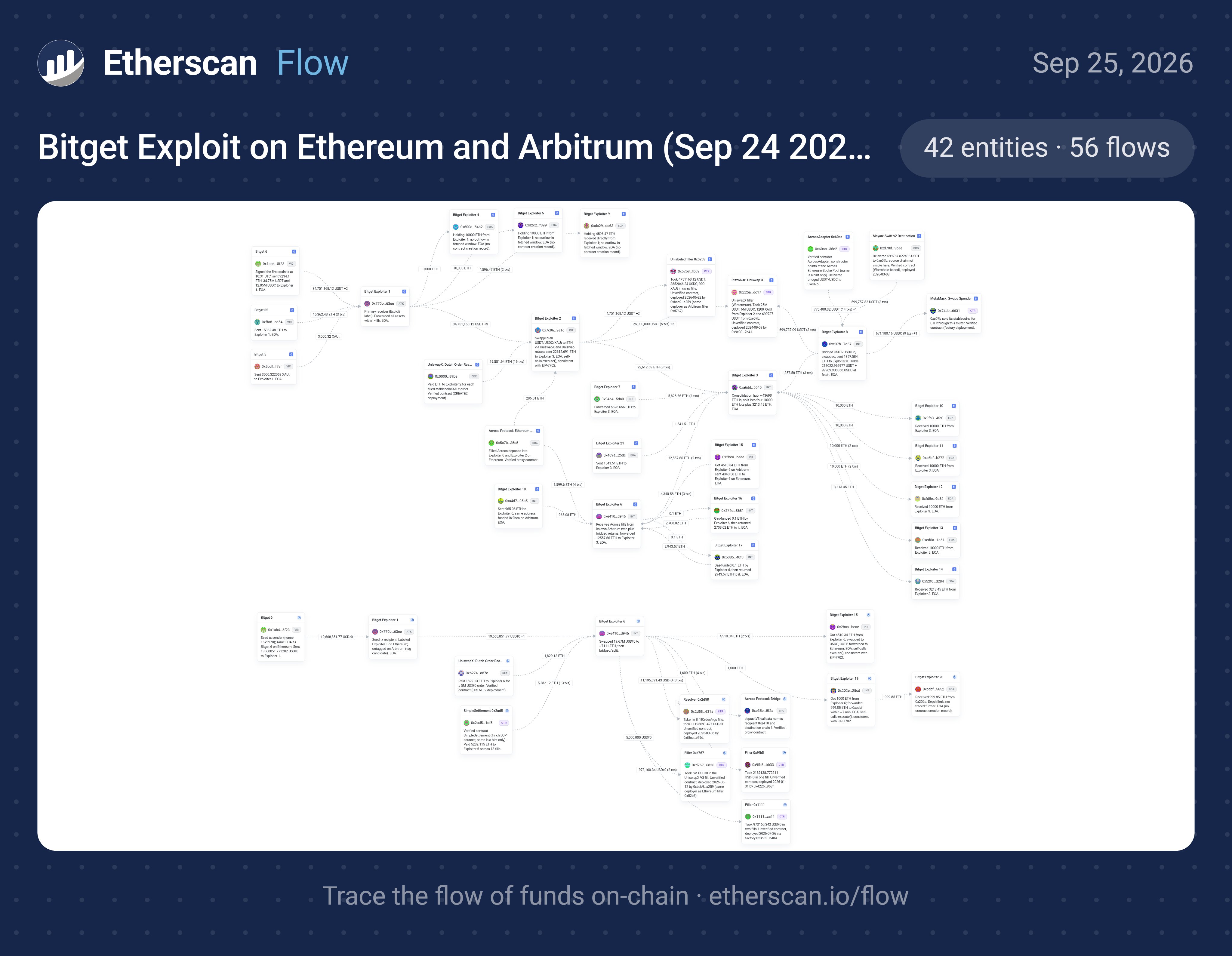
Etherscan maps transaction flows linked to the Bitget incident across Ethereum and Arbitrum, incorporating onchain references from multiple blockchain analysts
How Arbitrum Works Under the Hood
From Ethereum To Layer-2 Rollups
To understand Arbitrum’s design, it helps to situate it within Ethereum’s broader scaling roadmap. Ethereum offers a globally shared state machine with strong decentralization and security, but it has limited throughput and relatively high gas costs, especially during periods of heavy demand. Rather than attempting to scale by increasing block size or compromising on decentralization, Ethereum’s roadmap envisions a modular architecture in which the base layer focuses on data availability and settlement, while most execution moves to layer‑2 networks such as optimistic and zero‑knowledge rollups.
Arbitrum is part of the optimistic rollup camp. In an optimistic rollup, transactions are assumed to be valid by default and executed off‑chain by a specialized sequencer, which orders transactions and produces compressed batches. These batches, containing enough data to reconstruct the state transitions, are periodically posted to Ethereum. The assumption of validity is “optimistic” because it can be challenged: if any party believes the sequencer has included an invalid state transition, they can initiate a fraud‑proof process on Ethereum that replays the disputed computation and determines the correct outcome. This mechanism allows Arbitrum to scale execution without giving up Ethereum’s role as the ultimate arbiter of correctness.
An important consequence of this architecture is that Arbitrum’s security depends on data availability and the presence of at least one honest participant willing to challenge fraud. The rollup must ensure that all necessary transaction data are posted to Ethereum so that anyone can reconstruct the state. This is why Arbitrum’s base rollup design (as opposed to variants like AnyTrust) leans heavily on Ethereum for data availability: data is stored on Ethereum, making censorship or data withholding attacks much harder. The downside is cost, since publishing that data consumes Ethereum block space, but the upside is a security model that is as robust as Ethereum’s.
Users interact with Arbitrum by bridging assets, typically ETH and ERC‑20 tokens, from Ethereum or other chains. When a user deposits ETH into the canonical bridge contract on mainnet, the L2 sequencer mints a corresponding balance on Arbitrum, allowing them to transact with much lower fees and faster confirmation times. Withdrawing back to Ethereum involves initiating an exit on the L2 and waiting out the challenge period, during which anyone can contest the withdrawal if it relies on fraudulent state. This delay is an inherent feature of optimistic rollups, although users often rely on liquidity providers or cross‑chain bridges to obtain faster exits in practice.
Nitro, BoLD, and Fraud Proofs
Under the hood, Arbitrum’s current generation technology stack is known as Nitro, which powers Arbitrum One, Arbitrum Nova, and the broader Arbitrum chains ecosystem. Nitro uses a highly optimized EVM implementation, advanced compression, and a custom operating system (ArbOS) to manage the L2 execution environment. The Nitro stack has undergone multiple upgrades, with ArbOS releases adding features, performance improvements, and, increasingly, new virtual machines such as Stylus that coexist alongside the traditional EVM.
A key security innovation in this stack is the BoLD protocol, Arbitrum’s upgraded dispute‑resolution system for fraud proofs. In simple terms, BoLD governs what happens when two validators disagree about the result of a transaction or batch. Because all input data is posted on Ethereum, both validators can in principle execute the same code and arrive at a result; if they reach different conclusions, at least one must be wrong. BoLD orchestrates an interactive process in which the disagreeing parties narrow down the point of divergence step by step, eventually isolating a single instruction or state transition. Ethereum then executes just this minimal fragment on-chain to determine which party is correct, after which invalid claims can be penalized and the canonical chain continued.
This interactive fraud‑proof scheme is crucial for scalability because it avoids the need for Ethereum to re‑execute entire batches of L2 transactions. Instead, disputes are resolved by executing only a tiny amount of code on-chain, while the bulk of computation remains on Arbitrum. The system is designed so that it is always possible for an honest validator to prove fraud if it occurs, ensuring that the sequencer cannot get away with invalid state transitions as long as the economic incentives encourage at least one honest participant to monitor and challenge.
Costs on Arbitrum are kept low through several mechanisms that take advantage of this architecture. First, transaction data is batched and amortized: a single Ethereum transaction might contain hundreds of L2 transactions, spreading the L1 gas cost across many users. Second, Arbitrum compresses data before posting it on-chain, reducing the raw bytes that need to be stored and thus the gas consumed. Third, Ethereum’s EIP‑4844, sometimes called “proto‑danksharding,” introduced a dedicated data availability lane using “blob” space, which is significantly cheaper than traditional calldata. Arbitrum leverages these blobs to further reduce the cost of posting transaction data, resulting in an order‑of‑magnitude reduction in fees relative to older architectures. Finally, because Ethereum does not re‑execute Arbitrum’s transactions except in rare fraud‑proof cases, the base layer’s computational burden is minimized, allowing Ethereum to support many rollups in parallel.
AnyTrust and Data Availability
Not all Arbitrum chains use the same data availability model. While Arbitrum One operates as a full rollup that posts all data to Ethereum, Arbitrum Nova and some custom chains use a variant of the Nitro technology known as AnyTrust, which trades a small amount of additional trust for significantly lower costs. In the AnyTrust design, data availability is outsourced to a separate Data Availability Committee (DAC) rather than relying entirely on Ethereum.
The AnyTrust protocol assumes a committee of N members, of whom at least two are honest. Instead of posting full transaction data to Ethereum, the sequencer encrypts data and distributes it to the committee members, who sign off on its availability. Only a minimal amount of information is posted to Ethereum, such as a commitment to the data and committee signatures, which drastically reduces gas usage. If a dispute arises or data is withheld, honest committee members can reveal the relevant information. The assumption that at least two members remain honest is weaker than assuming a single honest participant, but it is still a trust assumption that goes beyond Ethereum’s base security model.
This trade‑off allows AnyTrust chains like Arbitrum Nova to deliver ultra‑low fees and very high throughput, making them suitable for applications where users demand sub‑cent transaction costs and can tolerate a mild additional trust assumption, such as gaming, social media, and advertising microtransactions. Nova is described as an EVM‑equivalent mainnet chain that uses ETH as the native gas token, with sub‑second block times and the capacity for thousands of transactions per second. In practice, this has enabled workloads involving hundreds of thousands to millions of daily transactions during peak usage for social and gaming applications, demonstrating the potential of combining Ethereum security with more flexible data availability solutions.
AnyTrust’s existence alongside the pure rollup model illustrates Arbitrum’s broader modular approach. Developers and enterprises can choose between full Ethereum‑backed data availability on Arbitrum One, AnyTrust‑based ultra‑low‑cost environments like Nova, or custom chains that calibrate their trust and performance assumptions to specific use cases. This flexibility is a key differentiator in a competitive L2 landscape that includes other optimistic rollups such as Optimism, as well as various zero‑knowledge rollups with their own performance‑security trade‑offs.
Readers don't click Arbitrum for its own technology narrative — they click to track which established DeFi protocols (Curve, Aave, Instadapp, Uniswap) chose Arbitrum as their multichain beachhead, treating it as a credibility signal for the protocol, not the chain.
The Arbitrum Chain Ecosystem
Arbitrum One: General-Purpose DeFi Hub
Arbitrum One is the flagship chain in the ecosystem and is widely viewed as one of the leading L2s for Ethereum‑based DeFi. Launched in 2021 by Offchain Labs, Arbitrum One quickly attracted exchanges, lending protocols, derivatives platforms, and other financial applications looking for lower transaction costs and faster confirmation times than were available on mainnet. Because it is EVM‑equivalent, developers were able to redeploy Solidity contracts with few or no changes, and user interfaces built for Ethereum could often be adapted with minimal effort.
The result is a dense financial ecosystem on Arbitrum One, characterized by deep liquidity and a broad array of markets. The network hosts some of the largest perpetual futures exchanges in crypto, with open interest across the Arbitrum perpetuals ecosystem exceeding 1.2 billion dollars in recent snapshots, and the variational_io exchange alone accounting for roughly 921 million in open interest. These derivatives platforms benefit from Arbitrum’s low fees, which make high‑frequency trading and complex strategies more economical, as well as from its close integration with Ethereum‑native stablecoins and collateral assets.
Beyond derivatives, Arbitrum One has become a home for spot DEXs, lending and borrowing markets, collateralized stablecoin protocols, and structured products. The ecosystem includes native protocols and deployments of established Ethereum projects, often with additional incentives funded through the ARB token or governance programs. For example, MUX Protocol, an aggregated perpetuals platform, integrated with GMX and Gains while also operating its own liquidity pool on Arbitrum; at one point it was described as having the third‑highest total value locked among on-chain perpetuals platforms, underscoring the concentration of derivatives liquidity on Arbitrum.
This concentration of liquidity has flywheel effects. As more traders and protocols deploy on Arbitrum One, more market makers and arbitrageurs are attracted to the network, further deepening order books and improving execution quality. This in turn strengthens the case for stablecoin issuers, institutional players, and tokenization platforms to treat Arbitrum as a primary settlement environment, because they can tap into existing liquidity rather than bootstrapping from scratch. The result is increasingly a self‑reinforcing perception of Arbitrum One as Ethereum’s finance‑native L2.
Arbitrum Nova: Ultra-Low-Cost For Social And Gaming
While Arbitrum One is designed as a general‑purpose rollup with a focus on finance, Arbitrum Nova targets a different segment: high‑throughput, ultra‑low‑fee applications such as gaming, social networks, and microtransaction‑heavy workloads. Nova is an EVM‑equivalent mainnet chain that leverages the AnyTrust data availability model to deliver sub‑cent average gas fees, typically in the range of fractions of a cent to a few cents, and sub‑second block production in the range of roughly a quarter to half a second. It uses ETH as the native gas token, preserving a familiar user experience and aligning with Ethereum’s broader economic structure.
Nova’s design makes it particularly well‑suited for use cases where users may not be willing to pay even a few cents per transaction, such as in‑game item transfers, tipping on social platforms, or ad‑driven microtransactions. Its ability to support burst throughput in the thousands of transactions per second has allowed it to handle workloads involving hundreds of thousands to millions of daily transactions during peak periods, especially in gaming and social contexts. Because it remains EVM‑compatible, developers can use familiar tooling and smart contract patterns, while end users can rely on wallets and interfaces that also work on Ethereum and Arbitrum One.
Although Nova is more specialized than Arbitrum One, it is part of a broader architectural vision in which different chains optimized for different workloads remain connected through shared infrastructure and liquidity. Projects building social or gaming experiences on Nova can tap into asset liquidity from Arbitrum One or Ethereum, while still offering near‑instant and near‑free interactions to end users. Conversely, financial applications on Arbitrum One can integrate with Nova‑based user interfaces to provide smoother onboarding and lower‑friction user experiences, particularly for small‑ticket transactions and rewards.
The ecosystem around Nova has been dynamic, with some projects expanding, pivoting, or winding down over time, reflecting a broader experimentation cycle across the gaming and social sectors. In weekly ecosystem updates, Nova has even been described as drifting into maintenance mode in certain phases, illustrating that specific networks and configurations may evolve as usage patterns change. Nevertheless, the underlying design of Nova as a high‑throughput, AnyTrust‑based L2 remains a key proof point for Arbitrum’s multi‑chain strategy and its willingness to explore different performance‑security combinations for different markets.
Custom Chains And Enterprise Deployments
In addition to Arbitrum One and Nova, the Arbitrum platform offers a framework for launching dedicated chains that run the Arbitrum technology stack but operate as separate networks with their own parameters, governance, and, in some cases, data availability choices. Organizations can launch Arbitrum chains with full control over execution logic, fee models, validator sets, and compliance features, enabling them to tailor the environment to specific business or regulatory requirements. This is a key element of Arbitrum’s positioning as a finance‑native platform rather than just a single L2.
The Arbitrum Foundation’s 2025 transparency report highlights the growth of this chain ecosystem, noting that more than 100 Arbitrum chains were live or in development during that period. These include chains launched by financial institutions, consumer applications, and infrastructure providers, as well as Robinhood Chain, which uses Arbitrum technology to support tokenized assets and integrated trading experiences for Robinhood’s customer base. Under the Arbitrum Chain Expansion framework, these chains contribute a portion of their net protocol revenue—reported as on the order of ten percent—back to the broader ecosystem, creating an economic flywheel that aligns the incentives of app‑specific chains with the shared liquidity environment of Arbitrum One and other networks.
Enterprise and institutional deployments illustrate how this model can be used to bridge traditional finance and onchain markets. The transparency report notes that Robinhood began offering tokenized U.S. equities and ETFs on Arbitrum One for European customers, growing to nearly two thousand tokenized assets within six months, and that major asset managers such as Franklin Templeton and WisdomTree expanded their tokenized financial products on Arbitrum. The value of real‑world assets (RWAs) on the network reportedly grew by a factor of seven year over year, surpassing 800 million dollars in aggregate, partly supported by DAO‑approved initiatives like the STEP program. These developments underscore how Arbitrum’s chain ecosystem and finance‑native positioning give it an edge in attracting tokenization projects.
Projects like AmericanFortress provide another example of institutional‑grade infrastructure built on Arbitrum. AmericanFortress announced a compliant privacy infrastructure on Arbitrum aimed at institutional and high‑volume DeFi activity, with features such as human‑readable names that map to automatically generated stealth addresses, designed to obscure transaction flows while maintaining compliance capabilities. The announcement explicitly frames Arbitrum as a finance‑native blockchain platform with infrastructure for applications, tokenization, and dedicated blockchain environments, emphasizing the platform’s suitability for programmable, software‑driven markets. Combined with chain‑specific deployments and collaborations with traditional financial players, these developments illustrate how custom Arbitrum chains and specialized infrastructure are extending the platform’s reach beyond purely retail or crypto‑native use cases.
Arbitrum For Users: Bridging, Fees, And Stablecoins
Bridging ETH And Tokens
For end users, the primary touchpoints with Arbitrum are bridging, transacting, and interacting with applications. Bridging usually starts on Ethereum mainnet, where a user locks ETH or ERC‑20 tokens into a canonical bridge contract; after a short delay, the corresponding assets are minted or credited on Arbitrum, allowing the user to transact in the L2 environment. This design preserves a clear relationship between the L1 and L2, with Ethereum serving as the ultimate source of truth about asset ownership, even as most day‑to‑day activity occurs on Arbitrum. Users can similarly bridge assets from Arbitrum back to Ethereum or to other L2s via cross‑chain protocols, often relying on liquidity providers to avoid the full challenge period associated with optimistic rollup exits.
On Arbitrum One, ETH is the native gas token, just as on Ethereum, and most popular ERC‑20 tokens are available through bridges or native issuance. On Arbitrum Nova, ETH is likewise used as the gas token, preserving consistency across the ecosystem and easing UX for users who hold ETH as their primary asset. Because Arbitrum is EVM‑equivalent, users can leverage familiar wallets such as MetaMask, Rabby, or Coinbase Wallet, and portfolio trackers that support Ethereum can typically be extended to include Arbitrum networks with minimal integration work. The bridging process has become sufficiently mainstream that many centralized services, including exchanges and fintech platforms, now support direct deposits and withdrawals to Arbitrum, bypassing Ethereum for retail users who are primarily interested in low‑fee onchain interactions.
As the ecosystem has grown, bridging between Arbitrum and other environments has extended beyond basic asset transfers into more complex workflows. For example, derivatives platforms running on Arbitrum are integrated with external venues like Hyperliquid, and guides have been published explaining how traders can bridge from Arbitrum to Hyperliquid to take advantage of cross‑platform arbitrage and yield strategies. These flows position Arbitrum as a liquidity hub within a multi‑chain trading stack, where ETH and stablecoin balances on Arbitrum can be quickly reallocated to specialized trading venues or app‑specific chains, often with both security and user experience benefits relative to bridging directly from mainnet Ethereum.
Fees, Performance, And EIP-4844
Arbitrum’s appeal for everyday users is closely tied to its fee structure and performance characteristics. As noted earlier, the Nitro stack lowers L1 costs through a combination of batching, compression, and the use of Ethereum’s EIP‑4844 blob space. Batching means that many L2 transactions are compressed into a single L1 transaction; compression reduces the byte size of posted data; and blobs provide a cheaper data availability lane than traditional calldata, collectively yielding significantly lower per‑transaction costs. Because Ethereum does not re‑execute Arbitrum’s transactions except when fraud proofs are triggered, the computational burden on the base layer is also minimized, allowing more capacity to be allocated to rollup data.
In practice, this means that routine transactions such as token swaps, lending interactions, or NFT transfers on Arbitrum typically cost a fraction of what they would on Ethereum mainnet, often by an order of magnitude or more, depending on network conditions on both layers. For high‑frequency traders and market‑makers, these savings can be substantial, enabling strategies that would be prohibitively expensive on mainnet. For casual users, low fees reduce the friction of interacting with DeFi, gaming, or social applications, especially when combined with fast confirmation times and the ability to batch multiple actions in a single transaction at the application level.
Performance on Arbitrum manifests not only in low fees but also in block times and throughput. The sequencer can confirm transactions within seconds or less, giving users a near‑instant sense of finality at the L2 level, even though absolute finality in an economic sense is contingent on L1 settlement and the challenge period. Throughput capacity is sufficient to handle heavy DeFi usage, including periods of volatility when trading volumes spike and gas prices increase. On Nova and other AnyTrust chains, sub‑second block times and the ability to handle thousands of transactions per second are reported, making them suitable for real‑time interactive applications and microtransaction flows.
EIP‑4844’s introduction of blob space has been particularly impactful for Arbitrum’s fee structure. By separating data availability from execution and offering a cheaper lane for rollup data, Ethereum has enabled L2s like Arbitrum to reduce their marginal cost of posting transaction data by roughly an order of magnitude relative to pre‑4844 conditions. This development aligns with Ethereum’s broader rollup‑centric roadmap and provides a path for further scaling as more execution load migrates off‑chain. For users, the impact is felt as persistently low fees even during periods of increased activity, which is critical for sustaining the programmable economy narrative that depends on high‑frequency, low‑value transactions being economically viable.
Stablecoins And USDC As Settlement Layer
An important dimension of Arbitrum’s role in the programmable economy is its emergence as a settlement layer for stablecoin‑denominated transactions. Stablecoins such as USDC have become the default settlement asset in many DeFi protocols, powering trading, lending, payments, and cross‑border value transfer. On Arbitrum, billions of dollars in stablecoins circulate across exchanges, money markets, and on‑chain treasuries, and millions of users hold stablecoins as their primary onchain balance. This concentration reflects both Arbitrum’s DeFi depth and the trend toward dollar‑denominated onchain finance.
Institutional and platform integrations reinforce this trend. Coinbase, for example, has been involved in deploying USDC on various chains and operating treasury strategies that distribute yield on USDC balances held across networks. In one recent configuration, Coinbase was described as the official treasury wallet deployer for USDC on HyperliquidX after the activation of a new architecture, with billions in USDC across Hyperliquid and Arbitrum collectively. Although that specific setup centers on Hyperliquid, the presence of more than a billion dollars in USDC on Arbitrum in that context underlines the network’s importance as a locus of stablecoin liquidity and yield‑bearing strategies.
Mainstream consumer platforms also point to Arbitrum’s growing role as stablecoin infrastructure. Cash App, a widely used payments application, has enabled USDC transfers across multiple chains including Solana, Ethereum, Polygon, and Arbitrum, with no fees and no separate wallet required for users in its initial rollout. This type of integration effectively abstracts away the complexity of chain selection for end users while treating Arbitrum as a first‑class settlement option alongside major L1s and other L2s. Similarly, payment networks such as Mastercard have announced plans for onchain settlement using stablecoins across several chains, including Ethereum, Solana, Base, Polygon, Arbitrum, and XRPL, indicating a view of Arbitrum as one of the core networks in a multi‑chain settlement stack.
These developments reinforce the idea that Arbitrum is not just a venue for speculative trading but a settlement layer for real economic activity, denominated primarily in stablecoins like USDC. As stablecoins become the operating capital of DeFi, institutional markets, and cross‑border payments, Arbitrum’s combination of low fees, EVM equivalence, and strong ties to Ethereum make it an attractive base for issuing and using these assets. The result is a feedback loop in which stablecoin usage deepens liquidity, which attracts more protocols and institutions, which in turn increases demand for stablecoin rails on Arbitrum.

Arbitrum rolls out priority gas auctions and fast feed for faster transactions.

Arbitrum For Developers: EVM, Stylus, And Tooling
EVM Equivalence And Compatibility
From a developer’s standpoint, one of Arbitrum’s core strengths is its EVM equivalence. Arbitrum One and Nova are designed to behave like Ethereum at the smart contract execution level, meaning that the same Solidity bytecode that runs on Ethereum can run on Arbitrum with essentially identical semantics. This compatibility extends to tooling, including compilers, testing frameworks, debugging tools, and frontend libraries. Developers can use familiar workflows with Hardhat or Foundry, deploy contracts using Truffle or direct RPC calls, and interact with them via Web3.js or Ethers.js without needing to learn a new virtual machine or execution model.
EVM equivalence is especially important for projects that maintain multi‑chain deployments. Many DeFi protocols operate on Ethereum, Arbitrum, Optimism, and sometimes other EVM chains. Arbitrum’s compatibility allows these teams to share codebases, security audits, and deployment scripts, simplifying governance across chains and reducing the risk of divergent code behavior. It also facilitates composability: protocols deployed on Arbitrum can integrate with each other using the same standards for tokens (such as ERC‑20, ERC‑721, and ERC‑4626) and middleware (such as price oracles) that they use on Ethereum.
On a more practical level, Arbitrum’s EVM equivalence means that developers can onboard users with minimal friction. Wallets that already support Ethereum can be configured to use Arbitrum by simply adding a network configuration, and DeFi interfaces can be adapted by switching RPC endpoints and chain IDs. This is particularly valuable when competing with other L2s and sidechains that may require more bespoke tooling or that introduce subtle differences in EVM semantics. While Optimism and some other optimistic rollups also pursue EVM equivalence, Arbitrum’s specific implementation within Nitro and its trajectory toward supporting additional execution environments via Stylus highlight its willingness to innovate beyond a strict Ethereum clone while preserving compatibility.
Stylus: WASM Smart Contracts In Rust And More
Stylus represents one of Arbitrum’s most ambitious technical upgrades, adding a second, coequal virtual machine alongside the EVM that can execute WebAssembly (WASM) smart contracts written in languages like Rust, C, and C++. Introduced as an upgrade to the Nitro stack (ArbOS 32), Stylus allows developers to write smart contracts in mainstream systems programming languages and compile them to WASM, which is then executed within the Arbitrum environment. EVM contracts continue to behave exactly as they do on Ethereum, but they now coexist with a parallel runtime that opens up new performance and tooling possibilities.
Stylus is particularly attractive for compute‑intensive workloads. Because WASM execution can be more efficient than EVM bytecode for certain types of operations, especially those involving complex in‑memory computations, cryptographic primitives, or numerical algorithms, Stylus contracts can offer substantially reduced gas costs for memory‑ and compute‑heavy logic. The Arbitrum documentation emphasizes that the gas advantages of Stylus are concentrated in computation rather than storage: if a contract mostly reads and writes storage with little computation, Solidity on the EVM may be preferable; but if the contract performs heavy cryptography, math‑heavy DeFi calculations, zero‑knowledge proof verification, or sophisticated in‑memory algorithms, Stylus can deliver meaningful cost savings.
A key design feature of Stylus is its interoperability with Solidity contracts. Because it operates as a second virtual machine within the same environment, Stylus contracts and traditional EVM contracts can call each other directly. This allows developers to build hybrid applications where performance‑critical components are written in Rust or C++ and compiled to WASM, while governance, access control, and other logic remain in Solidity for familiarity and auditability. It also enables developers to port existing Rust or C/C++ libraries into the smart contract environment, leveraging mature ecosystems and battle‑tested code for new use cases.
Stylus programs go through stages of coding, activation, execution, and proving. After a developer writes and deploys a Stylus contract, it must be activated and is subject to reactivation requirements, such as needing to be reactivated once per year or after Stylus upgrades, to ensure that contracts remain compatible with the evolving runtime. The proving stage integrates Stylus execution into Arbitrum’s broader fraud‑proof and verification system, ensuring that WASM contracts are subject to the same security guarantees as EVM contracts within the rollup framework. Collectively, these features make Stylus a powerful tool for developers building advanced financial infrastructure, high‑performance DeFi protocols, or applications that require heavy offchain computation to be replicated onchain.
Launching Chains And Ecosystem Programs
Beyond deploying contracts on Arbitrum One or Nova, developers and organizations can launch their own Arbitrum chains with configurable execution environments, fee models, governance structures, and validation schemes. The “Launch a Chain” framework allows teams to deploy chains that use the Arbitrum technology stack while tailoring parameters to specific use cases, such as institutional finance, gaming, or regulated markets. These chains can choose between rollup and AnyTrust data availability models, customize gas tokens and fee schedules, and embed compliance logic or whitelisted validator sets, all while remaining connected to a global settlement layer and shared liquidity pools.
The Arbitrum Foundation and DAO play an active role in supporting builders through grants, accelerator programs, and technical assistance. The Foundation’s 2025 report notes that it approved 189 ecosystem deals in a single year, supporting teams across DeFi, infrastructure, and consumer applications. Many of these were channeled through targeted initiatives such as Trailblazer, ArbiFuel, and the Audit Subsidy Program, which collectively provide capital, infrastructure credits, and security resources to help teams move from early development to production deployment. Founder enablement initiatives like Open House and events such as Arbitrum Founder House London bring together teams like tiltprotocol and bondoncredit—working on onchain hedge fund infrastructure and programmable credit markets for AI agents—with partners like Robinhood Chain, AWS, Offchain Labs, and other industry leaders to accelerate product launches on the Arbitrum platform.
These programs illustrate how the technical capabilities of Arbitrum, including EVM equivalence, Stylus, and customizable chains, are being matched with ecosystem‑level support to cultivate a pipeline of new projects. Some focus on DeFi primitives and derivatives, others on asset tokenization and RWAs, and still others on niche markets like tokenized compute or DAO tooling. By aligning grants, technical support, and governance incentives, Arbitrum aims to build not just a scalable execution environment but a self‑sustaining ecosystem where new markets can be launched, iterated on, and scaled.
- 01Curve ecosystem Arbitrum expansion↗
Multiple high-click headlines tied to Curve's Llama Lend markets, crvUSD pools, and Michael Egorov's direct ARB reinvestment made Arbitrum the visible center of Curve's multichain push.
- 02Institutional DeFi onboarding↗
Blackrock BUIDL's STEP application, Franklin Templeton's FOBXX launch, BitGo custody support, and Robinhood Wallet partnership signaled TradFi treating Arbitrum as the L2 of record.
- 03ARB grants and DAO treasury↗
The $40M STIP grant program (GMX as top recipient), the $3B DAO war chest, and the STEP RWA program collectively made Arbitrum's treasury deployment a recurring story readers tracked as a power signal.
- 04Arbitrum vs Solana narrative↗
Active-user comparisons, Cumberland's compute-capability question, and the ARB all-time-high framed as outpacing Solana's meme-coin boom fed a competitive 'underdog winning' storyline.
- 05DeFi protocol multichain arrivals↗
CoW Swap, Instadapp Fluid, Uniswap v4, and Aave GHO each generated clicks not for Arbitrum itself but for the milestone of a blue-chip protocol going live there, with incentive amounts as the hook.
- 06Arbitrum Stylus developer unlock↗
The Stylus launch allowing Rust/C++ smart contracts opened a new developer audience and was clicked as a technical differentiator against EVM-only competitors.
Governance, ARB Token, And The DAO
ARB Token And Airdrop
The ARB token is the primary governance token for the Arbitrum ecosystem, used to participate in decision‑making processes that shape the evolution of Arbitrum One, Nova, and the broader chain framework. ARB was initially distributed via an airdrop to early users and ecosystem participants, with eligibility and distribution rules published by the Arbitrum Foundation. According to the airdrop specifications, individual entitlements were determined based on onchain activity and other criteria, with a minimum airdrop size of 625 tokens and a maximum of 10,250 tokens for eligible addresses. This distribution aimed to reward early adopters while seeding a wide base of governance participants.
Following the airdrop, ARB began trading on major crypto exchanges, and its price has exhibited the volatility typical of governance tokens, influenced by broader market cycles, ecosystem news, and governance outcomes. Historical price data aggregators track ARB’s daily, weekly, and monthly closing prices, providing transparency into its market performance over time. While short‑term price moves attract trader attention, the long‑term significance of ARB lies in its role as a coordination mechanism for the Arbitrum DAO, where token holders can propose and vote on protocol upgrades, funding programs, and ecosystem‑level initiatives.
In addition to governance, ARB has sometimes been used in incentive programs to bootstrap liquidity or reward users of certain protocols, although its primary designed function is governance rather than fee payment or collateral. Gas fees on Arbitrum are paid in ETH, not ARB, aligning with Ethereum’s broader economic model and avoiding fragmentation of the fee token landscape. This separation between gas and governance tokens is common among L2s and reflects a desire to maintain ETH as the universal economic anchor while using governance tokens to manage protocol evolution.
Arbitrum DAO Structure And Governance Processes
The Arbitrum DAO is the community‑driven governance body for the Arbitrum ecosystem, composed of ARB holders who can submit, discuss, and vote on proposals. Governance discussions generally begin on the Arbitrum Governance Forum, an online venue where community members post proposals, debate their merits, and iterate on specifications before they are moved to on‑chain voting. Proposals cover a wide range of topics, including grant programs, sequencer fee policies, security council elections, and protocol upgrades.
One example of DAO‑driven funding is the Short‑Term Incentive Program (STIP), which allocated ARB tokens to various protocols to incentivize usage and liquidity. The MUX Protocol’s proposal in STIP Round 1 illustrates how this process works: MUX submitted a detailed plan explaining its integration with GMX and Gains and the role of its native liquidity pool, which was described as having among the highest TVL in the on‑chain perpetuals space. The DAO evaluated this proposal alongside others and voted on whether to approve the requested incentives, balancing ecosystem growth against concerns about token emissions and long‑term sustainability. This type of deliberation is central to the DAO’s function as a capital allocator and ecosystem steward.
Governance decisions often involve coordination between the DAO, the Arbitrum Foundation, and other stakeholders such as security councils or technical teams. The Foundation may provide transparency reports, strategic priorities, and legal or operational support, while the DAO sets high‑level parameters and approves major funding initiatives. Over time, this multi‑stakeholder governance model is intended to distribute power away from a single corporate entity and toward a more decentralized community, though in practice the balance between decentralization and operational efficiency remains an evolving point of debate.
Foundation, Transparency, And Public-Sector Engagement
The Arbitrum Foundation plays a significant role in guiding ecosystem strategy and engaging with external stakeholders, including traditional financial institutions, regulators, and public‑sector organizations. Its 2025 transparency report framed the year as a period of accelerated institutional adoption, highlighting collaborations with major asset managers and financial platforms. Robinhood’s launch of tokenized U.S. equities and ETFs for European customers on Arbitrum One, scaling to nearly two thousand tokenized assets, was cited as a landmark example of mainstream financial products moving onchain. Similarly, asset managers like Franklin Templeton and WisdomTree expanded their tokenized offerings on Arbitrum, contributing to a reported sevenfold increase in RWA value on the network year over year.
Beyond private‑sector finance, the Foundation has engaged with public‑sector and multilateral organizations on the role blockchain can play in digital governance. Over the past year, it has worked with the United Nations Development Programme (UNDP) on public‑sector innovation, culminating in the launch of a Blockchain Advisory Group where Arbitrum is a contributor to discussions about how blockchain infrastructure can support public‑sector applications. This engagement highlights the platform’s ambition to serve not only as a venue for private markets but also as a component of future digital public infrastructure.
Transparency initiatives, including detailed reporting on ecosystem deals, builder programs, and financial flows, are part of the Foundation’s efforts to build trust with both the DAO and external partners. By disclosing metrics such as the number of ecosystem deals approved (189 in 2025), the distribution of funding across sectors like DeFi and consumer applications, and the performance of chain expansion frameworks, the Foundation aims to make its actions legible and accountable to ARB holders and the broader community. This aligns with a broader trend among major L2s, including Optimism, toward more formalized governance and public accountability frameworks, as the financial stakes associated with these networks continue to grow.
Markets And Use Cases On Arbitrum
DeFi, Perpetuals, And Liquidity
Arbitrum’s core identity as a finance‑native platform is most visible in its DeFi ecosystem, particularly in derivatives and perpetual futures markets. The network hosts multiple perpetual DEXs and margin trading platforms, with combined open interest surpassing 1.2 billion dollars in recent snapshots, and the variational_io exchange alone ranking among the top three crypto perp exchanges by open interest with approximately 921 million. These platforms offer leverage, synthetic assets, and advanced order types, catering to retail and professional traders who require deep liquidity and low transaction costs.
Protocols like GMX, Gains, and MUX have used Arbitrum’s low fees and composability to build sophisticated trading systems that route orders across multiple liquidity pools, integrate with external price oracles, and provide rebates or rewards to liquidity providers. MUX, for instance, operates an aggregated perpetuals platform that plugs into GMX and Gains liquidity while also maintaining its own pool, which was described as having the third‑highest TVL among on‑chain perpetuals at one point. This kind of aggregated liquidity is easier to implement on Arbitrum than on Ethereum because gas costs for complex routing logic and frequent oracle updates are lower, making the economics of multi‑pool routing more favorable.
The presence of deep derivatives liquidity also benefits spot markets and lending protocols, which can anchor their pricing and risk models to robust on‑chain signals. Money markets on Arbitrum can offer leveraged yield strategies that rely on derivatives for hedging, while stablecoin issuers and RWA platforms can use on‑chain derivatives markets to manage duration or interest rate risk. Over time, this interconnected web of perps, spot, lending, and RWAs moves Arbitrum closer to the vision of a programmable financial system where each component is a composable smart contract that can be integrated into higher‑level strategies.
Tokenization, RWAs, And Programmable Finance
Asset tokenization—representing traditional financial assets or real‑world claims as onchain tokens—is a major thematic driver for Arbitrum’s institutional strategy. The Arbitrum Foundation’s transparency report notes that RWAs on the network exceeded 800 million dollars, with value growing by a factor of seven year over year, supported in part by DAO‑approved initiatives like the STEP program that targeted strategic tokenization efforts. Robinhood’s deployment of tokenized U.S. equities and ETFs for European customers on Arbitrum One, which grew to nearly two thousand tokenized assets within six months, exemplifies how traditional retail brokerage products can be brought onchain to benefit from programmable settlement and composability.
Other institutional players, such as Franklin Templeton and WisdomTree, have expanded tokenized funds and instruments on Arbitrum, tapping into the network’s DeFi ecosystem for secondary liquidity and leveraging its connection to Ethereum for global settlement. Platforms like RealityFi, associated with Bitget, have used Arbitrum as infrastructure for tokenized markets that connect assets to global capital pools, framing the move as part of a broader shift in which financial markets—previously siloed, jurisdiction‑bound, and intermediated—become software‑defined and globally accessible.
On the more experimental side, projects like USD.AI (USDAI) are exploring tokenized compute markets on Arbitrum. USDAI treats GPUs as programmable collateral, using tokens to represent compute capacity that can be lent, borrowed, and used as backing for credit. This creates a new category of compute‑backed credit markets that operate on Arbitrum, with loans such as a 98.1 million dollar facility cited as evidence of growing demand. Variational_io’s listing of private markets for companies like SpaceX, OpenAI, and Anthropic on Arbitrum further illustrates how traditionally illiquid private equity exposure can be made programmable, with tokenized representations of such assets traded on a perpetual DEX that taps into global liquidity.
These tokenization and programmable finance use cases rely heavily on Arbitrum’s core properties: low fees, deep liquidity, EVM compatibility, and tight coupling to Ethereum for settlement. As the programmable economy narrative gains traction, Arbitrum’s role as a “finance‑native” L2 means it is often the platform of choice for experiments in making new market verticals—whether equities, funds, private markets, or compute—operable through smart contracts and stablecoin‑denominated settlement.
Beyond Finance: Gaming, Social, And Advertising
Although finance is the dominant theme, Arbitrum’s ecosystem also includes gaming, social, and advertising use cases, particularly on Arbitrum Nova. Nova’s ultra‑low fees and high throughput make it ideal for in‑game economies and social interactions where users expect near‑instant confirmation and negligible transaction costs. Games can use Nova for item ownership, crafting, and trading, while social protocols can record posts, reactions, and tipping events onchain without imposing noticeable fees on users. The EVM‑equivalent environment ensures that these applications can still integrate with DeFi primitives or use standard token contracts.
A notable example of non‑financial experimentation is LG Electronics’ pilot of an onchain advertising network on Arbitrum. LG is testing how advertising markets, traditionally opaque and intermediated, can be brought onchain, with Arbitrum providing infrastructure for transparent bidding, impression recording, and settlement. Coverage has framed this initiative as a blockchain‑based bid for a global advertising market estimated in the hundreds of billions of dollars, suggesting that programmable ad impression tracking and payment flows could be a significant non‑financial application of L2 infrastructure. Such a network could leverage Nova for micro‑impression accounting while settling net flows in stablecoins on Arbitrum One or other chains.
More broadly, the combination of gaming, social, and advertising on Arbitrum demonstrates how the programmable economy extends beyond trading and lending. User attention, engagement, and content can be represented as onchain primitives that interact with financial components like rewards, tipping, and sponsorship payments. Nova’s architecture is particularly conducive to such experiments, while Arbitrum One provides the financial backbone for higher‑value transactions and long‑term settlement.
Privacy, Compliance, And Institutional DeFi
Institutional adoption of Arbitrum requires not only performance and liquidity but also privacy and compliance capabilities. AmericanFortress’s launch of a privacy infrastructure on Arbitrum for institutional and high‑volume DeFi activity is one example of efforts to meet these requirements. The system uses human‑readable “@names” that map to automatically generated stealth addresses, allowing users to send assets in a way that obscures public transaction histories while maintaining the ability to comply with regulatory requirements or audits. This approach seeks to balance the transparency of public blockchains with the confidentiality expectations of institutional finance.
Arbitrum’s characterization in the AmericanFortress announcement as a finance‑native blockchain platform underscores why it is seen as a suitable venue for such privacy layers. Because it already hosts one of the largest financial ecosystems on Ethereum, with deep liquidity and predictable execution, adding compliance‑oriented privacy rails on top enables institutions to use DeFi infrastructure without exposing all activity to public view. At the same time, the platform’s emphasis on programmable markets means that privacy solutions can be built as composable smart contracts that integrate with existing DeFi protocols rather than requiring entirely separate infrastructure.
Public‑sector and multilateral engagements, such as the collaboration with UNDP on blockchain’s role in public‑sector innovation and the launch of a Blockchain Advisory Group, also suggest that Arbitrum is being considered for applications that require careful balancing of transparency, privacy, and governance. Whether in the context of central bank digital currencies, government bond markets, or digital public services, these discussions involve questions about how to design systems that are programmable and transparent yet compatible with legal and privacy frameworks—a space where Arbitrum’s mix of rollup security, customizable chains, and privacy infrastructure may prove relevant.
ARU goes public with a token backed by allocated physical metals, including gold, silver, copper and platinum-group metals, held in Swiss custody, issued on Arbitrum and redeemable in kind

Risks, Security, And Incidents
Security Model And Challenges
Arbitrum’s security model is rooted in Ethereum’s consensus, but it introduces additional layers and assumptions that must be understood. For Arbitrum One, the optimistic rollup model relies on the posting of all necessary data to Ethereum and the availability of a fraud‑proof mechanism through protocols like BoLD. As long as the data remains available and at least one honest validator is willing and able to challenge fraudulent state transitions, the system can detect and revert invalid activity. This security model is robust in theory but depends on economic incentives and the operational readiness of validators and challengers.
Sequencer centralization is another consideration. Many L2s, including Arbitrum, initially operate with a relatively centralized sequencer that orders transactions, even if they are subject to fraud proofs and eventual decentralization roadmaps. While users benefit from fast confirmations and consistent UX, they are exposed to risks such as temporary censorship, ordering manipulation (MEV), or outages if the sequencer experiences downtime. Over time, governance processes and protocol upgrades aim to decentralize sequencing or introduce mechanisms for sequencer accountability, but the path and timelines vary across L2s.
For AnyTrust‑based chains like Arbitrum Nova, additional trust assumptions are introduced. Instead of relying solely on Ethereum for data availability, Nova outsources data storage to a Data Availability Committee and assumes that at least two of its N members remain honest. This model lowers costs but creates a potential failure mode if a majority of committee members collude or are compromised. As a result, AnyTrust chains are typically positioned for use cases where ultra‑low fees are essential and the user base is willing to accept a marginally weaker security model than a pure rollup. Understanding these trade‑offs is important for both developers and users when choosing where to deploy or hold assets.
Ecosystem Incidents And Operational Risks
Because Arbitrum is a programmable platform hosting many independent protocols, user risk often arises not from the base layer itself but from smart contract vulnerabilities, governance failures, and operational compromises at the application level. For instance, an incident involving an unauthorized mint of vsdCRV on Arbitrum highlighted the risks of key compromise and token contract misconfiguration. In that case, an attacker gained control of a deployer private key and minted trillions of vsdCRV tokens, then began swapping the funds into ETH, prompting emergency responses from affected protocols. Subsequent investigations suggested that core funds and most services were unaffected, but the episode underscored the importance of key management, contract upgradability controls, and incident response capabilities within the Arbitrum ecosystem.
Similarly, operational decisions by projects can lead to shifts in the ecosystem’s structure. Weekly project updates have documented cases where projects on Arbitrum Nova drift into maintenance mode, infrastructure experiments like Botanix wind down, or NFT games and social projects cease operations. While these are not security incidents per se, they represent platform risk for users who hold tokens or assets tied to specific applications. Arbitrum’s modular chain architecture and relatively low deployment costs make it easy to experiment, but they also increase the likelihood that some experiments will fail, requiring users and investors to manage protocol‑specific risk separately from base‑layer security.
Bridge‑related risks are another important category. While Arbitrum’s canonical bridge between Ethereum and Arbitrum is part of the protocol’s core design, many users rely on third‑party bridges or liquidity networks to move assets quickly across chains, including from Arbitrum to specialized venues like Hyperliquid. These bridges can introduce additional attack surfaces, including contract vulnerabilities, validator collusion, and misconfigured liquidity management. As cross‑chain strategies become more common in the programmable economy, understanding the security properties of each bridge and the trade‑offs between speed, cost, and trust assumptions becomes essential.
Regulatory And Governance Risks
As Arbitrum’s role in DeFi, RWAs, and institutional markets expands, regulatory and governance risks take on greater importance. On the regulatory side, questions about the legal status of governance tokens like ARB, the classification of onchain derivatives and tokenized securities, and the obligations of stablecoin issuers and financial institutions using Arbitrum remain areas of active debate. Regulatory developments in major jurisdictions can impact the ability of protocols to operate, the willingness of institutions to deploy capital, and the design of compliance features on Arbitrum chains.
Governance risks include both process and outcome uncertainties. While the Arbitrum DAO provides a framework for decentralized decision‑making, concentration of token holdings, low voter participation, or information asymmetries can lead to outcomes that do not reflect the broader community’s preferences. Controversies around funding programs, disagreements over chain expansion frameworks, or debates about sequencer decentralization can create uncertainty for developers and users. The interplay between the DAO, the Arbitrum Foundation, and other stakeholders must be managed carefully to maintain alignment and avoid governance capture, especially as the economic value secured by Arbitrum continues to grow.
Arbitrum One mainnet launch
Arbitrum Nova (AnyTrust) mainnet for gaming/social
ARB token airdrop and DAO governance launch
STIP $40M grant program — GMX largest recipient
Ethereum Dencun upgrade cuts Arbitrum fees via EIP-4844 blobs
Arbitrum Stylus launch enabling Rust/C++ smart contracts
BlackRock BUIDL applies for Arbitrum STEP RWA program
Franklin Templeton FOBXX on-chain money market fund deploys on Arbitrum
How Arbitrum Compares To Other Ethereum Scaling Solutions
Optimistic vs ZK Rollups
Ethereum’s L2 landscape includes both optimistic rollups like Arbitrum and Optimism, and zero‑knowledge (ZK) rollups such as zkSync and Starknet. The fundamental difference lies in how they ensure correctness of off‑chain execution. Optimistic rollups assume transactions are valid and rely on fraud proofs to catch incorrect state transitions, with a challenge period during which withdrawals can be contested. ZK rollups, by contrast, generate cryptographic validity proofs (zero‑knowledge proofs) that attest to the correctness of batched state transitions, allowing Ethereum to verify them without re‑execution and without requiring a challenge period.
Each approach has trade‑offs. Optimistic rollups like Arbitrum benefit from simpler prover infrastructure and EVM compatibility, which has allowed them to achieve scale earlier and support existing Solidity ecosystems with minimal friction. However, they impose a withdrawal delay due to the challenge period, and their security depends on the presence of honest challengers and robust fraud‑proof systems like BoLD. ZK rollups can, in principle, offer faster finality and stronger guarantees without reliance on challengers, but they require more complex prover hardware and software and have historically faced challenges achieving full EVM equivalence at scale.
Arbitrum’s strategy has been to lean into the strengths of optimistic rollups—EVM equivalence, mature tooling, and easier integration with existing DeFi—and to extend its capabilities through innovations like Stylus and AnyTrust rather than attempting to compete purely on proof technology. As Ethereum continues to evolve, it is likely that both optimistic and ZK rollups will coexist, with different architectures better suited to different use cases or regulatory environments.
Arbitrum vs Optimism
Arbitrum and Optimism are often mentioned together as leading optimistic rollups for Ethereum. Both aim to provide scalable, low‑fee environments with EVM equivalence, and both have governance tokens (ARB and OP) and DAO‑like structures. From a user perspective, the experience of bridging ETH, paying gas, and interacting with DeFi protocols is broadly similar. Differences emerge in technical implementation details, governance philosophies, and ecosystem composition.
On the technical side, Arbitrum’s Nitro stack and BoLD fraud‑proof system represent one set of design choices, while Optimism’s Bedrock architecture and fault‑proof plans represent another. Both seek to minimize L1 costs through batching and compression, and both are integrating with Ethereum’s EIP‑4844 blob space, but their approaches to decentralizing sequencers, enabling permissionless validation, and supporting new execution environments differ. Arbitrum’s introduction of Stylus as a coequal WASM virtual machine is a distinctive move toward multi‑VM support that allows Rust and C++ contracts to run alongside Solidity. Optimism, for its part, has focused on building the OP Stack and fostering a network of chains like Base, emphasizing a “superchain” vision.
In governance terms, Arbitrum’s DAO and Foundation structure, with transparent reporting on ecosystem deals and chain expansion frameworks, reflects one approach to balancing decentralization and coordination. Optimism’s Collective, with experiments in retroactive public goods funding and “citizenship,” reflects another. For developers and institutions choosing between Arbitrum and Optimism, considerations may include not only technical performance and fees but also governance stability, ecosystem partners, and alignment with long‑term strategic goals. Many multi‑chain projects choose to deploy on both networks, leveraging their respective strengths and diversifying platform risk.
Arbitrum vs Base and Other L2s
Beyond Optimism, Arbitrum competes and collaborates with a range of L2s and sidechains, including Base (built on the OP Stack), Polygon’s various scaling solutions, and ZK rollups like zkSync and Starknet. Base, backed by Coinbase, positions itself as a developer‑friendly L2 closely integrated with Coinbase’s products and user base, while Polygon offers a multi‑chain ecosystem that includes sidechains, ZK rollups, and enterprise chains. In this environment, Arbitrum’s differentiation lies in its finance‑native focus, its combination of rollup and AnyTrust chains, and its willingness to support custom chains with revenue‑sharing frameworks.
For institutions and tokenization platforms, selecting Arbitrum over alternatives may come down to the maturity of its DeFi ecosystem, availability of privacy and compliance infrastructure, and the depth of its builder programs and ecosystem support. For developers and retail users, the choice may hinge on specific protocol deployments, user experience, and the perceived reliability of each network. As more applications abstract away chain selection—through wallets that route transactions to the “best” L2 or through custodial platforms that support multiple chains—Arbitrum’s challenge is to remain part of the default set of infrastructure choices for both developers and end users in a multi‑chain world.
Conclusion
Arbitrum has evolved from a single optimistic rollup into a broad platform for scalable, Ethereum‑secured computation that is increasingly finance‑native in both technology and use cases. Its core rollup, Arbitrum One, leverages the Nitro stack, BoLD fraud proofs, and Ethereum’s EIP‑4844 upgrade to offer low‑fee, high‑throughput execution while maintaining a strong security link to Ethereum. Arbitrum Nova and the AnyTrust protocol extend this model to ultra‑low‑cost, high‑throughput applications where modest additional trust assumptions are acceptable, enabling gaming, social, and advertising use cases that require microtransactions at scale. The framework for launching custom Arbitrum chains allows enterprises and protocols to tailor their own environments, contributing to an expanding chain ecosystem that feeds back into shared liquidity and governance.
For users, Arbitrum offers a familiar Ethereum‑like experience with cheaper and faster transactions, anchored by ETH as the gas token and bridged assets such as USDC for settlement. For developers, EVM equivalence, Stylus’s WASM capabilities, and robust tooling make it an attractive environment for both traditional Solidity‑based DeFi and cutting‑edge compute‑intensive applications. Governance via the ARB token and the Arbitrum DAO provides a mechanism for community control and ecosystem funding, supported by the Arbitrum Foundation’s transparency and strategic initiatives. Across DeFi, RWAs, tokenized compute, gaming, and even onchain advertising, Arbitrum is emerging as a key venue for the programmable economy, where markets, transactions, and business processes are encoded in software and executed on a globally accessible, Ethereum‑secured substrate.
Rapid multichain deployments of complex protocols (Curve Llama Lend, Aave v3, GMX v2) compress audit timelines; the Profanity vanity-address compromise that threatened non-Arbitrum deployers illustrates toolchain risk at the deployment layer.
Arbitrum One runs a single sequencer operated by Offchain Labs; BOLD dispute protocol upgrades are in progress to decentralize fraud proofs, but sequencer centralization remains unresolved.
BlackRock BUIDL and Franklin Templeton FOBXX participation in the STEP program brings regulated-asset infrastructure onto an L2 still operating under a multi-sig security council, creating a compliance surface regulators have not yet formally addressed.
A significant share of Arbitrum TVL is incentive-driven via STIP and LTIPP grant programs; protocol liquidity concentrated in GMX, Curve, and Aave could rotate rapidly if grant epochs end without sustained organic yield.
ARB token has shown sharp drawdowns concurrent with ecosystem growth (active users outpacing Solana while token value declined), suggesting token value is loosely coupled to network usage under the current governance model.
A documented gas exhaustion event ('Arbitrum runs out of gas') demonstrated sequencer throughput limits under load, though the chain recovered without funds at risk.
Outlook
Looking ahead, Arbitrum’s trajectory will be shaped by several converging forces. On the technical front, continued optimization of Nitro, broader adoption of Stylus, and further integration with Ethereum’s scaling roadmap—including eventual full data sharding—could push fees even lower and make more complex applications economically viable. On the ecosystem side, the growth of tokenized assets, institutional DeFi, and programmable credit and compute markets will test Arbitrum’s ability to serve as both a high‑performance execution layer and a trusted settlement environment. Governance evolution through the Arbitrum DAO and Foundation, including decisions about sequencer decentralization, chain expansion, and funding priorities, will influence how resilient and adaptable the platform remains in the face of regulatory and competitive pressures.
In a multi‑chain world that includes other optimistic rollups like Optimism, ZK rollups, and L1 alternatives, Arbitrum’s challenge is to maintain its position as a default infrastructure choice for finance‑native applications while extending its reach into adjacent domains like gaming, social, and digital public infrastructure. If it can continue to balance security, scalability, and programmability while aligning incentives among developers, institutions, and the DAO, Arbitrum is likely to remain a central pillar in Ethereum’s broader L2 ecosystem and a key engine of the programmable economy.
Latest Arbitrum news
Etherscan maps transaction flows linked to the Bitget incident across Ethereum and Arbitrum, incorporating onchain references from multiple blockchain analystsArbitrum rolls out priority gas auctions and fast feed for faster transactions.ARU goes public with a token backed by allocated physical metals, including gold, silver, copper and platinum-group metals, held in Swiss custody, issued on Arbitrum and redeemable in kind ARU launches on Arbitrum One with physically backed commodity reserve
Sources
19 records from 10 domains
docs.arbitrum.io
- docs.arbitrum.io· get-started / arbitrum-introduction
- docs.arbitrum.io· run-arbitrum-node / arbos-releases / overview
- docs.arbitrum.io· stylus / gentle-introduction
- docs.arbitrum.io· how-arbitrum-works / deep-dives / anytrust-protocol
- docs.arbitrum.io· how-arbitrum-works / bold / bold-technical-deep-dive
arbitrum.io
dune.com
thirdweb.com
docs.arbitrum.foundation
forum.arbitrum.foundation
blog.arbitrum.foundation
x.com
tradingview.com
coinmarketcap.com
Community notes
Spot something off or out of date? Drop a note. Editors review topic notes daily and roll accepted fixes into the explainer — contributors are recognized in the monthly $SQUID drop.
Loading notes…
Help improve this topic
Have a story or tip about this topic? Submit it. See something missing? Leave a note. Editors review daily; accepted submissions and fixes count toward the monthly $SQUID drop.