
In-depth blockchain explainer for crypto readers, covering fundamentals, stablecoins and USDC, tokenization, DeFi, AI agents, regulation, security, and institutional adoption to help you make sense of the onchain financial system’s next decade.
- x.com76
- coindesk.com19
- theblock.co16
- cointelegraph.com11
- prnewswire.com9
- globenewswire.com6
- chainwire.org4
+90 sources across the wider coverage universe
 Beyond the sky: The story of how Jeff built Hyperliquid, a blockchain and crypto trading exchange, into the most profitable startup per employee on earth.2026-04
 Operation Atlantic deploys real-time blockchain tracing to disrupt $83.8M in crypto approval phishing2026-04
 Coinbase teams up with US Secret Service and UK NCA to freeze $12M stolen via phishing, identifying over 20,000 victims as blockchain speed outpaces traditional finance response times2026-04
 SkyMapper taps Avalanche to secure global telescope data, launching blockchain network to turn astronomical observations into immutable, verifiable records2026-04
 South Korea to pilot blockchain-based deposit tokens replacing government expense cards, targeting full rollout by Q4 as public sector payments go onchain2026-04
 Alchemy integrates with Canton Network, joining 800+ validators and major financial giants to scale $8T+ tokenized asset ecosystem for institutional blockchain adoption2026-04
Blockchain: An Evergreen Explainer for the Onchain Era
At its core, this technology is a shared, tamper-evident ledger that lets many parties record, verify, and synchronize transactions without relying on a single central intermediary. In practice, that deceptively simple idea is reshaping how value moves, how markets settle, and how software itself behaves, forming the backbone for cryptoassets, tokenized markets, decentralized finance (DeFi), stablecoins such as USDC, and a new generation of AI-powered “agentic” systems that transact directly onchain.
Foundations: What Blockchain Actually Is
The simplest way to understand a blockchain is as a database that is maintained collectively by a network rather than by one administrator. Instead of a bank or clearinghouse holding the authoritative ledger, thousands of computers—called nodes—each maintain a copy of the same record of transactions and use a consensus protocol to agree on updates. Every set of new transactions is grouped into a block, cryptographically linked to the previous block, forming an append-only chain that is extremely hard to rewrite without controlling much of the network’s power. This structure delivers a form of distributed trust: participants can verify the full history themselves, rather than trusting a black-box intermediary.
Authoritative technical overviews emphasize three properties that distinguish blockchains from conventional databases: decentralization, immutability, and transparency. Decentralization means no single entity has unilateral control over writes to the ledger; instead, rules are enforced by software and consensus among nodes. Immutability follows from the use of cryptographic hashes to link blocks, making changes to historical data immediately detectable and economically costly. Transparency arises because the ledger is typically replicated and auditable, allowing anyone to inspect transaction histories even if participants are pseudonymous. Together, these properties explain why blockchains became attractive first for censorship-resistant money like Bitcoin and later for programmable financial infrastructure.
The term “blockchain” now spans several architectural families rather than a single canonical design. Public or permissionless networks, such as Bitcoin and Ethereum, are open to anyone to join, validate, and transact, using economic incentives and cryptography rather than identity-based access to keep participants honest. Permissioned or consortium blockchains restrict validation to known entities—like banks in a trade finance network—who may rely on legal agreements and governance frameworks alongside cryptographic safeguards. Hybrid designs blur this line, for example by using public networks for settlement while maintaining private data offchain. This diversity reflects the fact that blockchain is not one product but a design space for distributed ledgers.
A persistent misconception in public discourse is that blockchain and crypto are synonymous. In practice, blockchain is the underlying distributed database technology, while crypto refers to the broader ecosystem of cryptographically-secured digital assets, protocols, and applications built on top of that infrastructure. Many enterprise deployments use blockchain for provenance or interbank settlement without issuing a volatile token; conversely, most public crypto networks rely on a blockchain to coordinate ownership and enable open participation. For a crypto-focused audience, the key point is that blockchain is the settlement and state layer that makes onchain assets, markets, and applications possible.
From Ledgers to Distributed Ledgers
Historically, financial systems have relied on centralized ledgers maintained by trusted institutions such as banks, central securities depositories, or clearinghouses. These entities prevent double spending, track asset ownership, and resolve disputes, but they also introduce latency, cost, and single points of failure. The conceptual leap of blockchain is to replace institutional trust with verifiable computation and shared state. Instead of trusting that a bank will update your balance correctly, you can verify every change directly in the shared ledger, with consensus rules ensuring only valid transactions are accepted.
The National Institute of Standards and Technology (NIST) describes blockchain as a specific type of distributed ledger where data is structured in sequential blocks and secured using cryptographic techniques. Each block contains a batch of transactions, a timestamp, and a reference (typically a hash) to the previous block, creating a chronological record that cannot be changed without altering all subsequent blocks. Because the ledger is replicated across many nodes, availability is high and there is no single database to corrupt or censor. This is why blockchains are sometimes described as “trustless” systems, even though in practice users are choosing to trust the protocol and its governance rather than a single institution.
IBM’s enterprise-focused overview adds an important nuance: blockchains are particularly useful when multiple parties who do not fully trust one another need to share a common view of data and coordinate business processes. In such settings, traditional approaches such as bilateral reconciliation, central hubs, and batch settlement add complexity and delay. A shared ledger, by contrast, can become the single source of truth for asset registries, trade records, or payment flows, with smart contracts automating many of the rules that would otherwise be enforced by operations teams. This is precisely why banks, payment networks, and market infrastructures are experimenting with moving key functions “onchain.”
Types of Blockchains and Where They Show Up
Differentiating between public and permissioned blockchains is more than a technical detail; it shapes the kind of applications that are feasible and the regulatory environment around them. Public networks like Bitcoin and Ethereum offer maximal openness and composability. Anyone can create a wallet, deploy a smart contract, or build a DeFi protocol that interacts with existing assets, without seeking permission. This has enabled rapid innovation but also attracted speculative excess, hacks, and regulatory scrutiny.
Permissioned or consortium chains, often used in enterprise and interbank contexts, trade some openness for more predictable governance and compliance. Participants are typically known institutions operating under legal agreements, and consensus mechanisms may be optimized for performance rather than open participation. Projects like central bank digital currency (CBDC) platforms and interbank settlement networks often adopt this model, sometimes complemented by public-chain connectivity for cross-border or retail-facing components. The boundaries are increasingly porous, as tokenization initiatives bridge traditional securities infrastructure and public DeFi liquidity.
A final distinction that matters in practice is between Layer 1 blockchains—the base consensus and data availability networks—and Layer 2 or higher-layer protocols built atop them. While this taxonomy is not explicit in classical technical overviews, it is critical for understanding today’s crypto markets. Base layers like Bitcoin, Ethereum, or Algorand provide security and settlement guarantees; rollups, payment channels, and application-specific chains offload computation and achieve higher throughput while relying on the underlying chain for finality. This modularity is central to current debates about scalability and performance.

Google and Apple are hiring crypto talent as job listings point to potential projects involving stablecoins, tokenized deposits and blockchain infrastructure

How Blockchain Works Under the Hood
To appreciate what blockchain enables for crypto, payments, and AI-driven markets, it is necessary to understand its core technical building blocks: data structures, cryptography, and consensus. Although implementations differ, the underlying patterns are consistent across most major networks.
Data, Blocks, and Cryptography
At the most granular level, blockchains record transactions, which are state transitions. A transaction might transfer coins from one address to another, update the ownership of a tokenized bond, or invoke a smart contract to modify its internal state. Each transaction is digitally signed by the owner of the relevant private key, allowing nodes to verify that the sender is authorized to spend or act. Because signatures are checked by every validating node, end-to-end integrity is enforced collectively rather than by a single system administrator.
These transactions are grouped into blocks. A block typically contains a header, which includes metadata such as a timestamp, a reference (hash) to the previous block, and a root hash summarizing all transactions, as well as the body containing the actual transaction data. Many blockchains use Merkle trees or similar hash-based data structures so that the entire set of transactions in a block can be committed to with a single hash, enabling efficient proofs of inclusion. This is what allows lightweight clients to verify that a particular transaction was included without storing the full chain.
Cryptographic hash functions underpin the immutability of the blockchain. A hash function maps arbitrary input data to a fixed-length output such that even a tiny change in the input produces an unpredictable and unrelated output. By including the hash of the previous block in the current block, the chain forms a linked structure where altering any historical transaction would change the hash of its block and all subsequent blocks. Because consensus requires nodes to agree on the longest or otherwise valid chain, an attacker would have to recompute and propagate an alternative history faster than honest nodes can extend the legitimate chain, which is economically and technically prohibitive under normal assumptions.
Public-key cryptography provides the basis for ownership and authentication on blockchains. Users generate key pairs where the private key remains secret and the public key or address is shared. When a transaction is signed, anyone can verify the signature using the public key, confirming that the transaction could only have been produced by someone with the corresponding private key. In smart contract platforms, signatures are also used to authorize contract calls, and smart contracts themselves can enforce that only certain keys or multisignature arrangements are permitted to execute specific functions.
Consensus and Finality
Decentralized consensus is the process by which nodes agree on which transactions to include and in what order. Classical consensus research predated blockchain, but public blockchains had to solve a harder version of the problem, where participants may be unknown, geographically distributed, and economically incentivized to cheat. Bitcoin’s proof-of-work (PoW) approach aligns incentives by requiring miners to expend computational energy to propose valid blocks; the longest chain with the most accumulated work is considered canonical, making it expensive to rewrite history.
Subsequent networks explored alternative consensus mechanisms, particularly proof-of-stake (PoS), where validators lock up tokens as collateral and are rewarded for honest participation or penalized for misbehavior. Some PoS systems also adopt Byzantine fault-tolerant (BFT) algorithms to provide faster finality, so that once a block is confirmed by a supermajority of validators, it is extremely unlikely to be reverted. Research on software-defined blockchains further integrates consensus logic with programmable network control, for example in Internet-of-Vehicles contexts where smart contracts can help verify signatures and update state after each transaction. These innovations attempt to balance performance, energy efficiency, and security.
Finality is a key concept for markets and payments. In traditional finance, settlement finality is a legal concept that determines when obligations are irrevocably discharged. On blockchains, probabilistic finality in PoW systems arises as blocks accumulate on top of a transaction; the more confirmations, the harder it is to reorganize the chain. In BFT-style PoS systems, finality can be explicit once a block is justified by a quorum of validators. These properties matter when tokenized securities or high-value payments are moved onchain, since institutions must align operational and legal definitions of final settlement with the technical behavior of the network.
Because consensus protocols define how value is created and secured, they are also governance levers. For example, when Algorand published a roadmap to achieve quantum resistance by 2028, it signaled not only a cryptographic transition but also a multi-year coordination process among validators, users, and developers to adopt new primitives without fragmenting the network. Similar considerations apply when networks change staking economics, transaction fee models, or validator sets; such changes can materially alter incentives and security guarantees.
Smart Contracts and Onchain Logic
If blockchains provide a shared state machine, smart contracts are the programmable logic that runs on that machine. IBM defines smart contracts as digital contracts stored on a blockchain that automatically execute when predetermined conditions are met. Conceptually, they implement “if/when…then…” statements in code: if party A deposits collateral and market price crosses a threshold, then the protocol will release funds or trigger a liquidation without human intervention. A network of nodes executes this logic and updates the shared state when conditions are satisfied and verified.
On platforms such as Ethereum, smart contracts are deployed as programs whose code and state live onchain. Users and other contracts send transactions invoking specific functions, passing data, and paying gas fees for computation and storage. Because all validating nodes must execute the same code and arrive at the same result, the environment is intentionally deterministic and restricted; external data is brought in via oracles rather than direct system calls. Within those constraints, contracts can represent tokens, exchanges, lending protocols, onchain governance, and much more.
Smart contracts are also central to emerging software-defined blockchain architectures in specialized domains. Research on software-defined blockchains for the Internet of Vehicles, for example, uses contracts to verify the correctness of transaction signatures and to update pre- and post-transaction states, integrating real-world sensor data with onchain rules. In DeFi, contracts manage liquidity pools, calculate interest rates, and distribute rewards according to codified algorithms. In confidential finance, such as Zama’s confidential USDC (cUSDC) lending integration with Morpho and Steakhouse vaults, contracts orchestrate complex flows while leveraging cryptography to keep individual positions private.
The deterministic, open, and composable nature of smart contracts has profound implications. It allows developers to build modular financial primitives that others can integrate without bilateral negotiations, enabling the “money Legos” ethos that accelerated DeFi’s growth. It also creates attractive targets for attackers: a bug in a single contract can expose all funds locked in it, and exploits can propagate across integrated protocols. Consequently, security auditing, formal verification, and conservative governance have become central disciplines in serious onchain development.
Readers click blockchain stories when the infrastructure is already live and handling real money — not when it is promised: SWIFT banks going live, a $22B HELOC ledger, Paxos clearing US securities, and Stripe building its own rails all outperformed every governance or technology-explanation angle, revealing that the audience has moved past 'could blockchain work?' to 'who is winning the race to own the plumbing?'
Crypto, Stablecoins, and the Future of Payments
Although blockchains can record any kind of state, their first and most visible application has been digital money. Understanding how cryptoassets and stablecoins use blockchain as a settlement layer is essential to grasping where payments, remittances, and financial infrastructure may be headed.
Native Cryptoassets and Payment Use Cases
Bitcoin introduced the idea of a purely peer-to-peer electronic cash system where users can send value directly without intermediaries, with the blockchain serving as a public ledger of all transactions. While Bitcoin itself functions today more as a store of value and collateral asset than as everyday cash, its design demonstrated that a decentralized network could achieve global, censorship-resistant settlement. Subsequent networks extended this model to programmable platforms like Ethereum and to payment-focused chains that optimize for throughput and low fees.
In the payments industry, incumbent networks have been exploring where blockchain fits into existing rails. Interviews with senior executives at firms such as Mastercard highlight that blockchain is increasingly seen less as a speculative asset class and more as an enabling infrastructure for the “future of payments,” especially for cross-border use cases and digital-native commerce. Such leaders operate at the intersection of card networks, banks, and crypto-native ecosystems, and their perspectives reflect an emerging consensus: blockchains are unlikely to replace payment networks wholesale, but they can streamline settlement, reduce counterparty risk, and enable 24/7, programmable value transfer behind the scenes.
Cross-border remittances and B2B payments illustrate the opportunity. Traditional correspondent banking chains can involve multiple intermediaries, each adding cost and delay. Tokenized balances on a shared ledger, or CBDC platforms like Project mBridge that connect multiple central banks on a common blockchain-based settlement infrastructure, promise to reduce these frictions. By reaching a minimum viable product stage in mid-2024, mBridge demonstrated that multi-CBDC platforms can handle real-value cross-border transactions in a controlled environment, validating the technical feasibility of blockchain-based wholesale settlement.
Still, native cryptoassets remain volatile and are not typically used for pricing goods or paying salaries. This gap paved the way for fiat-referenced stablecoins.
Stablecoins, USDC, and Digital Cash on Blockchains
Stablecoins are cryptoassets designed to maintain a stable value, usually pegged to a fiat currency such as the US dollar. They achieve this through various mechanisms, from fully reserved backing in bank accounts or short-term Treasuries to algorithmic stabilization. Asset-backed stablecoins like USDC have gained traction among institutions because their design more closely resembles traditional e-money and money market funds, making them more amenable to regulation.
USDC in particular has become a base currency in DeFi and on centralized exchanges, enabling users to park value in dollar terms while remaining within the crypto ecosystem. Its onchain representation allows it to move instantly between wallets, protocols, and chains, making it an ideal medium of exchange for onchain trading, lending, and payments. Innovations like Zama’s confidential USDC (cUSDC), which wraps USDC in cryptographic protections to keep individual positions private, show how stablecoins are being used as building blocks for more sophisticated financial products. By integrating cUSDC with Morpho and Steakhouse’s vaults, Zama’s approach provides yield opportunities for holders while preserving confidentiality—a critical feature as institutional and high-net-worth capital becomes more sensitive to transaction-level transparency.
Regulators have increasingly treated stablecoins as a distinct category within digital assets rather than lumping them together with volatile cryptocurrencies. State Street’s analysis of the 2025 regulatory landscape noted that one of the clearest signals was the continued migration of fiat-referenced stablecoins from the periphery toward a regulated product category, with obligations around reserves, redemption, segregation, and governance. In the United States, a major milestone was the passage of the Guiding and Establishing National Innovation for US Stablecoins (GENIUS) Act, which created a federal framework for payment stablecoins, defining permissible issuers, reserve guidelines, and supervisory expectations. For stablecoin issuers and users, this kind of clarity is crucial for integrating tokens like USDC into mainstream payment and banking infrastructure.
Internationally, bodies such as the IMF have argued that attempting to ban or severely restrict stablecoins in emerging markets is unlikely to succeed and may drive usage underground. Instead, they advocate strengthening regulation, enhancing blockchain analytics capabilities, and modernizing payment rails, as seen in Nigeria’s ongoing response to rapid crypto adoption. This perspective aligns with the broader trend highlighted by State Street: regulators are moving from ad hoc responses to more explicit frameworks covering licensing, prudential treatment, and financial crime controls for digital assets.
CBDCs and Cross-Border Rails
While private stablecoins and tokenized bank deposits are one path to digital money on blockchains, central banks themselves are exploring CBDCs. These come in two main flavors: wholesale CBDCs used by banks and financial institutions on permissioned networks, and retail CBDCs that citizens and businesses can hold directly. Project mBridge is a prominent example of a multi-CBDC platform for cross-border payments, developed by the BIS Innovation Hub alongside several Asian central banks. The project’s MVP stage in 2024 showed that a shared blockchain-based infrastructure can support near real-time, atomic settlement of cross-border payments and foreign exchange between participating jurisdictions.
CBDCs and stablecoins are not mutually exclusive. In some visions, wholesale CBDCs might settle interbank obligations while regulated stablecoins like USDC handle retail and open-network use cases, including DeFi, consumer payments, and AI-driven onchain commerce. Payment networks, banks, and fintechs increasingly talk about a “multi-rail” future, where card networks, instant payment systems, CBDCs, and stablecoin-based rails coexist and interoperate. For crypto-native builders and investors, this means the role of blockchains as neutral, programmable settlement layers is likely to expand even if end-users are not always aware they are transacting “onchain.”
Blockchain Association CEO Summer Mersinger steps down; Kristin Smith returns as interim CEO

Beyond Coins: Tokenization, DeFi, and Digital Culture
Blockchain’s impact extends far beyond currencies and payments. Tokenization, DeFi, and digital cultural assets such as NFTs and fan tokens illustrate how blockchain is being used to represent and trade a wide variety of claims and experiences.
Asset Tokenization and Onchain Markets
Asset tokenization refers to representing claims on real-world assets—such as securities, funds, real estate, or commodities—as tokens on a blockchain. These tokens can then be transferred, fractionally owned, and used as collateral in onchain markets. The Business Research Company estimates that the asset tokenization market has been growing exponentially, projecting it to rise from roughly \(1474.72\) billion dollars in 2025 to about \(2024.55\) billion in 2026. Although methodologies vary across analysts, the direction of travel is clear: tokenization is moving from experiments to material market segments.
More granular metrics illustrate the same trend. Cointelegraph reported that the tokenized financial asset market—focusing on onchain representations of funds, treasuries, bonds, and similar instruments—had reached approximately \(43\) billion dollars, up about \(37\%\) in six months, as institutions accelerate blockchain adoption. This growth is driven in part by tokenized money market funds and short-term bond products that offer onchain access to dollar-denominated yields, as well as by early experiments in tokenized equities and structured products. A16z crypto summarizes the institutional thesis succinctly: Wall Street is moving onchain because tokenization offers faster settlement, lower costs, and 24/7 global access compared with legacy market infrastructure.
Concrete initiatives underscore this shift. In early 2026, Blockchain.com and Ondo Finance launched onchain tokenized U.S. stocks for European investors, using blockchain to represent fractional claims on U.S. equities while handling regulatory custody and execution offchain. By tokenizing economic exposure to blue-chip stocks and making them tradable onchain, such projects blur the line between traditional brokerage services and DeFi-style protocols. Meanwhile, infrastructure-focused firms are building the plumbing—compliant custodians, tokenization platforms, and interoperability standards—that allows large asset managers and banks to experiment without rebuilding everything from scratch.
It is useful to contrast traditional and tokenized markets along several dimensions:
| Aspect | Traditional Market Infrastructure | Tokenized / Onchain Representation |
|---|---|---|
| Trading hours | Limited to exchange hours, with batch after-market clears | 24/7 global access, subject to protocol and venue uptime |
| Settlement time | T+1 or longer, with intermediaries | Near-instant or T+0 settlement when tokens move onchain |
| Fractional ownership | Often constrained by lot sizes | Native fractionalization down to very small units |
| Composability | Siloed systems and products | Assets can plug into multiple protocols (lending, AMMs, etc.) |
| Transparency | Opaque post-trade reporting, limited order book visibility | Onchain transfers and positions visible, with privacy trade-offs |
While tokenization promises efficiency gains, it also raises questions about legal finality, investor protection, and systemic risk. For example, if a tokenized bond trades on a public blockchain but the underlying bond remains custodied in a traditional CSD, disputes about ownership or settlement failure may cross legal regimes. Regulators and standard-setters are therefore working to align prudential treatment and financial crime controls for tokenized assets with existing frameworks for securities and funds. This work is ongoing and will strongly influence which tokenization models scale.
DeFi, Liquidity, and Confidential Finance
Decentralized finance is the umbrella term for financial services implemented as smart contracts on public blockchains, often without traditional intermediaries. DeFi protocols enable users to trade assets, provide liquidity, borrow and lend, and access derivatives markets using non-custodial wallets. The composability of smart contracts allows protocols to integrate one another’s tokens and functions, leading to emergent ecosystems where liquidity, governance, and risk are deeply intertwined.
From a technical standpoint, DeFi demonstrates blockchain’s role as a global settlement and state layer for programmable finance. Automated market makers (AMMs) replace order books with pricing curves, continuously updating pool balances and prices as users swap tokens. Lending protocols algorithmically adjust interest rates based on utilization, and liquidations are triggered by onchain price feeds and collateral ratios. All of this is transparent and auditable in real time, though complexity often exceeds what unsophisticated users can easily understand.
Privacy is one of DeFi’s most active frontiers. Public blockchains expose every transaction and often aggregate user behavior across addresses, enabling sophisticated analytics but also putting commercial and personal privacy at risk. Zama’s work on confidential tokens illustrates one direction for addressing this tension. By leveraging homomorphic encryption and other cryptographic techniques, Zama’s cUSDC allows balances and transaction amounts to remain encrypted while still enabling smart-contract-driven lending via platforms such as Morpho and Steakhouse. Users can thus earn yield on confidential USDC positions while benefiting from the composability and automation of Ethereum-based protocols. This pattern—public verifiability of system correctness combined with selective privacy for individual positions—is likely to become a design template for institutional DeFi.
As more institutional money enters DeFi, compliance becomes central. Regulators and large financial institutions are demanding robust controls against money laundering, sanctions evasion, and market manipulation. This has spurred growth in blockchain analytics firms and compliance tools that monitor flows, label addresses, and provide risk scores. The G7’s recent warning about North Korea’s crypto hack spree—citing estimates that DPRK-linked hackers stole at least \(2.02\) billion dollars in crypto in 2025, pushing the all-time total to about \(6.75\) billion—underscored that onchain crime is now treated as a geopolitical security issue, not just a niche technical concern. Calls for coordinated international action, even without specific new sanctions, signal that DeFi and cross-chain bridges will face increasing scrutiny as potential channels for state-linked cybercrime.
NFTs, Fan Tokens, and Digital Culture
Non-fungible tokens (NFTs) represent unique assets on a blockchain, ranging from digital art and collectibles to in-game items and event tickets. While hype cycles have come and gone, the underlying mechanism—tokenized, verifiable ownership of digital objects—remains relevant for creators, brands, and communities. Sports and entertainment have been especially active areas, with fan tokens emerging as a hybrid between collectibles and functional tools.
Regulation has struggled to keep up, but there are signs of maturing frameworks. At the DC Blockchain Summit in March 2026, the chairs of the U.S. Securities and Exchange Commission (SEC) and the Commodity Futures Trading Commission (CFTC) jointly released guidance titled “Application of the Federal Securities Laws to Certain Types of Crypto Assets and Certain Transactions Involving Crypto Assets.” The framework classified crypto assets into five categories: digital commodities, digital collectibles, digital tools, stablecoins, and digital securities. Fan tokens were recognized as having hybrid characteristics, situated across the digital collectibles and digital tools categories. A digital collectible, in this context, is a crypto asset designed to be collected or used that may represent rights to artwork, media, in-game items, or cultural moments; digital tools provide functional utility, such as access to voting, experiences, or services.
For platforms like Chiliz and the broader “SportFi” landscape, this clarity is significant. It acknowledges that fan tokens are distinct from investment contracts in many cases, while still recognizing that some token structures could cross into securities territory depending on how they are marketed and used. More broadly, it illustrates a regulatory approach that looks beyond the underlying blockchain technology and focuses on economic reality: what rights the token conveys, how it is used, and how it is sold. For crypto markets, that means NFTs, fan tokens, and other cultural tokens will likely coexist with stricter oversight of token designs that resemble traditional securities.
Infrastructure, Security, and Governance
Behind every onchain transaction lies a complex stack of infrastructure, governance decisions, and security assumptions. As blockchains become embedded in mainstream finance and AI-driven systems, these layers matter as much as the user-facing applications.
Physical and Protocol Infrastructure
Blockchain networks rely on a distributed set of nodes that store the ledger, validate transactions, and participate in consensus. In public networks, these nodes may be run by individuals, specialized providers, exchanges, or institutional validators. Underneath, there is a physical footprint of data centers, mining rigs, and specialized hardware. Companies build prefabricated data center modules to deploy mining or validation capacity near cheap power sources, while cloud providers offer managed blockchain node services to enterprises.
At the protocol level, infrastructure includes client software, developer tooling, indexing services, oracles, and cross-chain bridges. NIST emphasizes that choices about block size, transaction throughput, and network topology all affect scalability and latency. A blockchain optimized for high throughput and low latency may sacrifice some decentralization or increase hardware requirements for running a full node. Conversely, systems that prioritize maximal decentralization may have limited transaction capacity and higher fees, prompting the development of Layer 2 scaling solutions.
Enterprise-oriented overviews stress the importance of integrating blockchain infrastructure with existing IT systems. For example, in supply chain or trade finance applications, blockchains often function as shared data layers that must connect to ERP systems, identity management, and legacy databases. This is where middleware, APIs, and standards become critical. The emergence of “BlockchAIn digital infrastructure” as a category—spanning custodians, tokenization platforms, compliance tools, and analytics—reflects the growing maturity of this stack, as public companies and specialized firms compete to provide reliable, regulated building blocks for institutions.
Regulation, Investigations, and Compliance
Regulatory approaches to blockchain and crypto have evolved from initial uncertainty to more systematic frameworks. State Street’s review of 2025 developments identifies three recurring themes: clearer licensing and conduct expectations for intermediaries; more explicit treatment of digital money, including stablecoins and tokenized deposits; and ongoing efforts to align global prudential and financial-crime standards for digital assets. For asset managers and banks, these trends mean that operating onchain increasingly resembles operating in traditional markets in terms of regulatory expectations, even if the technology stack is new.
In the United States, several developments stand out. The GENIUS Act created a federal framework for payment stablecoins, clarifying who can issue them and under what conditions, with requirements for reserves, redemption rights, and governance. The Federal Reserve and FDIC withdrew earlier restrictive joint statements that had cast doubt on banks’ involvement in crypto-asset activities, replacing them with guidance focused on safe, sound engagement in crypto safekeeping and related services. The Office of the Comptroller of the Currency (OCC) issued Interpretive Letter 1184, confirming that national banks may provide and outsource crypto-asset custody and execution services and may buy and sell assets held in custody at a customer’s direction, subject to risk management and applicable law. Together, these moves open the door to deeper integration between regulated banking and blockchain-based assets.
Law enforcement and regulatory investigations have also grown more sophisticated. The pseudonymous but transparent nature of blockchains allows authorities to trace flows of illicit funds in ways that are impossible with cash. High-profile cases, including cross-border recoveries of fraud proceeds involving authorities in jurisdictions like the UK and Ghana, show that onchain investigations can result in real-world asset seizures when combined with traditional policing and international cooperation. At the same time, sophisticated adversaries adapt, using mixers, cross-chain hopping, and privacy tools to obfuscate flows.
The G7’s statement linking North Korea’s crypto theft operations to nuclear and missile financing illustrates how geopolitical stakes have risen. Chainalysis estimates that DPRK-linked hackers stole at least \(2.02\) billion dollars in crypto in 2025 alone, pushing the all-time total attributed to such actors to around \(6.75\) billion. The G7 leaders called for joint action to address North Korea’s cryptocurrency thefts and cybercrimes, although they did not yet specify new sanctions or enforcement tools. For DeFi and cross-chain protocols, this is a warning shot: the more they become critical financial infrastructure, the more they can expect to be targeted both by sophisticated attackers and by regulators demanding robust safeguards.
Decentralized identity (DID) is increasingly seen as the missing layer for institutional blockchain adoption. A Forbes Technology Council article argues that without reliable, privacy-preserving identity primitives, institutions will struggle to satisfy KYC/AML obligations while leveraging open public networks. DID frameworks aim to bridge this gap by allowing individuals and entities to hold verifiable credentials issued by trusted authorities, which can be selectively disclosed to onchain applications without exposing unnecessary personal data. This aligns with regulators’ push to strengthen financial crime controls and could become a key enabler for compliant DeFi and tokenized markets.
Security Threats: Hacks, Cryptography, and Quantum
Security in blockchain systems is multidimensional. At the protocol level, consensus mechanisms must withstand attacks such as 51% control, long-range attacks in PoS, and network partitioning. At the smart contract level, bugs and vulnerabilities can lead to catastrophic losses. Social engineering, phishing, and compromised private keys remain evergreen threats for end-users. The open, composable nature of DeFi means that failures in one protocol can cascade across dependencies, creating systemic risks.
Nation-state actors have become prominent adversaries. As noted, North Korea-linked groups have exploited weaknesses in exchanges, bridges, and DeFi protocols to steal billions of dollars in crypto, often by compromising private keys or exploiting coding errors. These operations demonstrate that security is not just about cryptography; it encompasses operational security, governance, and the incentives that drive developers, auditors, and infrastructure providers to prioritize—or neglect—defensive measures.
Looking ahead, quantum computing poses a potential long-term threat to the cryptographic primitives used in most blockchains. Many networks rely on elliptic-curve digital signature algorithms (ECDSA or EdDSA) for transaction signatures, which could theoretically be broken by sufficiently advanced quantum computers using algorithms such as Shor’s. While practical, large-scale quantum attacks are not imminent, research progress has prompted some projects to begin transitioning toward quantum-resistant schemes. Algorand’s roadmap to achieve full quantum resistance by 2028 is a notable example, involving a multi-year cryptographic overhaul and migration path for users. This initiative reflects a broader industry recognition that crypto-agility and governance mechanisms for cryptographic upgrades are essential.
Some analysts argue that quantum risk is as much a governance and coordination problem as a mathematical one. Even if quantum-resistant algorithms are available, getting millions of users and billions of dollars in assets to migrate keys and update contracts requires social consensus, tooling, and clear incentives. This challenge is amplified by the existence of “zombie keys”—addresses that have exposed public keys but are no longer actively controlled—such as old Bitcoin addresses created before best practices evolved. These could be particularly vulnerable in a post-quantum world. For long-term holders and protocol designers, planning for orderly migrations and emergency responses is becoming part of responsible risk management.
Governance and Protocol Evolution
Unlike traditional software systems that can be updated unilaterally by a company, public blockchains evolve through complex governance processes. Changes to consensus rules, fee markets, or cryptographic primitives must be coordinated among core developers, validators or miners, application builders, and users. Governance mechanisms range from informal social consensus to onchain voting and formalized improvement proposal processes.
Research on blockchain’s impact on corporate performance and governance in new firms suggests that the technology’s transparency and verifiability can reduce agency costs and improve monitoring, but also introduces new complexities in coordinating diverse stakeholders. In crypto networks, token-based governance can give users direct influence over protocol parameters, but it may also concentrate power among large holders and sophisticated actors. Debates around treasuries, fee distribution, and protocol-owned liquidity illustrate how governance decisions can reshape incentives and risk profiles in ways that resemble, but do not exactly match, corporate governance in traditional firms.
Regulatory frameworks interact with protocol governance in subtle ways. For example, when stablecoin laws specify reserve requirements and redemption rights, they effectively constrain how token issuers can structure governance and risk-sharing mechanisms. When securities regulators classify certain tokens as digital securities, they influence how protocol teams design token distributions, voting rights, and revenue-sharing features to avoid falling into regulated categories. Over time, the interplay between protocol-level governance and external regulation is likely to be a key determinant of which blockchain ecosystems can attract sustained institutional participation.
Mastercard and Sei survey 40+ leaders on how institutions choose a blockchain

Blockchain x AI: Agentic Finance and Autonomous Markets
The convergence of blockchain and artificial intelligence is not merely rhetorical. Both technologies address different aspects of trust and automation: AI optimizes decisions under uncertainty, while blockchain provides verifiable state and settlement. Together, they enable autonomous agents that can hold assets, execute strategies, and interact with other agents and protocols directly onchain.
Why AI Needs Blockchains
AI systems today operate largely within centralized platforms, relying on traditional payment methods and proprietary data stores. As AI agents become more autonomous—making transactions, signing contracts, and interacting with multiple counterparties—they face two challenges: how to transact value in a programmable, global way; and how to establish trust and accountability in interactions with humans and other agents. Blockchains address both by providing programmable money and immutable logs of actions.
Payment rails based on tokens like USDC allow AI agents to send and receive funds with fine granularity and programmable conditions. For example, a trading bot can deploy capital into DeFi strategies, pay for data feeds, or settle microtransactions with other agents without going through bank APIs or card networks. Smart contracts can encode rules about collateralization, leverage, and risk limits, providing guardrails around agent behavior. Oracles can feed in external data—prices, weather, IoT readings—on which agents can condition their actions.
From the perspective of builders and investors, this convergence is often framed as “Web4” or “AI x blockchain,” suggesting a future where trillions of dollars of economic activity are mediated by AI-driven agents transacting onchain. Hackathons and challenges, such as the COTI Vibe Code Challenge: Agent Edition, explicitly invite developers to build private AI agents that operate on blockchain networks, positioning AI agents as next-generation users of DeFi and onchain services. While such projections can be speculative, they highlight a real design space: onchain agents that are not just tools for humans, but counterparties in their own right.
Agentic Finance Platforms and Private Agents
Emerging platforms illustrate how this “agentic finance” might work in practice. Bluwhale, for example, positions itself as a blockchain-based orchestration layer where AI agents can use an individual’s financial services information to transact on their behalf. By anchoring agent behavior in verifiable onchain contracts and permissions, such systems aim to bring trust, compliance, and risk intelligence into the transaction layer itself. Instead of simply providing payment rails, they act as policy engines: agents can act autonomously within predefined limits and with continuous monitoring.
Other efforts integrate compliance tooling directly into AI agent economies. Partnerships like that between CrystalPlatform and GoKiteAI’s agentic payment network, which embed blockchain analytics and risk scoring into agent-mediated transactions, exemplify this approach. The idea is to ensure that autonomous agents cannot easily route funds through sanctioned addresses or high-risk protocols without triggering alarms or being blocked, thereby satisfying regulatory expectations even in a highly automated environment. For crypto-native protocols, this raises questions about how much autonomy and censorship resistance they are willing to retain versus how much compliant capital they hope to attract.
Privacy is a crucial piece of this puzzle. If AI agents are to manage user finances at scale, exposing all their actions on public ledgers could create significant surveillance and front-running risks. Confidential token schemes like Zama’s cUSDC offer one approach, allowing agents to interact with DeFi protocols while keeping position-level data encrypted. Combined with zero-knowledge proofs and privacy-preserving identity credentials, this could enable AI-driven financial automation at scale without compromising confidentiality.
Identity, Compliance, and Trust for AI Agents
As AI agents become more prevalent participants in onchain ecosystems, identity and reputation will matter as much for them as for human users. Decentralized identity standards can allow agents to hold verifiable credentials—for example, attesting that they are controlled by a regulated entity, have passed certain audits, or adhere to specific risk policies. Smart contracts can then require such credentials as a condition for participation, creating permissioned layers atop public networks that remain open to any agent that can meet the criteria.
For institutional adoption, this identity layer is particularly important. The Forbes Technology Council piece on DID as the missing layer for institutional blockchain adoption highlights that without standardized, interoperable identity primitives, institutions must rely on bespoke whitelists and offchain processes, undermining the benefits of open networks. In an AI-driven context, this gap is even more acute: it is not feasible to manually vet every agent; instead, verifiable, machine-readable credentials and reputation systems are required.
Ultimately, agentic finance places new demands on blockchain governance. If AI agents can vote in protocol governance, manage treasuries, and interact with complex derivatives, their design and incentives become systemic risk factors. Ensuring that governance mechanisms cannot be easily captured or manipulated by swarms of agents, and that safety constraints are enforced at the protocol level, is likely to become an important research and regulatory topic in the coming years.
- 01TradFi institutions going live↗
SWIFT, JP Morgan Kinexys, Paxos, and TD Securities headlines dominated high clicks because readers want confirmation that blockchain has crossed from pilot into operational financial infrastructure.
- 02Payments rails buildout↗
Stripe, Convera/Ripple, Walmart OnePay, and Raise/Solana stories show readers tracking which companies are converting stablecoin and blockchain theory into actual payment volume.
- 03RWA tokenization reaching scale↗
Figure's $22B HELOC stack, Canton Network's $8T+ asset claim, and the $43B tokenized-asset market milestone pulled readers who are calibrating how fast traditional assets move onchain.
- 04AI-blockchain convergence layer
Pantera's convergence thesis, Origins' verifiable-compute chain, Krain's AI-native L2, and Chainalysis AI agents collectively signal a new architecture readers are trying to understand early.
- 05Privacy and post-quantum security frontier↗
Arc's post-quantum roadmap and Zama's FHE unicorn round attracted readers aware that current cryptographic assumptions are a ticking risk for long-lived onchain assets.
- 06Regulatory sovereignty battles↗
Malta resisting ESMA oversight and Paxos winning SEC registration framed blockchain regulation as a jurisdiction-level power struggle readers are watching to anticipate where compliant capital lands.
Institutional Adoption and Real-World Impact
Beyond crypto-native communities, blockchains are increasingly embedded in traditional finance, corporate processes, and public policy. Understanding this institutional turn is key to assessing which aspects of the technology are durable versus cyclical.
Wall Street, RWAs, and Tokenized Capital Markets
Institutional enthusiasm around “real-world assets” (RWAs) reflects a recognition that tokenization’s immediate value may lie less in reinventing money and more in modernizing capital markets. A16z crypto’s analysis of why Wall Street is moving onchain emphasizes that tokenization can offer shorter settlement times, reduced counterparty risk, and continuous, global market access. For products like U.S. Treasuries, investment funds, and structured notes, the ability to issue and manage tokens on a shared ledger simplifies operations and enables new distribution channels.
The growing \(43\) billion dollar tokenized asset market cited earlier includes significant volumes in tokenized funds and money market instruments, as well as tokenized private credit and structured products. For issuers, tokenization can expand the investor base beyond traditional brokerage channels and enable smaller ticket sizes; for investors, it can provide more flexible collateral that can be plugged into DeFi protocols for leverage or hedging. However, regulators have been clear that tokenization does not change the underlying asset’s regulatory status; a tokenized security remains a security, subject to the same disclosure and investor protection requirements.
Projects like Blockchain.com and Ondo’s onchain tokenized U.S. stocks offering for European investors illustrate the interplay between traditional securities regulation and onchain infrastructure. Economic exposure to equities is delivered via tokens, but underlying custody and execution remain within regulated broker-dealer and custodian frameworks. This trade-off—leveraging onchain composability while retaining key protections offchain—is likely to characterize many institutional tokenization efforts in the near term.
Corporates, Supply Chains, and Governance
Beyond financial markets, corporations are experimenting with blockchain for supply chain traceability, trade finance, and internal governance. Studies examining the impact of blockchain technology on corporate performance and governance in new firms suggest that adoption can enhance transparency, improve access to finance, and strengthen stakeholder trust, while also requiring new capabilities and coordination mechanisms. For example, recording supply chain events on a shared ledger can reduce disputes, speed up financing against receivables, and provide consumers with verifiable provenance information.
Enterprise blockchains often adopt permissioned architectures, with consortia of firms agreeing on governance rules and onboarding criteria. IBM’s work in this space highlights use cases such as food safety tracking, where immutably recorded temperature and handling data can facilitate recalls, or trade finance platforms where multiple banks and shippers share documentation on a blockchain to reduce fraud and delay. While these systems do not always involve open public networks or cryptoassets, they share the same core idea: using a shared, append-only ledger to synchronize state among parties who do not fully trust one another.
From a governance perspective, blockchain can also be used for corporate voting and internal decision-making. Onchain governance tools allow shareholders or token holders to vote on proposals with cryptographic assurance that votes are counted accurately and cannot be censored or altered. However, as research emphasizes, merely putting governance onchain does not solve underlying agency problems; the design of voting rights, information flows, and incentive structures remains critical. In some cases, token-based governance can even exacerbate concentration of power if large holders dominate outcomes without meaningful checks.
Emerging Markets, Public Policy, and Financial Inclusion
In emerging markets, blockchain and crypto adoption often intertwine with macroeconomic and political dynamics. High inflation, capital controls, and limited access to banking services can drive individuals and businesses to seek alternatives in stablecoins, Bitcoin, or DeFi protocols. Public policy responses vary widely, from attempts to ban or severely restrict crypto to more nuanced approaches that focus on regulation, taxation, and the integration of blockchain analytics into supervisory toolkits.
International organizations such as the IMF have increasingly argued that blanket bans are both difficult to enforce and potentially counterproductive. Instead, they advocate strengthening regulation and supervision of crypto intermediaries, expanding blockchain analytics capabilities to monitor systemic risk and illicit activity, and modernizing payment rails so that regulated alternatives remain competitive. Experiences in countries like Nigeria, where adoption has remained high despite restrictions, reinforce the view that demand for digitally-native, dollar-linked assets will not vanish simply because authorities disapprove.
Meanwhile, cross-border collaborations such as those between UK and Ghanaian authorities to recover crypto fraud proceeds illustrate how blockchain’s transparency can aid law enforcement when international cooperation exists. For victims and regulators, the ability to trace and sometimes claw back stolen funds represents a meaningful benefit relative to traditional wire fraud. For criminals, the increasing sophistication of onchain investigations raises the cost of operating at scale.
Key Debates and How to Think Critically
As blockchain matures, debates have shifted from “Does this technology matter?” to “Where does it genuinely add value, and under what conditions?” For a crypto news audience, being able to navigate these debates critically is essential.
Scalability, Performance, and Design Trade-offs
Scalability has been a central challenge since Bitcoin’s early days. NIST and other technical analyses note that blockchains face inherent trade-offs among throughput, latency, decentralization, and security. Increasing block size or decreasing block time can raise transaction capacity but makes it more demanding to run a full node, potentially centralizing validation in large data centers. Layer 2 solutions like rollups and payment channels attempt to square this circle by moving most computation offchain while using base layers as secure settlement and data availability backbones.
Research on “contextualizing blockchain performance” emphasizes that raw metrics like transactions per second (TPS) can be misleading without considering workload characteristics, security assumptions, and the cost of decentralization. A high-TPS chain that relies on a small number of trusted validators may work well for a corporate supply chain but is ill-suited for censorship-resistant global money. Conversely, a highly decentralized chain with limited throughput may require careful design of higher-layer protocols to avoid congestion and high fees. For investors and builders, the key is to match technical architecture with use case requirements rather than chasing headline performance numbers.
Permissioned vs Permissionless
The tension between permissioned and permissionless architectures is not a binary but a spectrum. Public networks maximize openness and censorship resistance but are harder to regulate and optimize for specific institutional needs. Permissioned networks offer more control and compliance but may depend on governance structures that reintroduce trusted intermediaries. Many real-world systems are likely to use hybrids: permissioned backbones for interbank settlement, public chains for distribution and liquidity, and bridges or oracles to connect them.
For institutions, decisions about which networks to use involve considerations of regulatory comfort, counterparty risk, ecosystem maturity, and strategic positioning. For crypto-native communities, the concern is often whether institutional influence will erode decentralization or co-opt protocols for narrow interests. In practice, both worlds are converging: institutions experiment with public DeFi under controlled conditions, while DeFi protocols introduce permissioned pools and compliance features to attract larger capital.
Evaluating Blockchain Projects
Given the proliferation of blockchain projects, tokens, and narratives, critical evaluation is essential. At a high level, questions to ask include: what problem is this protocol solving, and does that problem actually require a blockchain? How is security achieved, and who bears the risk if things go wrong? What is the governance structure, both in code and in practice? How does the token, if any, relate to the protocol’s usage and value, beyond speculative trading?
Institutional analyses such as those by State Street and a16z highlight that durable value tends to accrue to infrastructure that solves real frictions—such as cross-border settlement, collateral optimization, and streamlined market operations—rather than to speculative tokens untethered from usage. The rapid growth of tokenized money market funds and treasuries, as well as the adoption of stablecoins like USDC in both retail and institutional contexts, suggests that products that bridge traditional and onchain finance are particularly likely to endure. At the same time, regulatory classification of tokens as digital securities, commodities, or other categories will materially impact their viability and that of associated projects.
For AI- and agentic-finance projects, additional scrutiny is warranted. How are agents constrained and audited? What happens if an AI-driven strategy behaves unexpectedly or maliciously? Are privacy and identity handled in a way that balances user protection with regulatory requirements? Projects that treat these questions as core design challenges, rather than afterthoughts, are more likely to earn trust from sophisticated users and regulators.
NIST publishes foundational blockchain technology overview (IR 8202)
BIS Project mBridge reaches minimum viable product for multi-CBDC cross-border settlement
Tokenized real-world asset market surpasses $15B across public chains
- 2026-05milestone
Pantera Capital Blockchain Letter declares AI-crypto convergence cycle has begun
Zama achieves unicorn valuation with 100x FHE speed claim for onchain privacy
- 2026-06launch
SWIFT confirms 25+ banks going live with blockchain-based 24/7 cross-border payments
- 2026-06regulatory
Paxos becomes first blockchain-native firm SEC-registered to clear and settle US securities
Tokenized asset market tops $43B as institutional adoption accelerates
Conclusion and Outlook
Blockchain has evolved from a niche experiment in peer-to-peer digital cash to a broad technological and institutional phenomenon that underpins crypto markets, stablecoins, tokenized assets, DeFi, and emerging AI-driven agent economies. At a technical level, it offers a shared, tamper-evident state machine secured by cryptography and consensus; at an institutional level, it provides new ways for organizations and individuals to coordinate, settle, and govern economic activity across borders and jurisdictions. These capabilities have attracted a wide array of stakeholders—from retail traders and DeFi degens to central banks, asset managers, and AI researchers—each bringing their own priorities and constraints.
Recent developments underscore both the opportunities and the challenges ahead. The exponential growth of the asset tokenization market and the rise of a \(43\) billion dollar tokenized financial asset segment show that tokenization is moving from proof-of-concept to meaningful scale. Initiatives like Blockchain.com and Ondo’s tokenized U.S. stocks in Europe and Project mBridge’s multi-CBDC platform demonstrate that major financial and policy institutions are taking onchain infrastructure seriously. At the same time, the G7’s focus on North Korean crypto thefts, the push for stronger digital asset regulation, and the emergence of decentralized identity and confidential token schemes illustrate that security, compliance, and privacy concerns are central, not peripheral, to blockchain’s future.
The convergence of blockchain with AI-driven agents adds both excitement and complexity. Agentic finance platforms such as Bluwhale, challenges like COTI’s Agent Edition, and integrations of compliance tools into AI agent economies hint at a world where autonomous systems transact and govern onchain at scale. Realizing the benefits of such a world will require robust identity frameworks, privacy-preserving computation, and governance mechanisms that can handle both human and AI stakeholders. It will also require careful regulatory balancing: enabling innovation while mitigating systemic and geopolitical risks.
For a crypto news audience, the key takeaway is that “blockchain” is no longer a monolithic buzzword. It is a layered, evolving stack of technologies, institutions, and practices that collectively define what it means for value, contracts, and code to live onchain. Understanding the nuances—public versus permissioned, stablecoins versus CBDCs, tokenization versus speculation, transparency versus privacy, human versus AI agents—is essential to navigating the next decade of crypto, markets, and digital infrastructure. Whether one’s interest lies in DeFi yields, RWA tokenization, AI trading agents, or the future of payments, the shared ledger at the core of blockchain remains the reference point against which these innovations must be understood and assessed.
Latest Blockchain news
Google and Apple are hiring crypto talent as job listings point to potential projects involving stablecoins, tokenized deposits and blockchain infrastructureBlockchain Association CEO Summer Mersinger steps down; Kristin Smith returns as interim CEOMastercard and Sei survey 40+ leaders on how institutions choose a blockchain Swift and Wells Fargo join LF Decentralized Trust alongside 13 other members, expanding blockchain infrastructure participation across finance and Web3
 CFTC says U.S. commodities firms can invest in tokenized assets and use blockchain records, signaling broader acceptance of blockchain in financial markets
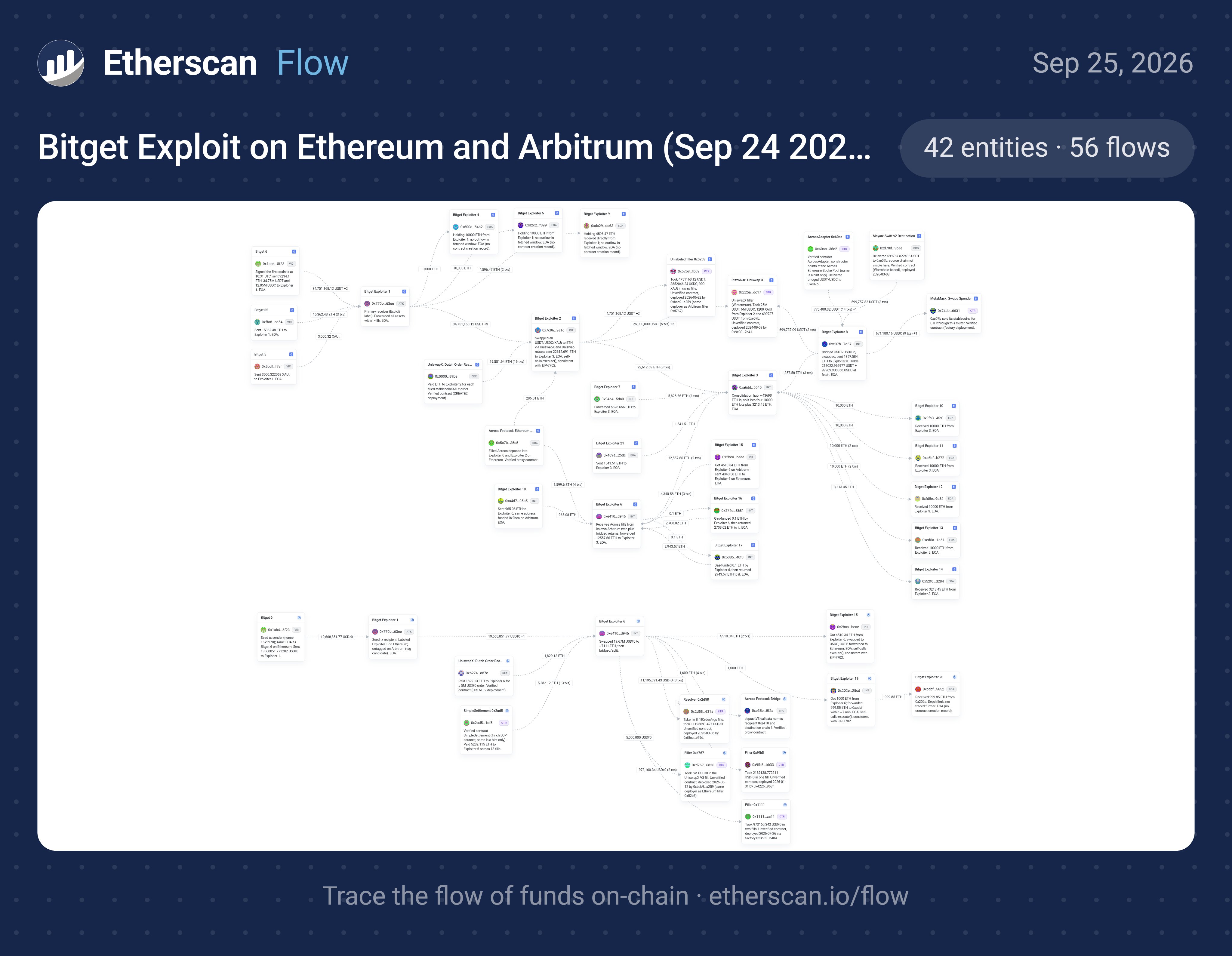 Etherscan maps transaction flows linked to the Bitget incident across Ethereum and Arbitrum, incorporating onchain references from multiple blockchain analysts
Sources
19 records from 14 domains
nvlpubs.nist.gov
sciencedirect.com
thebusinessresearchcompany.com
statestreet.com
x.com
bis.org
crypto.news
blockchain.com
crowdfundinsider.com
ibm.com
a16zcrypto.com
tradingview.com
theglobeandmail.com
chiliz.com
Community notes
Spot something off or out of date? Drop a note. Editors review topic notes daily and roll accepted fixes into the explainer — contributors are recognized in the monthly $SQUID drop.
Loading notes…
Help improve this topic
Have a story or tip about this topic? Submit it. See something missing? Leave a note. Editors review daily; accepted submissions and fixes count toward the monthly $SQUID drop.