
How semiconductors, AI, stablecoins, and blockchain protocols interconnect — and why nation-state tech policy, corporate treasury adoption, and regulatory frameworks are reshaping crypto's foundational infrastructure.
+30 sources across the wider coverage universe
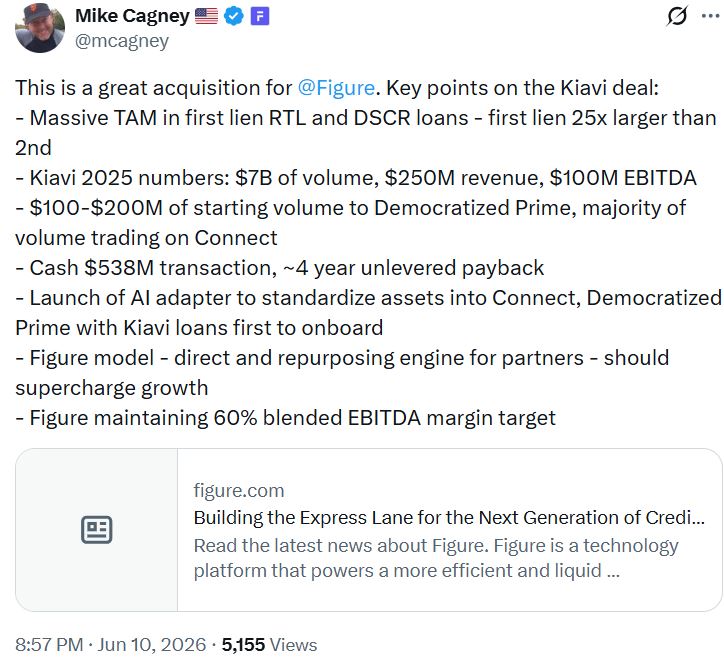 Figure Technology’s $717 million Kiavi acquisition supercharges AI-driven lending and earnings2026-06
 MAS revokes Bsquared Technology's DPT licence over compliance breaches and misleading information2026-05
 Paragon launches three new perpetual markets for AI connectivity layer, including Corning, Credo Technology, and Coherent2026-07
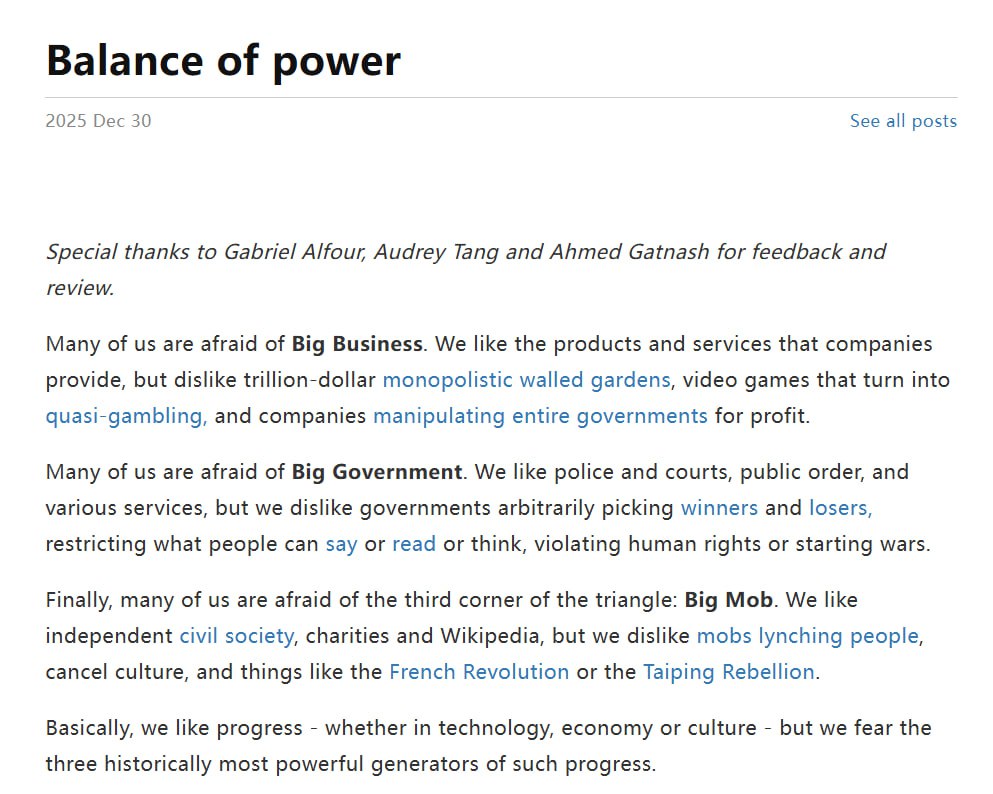 Vitalik Buterin published an article, "Balance of Power," where he emphasized that preventing the excessive concentration of power is key to avoiding societal crises while advancing technology, economy, and culture globally.2025-12
 3 ex-Signature Bank execs launch blockchain-powered narrow bank backed by Paradigm, Winklevoss. N3XT Bank operates under a Wyoming charter and opened its proverbial doors on Thursday.2025-12
 A look into the ways China has used blockchain technology to lift 98 million people out of poverty since 2012.2025-12
Crypto and technology are not parallel tracks — one is a subset of the other. Blockchain networks, AI inference engines, semiconductor fabs, and payment rails are all expressions of the same underlying phenomenon: software and hardware reshaping who controls money, data, and infrastructure.
What "Technology" Actually Means in a Crypto Context
The word gets used loosely. In practice, when crypto commentators invoke technology they typically mean one of four distinct layers:
1. Protocol infrastructure — the consensus mechanisms, cryptographic primitives, and networking code that make blockchains run 2. Application software — wallets, exchanges, DeFi protocols, stablecoins, and the APIs that connect them to the wider internet 3. Physical compute — the ASICs, GPUs, data centers, and power grids that execute the above 4. Financial technology integration — the regulatory, banking, and payment-system plumbing that lets digital assets touch the legacy economy
Understanding which layer a news story is about prevents a lot of confusion. An Oman Bitcoin mining announcement and a Coinbase investor-day appearance are both "technology stories" — but they operate on entirely different planes.

Figure Technology’s $717 million Kiavi acquisition supercharges AI-driven lending and earnings
Semiconductors: The Substrate Beneath Everything
No blockchain runs without chips. Bitcoin mining is an industrial-scale ASIC business; Ethereum's validator set depends on commodity server hardware; AI inference — increasingly intertwined with on-chain activity — is a GPU story dominated by NVIDIA and a handful of Asian ODMs.
The geopolitical dimension of this has sharpened considerably. The United States, which pioneered semiconductor design through companies like Intel, progressively offshored fabrication to Taiwan and South Korea over several decades. That decision is now the subject of active policy reversal: the CHIPS and Science Act (2022) allocated roughly $52 billion to domestic fab incentives, and the trade-policy arguments for protecting domestic semiconductor capacity have become mainstream across party lines. As one prominent political voice put it recently — referencing the "Intel Inside" era — the failure to protect domestic chip manufacturing with tariffs was an economic self-inflicted wound.
For crypto markets, semiconductor supply chains matter because they set a floor on mining economics and an upper bound on AI compute capacity. When fabs are constrained, hash rate growth slows and GPU cloud costs rise — both of which affect protocol economics and the cost of training the AI models increasingly deployed in DeFi risk engines and trading systems.
Readers click technology stories not for abstract innovation but for moments where institutional power — banks, governments, courts, museums — either adopts or confronts crypto infrastructure, revealing that legitimacy battles drive more engagement than technical breakthroughs alone.
Bitcoin as Freedom Technology — and as Corporate Treasury Asset
The phrase "Bitcoin is technology for freedom" — articulated clearly by BTCPrague co-founder Martin Kuchař and echoed across the conference circuit — captures a philosophical claim that Bitcoin's proponents treat as foundational: that a censorship-resistant, fixed-supply monetary network is a human-rights instrument, not merely a speculative asset.
That framing coexists, sometimes uneasily, with Bitcoin's parallel life as a corporate balance-sheet item. Public companies — from MicroStrategy to smaller technology firms like KULR Technology — have adopted Bitcoin treasury strategies, treating BTC as a reserve asset against dollar debasement. KULR, for example, had accumulated over 1,000 BTC at an average cost near $98,000; subsequent price moves have tested the thesis. Meanwhile, Trump Media & Technology Group transferred more than $204 million in Bitcoin to Crypto.com addresses in mid-2026, signaling that even media and branding entities are treating BTC as a liquid reserve instrument.
The tension between "freedom technology" and "treasury technology" is not a contradiction — it reflects Bitcoin's dual nature as both a monetary protocol and a commodity-like asset that institutions can hold. Both readings share the underlying premise that the network's technical properties (decentralization, fixed supply, immutability) are what generate its value.

MAS revokes Bsquared Technology's DPT licence over compliance breaches and misleading information
AI and Crypto: Two Converging Compute Stacks
Artificial intelligence and blockchain technology share more infrastructure than their respective communities usually acknowledge. Both are compute-intensive, both generate large volumes of transaction-like data (model inferences, on-chain state changes), and both are increasingly regulated as financial infrastructure.
The convergence is showing up in deal flow. Figure Technology's $717 million acquisition of Kiavi — a real estate lender — is explicitly structured around AI-driven underwriting, representing one of the larger AI-meets-fintech transactions of 2026. The thesis: machine learning models can price credit risk faster and more accurately than traditional underwriting, compressing the cost of origination and enabling new lending products. On-chain settlement of those loans remains a secondary consideration for now, but the integration path is clear.
On the institutional side, agentic AI — autonomous software agents that can take sequences of actions without continuous human input — is emerging as a distinct product category. Hong Kong's Science and Technology Parks Corporation is co-hosting a dedicated agentic AI demo day (Build East, July 7, 2026) specifically to surface talent building in this space. The relevance to crypto is direct: autonomous agents that can hold wallets, sign transactions, and interact with DeFi protocols represent a new class of on-chain participant that existing regulatory frameworks were not designed for.
David Sacks, who served as the White House's AI and crypto policy coordinator, stepped down from his operational role in mid-2026 and transitioned to the President's Council of Advisors on Science and Technology. His tenure was notable for attempting to develop a unified federal framework that addressed AI and digital assets as related technology-policy problems rather than siloed regulatory categories — a framing that has since influenced Congressional drafting on both stablecoin legislation and AI governance.
Stablecoins as Financial Technology Infrastructure
Stablecoins are the clearest example of crypto technology achieving product-market fit at scale. Tether (USDT) and USD Coin (USDC) collectively settle trillions of dollars annually, functioning as dollar-denominated payment rails for markets that either lack access to the traditional banking system or find it too slow and expensive.
Regulatory frameworks are catching up. The Singapore Monetary Authority (MAS) revoked Bsquared Technology's Digital Payment Token licence in 2026 over compliance failures and misleading information — a signal that the window for operating stablecoin-adjacent businesses without robust compliance infrastructure is closing. Jurisdictions that previously operated as light-touch entrepôts are now applying real licensing standards.
The "integrating financial technology innovation into regulatory frameworks" challenge — essentially, how regulators absorb fast-moving payment technology without either stifling it or enabling systemic risk — is the central policy problem of the decade. Stablecoins sit at its intersection: they are simultaneously a technology product (programmable money on a blockchain), a financial instrument (a claim on reserve assets), and a payment network (competing with ACH, SWIFT, and card rails).
Binance's rollout of TradFi perpetual contracts — including instruments tracking semiconductor ETFs like SOXL and individual tech stocks like Marvell Technology — illustrates how crypto trading infrastructure is absorbing traditional financial assets, not just the other way around. The tooling developed for crypto derivatives markets (24/7 settlement, transparent margin, on-chain collateral) is being applied to instruments that previously only existed in regulated futures markets.
Paragon launches three new perpetual markets for AI connectivity layer, including Corning, Credo Technology, and Coherent
Nation-State Technology Strategies and Crypto
Governments are no longer passive observers of crypto infrastructure — they are participants. Oman's launch of Omanhash, a national Bitcoin mining pool operated through the Ministry of Transport, Communications and Information Technology alongside Frontier Technologies, is a structural example. The pool is designed to aggregate licensed miners under a regulated umbrella, giving the state visibility into hash rate, energy consumption, and revenue flows that would otherwise be opaque.
This is a meaningful model. Rather than banning mining (as China did in 2021) or permitting it with minimal oversight, Oman is building state-level coordination infrastructure that brings licensed miners into a formal regulatory perimeter. The Arabian Peninsula more broadly — with its surplus energy capacity and sovereign wealth capital — is positioned as a significant mining jurisdiction for the remainder of the decade.
China's approach tells a cautionary tale from a different angle. The corruption case against Yao Qian, the architect of China's digital yuan (e-CNY), revealed that a senior technology official overseeing the country's central bank digital currency project had accepted 2,000 ETH in bribes — worth roughly 60 million yuan at peak prices. The case, aired in a state documentary titled "Technology Empowering Anti-Corruption," underscores that the political and financial stakes attached to CBDC infrastructure are high enough to attract serious corruption risk.
Canada is moving in yet another direction: AVAX One Technology's 10 MW AI/HPC micro-grid data center initiative in Alberta represents the emerging pattern of co-locating AI compute with cryptocurrency mining infrastructure, sharing power procurement costs and physical plant while running workloads that have different temporal demand profiles.
- 01Digital identity verification stakes
The forged-passport-via-ChatGPT story and Worldcoin's biometric identity launch forced readers to confront how AI and crypto together can both enable and threaten identity verification systems.
- 02Institutional blockchain adoption
Banks and exchanges from DBS to QNB to LSE adopting blockchain for real settlement pulled readers tracking when TradFi stops piloting and starts deploying.
- 03Government legitimacy signals
China's Web3 white paper, Vietnam's crypto legalization, and Abu Dhabi's DLT regulations showed readers that state-level endorsement is a leading indicator of where capital flows next.
- 04Privacy tools under legal threat
The Tornado Cash DOJ critique and self-custodial wallet crackdown framing engaged readers alarmed that compliance pressure could structurally eliminate permissionless crypto primitives.
- 05Cross-chain execution technology
1inch's intent-based atomic swaps and Uniswap's Guidestar acquisition attracted readers tracking which routing and AMM architectures will dominate multi-chain trading infrastructure.
- 06ZK and L2 scaling deployments
Buenos Aires' ZK-backed digital identity and TON's Polygon-powered L2 showed readers that zero-knowledge proofs had crossed from research into civic and consumer deployments.
Blockchain as Development Infrastructure
Beyond financial applications, blockchain technology is being evaluated — and in some cases deployed — as infrastructure for development programs. China has used distributed ledger systems as part of its poverty alleviation programs, with government reporting attributing some administrative efficiency gains in the tracking of rural development subsidies to blockchain-based record systems covering populations in the tens of millions. The claims warrant scrutiny — state-reported impact figures on technology programs are notoriously optimistic — but the underlying logic (immutable, auditable records for welfare disbursement) is sound and has been independently validated in smaller pilots in other jurisdictions.
Vitalik Buterin's essay "Balance of Power," published in 2026, frames the broader stakes: the concentration of technological power — whether in states, corporations, or protocol developers — is itself a systemic risk. His argument is that decentralization is not merely a technical property of blockchains but a social and political objective: preventing any single actor from gaining enough control over critical infrastructure to unilaterally reshape the rules. This is as much a governance philosophy as a technical specification.
The Broadband Moment Thesis
A recurring claim in crypto circles is that the industry is approaching its "broadband moment" — the inflection point at which the technology becomes infrastructural, invisible, and assumed rather than novel. The analogy is to the mid-1990s transition from dial-up internet to always-on broadband: the technology did not change its fundamental nature, but its friction dropped far enough that ordinary users stopped thinking about it and started using it.
The argument for 2026 being near that inflection rests on several developments: stablecoin payment UX has improved to the point where cross-border transfers are faster and cheaper than wire transfers for many corridors; wallet onboarding has simplified substantially; and major financial institutions — Coinbase presenting at J.P. Morgan's Global Technology, Media and Communications Conference being a representative data point — are treating crypto infrastructure as a standard investment category rather than a speculative outlier.
The counterargument is that user experience problems remain severe outside the enthusiast population, and that much of what looks like mass adoption is institutional participation rather than retail utility.
- 2023-01regulatory
Abu Dhabi ADGM releases DLT Foundations Regulations 2023
- 2023-07launch
Worldcoin official launch with biometric digital identity
- 2024-03regulatory
UK court rules Craig Wright is not Satoshi Nakamoto
- 2024-05regulatory
FIT21 crypto market structure bill passes US House
- 2024-06milestone
Buenos Aires deploys ZK-backed digital identity for 3.6M citizens via ZKsync
- 2024-09launch
DBS launches Token Services on permissioned Ethereum-compatible blockchain
- 2024-10milestone
QNB adopts JPMorgan Kinexys for 24/7 USD payment processing
- 2025-01regulatory
Vietnam legalizes crypto under new digital technology law
Outlook
The technology layer beneath crypto is expanding faster than the asset-price narrative typically captures. Semiconductor policy is reshaping mining economics; AI and blockchain are converging at the infrastructure layer; nation-states are shifting from prohibition toward regulated participation; and stablecoin payment rails are quietly achieving the kind of mundane utility that precedes broad adoption. The central uncertainty is regulatory: jurisdictions that get the framework right — clear rules for stablecoins, mining, AI agents, and digital asset custody — will attract the infrastructure investment that determines where the next decade of development happens. Those that don't will find the infrastructure migrates to places that do.
Latest Technology news
Figure Technology’s $717 million Kiavi acquisition supercharges AI-driven lending and earningsMAS revokes Bsquared Technology's DPT licence over compliance breaches and misleading informationParagon launches three new perpetual markets for AI connectivity layer, including Corning, Credo Technology, and CoherentVitalik Buterin published an article, "Balance of Power," where he emphasized that preventing the excessive concentration of power is key to avoiding societal crises while advancing technology, economy, and culture globally.3 ex-Signature Bank execs launch blockchain-powered narrow bank backed by Paradigm, Winklevoss. N3XT Bank operates under a Wyoming charter and opened its proverbial doors on Thursday.A look into the ways China has used blockchain technology to lift 98 million people out of poverty since 2012.Community notes
Spot something off or out of date? Drop a note. Editors review topic notes daily and roll accepted fixes into the explainer — contributors are recognized in the monthly $SQUID drop.
Loading notes…
Help improve this topic
Have a story or tip about this topic? Submit it. See something missing? Leave a note. Editors review daily; accepted submissions and fixes count toward the monthly $SQUID drop.