
A crypto wallet stores the cryptographic keys that prove ownership of blockchain assets. This guide covers types, security risks, AI agent integration, quantum threats, and regulatory developments.
+32 sources across the wider coverage universe
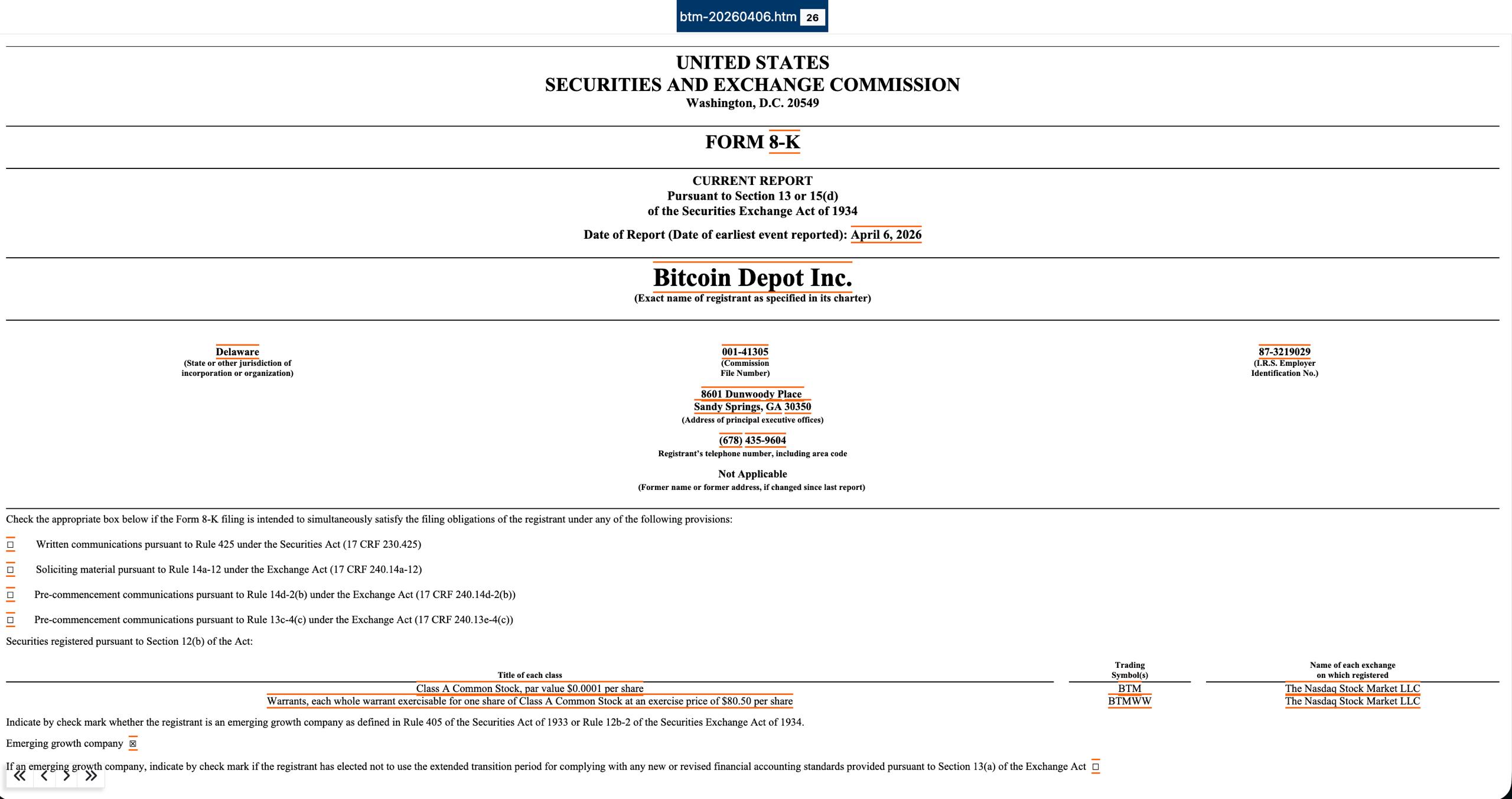 Bitcoin Depot discloses $3.6M BTC theft from corporate wallets in SEC filing, two weeks after breach2026-04
 Tempo releases Accounts SDK enabling passkey-based wallets with 1-line integration, bringing Face ID logins, transaction simulation, and gas sponsorship to apps2026-04
 Exodus Pay brings Visa and Apple Pay spending to self-custodial Bitcoin wallets, rolls out in five states2026-04
 Analyst reviews 47 crypto OpSec failures, revealing one common mistake made by 100% of victims, highlighting critical security gaps across wallets, users, and Web3 practices2026-04
 Analyst shares guide on defending against DNS & BGP hijacks in Web3, outlining how attackers exploit domains to drain wallets via malicious frontends2026-04
 Thunes brings USDC settlement to 12B wallets across 140+ countries via Circle Payments Network2026-04
A cryptocurrency wallet is software or hardware that stores the cryptographic keys needed to sign blockchain transactions — it doesn't hold coins directly, but controls the proof of ownership that lets a user spend them.
Wallets are the primary interface between humans (and increasingly, software agents) and every blockchain network. Understanding how they work, where they fail, and how they are evolving is foundational knowledge for anyone participating in crypto markets, DeFi, or the emerging onchain economy.
How Wallets Actually Work
Every wallet is built around a key pair: a private key (a secret number, usually 256 bits long) and a public key derived from it through elliptic-curve cryptography. The public key generates a wallet address — the string of characters you share when you want to receive funds. The private key generates a digital signature that authorizes outgoing transactions.
Because the private key is all that matters for control, "losing your wallet" in a practical sense means losing access to that key. The phrase "not your keys, not your coins" captures this exactly: if a third party holds the private key on your behalf, they control the asset.
Most modern wallets use a seed phrase (also called a mnemonic or recovery phrase) — typically 12 or 24 words derived from the BIP-39 standard — as a human-readable backup of the root key. From this single seed, hierarchical deterministic (HD) wallets can generate millions of distinct addresses across multiple blockchains.

Bitcoin Depot discloses $3.6M BTC theft from corporate wallets in SEC filing, two weeks after breach
Custodial vs. Non-Custodial
The most important practical distinction is who holds the keys.
Custodial wallets — offered by exchanges like Coinbase or Binance — manage keys on the user's behalf. The user authenticates with a username and password; the platform handles key storage, backup, and transaction signing. This is convenient and recoverable if you forget credentials, but it introduces counterparty risk: exchange hacks, insolvencies, and regulatory freezes have historically locked users out of their funds.
Non-custodial wallets — software like MetaMask, Trust Wallet, or Phantom — generate and store keys locally on the user's device or in a browser extension. The user is solely responsible for backing up the seed phrase. There is no customer support that can restore access if it is lost, but there is also no central point of failure.
This tradeoff between convenience and sovereignty sits at the heart of most wallet design decisions.
Readers click wallet stories at both extremes of the custody spectrum — catastrophic loss of control (OpSec failures, draining dormant wallets, phishing drainers) and frictionless gain of control (passkey SDKs, AI-bot trading, one-line integrations) — revealing that the central anxiety is not security in the abstract but who holds the keys and whether that person is competent or even awake.
Types of Wallets
Software (Hot) Wallets
Hot wallets are internet-connected applications: browser extensions, mobile apps, or desktop clients. They offer immediate transaction signing, making them practical for frequent DeFi activity, token trading, and payments. The tradeoff is exposure — private keys or seed phrases stored on an internet-connected device are vulnerable to malware. Microsoft researchers recently documented malware that hijacks crypto wallet software and spreads via USB sticks, highlighting that threat vectors extend beyond phishing and into physical media.
Hardware (Cold) Wallets
Hardware wallets — devices from manufacturers like Ledger and Trezor — keep private keys on isolated, offline microcontrollers. Transaction signing happens on the device itself; the private key never touches an internet-connected computer. They are widely considered the most secure option for significant holdings, a point covered in depth in how-hardware-wallets-protect-cryptocurrency-assets coverage — though air-gapped signing only protects a key that was random to begin with. Coinkite disclosed in 2026 that a years-old firmware defect had weakened the randomness behind some Coldcard seeds: isolation from the internet is necessary for hardware-wallet security, but not sufficient if the software generating the key is itself flawed. The tradeoff is friction: hardware wallets require physical access and are less practical for high-frequency trading.
Smart Contract Wallets
Smart contract wallets (sometimes called account abstraction wallets) replace the standard externally owned account (EOA) model with programmable contract logic. This enables features impossible with traditional wallets: social recovery (regaining access via trusted contacts rather than a seed phrase), spending limits, multi-signature authorization, and gasless transactions where a third party pays fees. By the second quarter of 2026, Safe, an account-abstraction wallet standard, had accumulated more than 63 million smart accounts, a 20% year-over-year increase, and processed nearly 130 million transactions in that quarter alone: account abstraction has moved well past the experimental phase into infrastructure carrying measurable, growing volume.
Multi-Signature Wallets
Multisig wallets require M-of-N key holders to sign a transaction before it executes — for example, 2 of 3 signers must approve. This is standard for institutional custody, DAO treasuries, and high-value DeFi protocol funds. The Canton Token Standard V2 (CIP-0112), approved recently, extends this model with single-signature authorization through wallets while enabling multi-tier custody chains and privacy-enhanced batch settlement — illustrating how wallet standards continue to evolve at the protocol layer.
Wallets as Onchain Identity
A wallet address functions as a persistent, pseudonymous identity on any public blockchain. On-chain analytics firms like Arkham Intelligence have built leaderboard infrastructure that ranks wallets and entities by asset holdings, transaction volume, and behavioral patterns — effectively treating wallet addresses as observable actors rather than anonymous strings.
This pseudonymity cuts both ways. It enables the kind of post-hoc forensics that identified suspected insider trading — three wallets funneling $24.25M in profits to a centralized exchange after a series of well-timed market bets — while also allowing legitimate users to separate on-chain activity from personal identity.
The growth of wallet-native activity is measurable: one DEX ecosystem tracked 69,000 unique wallets trading a token at launch; within months that figure reached 506,000 — a sevenfold expansion in unique participants entirely visible on-chain without any platform reporting.

Tempo releases Accounts SDK enabling passkey-based wallets with 1-line integration, bringing Face ID logins, transaction simulation, and gas sponsorship to apps

Passkey-based wallets in one line of code. The onboarding friction for crypto just dropped by an order of magnitude. No seed phrases, no extensions — just biometrics. The question is whether passkey wallets can handle the complexity of DeFi or if they are limited to simple transfers.
Security Risks and Failure Modes
Private Key Exposure
The most common losses stem from private key or seed phrase exposure: phishing sites that mimic wallet interfaces, clipboard hijackers that swap copied addresses, and browser extensions with malicious updates. The USB-spread malware documented by Microsoft represents the same threat through a different delivery mechanism.
Hardware Wallet Firmware Risk
The theoretical case for hardware wallets — an air gap between the private key and any internet-connected device — collapsed for a subset of Coldcard owners in 2026. Coinkite's own advisory confirms a seed-randomness defect present in firmware shipped since March 2021: Mk2 and Mk3 devices on firmware 4.0.1 through 4.1.9 generated seeds that are considered fully at risk unless the user supplied at least 50 independent physical dice rolls as supplemental entropy, while Mk4, Mk5, and Q devices on pre-fix firmware carried roughly 72 bits of effective entropy instead of the expected 128. Attackers began sweeping wallets built on the flawed firmware in coordinated waves starting July 30, 2026, exploiting what was by then a five-year-old bug; TRM Labs reported, citing Galaxy Research's running count, roughly 1,816 BTC — about $116 million at the time — drained from more than 5,200 addresses as of August 5, a tally still climbing when it was published. The remediation is the part users most often get wrong: Coinkite is explicit that installing the patched firmware does not repair an already-generated seed — anyone who created a wallet on vulnerable firmware has to generate an entirely new seed on updated hardware and migrate funds across, not simply update and keep using the old one. The episode reframes what "cold storage" security actually guarantees: physical isolation protects a key from network attackers, but it cannot protect against a key that was never random in the first place.
Smart Contract Vulnerabilities
For wallets that interact with DeFi protocols, the wallet itself may be secure while the contracts it interacts with are not. The Humanity Protocol incident — where wallets linked to the project were drained of over $32 million and 100 million unauthorized tokens were minted — illustrates how a protocol-level compromise or insider exploit can drain funds regardless of wallet security practices. On-chain analyst ZachXBT flagged the incident as possibly staged, underscoring that not all "hacks" are external attacks.
Quantum Computing Exposure
A Coinbase report on quantum computing risk flagged exchange cold wallets and millions of Bitcoin addresses exposed by address reuse as potential long-term vulnerabilities. Current elliptic-curve cryptography (ECDSA) is not broken by today's quantum hardware, but addresses that have revealed their public key by signing a transaction are theoretically more vulnerable to future cryptanalytically-relevant quantum computers. Best practice is to use each address only once — a standard HD wallet generates fresh addresses automatically, but many users ignore the recommendation.
Regulatory and Legal Risk
Governments are increasingly examining crypto wallet regulations. Finance ministries reviewing law enforcement practices before regulating crypto wallets signals that policymakers are grappling with how to apply existing financial crime frameworks — anti-money-laundering rules, asset seizure authorities — to self-custodial infrastructure. The outcome of these reviews will shape whether non-custodial wallets face reporting requirements, mixing restrictions, or travel-rule obligations similar to those applied to exchanges.
- 01OpSec failures and phishing drains
Readers are drawn to post-mortems that name the exact mistake — increaseApproval signatures, reused keys, DNS hijacks — turning abstract risk into a personal checklist.
- 02Passkey and UX abstraction
The highest-clicked story was a developer SDK collapsing wallet creation to one line with Face ID, signalling readers see UX as the real adoption bottleneck, not price.
- 03Dormant wallet reactivation
Sleeping wallets suddenly draining or becoming targets of legal claims carry a thriller quality — unclaimed fortune or forgotten risk that can resurface years later.
- 04On-chain whale and institutional tracking
Readers track large named wallets (Tom Lee's BitMine, a16z HYPE accumulation, Bhutan sovereign BTC) to infer institutional positioning before it hits headlines.
- 05Compliance freezes and law enforcement cooperation
Tether freezing $344M across two wallets at OFAC request spotlights that stablecoin balances are not truly sovereign — a tension that resonates with self-custody advocates.
- 06One-API developer wallet infrastructure
Multiple headlines (Crossmint, Base MCP, Polygon Open Money Stack, Enso Quote Simulator) show readers tracking the race to commoditise wallet plumbing for builders.
AI Agents and Autonomous Wallets
One of the more significant recent developments is the integration of wallets with AI agent frameworks. Coinbase has launched tooling that lets AI agents hold wallets, execute trades, and make payments autonomously — treating a wallet as a programmable economic actor rather than a passive storage tool.
This creates a new trust surface. When an agent controls a wallet, the question of authorization becomes layered: who authorized the agent, what spending limits apply, and how are those limits enforced on-chain? Projects like .pie and 0xTrikon are building identity and trust-layer infrastructure specifically for AI-native Web3 applications, recognizing that agent identity — not just human identity — needs reliable wallet binding. The same automation cuts the other way, too: Boltz, a non-custodial Bitcoin swap service, suspended operations indefinitely in August 2026 after concluding that AI-assisted attackers were iterating faster than its own team could find and patch bugs — a preview of the same automation dynamic working against wallet-adjacent infrastructure rather than for it.
Tether's reported participation in a $1.4 billion round for NEURA Robotics, focused on putting self-custodial wallets and edge AI into robots, extends this logic further: wallets as embedded economic endpoints for non-human physical agents. These use cases push wallet design toward programmable policy enforcement, fine-grained permission scoping, and audit trails — features the smart contract wallet model is better positioned to provide than traditional EOAs.
Wallets in Payments and the USDC Ecosystem
For stablecoin payments — particularly USDC on networks like Ethereum, Base, and Solana — wallets function as the payment endpoint, replacing bank account numbers. The growth of on-chain payment rails depends on wallet UX being accessible enough for non-technical users, which has driven investment in embedded wallets (wallets provisioned inside apps without the user ever seeing a seed phrase) and gasless transaction flows where application developers absorb network fees.
The launch of privacy features like those in nyxmoney — private accounts added directly into existing Ethereum wallets — reflects demand for payment confidentiality that public blockchain transparency does not natively provide. These are early-stage but indicate the direction: wallets as feature-rich financial accounts, not just key stores.
Exodus Pay brings Visa and Apple Pay spending to self-custodial Bitcoin wallets, rolls out in five states
EXOD is down 84% YoY and analysts just slashed targets to $19-21 even with this launch — so the market is pricing this as a survival pivot, not a growth catalyst. The CFO saying they want to "own the payments process end-to-end" tells you where the margin extraction happens: somewhere between your self-custodial stablecoin and the Visa settlement, there's a conversion spread they're not disclosing yet. Five-state rollout with "nationwide through April" is an aggressive timeline for a company burning through cash, especially when PYUSD and Coinbase's on-chain rails are already fighting over the same spend-your-crypto-at-merchants niche.
Institutional and Whale Activity
On-chain wallet tracking has made large-holder (whale) behavior directly observable. When wallets withdraw thousands of Bitcoin from exchanges in concentrated windows — as seen with a single address withdrawing 2,341 BTC ($144.68M) over five days — analysts interpret this as accumulation signals, since moving Bitcoin off exchanges typically indicates a preference for self-custody over near-term selling.
Institutional participants increasingly use purpose-built custody infrastructure rather than standard wallets, often combining hardware security modules (HSMs), multi-party computation (MPC) key sharding, and governance workflows — solutions that abstract the key management layer while maintaining non-custodial control over assets.
- 2025-08milestone
a16z-linked wallets begin accumulating HYPE, reach ~$356M position
- 2026-04exploit
Gnosis Pay Zodiac delay-module exploit drains user wallets; co-founder pledges full reimbursement
- 2026-05regulatory
Tether freezes $344M USDT across two wallets flagged by U.S. authorities
- 2026-05exploit
TrapDoor campaign: 34 fake packages across npm/PyPI/Rust target Solana, Sui, Aptos devs
- 2026-06regulatory
Bitcoin Depot discloses $3.6M BTC theft from corporate wallets in SEC filing
- 2026-06launch
Tempo releases Accounts SDK: passkey-based wallets with 1-line integration and gas sponsorship
- 2026-06milestone
Zcash announces quantum-recoverable wallet launch within weeks; full resistance roadmap by 2027
- 2026-06regulatory
New York lawsuit filed seeking ownership of 39,069 dormant Bitcoin wallets holding $285B
Wallet Hygiene: Practical Principles
A few principles hold regardless of which wallet type a user chooses:
- Back up the seed phrase offline, in physical form, stored in multiple locations. Never store it digitally or photograph it.
- Use hardware wallets for significant holdings; reserve hot wallets for amounts you are comfortable treating as operational cash.
- Verify addresses carefully before every transaction. Address-poisoning attacks generate look-alike addresses that differ only in the first and last few characters.
- Revoke unused token approvals regularly. DeFi interactions grant smart contracts allowances to spend wallet funds; unused approvals are a persistent attack surface.
- Use fresh addresses for receiving Bitcoin to minimize quantum-exposure risk and to reduce address-clustering analysis.
Outlook
Wallets are becoming more complex, more programmable, and more embedded in non-wallet applications — but the underlying security model has not fundamentally changed. The private key remains the root of trust. As AI agents acquire wallet capabilities, as quantum computing matures, and as regulators move from observation to rule-making, the stakes around key management and wallet infrastructure will increase. The trajectory is toward wallets that are less visible to end users (embedded, gasless, recoverable) while remaining more powerful as programmable economic primitives — but the fundamental tension between convenience and self-sovereignty is unlikely to resolve cleanly.
Latest wallets news
Bitcoin Depot discloses $3.6M BTC theft from corporate wallets in SEC filing, two weeks after breachTempo releases Accounts SDK enabling passkey-based wallets with 1-line integration, bringing Face ID logins, transaction simulation, and gas sponsorship to appsExodus Pay brings Visa and Apple Pay spending to self-custodial Bitcoin wallets, rolls out in five statesAnalyst reviews 47 crypto OpSec failures, revealing one common mistake made by 100% of victims, highlighting critical security gaps across wallets, users, and Web3 practicesAnalyst shares guide on defending against DNS & BGP hijacks in Web3, outlining how attackers exploit domains to drain wallets via malicious frontendsThunes brings USDC settlement to 12B wallets across 140+ countries via Circle Payments NetworkSources
5 records from 5 domains
coldcard.com
blog.coinkite.com
trmlabs.com
theblock.co
decrypt.co
Community notes
Spot something off or out of date? Drop a note. Editors review topic notes daily and roll accepted fixes into the explainer — contributors are recognized in the monthly $SQUID drop.
Loading notes…
Help improve this topic
Have a story or tip about this topic? Submit it. See something missing? Leave a note. Editors review daily; accepted submissions and fixes count toward the monthly $SQUID drop.