
Arkham Intelligence is a blockchain analytics platform that tracks and attributes on-chain wallet activity to real-world entities — institutions, governments, and funds — across Bitcoin, Ethereum, Solana, and other networks.
- x.com39
- coindesk.com3
- info.arkm.com2
- youtube.com1
- platform.arkhamintelligence.com1
- unchainedcrypto.com1
- arkhamintelligence.com1
+7 sources across the wider coverage universe
 Arkham releases ultimate guide to tracking Zcash transactions but with one major catch2026-04
 Arkham breaks down onchain AI agents and agentic payments, detailing how autonomous systems initiate transactions across Visa, Mastercard, PayPal, and Solana rails2026-05
 Arkham adds Hyperliquid trades, positions and PnL tracking to its Intel platform2026-07
 Arkham launches decentralized trading on Solana, enabling users to track top tokens and traders in real time and execute trades with integrated onchain intelligence2026-04
 Arkham launches an Elo-style ranking system for prediction market traders, rewarding forecasting accuracy over profits to identify top-performing bettors2026-06
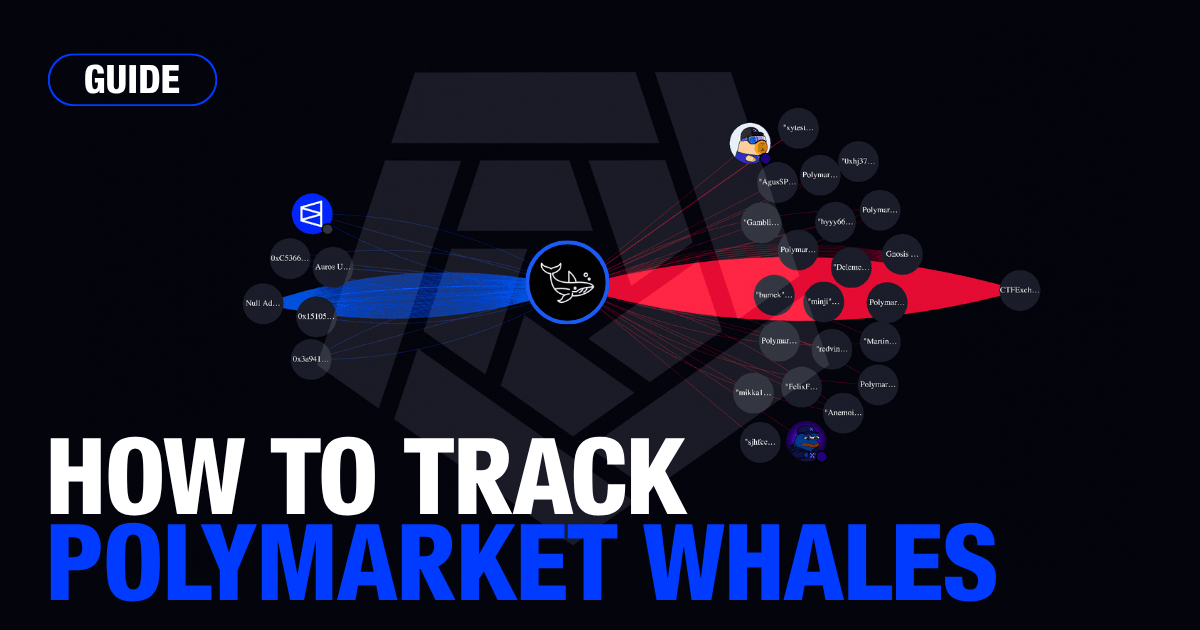 Arkham unveils a new guide showing users how to track Polymarket whales, analyze onchain betting positions, and uncover strategies driving prediction markets2026-05
A blockchain intelligence platform that links on-chain wallet addresses to real-world identities, Arkham has become one of the most widely cited data sources in crypto — used by traders, journalists, and researchers to follow institutional money flows in real time.
What Arkham Is
Founded in 2020 and publicly launched in 2023, Arkham Intelligence (arkhamintelligence.com) is a multi-chain analytics platform whose central product — Arkham Intel — maps wallet addresses to named entities: hedge funds, exchanges, governments, corporations, and individuals. The company describes this as "blockchain intelligence": turning the pseudonymous ledger of on-chain transactions into a readable map of who holds what, and where value is moving.
The platform aggregates data across Bitcoin, Ethereum, Solana, and dozens of other networks, combining algorithmic clustering, public disclosures, exchange deposit patterns, and crowdsourced labeling to build what amounts to a live directory of crypto ownership. As of 2025, Arkham tracks tens of thousands of labeled entities and makes much of this data freely searchable.
Arkham also operates a native utility token, ARKM, which powers its Intel Exchange — a marketplace where users can buy and sell intelligence tips (such as wallet attributions or entity links) using the token as currency.

Arkham revisits the 2016 DAO hack: how a 3.6M ETH exploit split Ethereum and Ethereum Classic

The Core Product: Arkham Intel
Arkham's flagship offering is its wallet and entity tracking interface, which it released a comprehensive guide to in 2025 covering wallet tracking, entity monitoring, transaction tracing, and real-time multi-chain analytics.
At its simplest, a user can paste any wallet address and see:
- Historical balances across tokens and chains
- Inflow and outflow transactions, timestamped and linked to counterparties where known
- Entity attribution — whether the address is linked to Coinbase, a known fund, a government wallet, or a flagged attacker
- Visualized fund flows, showing how assets move between clusters of addresses
This kind of data, once the province of firms like Chainalysis or Elliptic (which charge institutional licensing fees), is surfaced by Arkham in a consumer-friendly interface. The tradeoff is that Arkham monetizes intelligence itself — through the Intel Exchange and through ARKM token demand.
Multi-Chain Coverage
Arkham's coverage spans Bitcoin (BTC) and Ethereum (ETH) natively, and has extended to Solana, where it launched a decentralized trading feature in 2025 that lets users track top tokens and traders in real time and execute trades with integrated on-chain intelligence. The integration of trade execution directly into an analytics interface represents a meaningful product expansion: instead of noticing that a whale is accumulating and then switching to a DEX, the analysis and trade can happen in one workflow.
Readers click Arkham stories not for the analytics tooling itself but for the investigative payoffs it produces — named hack perpetrators, exposed KOL schemes, and sovereign wallet reveals are consistently more magnetic than any platform feature announcement.
Why Institutional Tracking Matters
Much of Arkham's cultural weight in crypto markets comes from its ability to attribute large on-chain movements to institutional actors — and to publish those attributions publicly before the actors themselves have commented.
BlackRock and Sovereign Wealth
When BlackRock launched BITA, its Bitcoin Premium Income ETF employing an actively-managed options overlay, Arkham indexed the ETF's holdings almost immediately, allowing market participants to monitor the fund's Bitcoin exposure in real time. This is part of a broader pattern: Arkham has become a de facto transparency layer for the growing ecosystem of institutional Bitcoin products, including ETFs and separately managed accounts, whose custodial wallets generate on-chain footprints even when the issuers themselves are not forthcoming about daily holdings.
The platform also tracks sovereign Bitcoin holders. Bhutan's government-linked BTC reserves — accumulated through state-run hydropower-subsidized mining — have been a recurring Arkham data point. When $34.5 million in bitcoin moved from Bhutan-linked wallets to Binance, with holdings falling below 1,750 BTC, Arkham's attribution preceded any official statement. A subsequent report of $1 billion in BTC leaving sovereign-linked wallets prompted Bhutan to publicly deny selling — illustrating both the power and the friction that comes with real-time on-chain attribution. By mid-2026, Bhutan's cumulative exchange outflows tracked by Arkham had crested $230 million.
Mt. Gox
The long-running saga of Mt. Gox creditor repayments — involving billions in BTC that the defunct exchange is returning to creditors nearly a decade after its 2014 collapse — has been tracked almost entirely through Arkham attributions. When Mt. Gox moved $739 million worth of bitcoin to two addresses, Arkham's public alert preceded market reaction. These attribution events have become market-moving: large BTC movements from known Mt. Gox wallets typically cause immediate price volatility as traders anticipate potential selling pressure.
Grayscale and Institutional Accumulation
A suspected Grayscale-linked address that accumulated over $10 million in the HYPE token — sourcing supply from Wintermute, FalconX, Coinbase, and OTC desks — was surfaced by Arkham before Grayscale made any public disclosure. This kind of pre-announcement visibility gives Arkham users an informational edge that professional investors previously obtained only from proprietary blockchain analytics subscriptions.
Controversial Moments and Privacy Debates
Arkham's model — making pseudonymous wallet data legible and attributing it to real entities — is not without critics. The platform has been described as "doxing infrastructure" by privacy advocates, who argue that linking wallets to individuals creates real-world risk for crypto holders in jurisdictions with weak rule of law, and that the Intel Exchange's incentive structure rewards the unmasking of private individuals, not just institutional actors.
The Iran Central Bank Exposure
A notable episode: Arkham exposed an alleged wallet network linked to the Central Bank of Iran following a $344 million USDT freeze. The disclosure raised difficult questions about the dual use of on-chain intelligence — it simultaneously served as a tool for financial sanctions enforcement and demonstrated that any entity holding significant crypto, including state actors, can be tracked. Iran's central bank appearing on Arkham's platform underscored that the platform's reach extends beyond Western institutional players.
The BlackRock Sell Alert
In a high-profile incident, Arkham sent crypto traders into a brief panic with a post claiming BlackRock was selling Bitcoin. The claim reignited debate about attribution accuracy: when a labeled wallet moves funds, the inference about intent — accumulation, selling, internal transfer, security rotation — requires human judgment that automated alerts don't always supply. The episode highlighted how Arkham's public reach can amplify market misreads when attribution is correct but interpretation is hasty.
Prediction Markets Analytics
Arkham launched analytics tooling for prediction markets, giving users the ability to track Polymarket whales, analyze on-chain betting positions, and uncover the strategies driving prediction market outcomes. The product launched amid explicit concerns about privacy risks and strategy crowding — if large bettors can be identified and their positions front-run, the market's price discovery function degrades.
- 01hack attribution and laundering trails
Readers want to see on-chain evidence that names specific groups — Lazarus, Chinese mining pools — and tracks stolen funds through laundering routes like Thorchain.
- 02bounty-driven doxx investigations
The crowd-funded bounty model for exposing FTX hackers, Wintermute attackers, and the $DJT creator turned on-chain sleuthing into participatory accountability journalism.
- 03sovereign and institutional wallet surveillance
Revelations that Bhutan, US government wallets, BlackRock ETF, and Genesis are moving large BTC positions gave readers rare visibility into macro-scale on-chain behavior.
- 04KOL and celebrity crypto exposure
Tagging 950+ high-profile addresses including Trump, Vitalik, and Justin Sun reframed Arkham as a celebrity financial surveillance tool, pulling in readers beyond the DeFi core.
- 05platform deanonymization controversy
The reversible email hash disclosure and Arkham's stated belief that crypto should be deanonymized sparked a direct tension between the platform's utility and privacy norms.
- 06perp exchange and ARKM token expansion
Launching a KYC-gated perpetual futures exchange with points-to-ARKM conversion marked a pivot from pure intelligence tool to trading venue, shifting the platform's risk profile.
New Product Surface: Leaderboards
Arkham's Leaderboards feature ranks labeled entities against one another by on-chain asset holdings. Users can see which funds, governments, or protocols hold the most assets in a given category — sovereign Bitcoin holders ranked by reserve size, DeFi protocols ranked by TVL in wallets Arkham has attributed, or top traders on Solana ranked by realized gains.
The feature makes the Intel platform more useful as a competitive intelligence layer: a fund manager can see, for example, how Bhutan's sovereign BTC reserves compare to other nation-state holders, or how Grayscale's ETH holdings sit relative to other institutional custodians. Morgan Stanley's on-chain footprint appearing on Arkham is part of the same trend — as traditional financial institutions acquire crypto assets, their custodial wallets become Arkham data points.

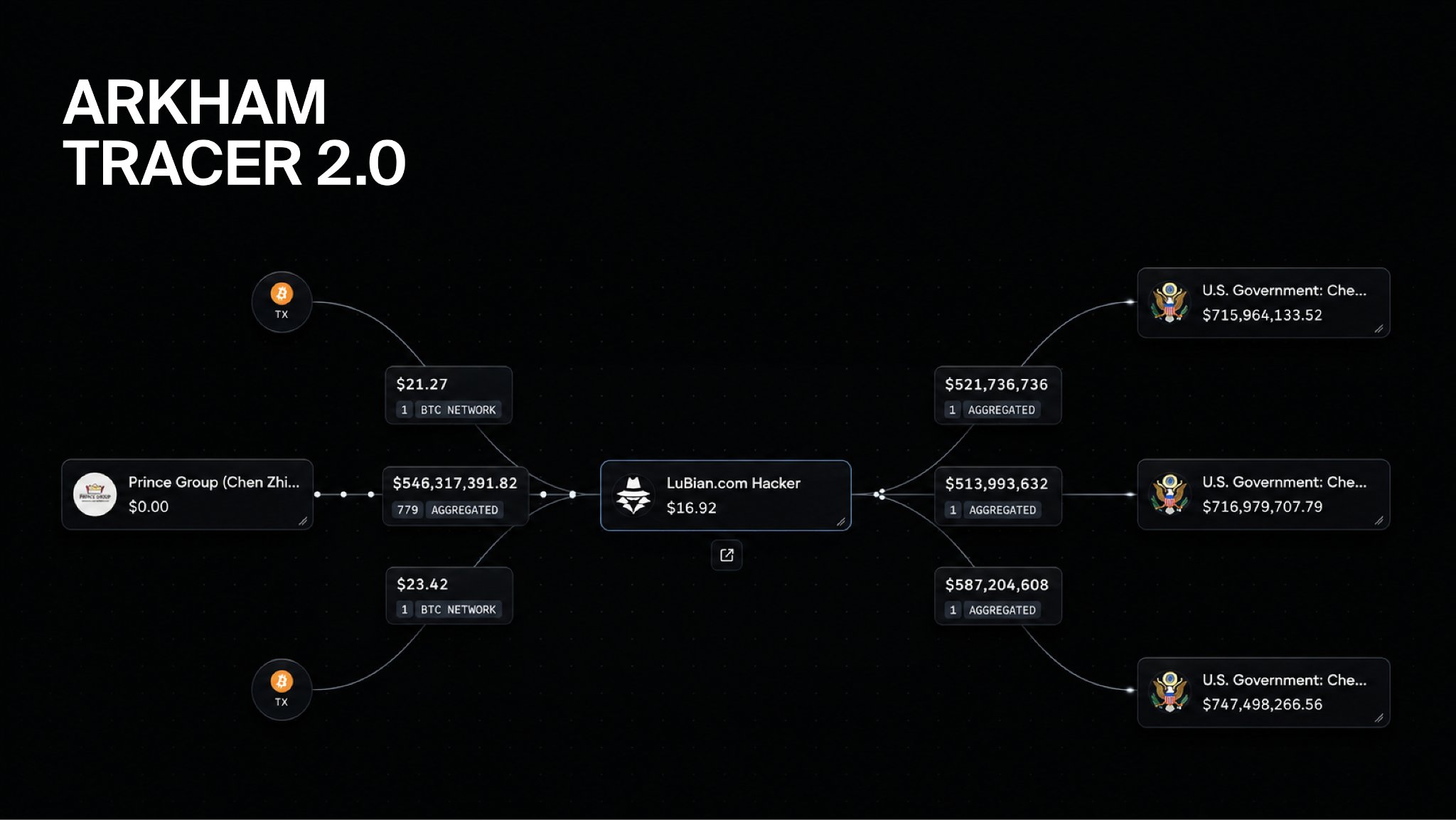
Arkham launches Tracer v2 to follow fund flows across bridges and chains
Expanding Thematic Coverage
Beyond pure wallet tracking, Arkham has invested in explanatory content and thematic intelligence products:
- Tokenized stocks: Arkham released a guide explaining how blockchain-based equities bring traditional shares on-chain, tracking how real-world asset (RWA) protocols handle issuance and secondary trading.
- AI agents and agentic payments: Coverage of how autonomous AI systems are initiating on-chain transactions across Visa, Mastercard, PayPal, and Solana rails — a thematic area where on-chain intelligence is newly relevant, since AI agents generate wallet footprints that Arkham can attribute.
- Japan's AI-crypto framework: Arkham highlighted Japan's proposed framework as the LDP pushes for tokenized banking rails, stablecoins, and autonomous financial agents — situating blockchain intelligence in a regulatory context where state-level crypto policy is evolving rapidly.
- Exploit tracking: When a third-party bridge to Polkadot was exploited and an attacker minted 1 billion DOT tokens on Ethereum before draining over $240,000 in ETH from liquidity pools, Arkham published a real-time tracker for the attacker's wallet. This use case — near-instant exploit attribution — has made Arkham a standard reference in security incident reporting.
- GCR address tagging: Arkham confirmed wallet addresses linked to the pseudonymous trader GCR, illustrating how even high-profile anonymous market participants can have their on-chain activity attributed once a sufficient cluster of circumstantial evidence accumulates.
The Intel Exchange and ARKM Token
The Intel Exchange is Arkham's most distinctive and contested feature. Users can post bounties in ARKM for wallet attributions — for example, "identify the wallet behind this DEX trader" — and other users can submit tips to claim the bounty. Confirmed tips transfer ARKM from the bounty poster to the submitter.
Critics argue this creates a financial incentive for unmasking individuals. Arkham's response has been to frame the exchange as focused on institutional and protocol-level intelligence, where the public interest in transparency outweighs individual privacy concerns. In practice, the exchange has been most visibly used for institutional attribution — identifying exchange cold wallets, fund custody addresses, and protocol treasuries — rather than targeting individuals.
ARKM trades on major centralized exchanges and has been used as a governance and fee token within the platform's ecosystem.
- 2023-07launch
Arkham Intel Exchange launch; reversible email hash controversy surfaces
- 2023-08milestone
$160M found in alleged Terra wallets via Arkham bounty
- 2024-01milestone
Arkham tracks Genesis Trading redeeming 32,000 BTC from GBTC during bankruptcy
- 2024-07governance
$150k bounty posted for $DJT creator; ZachXBT wins award identifying Shkreli
- 2024-09launch
Arkham launches KOL address labels, tagging 950+ high-profile wallets
- 2025-02exploit
Lazarus Group confirmed as Bybit hacker via Arkham; $1.5B loss tracked on-chain
- 2025-05milestone
Lazarus completes laundering of Bybit proceeds; 500k ETH converted via Thorchain
- 2025-06launch
Arkham launches perpetual futures exchange with KYC and ARKM rewards program
Technical Foundation
Arkham's attribution engine uses a combination of:
- Heuristic clustering: Addresses that co-sign transactions or share deposit behaviors are grouped into likely common-ownership clusters.
- Exchange deposit analysis: Deposits to known exchange hot wallets can be reverse-traced to identify depositor addresses.
- Public disclosure cross-referencing: On-chain proof-of-reserve publications, regulatory filings, and voluntary wallet disclosures from institutions are ingested and mapped.
- Crowdsourced labeling: The Intel Exchange incentivizes users to contribute attributions, which Arkham's team reviews before publishing.
The platform's real-time alerts system means that new large transactions from labeled entities surface to subscribers within seconds of on-chain confirmation — which is why Arkham posts consistently precede traditional news coverage of major fund movements.
Outlook
Arkham's trajectory points toward deeper integration of blockchain intelligence with financial action — the Solana trading launch is an early example of a platform that began as a data tool becoming an execution venue. As institutional Bitcoin exposure grows through ETFs, sovereign holdings, and corporate treasuries, the demand for real-time custodial wallet transparency will grow with it. The platform's expansion into AI agent transaction tracking also positions it well for a potential future where autonomous systems generate significant on-chain volume.
The persistent tension is between transparency and privacy. Regulatory pressure on crypto — particularly around sanctions compliance and AML — creates institutional demand for the kind of attribution Arkham provides. But as the Iran central bank episode demonstrated, the same tools that serve compliance can serve surveillance. How Arkham navigates that duality, especially as its dataset deepens and its attribution accuracy improves, will shape both its commercial trajectory and its standing in the broader crypto policy debate.
Latest Arkham news
Community notes
Spot something off or out of date? Drop a note. Editors review topic notes daily and roll accepted fixes into the explainer — contributors are recognized in the monthly $SQUID drop.
Loading notes…
Help improve this topic
Have a story or tip about this topic? Submit it. See something missing? Leave a note. Editors review daily; accepted submissions and fixes count toward the monthly $SQUID drop.