
Comprehensive explainer on “ledger” in crypto, covering Ledger hardware wallets, public blockchains like the XRP Ledger, security practices, tokenized assets, AI-driven payments, and how users safely interact with Bitcoin, XRP, stablecoins and DeFi.
+35 sources across the wider coverage universe
 Ledger names Ian Rogers Chief Human Agency Officer, tasking him with ensuring human control as AI agents take on financial operations in the crypto ecosystem2026-04
 Fake Ledger app on Apple's Mac Store drains G. Love's $420K Bitcoin retirement fund2026-04
 SlowMist uncovers macOS malware that steals Telegram sessions and swaps Ledger, Trezor apps for phishing loaders2026-07
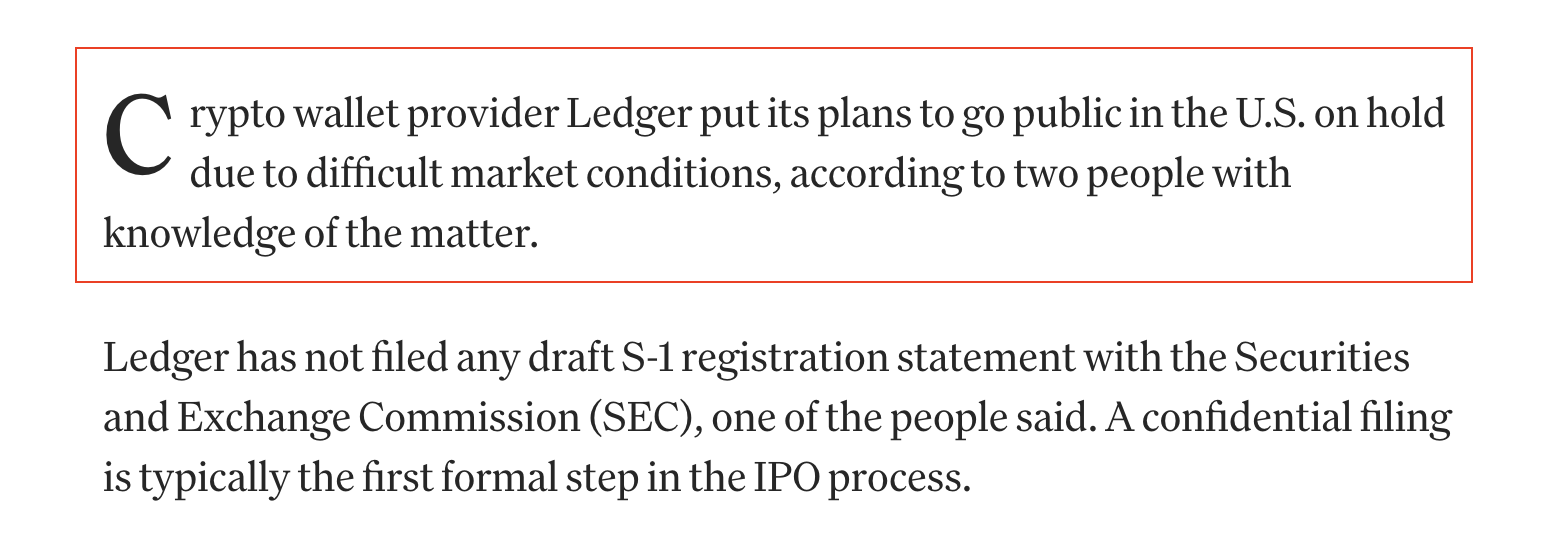 Ledger pauses US IPO plans amid unfavorable market conditions2026-05
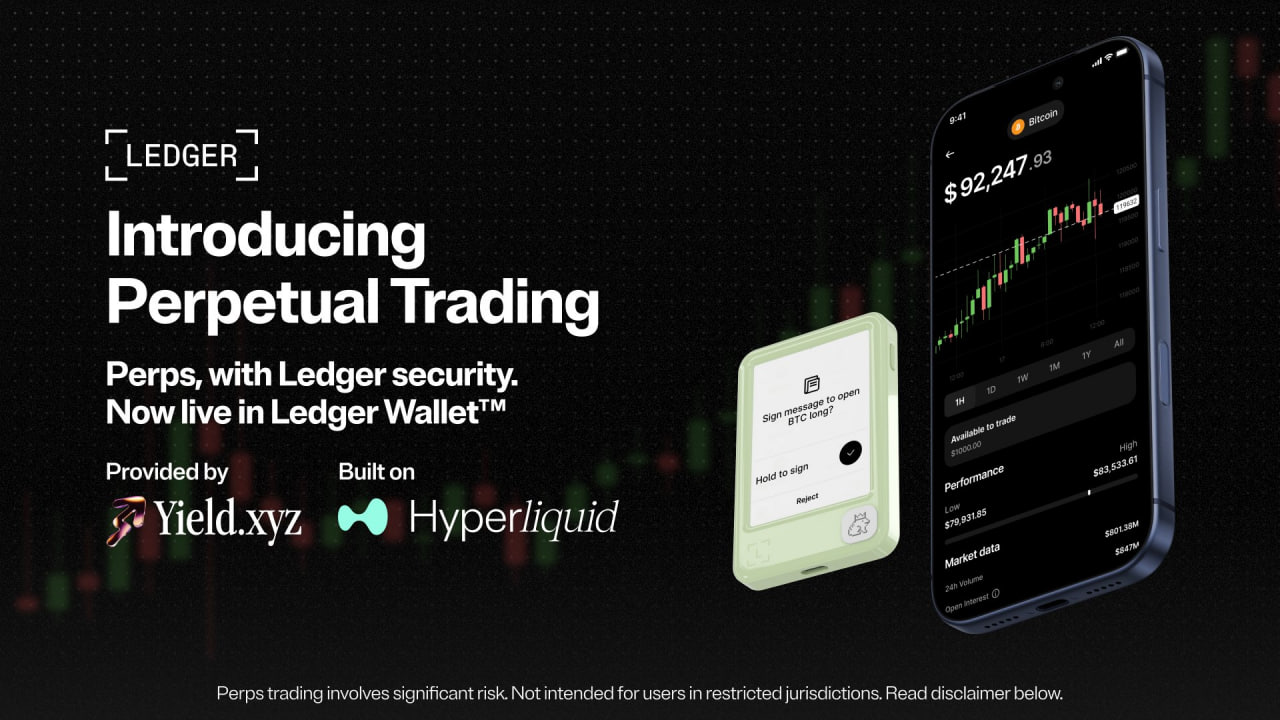 Ledger integrates Hyperliquid perps trading via Yield.xyz, bringing hardware-secured, self-custodial access to onchain derivatives markets for select users2026-05
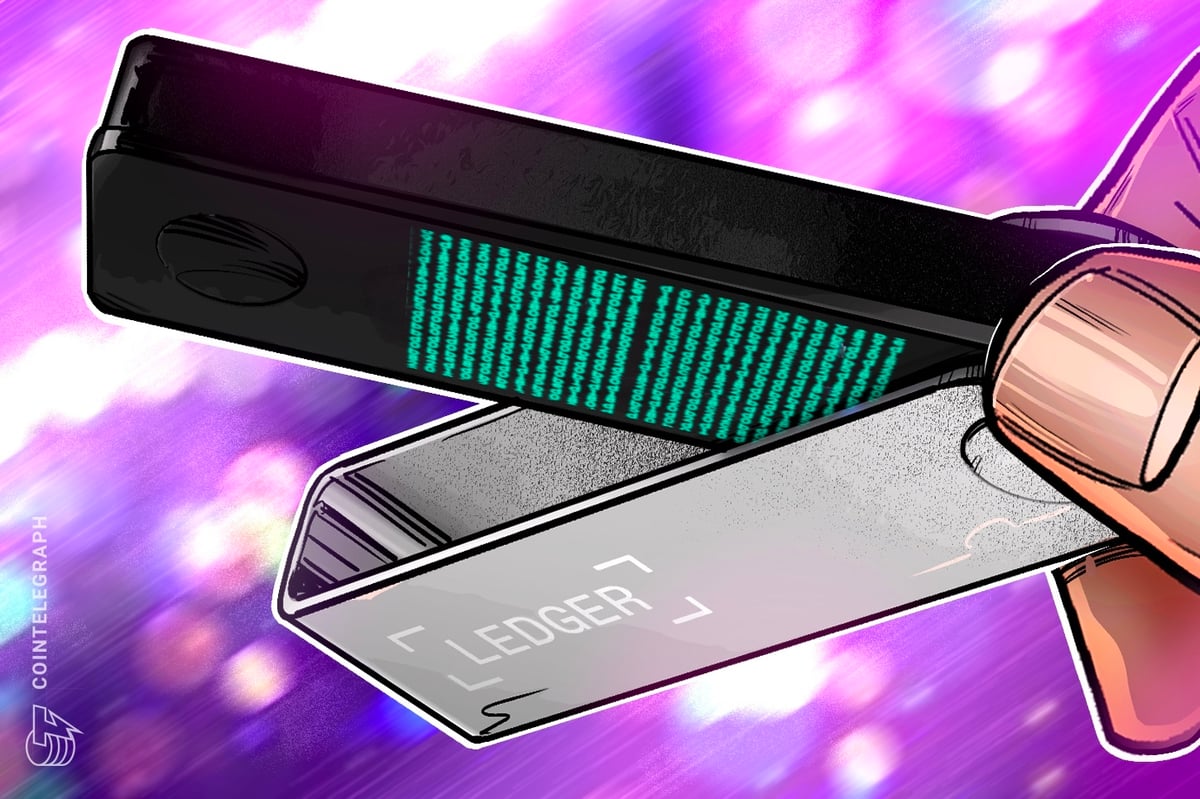 Counterfeit Ledger Nano S Plus with embedded WiFi sold on Chinese marketplace, steals seed phrases via fake Ledger Live2026-04
Ledger in Crypto: Hardware, Blockchains, and the Future of Digital Records
In crypto markets, the word ledger describes both the shared database that records every transaction on a blockchain and one of the industry’s most prominent hardware wallet brands. Understanding how these meanings connect is essential to making sense of Bitcoin, XRP, stablecoins, tokenized Treasuries, and the tools that keep them secure.
What “ledger” means in the crypto ecosystem
At its core, a ledger is simply a record of who owns what and how that ownership changes over time. Traditional finance maintains ledgers inside banks, brokers, and clearing houses; crypto replaces many of those private databases with public, cryptographically secured ledgers shared across thousands of nodes around the world. Each blockchain is, in effect, a specialized ledger with its own rules for how balances are updated, how consensus is reached, and who can participate in validating transactions.
Blockchains like Bitcoin and the XRP Ledger (XRPL) are therefore different implementations of the same basic idea: an ordered, tamper-evident log of transactions that all participants agree to treat as the source of truth. In Bitcoin, this ledger is structured around unspent transaction outputs; in account-based systems like XRPL, the ledger tracks balances and objects tied to specific accounts. Regardless of structure, all of these systems aim to make it computationally and economically infeasible to alter past records, which is why they are often described as immutable ledgers.
The term “ledger” also appears in protocol-specific contexts. The XRP Ledger, for example, is the name of Ripple’s preferred blockchain for payments and tokenization, with recent upgrades aimed at improving security, lending infrastructure, and institutional use cases. Zcash developers publish ongoing “ledger integration” updates as they refine how privacy-preserving transactions are represented and validated in the protocol’s state. Other networks, such as COTI, speak of migrating from one ledger generation to another as they roll out new privacy and scaling technologies. In each case, the ledger is the canonical state machine that defines the network.
Finally, “Ledger” with a capital L refers to a French hardware wallet manufacturer whose devices and software are used to secure private keys for Bitcoin, XRP, USDC, and many other assets. In the self-custody model, users rely on Ledger devices to sign transactions against public blockchains, which means the company sits at a crucial interface between private key management and public ledgers. The same term therefore covers both the infrastructure that records crypto ownership and the tools individuals use to interact with that infrastructure.

Payward partners with Ledger to bring hardware signers to Kraken and xStocks to Ledger Wallet
Ledger as a hardware wallet company
Products, positioning, and the Ledger Live app
Ledger is best known for its line of hardware wallets, which are small dedicated devices designed to store private keys offline and sign transactions in a secure environment. When a user sends Bitcoin, XRP, USDC, or another supported asset, the transaction is prepared in software but the private key never leaves the Ledger device; only a signed transaction hash is returned to be broadcast to the blockchain. This architecture makes it much more difficult for malware on a laptop or phone to steal keys, because the secrets never exist in general-purpose memory.
The company wraps this hardware in a broader software experience called Ledger Live. Ledger Live acts as the control center for a user’s holdings, allowing them to generate new addresses, initiate transfers, track portfolio balances, and manage multiple assets and accounts from a single interface. Within the app, users can buy, swap, and stake supported cryptocurrencies, or connect to third-party DeFi and Web3 applications while still using their Ledger as the transaction signer. In effect, Ledger Live is a multi-chain wallet and portfolio dashboard, while the hardware device is the security core that approves or rejects each transaction.
Ledger’s product line has expanded over time to include devices with different form factors and capabilities. Some models remain USB-only and require a host computer for power, while others integrate a battery capable of roughly ten hours of normal use or up to around 150 transactions before recharging, reflecting a push toward mobile-first and on-the-go usage. All models are built around the same principle: protect private keys inside a secure hardware element and expose only carefully controlled signing functionality to the outside world. This is particularly relevant as more users interact with DeFi protocols, NFTs, the XRP Ledger ecosystem, and tokenized real-world assets that demand frequent on-chain activity.
Ledger has also positioned itself as an interface to newer asset classes. The company’s app now supports in-app swaps for certain tokenized securities offered by Ondo Finance, which operates a large tokenized securities platform with more than one billion dollars in total value locked and tens of thousands of asset holders. By integrating these products, Ledger allows users to hold and trade tokenized Treasuries and other securities from the same hardware device they use for Bitcoin and XRP, bringing traditional financial exposures onto self-custodied rails. This reflects a broader strategy of making the Ledger stack a hub for both crypto-native assets and regulated tokenized instruments.
Security model, seed phrases, and recovery
Ledger’s security model relies on a combination of tamper-resistant hardware, minimal attack surface, and a standardized backup mechanism known as a seed phrase. When a user initializes a new Ledger device, it generates a seed phrase consisting of 12 to 24 simple words chosen from a standardized list of 2,048 words. This seed is the root from which all of the wallet’s private keys are derived. It functions as a kind of master key or password reset code, capable of regenerating the entire wallet, including all derived private keys and addresses, on any compatible device.
A critical distinction in crypto security is the difference between a seed phrase and a private key. The seed phrase is a master secret; it can restore the entire wallet and all associated private keys. Each private key, by contrast, corresponds to a single wallet address or account and is used to sign transactions for that specific address. As Ledger’s own guidance emphasizes, the seed phrase is used for backup and recovery and can generate many private keys, while a private key is tied to one address and is only for transaction signing. This means the seed phrase is the single most sensitive piece of information a self-custody user controls.
Best practice for storing a seed phrase is entirely offline and on durable materials. Ledger recommends physically writing the phrase down on fire-resistant and water-resistant materials such as metal plates, and storing multiple copies in separate, secure locations like a home safe, a safety deposit box, or other trusted offline storage solutions. Storing the seed in a non-encrypted digital format—such as a cloud document, email, phone notes app, or screenshot—is strongly discouraged because it exposes the seed to malware, phishing, and remote hacking. The reasoning is straightforward: anyone who obtains the seed can recreate the wallet on their own device and move all funds without the original owner’s knowledge.
The consequences of losing a seed phrase can be severe. If a user still has access to their Ledger device but has misplaced the written backup, the company’s guidance is to create a new wallet, generate a new seed phrase, and transfer all funds from the old wallet to the new one as soon as possible. This prevents catastrophic loss if the original device is later damaged, lost, or fails, because the user will then have a properly backed-up seed for the new wallet. If a user has both lost their seed phrase and can no longer access their device, there is no way to recover the funds; without the seed, the cryptographic keys cannot be reconstructed, and the assets are effectively lost forever. Importantly, the seed phrase itself cannot be changed or modified; the only way to “rotate” is to create a new wallet with a new seed and move funds across.
This model places significant responsibility on the individual but also enables a high degree of sovereignty. For users transacting on Bitcoin, holding XRP to use the XRP Ledger’s built-in decentralized exchange, or navigating stablecoins like USDC and MXN-backed tokens, the seed phrase is the anchor of ownership. Hardware wallets like Ledger sit at the intersection of that personal responsibility and the security properties of the underlying blockchain ledgers.
Staking, DeFi access, and tokenized assets through Ledger
Beyond simple storage and transfers, Ledger has invested heavily in enabling secure participation in staking and DeFi without ceding custody. Staking is the process of locking crypto assets to help secure certain proof-of-stake networks, which use staked tokens and validator participation rather than pure proof-of-work to validate transactions. In exchange for contributing to network security, stakers earn rewards based on the amount of assets they lock and the specific chain’s inflation and reward mechanics. While centralized exchanges offer staking services, they generally require users to deposit assets into the exchange’s custody and accept its choice of validators and fee schedules.
Ledger’s staking design aims to preserve self-custody. When a user stakes assets through the Ledger app, they continue to control the private keys; the stake is delegated from their own address to a validator of their choice rather than pooled into an exchange omnibus account. This means the user has full control over their assets at all times, rather than being exposed to exchange insolvency or withdrawal freezes. The ability to choose a validator, which is typically not available when staking through centralized platforms like Binance or Kraken, gives users more influence over network governance and allows them to evaluate validator performance, uptime, and commission rates directly. Because Ledger is not a centralized custodian in this workflow, users can also avoid additional fees that exchanges might charge for staking-as-a-service.
In addition to staking, Ledger’s integration with tokenized real-world assets illustrates how hardware-secured wallets are becoming gateways to more traditional financial exposures. Ondo Finance, which runs what it describes as the world’s largest tokenized securities platform with over one billion dollars in total value locked and tens of thousands of asset holders, has partnered with Ledger so that users can perform in-app swaps for Ondo’s tokenized stocks and bond-like products. This allows an investor who already stores Bitcoin or XRP on a Ledger device to allocate into tokenized Treasuries or other securities without leaving the hardware-secured environment. It is an early example of how on-chain capital markets and self-custody tools are converging.
Ledger is also expanding its support for new networks dedicated to stablecoins and tokenized assets. For example, the company added native support for the ADI token associated with the ADI Chain network, a United Arab Emirates–linked layer-2 that focuses on stablecoins and related payment use cases. As stablecoins proliferate, including fiat-backed instruments like USDC, MXN-backed tokens, and new regulated dollar variants such as Ripple’s RLUSD, hardware wallet support becomes a prerequisite for serious adoption among users who prioritize self-custody. Integrations like ADI Chain support signal Ledger’s intention to remain a default storage and signing tool as tokenized cash instruments and real-world assets move onto various blockchains.
Business strategy and capital markets
On the corporate side, Ledger has had to adapt its funding and strategy to a shifting macro backdrop in both crypto and traditional equities. The firm had been considering an initial public offering in New York, with earlier reports suggesting it could seek a valuation above four billion dollars. However, it has paused those U.S. IPO plans, citing current market conditions and regulatory uncertainty, and as of the latest reporting it has not submitted a draft S-1 registration statement to the U.S. Securities and Exchange Commission. Instead, Ledger is exploring the possibility of raising additional private capital rather than proceeding directly to public markets.
This strategic pivot comes amid a broader environment in which investor attention and capital are often drawn to high-profile artificial-intelligence IPOs and large-cap tech rather than to crypto infrastructure plays. Industry commentary from figures such as Ledger executive Takatoshi Shibayama has underscored that the “capital tide” that lifted many crypto firms during the 2020–2021 bull market has not fully returned, even as AI-related offerings capture public market enthusiasm. Hardware wallet makers and exchanges must therefore demonstrate resilience and utility across cycles, emphasizing the long-term need for key management and self-custody rather than relying on speculative trading volumes alone.
Ledger is not alone in this recalibration. Analysis of digital asset firms like Ledger and Kraken suggests that both are adapting their business strategies in response to AI adoption and geopolitical challenges, which affect everything from regulatory risk to supply chains for secure chips. For Ledger, delays in public listing may provide more room to refine products like Ledger Live, deepen integrations with ecosystems such as the XRP Ledger and Zcash, and participate in new tokenization initiatives without the quarterly pressures of public markets. For users, the key point is that the hardware wallet provider’s business decisions can influence long-term support and security updates, making corporate stability another dimension of risk to monitor.
Readers use Ledger as a stress-test for the self-custody thesis itself — every incident (software supply-chain hack, fake app, executive kidnapping, seed-phrase custody debate) is read as evidence that hardware wallets either do or do not actually deliver the security they promise.
Public blockchains as ledgers: Bitcoin, the XRP Ledger, and beyond
Bitcoin and the original distributed ledger
Bitcoin introduced the first widely adopted model of a digital ledger maintained by a decentralized network rather than a central institution. In Bitcoin’s design, the ledger records unspent transaction outputs, or UTXOs. Every time someone sends BTC, they consume one or more UTXOs as inputs and create new UTXOs as outputs, which together define the current distribution of coins. This structure, combined with proof-of-work mining and cryptographic signatures, ensures that the ledger can be independently verified by any node and that double-spending is prevented without a central authority.
Hardware wallets like Ledger sit at the edge of this system. They store the private keys that control specific UTXOs and sign transactions that alter the ledger state, but they do not themselves maintain the full blockchain or determine which transactions are valid. That role is reserved for consensus nodes distributed around the world. The ledger metaphor is thus literal: the Bitcoin blockchain is the shared accounting book, while devices like Ledger act as tools that authorized parties use to write new entries into that book, subject to the protocol’s rules.
The XRP Ledger’s design and ongoing evolution
The XRP Ledger offers a contrasting but complementary model of a blockchain-based ledger. Instead of a UTXO system, XRPL uses an account-based model in which each account has a balance and can hold multiple asset types, including XRP, issued tokens, NFTs, and other on-ledger objects. Consensus does not rely on proof-of-work mining; instead, XRPL uses a variant of federated consensus in which a set of validator nodes agree on the next ledger state based on a shared list of trusted nodes. This design aims to support high throughput and low-latency settlement for cross-border payments and asset transfers.
Recent upgrades underscore how XRPL’s codebase and governance continue to mature. One notable release rebranded the core server software from “rippled” to “xrpld,” a seemingly cosmetic change that nonetheless signals the project’s evolution from a company-centric to a protocol-centric identity. The same v3.2.0 release shipped security patches across several emerging features, including Single Asset Vaults, a Lending Protocol, and permissioned decentralized exchanges, reflecting a push toward more sophisticated, institutionally relevant financial primitives on the ledger. These changes are part of what some commentators have described as a “seismic shift” in XRPL’s core, as it increasingly positions itself as infrastructure for regulated finance as well as retail payments.
Further incremental improvements come through targeted amendments. The fixCleanup3_1_3 upgrade, for example, automatically deletes expired NFT offers from the ledger, reducing clutter and lowering the risk of user confusion when interacting with on-chain marketplaces. The same patch addresses bugs related to vault withdrawals, permissioned domains, and loan accounting, which could otherwise create discrepancies or edge cases in lending and DeFi applications built on XRPL. Such upgrades, though technical, are critical in maintaining ledger integrity as the network supports more complex instruments like tokenized Treasuries, credit markets, and enterprise-centric payment flows.
Security at the protocol level is also a continuing focus. A recent proposal for the XRP Ledger emphasizes that the network’s transaction architecture already makes certain types of flash loan attacks structurally difficult, and it seeks to further formalize protections that would render a whole class of exploits essentially impossible on XRPL. Flash loan attacks—rapidly borrowing and repaying funds within a single block to manipulate DeFi protocols—have cost other ecosystems hundreds of millions of dollars. By designing the ledger and transaction sequencing to resist such patterns, XRPL aims to provide a safer environment for DeFi and tokenization use cases that might otherwise be exposed to aggressive arbitrage and manipulation.
Stablecoins and tokenized assets on public ledgers
Stablecoins and tokenized real-world assets are increasingly central to how ledgers are used. On the XRP Ledger, Ripple and Mexican exchange Bitso have announced that Bitso’s regulated MXN-backed stablecoin, MXNB, will be issued natively on XRPL and integrated into Ripple’s evolving payments product suite. This means that peso-backed liquidity will exist directly on the ledger and can be routed through Ripple’s enterprise payment systems, enabling cheaper and faster cross-border flows between Mexico and other jurisdictions that settle in seconds rather than days. Such use cases depend on the ledger’s ability to represent fiat-backed tokens with predictable redemption mechanics.
Ripple has also introduced Ripple USD (RLUSD), a dollar-backed stablecoin, and is supporting it alongside XRP in new developer offerings. The XRPL AI Starter Kit, for instance, includes support for X402-powered payments using both XRP and RLUSD, allowing AI agents to pay for APIs, compute, and other services while transacting on the XRP Ledger. This pairing of a volatile cryptoasset (XRP) and a stablecoin (RLUSD) illustrates how developers may choose different instruments depending on their risk tolerance and use case, but in both cases the ledger is the shared state machine that records the transactions.
Ledger hardware plays a complementary role by enabling secure storage of these tokens. Beyond mainstays like Bitcoin and Ethereum-based USDC, Ledger has added support for more specialized ecosystems. The integration of the ADI token, tied to the ADI Chain network, brings hardware-level support to a UAE-linked layer-2 chain focused on stablecoins and payments. ADI Chain’s growth reflects rising demand for regionally aligned stablecoin networks, especially in jurisdictions looking to develop their own digital asset strategies. Ledger’s role here is infrastructural: it does not issue the stablecoins or run the chain, but it allows users to hold and transact them safely.
Tokenized securities and Treasuries represent another fast-growing category. Ondo Finance, which has more than one billion dollars in total value locked and a base of tens of thousands of asset holders, runs a suite of tokenized government debt and related products. Ledger’s support for in-app swaps into Ondo’s tokenized stocks means that tokenized U.S. Treasury funds, for example, can be bought and held directly from a hardware wallet environment. At the same time, Ondo has participated in high-profile cross-bank experiments in which tokenized Treasuries are redeemed across borders and institutions.
One landmark demonstration saw Ondo, JPMorgan, Mastercard, and Ripple collaborate to complete the first near real-time, cross-border, cross-bank redemption of a tokenized U.S. Treasury fund on the XRP Ledger. In that transaction, Ondo’s tokenized U.S. government debt was redeemed on XRPL, with Mastercard’s Multi-Token Network routing instructions to JPMorgan’s Kinexys blockchain unit, and settlement occurring in under five seconds, even outside traditional banking hours. This experiment showcases how a public ledger like XRPL can serve as neutral infrastructure for moving regulated assets between banks and jurisdictions, with tokenized Treasuries functioning as on-chain cash equivalents. It also illustrates why hardware wallets and robust key management are increasingly important for both retail and institutional participants in these markets.
Privacy-focused ledgers and Zcash’s roadmap
Not all ledgers aim for maximum transparency. Zcash, for instance, is a privacy-focused blockchain that uses zero-knowledge proofs to shield transaction details while still allowing nodes to verify that the ledger remains consistent and that no new coins are created illicitly. This makes integration with hardware wallets more complex, because devices and software must handle shielded addresses, viewing keys, and proof generation rather than simple transparent transfers.
The Zcash project has highlighted these complexities through regular communication from its ledger integration team, which reports on general progress, responses to protocol issues, and preparations for upgrades like the forthcoming Ironwood release. One such update described an emergency soft-fork response, illustrating that even well-audited ledgers occasionally require rapid, coordinated changes to fix consensus or security issues. Soft-forks of this kind must be handled carefully so that nodes and wallets remain in sync and users do not see inconsistent balances or transaction histories.
For hardware wallet vendors, supporting a privacy-preserving ledger like Zcash entails both technical integration and ongoing monitoring of protocol changes. Narratives around upcoming upgrades such as Ironwood, which is expected to adjust Zcash’s core architecture, remind users that ledger design is not static. As networks adopt new proof systems, privacy features, or performance improvements, the way the ledger represents state and transactions can change, and wallet software and hardware must evolve alongside.
Evolving and sunsetted ledgers
Other networks underscore the lifecycle nature of ledgers. COTI, for example, has indicated that its version 1 ledger will be sunset by a future date and that users in certain applications, such as VIPER or earlier “COTI Ledger” environments, will need to upgrade to a more powerful, privacy-focused version 2. While details vary by project, the pattern is common: a first-generation ledger with limited features gives way to an upgraded protocol, and users must move assets or update clients to remain supported.
From a user’s standpoint, this highlights why self-custody and wallet flexibility matter. If a network sunsets an old ledger, custodial platforms may or may not handle migrations on behalf of customers, whereas a user with direct control of their keys can follow project instructions and move funds as needed. Hardware wallets like Ledger, which support a broad range of chains, can help smooth these transitions, but users still need to pay attention to announcements and upgrade timelines.
Security, audits, and incidents
Ledger’s 2020 customer data breach
Security in crypto is not only about private keys and consensus algorithms; it also involves the handling of customer data and off-chain systems. In June 2020, Ledger, the hardware wallet manufacturer, suffered a significant data breach that exposed over one million email addresses from its e-commerce and marketing databases. The compromised data, which was initially sold and later dumped publicly in December 2020, included names, physical addresses, and phone numbers for many customers. Importantly, the breach did not compromise hardware devices or seed phrases; funds on Ledger wallets remained secure. However, the exposure of personal data created a serious phishing and harassment risk.
Following the leak, many affected users reported targeted phishing emails attempting to trick them into revealing their seed phrases or installing malicious software, as well as threatening messages that cited their home addresses to extort payment. The incident illustrated that even companies whose core products are designed for security can have vulnerabilities in their web infrastructure and customer data handling. It reinforced best practices such as never revealing a seed phrase to anyone, never typing it into a website or app, and treating unsolicited communications with extreme skepticism, especially if they reference hardware wallet purchases or delivery details.
From an industry perspective, the Ledger breach became a case study in the need for strong data minimization and compartmentalization practices. Because personal information is not required to verify blockchain transactions or maintain ledgers, many in the crypto community argued that wallet manufacturers and exchanges should collect and retain as little identifiable information as possible. While regulatory requirements such as know-your-customer rules constrain how far this can go, the breach showed that the reputational and security costs of holding large troves of customer data can be substantial.
Hardware security research and the Trezor Safe 7 disclosure
Ledger is also active on the security research side, sometimes in ways that involve its competitors. In 2024, Trezor, another major hardware wallet maker, disclosed that a vulnerability had been found in one of the secure element chips in its Trezor Safe 7 device, specifically the TROPIC01 chip produced by Tropic Square. The vulnerability was identified through an audit conducted by Ledger’s security team, but Trezor emphasized in its response that the issue did not give attackers access to user funds, PINs, or wallet backups.
According to Trezor, the TROPIC01 vulnerability affects only one of three independent security layers in the Safe 7 device. The keys to users’ coins and the wallet backup are not stored on the TROPIC01 chip, by design, so compromising that single component is insufficient to access funds. The vulnerability also does not enable the creation of tampered devices with persistent malicious firmware, which limits the risk of supply-chain attacks. As a result, Trezor stated that users did not need to take any action; the Safe 7 remained safe and secure, and day-to-day usage continued to protect assets.
Because the issue arises at the hardware level, a full fix cannot be applied remotely via a firmware update. Instead, Tropic Square has been working on a new batch of chips that corrects the reported vulnerability for future devices. This incident underscores two important points. First, even purpose-built security chips can harbor flaws, and independent research—including from competitors—plays a vital role in discovering and disclosing them responsibly. Second, robust wallet design aims to avoid single points of failure; by ensuring that keys and backups are not stored on any one chip, vendors can absorb component-level vulnerabilities without putting user funds at risk.
Protocol-level security: XRPL upgrades and DeFi hardening
While hardware wallets guard keys at the edge, ledger-level security improvements are continually rolling out on major chains. On the XRP Ledger, the v3.2.0 release combined branding changes with substantive security enhancements, shipping patches across new modules such as Single Asset Vaults, a Lending Protocol, and permissioned decentralized exchanges. These features are aimed at more complex financial applications, including institutional DeFi and regulated markets, where misconfigurations or edge-case bugs could lead to loss of funds. By keeping the core server code up to date and addressing vulnerabilities proactively, XRPL developers are trying to ensure that the ledger remains a trustworthy platform for these use cases.
The fixCleanup3_1_3 amendment is another example of protocol-level security and hygiene work. By automatically deleting expired NFT offers, the upgrade prevents stale orders from lingering on the ledger, which could otherwise be exploited for confusion or mispricing in NFT marketplaces. The same patch fixes bugs in vault withdrawals, permissioned domains, and loan accounting—issues that might not threaten the entire network but could have serious consequences for individual users and dApps if left unresolved. Regular maintenance amendments like this show how ledger governance must balance stability with iterative improvement.
XRPL’s efforts to address flash loan attacks also highlight the interplay between ledger architecture and DeFi risk. Because XRPL transactions follow a specific order and settlement model, the window for borrowing and repaying funds within a single ledger close is limited. A recent proposal goes further, suggesting changes that would make the class of flash loan exploits that have cost other networks hundreds of millions of dollars structurally impossible on XRPL. The goal is to design the ledger and transaction semantics so that certain harmful combinations of actions simply cannot be executed in one atomic bundle, forcing would-be attackers into less effective strategies. Whether other ledgers follow similar approaches remains to be seen, but the example underscores how protocol rules shape the risk profile of on-chain finance.
User-level security: practicing robust self-custody
Even with strong hardware and protocol security, the weakest link is often user practice. Ledger’s own documentation emphasizes that seed phrase management is the most critical task for anyone using its devices. Physically recording the seed on durable, fireproof, and waterproof materials and storing separate copies in secure locations greatly reduces the risk of loss from accidents or natural disasters. Keeping the seed entirely offline and never storing it in plaintext digital form prevents an entire category of malware, keylogger, and cloud compromise scenarios.
Beyond the seed, users must remain vigilant about phishing and social engineering. After the 2020 data breach, many Ledger customers were targeted by emails and messages impersonating support staff and urging them to “verify” their recovery phrase or install “critical updates” via links that led to fake apps or websites. The company’s guidance, echoed by security experts, is unequivocal: legitimate support will never ask for a seed phrase, and any request to type the phrase into a computer or phone is almost certainly malicious. Connecting a Ledger device only to official software, verifying transactions on the device screen, and treating unsolicited contact with suspicion are key habits for safe self-custody.
Finally, users should consider operational resilience. That includes periodic checks that seed backups are legible and complete, rehearsed recovery on a spare device when appropriate, and clear documentation so that heirs or trusted parties can access funds if the owner becomes incapacitated. Because a ledger is a long-lived record of value, key management is inherently a long-term responsibility.
- 01Connect Kit supply-chain hack↗
Three separate headlines on the same exploit — compromise notice, technical remediation, and CEO response — drew a combined ~325 clicks, signalling readers tracked accountability and recovery steps, not just the breach itself.
- 02Co-founder kidnapping saga
Physical attacks on crypto executives generated sustained interest across five distinct story beats (initial rumour, denial, rescue, arrests, final suspect) totalling ~467 clicks, treating the incident as a real-world proof-of-stake in self-custody risk.
- 03EigenLayer and DeFi integrations via Ledger Live↗
The Kiln LST restaking headline was the single most-clicked item, reflecting reader appetite for hardware wallets evolving into active DeFi participation surfaces rather than passive cold storage.
- 04XRP Ledger as tokenization platform
Tokenized T-Bills, RLUSD stablecoin, and a network self-healing halt across ~371 combined clicks show readers tracking XRP Ledger as a distinct institutional-grade chain, separate from Ledger the company.
- 05Ledger Recover seed-phrase custody controversy↗
Three headlines on opt-in cloud seed backup — announcement, backlash, and retreat — drew ~276 clicks, revealing readers are acutely sensitive to any deviation from pure local key custody.
- 06Institutional distributed-ledger adoption
JPMorgan settling on a public ledger via Chainlink/Ondo, CME tapping Google Cloud's Universal Ledger, and BIS CBDC architecture collectively attracted ~309 clicks from readers tracking TradFi's convergence with on-chain infrastructure.
Ledgers, AI, and autonomous finance
The XRPL AI Starter Kit and agentic payments
Artificial intelligence is increasingly intersecting with blockchain ledgers, not just as a tool for analyzing on-chain data but as active participants in transactions. Ripple has introduced the XRPL AI Starter Kit, a set of tools and integrations designed to help developers build agentic payment applications on the XRP Ledger. These applications envision AI agents that can hold balances, initiate payments, and interact with services autonomously, within constraints defined by their human operators. The starter kit supports X402-powered payments using XRP and Ripple USD (RLUSD), enabling such agents to transact for APIs, compute resources, and other machine-to-machine services.
The combination of AI agents and a fast, low-cost ledger like XRPL creates new possibilities and new risks. On the one hand, AI systems could manage subscriptions, rebalance portfolios, or arbitrage across exchanges in real time, all while recording every move on a transparent public ledger. On the other hand, giving an AI process access to funds raises questions about error handling, adversarial inputs, and governance. Hardware wallets and multi-signature schemes may play a role in constraining what AI agents can do—for example, by requiring human approval above certain thresholds or for specific transaction types—but the XRPL AI toolkit shows that the industry is actively exploring these frontiers.
AI adoption at crypto firms and in market strategy
Beyond protocol tooling, AI is reshaping how crypto firms operate. Analysis of digital asset companies notes that both Ledger and centralized exchanges like Kraken are adjusting their business strategies in light of AI adoption and geopolitical challenges. For a hardware wallet manufacturer, AI can be both an opportunity and a competitive threat. AI-powered code analysis and fuzzing tools can help harden firmware and wallet software, but AI chips and data-center plays also compete for investor attention that might otherwise go to crypto infrastructure IPOs. The decision to pause a U.S. IPO and potentially pursue private capital reflects this shifting landscape.
On the trading and asset allocation side, firms such as MindEdge Ventures are applying AI-driven techniques to navigate between crypto and traditional markets. MindEdge describes using liquidity cycle mapping and cross-market correlation analytics to engineer strategic stock-to-crypto reallocation pathways capable of adapting to dynamic economic environments. By emphasizing structured capital deployment and adaptive diversification ratios, such strategies aim to enhance long-term scalability and investor readiness for a more digital, tokenized market environment. Sonic Strategy, mentioned as an institutional access and sales arm via public markets for investors unable to hold crypto directly, illustrates how traditional securities and on-chain assets are increasingly intertwined.
These developments point toward a future in which AI models not only analyze ledger data but also shape how capital flows through ledgers, deciding when to move from equities to Bitcoin, from stablecoins like USDC or RLUSD into tokenized Treasuries, or from centralized exchanges into self-custody. The transparency and programmability of ledgers make them natural substrates for such strategies, though they also introduce new systemic risks if many AI agents act on similar signals at once.
Risks and governance for AI-driven on-chain agents
As AI agents gain the ability to initiate ledger transactions, governance and safety become paramount. An AI model controlling a wallet that can sign XRP or USDC transfers on a public blockchain could, in principle, be manipulated into draining funds through prompt injection or adversarial inputs. Even without malicious interference, mis-specified objectives could lead to reckless trading or overexposure to illiquid assets. This is where the separation between signing hardware and application logic becomes important: by keeping the private keys in a Ledger device or a multi-signature setup, humans can enforce hard limits on what an AI agent is allowed to do.
The XRPL AI Starter Kit’s architecture, which focuses on specific payment flows using XRP and RLUSD, can be seen as an effort to scope AI capabilities narrowly and safely. Developers can design agentic applications that operate within predefined transaction templates, rate limits, or approval workflows, reducing the attack surface. Over time, similar patterns may emerge on other ledgers and in multi-chain wallets, where AI agents handle routine microtransactions but larger transfers require hardware-confirmed human approval.
For regulators and policymakers, AI-driven on-chain agents raise additional questions about responsibility and accountability. If an AI agent executes a transaction that violates sanctions or anti-money-laundering rules, who is responsible—the developer, the user, or the model provider? Ledgers record what happens, but they do not answer these normative questions. As AI becomes more deeply embedded in ledger interactions, these issues will move from theoretical debates to practical concerns.
Business models, regulation, and capital-market bridges
Ledger’s paused IPO and the public–private funding balance
Ledger’s decision to pause its U.S. IPO plans highlights the tension between private and public funding routes in an industry that remains cyclical and politically contested. The company reportedly considered a New York listing at a valuation above four billion dollars but chose to shelve the plan, citing unfavorable market conditions and regulatory shifts. As of the latest updates, Ledger has not filed a draft S-1 registration with the SEC and is instead exploring private capital-raising options. For a hardware wallet maker, the calculus includes not only general equity market sentiment but also regulatory scrutiny of crypto-related businesses and potential volatility in revenues tied to trading cycles.
Choosing to remain private longer can allow a company like Ledger to iterate on products, respond to security incidents, and adapt to protocol developments such as XRPL’s upgrades or Zcash’s Ironwood roadmap without the short-term pressures of quarterly earnings. However, it also means that the firm must rely on venture and private equity capital, which may be more sensitive to macro factors like interest rates and AI-driven sector rotations. Analysis suggesting that both Ledger and Kraken are adapting to AI adoption and geopolitical challenges underlines that the strategic environment is complex and rapidly evolving.
Custodians, self-custody, and regulatory expectations
Regulation shapes how ledgers are used and how key management is structured. Centralized exchanges like Kraken operate as custodians: they hold customer assets on omnibus accounts on ledgers and maintain internal databases that show each user’s stake. Hardware wallets like Ledger facilitate self-custody, in which users hold their own keys and interact with blockchains directly. Both models are subject to regulatory expectations around security, anti-money-laundering controls, and customer protection, but the implementation differs.
As regulators focus more on the risks of centralized intermediaries, especially in the wake of high-profile exchange failures, self-custody tools gain relative appeal. At the same time, hardware wallet makers must navigate export controls, supply-chain constraints for secure chips, and consumer protection rules in multiple jurisdictions. Geopolitical tensions can affect where devices are manufactured, what cryptographic modules are permitted, and which markets can be served. Firms must also consider how to support regulated assets like tokenized Treasuries or bank-issued stablecoins on ledgers without themselves becoming regulated as securities brokers or payment institutions.
In staking and DeFi, the distinction between custody and non-custody can blur. Ledger’s approach, in which users retain private keys and delegate stakes to validators of their choice, is designed to preserve self-custody and avoid the custodial risk profile of centralized staking services. However, as yields and complex structured products emerge on-chain, regulators may scrutinize even self-custodial interfaces to ensure that disclosures and risk warnings are adequate. The boundary between protocol-level risk and application-level responsibility is still being negotiated.
Traditional finance bridges: tokenized Treasuries, stablecoins, and payment networks
The most striking recent examples of ledgers meeting traditional finance involve tokenized Treasuries and bank-linked payment networks. The collaborative experiment involving Ondo Finance, JPMorgan, Mastercard, and Ripple illustrated this vividly. In that demonstration, a tokenized U.S. Treasury fund issued by Ondo was redeemed across borders and between banks using the public XRP Ledger as the settlement layer. Mastercard’s Multi-Token Network routed instructions to Kinexys, JPMorgan’s blockchain unit, while the redemption itself was processed on XRPL in under five seconds, outside normal banking hours. For participants, the ledger offered speed and transparency; for regulators and traditional institutions, it offered a testbed for how regulated assets might move on public infrastructure.
Stablecoins play a central role in these bridges. Bitso’s MXNB, a regulated MXN-backed stablecoin issued on XRPL, feeds directly into Ripple’s enterprise payments solutions, providing localized liquidity for corridors involving the Mexican peso. Ripple’s RLUSD, a dollar-backed stablecoin, is being integrated into agentic payment flows via the XRPL AI Starter Kit, bridging machine-to-machine transactions with traditional currency units. Other networks, like ADI Chain, are emerging with regional or thematic focuses on stablecoins and real-world assets, with Ledger adding hardware support for their native tokens.
For investors, these developments mean that ledgers are no longer solely venues for speculative crypto trading but are becoming infrastructures for conventional financial activity. Tokenized Treasuries may allow for 24/7 collateral mobility; stablecoins provide programmable cash for on-chain settlement; and payment networks like Mastercard’s Multi-Token Network act as orchestrators that connect banks and blockchains. Hardware wallets and robust custody solutions must evolve to accommodate these new instruments while maintaining security and regulatory compliance.
Ledger Recover announced; seed-phrase escrow backlash forces postponement
Ledger Connect Kit npm library compromised; drainer injected into live dApps
Fake Ledger Live app on Microsoft Store confirmed; 16.8 BTC stolen
Ledger Stax hardware wallet launches after repeated delays
Ledger Recovery Key physical card (24-word seed storage) announced
- 2025-01milestone
Co-founder David Balland kidnapped for €10M ransom; rescued within days, eight arrested
Ledger suffers data breach via payment processor Global-e, exposing customer contact details
Final suspect in Balland kidnapping arrested after year as fugitive; record 2025 revenue and $100B AUC reported
How users interact with ledgers in practice
Self-custody versus custodial platforms
From an end-user perspective, the most immediate decision is whether to hold assets on a custodial platform, such as a centralized exchange, or to adopt self-custody with tools like Ledger hardware wallets. When users hold coins on an exchange, the exchange controls the private keys and entries on the underlying ledger, while users see balances reflected in the exchange’s internal database. This can be convenient, especially for frequent trading, but it exposes users to exchange-specific risks like insolvency, hacking, or withdrawal freezes.
Self-custody, by contrast, places the private keys in the user’s hands—literally, in the case of a hardware device. With a Ledger wallet, a user owns the private keys that control their coins and interacts directly with the ledger through signed transactions. In staking contexts, this means that when a user stakes via Ledger, they are delegating stake from their own address to a validator rather than sending coins to an exchange-controlled address. Ledger emphasizes that this preserves full control over assets and allows users to choose their own validators, a choice typically not offered when staking through platforms like Binance or Kraken. The trade-off is that users must manage their seed phrase and device security without a centralized entity to fall back on.
Apps, staking, and portfolio management workflows
The typical workflow for a self-custody user today involves a blend of hardware and software. After setting up a Ledger device and recording the seed phrase, a user connects it to the Ledger Live app to create accounts for various chains—Bitcoin, Ethereum, XRP, and others. Through Ledger Live, they can see balances, receive funds to new addresses, and initiate transfers that the device must confirm. For assets like XRP, the app may also integrate with XRPL-based services, including decentralized exchanges, NFT marketplaces, and tokenized asset platforms.
Staking is increasingly integrated into this workflow. On supported proof-of-stake networks, Ledger Live allows users to delegate stake to validators directly from the app, with the hardware device signing the delegation transaction. Rewards accrue to the user’s own address and can be claimed or compounded at will, again with the private keys never leaving the Ledger device. This design offers many of the benefits of staking-as-a-service—simplified interfaces, validator discovery—without the custodial risks of sending coins to an exchange.
DeFi and tokenization add further layers. With its integration of Ondo’s tokenized securities, Ledger Live users can swap into tokenized Treasuries and other assets, holding them alongside cryptoassets under the same seed phrase. Support for tokens like ADI expands access to new stablecoin-focused ecosystems. As tools like the XRPL AI Starter Kit mature, users may also find themselves delegating limited transaction authority to AI agents that operate within their wallets’ constraints, paying for AI services in XRP or RLUSD while a Ledger device enforces spending caps. In all of these cases, the user interacts with a user-friendly app, but actual control rests in the keys secured by the hardware.
Long-term risk management: backups, upgrades, and protocol changes
Because ledgers are long-lived records, long-term risk management is essential. Seed phrase storage is the first component: as Ledger emphasizes, losing the seed while the device still works is a warning sign, not a disaster, but it should prompt immediate action to create a new wallet with a new seed and transfer funds. Doing so ensures that a future device failure will not lead to permanent loss. Users must also plan for inheritance or incapacitation, balancing the need for secrecy with the need for trusted successors to locate and use the seed when necessary.
Protocol and software upgrades add another dimension. On the XRP Ledger, node operators and infrastructure providers must update to new versions like v3.2.0 or amendments like fixCleanup3_1_3 to maintain compatibility and benefit from security patches. For ordinary users, these upgrades are usually abstracted away by wallet software and exchanges, but they can have visible effects, such as the disappearance of expired NFT offers from interfaces that query the ledger. On privacy-focused chains like Zcash, emergency soft-forks or major upgrades like Ironwood may require coordinated updates from wallets and service providers to ensure that shielded transactions continue to function correctly.
Occasionally, entire ledger generations are deprecated, as in the case of COTI’s announced sunset of its version 1 ledger in favor of a new, more privacy-focused version 2. Users of older dApps or wallets must follow migration instructions to avoid being stranded on an unsupported ledger. Self-custody makes this possible, but it also requires users to stay informed. As tokenization increases—encompassing everything from USDC-like stablecoins to MXNB peso tokens and tokenized Treasuries—staying current with ledger-level and application-level changes becomes an integral part of portfolio management.
NFTs, DeFi, and everyday interactions with on-chain ledgers
For many users, their most visible interactions with ledgers come through NFTs and DeFi applications. On XRPL, NFTs are native objects in the ledger’s data structure, and NFT marketplaces interact directly with these objects. The fixCleanup3_1_3 upgrade’s automatic deletion of expired NFT offers exemplifies how ledger maintenance can improve user experience by preventing clutter and reducing confusion over which offers remain valid. It also lowers the risk that outdated offers could be resurfaced or misinterpreted by poorly written applications.
DeFi interactions, whether on XRPL or other chains, typically involve smart contracts that read and write to the ledger as they manage loans, collateral, and liquidity pools. Bugs in these contracts or in the underlying ledger logic can cause serious problems, which is why patches to vault withdrawal logic and loan accounting, such as those included in fixCleanup3_1_3, are so important. Proposals to prevent flash loan attacks at the ledger level likewise show how protocol designers can harden the environment in which DeFi runs. For users, the key takeaway is that the ledger is not a static backdrop; it is an evolving system whose rules directly affect the safety and functionality of DeFi and NFTs.
Conclusion
Across meanings and implementations, the concept of a ledger lies at the heart of crypto. Public blockchains like Bitcoin and the XRP Ledger are shared, tamper-evident ledgers that record ownership and enable decentralized settlement. Privacy-focused networks like Zcash experiment with ways to maintain ledger integrity while hiding transaction details, and evolving ecosystems like COTI illustrate that even ledgers themselves can be versioned and replaced as technology advances. On top of these systems, stablecoins, tokenized Treasuries, and NFTs create new classes of on-chain assets that depend on the reliability and security of the underlying ledger.
At the same time, hardware wallets and key management tools—exemplified by Ledger’s devices and the Ledger Live app—provide the means for individuals and institutions to interact with these ledgers safely. By storing private keys in secure elements, using seed phrases as master backups, and integrating staking and DeFi while preserving self-custody, Ledger and similar products bridge the gap between abstract protocol design and practical asset management. Incidents such as Ledger’s 2020 customer data breach and the Trezor Safe 7 chip vulnerability reveal that security is an ongoing process that spans hardware, software, and organizational practices. They also highlight the importance of defense in depth and of transparent disclosure when issues arise.
Emerging trends further complicate and enrich this landscape. AI agents are beginning to transact on ledgers, as seen in Ripple’s XRPL AI Starter Kit, while firms apply AI-driven analytics to navigate liquidity cycles and cross-market correlations. Traditional financial institutions, from JPMorgan to Mastercard, are using public ledgers like XRPL to experiment with cross-border tokenized Treasury redemptions and stablecoin-based payments. Hardware wallet makers and exchanges must balance regulatory expectations, geopolitical uncertainty, and capital-market conditions as they decide whether and when to seek IPOs or remain privately funded.
For crypto users and observers, the unifying theme is that “ledger” is no longer just an accounting term. It is a multifaceted concept that encompasses public blockchains, privacy-preserving protocols, regional stablecoin networks, tokenized securities platforms, and the hardware and software that keep private keys safe. Understanding how these layers interact is essential to assessing the risks and opportunities in Bitcoin, XRP, stablecoins like USDC and MXNB, and the broader tokenized economy.
Outlook
Looking ahead, ledgers are likely to become even more central to both crypto-native and traditional financial activity. Public chains such as the XRP Ledger will continue to evolve through upgrades that emphasize security, programmability, and compatibility with tokenized securities and stablecoins, while privacy-focused networks refine their approaches to shielded transactions and scalability. Hardware wallets and self-custody tools will need to support a growing array of assets, from AI-agent-managed RLUSD balances to region-specific stablecoins and tokenized Treasuries, without sacrificing usability or security.
Regulatory frameworks and capital markets will influence the pace and direction of this evolution. Decisions like Ledger’s pause of its U.S. IPO plans suggest that crypto infrastructure firms may pursue longer private lifecycles while integrating more deeply with traditional financial institutions and payment networks. As AI, geopolitics, and monetary policy continue to reshape the investment landscape, ledgers—both as blockchains and as hardware-secured records of ownership—will remain foundational to how value is created, transferred, and preserved in the digital age.
Latest Ledger news
Sources
18 records from 10 domains
ledger.com
shop.ledger.com
haveibeenpwned.com
blockspace.media
trezor.io
ondo.finance
tradingview.com
x.com
instagram.com
ripple.com
Community notes
Spot something off or out of date? Drop a note. Editors review topic notes daily and roll accepted fixes into the explainer — contributors are recognized in the monthly $SQUID drop.
Loading notes…
Help improve this topic
Have a story or tip about this topic? Submit it. See something missing? Leave a note. Editors review daily; accepted submissions and fixes count toward the monthly $SQUID drop.