
Explainer on how kidnapping intersects with crypto: why digital assets attract abductors, key global cases from France to Minnesota, how blockchain forensics and exchanges help police, and what users and firms can do to manage physical security risk.
+10 sources across the wider coverage universe
 Police nab final suspect in Ledger co-founder David Balland €10M ransom kidnapping after year on the run2026-03
 Kidnappers target Sandbox co-founder Sébastien Borget's wife as France logs 41 crypto-linked cases2026-05
 Coinbase’s blockchain forensics helped UK police trace a kidnapping-linked theft onchain, leading to five convictions and showcasing how transparent ledgers can make the crypto economy safer than cash.2026-05
 Ledger co-founder Larchevêque demands crypto holders' right to carry guns after co-founder kidnapped for $11.5M ransom2026-03
 French magistrate and her mother escape 30-hour crypto ransom kidnapping as French police arrest six suspects in botched plot. [theblock](2026-02
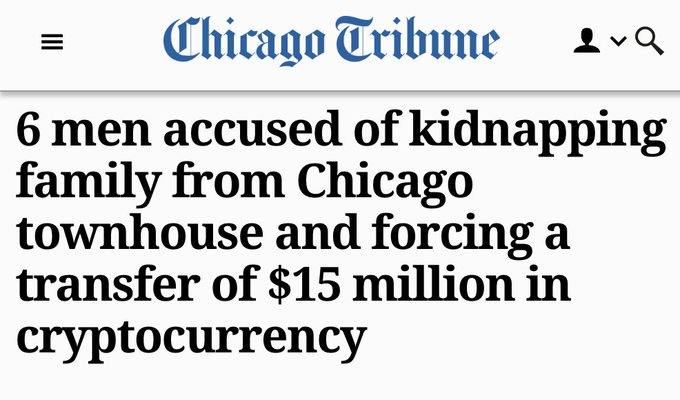 Six men accused of kidnapping three family members and a nanny from a Chicago townhouse in October, allegedly forcing a transfer of approximately $15 million in crypto assets.2025-02
Kidnapping in the Crypto Economy: An Evergreen Explainer
In the digital-asset world, kidnapping has evolved into a form of offline attack aimed at forcing victims or their families to hand over access to cryptocurrency accounts, wallets, or ransom payments. Rather than exploiting code, these crimes exploit people, turning private keys, exchange logins, and even reputations into leverage for extortion.
Understanding Kidnapping in a Crypto Context
At its core, kidnapping is the unlawful abduction and detention of a person against their will, typically in order to extract a ransom, force some action, or retaliate over a dispute. In most jurisdictions it is one of the most serious violent crimes, often carrying decades-long prison sentences, as reflected in cases where U.S. federal prosecutors charged suspects with kidnapping and related counts after armed home invasions targeting cryptocurrency holders. Malaysian authorities, for example, can seek 30 to 40 years in prison under Section 3(1) of the Kidnapping Act for suspects accused of abducting victims in a crypto ransom case in Genting Highlands. Whatever the jurisdiction, the defining elements remain deprivation of liberty and coercion, often backed by threats of lethal force.
Within the crypto space, the term “crypto kidnapping” is not a formal legal category but a descriptive label used by media, security firms, and law enforcement to refer to situations where kidnapping and digital assets intersect. In some cases, kidnappers demand ransom expressly in Bitcoin or other cryptocurrencies, as happened in one of the first widely reported incidents in January 2015, when a Canadian national living in Costa Rica was abducted and the perpetrators sought the equivalent of 500,000 U.S. dollars in Bitcoin. In other incidents, criminals physically detain victims and force them, at gunpoint or under torture, to unlock wallets, enter exchange passwords, or sign transactions transferring millions in crypto. A third pattern involves disputes within the crypto ecosystem itself, where business partners or competitors allegedly resort to abduction and prolonged physical abuse to gain leverage in a financial conflict.
These distinctions matter because they shape both how risk is assessed and how it can be mitigated. In a “ransom-for-Bitcoin” case, the kidnappers may never have any direct access to the victim’s wallets; rather, they threaten violent harm unless friends, family, or employers arrange payment in a specified crypto asset that can be moved quickly and cross-border. In a “kidnap-to-transfer” case, by contrast, the entire focus is on coercing a specific individual into authorizing transactions, often over multiple hours and locations, as seen in the Minnesota home invasion where a family was held hostage and the victim was driven to a remote cabin to retrieve hardware wallets and transfer more than 8 million dollars in cryptocurrency. Internal-dispute cases, like the high-profile SoHo townhouse ordeal linked to a crypto disagreement, fall somewhere in between, blurring lines between kidnapping, extortion, and assault in ways that challenge both legal frameworks and industry norms.
For the crypto industry, these episodes are more than isolated crimes; they represent a convergence of physical security, financial regulation, and public perception. When the WonderFi chief executive in Canada was abducted in downtown Toronto, forced into a car, taken roughly 23 kilometers away, and released only after paying a reported 1 million dollars in ransom, he had to reassure the public in follow-up statements that all client funds and data remained safe and untouched. Similarly, in France, a series of kidnappings and attempted abductions targeting crypto entrepreneurs and their families has raised questions about whether the country can continue to pitch itself as a welcoming hub for digital-asset innovation while ensuring basic personal safety for founders and investors. Each incident reinforces the idea that crypto risk is not confined to market volatility or smart-contract exploits but extends into the physical lives of those who hold or manage valuable keys.
Reliable global statistics on crypto-linked kidnappings are still scarce, in part because these events cut across traditional crime categories and are often investigated under generic kidnapping or robbery statutes rather than a special “crypto” label. However, fragmented reporting provides hints of a growing pattern. A French media report cited by crypto.news noted that authorities in France had recorded 41 crypto-linked abductions since the start of 2026, roughly one case every two and a half days, a level of activity serious enough to trigger public statements and protective measures from senior officials. Control Risks, a security consultancy, has argued that while kidnaps-for-crypto-ransom began with a handful of relatively sophisticated cases involving businesspeople associated with exchanges, more recent incidents include victims in countries and communities where traditional kidnapping patterns are less complex, suggesting diffusion of tactics into a broader criminal repertoire. These threads together suggest that “crypto kidnapping” is less a standalone phenomenon than a new twist in an old crime, shaped by the availability of digital assets as both loot and ransom.

Police nab final suspect in Ledger co-founder David Balland €10M ransom kidnapping after year on the run

Must have been a long way coming. Glad to hear all suspects being nabbed. Until investigation
Why Crypto Attracts Kidnappers
The underlying incentives that make cryptocurrency appealing to legitimate users also make it attractive to kidnappers. Bitcoin and other digital assets can be transferred globally within minutes, without the friction of banking hours or the need for intermediaries to approve transactions. For criminals, that speed can compress the window in which law enforcement or family negotiators might delay payment, trace funds through the banking system, or freeze accounts. Early kidnaps-for-ransom involving Bitcoin were often motivated by a belief that cryptocurrencies offered near-total anonymity and were beyond the reach of traditional tracing methods, making them an ideal vehicle for extortion. Unlike bags of cash, there is no need to physically move funds away from a handover location; unlike wire transfers, there is no obvious bank that can be subpoenaed or pressured.
In practice, the relationship between crypto and anonymity has proven more complex. Public blockchains create permanent, transparent ledgers of every transaction, and specialized analytics firms and law-enforcement units have become increasingly adept at following the flow of funds across addresses, services, and jurisdictions. In the United Kingdom, for instance, West Midlands Police worked with Coinbase and blockchain-intelligence provider TRM Labs to trace cryptocurrency stolen during a series of violent robberies where victims were targeted through the dating app Grindr. Those attacks included multiple counts of kidnap, false imprisonment, and aggravated assault, yet the digital trail left by the stolen crypto became decisive evidence at trial, contributing to the conviction of five individuals and combined sentences totaling more than 78 years in prison. Two of the perpetrators even changed their pleas to guilty after investigators presented new blockchain-tracing evidence, illustrating that the same transparent ledgers kidnappers hope to exploit can be turned against them.
The appeal of cryptocurrency therefore rests less on absolute anonymity and more on a different set of practical trade-offs. Ransomers can publish a single address for payment and receive funds from anywhere in the world, even if they lack traditional bank accounts or operate in jurisdictions with weak financial infrastructures. They can attempt to launder those funds through mixers, cross-chain bridges, or high-turnover exchanges, betting that the complexity and scale of on-chain activity will slow or frustrate investigators. Meanwhile, victims may feel pressured to pay quickly rather than risk prolonged exposure of a kidnapped family member, treating potential forensic traceability as a long-term concern rather than a reason to refuse payment outright. For kidnap-to-transfer schemes, the irreversibility of most blockchain transactions amplifies the leverage of threats; once a coerced transfer is confirmed on-chain, recovery typically requires law-enforcement intervention at the level of exchanges or off-ramps rather than a simple reversal.
The human element is central. Many crypto users are accustomed to thinking of security in terms of phishing emails, malware, or exchange hacks, not masked assailants at the front door. However, as home-invasion cases in Minnesota and California demonstrate, criminals have discovered that compelling a victim to unlock their phone, recite two-factor authentication codes, or retrieve a hardware wallet can be more straightforward than compromising a well-secured online platform. In Grant, Minnesota, the Garcia brothers zip-tied a family at gunpoint, held them for more than eight hours, and then physically transported the primary victim to a remote cabin to collect additional devices and authorize transfers totaling more than 8 million dollars in cryptocurrency. In California, men from Tennessee allegedly posed as UPS, pizza delivery, and DoorDash drivers to gain access to victims’ homes before violently stealing a reported 6.5 million dollars in digital assets, according to a federal indictment. These incidents illustrate a shift from purely virtual threat models to hybrid attacks that blend social engineering, physical intimidation, and digital theft.
Finally, the social visibility and perceived wealth of certain crypto participants can create an environment in which they are seen as attractive targets. High-profile founders like The Sandbox’s Sébastien Borget, whose metaverse project and token have drawn global attention, are easily identifiable figures, and the attempted kidnapping of his wife at their home outside Paris has underlined the personal risk that can accompany public success. In Canada, WonderFi’s CEO was grabbed off a downtown Toronto street in a brazen abduction that suggests at least some kidnappers are willing to act in busy, surveilled urban environments to reach perceived “crypto financiers.” France’s position as home to major exchanges, wallet companies, and blockchain gaming projects, combined with its ambition to be a European crypto hub, has made it an especially revealing test case of how offline crime adapts when a nation’s digital-asset sector grows faster than traditional personal-security norms.
Kidnappers target Sandbox co-founder Sébastien Borget's wife as France logs 41 crypto-linked cases
Case Studies: How Crypto Kidnapping Plays Out
From Costa Rica to South Africa: The Early Bitcoin Ransom Era
The first widely reported kidnap-for-crypto-ransom occurred in January 2015, when a Canadian national living in San José, Costa Rica, was abducted and held while his captors demanded the equivalent of 500,000 U.S. dollars in Bitcoin. According to security analysis from Control Risks, the case stood out at the time because ransom demands denominated in digital assets were almost unheard of, and both negotiators and law enforcement were still grappling with the practicalities of arranging and tracing such payments. The perpetrators appeared to be financially motivated criminals who had adapted classic kidnapping tactics—abducting a foreign national in a relatively high-risk environment—to a new payout mechanism, treating Bitcoin as a kind of offshore bank account that could be accessed without normal controls.
Two years later, in December 2017, another high-profile incident underscored the connection between kidnapping and the crypto industry itself. In Kiev, Ukraine, a financially motivated criminal group kidnapped an employee of a United Kingdom–registered cryptocurrency exchange. The victim was reportedly released after a ransom of roughly 1 million dollars in Bitcoin was paid, suggesting that kidnappers were no longer merely targeting wealthy individuals who happened to own crypto but were explicitly selecting victims with privileged access to exchange systems or treasury assets. For security professionals, this case illustrated how insider knowledge and organizational roles could become risk factors in regions where kidnappers are accustomed to targeting executives, and it hinted at the possibility that exchange employees might require the same kind of personal security protocols as staff at traditional banks.
Perhaps most striking in Control Risks’ survey was the 2018 abduction of a 13-year-old boy from a playground in Mpumalanga, South Africa, in a case where the kidnappers also demanded ransom in cryptocurrency. The victim’s young age, the use of a public playground as the abduction site, and the location in a country with historically high levels of kidnapping but relatively lower crypto penetration suggested that ransom-in-crypto was spreading beyond a narrow band of sophisticated criminals and tech-sector insiders. Instead, it appeared that the idea of requesting Bitcoin or similar assets had begun to circulate in broader criminal networks as a contemporary alternative to cash, with local gangs experimenting with the format even in contexts where the exchange infrastructure for converting crypto into local currency might be patchy. Across these early cases, the common element was the use of digital currencies as a payment medium, rather than forced access to the victim’s existing wallets.
North America: Home Invasions, Carjackings, and Executive Targets
In the United States, the Minnesota case involving brothers Isiah and Raymond Garcia has become a reference point for the “kidnap-to-transfer” model. On September 19, 2025, the brothers allegedly traveled from Texas to Grant, Minnesota, where they entered a family home, held the occupants at gunpoint, and zip-tied them while demanding access to the primary victim’s cryptocurrency accounts. Over the course of more than eight hours, they kept the family under armed guard, forcing the victim to initiate transfers from digital wallets and then abducting him to the family’s cabin in northern Minnesota to retrieve additional storage devices. By the end of the ordeal, prosecutors say the Garcias had coerced transfers worth over 8 million dollars in cryptocurrency, turning a domestic residence into the setting for a high-stakes, real-time exfiltration of digital assets.
Law enforcement ultimately tracked down and arrested the brothers in Texas in September 2025, and subsequent filings detail how federal and local authorities collaborated in the investigation. Initially charged in Washington County with kidnapping with a firearm, aggravated robbery, and burglary, they were soon also charged in a federal complaint with kidnapping, underscoring the seriousness with which authorities treat such crimes when interstate travel and high-value digital assets are involved. By mid-2026, both men had pleaded guilty to interference with commerce by robbery, admitting that they used firearms, restraints, and threats to carry out the scheme and agreeing to pay more than 8 million dollars in restitution. Each now faces a potential sentence of up to 20 years in federal prison, with sentencing to be scheduled later, signaling that even when charges are ultimately framed as robbery rather than kidnapping, the presence of cryptocurrency does not mitigate the severity of punishment.
Other U.S. cases show how kidnappers blend deception and force to gain access to victims’ homes and devices. In California, a federal grand jury indicted three men, including two from Tennessee, accusing them of orchestrating a violent robbery spree across the Bay Area and Los Angeles that netted more than 6.5 million dollars in digital assets. According to the indictment described in media reports, the suspects posed as UPS couriers, pizza delivery staff, and DoorDash drivers to get victims to open their doors, then forced their way in and compelled the occupants to hand over access to their crypto accounts. This deceptive use of everyday service brands illustrates how attackers can exploit trust in familiar delivery channels to break the physical barrier that typically protects home-based crypto self-custody setups.
A separate Department of Justice case, highlighted by coverage from The Block and others, involved a brazen Bitcoin kidnapping and carjacking plot in which a group of six men from Florida targeted a married couple, Sushil and Radhika, in order to steal their cryptocurrency. The offenders carjacked the couple and kidnapped them, seeking to coerce the transfer of their Bitcoin holdings, and one co-conspirator has now pleaded guilty and faces up to 20 years in prison. The case reinforces two themes: the willingness of criminals to mix vehicle theft, kidnapping, and digital extortion in complex schemes, and the growing reliance of prosecutors on narratives that emphasize both the physical and digital dimensions of the crime.
North of the U.S. border, the abduction of WonderFi CEO Dean Skurka in Toronto encapsulates the risks faced by visible crypto executives even in relatively low-violence urban centers. According to Canadian media, Skurka was pulled into a vehicle in the heart of downtown, driven approximately 23 kilometers west to a park, and held while kidnappers demanded money. He was released more than an hour later, reportedly after paying a 1 million dollar ransom, and later confirmed in an email to CBC News that he was safe and that no client funds or data had been affected by the incident. While the specific payment method has not been fully detailed publicly, the targeting of a digital-asset exchange executive, combined with a ransom apparently calibrated to his perceived financial profile, fits the broader pattern of criminals linking kidnapping opportunities to the rapid wealth creation and visibility associated with crypto startups.
France: A Kidnapping Spree in a Budding Crypto Hub
France has emerged as one of the clearest examples of how a growing crypto sector can intersect with a spike in kidnapping risk. The attempted abduction of The Sandbox co-founder and chief operating officer Sébastien Borget’s wife at their home in Villenoy, in the Seine-et-Marne region, drew particular attention. According to reporting summarized by WuBlockchain and crypto.news, suspects posed as delivery workers to persuade her to open the gate, after which five masked accomplices rushed in and tried to force her into a vehicle. Neighbors intervened after hearing her calls for help, prompting the attackers to flee, and she escaped without physical injury. French media named two teenage suspects, born in 2009 and 2010, who were arrested, while four others remained at large at the time of reporting. Early evidence suggested the incident was linked to cryptocurrency, although investigators were still probing the exact motive.
This was not an isolated case. Crypto.news, citing French newspaper Le Journal du Dimanche, reported that authorities had logged 41 crypto-linked abductions since the start of 2026, a rate of roughly one every two and a half days, prompting concerns about the safety of digital-asset entrepreneurs and investors in the country. Another incident involved the kidnapping of a mother and her son in France in a plot aimed at extorting around 400,000 dollars in cryptocurrency from a crypto entrepreneur, with police ultimately rescuing the victims and frustrating the ransom scheme, according to contemporary newsroom coverage referenced by the user prompt. Taken together, these events suggest an environment in which both opportunistic criminals and more organized gangs are aware that France hosts a cluster of high-net-worth crypto participants, including metaverse builders like The Sandbox and major wallet manufacturers, and are experimenting with abductions as a way to monetize that awareness.
The French state has begun to respond in ways that go beyond individual investigations. Bloomberg reported that authorities are actively seeking to reassure jittery digital-asset executives and investors as the spate of kidnappings and attempted abductions threatens to undermine the country’s ambitions to be a European crypto hub. Measures reportedly include heightened protection for certain executives, more visible policing around key industry events, and public messaging aimed at signaling that the government recognizes and is addressing the specific threat to crypto professionals. Interior ministry officials have spoken publicly about shielding crypto pioneers from what some local commentary has described as “kidnap raids,” emphasizing that France wants to remain a place where blockchain innovation can flourish without putting founders and their families in undue danger. The result is a test case of how national authorities balance economic-development narratives and security realities in an industry that can make individuals wealthy and visible very quickly.
Asia and Eastern Europe: Ransom Plots and Alleged Police Abuse
In Southeast Asia, a case in Malaysia illustrates how cross-border actors may converge on high-value crypto targets. The New Straits Times reported that three South Korean nationals appeared in court over an alleged kidnapping in the Genting Highlands resort area involving a crypto ransom of 39.6 million Malaysian ringgit, equivalent to several million U.S. dollars. The trio were being investigated under Section 3(1) of the country’s Kidnapping Act, which carries a prison sentence of between 30 and 40 years, reflecting Malaysian authorities’ view of the seriousness of the crime. Although detailed facts of the incident are still emerging, the framing as a “crypto ransom” case places it within the same continuum as earlier Bitcoin ransom demands, but with sizeable sums and international suspects.
Eastern Europe has produced a more disturbing variant, where law enforcement officers themselves are alleged to have carried out the crime. A report highlighted by Decrypt described claims that Ukrainian police officers kidnapped crypto entrepreneurs in order to extort millions in digital assets. While details remain limited in summary coverage, the allegations suggest that the entrepreneurs were unlawfully detained and pressured to transfer funds, blurring the line between official authority and criminal enterprise. For the broader ecosystem, such cases underscore that the threat of coercion can arise not only from freelance criminals but also from corrupt actors within state structures, complicating the standard advice to “contact the authorities” in high-risk environments and raising questions about how to manage jurisdictional risk when choosing where to live, travel, or incorporate a crypto business.
Internal Crypto Disputes Turning Violent
Not all crypto-linked kidnappings involve external criminals targeting industry participants; some arise from disputes within the crypto community itself. In New York City, an Italian investor was allegedly held captive and tortured for over two weeks in a luxury SoHo townhouse in a conflict described by police as stemming from a cryptocurrency dispute. According to ABC News, two men, John Woeltz and William Duplessie, were indicted by a grand jury on a dozen counts, including kidnapping, assault, and coercion, after investigators concluded that the victim had been forcibly confined for roughly 17 days. NYPD officials alleged that the perpetrators forced the victim to take narcotics and subjected him to various forms of torture, including placing his feet in water and shocking them, in an effort to pressure him over crypto-related money.
The SoHo case has continued to attract attention as the legal process unfolds. Duplessie, characterized in some local coverage as a “crypto millionaire,” was reportedly released from Rikers Island after his mother posted a 250,000 dollar bond, even as he awaits trial on the serious kidnapping and torture charges. Prosecutors initially opposed bail, citing the severity of the allegations and the prolonged nature of the confinement, but a judge eventually granted release under conditions, while co-defendant Woeltz remained held without bail. The presence of a 24-year-old woman arrested on related kidnapping and unlawful imprisonment charges further complicates the narrative, suggesting a small network around the victim rather than a simple two-person dispute. Beyond the lurid details, the case illustrates how conflicts over digital assets, especially when large sums and informal agreements are involved, can escalate into extreme forms of coercion that mirror what is seen in organized-crime contexts.
From an industry standpoint, internal-dispute kidnappings pose reputational risks beyond those associated with external attacks. When investors or founders resort to violence to resolve disagreements over token allocations, deal proceeds, or wallet access, it reinforces stereotypes of crypto as a “Wild West” where personal safety and legal norms are fragile. At the same time, such cases remind observers that kidnapping is a method rather than a motive; the underlying conflicts may relate to business deals, but the choice to abduct and torture reflects individual criminal decisions, not an inherent property of cryptocurrency itself. Nevertheless, for regulators and courts, the presence of digital assets at the center of the dispute can shape how cases are framed and publicized, reinforcing the perception that crypto wealth can destabilize relationships and tempt some participants toward unlawful self-help.

Coinbase’s blockchain forensics helped UK police trace a kidnapping-linked theft onchain, leading to five convictions and showcasing how transparent ledgers can make the crypto economy safer than cash.
Law Enforcement and Industry Responses
Blockchain Forensics and the Role of Exchanges
One of the defining features of crypto-linked kidnapping cases over the past decade has been the growing role of blockchain forensics. In the early days of Bitcoin ransom demands, many kidnappers assumed that receiving funds in cryptocurrency would make them untraceable, but subsequent investigations have demonstrated how on-chain analysis can reconstruct the flow of extorted money. The Grindr-targeted robberies in the United Kingdom provide a vivid example: West Midlands Police, working with Coinbase and TRM Labs, were able to follow the stolen funds across the blockchain, linking them to specific suspects and presenting that evidence in court. The resulting convictions of five individuals on charges including kidnap, false imprisonment, and aggravated assault, accompanied by over 78 years of combined prison time, have been cited as proof that crypto can be “safer than cash” in some respects, because it leaves a durable transactional footprint.
Exchanges occupy a pivotal position in this ecosystem. Coinbase’s involvement in the UK case shows how major platforms, armed with compliance teams and access to user KYC data, can act as investigative partners when criminals attempt to cash out extorted crypto. By correlating deposit addresses with blockchain intelligence and account records, exchanges can flag suspicious inflows, freeze assets pursuant to legal orders, and provide critical evidence about the identities behind wallets that might otherwise be known only as alphanumeric strings. Beyond individual cases, this collaboration sends a deterrent message: even if kidnappers manage to coerce a victim into transferring funds, converting those funds back into fiat, or spending them through regulated platforms, may expose them to detection.
Prosecutions, Sentencing, and the DOJ’s Stance
Across jurisdictions, prosecutors have signaled that kidnappings involving digital assets will be treated as seriously as those involving cash, if not more so. In the Minnesota case, U.S. federal prosecutors pursued both kidnapping and robbery angles, ultimately securing guilty pleas on interference with commerce by robbery charges while preserving the possibility of up to 20-year sentences for each defendant. The formal charging documents describe a sophisticated, premeditated operation that involved interstate travel, the use of firearms, and protracted detention of a family, with the crypto component treated as aggravating rather than mitigating. Similarly, in the Florida Bitcoin kidnapping and carjacking case, the Department of Justice emphasized the brazen nature of the crime and noted that a co-conspirator who pleaded guilty now faces a potential 20-year term.
These cases fit into a broader DOJ posture that frames violent attempts to steal cryptocurrency as part of the same continuum as high-value bank robberies, extortion schemes, and organized crime. Coverage of a California spree in which Tennessee men allegedly robbed and kidnapped victims to seize 6.5 million dollars in crypto indicates that federal authorities are willing to deploy grand jury indictments and multi-count charges to tackle such conduct. By bringing cases in federal court, prosecutors can leverage statutes that cover interference with interstate commerce, use of firearms in crimes of violence, and conspiracies that cross state lines, ensuring that kidnappers cannot hide behind the technical novelty of their target asset.
Outside the United States, the severity of potential sentences also reflects a clear deterrent intent. In Malaysia, the South Korean suspects in the Genting Highlands crypto ransom case face up to 40 years in prison if convicted under the Kidnapping Act, underlining that local courts view crypto-motivated abductions as on par with other forms of hostage-taking. In France, while many of the recent crypto-linked kidnappings and attempts are still in earlier stages of investigation, the rescue of victims and arrest of suspects in cases like the attempted kidnapping of Borget’s wife suggest that authorities are prepared to treat such crimes as matters of national concern rather than isolated incidents. The SoHo torture case in New York, with its grand jury indictment on multiple kidnapping and assault counts, further demonstrates that when crypto disputes cross into physical violence, the response from the justice system is uncompromising.
Policy, Protection, and Industry Adaptation
Beyond individual prosecutions, governments and industry players are beginning to adjust policies and practices to the reality of crypto-linked kidnapping risk. The French government’s effort to “shield” crypto executives after a kidnapping spree, as reported by Bloomberg, is one prominent example. By publicly acknowledging that digital-asset leaders have become attractive targets and promising dedicated protective measures, French authorities are sending a signal both to domestic entrepreneurs and to international investors that physical security is now part of the country’s broader crypto strategy. That response highlights an emerging pattern in which personal security and financial regulation are treated as interconnected pillars of a healthy crypto ecosystem.
Security consultancies have also emphasized that the foundational principles of critical incident management remain applicable in crypto ransom cases. Control Risks, for instance, notes that effective preparation and response—encompassing risk assessments, crisis-management plans, training, and professional negotiation support—are just as vital when ransom is demanded in Bitcoin as when it is demanded in cash. The medium of payment may affect the logistics of transfers and the avenues for tracing funds, but it does not alter the basic need for organizations to prepare staff, especially those traveling or operating in high-risk environments, for the possibility of abduction. For exchanges and crypto firms, that may include reviewing which employees have unilateral access to large wallets, where executives travel, and how incidents would be handled if they occurred in jurisdictions with limited rule of law.
On the industry side, there are signs of product and policy innovation aimed at mitigating kidnap risk. Some exchanges, according to recent newsroom coverage referenced in the user prompt, have introduced account lock or “panic” features designed for users in high-risk kidnapping countries, allowing them to freeze activity quickly if they fear coercion. While implementation details vary, the underlying concept is to create mechanisms that make it harder for coercers to extract large sums in a single session, whether by requiring additional approvals, enforcing withdrawal delays, or embedding duress signals within the user interface. Combined with the growing use of multi-signature wallets and time-locked smart contracts at the institutional level, these measures reflect a recognition that crypto security must account not only for hackers but also for armed intruders.
Readers click crypto kidnapping stories for named victims and physical brutality — the Ledger co-founder's severed finger and the Minnesota family's nine-hour ordeal drew far more engagement than statistical trend tallies, revealing that audiences understand crypto wealth exposure has become a direct personal safety liability, not merely a financial one.
Managing Risk for Crypto Users and Firms
For individual crypto users, especially those holding significant balances or living in regions with elevated kidnapping rates, managing risk begins with recognizing that digital wealth can have physical consequences. The cases reviewed above show that victims have ranged from exchange employees and founders to private investors and even relatives, such as spouses or children, who may have little direct involvement in crypto but are seen as leverage. Basic personal-security practices—avoiding conspicuous displays of wealth, limiting the public disclosure of home addresses, and being cautious about who is told about large holdings—remain important first steps. While many of these habits are familiar from broader discussions of personal safety, crypto culture, with its emphasis on online transparency and community, can inadvertently encourage behaviors that increase visibility to potential kidnappers.
At the organizational level, crypto exchanges, DeFi projects, and custody providers can treat kidnapping as a specific scenario in their risk-management frameworks. That involves mapping which roles have direct control over large wallets or critical systems and ensuring that no single individual’s coercion could result in catastrophic losses. Multi-signature treasury arrangements, where multiple approvals are required to move funds, can help ensure that abducting one executive does not automatically grant access to the entire corporate balance sheet. Time-delayed withdrawals and out-of-band verification procedures, while sometimes seen as friction in user experience, can provide crucial windows for detection and intervention if a transaction is initiated under duress.
Travel and event security are also significant considerations, particularly for prominent founders attending conferences or investor meetings in jurisdictions where kidnapping-for-profit is more common. Companies can assess whether to provide security details, vary routes and routines, and brief executives on local kidnapping trends, including the possibility that criminals may specifically target “crypto people” either because of their actual holdings or because of stereotypes about the industry. For remote-first firms, these assessments may extend to deciding where team members are encouraged or discouraged from relocating, balancing the benefits of tapping global talent against the potential physical risks in certain locales.
Technology can help, but it is not a panacea. Hardware wallets, such as those popularized by French manufacturers, are excellent tools for defending against online hacks but can become pressure points in kidnap scenarios if criminals know—or believe—that a device at a victim’s home contains substantial funds. Some users respond by distributing holdings across multiple wallets, keeping only small sums in any single device and storing backups in secure, offsite locations. Others adopt mental or physical separation between themselves and the credentials for their largest stores of value, ensuring that under coercion they could only access a limited subset of holdings. In each case, the goal is to reduce the payoff of a successful kidnapping without undermining legitimate access needs.
Finally, incident response planning is crucial. While no one wants to imagine being kidnapped or seeing a colleague abducted, organizations that handle significant digital assets increasingly see value in rehearsing how they would respond if such an event occurred. That can include establishing relationships with specialist kidnap-and-ransom consultants, clarifying decision-making authority over potential ransom payments, and understanding the legal landscape in relevant jurisdictions, including any prohibitions on paying certain counterparties. Even for smaller firms and individual investors, knowing in advance whom to contact—local police, consular officials, legal counsel, or exchange security teams—can make a critical difference in the chaotic hours when a kidnapping is first discovered.
- 01France crypto kidnapping wave↗
A cascade of French incidents — Ledger co-founder, Sandbox co-founder's wife, a magistrate, a crypto firm boss's father, and a foiled Nantes commando plot — made France the dominant dateline for targeted crypto violence and kept readers returning for each new arrest.
- 02Ledger co-founder Balland serial updates
Named victim, reported finger amputation, €10M ransom, eight initial arrests, a Moroccan mastermind capture, and a year-long manhunt for the final suspect gave this case an episodic quality that generated repeated clicks across more than half a dozen distinct headlines.
- 03US domestic forced-transfer heists↗
The Chicago townhouse $15M family abduction and the Minnesota brothers' $8M nine-hour ordeal — both ending in federal charges — reframed violent crypto robbery as an American domestic threat, not an overseas anomaly.
- 04Escalating global frequency data↗
NBC News tallying 67 bitcoin-linked kidnappings across 44 countries with 2024 and 2025 both at decade highs turned isolated incidents into a documented, accelerating pattern that readers found alarming.
- 05Industry self-defense and policy responses↗
Headlines about a Ledger co-founder demanding gun rights, the 'Bitcoin Family' distributing keys across four continents, and France's interior minister convening industry meetings showed readers how the threat is reshaping both individual behavior and government policy.
- 06Blockchain forensics enabling convictions↗
Coinbase helping UK police trace kidnapping-linked theft onchain and secure five convictions offered a counter-narrative — transparent ledgers as a law enforcement asset — that stood out against the dominant victim-side framing.
Outlook
Crypto-linked kidnappings sit at the uncomfortable intersection of cutting-edge finance and age-old violent crime. The cases documented to date—from early Bitcoin ransom demands in Costa Rica and Ukraine to complex home invasions in Minnesota, California, France, Malaysia, and beyond—suggest that as long as large stores of digital value can be controlled by individuals, some criminals will view those individuals as targets. At the same time, the experience of law enforcement and industry over the past decade shows that the transparency of blockchains can turn what criminals imagine to be an anonymous escape route into a trail of evidence, as in the UK Grindr case where Coinbase and TRM Labs’ analytics helped secure convictions and lengthy prison terms.
Looking ahead, the balance between risk and resilience will depend on how quickly personal-security practices, corporate governance, and public policy can adapt. Nations that aspire to be crypto hubs, such as France, will need to match promotional rhetoric with concrete measures to protect founders and investors, while exchanges and wallet providers will likely continue to refine features that allow users to signal distress or limit the damage from coerced transactions. For the crypto community, the challenge is to integrate these lessons into an evolving security culture, recognizing that securing keys increasingly means securing people. If that happens, the same technologies that have made kidnapping-for-crypto possible may, over time, also make it harder for kidnappers to profit and easier for victims to obtain justice.
- 2025-01milestone
Ledger co-founder David Balland kidnapped; both victims rescued, eight arrested
Sandbox co-founder Sébastien Borget's wife targeted; France logs 41 crypto-linked kidnapping cases
- 2025-06regulatory
Alleged French crypto kidnapping mastermind Bajjou arrested in Morocco
French Interior Minister meets crypto industry leaders on violent extortion surge
French police rescue father of crypto firm boss; finger reportedly severed, five suspects arrested
Texas brothers plead guilty in $8M armed Minnesota crypto kidnapping
- 2026-06regulatory
Spain arrests final suspect in 2025 Ledger co-founder kidnapping after year as fugitive
Latest Kidnapping news
Police nab final suspect in Ledger co-founder David Balland €10M ransom kidnapping after year on the runKidnappers target Sandbox co-founder Sébastien Borget's wife as France logs 41 crypto-linked casesCoinbase’s blockchain forensics helped UK police trace a kidnapping-linked theft onchain, leading to five convictions and showcasing how transparent ledgers can make the crypto economy safer than cash.Ledger co-founder Larchevêque demands crypto holders' right to carry guns after co-founder kidnapped for $11.5M ransomFrench magistrate and her mother escape 30-hour crypto ransom kidnapping as French police arrest six suspects in botched plot. [theblock]( Two armed brothers kidnapped a Minnesota family and forced an $8M crypto transfer before being arrested days later in Texas. They now face federal kidnapping and robbery charges after the violent nine-hour ordeal.
Sources
18 records from 15 domains
youtube.com
justice.gov
x.com
bloomberg.com
trmlabs.com
fox9.com
nst.com.my
instagram.com
controlrisks.com
coinstats.app
abcnews.com
facebook.com
crypto.news
crowdfundinsider.com
knsiradio.com
Community notes
Spot something off or out of date? Drop a note. Editors review topic notes daily and roll accepted fixes into the explainer — contributors are recognized in the monthly $SQUID drop.
Loading notes…
Help improve this topic
Have a story or tip about this topic? Submit it. See something missing? Leave a note. Editors review daily; accepted submissions and fixes count toward the monthly $SQUID drop.