
In-depth explainer on Ethereum upgrades—how EIPs become hard forks, what Shapella, Dencun, Pectra, Fusaka, and Glamsterdam change for users, L2s, and security, and why the roadmap toward danksharding and account abstraction matters.
+1 sources across the wider coverage universe
 Ethereum faces major near-meltdown as an unexpected Fusaka upgrade bug threatens chain stability.2025-12
 Ethereum's upgrade 'Fusaka' is going live December 3rd2025-11
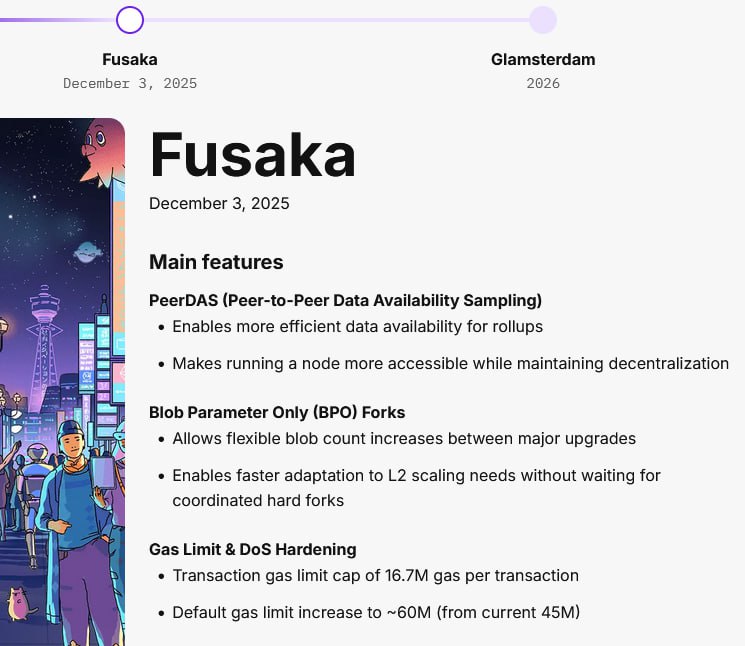 Ethereum’s Fusaka Upgrade Lands Tomorrow: an 8× Data Boost and Cheaper Rollups2025-12
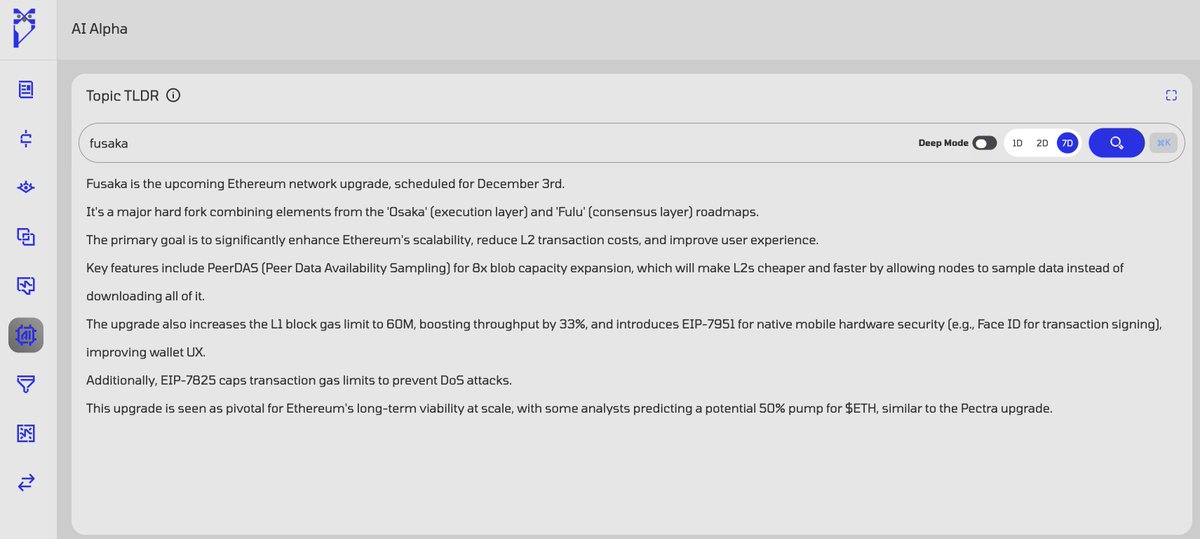 Everything you need to know about the December 3rd Ethereum Fusaka upgrade2025-11
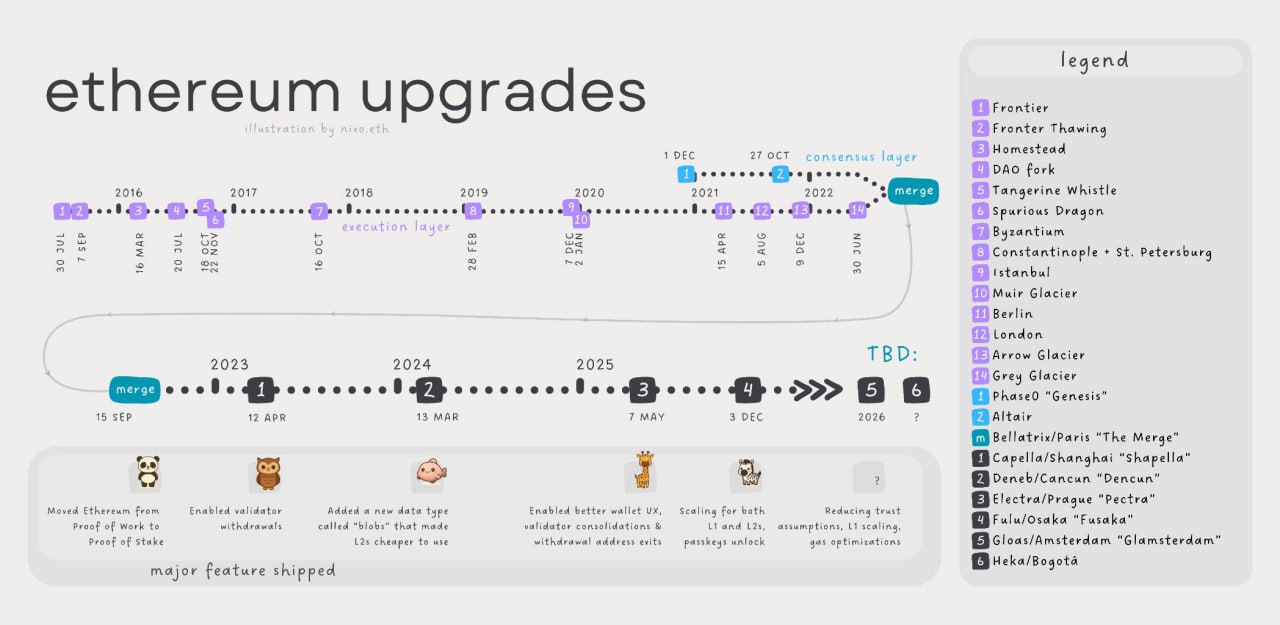 Ethereum’s ‘Glamsterdam’ upgrade aims to fix MEV fairness. Glamsterdam is a two simultaneous upgrades taking place on Ethereum’s two core layers. At the heart of the upgrade is ePBS and Block-level Access Lists. The full scope of the upgrade has not yet been finalized, but developers are targeting it to go live in 2026.2025-12
 Ethereum completed its transition from experiment to global infrastructure in 2025, marked by major protocol upgrades, regulatory clarity, institutional adoption, booming L2 ecosystems, and growing use across finance, AI, privacy, and real-world assets.2025-12
Ethereum Upgrades: How the World’s Settlement Layer Keeps Evolving
Network-wide Ethereum upgrades are coordinated protocol changes that update the rules every node follows, typically through hard forks that activate at specific block or epoch numbers. Together, these upgrades bundle Ethereum Improvement Proposals (EIPs) to push the chain toward greater scalability, security, and usability while preserving decentralization and its role as a neutral base layer for global finance and applications.
What Is An Ethereum Upgrade?
At the simplest level, an Ethereum upgrade is a synchronized software update to the protocol that all nodes, validators, and client implementations must adopt to remain on the canonical chain. Because Ethereum is decentralized and lacks a central administrator, these upgrades are not “pushed” to users in the way mobile apps are; instead, they are activated at a predetermined block height or consensus epoch, and nodes that do not update will continue following the old rules on a minority, non-canonical fork. This is why announcements from the Ethereum Foundation and client teams emphasize that node operators must update both their execution-layer and consensus-layer clients before each major fork. In the Shapella and Dencun announcements, for example, the Foundation warned that running outdated clients would leave operators stuck on an incompatible chain that cannot send Ether or participate in the upgraded network. For everyday users who hold ETH on exchanges or in mainstream wallets, however, most upgrades are intentionally designed to be seamless and require no action.
Behind that simple description lies a complex governance and engineering process. Ethereum Improvement Proposals, or EIPs, are the formal documents that specify protocol changes, from low-level opcodes to high-level mechanisms like data blobs and new account types. Developers debate, refine, and test EIPs across public calls, GitHub discussions, and specialized testnets before a curated set is bundled into a named upgrade such as Shapella, Dencun, Pectra, or Fusaka. These bundles usually include both execution-layer changes, which affect the Ethereum Virtual Machine (EVM) and transaction processing, and consensus-layer changes, which affect validator responsibilities and how the chain finalizes blocks. Over time, this iterative process has taken Ethereum from a proof-of-work smart contract platform to a proof-of-stake “global infrastructure” that settles trillions in stablecoin transfers, anchors hundreds of Layer 2 networks, and increasingly underpins traditional finance, AI, and real-world asset systems.

Ethereum faces major near-meltdown as an unexpected Fusaka upgrade bug threatens chain stability.

"While Prysm operators scrambled to implement the emergency workaround flag –disable-last-epoch-targets, alternative clients, including Lighthouse, Teku, Nimbus, and Lodestar, continued validating blocks without interruption. The incident reinforced long-standing arguments for client diversity as Ethereum’s primary defense against consensus failures. Developer Kydo captured the significance, noting that the upgrade simultaneously reinforced four critical narratives: Zero-downtime operations Layer-2 scaling capability through PeerDAS activation Client diversity protection Revenue-generating potential."
Why Ethereum Upgrades Matter
Ethereum’s upgrade cadence is ultimately about defending and expanding its role as a neutral settlement layer for a growing share of the world’s economic activity. The Ethereum Foundation recently highlighted that more than \$18.8 trillion in stablecoin volume settled on Ethereum in a single year, with major banks, asset issuers, and payment processors now using Layer 2 (L2) rollups for verifiable settlement at scale. At the same time, transaction costs on the Layer 1 (L1) mainnet reached five‑year lows and dropped below one cent on many Layer 2 networks, making everyday payments, remittances, and savings products viable use cases for mainstream users rather than niche experiments. This is not an accident: it is the direct result of upgrades like Dencun and Fusaka, which reorganize how data is stored and propagated so that rollups can post transaction batches more cheaply. When combined with account-abstraction improvements in Pectra and planned execution changes in Glamsterdam, these upgrades are repositioning Ethereum from a congested, experimental chain into a high-capacity, low-friction base layer for consumer apps, institutional settlement, and machine‑to‑machine interactions.
Crucially, upgrades also aim to keep Ethereum secure at a “trillion‑dollar” scale. The Trillion Dollar Security (1TS) Project, an ecosystem initiative cataloging Ethereum’s security challenges, frames upgrades as a primary tool for addressing structural risks like validator centralization, smart contract bugs, MEV extraction, and user‑interface exploits. That philosophy shows up in concrete proposals: Shapella introduced orderly validator withdrawals to manage stake liquidity; Dencun added Beacon chain roots to the EVM and new churn limits; Pectra raised validator balance caps and expanded account controls; Fusaka tightened gas and DoS parameters while expanding data capacity; and Glamsterdam’s ePBS proposal seeks to replace today’s trust‑based MEV relays with in‑protocol builder markets. Each step reflects an attempt to harden Ethereum’s infrastructure while it carries more value, more users, and more diverse applications. Those changes, in turn, influence how investors, regulators, and enterprises perceive Ethereum’s reliability relative to other chains and to existing financial rails.
Upgrades also matter for developers and the broader ecosystem roadmap. L2 projects like Arbitrum, Optimism, Base, and zk‑rollups all depend on Ethereum’s data availability layer and fee structure; when an upgrade like Dencun introduces blob‑based data posting or Fusaka introduces PeerDAS sampling, it directly changes the cost curves and design space for those rollups. In recent interviews, rollup founders have been explicit that their scaling roadmaps assume continued Ethereum L1 improvements, including higher blob throughput, parallel execution, and MEV reforms. For decentralized finance (DeFi), upgrades can reduce gas overhead for complex strategies, enable more sophisticated wallet features, and open safer cross‑chain interoperability standards, as seen with emerging standards like ERC‑7683 for cross‑rollup settlement. For application teams, understanding the upgrade roadmap has become a strategic necessity rather than an optional curiosity.
Finally, Ethereum upgrades matter because they shape user experience. The Pectra upgrade, for example, introduced EIP‑7702, allowing regular externally owned accounts (EOAs) to temporarily behave like smart contracts and unlock features such as transaction batching, gas sponsorship, social recovery, and passkey-based authentication. Dencun’s cheap blobs and Fusaka’s PeerDAS have made it possible for consumer-facing apps to offer onchain interactions at near‑zero transaction fees, enabling “super app” experiences that embed identity, chat, and payments into a single interface on Ethereum L2s. Meanwhile, security-focused efforts like the Clear Signing standard aim to end “blind signing,” a root cause behind many wallet‑draining scams. All of these shifts are mediated through the upgrade process, which is why following that process is increasingly important for anyone building on or investing in Ethereum.
Readers click Ethereum upgrade stories not for the intended beneficiaries (cheaper L2 users, better-rewarded validators) but for the unintended redistribution: the top headline was about beaverbuild capturing block-builder dominance post-Dencun — outperforming every fee-reduction story — while EIP-7702 wallet-drain exploits beat Pectra feature explainers, and a single Fusaka bug scare outranked the upgrade's own announcement.
How Ethereum Upgrades Work
EIPs, Hard Forks, and Client Diversity
Under the hood, Ethereum upgrades are governed by an open, standards-driven process centered on Ethereum Improvement Proposals. An EIP is a technical specification that includes motivation, design rationale, and precise changes to the protocol or surrounding standards such as token formats. EIPs are categorized into core protocol changes, networking, interface standards, and meta-process changes, among others; the core EIPs are the ones that eventually get bundled into network upgrades. For example, Dencun’s EIP‑7569 umbrella lists core proposals such as EIP‑4844 (proto‑danksharding), EIP‑4788 (Beacon block root in the EVM), and EIP‑7516 (BLOBBASEFEE opcode), each of which modifies a different aspect of how Ethereum processes and prices data. Similarly, Pectra bundled 11 EIPs, including EIP‑7702 on smart-account EOAs and EIP‑7251 on validator stake consolidation.
When a set of EIPs is agreed upon for a given upgrade, client teams implement them in their respective codebases. Ethereum deliberately maintains multiple execution-layer clients (such as Geth, Nethermind, Besu, Erigon, and Reth) and multiple consensus-layer clients (such as Prysm, Lighthouse, Teku, Nimbus, Lodestar, and Grandine) to avoid a single codebase becoming a systemic point of failure. Each client must independently implement and test the EIPs, and client diversity is encouraged so that bugs in one implementation cannot easily halt the entire network. Before an upgrade goes to mainnet, the Ethereum Foundation typically publishes a table of minimum and recommended client versions for both layers, as it did for Dencun and later for the Fusaka testnets. Validators are instructed to ensure that both their beacon node and validator client are updated, as well as any external block‑building software they rely on.
The technical activation of an upgrade usually takes the form of a hard fork. A hard fork is a non‑backward‑compatible change to the protocol rules that requires all nodes to upgrade or risk diverging onto an incompatible chain. The activation point is set in advance, either as a block height on the execution layer or an epoch on the consensus layer; Shapella, for instance, activated at epoch 194048, while Dencun activated at epoch 269568. Once that point is reached, nodes running upgraded clients start following the new rules, while outdated nodes continue following the old rules. Because Ethereum has a strong social consensus around canonical upgrades, the vast majority of economic activity and infrastructure follows the upgraded chain, leaving any minority forks economically irrelevant. This mechanism gives developers a way to introduce sweeping changes—such as the switch to proof‑of‑stake with The Merge or the introduction of data blobs with Dencun—without requiring user‑by‑user opt‑in.
From Testnet to Mainnet
Before any upgrade reaches the Ethereum mainnet, it is extensively tested on dedicated testnets that mimic mainnet behavior but do not carry real economic value. Historically, testnets such as Goerli and Sepolia served this role; more recently, Holesky was launched as a large‑scale testnet designed specifically for staking and infrastructure testing. The Ethereum Foundation’s announcements for upgrades like Dencun and Fusaka follow a similar pattern: first, activation on one or more testnets at specified slots or epochs, then observation and bug‑fixing across several weeks, and only then a mainnet activation date. For the Fusaka upgrade, for example, the Foundation scheduled activation on Holesky at slot 5,283,840, followed by Sepolia and then Hoodi at later dates in October, ensuring that the entire stack—from client implementations to rollups and infra providers—could test their systems against the new PeerDAS and blob parameters.
Testnets are also where new mechanisms like PeerDAS, Verkle trees, or enshrined proposer‑builder separation can be battle‑tested under realistic but consequence‑free conditions. For Fusaka, developers even opened the upgrade to a large public audit contest with significant rewards, reflecting the stakes involved in altering the data availability layer and scaling blob throughput. Once an upgrade is stable on testnets, mainnet activation is scheduled, and infrastructure providers, exchanges, and application developers are given time to upgrade. After Fusaka, Ethereum developers plan to retire the Holesky testnet and shift testing to newer networks like Hoodi, which are better aligned with the upgraded architecture and the needs of rollup ecosystems. Testnet sunsets are themselves part of the evolution of the Ethereum stack, requiring developers to migrate their testing pipelines and faucet infrastructure.
It is worth stressing that while node operators and validators must upgrade their clients before each fork, ordinary ETH holders generally do not need to take any action. The Ethereum Foundation has repeatedly emphasized this point for Shapella, Dencun, and Fusaka, warning users to ignore scams that claim they must “upgrade” their ETH or provide private keys before a fork. Wallets and exchanges handle the technical details of supporting new protocol rules, and smart contract developers need only adjust their code if they plan to leverage new opcodes or transaction types. This separation of concerns is an important design goal: upgrades should be transformational under the hood but minimally disruptive at the surface.
Major Upgrades: Shapella, Dencun, and Pectra
Shapella: Unlocking Staked ETH
The Shapella upgrade, activated in April 2023, was the first major milestone after Ethereum’s transition to proof‑of‑stake and focused on enabling withdrawals from the Beacon Chain. The name “Shapella” reflects the combination of changes to the execution layer (Shanghai) and the consensus layer (Capella), highlighting the dual‑layer architecture that defines post‑Merge Ethereum. Before Shapella, validators could stake 32 ETH to participate in consensus and earn rewards, but they could not withdraw their principal or accrued rewards, raising questions about liquidity and long‑term participation incentives. Shapella addressed this by introducing both partial withdrawals, which automatically skimmed balances above 32 ETH back to designated withdrawal addresses, and full withdrawals, which allowed validators to exit and reclaim their entire balance after passing through an exit queue.
From a technical perspective, Shapella introduced EIP‑4895, which allowed Beacon chain withdrawals to be pushed to the execution layer as system‑level operations, and support for BLSToExecutionChange messages that let validators update their withdrawal credentials from BLS keys to standard ETH1 addresses. Nethermind’s analysis notes that partial withdrawals are processed according to validator indices, with a pointer looping through validators and withdrawing at a rate of 16 validators per block, while complete exits involve a withdrawal period of roughly 256 epochs (about 27 hours) for unslashed validators and 8,192 epochs (about 36 days) for slashed validators. This design balances liquidity and security by preventing sudden mass exits that could destabilize consensus while still providing a clear path for stakers to adjust their positions over time. Importantly, the Ethereum Foundation emphasized that Shapella did not introduce breaking changes for smart contracts and that regular users and exchanges did not need to do anything to prepare.
Economically, Shapella resolved uncertainty about whether enabling withdrawals would trigger a flood of validator exits. Analyses at the time suggested that while some exits were likely, especially from early stakers or those using custodians, many validators would prefer to remain staked, simply skimming rewards as partial withdrawals. That expectation proved broadly correct, and the post‑Shapella period saw Ethereum staking continue to grow as liquid staking protocols matured. More broadly, Shapella demonstrated that complex consensus‑layer changes could be shipped without major disruption, setting a precedent for subsequent multi‑EIP upgrades.
Dencun: Proto-Danksharding and Cheap Data Blobs
If Shapella was about unlocking capital, Dencun was about unlocking capacity. Activated on mainnet in March 2024 at epoch 269568, Dencun combined changes to both the execution and consensus layers and is best known for introducing EIP‑4844, also called proto‑danksharding. Proto‑danksharding added a new transaction type that can carry “data blobs,” large, fixed‑size chunks of data attached to transactions but stored only on the consensus layer for a limited time. The contents of these blobs are not accessible to the EVM; smart contracts can only access cryptographic commitments that prove the existence and correctness of the data. Ethereum nodes store blob data temporarily—on the order of 18 days, or 4096 epochs at the time of writing—after which the data is pruned, dramatically reducing long‑term storage requirements for node operators.
This architecture is tailored specifically for rollups. Before Dencun, rollups such as Arbitrum or Optimism had to post their batched transaction data as regular calldata, which is stored permanently on the execution layer and priced accordingly. This made data availability the main bottleneck and cost driver for L2 transactions. EIP‑4844 addressed the “calldata bottleneck” by creating a dedicated, cheaper data availability lane via blobs, with a separate base fee (BLOBBASEFEE) and a fixed per‑block blob limit—initially a target of three blobs and a maximum of six. Because blobs are short‑lived and do not burden execution, they can be priced far lower than calldata, and rollups can pass those savings on to users as lower gas fees. Ethereum.org’s roadmap materials describe proto‑danksharding as a critical stepping stone toward full danksharding, ultimately expected to help scale Ethereum to over 100,000 transactions per second when combined with mature rollups.
Dencun also included several other EIPs, such as EIP‑4788, which exposed recent Beacon chain roots to the EVM, enabling better synchronization between staking and execution logic, and EIP‑7514, which adjusted the maximum validator churn limit to more safely manage stake inflows and outflows. But the user‑visible headline was clear: following Dencun, L2 transaction fees fell dramatically as rollups migrated to blob‑based posting. Official communications and subsequent ecosystem reporting highlighted that L2 transaction costs dropped to well below one cent in many cases, opening the door for micro‑transactions, high‑frequency trading strategies, and consumer applications that would have been uneconomical on pre‑Dencun infrastructure. For developers, Dencun was proof that Ethereum could meaningfully change the economics of rollups without compromising security.
Pectra: Account Abstraction and Validator Consolidation
The Pectra upgrade, activated in May 2025 after more than a year and a half of development, is widely described as Ethereum’s largest upgrade since The Merge. The name reflects another dual‑layer combination: Prague for the execution layer and Electra for the consensus layer, merged into a single “Pectra” fork containing 11 EIPs spanning user experience, staking economics, and protocol efficiency. Pectra’s most user‑facing change was EIP‑7702, a novel approach to account abstraction that allows externally owned accounts—the typical wallets controlled by private keys—to temporarily function like smart contract accounts during specific transactions. Instead of forcing users to migrate to new smart contract wallet addresses, EIP‑7702 lets an EOA delegate control to a smart account contract that can execute code directly from the EOA’s address for the duration of a transaction bundle.
Practically, this enables features long discussed under the “account abstraction” banner. With EIP‑7702, wallets can support transaction batching, where a user approves a token and executes a swap in a single atomic action rather than in multiple transactions. Applications can sponsor gas for users, allowing newcomers to interact with dApps without first acquiring ETH for fees, and users can pay gas in arbitrary tokens rather than only ETH, with relayers or smart accounts handling the conversion under the hood. The design also opens the door to alternative authentication schemes such as passkeys, biometric verification, and multi‑device setups, as well as spending controls like daily limits or session‑based permissions. Because EIP‑7702 is designed to be complementary to ERC‑4337, the existing account abstraction standard, it lets today’s EOAs gradually acquire smart‑wallet superpowers without forcing a hard migration.
Pectra also delivered a major change for validators through EIP‑7251, which raised the maximum effective balance from 32 ETH to 2,048 ETH. Before this change, large stakers had to run multiple validator instances to stake more than 32 ETH, increasing operational complexity and, in some cases, centralization via staking pools. After Pectra, validators can consolidate stakes and earn rewards on their entire balance up to 2,048 ETH, enabling true compounding and simplifying infrastructure for large, professional validators. For ordinary users staking via pools or liquid staking tokens, the effect is mostly indirect, but for the health of the network, the change helps optimize validator set composition and encourage more efficient operations.
However, Pectra also highlighted the security trade‑offs inherent in adding powerful new wallet capabilities. Security firm Wintermute and on‑chain analysts quickly observed that EIP‑7702 delegations were being targeted by malicious actors; more than 80% of delegations were linked to wallet‑draining “sweeper” contracts that took over compromised EOAs and emptied them via authorized smart account logic. One widely reported incident involved governance token holders of Trump‑aligned World Liberty Financial (WLFI), who were targeted by a phishing campaign exploiting a “classic EIP‑7702” pattern: victims were tricked into signing a delegation that ceded control of their wallets to attacker contracts. These exploits did not reflect a bug in EIP‑7702 itself so much as the broader challenge of designing user interfaces and security practices around more complex account logic. They also reinforced the urgency of initiatives like the Clear Signing standard, which aims to end blind signing by standardizing how wallets display human‑readable transaction data.
Despite these early pains, Pectra marked a turning point in Ethereum’s usability narrative. Smart wallet adoption surged, with thousands of EIP‑7702 authorizations in the weeks following activation, as both retail and institutional users began to experience features like gasless onboarding and programmable spending limits. Crypto investment funds noted that Ether’s recovery after Pectra coincided with renewed inflows into digital asset products, suggesting that markets viewed the upgrade as a positive structural shift despite the security learning curve. In combination with Dencun’s fee reductions and Shapella’s staking flexibility, Pectra helped complete Ethereum’s transition from “beta” infrastructure into a more polished platform suitable for mainstream, regulated use cases.

Ethereum's upgrade 'Fusaka' is going live December 3rd
Eth going stronger 💪
Fusaka: PeerDAS, Blob Scaling, and L1 Performance
What Fusaka Changes Under the Hood
The Fusaka upgrade, executed as a coordinated hard fork of Ethereum’s consensus and execution layers, represents one of the most ambitious steps in Ethereum’s scaling roadmap. The name “Fusaka” fuses “Fulu,” the consensus-layer codename, and “Osaka,” the execution-layer codename, continuing the convention of naming consensus upgrades after stars and execution upgrades after Devcon host cities. After extensive testing on Holesky, Sepolia, and the newer Hoodi testnet, Fusaka was scheduled for mainnet activation in early December, with the Ethereum Foundation and independent analysts describing it as a pivotal moment for Ethereum’s data availability layer. The upgrade’s centerpiece is EIP‑7594, which introduces Peer Data Availability Sampling, or PeerDAS, as a new networking protocol for verifying blob data.
PeerDAS changes how nodes validate that blob data posted to Ethereum is actually available. Under proto‑danksharding, each node was effectively required to download full blobs to verify availability, limiting how many blobs the network could safely support without overwhelming bandwidth and storage. PeerDAS allows nodes to instead sample small, random chunks of blob data distributed across many peers, using cryptographic techniques to ensure that if enough random samples are accessible, the full data must also be available. This enables significant blob throughput scaling while keeping individual node resource requirements manageable, preserving decentralization. Official materials describe PeerDAS as a key step toward full data sharding, with estimates that it can reduce bandwidth requirements for full nodes by up to roughly 80% while supporting up to an eight‑fold increase in blob capacity compared with the initial proto‑danksharding configuration.
To safely roll out this capacity, Fusaka also introduces the concept of Blob Parameter Only (BPO) forks. Instead of requiring a full hard fork for each blob capacity change, BPO forks allow coordinated adjustments to the target and maximum number of blobs per block via simpler protocol messages. On testnets like Holesky and Sepolia, Fusaka’s BPO1 and BPO2 stages raised the per‑block blob target and maximum in two steps—for example, from the Dencun-era target of three blobs up to 10 and then 14, with corresponding maximums of 15 and 21—to observe performance and network behavior. On mainnet, similar staged increases allow developers to monitor how rollups, clients, and infrastructure adapt to higher blob volumes before pushing toward the full 8× target. In parallel, Fusaka refines execution-layer behavior through EIPs that tighten gas limit caps, add further DoS protections, and begin introducing history expiry mechanisms to limit the growth of long‑term storage, improving node synchronization and stability.
Fusaka’s impact is amplified by concurrent changes to L1 block capacity. Shortly before the upgrade, Ethereum increased the L1 gas limit from about 45 million to 60 million gas per block, effectively expanding L1 settlement capacity by roughly one‑third and setting the stage for even higher throughput as execution‑layer optimizations like parallel processing mature. Taken together, PeerDAS, BPO forks, and the higher gas limit significantly expand the amount of data Ethereum can ingest and the number of transactions it can process per unit time, especially when viewed through the lens of rollups that compress many user transactions into a single blob.
Effects on Layer 2s, Fees, and Value Accrual
For Layer 2 rollups, Fusaka is primarily about cheaper and more abundant data. Right now, when users transact on rollups like Arbitrum, Optimism, Base, or various zk‑rollups, those networks must pay “blob fees” to store compressed transaction data on Ethereum. Dencun’s EIP‑4844 significantly reduced these costs compared with calldata, but the blob supply was still relatively limited. PeerDAS and the BPO mechanism aim to change that by safely scaling blob capacity up to eight times, which analyses suggest could reduce average L2 data costs by 60–95% depending on demand and implementation details. As more blobs are available at lower prices, rollups can either pack more transactions into each blob or lower per‑transaction fees, potentially bringing the cost of L2 transactions down to just a few cents or even fractions of a cent in normal conditions.
Lower L2 fees have cascading effects on Ethereum’s broader value proposition. They improve the competitiveness of Ethereum‑based rollups relative to alternative high‑throughput chains, making it more attractive for consumer apps, games, and fintech products to build atop Ethereum’s security guarantees. They also encourage more onchain activity, which increases the total fees generated and burned via EIP‑1559, potentially putting mild deflationary pressure on ETH supply during periods of high use. Some commentators have argued that by making rollup throughput “cheap but not free,” upgrades like Fusaka help Ethereum reclaim value from its own scaling ecosystem: rollups can thrive on cheap data, but they still pay meaningful fees to L1, anchoring their security and long‑term sustainability in the mainnet. Rollup teams themselves, including Arbitrum’s leadership in public interviews, have emphasized that Ethereum’s data roadmap is central to their own scaling plans.
For users, the immediate Fusaka experience may feel subtle. Most people will not see a new button in their wallet labeled “PeerDAS,” and everyday transfers of ETH or ERC‑20s on L1 will work just as before. Yet over weeks and months, the compound effect of cheaper rollup fees and faster L1 finality can reshape behaviors. DeFi users may shift more activity to L2s without worrying about fee spikes; NFT platforms can offer low‑cost minting; and consumer “super apps” that combine chat, identity, and payments can offer seamless, near‑instant transactions settled on Ethereum-backed rails. High‑profile apps like World App, which now integrates encrypted chat, virtual accounts, and in‑chat crypto payments using major stablecoins and wrapped assets, exemplify how this new UX frontier is built on the assumption of dependable, low‑cost L2 infrastructure.
However, Fusaka also illustrates the risks inherent in complex protocol evolution. During testing, a consensus bug in one client implementation briefly led to a chain split scenario, and later reports of a “near-meltdown” bug underscored how tight the margins can be when upgrading live, high‑value infrastructure. While these issues were resolved through coordinated emergency responses and patches before sustained damage occurred, they highlight why Ethereum’s client diversity, public audit contests, and conservative feature staging matter. The decision to retire Holesky after Fusaka and rely more heavily on testnets like Hoodi is likewise a reflection of evolving testing needs and lessons learned.
- 01MEV block-builder capture↗
The single highest-clicked headline revealed that Dencun's real winner was beaverbuild seizing majority block-builder share, reframing the upgrade as a centralisation event rather than a public good.
- 02Pectra EIP-7702 wallet exploits↗
Multiple headlines about bots and hackers using EIP-7702 delegation to drain wallets — including WLFI — pulled readers who wanted to know whether the upgrade had put their own funds at risk.
- 03Dencun L2 fee compression↗
Readers tracked the direct consumer promise of Dencun — sub-penny fees on Optimism, Base, and Starknet — as both a technical milestone and a real-money validation of the rollup thesis.
- 04Pectra validator stake overhaul↗
The expanded maximum effective balance and the full testnet-to-mainnet journey (Holesky → Hoodi → May 7 mainnet) generated sustained click volume across many distinct headlines, showing readers tracked each deployment gate.
- 05Upgrade delay and testnet gauntlet
Readers followed the stop-and-start cadence of both Dencun (postponed from late 2023) and Pectra (delayed after two buggy testnets), treating delays as forward-looking signals of protocol fragility.
- 06Fusaka chain-stability scare↗
A single headline about an unexpected Fusaka bug threatening chain finality outperformed most planned-upgrade announcements, confirming readers respond disproportionately to existential consensus risk.
Beyond Fusaka: Glamsterdam, MEV Fairness, and Danksharding
Glamsterdam: ePBS and Parallel Execution
Looking beyond Fusaka, the next major hard fork on Ethereum’s roadmap is known as Glamsterdam. This upgrade, targeting activation around the third quarter of 2026, once again combines consensus-layer and execution-layer changes and is anchored by two headline EIPs: EIP‑7732, which enshrines proposer‑builder separation (ePBS) in‑protocol, and EIP‑7928, which introduces block‑level access lists to enable parallel execution. The “Glamsterdam” name itself signals the coordinated nature of the upgrade across both layers, a pattern that has become standard since Shapella and Dencun.
Today, the vast majority of Ethereum blocks—over 88% by some estimates—are built off‑chain through infrastructure like MEV‑Boost, which relies on trust‑based relays between validators and block builders. This system emerged organically to mitigate MEV (maximal extractable value) by separating block construction from block proposal, but it introduces centralization and censorship risks. Builders can operate without on‑chain identity, relays can censor transactions or fail to deliver payloads, and validators have limited recourse if a builder misbehaves. EIP‑7732 aims to address these issues by enshrining proposer‑builder separation directly in the Ethereum protocol. Under ePBS, builders become first‑class, on‑chain participants who submit cryptographically signed bids for block payloads, and a new Payload Timeliness Committee (PTC) of validators is tasked with attesting that payloads are delivered on time. The proposal also extends the data propagation window from roughly two seconds to about nine seconds, giving the network more time to propagate blocks without sacrificing liveness.
EIP‑7928, the second pillar of Glamsterdam, introduces Block‑Level Access Lists (BALs), which are records included in each block that map every account and storage slot the block touches, along with their post‑execution state values. By having this map upfront, nodes can schedule disk reads and validation tasks more intelligently, enabling parallel transaction execution across CPU cores during block processing. This is a significant architectural shift from today’s mostly sequential execution model. With BALs and other execution‑engine improvements, Glamsterdam creates a credible path to raising the L1 gas limit from the current 60 million toward 200 million over time, dramatically increasing the number of transactions that can be included per block. That expanded capacity, combined with more predictable MEV flows under ePBS, could lower L1 fees and further enhance Ethereum’s attractiveness for both settlement and direct user activity, though the actual fee impact will still depend on demand.
From an end‑user perspective, Glamsterdam’s changes are likely to be invisible in the short term but consequential over the long term. Better MEV handling can reduce instances where users’ transactions are frontrun or rearranged unfavorably, especially when paired with application‑level protections like CoW Swap’s integration into Aave’s swap widget across Ethereum, Arbitrum, Base, and Gnosis to provide better pricing and built‑in MEV protection. Parallel execution and higher gas limits can improve L1 throughput and reduce confirmation times, making it more feasible to use L1 for complex applications during periods of high activity. ETH holders, as with prior upgrades, will not need to take any explicit actions, but stakers and node operators will need to update both consensus and execution clients before activation.
Toward Full Danksharding and Massive L2 Scale
Glamsterdam is not the final step in Ethereum’s scaling journey. The long‑term vision centers on danksharding, a design that builds on proto‑danksharding and PeerDAS to provide massive blob capacity for rollups. Whereas proto‑danksharding introduced a small number of blobs per block—initially with a target of three and a maximum of six—and Fusaka’s PeerDAS plus BPO forks aim to scale that up to perhaps eight times, full danksharding envisions expanding the number of blobs per block to 64 or beyond. Instead of implementing classic sharding with separate execution shards, danksharding uses distributed data sampling across these blobs to scale data availability while keeping a single execution environment. Consensus clients will need various updates to handle the larger blobs and more complex sampling patterns, but the high‑level goal is clear: provide enough cheap data capacity that hundreds of rollups can dump compressed transaction data onto Ethereum, supporting millions of transactions per second in aggregate.
In this rollup‑centric vision, L2s continue to evolve as the primary user interface for most Ethereum activity, while L1 focuses on being a secure, highly scalable data and settlement layer. Dencun, Fusaka, and Glamsterdam can be seen as stages along this path. Dencun created the first dedicated blob lane; Fusaka scales blobs via PeerDAS and BPO; Glamsterdam improves L1 execution and MEV fairness so that a larger volume of rollup transactions can be settled quickly and safely. Full danksharding, which is still several years away according to Ethereum.org, will complete this trajectory by pushing blob capacity to the point where the marginal cost of L2 data becomes tiny, constrained more by rollup competition and bridging UX than by L1 limits.
For developers and investors, the practical implication is that Ethereum’s scalability roadmap is no longer a vague aspiration but a staged sequence of concrete upgrades, each with observable effects on fees and performance. Already, L2 transaction fees have dropped below one cent for many operations, and Ethereum’s official communications highlight how these upgrades have enabled use cases like global payments, remittances, and savings products at scales previously impossible on L1 alone. As danksharding matures, we can expect experimentation not only with financial applications but also with AI agents paying each other for compute, privacy‑preserving data markets, and real‑world asset systems that rely on Ethereum L2s for programmable settlement.
Security, UX, and the Trillion Dollar Security Initiative
Structural Security Challenges and 1TS
As Ethereum edges toward becoming the “backbone of the internet and global economy,” its security requirements grow accordingly. The Trillion Dollar Security (1TS) Project, an ecosystem‑wide effort spearheaded in part by the Ethereum Foundation, has produced an overview of security challenges facing the protocol and its surrounding ecosystem. These include protocol‑level concerns, such as validator centralization and consensus‑layer bugs; economic risks, such as MEV‑driven centralization pressures and incentive misalignments; and user‑level vulnerabilities, including phishing, blind signing, and insecure key management. Upgrades are one lever for addressing these challenges, but they must be complemented by standards, tooling, and education.
Shapella and Pectra, for instance, tackled staking‑related issues by enabling orderly withdrawals and allowing stake consolidation, which can reduce operational complexity and make it easier to manage large validator positions securely. Dencun and Fusaka address another class of risk: the tension between scalability and decentralization. By moving data blobs to the consensus layer and making them ephemeral, Dencun reduced long‑term storage requirements, while PeerDAS explicitly aims to keep bandwidth demands manageable as blob throughput scales. Glamsterdam’s ePBS proposal confronts MEV centralization risk by replacing off‑chain relay systems with in‑protocol builder commitments and on‑chain identity, making it easier to monitor and regulate builder behavior. Each of these changes reflects 1TS concerns about how to keep Ethereum resilient as it carries growing volumes of value and activity.
Clear Signing, Wallet Exploits, and EIP‑7702
One of the clearest illustrations of the interplay between upgrades, UX, and security is the saga around EIP‑7702 and wallet‑draining attacks. As discussed earlier, EIP‑7702 was designed to improve wallet usability by letting EOAs temporarily act like smart contracts, enabling features such as gas sponsorship, transaction batching, alternative authentication, and spending controls. But the same mechanism also expanded the attack surface: if a user with a compromised private key or poor signing practices delegates control of their account to a malicious smart contract, that contract can execute arbitrary logic from the user’s address, including draining all assets. On‑chain monitoring firms reported that more than 80% of EIP‑7702 delegations in the early weeks were associated with “sweeper” bots—automated contracts that took over EOAs and emptied them as soon as funds arrived.
The WLFI governance token incident brought this risk to the forefront. Hackers used a phishing campaign to trick WLFI tokenholders into signing transactions that appeared benign but in fact authorized EIP‑7702 delegations to attacker‑controlled contracts, leading to substantial losses. This was not a vulnerability in the EIP itself but a consequence of users blindly signing complex transaction data they did not fully understand—a longstanding problem in crypto, exacerbated by more sophisticated account logic. It also underscored the need for better signing UX and standards that ensure wallet interfaces display clear, human‑readable explanations of what a given signature authorizes.
The Ethereum Foundation and ecosystem partners responded with initiatives like Clear Signing, an open standard designed to “end blind signing” by defining how transaction data should be encoded and presented. The Clear Signing registry, stewarded by the Foundation’s Trillion Dollar Security initiative, aims to provide a canonical catalog of contract interfaces and data schemas so that wallets can reliably interpret and render transaction details for users. By coordinating wallet developers, security firms, and protocol researchers, Clear Signing seeks to drastically reduce the class of attacks where users sign opaque blobs of data without realizing they are granting broad permissions or delegations. In this sense, the combination of EIP‑7702, subsequent exploits, and the Clear Signing response illustrates how Ethereum’s security posture evolves in tandem with its upgrade roadmap: new capabilities surface new risks, which in turn drive new standards and tooling.
MEV Mitigations and App-Level Protections
Another security and fairness frontier is MEV, the extra value miners or validators can extract by reordering, censoring, or inserting transactions within a block. Upgrades like Glamsterdam’s ePBS are protocol‑level responses to MEV centralization and censorship risk, but the ecosystem is also exploring application‑level mitigations. For example, decentralized lending protocol Aave integrated CoW Swap into its swap widget on Ethereum, Arbitrum, Base, and Gnosis, giving users access to better pricing, deeper liquidity, and built‑in MEV protection that routes trades through batch auctions and private orderflow where appropriate. Combined with infrastructure like Flashbots’ MEV‑Share and private transaction relays, these innovations aim to reduce harmful MEV for end users even before ePBS becomes reality.
From the perspective of Ethereum upgrades, this multi‑layer approach is important. Protocol‑level changes can reshape the incentives and capabilities of validators and builders, but they take time to design, test, and deploy. In the interim, application‑level upgrades can shield users from the worst MEV effects and pilot mechanisms that may inform future EIPs. The interplay between Glamsterdam’s ePBS, Clear Signing, account abstraction, and DeFi‑level MEV protection illustrates how Ethereum’s upgrade story is increasingly intertwined with application design and user‑facing infrastructure.

Ethereum’s Fusaka Upgrade Lands Tomorrow: an 8× Data Boost and Cheaper Rollups
What Upgrades Mean for Users, Developers, and Institutions
Everyday Users and Wallets
For everyday users, the most obvious effects of upgrades show up in fees, transaction speed, and wallet capabilities. Shapella indirectly affected users by stabilizing staking economics; Dencun and Fusaka materially lowered transaction costs on major L2s; and Pectra’s EIP‑7702 began bringing Web2‑style UX improvements—like gasless onboarding and passkey authentication—to onchain wallets. In practice, this means that someone using a mobile wallet connected to a rollup can increasingly expect transactions to be cheap, fast, and bundled into intuitive flows where approving a token, swapping it, and setting spending limits can happen in a single, coherent action. Emerging “super apps” that combine identity, messaging, and payments on top of Ethereum rollups are built on exactly this assumption.
At the same time, upgrades also demand more from users in terms of security awareness. Features like EIP‑7702 and upcoming Clear Signing standards require users to understand what it means to delegate account control or to authorize a contract to spend tokens on their behalf. Wallets will do more work to present human‑readable explanations, but users must still be cautious about signing transactions from untrusted websites or chat messages. The rise of phishing and wallet‑draining schemes exploiting new features is a reminder that more powerful tools can be misused as well as used correctly. Over time, as Clear Signing and similar standards are adopted, we can expect a gradual shift from opaque hex data to more understandable prompts, reducing some of the friction and risk.
Developers and dApp Teams
For developers, each upgrade expands the design space but also adds complexity. Dencun’s blob transactions required rollup teams to redesign their data posting mechanisms, adapt fee markets, and refactor monitoring and analytics tools. Fusaka’s PeerDAS introduces new assumptions about data availability and sampling that rollups and bridges must integrate into their proofs and challenge windows. Pectra’s account abstraction features require dApp developers to think in terms of smart accounts, session keys, and sponsored transactions rather than raw EOAs and simple approvals. Glamsterdam’s parallel execution and higher gas limits will eventually change performance characteristics and best practices for contract design.
Developers also rely heavily on testnets and devnets to prepare for upgrades. When the Ethereum Foundation announced Fusaka’s activation on Holesky, Sepolia, and Hoodi testnets, it provided specific slot numbers and timestamps, along with lists of compatible execution and consensus client versions, so that developers could test their contracts, indexing services, and infra setups under realistic conditions. The planned retirement of Holesky after Fusaka, with testing shifting more toward Hoodi and other networks, means developers must periodically migrate their test environments and adjust their assumptions about faucet availability, network latency, and validator behavior. For teams building cross‑chain protocols or multi‑rollup deployments, understanding which upgrades have landed where—and how they affect gas costs, blob capacity, and MEV behavior—is essential.
Validators, Node Operators, and Institutions
For validators and node operators, upgrades primarily mean operational tasks and changing economics. Shapella’s withdrawal functionality allowed stakers to plan liquidity events, rebalance positions, and manage slashing risk more dynamically. Pectra’s EIP‑7251 let large operators consolidate stakes, reducing the number of validator keys and instances they needed to manage, which can improve security and lower costs. Dencun and Fusaka’s data changes, along with history expiry and gas limit increases, affect hardware requirements, synchronization times, and bandwidth usage. Node operators must carefully read client release notes, ensure compatibility with their monitoring and alerting systems, and test upgrades on testnets before mainnet activation.
Institutions—such as custodians, asset managers, and payment processors—view upgrades through the lens of risk, compliance, and opportunity. The Ethereum Foundation’s and ecosystem’s emphasis on the Trillion Dollar Security initiative and Clear Signing is partly aimed at this audience: to demonstrate that Ethereum is not just innovating on scalability but also investing in robust security and user protection. Regulatory clarity around staking, MEV, and stablecoins is still evolving in many jurisdictions, but the technical foundations laid by upgrades like Shapella, Dencun, and Pectra make it easier for institutions to evaluate Ethereum’s risk profile. Investment product flows following Pectra, as tracked by firms like CoinShares, suggest that well‑communicated, successful upgrades can bolster institutional confidence in ETH as an investable asset and in Ethereum as infrastructure, even amid broader market volatility.
Shapella mainnet: staked ETH withdrawals enabled for the first time
Dencun mainnet launch: EIP-4844 proto-danksharding and blob transactions activated
Optimism and Base fees drop below one cent in wake of Dencun blobs
Pectra mainnet launch (May 7): EIP-7702 and validator max-balance expansion go live
EIP-7702 exploited: bots and hackers drain wallets via malicious delegate contracts post-Pectra
Fusaka testnet launched; unexpected bug surfaces threatening chain stability
Ethereum Trillion Dollar Security Initiative announced as ecosystem-wide security push
Glamsterdam upgrade planned: EIP-7928 parallel transaction execution proposed for mid-2026
How To Follow and Prepare For Ethereum Upgrades
From a practical standpoint, following Ethereum upgrades involves paying attention to a few key sources: Ethereum Foundation blog posts, client team announcements, EIP repositories, and ecosystem reporting. Official upgrade announcements, like those for Shapella, Dencun, and Fusaka, provide authoritative information about activation epochs, client versions, and any special considerations. They typically stress that users of exchanges, digital wallets, or hardware wallets do not need to do anything unless specifically instructed by their providers, and they repeat warnings that anyone telling you to “upgrade your ETH” is running a scam. For node operators and validators, these posts are essential reading: they list compatible client versions and remind operators to update both their beacon nodes and validator clients, as well as any external dependencies such as external block builders.
Developers should go a step further by reading relevant EIPs, testing their applications on upgraded testnets, and monitoring ecosystem tooling. For Dencun, for example, many teams had to update their RPC clients and libraries to support the new blob transaction type and BLOBBASEFEE opcode. For Pectra, wallet developers and smart account frameworks needed to incorporate EIP‑7702 logic and consider how to expose its capabilities safely to users. For Fusaka, rollups, explorers, and indexers had to adapt to PeerDAS and changing blob parameters, while L1 dApps and infra providers had to ensure that gas limit changes and DoS protections did not break their assumptions. Keeping an eye on client release notes and joining public testing events—such as shadow forks and community calls—can significantly reduce the risk of surprises.
Ordinary users can prepare mainly by choosing reputable wallets and staying informed about basic security practices. Avoiding blind signing, double‑checking URLs, and being skeptical of urgent prompts to sign unusual transactions are evergreen principles that have become even more important in the era of EIP‑7702 and advanced smart accounts. As Clear Signing and similar standards are adopted, users should look for wallets that support them, as these will provide clearer transaction prompts and safer defaults. For those staking ETH via liquid staking tokens or directly, keeping track of upgrades that affect withdrawals, validator balances, or reward mechanics—such as Shapella and Pectra—can help in making informed decisions about when and how to adjust positions.
Conclusion
Ethereum’s upgrade history since The Merge tells a coherent story. Shapella unlocked staked ETH and demonstrated that complex consensus‑layer changes could be executed without major disruption. Dencun introduced proto‑danksharding and cheap data blobs, reshaping the economics of rollups and driving L2 fees toward fractions of a cent. Pectra fused execution‑ and consensus‑layer improvements into the largest upgrade yet, bringing account abstraction to EOAs via EIP‑7702 and allowing validators to consolidate stakes through EIP‑7251. Fusaka extended this trajectory by introducing PeerDAS and BPO forks, enabling up to eight‑fold blob capacity increases while raising the L1 gas limit and refining protocol performance. On the horizon, Glamsterdam promises enshrined proposer‑builder separation and parallel execution through ePBS and Block‑Level Access Lists, laying the groundwork for even higher throughput and fairer MEV handling.
Throughout this evolution, Ethereum has balanced three sometimes competing goals: scaling to support global activity, hardening security for a trillion‑dollar ecosystem, and improving user and developer experience. The Trillion Dollar Security initiative, Clear Signing standard, and protocol‑level MEV reforms reflect a recognition that scalability without safety is insufficient. At the same time, the rise of powerful account abstraction features and smart wallets underscores that UX improvements can themselves introduce new risks, as seen in early EIP‑7702‑related exploits. The ecosystem’s response—rapid incident analysis, UI updates, and new standards—highlights how Ethereum’s governance model extends beyond core developers to include wallets, security firms, and application teams.
For users, developers, and institutions, understanding Ethereum upgrades is no longer optional. These upgrades define the capabilities, costs, and risks of building on Ethereum and its L2s. They influence everything from DeFi strategy design and NFT minting economics to cross‑border payments and institutional settlement workflows. As Ethereum’s role in global finance, AI, privacy, and real‑world assets continues to grow, staying informed about upgrades—and about how they are tested, audited, and deployed—will be essential for anyone who wants to participate in or rely on this evolving infrastructure.
Outlook
Looking ahead, Ethereum’s roadmap suggests a future where L2s handle the vast majority of user transactions at negligible cost, while L1 focuses on being a highly scalable, robust settlement and data availability layer. Full danksharding will complete the transition from proto‑danksharding and PeerDAS to a world where dozens of blobs per block are the norm, supporting hundreds of rollups and millions of transactions per second in aggregate. Glamsterdam’s ePBS and parallel execution changes, followed by subsequent upgrades like Hegotá, will refine MEV markets and execution performance, enabling higher gas limits and more predictable costs. In parallel, security initiatives like 1TS and Clear Signing will continue to push for safer defaults, more transparent signing flows, and better alignment between user interfaces and protocol realities.
For the crypto ecosystem, this means Ethereum is likely to remain a central piece of infrastructure rather than fading into the background. Its upgrades directly shape the trajectories of major L2s, DeFi protocols, consumer “super apps,” and institutional adoption. The near‑term challenge will be managing the complexity that comes with more powerful features and more intricate interactions across L1 and L2, while preserving Ethereum’s core ethos of decentralization and neutrality. If the past sequence of Shapella, Dencun, Pectra, and Fusaka is any guide, the path forward will be iterative, transparent, and sometimes bumpy—but it will continue to move Ethereum from experimental protocol toward durable global infrastructure.
Latest Ethereum Upgrade news
Ethereum faces major near-meltdown as an unexpected Fusaka upgrade bug threatens chain stability.Ethereum's upgrade 'Fusaka' is going live December 3rdEthereum’s Fusaka Upgrade Lands Tomorrow: an 8× Data Boost and Cheaper RollupsEverything you need to know about the December 3rd Ethereum Fusaka upgradeEthereum’s ‘Glamsterdam’ upgrade aims to fix MEV fairness. Glamsterdam is a two simultaneous upgrades taking place on Ethereum’s two core layers. At the heart of the upgrade is ePBS and Block-level Access Lists. The full scope of the upgrade has not yet been finalized, but developers are targeting it to go live in 2026.Ethereum completed its transition from experiment to global infrastructure in 2025, marked by major protocol upgrades, regulatory clarity, institutional adoption, booming L2 ecosystems, and growing use across finance, AI, privacy, and real-world assets.Sources
19 records from 14 domains
fidelitydigitalassets.com
alchemy.com
everstake.one
chain.link
blog.ethereum.org
ethereum.org
ledger.com
cryptorank.io
tradingview.com
youtube.com
nethermind.io
unchainedcrypto.com
x.com
phemex.com
Community notes
Spot something off or out of date? Drop a note. Editors review topic notes daily and roll accepted fixes into the explainer — contributors are recognized in the monthly $SQUID drop.
Loading notes…
Help improve this topic
Have a story or tip about this topic? Submit it. See something missing? Leave a note. Editors review daily; accepted submissions and fixes count toward the monthly $SQUID drop.