
In-depth explainer of Ethereum’s Pectra upgrade, covering EIP‑7702 smart accounts, staking and validator changes, blob scaling for rollups, developer tooling, security risks, and what it all means for users and institutions.
+1 sources across the wider coverage universe
 Ethereum’s Pectra upgrade powers Lido’s consolidation mechanism, letting validators transfer balances directly and stay productive while migrating into stVaults2026-04
 Ethereum's upcoming Pectra upgrade to adjust validator stake range to ease operational burden and enhance reward opportunities for validators.2024-03
 Ethereum developers release Pectra client software for Holesky & Sepolia ahead of April mainnet upgrade.2025-02
 Trump-backed World Liberty Financial (WLFI) is under attack after Ethereum’s Pectra upgrade exposed a flaw in EIP-7702. Hackers are exploiting malicious delegate contracts to drain wallets, with SlowMist warning compromised keys can lead to total asset loss.2025-09
 Ethereum's Pectra upgrade went live on the Holesky testnet at epoch 115,968, kicking off critical stress tests before its mainnet debut, though finalization remains pending.2025-02
 Ethereum takes big step toward Pectra mainnet launch with successful Hoodi testnet upgrade, final deployment likely in Q2.2025-03
Ethereum’s Pectra Upgrade: A Complete Guide for Crypto Users, Validators, and Developers
Ethereum’s Pectra upgrade is a major 2025 network hard fork that combines the Prague execution-layer and Electra consensus-layer changes to deliver smarter wallets, more efficient staking, and expanded data capacity for rollups on mainnet.
What Is Pectra?
Pectra is the community nickname for Ethereum’s Prague–Electra network upgrade, a coordinated hard fork that simultaneously changes both the execution layer (EL) and consensus layer (CL) of the protocol. The shortened name blends “Prague,” which refers to the execution-layer specification, and “Electra,” which refers to the consensus-layer specification. Pectra follows the 2024 Dencun upgrade in Ethereum’s roadmap and focuses on three broad themes: advancing account abstraction, improving validator and staking user experience, and scaling data availability for rollups through “blob” capacity increases. As with previous hard forks, Pectra is implemented through a bundle of Ethereum Improvement Proposals, or EIPs, that define precise changes to the protocol’s behavior at a specific block and epoch.
On Ethereum mainnet, Pectra was successfully activated at epoch 364032 on May 7, 2025, at roughly 10:05 UTC, after months of testing on multiple testnets. From that epoch onward, all mainnet nodes are required to follow the new rules, which include a new transaction type for smart-wallet style functionality, new mechanisms for validator exits and deposits, and new parameters governing blob availability for rollups. Because Pectra is a consensus-breaking upgrade, it is classified as a hard fork: nodes that did not update to Pectra-compatible clients diverge from the canonical chain. This is why the Ethereum Foundation and client teams stressed that node operators, especially those running validators, had to upgrade both their execution and consensus clients in advance.
For everyday users, it is important to distinguish between protocol-level changes and asset-level changes. Pectra modifies how the Ethereum network processes transactions and manages staking, but it does not alter the ETH token itself. The Ethereum Foundation made clear that holders did not need to “upgrade” or swap their ETH; balances remain the same and compatible with existing wallets. Any message instructing users to migrate or convert ETH because of Pectra is therefore a scam, a pattern that has accompanied nearly every major Ethereum upgrade since the Merge. The real impact of Pectra manifests over time, as wallets adopt new smart account features, staking providers retool around the new validator rules, and rollups adjust to the expanded blob capacity.

Ethereum’s Pectra upgrade powers Lido’s consolidation mechanism, letting validators transfer balances directly and stay productive while migrating into stVaults

2.84M ETH is parked in the entry queue right now, a 49-day wait, so Pectra consolidations cut stVault migration from weeks of dead capital to roughly the 256-epoch withdrawability gap. With Lido V3 Phase 3 already live and stVault minting opened up under the ~3M ETH external cap, this is the missing plumbing for wrappers like Solstice and CorPrime to onboard existing validator books without blowing up yield continuity. If that flow scales, stVaults stop being validator ops tooling and turn into an operator-specific credit layer for stETH, where reserve ratios and fee tiers matter as much as raw TVL.
How Pectra Came Together: Roadmap, Testing, and Launch
Understanding Pectra’s significance requires situating it within Ethereum’s broader roadmap. After “the Merge” in 2022, which shifted Ethereum from proof-of-work to proof-of-stake, and “Dencun” in 2024, which introduced blob-based data availability for rollups, core developers prioritized a follow‑up upgrade that would refine the staking system and unlock more powerful account abstraction without breaking existing wallets. Early discussions referenced an EIP‑3074‑based design for account abstraction, but security and UX concerns led to the development of EIP‑7702, a different mechanism that could be safely deployed at scale. In parallel, concerns around validator set size and network overhead crystallized as the validator count surpassed one million, raising the cost of aggregation and bandwidth for consensus.
On the consensus side, the Electra specifications coalesced around several key goals: allow validators to have larger effective balances while maintaining a 32 ETH minimum, enable execution-layer triggered withdrawals, streamline validator deposits, and optimize attestation bandwidth. On the execution side, the Prague specifications folded in features such as the new EIP‑7702 transaction type, changes to calldata pricing, increased blob throughput, and precompiles for BLS12‑381 curve operations. Together, these were assembled into the Pectra hard fork, with multiple AllCoreDevs (ACD) calls aligning client teams and infrastructure providers on scope and timing.
Before touching mainnet, Pectra was trialed across several testnets. It went live on the Holesky testnet at epoch 115,968, where developers observed and resolved issues around finalization and network stability under the new rules. Subsequent forks on Sepolia and other environments helped validate the robustness of the upgrade across diverse node configurations and validator sets. In addition, Ethereum introduced the Hoodi testnet as a new, mainnet-like environment specifically geared toward testing Pectra-era features such as validator exits and staking operations with more realistic load patterns. Hoodi was designed to eventually replace Holesky as a long‑lived, high-capacity staging ground for staking and protocol changes, reflecting Ethereum’s need for testnets that mirror production conditions for PoS validators and rollups.
The Pectra testing process was not entirely smooth, and there were deliberate delays after buggy test runs, showing that Ethereum’s governance continues to err on the side of caution with major upgrades. Developers postponed earlier target mainnet slots in order to collect more data from Holesky and Sepolia, particularly around the new blob parameters and validator consolidation flows. By the time core engineers confirmed May 7, 2025, as the mainnet rollout date, Pectra’s client implementations had matured and cross‑client interoperability had been validated on Hoodi and other testnets.
Tooling ecosystems also had to adapt. For Solidity, the primary smart contract language, the compiler team shipped version 0.8.30 as a maintenance release timed to the Pectra upgrade. This release changed the default EVM target from Cancún to Prague, ensuring newly compiled contracts would be optimized and validated against the post‑Pectra execution environment. The Solidity team highlighted EIP‑7702 and EIP‑2537 as especially relevant, since the former introduces a new transaction type and account semantics and the latter adds a precompile necessary for on-chain BLS signature verification. Developers who wished to take advantage of these features were encouraged to upgrade their toolchains and test carefully against Pectra-compatible nodes.
Readers were most drawn to validator economics (EIP-7251's stake ceiling raise dominated at 636 clicks), but EIP-7702 wallet-drain exploits generated sustained multi-article engagement (172+129+111 clicks across three separate incidents), revealing readers treated the exploit story as an ongoing threat to monitor rather than a single event — security concern outpaced upgrade enthusiasm in aggregate clicks.
Account Abstraction via EIP‑7702: Smarter Wallets without Migration
From EOAs and Contract Accounts to Account Abstraction
Ethereum’s account model distinguishes between Externally Owned Accounts (EOAs), which are controlled by private keys, and contract accounts, which are controlled by on-chain code. EOAs are the familiar “regular wallets” that users manage with seed phrases or hardware devices, while contract accounts power smart contracts such as DeFi protocols or NFT marketplaces. Historically, most users have interacted with Ethereum using EOAs, but this model has UX limitations: EOAs cannot enforce complex spending rules, cannot batch arbitrary sequences of calls, and must pay fees in ETH directly for every transaction. Previous efforts at “account abstraction” sought to blur this line by allowing contract accounts to behave like first-class users, opening the door to smart wallets that can sponsor gas, batch actions, and implement sophisticated recovery schemes.
EIP‑4337, introduced prior to Pectra, enabled a form of account abstraction at the protocol’s “user operation” layer rather than in consensus itself, leading to a growing ecosystem of smart contract wallets that rely on specialized bundlers and paymasters. However, it did not change the underlying EOA model, meaning that users who wanted smart wallet features had to deploy new contract accounts, often with new addresses and seed phrases. This split made migrations cumbersome and slowed mainstream adoption of smart accounts. Pectra’s EIP‑7702 addresses this by enabling the majority of existing EOAs to opt into smart wallet functionality without changing addresses, while preserving backward compatibility with existing infrastructure.
How EIP‑7702 Works Under the Hood
EIP‑7702, titled “Set EOA Account Code,” introduces a new transaction type (commonly referred to as Type 4) that allows an EOA owner to delegate their account to an existing smart contract and thereby make it act like that contract for the duration of a transaction or until the delegation is revoked. At a high level, the EIP defines an authorization mechanism through which an EOA signs a message specifying a target contract address, chain ID, and nonce, and this authorization is then carried in a Type 4 transaction as part of an “authorization list.” When validators process such a transaction under Pectra, the protocol updates the code associated with the EOA’s address to mirror that of the authorized contract for the lifetime of the transaction, effectively letting the EOA execute with the logic of a smart wallet implementation.
The precise mechanics differ slightly between descriptions that emphasize purely per‑transaction delegation and those that focus on persistent “smart account mode.” Ethereum.org and the EIP text frame EIP‑7702 primarily as a transaction type that allows users to set their address to mimic a chosen smart contract for the purposes of executing that transaction. Etherscan’s explainer, however, notes that once enabled via a dedicated account update transaction, the smart account mode remains active until the user explicitly reverts it, with the delegated contract address visible on-chain as metadata for that EOA. In practice, wallet implementations can offer both patterns: one‑shot authorizations for specific operations and more persistent delegations that support repeated batching and gas abstraction without resending the same authorization every time.
Crucially, EIP‑7702 does not require users to migrate funds or create new contract accounts at the protocol level. The same private key continues to control the EOA, and the address on-chain remains unchanged; the only difference is that when a 7702-authorized transaction is processed, the EOA’s address temporarily or persistently inherits the bytecode of the delegated contract. Users can revoke or update a delegation by signing a new authorization that points to the zero address, resetting their account to behave like a plain EOA again. Because the EIP is implemented at the consensus layer, it avoids the need for specialized bundler infrastructure and fits within the existing transaction mempool and fee market.
UX Gains: Batched Transactions, Gas Sponsorship, Session Keys, and Recovery
The immediate appeal of EIP‑7702 lies in the features it unlocks for everyday users without requiring them to abandon their existing wallets. Once an EOA is delegated to a smart-wallet contract, that contract can implement batched transactions, allowing multiple actions to be bundled into a single transaction and signed once. For example, a user trading on a decentralized exchange can approve a token and execute a swap in one step instead of two separate transactions, reducing signing friction and potentially saving gas by amortizing overhead.
Gas sponsorship is another key capability. Smart-wallet contracts can integrate “paymaster” logic that lets a third party, such as a dApp or exchange, pay gas fees on behalf of the user, or allow the user to pay gas with ERC‑20 tokens like stablecoins rather than ETH. This is particularly powerful for onboarding: new users can receive stablecoins and begin interacting with DeFi or NFTs without first acquiring ETH just to pay transaction fees. Stablecoin payment flows can be designed such that the recipient or a sponsor covers gas, enabling experiences closer to mainstream fintech apps.
EIP‑7702‑enabled wallets can also support session keys and programmable policies. A user might delegate limited authority to a temporary key that can execute only specific functions, spend up to a capped amount per call or per day, and remains valid only for a certain time window. This design allows trusted applications, such as games or trading interfaces, to operate with fewer signature pop‑ups while limiting damage if a session key is compromised. On-chain policy engines can perform transaction simulation and enforce risk constraints, such as rejecting transfers to known phishing addresses or requiring multi‑factor confirmation for unusually large transfers.
Recovery mechanisms are another major UX gain. By delegating to smart-wallet contracts that support guardian‑based recovery, users can configure fallback procedures where trusted contacts or devices can approve a key rotation if the main key is lost. This moves Ethereum closer to mainstream security flows, where losing a device does not imply catastrophic loss of funds. Because EIP‑7702 applies to existing EOAs, users can adopt these recovery features incrementally without re‑platforming their assets or identities.
Security Risks and Wallet-Draining Exploits
The same flexibility that makes EIP‑7702 powerful also introduces new attack surfaces, and security researchers quickly began analyzing potential exploit patterns. An academic preprint titled “EIP‑7702 Phishing Attack” describes how malicious actors can trick users into signing delegations that point their EOAs to attacker-controlled contracts, thereby granting the attacker de facto control over subsequent transactions from that address. Because authorizations can be reused across many transactions until revoked, a single compromised authorization may have long‑lasting consequences if not promptly detected.
In the months following Pectra’s activation, on‑chain monitoring and security firms reported wallet-draining attacks that abused EIP‑7702-style delegation flows. Some bots and phishing sites lured users into signing seemingly innocuous approvals or account upgrade prompts that in reality authorized a malicious delegate contract, which could then sweep assets once the victim initiated further activity. Social media reports highlighted that if an attacker also obtained a user’s private key, the combination of EIP‑7702 delegation and key compromise enables complete asset loss, since the attacker can both control the account logic and sign arbitrary transactions. These incidents underscored that account abstraction does not magically eliminate key‑management risks and can in fact amplify the impact of phishing if users are not careful about what they delegate to.
Wallet developers have responded by tightening UX safeguards around EIP‑7702. Good practice includes clearly displaying the delegate contract address, verifying its provenance (for example, showing “MetaMask: EIP‑7702 Delegator” or another recognized name when appropriate), and offering one‑click delegation revocation that signs an authorization pointing to the zero address. Explorers such as Etherscan have added UI indicators showing whether an address is currently delegated and to which contract, helping users and auditors spot suspicious setups. Users are encouraged to treat delegation prompts with the same caution as approval requests for unlimited token allowances: only delegate to well‑audited, reputable smart-wallet implementations, and regularly review and prune delegations.
Beyond Ethereum: Wallets and Other Chains Adopting Pectra’s Pattern
On Ethereum, popular wallets like MetaMask and Ambire have embraced EIP‑7702 by exposing explicit “smart account” or “upgrade” flows that manage the delegation process under the hood. MetaMask, for instance, allows users to switch an existing EOA into smart-account mode via its UI, prompting an account update transaction and then showing the delegated contract on chain; users can later revert to a plain EOA if desired. Ambire integrates 7702 logic invisibly, so users benefit from batching and gas abstraction without manually toggling modes. These early integrations demonstrate how wallets can abstract away the underlying EIP while leveraging its capabilities to offer more intuitive experiences.
Pectra’s account abstraction design has also influenced other EVM-based networks. IoTeX, for example, released its Core v2.4.1 “Yap” hard fork with full Ethereum Pectra compatibility, including EIP‑7702 support and a “Pectra EVM” that aligns its execution semantics with Ethereum’s latest upgrade. IoTeX’s roadmap highlights account abstraction, rollups, and cross-chain BLS features as key benefits of this parity, underscoring how Pectra’s innovations propagate beyond Ethereum to the broader EVM ecosystem. As more chains implement Pectra-compatible environments, developers can build smart-wallet and gas sponsorship solutions once and deploy them across multiple networks.

Trump-backed World Liberty Financial (WLFI) is under attack after Ethereum’s Pectra upgrade exposed a flaw in EIP-7702. Hackers are exploiting malicious delegate contracts to drain wallets, with SlowMist warning compromised keys can lead to total asset loss.
Validator Experience Upgrades: EIP‑7251, EIP‑7002, EIP‑6110, and More
Staking Before Pectra: Fixed 32 ETH Chunks and a Million Validators
Prior to Pectra, every Ethereum validator had an effective balance of exactly 32 ETH, regardless of how much ETH the validator’s actual balance held above that threshold. Any ETH beyond 32 in a validator’s balance did not earn additional staking rewards; it was essentially idle capital from the perspective of consensus, even though it remained at risk of penalties and slashing. Users who wished to stake more than 32 ETH had to create multiple validators in 32 ETH increments, and staking pools or institutional providers managing large amounts of ETH would operate many thousands of validator keys.
This design made sense in Ethereum’s early PoS era, when a relatively small validator count simplified consensus and the protocol’s security analysis was calibrated around uniform 32 ETH stakes. Over time, however, the validator set ballooned to over one million validators, significantly increasing the number of attestations that needed to be processed and aggregated each epoch. More validators meant more BLS signatures, higher networking overhead, and a larger BeaconState, making consensus operations more resource‑intensive for both home stakers and professional operators. Additionally, fixed 32 ETH increments were inconvenient for users with non‑multiples of 32, who often had to rely on pooled products for fractional exposure.
EIP‑7251: Raising the Max Effective Balance to 2,048 ETH
EIP‑7251 tackles these issues by raising the constant that defines the maximum effective balance from 32 ETH to 2,048 ETH, while keeping the minimum validator threshold at 32 ETH. In practice, this means that a single validator can now earn rewards on any amount of staked ETH between 32 and 2,048, instead of being hard‑capped at 32. For example, a validator whose balance has grown to 33 ETH thanks to rewards will now have an effective balance of 33 and earn rewards on the extra 1 ETH as well, rather than having that extra ETH sit unproductive. Large staking operators can consolidate many existing 32 ETH validators into fewer, higher-balance validators up to the 2,048 ETH limit, reducing their operational complexity.
To opt into this new regime, validators must update their withdrawal credentials to a new 0x02 credential type, which signals that the validator can have an effective balance above 32 ETH. Validators that do not opt in can continue operating exactly as before, with fixed 32 ETH effective balances and the familiar automatic partial withdrawal behavior. For 0x02 validators, automatic sweeping of rewards above 32 ETH is disabled, allowing balances to compound over time inside the validator. These validators can still perform manual partial withdrawals if they wish to skim off excess rewards, but they are no longer forced to do so.
For large staking providers and ETF issuers, EIP‑7251 offers substantial operational efficiencies. Instead of managing, say, 64 separate 32 ETH validators, they can consolidate those balances into a single 2,048 ETH validator, cutting the number of keys to monitor, clients to run, and attestations to sign. This consolidation reduces network-level bandwidth consumption because there are fewer validator signatures to propagate and aggregate each epoch. ConsenSys and other researchers note that, depending on the extent of consolidation adoption, the number of validator messages could decrease by up to roughly a third or more, easing long‑term consensus scaling.
From a yield perspective, the APR benefits of consolidation are modest. Lido’s analysis suggests that the increase in staking APR from consolidation is small, on the order of a few basis points at best, with noticeable improvements only for very large validators holding on the order of 1,700 ETH or more. The main financial advantage for smaller stakers comes from compounding: by allowing rewards above 32 ETH to remain staked and count toward the effective balance, stakers benefit from auto‑compounding that incrementally boosts returns over time. Nevertheless, consolidation is not free of risk: larger validators may face higher slashing impact if they misbehave, and staking protocols must consider how to distribute those risks across participants.
EIP‑7002: Execution-Layer Triggerable Exits
Before Pectra, only a validator’s active signing key—the BLS key used for attestations and block proposals—could initiate a voluntary exit from the active set. Withdrawal credentials, which are separate “cold” keys or addresses that receive exited funds, were unable to trigger an exit themselves. This model posed challenges for delegated staking and pooled protocols: if a node operator controlled the validator signing key but a DAO or smart contract controlled the withdrawal credential, the DAO still had to rely on the operator to cooperate when an exit was desired. This created trust assumptions and exit friction, particularly for liquid staking tokens that needed to maintain redeemability.
EIP‑7002 solves this by introducing execution-layer triggerable withdrawals through a special predeployed contract that can be called from the execution layer by the address that holds the withdrawal credentials. Under Pectra, if a validator’s withdrawal credential is set to an Ethereum address, the owner of that address—whether an EOA or a smart contract—can invoke a function on this contract to request a voluntary exit. These exit messages are then appended to the execution block, relayed to the consensus layer, and processed as consensus‑layer exit operations.
This change has significant implications for trust models in staking. A DAO that controls the withdrawal credentials for a pool of validators can now initiate exits without needing the permission or cooperation of underlying node operators. That reduces the risk that a misaligned or compromised operator can hold users’ funds hostage by refusing to exit. For validators using EIP‑7251’s higher max effective balance, EIP‑7002 also enables manual partial withdrawals via execution-layer messages, letting them more flexibly manage compounding and reward skimming. Lido refers to these new capabilities as “Triggerable Withdrawals” and is designing oracle‑based flows where validators’ statuses can be reported to a contract that then orchestrates exits under certain safety constraints.
EIP‑6110: Faster and Simpler Validator Deposits
EIP‑6110 addresses another legacy from pre‑Merge Ethereum: the mechanism by which validator deposits were relayed from the execution layer to the consensus layer. Previously, the Beacon Chain relied on Eth1Data votes from block proposers, who referenced deposit contract logs in the execution layer with a 2,048‑block delay to guard against proof‑of‑work chain reorganizations. Even after the Merge, this delay remained, causing new validator deposits to experience activation lags of roughly nine hours between deposit and inclusion in the active set.
Under EIP‑6110, validator deposits are supplied directly within execution-layer blocks and parsed from execution logs by the consensus layer, eliminating the need for Eth1Data voting and the long delay. This simplifies the architecture, reduces the chance of deposit inclusion errors, and accelerates activation for newly deposited validators. ConsenSys estimates that deposit processing delays drop from around nine hours to roughly thirteen minutes under the new system, greatly improving the UX for new validators and staking services that need to react quickly to capital inflows.
EIP‑7549 and EIP‑2537: Consensus Efficiency and Cryptographic Precompiles
Pectra also includes EIP‑7549, a consensus-layer optimization that moves the committee index field outside of the signed portion of validator attestations. By removing this field from the data covered by BLS signatures, EIP‑7549 allows a given BLS signature to represent more attestations, reducing the total number of signatures that must be verified and aggregated. ConsenSys notes that this change can reduce the number of BLS signatures required to validate all votes in an epoch by a factor of up to 64, depending on aggregation strategies, and enables more attestation data to be packed into consensus blocks without increasing their byte size. For validators and clients, this means lower CPU and bandwidth requirements, contributing to long‑term scalability.
On the execution side, EIP‑2537 introduces precompiled contracts for BLS12‑381 curve operations, the same curve used by Ethereum’s consensus and many cross‑chain bridge designs. Before this EIP, verifying BLS signatures on-chain was prohibitively expensive in gas terms because it required implementing the entire pairing and scalar multiplication logic in EVM bytecode. The precompile dramatically lowers the cost of operations such as BLS signature verification and aggregate signature checks, making it more practical to implement secure, low-latency cross‑chain bridges and cryptographic protocols directly on Ethereum. The Solidity 0.8.30 release draws particular attention to EIP‑2537, as it represents the culmination of nearly five years of work to make BLS verification feasible at the protocol level.
Implications for Staking Protocols, ETFs, and Network Health
Taken together, Pectra’s validator-focused EIPs reshape Ethereum’s staking landscape. Large staking providers, including those servicing spot and futures ETFs, can streamline their validator operations via consolidation, reducing hardware and operational overhead. The IG analysis of Ether’s post‑Pectra price action notes that increasing the validator staking cap from 32 to 2,048 ETH is particularly relevant for institutional staking providers and ETF issuers, who can now manage their positions with fewer validators while maintaining economic security. At the same time, execution-layer triggerable exits and faster deposits improve the responsiveness and safety of liquid staking and other delegation‑based products.
Lido’s roadmap illustrates how protocols are adapting. Its v3 architecture, including stVaults, is designed to support larger MAX_EB validators from the outset, enabling staked ETH to be migrated into higher‑balance validators while minimizing downtime. Research is ongoing into how to best use consolidation across different modules, how to manage increased slashing exposure per validator, and how to re‑architect protocol accounting to handle larger validator balances. The protocol anticipates beginning full support for larger validators and consolidations in core modules around 2026, highlighting that Pectra’s staking primitives will shape Ethereum’s validator set composition for years.
However, consolidation also raises decentralization questions. If many validators consolidate into fewer, higher-balance keys, there is a risk that stake becomes more concentrated in certain operators or pools, increasing correlated slashing risk and potentially reducing the diversity of the validator set. Ethereum’s design still enforces a 32 ETH minimum to keep solo staking accessible, and EIP‑7251 is strictly opt‑in, allowing small stakers to keep operating as before. The ultimate impact on decentralization will depend on how widely consolidation is adopted and how staking protocols distribute stake across operators and geographies.
- 01EIP-7251 validator stake ceiling↗
The raise of the max effective balance from 32 ETH to 2,048 ETH directly affects staking economics for solo and institutional validators, making it the single highest-clicked angle by a wide margin.
- 02EIP-7702 wallet drain exploits↗
Multiple articles on bots and hackers exploiting the new delegate-contract authorization flow kept readers returning as each new incident (WLFI, Wintermute warning, bot activity) added a concrete victim or escalation.
- 03Testnet delays and progression↗
The sequential Holesky → Sepolia → Hoodi → mainnet cadence, punctuated by a high-profile delay after buggy tests, created a serialized narrative readers followed for launch readiness signals.
- 04Mainnet launch date confirmation↗
Readers clicked repeatedly on date-anchored articles (May 7 confirmation, epoch 364032 specifics) because a hard activation slot turns speculation into actionable timing for validators and DeFi protocols.
- 05Smart wallet adoption post-launch↗
Over 11,000 EIP-7702 authorizations in the first week demonstrated real user uptake of account-abstraction features without contract migration, validating a UX narrative that had been theoretical until mainnet.
- 06Lido and staking protocol impacts↗
Pectra's validator consolidation mechanics directly enable Lido's stVault migration path, drawing engagement from liquid-staking token holders tracking protocol-level changes to their yield infrastructure.
Blob Scaling and Data Availability: EIP‑7691, EIP‑7623, and EIP‑7840
From Dencun’s Proto-Danksharding to Pectra’s Blob Boost
Dencun’s introduction of blob-carrying transactions (often associated with EIP‑4844) marked a turning point in Ethereum’s scaling strategy, enabling rollups to post compressed transaction data and proofs to Ethereum using dedicated “blob” data fields that are much cheaper than calldata. Blobs are ephemeral: nodes keep them available for a limited time (around 4,096 epochs, roughly 18 days), after which they can be pruned, unlike calldata, which remains part of the chain’s historical state indefinitely. By design, this makes blobs ideal for rollup data availability, where only a recent window of data must be easily retrievable to reconstruct the L2 state, and it avoids long‑term storage bloat on Ethereum.
Post‑Dencun, Ethereum targeted an average of three blobs per block, with a maximum of six during high‑demand periods. This already delivered dramatic cost reductions for L2s, with estimates of 10–100x lower L1 data costs compared to using calldata, which in turn translated into materially lower transaction fees on optimistic and zk‑rollups. As rollup usage grew, however, demand for blob capacity continued to rise, prompting the need to revisit blob parameters. Pectra’s blob‑related EIPs respond to this pressure while preserving network stability.
EIP‑7691: Doubling Average Blob Throughput
EIP‑7691 increases Ethereum’s target blob count per block from three to six and raises the maximum from six to nine, roughly doubling typical blob throughput. The EIP also refines how the protocol configures blocks with respect to blob targets and maximums, enabling a dynamic adjustment of blob fee levels based on demand to keep usage sustainable. In practical terms, rollups now have access to more data availability bandwidth per block, allowing them to include more transactions in each L2 batch or support more users without hitting blob capacity ceilings as frequently.
This expansion is framed as a bridge toward future data availability solutions such as PeerDAS (peer‑to‑peer data availability sampling), which are expected to support far higher blob counts and more granular data distribution. Until those next‑generation mechanisms are ready, Pectra’s EIP‑7691 gives the rollup ecosystem more headroom, improving user experience by reducing the likelihood of blob capacity-induced fee spikes on popular L2s. Coinbase and other infrastructure providers have emphasized that increased blob capacity directly translates into lower fees and better performance on rollups that fully utilize blobs for data posting.
EIP‑7623: Calldata Pricing to Cap Worst-Case Block Size
Pectra also tweaks calldata economics through EIP‑7623, which raises the gas cost of calldata, particularly for data-heavy transactions. The rationale is twofold. First, by making calldata relatively more expensive than blobs, the protocol nudges rollups and other high‑volume data users away from calldata and toward blob‑based posting, aligning incentives with the intended scaling path. Second, higher calldata pricing helps bound the worst‑case block size in terms of bytes, reducing the risk that a small number of calldata-heavy transactions could bloat blocks and strain node bandwidth.
For most users, the impact of EIP‑7623 is minimal because typical transactions are not extremely data-heavy and continue to behave as before. Ethereum.org and ConsenSys estimate that over 99% of transactions remain largely unaffected by the new calldata pricing, while specialized applications that still rely on calldata for bulk data will face stronger incentives to migrate to blob‑based solutions. In combination with EIP‑7691, this creates a more sustainable and scalable balance between long‑term state and short‑term data availability.
EIP‑7840: Standardizing Blob Scheduling
EIP‑7840, another Pectra component, focuses on standardizing blob scheduling and configuration to support smoother future scaling. By formalizing how the execution layer and consensus layer coordinate blob-related parameters, EIP‑7840 lays groundwork for subsequent upgrades that may further increase blob counts or introduce more sophisticated data availability schemes. ConsenSys describes it as a preparatory step that makes future scaling changes more predictable and compatible across client implementations.
This forward‑looking work is complemented by EIP‑7685, which standardizes an execution-layer-to-consensus-layer communication format. While not blob-specific, EIP‑7685 ensures that future protocol changes requiring cross‑layer coordination—such as further blob adjustments or new staking flows—have a consistent messaging foundation, reducing the risk of misalignments between EL and CL clients.
Impact on Rollups and Pectra-Compatible EVM Chains
For rollup teams, Pectra’s blob scaling changes translate directly into more generous data availability budgets and a stronger economic signal to adopt blobs fully. L2s that previously posted some data via calldata now have additional reasons to refactor their architectures so that all batch data is carried in blobs, minimizing costs while aligning with Ethereum’s long‑term roadmap. More blob capacity per block also supports the growth of emerging application-specific rollups and voluminous use cases such as on‑chain gaming and high‑frequency DeFi, which can saturate data availability if not managed carefully.
Other EVM chains that aim for Ethereum compatibility are also incorporating Pectra’s blob semantics. IoTeX’s Pectra EVM, shipped as part of its Core v2.4.0 and v2.4.1 releases, promises parity with Ethereum’s latest execution environment, including support for rollups and cross-chain BLS features that depend on blob-style data and BLS precompiles. This convergence allows rollup frameworks and DA layers to target multiple chains with similar data models, potentially fostering cross‑chain ecosystems where rollup technology and tooling are portable between Ethereum and Pectra‑compatible L1s.
It's a bug, not a feature: bots use Ethereum's “Pectra” upgrade EIP-7702 to drain wallets

Developer-Facing Changes and Tooling
EIP‑2935: Accessing Historical Block Hashes
Beyond staking and blobs, Pectra includes EIP‑2935, which allows smart contracts to access older block hashes by storing them longer in a dedicated history structure. Previously, contracts could reliably access only the most recent 256 block hashes via the BLOCKHASH opcode; older hashes were no longer available on-chain and had to be provided by off‑chain infrastructure if needed. EIP‑2935 extends this horizon by preserving a longer history of block hashes that can be accessed through a standardized mechanism, improving on-chain access to randomness and historical state references.
This capability opens new possibilities for randomness beacons, proof systems, and trustless oracle designs that depend on verifiable historical data. Contracts implementing randomness schemes can sample from a deeper pool of block hashes, making manipulation harder, while light clients and protocols requiring proofs of inclusion across longer time spans can benefit from the extended history. Developers building advanced DeFi mechanisms or cross‑chain systems now have more robust on-chain primitives to work with.
EIP‑7685 and Cross-Layer Communication
EIP‑7685, while less publicized than EIP‑7702 or EIP‑7251, is an important infrastructural change that defines a standardized format for messages sent from the execution layer to the consensus layer. Prior to this EIP, such communication paths were more ad hoc, creating potential friction when introducing new EL‑originated messages, such as execution-layer triggered exits or deposit logs. By harmonizing the message schema, EIP‑7685 makes it easier to introduce new cross‑layer features in future upgrades and helps client teams maintain compatibility.
Developers who build tools that observe or simulate protocol behavior—such as block builders, relay services, or staking dashboards—benefit from this standardization because it reduces ambiguity in how certain events are encoded and transmitted between layers. Over time, EIP‑7685 should reduce the risk of consensus bugs caused by divergent interpretations of cross‑layer messages.
Solidity 0.8.30 and the Prague EVM
As noted earlier, the Solidity compiler team released version 0.8.30 in direct response to Pectra, switching the default EVM target from Cancún to Prague and ensuring that newly compiled contracts are compatible with the latest execution semantics. This includes awareness of EIP‑7702’s new transaction type and EIP‑2537’s BLS12‑381 precompile, among other changes. While most existing contracts continue to run unchanged after Pectra, developers who want to leverage new opcodes or precompiles must upgrade their tooling and test carefully on Pectra-enabled networks.
Because EIP‑7702 operates at the transaction layer, many dApps will not require code changes to support smart-account users; they simply see calls originating from EOAs that now have custom execution logic. However, contracts that assume all EOAs lack code or rely on certain invariants about the account model may need to revisit those assumptions in light of Pectra. The Solidity release notes emphasize that Pectra is an important step on the road to full account abstraction and that tooling will continue to evolve to support richer account types.
Testnets, Hoodi, and Developer Workflows
The launch of the Hoodi testnet, designed as a more mainnet-like environment for testing Pectra features, reflects the growing complexity of Ethereum’s staking and execution landscape. Hoodi is intended to replace Holesky over time as a go‑to testbed for large validator sets, complex exit flows, and staking protocol upgrades under Pectra’s new rules. Developers building staking services, smart-wallet infrastructure, and rollups can use Hoodi to simulate production conditions—such as high validator counts, consolidation operations, and EIP‑7002-triggered exits—without risking mainnet funds.
The Holesky and Sepolia disruptions observed during early Pectra test deployments also provided valuable lessons. A detailed post‑mortem from infrastructure providers notes that these incidents revealed edge cases in how client implementations handled certain Pectra interactions, including blob configuration and validator operations, prompting fixes before mainnet activation. For developers, this underscores the importance of testing their contracts and infrastructure against multiple client implementations on testnets, not just reference clients, to catch differences in behavior.
Building Safely on Pectra
With Pectra live, developers have new tools but also new responsibilities. For smart-account builders, EIP‑7702 offers a powerful native delegation primitive that can replace or complement ERC‑4337 flows. However, they must design contracts and frontends that minimize the risk of phishing and over‑delegation, perhaps by implementing built‑in spend limits, safe defaults, and easy revocation UX. For staking protocols, EIP‑7251 and EIP‑7002 open efficient consolidation and exit pathways, but protocols must carefully design slashing risk distribution and exit policies to avoid concentrating failure modes.
Rollup developers should ensure that their data pipelines maximize blob usage and account for the new pricing of calldata under EIP‑7623, potentially adding fallback logic for periods when blob demand and fees spike. Protocols that rely on BLS signatures or historical block hashes can begin integrating EIP‑2537 and EIP‑2935 to reduce gas costs and improve reliability. Overall, Pectra provides a richer base layer for developers, but the complexity of the system makes rigorous testing and security audits more critical than ever.
Pectra activates on Holesky testnet at epoch 115,968
Pectra activates on Sepolia testnet; first buggy test triggers formal delay
Hoodi testnet launched as final pre-mainnet dress rehearsal
Hoodi upgrade succeeds; May 7 mainnet date confirmed by core engineers
Pectra goes live on Ethereum mainnet at epoch 364032 (May 7, 06:05 ET)
EIP-7702 wallet-drain bots detected; Wintermute and SlowMist issue public warnings
WLFI targeted via malicious EIP-7702 delegate contracts post-Pectra
Over 11,000 EIP-7702 authorizations recorded in first week; Solidity v0.8.30 released
User Experience and Market Impact
What Pectra Means for Everyday Users
For nontechnical ETH holders, the most important message about Pectra is that it did not require any action regarding their ETH balances or wallets. No official “airdrop,” token migration, or manual upgrade of ETH was needed, and any claims to the contrary have been flagged by the Ethereum Foundation as scams. Users who held ETH on exchanges, in self-custodial wallets, or on hardware wallets before Pectra continued to hold the same ETH afterward, with all major providers updating their backend nodes to remain in sync with the new protocol.
However, users will gradually notice changes in how wallets and dApps behave. As EIP‑7702 is adopted, more wallets will offer “smart account” modes, enabling batched transactions, gas sponsorship, passkey-based authentication, and more granular spending controls. Features that were previously associated primarily with alternative L1s or high‑end smart wallets—such as one‑click DeFi interactions without separate approvals, recurring payments, and programmable portfolio rules—are increasingly available to mainstream Ethereum users without requiring them to change addresses.
On the staking side, Pectra enables more flexible solo staking and pooled staking experiences. Users with amounts like 40 ETH can stake it in a single validator that earns rewards on the full balance rather than splitting into multiple 32 ETH validators, provided they opt into the new withdrawal credential type via their staking setup. Over time, staking interfaces and protocols will surface options to compound rewards, consolidate validators, or initiate exits with reduced reliance on intermediaries, thanks to EIP‑7251 and EIP‑7002. For liquid staking token holders, backend improvements to exit flows and consolidation should translate into smoother redemptions and better capital efficiency, even if the UX surface appears unchanged.
Smart Wallets, Agentic Trading, and New UX Patterns
The combination of EIP‑7702 and existing account abstraction frameworks opens the door for more advanced forms of automated or agentic trading and portfolio management. Analyses of AI-powered trading tools emphasize that modern agent layers can use smart accounts to implement complex strategies, such as dynamically rebalancing portfolios, executing conditional orders, or managing cross‑chain positions, all from a single EOA that temporarily or persistently delegates to specialized smart-wallet contracts.
At the same time, these capabilities heighten the importance of robust permissioning and monitoring. A misconfigured trading bot or malicious “agent” could exploit EIP‑7702 delegations to drain funds swiftly if given excessive scope. The challenge for wallet and dApp designers is to harness the flexibility of smart accounts while making it easy for users to understand what powers they are granting and to enforce meaningful limits. As smart-wallet adoption surged in the weeks after Pectra—reflected in thousands of 7702 authorizations recorded on-chain—these questions moved from theoretical to practical.
Security Incidents and Lessons Learned
Pectra’s rollout has also been a live experiment in how the ecosystem handles new attack surfaces. Reports of wallet-draining bots exploiting EIP‑7702 flows, and of specific projects suffering attacks after delegations were misused or misrepresented, have underscored the need for security-first design in account abstraction. SlowMist and other security firms have warned that compromised private keys remain a critical vulnerability and that account abstraction does not remove the need for safe key storage; rather, it adds new modes of compromise via malicious delegate contracts.
The EIP‑7702 phishing research and early attack campaigns highlight several best practices. Users should verify the identity and reputation of any contract they delegate their EOA to and avoid signing delegations in contexts where the contract address is hidden or obfuscated. Wallets can help by making delegate information more prominent and offering simple flows to revoke all existing delegations if suspicious activity is detected. Projects integrating Pectra-era features are expected to invest heavily in audits and threat modeling, particularly around the authorization list mechanics and replay protections embedded in EIP‑7702.
Market Reaction and Institutional Flows
From a market standpoint, Pectra has been one of several factors shaping Ether’s price action alongside ETF flows, macro conditions, and Bitcoin’s trajectory. IG’s analysis of ETH after Pectra’s implementation notes that while the upgrade and renewed ETF inflows helped drive a roughly fifteen percent recovery from local lows, they were not sufficient on their own to sustain a broader breakout at that time. Ether traded within an established uptrend channel, oscillating around key technical levels, as institutional participation and staking demand provided a partial floor during pullbacks.
Nevertheless, the structural improvements Pectra delivers for staking—particularly EIP‑7251’s consolidation and EIP‑7002’s easier exits—are widely seen as positive for institutional adoption. Large holders and staking providers can optimize their validator operations, while ETF issuers and custodians can manage their staking exposure with less operational friction. Inflows into Ether-focused products after Pectra, noted in fund reports, suggest that some market participants view the upgrade as de‑risking Ethereum’s long‑term roadmap, even if short-term price action remains driven by broader factors.
Pectra’s Influence Beyond Ethereum
Finally, Pectra’s design is influencing other chains in the broader crypto ecosystem. IoTeX’s adoption of a Pectra-compatible EVM, including EIP‑7702 account abstraction and BLS-related features, illustrates how Ethereum’s protocol decisions propagate into alternative L1s seeking compatibility and differentiation. As more chains implement Pectra-aligned primitives, the line between “Ethereum features” and “EVM features” blurs, making it easier for developers to build cross‑chain smart wallets, staking tools, and rollup frameworks. This cross‑pollination reinforces Ethereum’s role as a reference platform for EVM design, even as other chains experiment with variations.
EIP-7702 lets EOAs temporarily delegate to arbitrary contracts; malicious delegate contracts can be used to drain wallets if a private key is compromised, with SlowMist and Wintermute both issuing warnings within days of mainnet launch.
Raising the max effective balance to 2,048 ETH reduces validator set churn but incentivizes large operators to consolidate, potentially concentrating block-proposal power among fewer entities over time.
EIP-7251 consolidation of validator balances means a single slashing event can affect a much larger stake quantum than the legacy 32 ETH cap, amplifying per-entity penalty exposure for large operators.
Two failed testnet runs on Holesky and Sepolia caused a formal delay, but the subsequent Hoodi testnet succeeded without finalization issues, and mainnet launched cleanly on May 7, 2025.
Protocols like Lido required non-trivial engineering to adopt Pectra's consolidation primitives, but the upgrade is backward-compatible and existing validator positions remained operational throughout.
Post-Pectra Ethereum ETF inflows recovered and digital-asset funds logged five consecutive weeks of inflows totalling $7.5B year-to-date through the upgrade window, suggesting the market read the launch as a net positive.
Outlook
Pectra represents one of Ethereum’s most consequential upgrades since the Merge, not because it radically changes the network’s identity, but because it refines and extends core pillars: account abstraction, staking, and rollup-centric scaling. By introducing EIP‑7702, it bridges the gap between today’s EOAs and tomorrow’s smart accounts, allowing hundreds of millions of existing addresses to gain access to sophisticated wallet logic without migration. By raising the max effective balance, enabling execution-layer exits, and streamlining deposits and attestations, it modernizes Ethereum’s staking system for an era of institutional participation and large validator sets. And by doubling blob capacity while tightening calldata pricing, it continues the “rollup‑first” roadmap, giving L2s more room to scale without overburdening the L1.
Looking ahead, Pectra is best seen as a foundation rather than a final destination. Future upgrades are expected to push data availability further through PeerDAS and full danksharding, deepen account abstraction and privacy, and explore additional refinements to staking and MEV mitigation. The existence of standards like EIP‑7685 and EIP‑7840 makes such future changes easier to implement consistently across clients. At the same time, the security lessons emerging from EIP‑7702’s early exploitation patterns will shape how the ecosystem designs and governs new powers at the protocol level.
For crypto users, the practical takeaway is straightforward: over time, Ethereum should become easier to use, cheaper at scale via rollups, and more rewarding and flexible to stake on, while preserving its core security model. For validators and developers, Pectra demands careful adaptation but offers powerful new tools to build and operate on a more capable base layer. As other EVM chains adopt Pectra-like semantics, the upgrade’s influence will extend beyond Ethereum itself, reinforcing its position as the primary reference point for smart contract platforms.
Latest Pectra news
Ethereum’s Pectra upgrade powers Lido’s consolidation mechanism, letting validators transfer balances directly and stay productive while migrating into stVaultsTrump-backed World Liberty Financial (WLFI) is under attack after Ethereum’s Pectra upgrade exposed a flaw in EIP-7702. Hackers are exploiting malicious delegate contracts to drain wallets, with SlowMist warning compromised keys can lead to total asset loss.It's a bug, not a feature: bots use Ethereum's “Pectra” upgrade EIP-7702 to drain wallets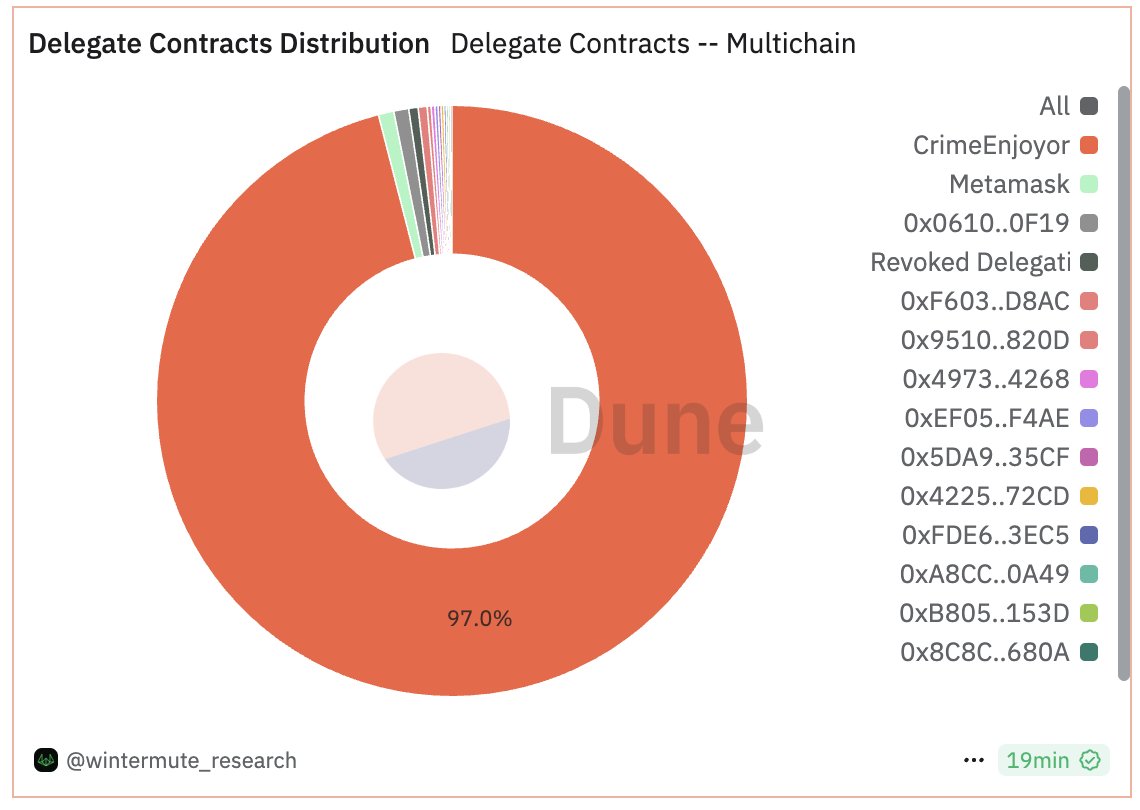 Wintermute flags Ethereum’s Pectra upgrade as a vector for Wallet-draining exploits through EIP-7702 functionality
 Crypto investment funds regain footing after $7 billion outflows earlier this year, driven by strong Bitcoin inflows and Ether’s recovery post-Pectra upgrade.
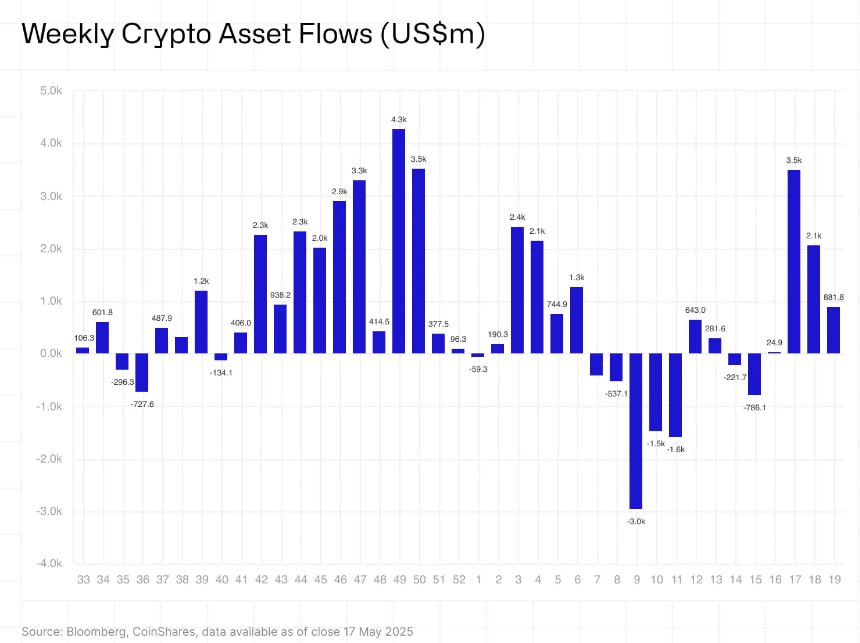 CoinShares records $785M inflows in digital assets last week, marking five straight weeks of gains and lifting 2024 year-to-date inflows to $7.5B, led by Bitcoin’s $557M and Ethereum’s $205M following the Pectra upgrade and new co-CEO Tomasz Stańczak’s appointment.
Sources
19 records from 18 domains
ethereum.org
mixbytes.io
eco.com
arxiv.org
eips.ethereum.org
thedefiant.io
blog.ethereum.org
blockdaemon.com
etherworld.co
consensys.io
bitget.com
x.com
info.etherscan.com
gate.com
youtube.com
blog.lido.fi
soliditylang.org
ig.com
Community notes
Spot something off or out of date? Drop a note. Editors review topic notes daily and roll accepted fixes into the explainer — contributors are recognized in the monthly $SQUID drop.
Loading notes…
Help improve this topic
Have a story or tip about this topic? Submit it. See something missing? Leave a note. Editors review daily; accepted submissions and fixes count toward the monthly $SQUID drop.