
Deep dive into Ethereum account abstraction, from ERC‑4337 smart wallets and Pectra’s EIP‑7702 to native frame transactions (EIP‑8141), explaining UX, security, stablecoin gas and multichain implications for crypto users and builders.
+4 sources across the wider coverage universe
 After ten years under sail, Ethereum’s account abstraction battles stormy seas and the growing risk of fragmented waters2026-06
 Base, Optimism, Coinbase and WalletConnect launch Native Account Abstraction (EIP-8130), cutting transaction costs by over 2x and bringing smarter wallets to EVM chains2026-07
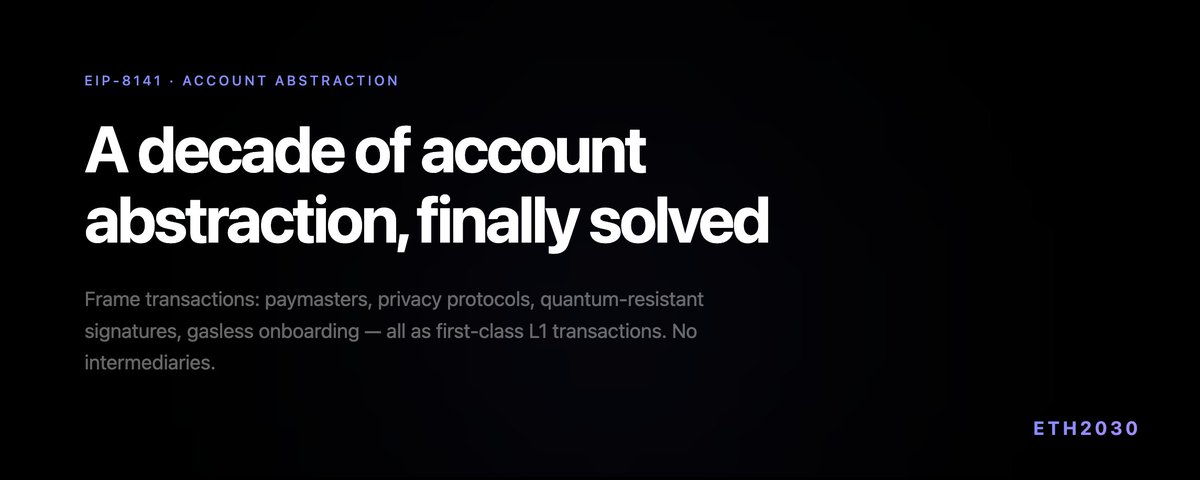 Vitalik’s EIP-8141 frame transactions simplify a decade of account abstraction into one core primitive for Ethereum2026-03
 Frame Transactions (EIP-8141) emerges as a flexible foundation for Ethereum account abstraction, enabling gas payments in ERC20 and modular transaction flows2026-03
 Particle Network adds EIP-7702 support, letting EOAs upgrade to smart accounts with cross-chain balances and gas abstraction2026-03
 OKX adds new account abstraction feature to its Web3 wallet2023-08
Account Abstraction: How Ethereum Wallets Become Smart Accounts
Account abstraction is a shift from rigid, key-controlled wallets to programmable accounts whose security, fee payments, and user experience are defined in code rather than hard‑wired into the protocol. It aims to erase the historical divide between externally owned accounts and smart contracts, making every account behave like a flexible smart wallet that can support features such as gas sponsorship, social recovery, and advanced signing schemes by default.
From EOAs and Contracts to Programmable Accounts
Ethereum’s original account model distinguishes sharply between two types of addresses: externally owned accounts, or EOAs, and contract accounts. EOAs are controlled by a single private key; they can send transactions, pay gas, and trigger contract execution, but they contain no code of their own. Contract accounts, by contrast, hold code and storage and can implement arbitrary logic, yet they cannot initiate transactions on their own and must be invoked by an EOA. This dichotomy is deeply baked into the protocol, with transaction validity and fee rules defined in terms of EOAs and their signatures.
In practice, this model has clear downsides for mainstream users. Losing a single private key means losing all access to the funds held by an EOA, and there is no native way to recover or rotate keys without moving funds to a new address. EOAs can only pay gas in the chain’s native token, such as ETH on Ethereum, which means every new user must acquire a volatile asset before they can perform even simple actions like sending a stablecoin payment. EOAs also cannot batch multiple actions, use session keys, or express more nuanced security policies such as multi‑signature approvals, daily spending limits, or device‑specific permissions without layering additional smart contracts on top. These constraints have made self‑custody powerful but unforgiving, and they stand in stark contrast to web‑scale consumer applications where logins, recovery, and subscriptions are routine.
Smart contract wallets emerged as a partial response, with projects like Safe (formerly Gnosis Safe) using contract accounts to simulate features such as multi‑signature control and role‑based permissions. However, these accounts still rely on EOAs to initiate transactions and pay gas, because the protocol only recognizes EOAs as valid senders. As a result, even sophisticated smart contract wallets inherit the fragility of a single key at the base layer and require additional deployment costs and setup steps before users can benefit from advanced features. The long‑term ambition behind account abstraction is to remove this dependency entirely, so that users never need to interact with bare EOAs at all, and instead use programmable accounts as their primary interface with the blockchain.

Ethereum and Base developers abandon plans to align account abstraction proposals EIP-8141 and EIP-8130, citing diverging priorities on security, scale and compliance

What Account Abstraction Actually Means
At its core, account abstraction is the idea that an account’s validation logic—the rules that determine whether a transaction is allowed and who pays for it—should be programmable like any other smart contract, rather than fixed in the protocol. In a fully abstracted model, the protocol enforces a minimal set of safety properties, such as preventing replay attacks and ensuring that gas is paid, but it does not dictate how signatures must be structured or which cryptographic scheme is used. Instead, each account can define its own verification code and gas payment logic as contract code.
Vitalik Buterin and other Ethereum researchers began discussing this vision as early as 2016, in proposals such as EIP‑86, which aimed to unify EOAs and contract accounts into a single, programmable account type. Those early attempts ran into concerns over denial‑of‑service risks and protocol complexity because allowing arbitrary code to run in the validation path makes it harder to ensure that blocks can be verified quickly and safely by all nodes. Over time, the community shifted toward incremental approaches that keep validation programmable at a higher layer while maintaining conservative guarantees in the base protocol. This incremental path is why there is now an ecosystem of overlay account abstraction via ERC‑4337, transitional proposals like EIP‑7702, and emerging protocol‑level designs such as EIP‑7701 and EIP‑8141.
Practically, account abstraction promises several categories of benefit. From a user experience perspective, it enables features like social logins, email‑based recovery, one‑click transaction batching, and gasless transactions where a dApp or service provider sponsors the fee. From a security perspective, it allows for multi‑signature policies, guardian‑based recovery, time‑locked withdrawals, and fine‑grained spending limits, all enforced at the account level rather than separately in each application. From a protocol and ecosystem standpoint, abstracted accounts can support alternative signature schemes, such as BLS or post‑quantum algorithms, without needing hard forks, and can integrate more closely with rollup infrastructure and cross‑chain interoperability layers. At the same time, these capabilities introduce new design risks: fragmented standards, complex transaction flows, and additional attack surfaces around smart wallet logic and fee sponsorships.
The trajectory of Ethereum’s account abstraction story reflects these trade‑offs. After nearly a decade of discussion, the ecosystem has converged on three main pillars: ERC‑4337 as the current overlay standard for smart contract wallets; EIP‑7702, introduced with the Pectra upgrade, as a way to give EOAs temporary smart account behavior; and EIP‑8141, the “frame transactions” proposal, as the candidate mechanism for fully native account abstraction in a future Hegota hard fork. Understanding how these pieces fit together is key to understanding both the promise and the risks of account abstraction.
Readers click AA stories most when abstraction disappears beneath a familiar product — wallet UX, stablecoin gas costs, or a specific L2 — and clicks on pure protocol explainers lagged a 'decade-long problem finally solved' framing by roughly 30x, revealing that the demand signal is AA as silent infrastructure, not as a cryptographic concept.
ERC‑4337: Overlay Account Abstraction via an Alt Mempool
Design and Core Components
ERC‑4337, formally titled “Account Abstraction Using Alt Mempool,” is the most widely deployed account abstraction standard on Ethereum today. Rather than modifying the base protocol to change transaction types or signature rules, ERC‑4337 creates an overlay system that operates in parallel with the existing transaction mempool. In this model, users never send raw Ethereum transactions directly from their smart wallets. Instead, they construct a pseudo‑transaction object called a UserOperation, which encapsulates the intended action along with the account’s validation and gas logic.
These UserOperation objects are broadcast to a dedicated alternative mempool that is monitored by specialized actors known as bundlers. A bundler collects multiple UserOperations, wraps them into a single standard Ethereum transaction, and submits that transaction to a special singleton contract on chain called the EntryPoint. The EntryPoint contract then processes each UserOperation, calling into the user’s smart contract wallet (often referred to as the “contract account”) to validate the operation and, if valid, execute the desired call. During validation, the EntryPoint may also interact with paymaster contracts that can sponsor gas for the user, as well as aggregator contracts that handle batched signature schemes.
By design, ERC‑4337 mirrors the core responsibilities of the protocol—validity checks, gas accounting, and transaction ordering—but shifts them into a smart contract and off‑chain service layer. This avoids any need to change consensus rules or the base transaction type, making ERC‑4337 deployable as a set of contracts and off‑chain services. The trade‑off is that it introduces new infrastructure roles (bundlers and paymasters) and places a great deal of trust in the correctness and security of the EntryPoint contract and its ecosystem. Recognizing this, the standard emphasizes the need for thorough auditing and careful implementation to mitigate denial‑of‑service and economic attack vectors.
What ERC‑4337 Unlocks for Users and Developers
Despite its complexity, ERC‑4337 has already proven that account abstraction is viable in production environments. Smart contract wallets built on this standard can implement social logins where account keys are derived from web2 identity providers, or can be split between devices and guardians to support social recovery and safer key storage. Applications can let users perform multiple actions in a single “one‑click” flow, such as approving a token, swapping it, and depositing into a yield protocol, all encapsulated in one UserOperation that the smart wallet executes in sequence.
ERC‑4337 also provides a framework for gas abstraction. Because the EntryPoint contract and paymasters handle fee payments, the user’s account does not need to hold ETH at all; instead, a paymaster can accept another token, such as a stablecoin, or can simply sponsor the transaction for free as part of a business model. This makes onboarding smoother, since a user can receive a token like USDC and immediately start transacting without going through an exchange to acquire native gas tokens first. Over time, wallet providers and infrastructure platforms such as Thirdweb, StackUp, and others have built SDKs and APIs that hide much of this complexity, enabling developers to integrate smart wallet functionality into dApps without handling UserOperation plumbing directly.
From a developer perspective, ERC‑4337 smart wallets are simply smart contracts that comply with certain interfaces for validation and execution, which allows for a wide variety of designs. Some wallets optimize for security, with multi‑signature and hardware wallet integration; others focus on low‑friction onboarding using email or phone‑based authentication. Teams building rollup‑centric applications can also use ERC‑4337 as a basis for intent‑based architectures, where users sign a high‑level description of what they want to achieve and off‑chain or cross‑chain services work out the optimal execution path. This flexibility has made ERC‑4337 a fertile ground for experimentation.
Limitations and Fragmentation Risks
The overlay nature of ERC‑4337, however, introduces its own drawbacks. Because UserOperations live in a separate mempool that is not processed by standard Ethereum clients, bundlers effectively become gatekeepers for ERC‑4337‑style transactions. If bundler infrastructure is sparse or centralized, users may be vulnerable to censorship or reliability issues that do not affect regular transactions. Moreover, ERC‑4337’s reliance on a single EntryPoint contract concentrates risk: any bug or vulnerability in this contract could impact the entire ecosystem of smart wallets that depend on it.
There is also a risk of fragmentation as different implementations, rollups, and wallet projects interpret and extend ERC‑4337 in slightly different ways. Some might add proprietary features in their wallet contracts; others may deploy modified EntryPoint contracts or custom paymaster interfaces tuned to particular chains. A recent commentary likened account abstraction’s evolution to “battling stormy seas and the growing risk of fragmented waters,” noting that ecosystem‑wide coherence is crucial if smart accounts are to become a universal primitive rather than a patchwork of incompatible standards. Because ERC‑4337 operates above the protocol layer, it is easier for L2s and sidechains to deviate from a single canonical implementation, exacerbating these concerns.
Finally, ERC‑4337 cannot fully escape the constraints that motivated account abstraction in the first place. Validation and gas logic are still executed as contract code inside the EVM, rather than integrated into the protocol’s transaction processing rules. This makes it harder to optimize for performance and leaves some desirable features—such as truly native ERC‑20 gas payments and protocol‑level privacy features—partially out of reach. These limitations are driving the push toward protocol‑level account abstraction proposals, even as ERC‑4337 continues to serve as the de facto standard for smart wallets in the meantime.
EIP‑7702 and the Pectra Upgrade: Giving EOAs Smart Wallet Superpowers
How EIP‑7702 Works
EIP‑7702, introduced as part of the Ethereum Pectra upgrade, represents a significant step toward account abstraction by enhancing EOAs with the ability to temporarily behave like smart contract accounts. Instead of requiring users to deploy a new smart contract wallet and migrate funds, EIP‑7702 allows an existing EOA to delegate its behavior to a contract implementation for the duration of a transaction. Technically, it does this by defining a new transaction type sometimes referred to as a “set code” transaction.
An EOA using EIP‑7702 signs a special authorization that includes the chain ID, the account address, and the current nonce. This authorization points to a specific contract that will receive delegated calls during the transaction. When a node processes such a transaction, the execution client verifies the signature, checks that the nonce matches, and confirms that the chain ID is valid. If these checks succeed, the client temporarily sets code for the EOA in a standardized format that effectively forwards calls to the designated contract via a defined delegation pattern. For the lifetime of that transaction, the EOA behaves as if it were a smart contract account implementing whatever logic is defined at the target address; afterward, the EOA reverts to being code‑less.
This design has two major advantages. First, it preserves backward compatibility: EOAs retain their addresses, balances, and ability to sign ordinary transactions, but they can opt into smart behavior on demand. Second, it avoids the need to permanently attach code and storage to EOAs, which would create new long‑term protocol burdens. By keeping the delegation transient and per‑transaction, EIP‑7702 gives EOAs much of the power of smart contract wallets while staying within a relatively conservative execution model.
Features Unlocked: Batching, Sponsorship, Delegated Actions
In terms of capabilities, EIP‑7702 effectively lets EOAs inherit the features of whatever smart wallet implementation they delegate to, without deploying that wallet as a standalone contract. If the delegated contract supports transaction batching, then an EOA can sign a single delegated transaction that triggers multiple calls. If the delegated contract integrates with ERC‑4337’s EntryPoint and paymaster ecosystem, the EOA can submit UserOperations and enjoy gas sponsorship and token‑based gas payments. EIP‑7702 also enables delegated actions: an EOA can grant another address limited authority to act on its behalf via the delegated contract, opening patterns such as session keys, spending delegates, or application‑specific permissions.
One concrete example comes from Circle’s work on USDC and account abstraction. USDC is a fiat‑backed stablecoin where Circle issues a corresponding amount of USDC when a business deposits dollars into its Circle Account, maintaining a 1:1 backing in high‑quality liquid assets. Historically, users who received USDC still needed ETH to pay gas when sending or spending it. With Pectra and EIP‑7702, a standard EOA can include a delegation signature that points to a smart wallet implementation capable of submitting ERC‑4337‑style UserOperations. Circle’s paymaster contracts can then evaluate these UserOperations, verify that the user has sufficient USDC, and cover the underlying ETH gas fees on their behalf, deducting USDC from the user’s balance.
Crucially, this flow no longer requires the user to deploy a dedicated smart wallet contract—something that previously involved paying gas for the deployment itself. Instead, from the moment an EOA is created, it can receive USDC and immediately send or spend it using a USDC‑powered, gas‑abstracted flow. The user perceives this as “gasless” USDC transactions, even though the underlying protocol still uses ETH for fee settlement. For developers, EIP‑7702 means that existing paymaster integrations can keep working with EOA senders, without code changes, once Pectra goes live.
Early Chain and Infrastructure Adopters
While Pectra is an Ethereum upgrade, its influence extends to other EVM‑compatible chains that aim to maintain parity with Ethereum’s latest features. IoTeX, for example, announced a Mainnet v2.4.0 upgrade that introduces an EVM Pectra hard fork with native account abstraction via EIP‑7702, alongside improvements in smart contract execution efficiency and node operator procedures. A subsequent IoTeX Core v2.4.1 “Yap” hard fork completed full Ethereum Pectra compatibility, unlocking account abstraction, rollups support, and cross‑chain BLS features for the IoTeX ecosystem. This makes IoTeX an early proving ground for Pectra‑style account abstraction outside Ethereum itself, allowing wallet and dApp developers to experiment with EIP‑7702 patterns in production on a different network.
On the infrastructure side, Particle Network has framed EIP‑7702 support as central to its “Universal Accounts” and chain abstraction vision. Particle’s universal accounts aim to give users a unified account and balance across multiple chains, abstracting away the fragmentation of liquidity and user identities in today’s multichain landscape. By adding EIP‑7702 support, Particle can upgrade any existing account to a universal account without changing addresses or migrating assets, because EOAs can temporarily delegate to smart logic that interprets and routes cross‑chain actions. This approach ties the Pectra‑era capabilities of EOAs into a broader strategy where one account can act across chains, supported by backend infrastructure that unifies execution and gas management.
Taken together, these early deployments suggest that EIP‑7702 will be more than a minor quality‑of‑life upgrade. It is increasingly the bridge between today’s EOA‑centric Ethereum and a future of smart accounts, enabling gasless stablecoin payments, cross‑chain execution, and seamless upgrades from legacy wallets to abstracted accounts, all without abandoning the familiar EOA address format.
After ten years under sail, Ethereum’s account abstraction battles stormy seas and the growing risk of fragmented waters
From Overlay to Native: EIP‑7701 and EIP‑8141 Frame Transactions
Why Native Account Abstraction Matters
While ERC‑4337 and EIP‑7702 have moved the ecosystem significantly closer to account abstraction, they both operate in ways that preserve the old transaction model at the protocol level. ERC‑4337 runs on top of the existing mempool and transaction type, using smart contracts and bundlers to simulate programmable validation and gas logic. EIP‑7702 provides EOAs with temporary smart behavior, but it still relies on standard transactions and does not fundamentally change how nodes evaluate validity and fees.
Native account abstraction, by contrast, aims to modify the protocol’s execution and transaction rules so that all accounts can define their own validation logic within bounded, protocol‑recognized constraints. Achieving this requires splitting validation from execution in the transaction lifecycle, constraining which opcodes and resource usage are permitted during validation to avoid denial‑of‑service issues, and developing new transaction formats that carry richer semantics than the current “from, to, gas, data” model. After years of incremental proposals, the community’s current candidates for this deeper change include EIP‑7701 and EIP‑8141.
EIP‑7701: Roles, Validation Code, and AA‑Specific Opcodes
EIP‑7701, titled “Native Account Abstraction,” proposes introducing a new transaction type along with a family of account abstraction–specific opcodes to enable protocol‑level roles such as “account” and “paymaster.” Instead of overlaying account abstraction logic via Solidity entry points and ABI‑encoded calls, EIP‑7701 defines a mechanism by which contracts can opt into these roles and provide validation code sections that the protocol can invoke directly during transaction validation.
Under this model, a contract becomes an account if it exposes a validation code section that complies with the protocol’s expectations. This validation code is not callable from ordinary EVM execution; it can only be executed by the protocol as part of validating an EIP‑7701 transaction. If the validation section reverts, the transaction is invalid and cannot be included in a block; if it succeeds, the transaction is considered valid and the corresponding account can be charged for gas. Similarly, a contract can take on the role of paymaster, providing validation logic that determines when and how it will pay gas on behalf of another account.
To support this, EIP‑7701 introduces new opcodes such as ACCEPTROLE for a contract to declare which role it is assuming during validation, and TXPARAMLOAD, TXPARAMSIZE, and TXPARAMCOPY for accessing transaction parameters in a structured way. Earlier versions of the proposal considered exposing ABI‑encoded transaction parameters as calldata to the validation code, but this would have effectively enshrined ABI encoding in the EVM specification. The revised design instead uses these TXPARAM* opcodes with indexed arguments to provide access to fields such as the sender, gas limits, and role context, without hard‑coding ABI rules into the protocol.
EIP‑7701 also explicitly considers compatibility with upgradeable proxy wallets. Because role lookup can be satisfied by any contract running in the account’s context via DELEGATECALL, existing smart wallets—whether based on ERC‑4337 patterns, Safe‑style proxies, or other designs—can upgrade to native account abstraction by introducing the necessary validation logic in a delegated implementation contract. This makes EIP‑7701 an evolutionary path for current smart wallet ecosystems rather than a forced migration to a completely new account type.
EIP‑8141: Frame Transactions as a Unified Primitive
If EIP‑7701 sketches out the roles and opcodes needed for native AA, EIP‑8141, titled “Frame Transactions,” goes a step further by redefining the transaction itself as a sequence of modular execution frames. EIP‑8141 introduces a new EIP‑2718 transaction type (type 0x06) where a single transaction is decomposed into distinct frames corresponding to functions like validation, gas authorization, execution, and optional deployment.
In this design, the outer transaction payload includes fields such as the chain ID, nonce, sender address, a list of frames to execute, and a list of validated signatures. Each frame has parameters including a mode (which specifies the execution semantics), flags for optional features, a target address, and a gas limit. When a node receives a frame transaction, it first ensures that the nonce matches the sender’s expected value and computes a canonical signature hash. It then validates the signatures in the transaction and proceeds to execute the frames in sequence, starting with a VERIFY frame responsible for signature validation and fee authorization, followed by one or more EXECUTE frames that perform the actual calls.
One key difference from ERC‑4337 is that frame transactions integrate validation into the protocol’s transaction processing rules, rather than routing everything through a single EntryPoint contract. Under ERC‑4337, the EntryPoint contract must interpret UserOperations, call into account contracts for validation, and handle gas accounting, all within EVM execution. With EIP‑8141, the protocol itself understands the structure of frames and can enforce constraints on what happens in the VERIFY stage, including opcode sandboxing and gas limits, to maintain denial‑of‑service resistance. This allows the network to reason about validation separately from execution and to implement advanced features, such as batched execution and ERC‑20 gas payments, as first‑class citizens rather than contract‑level hacks.
Vitalik Buterin has characterized EIP‑8141 as an “omnibus” proposal that wraps up and solves the remaining problems that account abstraction was intended to address. Among other things, frame transactions enable native support for batching, gas sponsorship, and privacy‑enhancing features at the protocol level, while preserving backward compatibility for EOAs and existing transaction types. Existing 0x‑style addresses remain valid, and standard EIP‑1559 transactions continue to work even as new frame‑based flows become available.
Validator and Mempool Implications
EIP‑8141 also has significant implications for validators and node operators. Because transactions are now sequences of frames with validation logic that can run arbitrary code within constrained bounds, nodes must simulate parts of the transaction before admitting it to the mempool. In particular, EIP‑8141 proposes that nodes perform a bounded EVM simulation over the VERIFY frame, capped at a gas limit (for example, 100,000 gas), to ensure that the account or paymaster can in fact pay for the transaction before it occupies space in the pending pool. This is a departure from the current model, where mempool admission is based on static checks such as nonce and balance.
To maintain security, the proposal integrates an EIP‑7562‑style opcode sandbox for validation logic, restricting which EVM operations are allowed during the VERIFY phase. Nodes must also track gas reservations made by paymasters across all pending frame transactions, so that a malicious paymaster cannot over‑commit its balance and cause a flood of unpaid transactions. These requirements mean that execution clients, mempool policies, and block selection logic all need to be upgraded and tested well in advance of activation. As of its latest status, EIP‑8141 has been granted “Considered for Inclusion” in the planned Hegota fork, with client teams like Geth, Erigon, and Nimbus expressing support during All Core Devs calls, but it is not yet a confirmed deliverable.
For validators, the shift to frame transactions represents both an operational burden and a long‑term simplification. In the short term, they must adapt to pre‑acceptance simulation, new mempool rules, and paymaster‑aware gas estimation. In the long term, a unified account abstraction model at the protocol level could reduce the need for separate overlay systems, proprietary bundler networks, and chain‑specific hacks, making the execution layer more coherent and efficient. The success of this transition will depend on careful coordination between researchers, client developers, wallet builders, and validators.
- 01EIP-8141 protocol endgame↗
Vitalik's 'Frame Transactions' framing — that a single EIP finally closes ten years of incomplete AA — drove high engagement because it offered narrative closure on a story readers had been following since ERC-4337.
- 02L2 fragmentation via ERC-4337↗
The Ethereum Interop Layer headline drew clicks by linking AA directly to a concrete pain point — wallets and balances siloed across Optimism, Arbitrum, and other L2s — rather than describing AA abstractly.
- 03Wallet product adoption↗
The top-clicked headline was OKX shipping AA into its live Web3 wallet, confirming readers engage most when AA moves from proposal to a named product they can open today.
- 04EIP-7702 EOA upgrade path↗
Multiple mid-tier headlines covering Particle Network, Sonic, and Circle USDC v2.2 all keyed on EIP-7702 as the near-term, backwards-compatible on-ramp for existing wallets, signaling readers tracking the incremental migration over a hard cut-over.
- 05Stablecoin gas abstraction↗
Circle's USDC v2.2 framing — paying gas in stablecoins rather than ETH — translated AA from developer infrastructure into a tangible user-facing benefit that stablecoin holders immediately understood.
- 06Real-world crypto payments↗
The GnosisDAO/Safe angle drew clicks by grounding AA in physical-world spending, making the technology legible to readers skeptical that on-chain UX improvements ever reach checkout counters.
UX, Security, and Sponsorship in an Abstracted World
Better UX: From Seed Phrases to Face ID and One‑Click Flows
One of the most visible promises of account abstraction is a user experience that feels much closer to mainstream apps than to command‑line tools. In the traditional model, users must securely store a 12‑ or 24‑word seed phrase, understand gas fees, and sign raw hexadecimal data to interact with dApps. Smart contract wallets built on account abstraction can replace these patterns with more intuitive flows. For example, wallets can use device‑bound keys stored in secure enclaves on smartphones, authenticated via Face ID or Touch ID, and rely on social recovery mechanisms where trusted guardians can help restore access if a device is lost.
Projects like Opclave illustrate this direction by combining account abstraction with Apple’s secure enclave and the OP Stack to create smart contract wallets that initiate transactions on rollups using biometric authentication. Here, the user’s iPhone effectively acts as a hardware wallet, with account abstraction providing the flexibility to define how signatures from the device are interpreted and how recovery works. Because the account logic is programmable, it can also enforce constraints such as transaction whitelists, spending limits, or multi‑factor approval flows that combine biometric checks with guardian confirmations.
ERC‑4337 and EIP‑7702 further allow wallets to present complex on‑chain actions as simple “do this” buttons. A game might issue a session key that allows a smart account to perform in‑game actions for a limited time or within a certain budget, without requiring the user to sign every move. A DeFi application might batch approval, swap, and deposit into a single operation, showing the user a clean summary while the smart account executes multiple underlying calls. With gas sponsorship via paymasters, users can experience dApps without ever seeing a gas slider or worrying about having enough ETH in their wallet, at least for initial interactions. These patterns are already emerging on L2s and sidechains that support ERC‑4337, and they are likely to accelerate as Pectra and, later, frame transactions roll out.
Security Gains and New Attack Surfaces
From a security standpoint, account abstraction is both a solution and a new challenge. On the positive side, programmable validation logic makes it easier to avoid single‑point‑of‑failure EOAs. Users can require multiple keys, devices, or guardians to approve high‑value operations while allowing lower‑risk actions to proceed with fewer checks. Smart accounts can implement time locks for large transfers, rate limits for specific tokens, and geographic or device‑based restrictions without relying on every application to implement these features separately. For institutions, smart wallets can encode complex governance policies directly into account logic, ensuring that on‑chain actions always respect off‑chain approvals.
Account abstraction can also improve signature safety. EIP‑8141’s frame transactions, for instance, encourage wallets to present users with a structured view of what they are signing—frames with explicit roles like validation, execution, and payment—rather than opaque calldata blobs. Hardware wallets and secure enclaves can integrate more robust signing models where users approve high‑level actions (“send 100 USDC to this merchant, paid by my stablecoin balance”) rather than manually verifying contract addresses and function signatures. Combined with vectorized math precompiles and ZK‑EVM advances that Vitalik has connected to the broader execution‑layer roadmap, the result could be wallets that are both more powerful and safer for non‑experts.
At the same time, shifting complexity into smart wallets creates more code that can fail. Bugs in account validation logic, paymaster contracts, or custom aggregators can lead to loss of funds or denial‑of‑service conditions. ERC‑4337’s EntryPoint contract and associated paymasters are particularly sensitive, which is why the standard stresses the need for rigorous audits. EIP‑8141’s requirement for pre‑simulation and opcode sandboxing in the VERIFY frame is similarly aimed at preventing malicious validation code from overwhelming nodes or bypassing gas checks. Nevertheless, these mechanisms are new and will need real‑world testing. Furthermore, gas sponsorship models introduce economic incentives for abuse: attackers may attempt to drain paymaster budgets via spam operations or exploit mispriced fee policies. Security in an abstracted account world will require not just safer base‑layer primitives but also robust monitoring, insurance, and recovery practices at the application level.
Sponsorships and New Business Models
One of the most economically interesting aspects of account abstraction is gas sponsorship. Paymasters can cover transaction fees on behalf of users and be reimbursed in alternative tokens, supported by off‑chain billing or subscription models. This opens the door for dApps to sponsor initial interactions, wallets to bundle gas costs into subscription fees, or stablecoin issuers to promote usage by making their tokens effectively “gas tokens” for end users. Circle’s USDC paymaster is a clear example: by allowing EOAs to transact using only USDC balances while Circle handles ETH gas behind the scenes, the company positions USDC as a frictionless medium for on‑chain payments.
More broadly, gas sponsorship allows Web3 applications to adopt familiar Web2 growth tactics. A game can let users play for free, covering gas costs until they reach a certain threshold of engagement, at which point it prompts them to deposit or pay a subscription. A decentralized exchange can subsidize a set number of trades per user to encourage trial. Payment platforms such as those being explored by GnosisDAO, combining Safe smart accounts with real‑world spending support, can hide gas entirely from the user experience and monetize through spreads or service fees instead. Although these examples involve business‑level decisions rather than protocol changes, account abstraction provides the technical foundation needed to turn “gasless” experiences into standard practice.
With Pectra and EIP‑7702, sponsorship models become accessible even to users who have never deployed a smart contract wallet, because EOAs can delegate to smart logic that integrates with paymasters from the outset. Looking ahead to EIP‑8141, the ability to pay gas using ERC‑20 tokens directly in the protocol’s Payment Frame could further simplify these flows and reduce the need for explicit paymaster contracts in some scenarios. As always, the challenge will be balancing user convenience with economic sustainability and regulatory considerations, especially when sponsorship intersects with KYC, AML, or consumer protection rules.
Stablecoins and Account Abstraction: USDC as a Gas Token
Gasless USDC and Pectra‑Powered Smart EOAs
Stablecoins are a natural fit for account abstraction because they address one of the most visible UX pain points: paying volatile native token fees for stablecoin transfers. USDC, issued by Circle, has become one of the leading dollar‑denominated stablecoins by maintaining full backing in cash and short‑term U.S. Treasuries and by operating across multiple EVM and non‑EVM networks. The combination of ERC‑4337, Pectra’s EIP‑7702, and Circle’s paymaster infrastructure transforms USDC from a mere transferable token into a functional “gas currency” for everyday users.
Under this model, a user can create a standard EOA wallet, receive USDC, and immediately send or spend that USDC using a delegation to a smart wallet implementation that constructs ERC‑4337 UserOperations. Circle’s paymaster evaluates each UserOperation, confirms that the user has enough USDC, and pays the ETH gas required for the bundled transaction that the bundler submits to the EntryPoint or, in future, the frame transaction. The user’s USDC balance is then debited to reimburse Circle for the ETH spent, but the user never needs to handle ETH directly. EIP‑7702 removes the need for a prior contract deployment step, making this flow available from the very first transaction.
This kind of USDC‑native UX aligns with broader moves by Circle to enhance the USDC and EURC stablecoin contracts on EVM chains, including improvements that reduce gas costs and better support account abstraction. Combined with AA‑enabled wallets and Pectra‑capable chains, these contract upgrades mean that stablecoin users can enjoy lower fees and more secure, programmable transfer logic, reinforcing stablecoins’ role as the main transactional currency in many DeFi and payments scenarios.
ERC‑20 Gas at the Protocol Level with Frame Transactions
Looking further ahead, EIP‑8141’s frame transactions expand stablecoins’ role by making ERC‑20 gas payments a protocol‑native feature. In EIP‑8141’s architecture, a dedicated Payment Frame within the transaction sequence handles fee settlement. Rather than requiring a paymaster contract to intermediate between ERC‑20 balances and ETH gas, the protocol can support fees denominated in approved ERC‑20 tokens directly, with logic that ensures validators are compensated appropriately. As described in coverage of the proposal, users could pay fees in tokens like USDC or USDT, provided the dApp or protocol defines a compatible payment frame and accepts those tokens.
This design greatly reduces the conceptual distance between “gas” and “token,” making it feasible for dApps to advertise a truly native‑feeling “pay in USDC” experience without complex smart contract plumbing. Validators may still ultimately be paid in ETH, depending on how the payment logic is configured, but the user’s perspective is unified: they hold one token, pay with that token, and receive services without worrying about asset conversion. For stablecoin issuers and payment providers, protocol‑level ERC‑20 gas opens new business models and makes on‑chain payments more competitive with traditional card networks.
In both the Pectra and Hegota contexts, the interplay between stablecoins and account abstraction illustrates a broader trend: the separation of the currency users see and the asset validators receive. Account abstraction moves flexibility into the account logic and transaction format, while stablecoins provide a user‑friendly, low‑volatility medium of exchange. Together, they make it easier to envision Ethereum and EVM‑compatible chains as everyday payment rails rather than speculative trading venues.
Base, Optimism, Coinbase and WalletConnect launch Native Account Abstraction (EIP-8130), cutting transaction costs by over 2x and bringing smarter wallets to EVM chains
Multichain, Interoperability, and Chain Abstraction
ERC‑4337 as the Backbone for an Ethereum Interop Layer
As Ethereum’s Layer‑2 rollup ecosystem has expanded, users increasingly experience the network as a fragmented archipelago of chains, each with its own bridges, gas tokens, and UX quirks. The Ethereum Foundation’s proposed Ethereum Interop Layer (EIL) aims to address this fragmentation by building an account‑based interoperability layer that unifies Ethereum’s rollups under Ethereum’s own security model. Notably, EIL is explicitly built on ERC‑4337 account abstraction and the principles of trustless, user‑initiated execution.
In the EIL vision, users sign once for a cross‑chain transaction, and the system orchestrates the necessary sequence of actions across L2s without introducing new trusted intermediaries. Because ERC‑4337 smart accounts can define arbitrary validation and execution logic, they can act as the orchestrators of these cross‑L2 operations, verifying state transitions and applying user‑defined safety checks even as funds move between rollups. By anchoring cross‑chain flows in users’ smart accounts, rather than in relayers or solvers, EIL preserves Ethereum’s core guarantees of self‑custody, censorship resistance, and verifiable on‑chain execution.
From a UX perspective, this is a natural extension of account abstraction: the wallet becomes the universal window into the Ethereum ecosystem, and the network feels like “one chain” again, even though under the hood it is composed of many rollups. The same smart account can manage balances, NFTs, and positions across multiple L2s, with AA‑enabled logic handling gas, bridging, and security policies in a consistent way. EIL thus exemplifies how account abstraction is not only about single‑chain wallets but also about restructuring how users interact with a multichain Ethereum.
Chain Abstraction and Universal Accounts Beyond Ethereum
Beyond Ethereum’s own rollups, account abstraction underpins broader efforts at “chain abstraction” across heterogeneous networks. Particle Network’s Universal Accounts are a prominent example, offering users a single account and balance view that spans multiple chains, made possible by backend infrastructure that synchronizes state and abstracts cross‑chain complexity. EIP‑7702 support is a key ingredient in this strategy because it allows existing EOAs on supported chains to be upgraded into universal accounts without new addresses or asset migration. When a user interacts with a dApp on any supported chain, their EOA can delegate to Particle’s smart logic, which interprets cross‑chain intents, routes transactions, and manages gas in an abstracted way.
This model differs from Ethereum’s EIL in that it extends across many chains, not just Ethereum rollups, but the conceptual role of account abstraction is similar. Programmable accounts and delegation mechanisms make it possible to separate user intent (“send 50 USDC to this merchant, from wherever my liquidity is cheapest”) from execution details (which chain, which bridge, which gas token). Infrastructure providers like Particle then build chain‑specific connectors and paymasters under the hood, while users experience a unified balance and identity.
Other EVM‑compatible chains, such as IoTeX, are also aligning with Ethereum’s account abstraction roadmap by adopting Pectra‑style EVM upgrades and EIP‑7702, ensuring that smart account patterns and tooling can port across ecosystems. This convergence suggests that, over time, account abstraction will play a central role in how users experience not just Ethereum but a broader “EVM universe” as a cohesive environment, even if chain‑level differences remain.
Implementation Challenges and Open Questions
Standardization vs. Fragmentation
As account abstraction becomes more central, the risk of a fragmented landscape of competing standards and partial implementations grows. Today’s ecosystem already includes ERC‑4337 overlay systems, Pectra’s EIP‑7702 transitional mechanism, and proposals like EIP‑7701 and EIP‑8141 that target native AA in the Hegota timeframe. Different L2s and sidechains may adopt these components at different times or in different combinations. Without careful coordination, this can lead to a situation where a smart account that works on one chain cannot easily function the same way on another, or where paymaster infrastructure needs to be customized for each environment.
The evolution of EIP‑7701 itself demonstrates the iterative nature of this standardization process. The proposal has undergone changes to remove reliance on ABI encoding and to better leverage existing features such as EIP‑1153 transient storage, while also enhancing proxy compatibility. Meanwhile, EIP‑8141 is being developed alongside other proposals, such as EIP‑8130 and Paradigm’s Tempo, that compete for inclusion in the same hard fork, underscoring that native AA is one piece of a larger execution‑layer design puzzle. The community will need to balance the desire for a clean, unified account abstraction model with the practical realities of client diversity, L2 autonomy, and the need for incremental deployment paths.
Mempool Complexity and DoS Considerations
Another open challenge is mempool complexity. ERC‑4337 has already introduced a parallel mempool for UserOperations, monitored by bundlers who must simulate operations before including them in EntryPoint calls. EIP‑8141 extends simulation into the protocol layer by requiring pre‑acceptance simulation of VERIFY frames for every frame transaction, along with sandboxed opcode policies and paymaster gas reservation tracking. These measures are designed to preserve denial‑of‑service resistance, but they also increase resource demands on nodes and introduce new attack vectors, such as flooding the mempool with transactions that are cheap to simulate but unlikely to be included in blocks.
Designing robust, fair mempool policies in this context is an ongoing research area. Node implementers must decide how to prioritize frame transactions relative to legacy transactions, how to handle pending paymaster commitments when account balances fluctuate, and how to avoid creating incentives for centralized “fast lanes” or proprietary transaction relaying markets. These questions intersect with broader debates over MEV, builder‑relay separation, and transaction censorship. Account abstraction may enable better user‑level control over MEV exposure—for example, by allowing smart accounts to choose privacy‑preserving execution paths—but it also complicates the underlying transaction flow in ways that must be carefully analyzed.
Developer Ergonomics and Tooling
For developers, the success of account abstraction hinges on tooling. While EIPs define low‑level mechanics, most application developers will interact with AA via SDKs, wallet APIs, and infrastructure services. Platforms like Thirdweb and StackUp already provide libraries for constructing UserOperations, integrating with paymasters, and deploying smart wallets, abstracting away much of ERC‑4337’s complexity. As EIP‑7702 and, later, frame transactions become available, these tools will need to evolve to support new transaction types and validation flows, ideally without forcing developers to learn multiple incompatible paradigms.
A typical AA integration may involve defining a wallet kernel contract, specifying validation and execution methods, configuring paymaster relationships, and exposing high‑level functions like “send token,” “batch,” or “sponsor transaction” to the front end. In Solidity, a simplified smart account might implement methods for signature validation and execution that the EntryPoint or protocol calls during the validation stage. For example, a pseudo‑interface might look like:
``solidity interface IAccount { function validateUserOp(bytes calldata userOp, bytes32 userOpHash) external returns (uint256 validationData); function execute(address target, uint256 value, bytes calldata data) external; } ``
In practice, the real interfaces and frame semantics are more complex, but the goal remains consistent: give developers well‑tested, audited building blocks so they can focus on user experience rather than cryptographic and protocol details. Achieving this across multiple chains, wallet providers, and application types will require continued collaboration between protocol researchers, client teams, and infrastructure providers.
Regulatory and Privacy Dimensions
Finally, account abstraction has regulatory and privacy implications that are only beginning to be explored. On the one hand, smart accounts can improve privacy by facilitating stealth addresses, rotating keys, and normalizing patterns like one‑time addresses for transactions, all managed by account logic rather than user discipline. They can also encode user‑chosen policies around data sharing and compliance into the account, potentially allowing more nuanced interactions with regulated services.
On the other hand, gas sponsorship and paymaster models may face scrutiny, especially when they involve subsidizing user activity or abstracting away gas payments in ways that resemble traditional financial intermediaries. Paymasters that accept fiat off‑chain or run KYC programs effectively become regulated entities, even if the underlying protocol remains permissionless. The ability to pay gas with stablecoins at the protocol level may blur the line between fee payments and money transmission. As Vitalik Buterin and others have noted, account abstraction is deeply tied to how users experience security and convenience in future metaverse‑style environments, but that same integration of identity, payments, and programmable accounts will draw attention from regulators and policy makers.
Case Studies: Wallets, Exchanges, and Hardware‑Backed Accounts
Safe, Payments, and the Modular Smart Account Stack
Safe is one of the most widely used smart contract wallet systems on Ethereum and other EVM chains, offering multi‑signature control and modular add‑ons that make it suitable for DAOs, treasuries, and power users. With EIP‑7702 and future native AA proposals, Safe‑style accounts can become more seamlessly integrated with the protocol. Safe’s documentation highlights how EIP‑7702 enables EOAs to have both code and storage, allowing them to function as smart contract accounts capable of transaction batching, gas sponsorship, and delegated actions. By linking EOAs to Safe modules via delegation, users can retain their familiar addresses while gaining the full feature set of Safe smart accounts, including advanced spending policies and plugin modules.
GnosisDAO, which incubated Safe, has pushed further into payments, exploring how account abstraction can allow users to spend from their crypto wallets in everyday contexts. By combining Safe smart accounts with payment rails and point‑of‑sale integrations, GnosisDAO aims to make real‑world spending as straightforward as tapping a card, with the smart account handling all on‑chain authorization and gas logic. In such systems, account abstraction underpins critical features like merchant whitelists, dynamic spending limits, and multi‑party authorization for high‑value payments, while paymasters and ERC‑20 gas mechanisms reduce friction at checkout.
Exchange Wallets and Retail Onboarding
Major exchanges and wallet providers are also adopting account abstraction to improve onboarding and retention. OKX, for example, has added account abstraction features to its Web3 wallet, enabling users to benefit from gasless transactions and batched operations when interacting with supported dApps. By integrating smart account logic behind the scenes, exchange‑linked wallets can simplify the user journey from custodial to self‑custodial usage, allowing gradual exposure to key management rather than an abrupt handoff of a seed phrase. These hybrid models show how account abstraction can coexist with centralized infrastructure while nudging users toward more direct on‑chain control over time.
Mobile Devices as Hardware Wallets: The Opclave Example
Opclave, a project showcased at ETHGlobal, demonstrates how mobile devices can become first‑class hardware wallets when combined with account abstraction. The team built a smart contract wallet that leverages Apple’s secure enclave and biometric authentication to initiate transactions on OP Stack–compatible rollups, providing a smoother user experience than traditional key management. In this design, the iPhone’s hardware security module stores key material and signs messages, while the smart wallet on chain encodes the rules for validation, recovery, and gas payment using account abstraction.
Opclave’s documentation notes that EIP‑4337 account abstraction opened the door to building smart contract wallets without additional trust assumptions beyond those already inherent in the protocol. By implementing their wallet as an ERC‑4337 account, the team could take advantage of features like batched transactions and social recovery while still benefiting from the secure enclave’s protection against key extraction. This pattern is likely to be replicated and extended as Android and other platforms provide robust hardware security, with account abstraction enabling flexible combinations of device keys, guardians, and off‑chain identity proofs.
Infrastructure and Ecosystem Builders
Behind these user‑facing projects are infrastructure companies and research teams shaping the account abstraction landscape. Alchemy, for instance, has launched support for account abstraction on networks like Zora and Fraxtal, aligning with the vision of embedded accounts across the Optimism Superchain. Rhinestone provides infrastructure and APIs for intent‑based interoperability and account abstraction and is active in community events such as WalletCon. Circle has upgraded USDC and EURC smart contracts to reduce gas fees and enhance security while improving support for account abstraction, reinforcing the synergy between stablecoins and smart accounts.
These efforts underscore that account abstraction is not a single feature but a stack. Protocol‑level changes like EIP‑7702 and EIP‑8141 sit at the base; shared standards like ERC‑4337 define intermediate interfaces; wallet providers, infra platforms, and dApps build on top to deliver user‑facing experiences. The pace and direction of adoption will depend on how well these layers align.
ERC-4337 UserOperations and Paymasters introduce novel attack surfaces — malicious Paymasters can drain sponsorship pools and bundler mempools remain a target for griefing attacks not present in standard EOA flows.
Competing AA standards (ERC-4337, EIP-7702, EIP-8141, chain-native implementations) risk producing incompatible smart account formats across L2s, recreating the bridge fragmentation problem at the wallet layer.
Bundler and Paymaster markets are currently dominated by a small number of providers (Alchemy, Stackup, Pimlico), creating single points of failure and censorship risk for sponsored transactions.
Gas sponsorship via Paymasters — where a third party pays fees on behalf of users — may attract money-transmission or payment-processor classification in jurisdictions that focus on who controls the fee flow.
Paymaster float must be pre-funded in ETH or accepted ERC-20s on each chain, creating working-capital overhead for sponsors but posing no systemic liquidity risk to broader DeFi markets.
AA does not introduce new token-price exposure; its primary market risk is adoption velocity — slow uptake leaves Paymaster and bundler operators with stranded infrastructure investment.
Conclusion
Account abstraction represents a profound rethinking of how users, applications, and protocols interact on Ethereum and other EVM‑compatible chains. It seeks to replace the brittle, key‑centric EOA model with programmable accounts that can express rich security policies, flexible fee payments, and user‑friendly interfaces as code. Overlay systems like ERC‑4337 have demonstrated the feasibility of smart contract wallets with social logins, gas sponsorship, and batch operations, while Pectra’s EIP‑7702 extends these capabilities to EOAs without requiring contract deployments.
At the same time, the long‑standing ambition for native account abstraction is taking concrete shape in proposals such as EIP‑7701 and EIP‑8141. These designs aim to move validation logic into the protocol’s transaction processing rules via roles, opcodes, and frame‑based transactions that separate verification from execution and support ERC‑20 gas payments natively. Their success will depend on addressing denial‑of‑service concerns, achieving cross‑client consensus, and providing smooth migration paths for existing wallets and dApps.
Throughout this evolution, account abstraction remains intertwined with broader themes: the rise of stablecoins like USDC as de facto gas tokens, the quest to make Ethereum’s L2 ecosystem feel like a single chain via ERC‑4337‑based interop layers, and the emergence of chain abstraction platforms that unify user accounts across multiple networks. It also raises new questions around standardization, regulatory treatment, mempool policy, and security engineering that will require careful, collaborative work to resolve. What is clear is that account abstraction is no longer a distant research goal. It is an active field of deployment and experimentation that will shape the next generation of wallets, dApps, and protocol upgrades.
Outlook
Over the next few years, the trajectory of account abstraction will be defined by three major milestones. First is the full rollout and adoption of Pectra with EIP‑7702 on Ethereum and Pectra‑aligned chains like IoTeX, which will determine how quickly EOAs can gain smart wallet capabilities in practice. Second is the consolidation of ERC‑4337 tooling and ecosystem standards, including cross‑L2 solutions like the Ethereum Interop Layer and broader stablecoin‑based gas sponsorship models. Third is the Hegota‑era debate over EIP‑8141 and related execution‑layer proposals, which will decide whether Ethereum embraces frame transactions as the foundation for native account abstraction.
For builders and users alike, the advice is consistent: treat account abstraction as both an opportunity and an evolving standard. Smart accounts will increasingly be the default way to interact with Ethereum and its rollups, but the exact mechanics—validation flows, fee tokens, interoperability guarantees—will continue to change as EIPs are refined and implemented. Keeping an eye on protocol upgrades such as Pectra and Hegota, experimenting with ERC‑4337 smart wallets, and understanding the role of paymasters and stablecoins in gas abstraction will be essential. If the ecosystem can navigate the risk of fragmentation and deliver coherent, secure primitives, account abstraction has the potential to make Ethereum feel not only like one chain again, but like an internet‑scale platform where self‑custody and mainstream usability finally meet.
Latest Account Abstraction news
Ethereum and Base developers abandon plans to align account abstraction proposals EIP-8141 and EIP-8130, citing diverging priorities on security, scale and complianceAfter ten years under sail, Ethereum’s account abstraction battles stormy seas and the growing risk of fragmented watersBase, Optimism, Coinbase and WalletConnect launch Native Account Abstraction (EIP-8130), cutting transaction costs by over 2x and bringing smarter wallets to EVM chainsVitalik’s EIP-8141 frame transactions simplify a decade of account abstraction into one core primitive for Ethereum Ethlabs recommends faster blocks, stronger censorship resistance, native account abstraction, and continued L1 scaling for Hegotá upgradeFrame Transactions (EIP-8141) emerges as a flexible foundation for Ethereum account abstraction, enabling gas payments in ERC20 and modular transaction flows
Sources
19 records from 17 domains
thirdweb.com
eips.ethereum.org
stackup.fi
docs.safe.global
consensys.io
galaxy.com
ethereum-magicians.org
circle.com
blog.particle.network
leviathannews.xyz
ccn.com
youtube.com
blog.ethereum.org
everstake.one
x.com
gate.com
ethglobal.com
Community notes
Spot something off or out of date? Drop a note. Editors review topic notes daily and roll accepted fixes into the explainer — contributors are recognized in the monthly $SQUID drop.
Loading notes…
Help improve this topic
Have a story or tip about this topic? Submit it. See something missing? Leave a note. Editors review daily; accepted submissions and fixes count toward the monthly $SQUID drop.