
Deep dive explainer on blockchain testnets: how they differ from mainnets, power Ethereum upgrades and DeFi launches, use USDC faucets and points programs, and signal where crypto’s next big ecosystems are being built.
+18 sources across the wider coverage universe
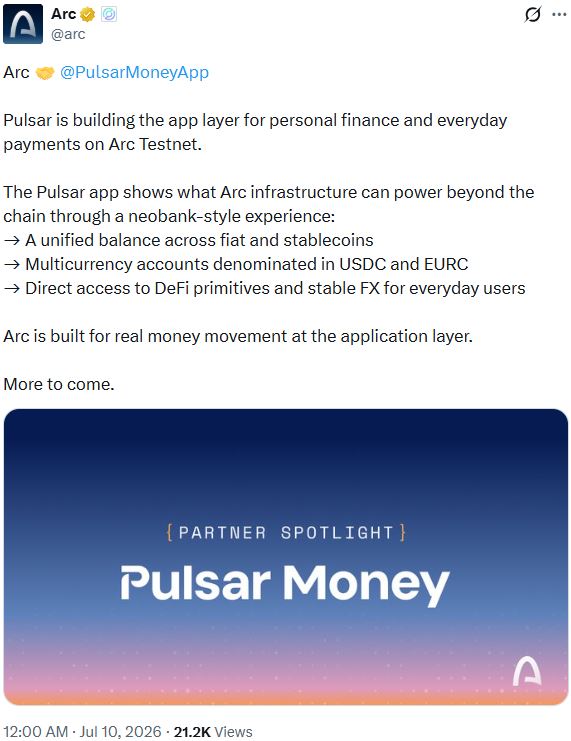 Pulsar launches a neobank-style personal finance app on Arc Testnet with fiat and stablecoin support2026-07
 ERC-8183 launches on Arc Testnet introducing Jobs for verifiable onchain work between AI agents and trustless commerce2026-04
 Quip Network goes live with quantum-classical testnet powered by D-Wave annealing hardware2026-04
 Introducing Domination Finance, the first DEX allowing users to trade market share instead of price.
Backed by ParaFi, Dragonfly, CoinGecko, and others.
Testnet is live!2026-04
Introducing Domination Finance, the first DEX allowing users to trade market share instead of price.
Backed by ParaFi, Dragonfly, CoinGecko, and others.
Testnet is live!2026-04 Tempo launches its public testnet2025-12
 OKX Wallet integrates Pharos Network testnet enabling seamless exploration of their ecosystem with upcoming pre-mainnet campaign activities through the official Wallet platform.2026-04
A testnet is a copy of a blockchain where developers and communities can trial code, upgrades, and new applications using valueless tokens, without risking real assets or disrupting the live mainnet. In practice, testnets have become the staging grounds for everything from Ethereum upgrades and Starknet releases to DeFi launches, USDC gas experiments, AI agents, and even quantum‑classical blockchains.
What is a testnet?
In blockchain terms, a testnet is an alternative instance of a network that mirrors the rules and functionality of the main chain but operates on its own ledger, with its own nodes and its own supply of play‑money tokens. The core idea is isolation: developers and validators can run the exact same client software and smart contracts they plan to use on mainnet, but any bugs, failures, or exploits are quarantined to the test environment and never touch real user funds. Because the testnet’s ledger is separate, balances and transactions on it are entirely distinct from the production chain, even if the protocol code is identical. That separation is what allows teams to rehearse network upgrades, simulate adverse conditions, and iterate on designs long before users see the results.
Crucially, testnet tokens are intentionally designed to have no monetary value and no bridge to mainnet assets. They are frequently described as “play money” because they can be minted in large quantities via faucets or by network maintainers, given away for free, and discarded when a test phase ends. Alchemy’s testnet overview stresses that the coins on a testnet “have no connection to transactions and value on the mainnet,” precisely to avoid any confusion that could put real capital at risk. Solana’s own wallet documentation goes further, warning users that devnet and testnet tokens “hold no real value” and cannot be transferred or converted into mainnet tokens in any way. This property is critical for both security and regulatory reasons: when nothing at stake is financially real, teams can safely run experiments that would be unacceptable on a production chain.
Even though testnets are “fake” in an economic sense, they are real networks from a technical perspective. Nodes exchange blocks, validate transactions, and execute smart contracts using the same cryptography, consensus rules, and gas accounting as the corresponding mainnet. For many projects, the testnet is compiled from the exact same codebase as the production chain, sometimes with minor configuration changes such as shorter block times or different gas limits to encourage stress testing. Developers expect the environment to behave as closely as possible to “the real thing,” because the whole purpose is to reveal bugs and performance issues that might emerge once an upgrade or application is live. When testnets work well, users can assume that something which succeeds on testnet is more likely—not guaranteed—to behave correctly on mainnet, too.
Over time, testnets have expanded from being a narrow developer tool to becoming a visible part of how crypto projects communicate progress to the market. Announcements often follow a familiar sequence: a new feature or protocol is introduced in a technical paper or blog, then deployed to a testnet, then refined through community feedback and monitoring, and finally shipped to mainnet as a named release. The timeline around Starknet v0.14.3 illustrates this rhythm: the version was announced with a clear path of testnet activation on June 9 followed by mainnet activation on June 22, giving the ecosystem almost two weeks to exercise dynamic gas fees, faster block production, and RPC changes before real funds were in play. For readers of crypto news, “testnet is live” has become a shorthand signal that a project is entering the serious pre‑launch phase where code is ready to be scrutinized, attacked, and polished.

Pulsar launches a neobank-style personal finance app on Arc Testnet with fiat and stablecoin support
Testnet vs mainnet vs devnet
To understand why testnets exist, it helps to distinguish them from two closely related environments: mainnet and devnet. Mainnet is the live, production blockchain where real assets move and economic value is at stake. On Bitcoin’s mainnet, transactions transfer BTC between wallets, miners secure the network with substantial energy expenditure, and any bug in consensus rules can have global financial implications. On Ethereum mainnet, smart contracts manage billions of dollars in DeFi collateral, NFTs, and stablecoins; users pay gas in ETH, and every transaction is recorded on a ledger whose integrity must never be compromised. Mainnets therefore prioritize security, decentralization, and stability over experimentation. Upgrades are slow, highly coordinated, and often contentious precisely because the cost of error is so high.
A testnet, by contrast, is production‑like but stakes‑free. It runs the same or similar protocol as mainnet, but the coins have no market price and the ledger can be reset, patched, or even discarded if necessary. In Ethereum’s ecosystem, public testnets such as Sepolia and Holesky mimic many aspects of the main chain, allowing developers to deploy contracts and validators to rehearse staking or slashing conditions without touching real ETH. Chainlink’s comparison of Sepolia and Holesky underscores that both are fully functional networks with blocks, nodes, and gas fees, but their goals differ: Sepolia is tuned as a developer playground with a closed validator set and low resource requirements, while Holesky is open and focused on testing validation and staking at scale. In both cases, though, failures can be fixed with far less drama than a comparable failure on mainnet, because no one’s life savings are on the line.
Devnet, or “development network,” typically sits one step earlier in the pipeline and is even more forgiving than a public testnet. A devnet might be a local blockchain instance running on a single laptop, an ephemeral in‑memory chain spun up for automated tests, or an internal cluster managed by a protocol team. Solana’s documentation describes its devnet as a space where builders can access all mainnet functions for testing without interacting with or risking real assets, while the project’s formal testnet is aimed more at validators measuring network performance and stability. On Ethereum, tools like Anvil and Hardhat offer local EVM chains where contracts can be deployed instantly, blocks mined on demand, and state rewound for debugging. These development networks are invaluable for rapid iteration, but because they do not reflect the latency, congestion, or emergent behavior of a global network, teams still need public testnets for realistic rehearsal.
The differences between these three environments can be summarized along several dimensions that matter to developers, validators, and users.
| Aspect | Mainnet | Testnet | Devnet / Local / Private |
|---|---|---|---|
| Economic value | Real assets, real market prices | Tokens intentionally valueless, obtainable from faucets or grants | No real assets; entirely synthetic |
| Ledger | Canonical production ledger | Separate ledger, sometimes resettable or ephemeral | Usually private or ephemeral; often discarded frequently |
| Primary users | End‑users, DeFi protocols, enterprises, institutions | Developers, validators, infrastructure providers, early community testers | Individual developers and protocol teams |
| Security / decentralization | Highest possible; conservative change management | Medium to high, but often with smaller validator sets or different parameters | Low; may run on a single machine |
| Upgrade cadence | Slow, tightly coordinated, widely communicated | More frequent, used to test new client versions or features | Extremely fast, often automated |
| Risk tolerance | Very low; bugs can cause catastrophic loss of funds | Higher; failures are acceptable if they reveal issues before mainnet | Very high; breaking everything is part of the process |
| Token acquisition | Purchased on exchanges, earned via mining/staking, or received in on‑chain interactions | Requested freely from faucets or allocated for testing and development | Minted programmatically; no external market |
This kind of structural comparison is not just conceptual; it drives concrete operational decisions. When Ethereum plans a major upgrade such as the Fusaka hard fork, the Ethereum Foundation first pushes client releases to testnets and only later coordinates a final mainnet activation. Stellar’s Yardstick (Protocol 26) upgrade follows a similar pattern: stable releases drop in early April, testnet upgrade is scheduled for April 16, and the mainnet upgrade vote is slated for May 6, giving businesses and developers a structured path from dev to test to production. The repeated choreography—devnet prototypes, testnet rehearsals, mainnet launch—illustrates why each environment is needed and why testnets occupy a critical middle ground.
Readers use testnet coverage as a mainnet launch countdown clock — the highest-click clusters are Ethereum upgrade testnets (Dencun, Pectra) where each sequential deployment (Goerli → Holesky → Hoodi) functioned as a public timer, not a technical curiosity.
How testnets actually work
Under the hood, a testnet is a blockchain with its own genesis block, network ID, and often a distinct chain ID that prevents accidental transaction replay between networks. Nodes that join the testnet connect to specific bootstrapping peers or RPC endpoints, maintain a separate database of blocks, and obey consensus rules that generally match those of the intended mainnet. In Ethereum’s case, this means EVM execution, gas metering, and consensus clients behave as on mainnet; in Solana’s case, it means the proof‑of‑history and Tower BFT logic is preserved, even if network parameters differ. Testnets can run their own explorers, indexing services, and telemetry tools, often mirroring the stack used in production so that observability and debugging workflows carry over.
Testnet tokens are usually minted in one of two ways: either they are pre‑allocated in the genesis configuration to certain addresses, or they can be issued on demand by special faucet accounts. Faucets are web services or scripts that send small amounts of testnet coins to any address that proves minimal “cost” such as a CAPTCHA, social login, or rate limit. Chainlink maintains a testnet faucet where developers can request test ETH on Sepolia or Goerli, as well as testnet tokens on other chains, in order to exercise their Chainlink‑enabled contracts. Circle’s various testnet faucets distribute both native test tokens like ETH and POL and stablecoins such as USDC and EURC on test networks, reflecting the growing need to test stablecoin flows under realistic conditions. Because these tokens have no market value, there is no incentive to hoard them; instead, the challenge is often preventing abuse, such as bots draining faucet balances or spamming the network.
Some testnets adjust technical parameters to encourage aggressive testing. Block times may be shorter, gas limits higher, or difficulty targets lower to allow developers to see transactions confirmed quickly and to cram many operations into a single block. Chainlink notes that Sepolia uses a closed validator set that makes it easy to sync a node with minimal disk usage and system resources. That design choice favors fast start‑up times and predictability over decentralization: ideal for testing, but not acceptable for a production mainnet that secures billions in value. Holesky, by contrast, is set up as an open validator network intended to mirror the scale of Ethereum’s staking and validation environment, helping client teams test performance and slashing logic before those changes go live on mainnet. Testnets for other ecosystems make similar trade‑offs, balancing realism against resource constraints.
Importantly, testnets are not always permanent. Some are long‑lived “canonical” testnets, like Sepolia or Holesky, which persist through multiple protocol versions and become the default destination for dApp testing. Others are short‑lived and highly specific, spun up around particular upgrades, hard forks, or experimental features. Kaspa’s community, for example, has run multiple numbered test networks such as “testnet‑10” to trial a hard fork named Toccata, ensuring consensus behavior is sound before flipping the switch on mainnet. Similarly, protocol teams often launch “release candidate” networks, as Dusk did with its Boreas RC on DuskDS testnet, signaling a final validation stage before the mainnet release. When the testing window closes, these specialized networks may be shut down entirely, their ledger frozen as a historical artifact or discarded altogether.
Newer forms of testnets push the concept even further by experimenting with different forms of computation and trust. Quip.Network’s public testnet, built in consultation with D‑Wave, combines a classical blockchain with access to quantum annealing hardware so researchers can explore how quantum resources might be orchestrated via decentralized consensus. Postquant Labs reported over 13,000 sign‑ups for that testnet, underlining both the curiosity around quantum‑classical hybrids and the fact that such radical experiments can only be responsibly attempted in a non‑economic environment. AI‑oriented projects like Lithosphere’s Makalu testnet or Arc’s ERC‑8183 “Jobs” standard for on‑chain work between AI agents likewise use testnets to prove out new forms of computation pricing and task verification before any real economic exposure. In each case, the testnet is not an afterthought but a core research tool.
Why testnets matter for developers, protocols, and users
For protocol developers, testnets are the primary safety valve in an otherwise unforgiving environment. Once an upgrade hits mainnet, any bug in consensus, gas accounting, or state transition logic can fork the chain, freeze funds, or create exploitable inconsistencies. Ethereum’s upgrade pipeline shows how seriously the ecosystem takes this risk: client teams first trial changes on private devnets, then on public testnets, and only after extensive monitoring do they schedule a mainnet fork. The Ethereum Foundation’s update on the upcoming Fusaka upgrade describes this process explicitly, noting that the first testnet upgrade will give the community a clearer sense of timing and surface any incompatibilities before mainnet adoption. Similarly, Stellar’s Yardstick Protocol 26 upgrade guide lays out a schedule where testnet integration happens weeks before a mainnet governance vote, and advises businesses to adopt updated SDKs on testnet first. The pattern is clear: in a high‑stakes environment, testnets are where breaking changes are supposed to happen.
Layer‑2 networks and newer L1s follow the same playbook. Starknet v0.14.3, for instance, is scheduled to hit testnet before mainnet, with the pre‑release notes emphasizing dynamic L2 gas base fees tied to the STRK token price, faster block production, and lower target gas per block while maximum block size remains unchanged. That mix of economic and performance changes is exactly the kind of thing that needs to be hammered on in a sandboxed environment, especially when coupled with API changes such as deprecating RPC 0.8. If something goes wrong on the Starknet testnet, node operators and explorer teams can upgrade, roll back, or patch without anyone losing funds. When similar issues arise on a mainnet, the options are far more constrained. Solana’s Alpenglow consensus rollout reportedly saw issues on testnet that had to be resolved before the new protocol could be considered ready, again highlighting that testnets are the stage on which new consensus designs earn their stripes.
For application developers, testnets are the difference between shipping with confidence and “testing in production.” Alchemy’s overview notes that testnets are widely used to ensure that smart contracts and decentralized applications behave as intended and are secure before moving to a live network. Even a relatively simple ERC‑20 token can harbor subtle bugs in allowance logic or transfer hooks; complex DeFi protocols compound those risks with intricate state machines, liquidation mechanisms, and cross‑contract interactions. Running these systems on a testnet allows teams to simulate user flows, fire drills, and edge cases using the actual infrastructure—RPC endpoints, indexers, oracles—that will be used after launch. Bugs discovered here cost time and reputation, but not capital.
Testnets have also become key to community‑driven onboarding and education. Many DeFi teams now launch their products first on public testnets, accompanied by “quests,” trading competitions, or points programs that reward users for trying the product without exposing them to real market risk. Hypercall’s recurring testnet trading competitions, for example, let traders experiment with the protocol’s interface and order types in a live environment with real‑time leaderboards, but using synthetic assets and prize pools rather than actual deposits. Likewise, Domination Finance’s testnet launch gave users a way to explore its novel “trade market share instead of price” concept before any mainnet liquidity was at stake. These pre‑mainnet campaigns serve as marketing, stress‑testing, and user research all at once, while reinforcing the distinction between “just testing” and true capital deployment.
Stablecoin projects and RWA (real‑world asset) initiatives are embracing testnets as a way to prove out compliance, custody, and integration flows. Circle’s testnet faucet, which offers free access to testnet versions of USDC and EURC alongside native tokens like ETH and POL, acknowledges that developers want to simulate stablecoin transfers, payments, and gas usage under realistic conditions. On Arc’s testnet, USDC is even used as the native gas token, meaning transaction fees are paid in USDC instead of a separate cryptocurrency, a design pattern that may ultimately influence how some production chains structure their fee markets. COTI’s Nightfall rollup has already hosted what it describes as the world’s first private RWA on its testnet, indicating that privacy‑preserving finance experiments are also playing out in sandboxed environments before touching regulated assets. In this context, testnets become not only technical proving grounds but also regulatory sandboxes.
Tests in gaming, identity, and AI show the breadth of use cases. Mina Protocol’s “Wizard Battle” game, a turn‑based PvP strategy experience, ran over 11,000 matches on testnet before preparing for a mainnet launch, giving developers a trove of data on gameplay dynamics, transaction throughput, and user experience in a risk‑free setting. Identity and proof‑of‑human projects have used testnet faucets and gating mechanisms to explore how on‑chain identity proofs can be required before interacting with certain dApps, without subjecting real users to irreversible mistakes. Virtuals, which powers autonomous robot commerce on Base, has extended its framework to Arc’s testnet as well, allowing AI agents to experiment with job execution and payments in a low‑stakes environment while standards like ERC‑8183 formalize on‑chain work between agents. For AI‑native systems and robots that operate autonomously, the need to test on “fake money” before touching live assets is especially acute.
Finally, testnets matter for end‑users because they help demystify crypto. Wallets like OKX’s, which recently integrated the Pharos Network testnet, encourage users to explore new ecosystems without requiring deposits of real funds. Education campaigns can walk newcomers through signing transactions, managing addresses, and understanding gas fees on testnets first. That process, combined with clear warnings—like Solflare’s messaging that devnet and testnet tokens are not real and must never be treated as such—reduces the risk of user error when people later move to mainnet. In this sense, testnets function as simulators not only for code but also for human behavior.

ERC-8183 launches on Arc Testnet introducing Jobs for verifiable onchain work between AI agents and trustless commerce
This is definitely what the AI economy needs. AI agents get to hire each other and I can't wait to see the competition between them
Types of testnets and design choices
Not all testnets are created equal. Broadly, they can be classified along several axes: scope (ecosystem‑wide vs app‑specific), lifetime (long‑lived vs ephemeral), governance (permissioned vs permissionless), and purpose (developer sandbox vs validator performance lab). Ethereum’s landscape offers a clear example of purpose‑driven diversity. Sepolia is described as a developer’s playground, optimized for contract and dApp testing, with a closed validator set that ensures easy syncing and low disk usage. Holesky, by contrast, is open to anyone who wants to test validation and staking, and is used to stress‑test protocol upgrades at scale before deploying them on mainnet. Both are “Ethereum testnets,” but they serve distinct constituencies and embody different trade‑offs between realism and convenience.
Other ecosystems draw similarly sharp distinctions. Solana’s documentation divides its non‑production networks into devnet—meant for developers to experiment with application code—and testnet, which focuses on network performance and stability and is oriented toward validators. On both networks, tokens have no real value and cannot be bridged to mainnet, but the workloads and expectations differ: devnet might see a flurry of half‑finished projects and rapid RPC changes, while testnet is where validator operators try out new releases, measure vote latency, and test hardware configurations. This mirrors traditional software practices where separate staging, QA, and performance environments coexist with developer sandboxes.
Canonical, long‑lived testnets serve as shared infrastructure for an entire ecosystem. Sepolia and Holesky on Ethereum, devnet and testnet on Solana, and Moca Chain’s multi‑version testnet for Cosmos‑based upgrades all fall into this category. They are typically maintained by core teams or foundations, come with official documentation and explorer support, and are expected to stay online for years. Developers target them when building wallets, dApps, or indexers, and infrastructure providers often run nodes on them as part of their service offerings. Because these testnets must accommodate many use cases, their parameters are conservative; throughput and stability matter more than aggressive experimentation.
At the other end of the spectrum are app‑specific or release‑specific testnets. Projects like Dusk with its DuskDS testnet, or Litecoin’s LitVM testnet, create dedicated networks to trial a new VM, bridge, or consensus change without disturbing the broader ecosystem. LitVM’s testnet, launched in Q1 2026, is particularly notable because it brings an EVM‑compatible execution environment to Litecoin, a chain historically focused on payments. The LitVM testnet lets developers deploy Solidity contracts and experiment with DeFi and NFT use cases on Litecoin’s infrastructure, while the Litecoin Foundation and community measure performance and security before any potential mainnet deployment. Because these networks are specialized, they may be shut down or merged into mainnet once their work is done.
Emerging themes such as privacy, AI, and quantum computing are also shaping testnet design. COTI Nightfall’s testnet supports privacy‑preserving rollup logic and has been used to host a private RWA deployment, which presents both technical and regulatory questions. Quip.Network’s testnet introduces a quantum‑classical architecture where on‑chain coordination can trigger quantum annealing computations on D‑Wave hardware, opening up questions about latency, randomness, and verification that simply cannot be addressed in a traditional EVM testnet. AI‑centric testnets like Makalu, which focuses on structured AI execution, must consider not only block production and gas fees, but also how to represent computation graphs, model calls, and data dependencies on‑chain. These specialized testnets illustrate how the concept is being stretched to accommodate new computing paradigms, but the underlying principle remains: experiment off to the side, then promote what works.
Governance and incentives are another dimension. Some testnets are entirely un‑incentivized; participants contribute time and resources purely for ecosystem health or their own development needs. Others are “incentivized testnets,” where validators or community members earn points, reputation, or even tokens for running nodes, reporting bugs, or completing testing tasks. BYDFi’s overview of the “testnet crypto news” landscape highlights how institutional “sandboxes” and incentive programs are becoming more common, as regulators and enterprises look for controlled environments to explore blockchain use. RXUSD’s Genesis Points Program, which grants bonus points and a unique access code linked to a wallet for testnet access if users register before mainnet launch, is an example of how projects now tie testnet participation to future on‑chain rewards. Similarly, Moca Chain’s v1.2 testnet milestone came with an official faucet for partners, which doubles as both developer support and an early‑adopter signal.
- 01Ethereum upgrade testnet sequencing↗
Dencun and Pectra each produced multiple high-click stories because the Goerli → Holesky → Hoodi hop sequence was a legible public countdown to mainnet, giving readers repeated entry points.
- 02Incentivized testnet airdrop farming
Initia's 90%-to-testnet-users airdrop and Sonic Labs' teased incentivized testnet signaled that testnet participation was becoming a direct financial strategy, not just developer due diligence.
- 03L2 performance benchmarking on testnet↗
Base Flashblocks at 200ms, dYdX Cosmos sub-2s block times, and Hyperliquid EVM testnet announcements drew clicks because testnets were being used as benchmark-theater to establish speed credibility before mainnet.
- 04Institutional sandbox proofs↗
ABN AMRO and 21X completing an on-chain tokenized asset trade on Polygon testnet showed readers that regulated institutions are using testnets as regulatory proof-of-concept environments, not just developer sandboxes.
- 05Novel-primitive testnet launches↗
Babylon Bitcoin staking, Fhenix confidential L2, Xion USDC-native L1, and Quip quantum-classical testnet each attracted clicks as first-of-kind experiments where the testnet itself was the news event.
- 06Testnet attack and disruption vectors↗
The Bitcoin testnet griefing attack that generated three years' worth of blocks in a week revealed that low-cost spam can destabilize shared developer infrastructure and frustrate legitimate testing.
Using a testnet in practice
From a developer’s perspective, interacting with a testnet typically follows a predictable workflow. First, you configure your tools—wallets, SDKs, or command‑line frameworks—to point at the testnet’s RPC endpoints and chain ID. Then you obtain testnet tokens, usually via a faucet. With that in place, you deploy contracts or applications, exercise their functions under a variety of scenarios, and inspect behavior using explorers or logs. Finally, you iterate on code, fix issues, and repeat until the system behaves as desired. While the details vary by stack, the Arc network’s testnet documentation provides a concrete, end‑to‑end example.
In Arc’s workflow, developers start by installing Foundry, a popular Ethereum development toolkit that includes command‑line tools such as forge for compiling and testing contracts and cast for interacting with networks. They then create a .env file that stores the Arc testnet RPC URL, typically something like https://rpc.testnet.arc.network, and load it into the shell environment. After running local tests with forge test to confirm compilation and basic behavior, the next step is to set up a wallet, generate a keypair, and request testnet funds. Arc’s design is unusual because it uses USDC as its native gas token: transaction fees on the testnet are paid in USDC rather than a separate coin. To fund the wallet, developers visit Circle’s faucet, select the Arc testnet, and request testnet USDC, which is then used to pay for deployment and subsequent transactions.
Once the wallet is funded, deploying a contract is as straightforward as running a forge create command against the Arc testnet RPC, passing the private key and contract details. The deployment transaction is mined on the testnet, and developers can view it on the Arc testnet explorer by pasting the transaction hash. Interacting with the contract involves calls such as cast call to read state and cast send to trigger state‑changing functions, with gas costs paid in testnet USDC. A simple counter contract illustrates the full cycle: after deployment, the initial value might be zero; an on‑chain increment function call changes it to one, and the explorer confirms both the transaction and new state. This path—configure RPC, fund with testnet tokens, deploy, interact—is nearly identical on Ethereum, Solana, or any other programmable chain, differing only in tooling.
For users and integrators, wallets abstract much of this complexity. Interfaces such as Solflare or MetaMask allow switching between networks with a dropdown, automatically redirecting transactions to mainnet, testnet, or devnet endpoints. Solflare’s help center notes that when users switch to Solana devnet or testnet, the wallet explicitly warns that tokens in those environments are not real and cannot be bridged to mainnet. Swap interfaces, NFT galleries, or DeFi dashboards may look identical across networks, but the underlying balances and contract addresses differ, which underscores why clear labeling and UX cues are essential. Mistakes—such as sending funds to a testnet address expecting them to appear on mainnet—are far less likely when the UI reinforces the separation.
From the perspective of a hypothetical startup, say a fictional project named Hoodi building a privacy‑preserving identity dApp, testnets are woven into the entire launch narrative. Hoodi’s developers might begin by writing smart contracts and testing them against a local devnet using tools like Hardhat. Once satisfied, they would deploy to a public testnet such as Sepolia or Arc, integrating with testnet versions of oracles, stablecoins, and proof‑of‑human services. They could then invite early adopters to interact with the app on testnet, perhaps distributing non‑transferable “tester badges” or off‑chain points in recognition of their contributions. Feedback from this phase would inform code refinements, UX improvements, and threat modeling. Only after passing internal audits and surviving public testnet scrutiny would Hoodi plan a mainnet launch, with a clear communication that “testnet is over; real value is now at stake.” This fictitious example mirrors the playbook many real teams follow.
Best practices when using testnets resemble those for secure development generally. Liminal Custody’s guidance on testnets emphasizes regular testing, realistic simulation of production conditions, careful separation of testnet and mainnet tokens, and meticulous documentation of testing processes. Even though testnet coins are valueless, security mindsets should carry over: developers are advised to treat testnet credentials with seriousness, avoid re‑using mainnet private keys on testnets, and involve the broader community in coordinated testing for major upgrades. BYDFi’s analysis of testnet activity in May 2026 echoes this, noting that testnets are critical for catching bugs and system issues, but only if developers actively exercise their code under diverse conditions. In short, testnets are most powerful when they are noisy, not quiet.
Risks, limitations, and misconceptions
Despite their importance, testnets are often misunderstood. A common misconception is that success on testnet guarantees success on mainnet. In reality, testnets differ from mainnets in several crucial ways. Their validator sets are often smaller and less diverse, their node operators more technically sophisticated, and their usage patterns skewed toward developers rather than retail users. Chainlink’s description of Sepolia as a closed validator network highlights that it is intentionally easier to synchronize and operate than Ethereum mainnet, which must tolerate a global, adversarial environment. Solana’s testnet emphasizes validator‑oriented workloads and performance testing, which may not capture every behavioral nuance of a congested mainnet handling NFT mints or memecoin frenzies. As a result, some bugs, especially those tied to scale, MEV, or unexpected user incentives, may only emerge after mainnet deployment.
Another misconception is that testnet tokens have (or could acquire) monetary value. Alchemy and Solflare both stress that testnet and devnet tokens are detached from mainnet value and cannot be bridged or converted. Chainlink’s faucets distribute testnet ETH, LINK, and other tokens explicitly for development and testing, and they are designed to be freely obtainable and rate‑limited, not scarce. Circle’s testnet USDC and EURC serve a similar role. Nonetheless, there have been episodes where scammers attempted to sell “testnet ETH” to unsuspecting newcomers or where users mistakenly believed testnet balances would entitle them to future airdrops. Developers and media alike have a responsibility to counter these narratives by explaining that any future rewards are discretionary and that testnet coins themselves are never intrinsically valuable.
Testnets can also create a false sense of security if they are not used rigorously. If a project deploys code to a testnet but fails to simulate realistic pressure—such as high transaction volume, adversarial interactions, or partial network failures—then the exercise may offer little reassurance. Liminal’s best‑practice recommendations point out that testnets are most valuable when teams strive to replicate mainnet conditions as closely as possible, including edge cases and attack scenarios. BYDFi similarly observes that testnets are intended to surface bugs and vulnerabilities before launch, not simply to check a box. A quiet testnet can be a red flag, suggesting that code is untested in the wild even if it technically exists on a test network.
Operationally, testnets carry their own risks and costs. Because they are less economically important, node operators may upgrade software more aggressively or experiment with unproven configurations, which can lead to instability and outages. Solana’s Alpenglow testnet rollout reportedly encountered issues that had to be fixed before the protocol could move forward, illustrating how testnets can suffer from downtime or unexpected behavior that would be unacceptable on mainnet. For developers trying to run automated test suites or integration tests against these networks, such instability can be frustrating. There is always a trade‑off between bleeding‑edge experimentation and the reliability required for continuous integration.
Incentivized testnets introduce another layer of complexity. Programs that reward users with points, NFTs, or tokens in exchange for testnet participation can attract sybil attacks or farming behavior, where participants script mass interactions that do little to improve code quality. At the same time, well‑designed incentives can draw in diverse users and corner‑case behaviors that developers would not anticipate. Trading competitions like Hypercall’s, testnet “battles” like Mina’s Wizard Battle, and points systems such as RXUSD’s Genesis program all walk this tightrope, aiming to solicit meaningful engagement without diluting signal. Good governance, transparent criteria, and anti‑sybil mechanisms (such as proof‑of‑human or identity gating) can help ensure that testnets serve their intended purpose rather than becoming mere airdrop farms.
Quip Network goes live with quantum-classical testnet powered by D-Wave annealing hardware
Testnets in the broader crypto market cycle
Viewed in aggregate, testnet activity offers a kind of early‑warning indicator for where crypto is headed next. Galaxy Digital’s research on “10 things that show crypto is booming” notes that rising metrics such as DeFi total value locked (which surpassed \(220\) billion USD), surging venture investment into crypto startups, and new all‑time‑high market capitalization have historically been accompanied by intense development work across the stack. Much of that work surfaces first as testnets: new L1s and L2s spinning up alpha networks, DeFi protocols running closed beta sandboxes, and infrastructure projects hosting public test environments for oracles, bridges, or privacy tech. When testnet launch announcements proliferate, it often signals that a wave of mainnet releases is in the pipeline.
BYDFi’s May 2026 testnet news roundup characterizes the current moment as a “crucial innovation phase,” with testnets being used to run applications and test protocol upgrades using valueless tokens to ensure security and stability before mainnet. The piece highlights not only traditional blockchain projects but also institutional sandboxes where banks, exchanges, or regulators explore blockchain rails in a controlled fashion. This dovetails with broader trends such as central bank digital currency pilots, tokenized securities experiments, and RWA platforms that must first prove their tech and compliance on non‑production networks. In effect, testnets are where the next crop of narratives—AI, quantum, RWA, privacy, gaming—are being seeded.
Another emerging trend is the use of testnets to explore alternative fee structures and economic models. Arc’s decision to use USDC as the native gas token on its testnet hints at a future where stablecoins, rather than volatile native tokens, pay for execution. Experiments like ERC‑8183 on Arc testnet, which defines jobs for verifiable on‑chain work between AI agents, depend on such predictable fee assets to price computation and tasks reliably. Similarly, some rollups and sidechains are testing sequencer fee auctions, MEV capture, or cross‑domain fee rebates on testnets before rolling them out on mainnet. If these experiments gain traction, the way users experience “gas” and “transaction fees” could look very different in a few years, and testnets are where that future is currently being prototyped.
Gaming and consumer applications add another dimension. Projects like Wizard Battle on Mina, Domination Finance’s market‑share DEX, and numerous Web3 games reaching mainnet after extensive testnet battles illustrate that the path from idea to a polished consumer experience runs through months of testing. Testnets allow designers to tweak reward curves, matchmaking, and token economies in real‑time, before the sunk cost of a mainnet deployment makes such changes contentious. As crypto pushes further into mainstream consumer markets, we can expect testnets to become a familiar part of marketing campaigns, with “testnet seasons” and “beta passes” mirroring patterns seen in traditional gaming.
Testnets also intersect with the narrative of “multi‑chain” and “aggregated” ecosystems. Agglayer’s chain‑agnostic design, which now includes networks like Miden on testnet, underscores how teams are using non‑production environments to explore interoperability and shared security models before committing to a particular mainnet topology. Similarly, OKX Wallet’s integration of the Pharos Network testnet points to a future where wallets route users across many chains, some experimental, some mature, depending on the task at hand. In this context, testnets are not just side‑chains for prototyping but active participants in how liquidity, identity, and computation move across a web of blockchains.
Ethereum Holesky testnet launches, replacing Goerli as the primary staking and protocol testnet
Dencun upgrade activates on Goerli testnet (January 17), introducing EIP-4844 proto-danksharding blobs
Dencun activates on Holesky testnet (February 7), final testnet before mainnet deployment
- 2024-05exploit
Bitcoin testnet griefing attack generates three years of blocks in one week, exposing testnet infrastructure vulnerability
Ethereum Pectra upgrade activates on Holesky testnet at epoch 115,968; finalization initially pending
Hoodi testnet successfully runs Pectra upgrade, clearing final pre-mainnet gate
Ethereum Pectra upgrade goes live on mainnet (May 7) following successful Hoodi testnet
Quip Network launches quantum-classical blockchain testnet built with D-Wave annealing hardware
Conclusion
Testnets began as humble clones of mainnets, created so that client developers and protocol researchers could avoid catastrophic mistakes on live networks. Today, they are central to how crypto develops, communicates, and governs itself. A testnet is, at its core, an independent blockchain that mirrors mainnet functionality but operates on a separate ledger with valueless tokens, enabling rapid experimentation, realistic rehearsals, and community participation without financial risk. The distinction between mainnet, testnet, and devnet maps directly onto the software lifecycle: local development for quick iteration, public testnets for high‑fidelity simulation, and mainnet for secure, production‑grade operation.
Modern ecosystems have layered rich structures on top of this basic pattern. Ethereum maintains multiple testnets tailored to different purposes, from developer playgrounds like Sepolia to validator‑oriented networks like Holesky. Solana distinguishes between devnet and testnet to separate application experimentation from validator performance testing. Projects like LitVM, Quip.Network, COTI Nightfall, and Arc illustrate how specialized testnets are used to trial new VMs, quantum‑classical architectures, privacy‑preserving RWAs, and USDC‑based gas models before any mainnet commitments. Across DeFi, gaming, AI, and identity, testnets host not just code but communities: traders in Hypercall’s competitions, players in Wizard Battle’s matches, and early adopters in points and faucet programs that turn testing into a participatory experience.
At the same time, testnets carry their own limitations and risks. Their smaller, often more centralized validator sets and different usage patterns mean they cannot fully predict mainnet behavior, especially under extreme market conditions. Misconceptions about testnet token value and airdrop eligibility invite scams and disappointment, which is why educational efforts by projects and media must stress that testnet coins are inherently valueless. Incentivized testnets must balance genuine testing needs against sybil‑driven farming. And as testnets proliferate in an increasingly multi‑chain world, coordination costs for developers and infrastructure providers rise.
Even with these caveats, the trajectory is clear. Testnets are where crypto’s future mainnets are rehearsed. Every Ethereum upgrade, Starknet release, Solana consensus change, or DeFi protocol launch now passes through multiple dry runs on devnets and testnets before touching real assets. For a crypto‑savvy news audience, paying attention to testnet launches, upgrades, and participation patterns is a way to see around the corner: the innovations, experiments, and sometimes failures that will shape tomorrow’s production networks are being played out on these supposedly “fake” chains today.
Outlook
Looking ahead, testnets are likely to become even more specialized, automated, and integrated into both developer workflows and user experiences. On the developer side, we can expect richer “shadow fork” and simulation infrastructures, where mainnet state is mirrored into ephemeral testnets to trial upgrades under near‑identical conditions. Public testnets will continue to split into categories: long‑lived canonical networks for general dApp development, and short‑lived, highly experimental networks tied to specific releases, features, or research questions. As AI‑native protocols, quantum‑classical hybrids, and RWA platforms mature, their testnets will need to handle not just transactions but complex computation graphs, compliance constraints, and off‑chain hardware interactions.
On the user side, testnets will increasingly be framed not just as “developer only” spaces but as safe training grounds and preview environments. Wallets will likely make network switching even more seamless, while clearly signaling what is real and what is simulated, so that newcomers can learn without fear of loss. Incentivized testnets and points programs will evolve as projects refine how to reward meaningful testing rather than simple activity farming. And in an era where Ethereum upgrades, USDC‑powered chains, and cross‑chain aggregators vie for attention, coverage of testnets in crypto media will remain one of the best ways to track where serious builders—and not just speculators—are focusing their efforts.
Latest Testnet news
Pulsar launches a neobank-style personal finance app on Arc Testnet with fiat and stablecoin supportERC-8183 launches on Arc Testnet introducing Jobs for verifiable onchain work between AI agents and trustless commerceQuip Network goes live with quantum-classical testnet powered by D-Wave annealing hardwareIntroducing Domination Finance, the first DEX allowing users to trade market share instead of price.
Backed by ParaFi, Dragonfly, CoinGecko, and others.
Testnet is live!Tempo launches its public testnetOKX Wallet integrates Pharos Network testnet enabling seamless exploration of their ecosystem with upcoming pre-mainnet campaign activities through the official Wallet platform.Sources
20 records from 18 domains
liminalcustody.com
crypto.com
masterthecrypto.com
youtube.com
galaxy.com
ethereum.org
forum.solana.com
alchemy.com
docs.arc.io
blog.ethereum.org
x.com
bydfi.com
stellar.org
thequantuminsider.com
litecoin.watch
chain.link
help.solflare.com
faucet.circle.com
Community notes
Spot something off or out of date? Drop a note. Editors review topic notes daily and roll accepted fixes into the explainer — contributors are recognized in the monthly $SQUID drop.
Loading notes…
Help improve this topic
Have a story or tip about this topic? Submit it. See something missing? Leave a note. Editors review daily; accepted submissions and fixes count toward the monthly $SQUID drop.