
ARB is Arbitrum's governance token, used to vote in a DAO that controls one of crypto's largest treasuries. A guide to its tokenomics, unlocks, DeFi incentives like DRIP, and governance fights.
- x.com23
- coindesk.com3
- theblock.co3
- forum.arbitrum.foundation3
- dlnews.com2
- commonwealth.im1
- forum.synapseprotocol.com1
+30 sources across the wider coverage universe
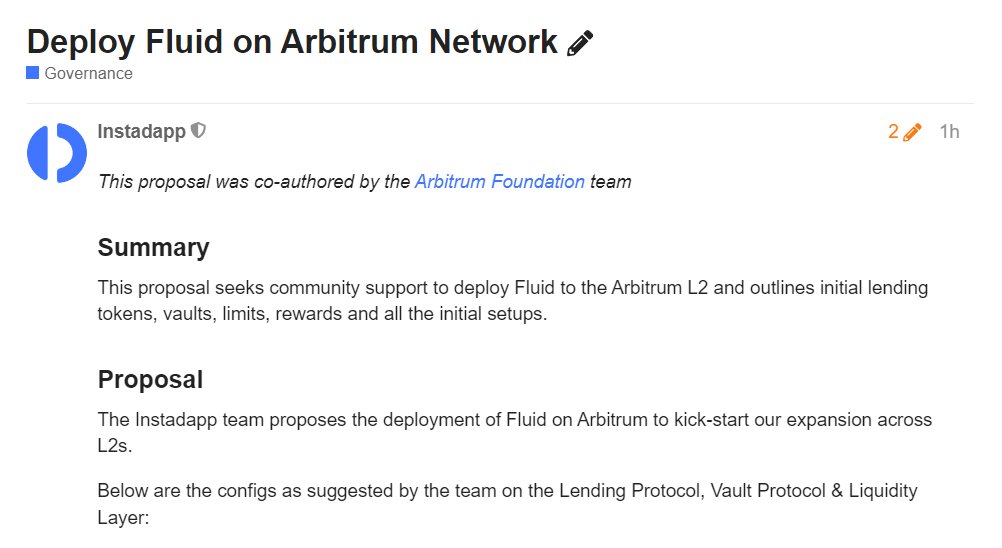 Instadapp Fluid is going multichain.
A new proposal to deploy on Arbitrum is now available on the governance forum. Arbitrum deployment and 400k $ARB incentives.2024-06
Instadapp Fluid is going multichain.
A new proposal to deploy on Arbitrum is now available on the governance forum. Arbitrum deployment and 400k $ARB incentives.2024-06 BitGo launches support for Arbitrum, allowing clients to custody $ARB using the provider's wallets2024-04
 Arbitrum proposes ARB Staking mechanism to boost DAO security and governance participation.2024-06
 Active users on Arbitrum leapfrog Solana despite declining ARB token value2024-05
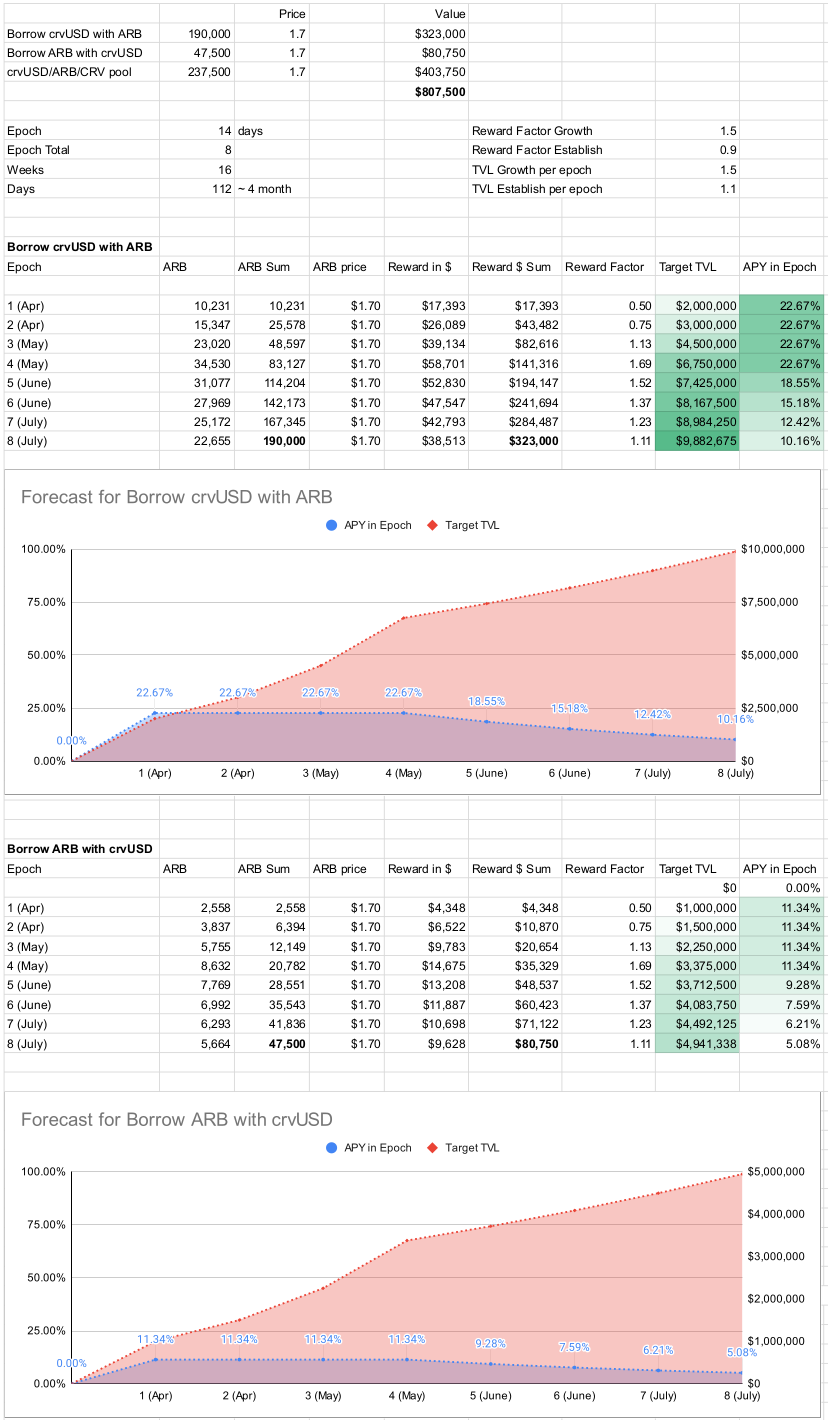 Curve Founder Michael Egorov, after reinvesting $ARB investment gains into incentivizing Llama Lend on Arbitrum, requests grant for matching funds2024-04
 Arbitrum DAO votes to approve $215 million gaming ecosystem fund proposed by Arbitrum Foundation. The proposal will allocate 225 million ARB tokens worth about $215 million at current prices over three years to a newly-created Gaming Catalyst Program (GCP).2024-06
ARB is the native governance token of Arbitrum, an Ethereum Layer 2 (L2) scaling network, used to vote on protocol decisions and direct one of the largest decentralized treasuries in crypto rather than to pay for transaction fees.
ARB sits at the center of a sprawling on-chain economy: a multi-billion-dollar treasury, a DeFi ecosystem that competes directly with Solana and other L2s, and a steady cadence of incentive programs, token unlocks, and contested governance fights. Understanding ARB means understanding how decentralized governance distributes capital at scale—and where that experiment strains.
What Arbitrum and ARB Are
Arbitrum is a suite of Ethereum scaling technologies built by Offchain Labs. Its flagship chain, Arbitrum One, is an optimistic rollup: it batches transactions off the main Ethereum chain, posts compressed data back to Ethereum for security, and assumes transactions are valid unless challenged within a dispute window. The result is faster, cheaper transactions that still inherit Ethereum's settlement guarantees. A second chain, Arbitrum Nova, targets gaming and social applications with even lower costs.
Crucially, ARB is not the network's gas token—transaction fees on Arbitrum are paid in ETH. ARB is a governance token. Holding it confers voting rights in the Arbitrum DAO (decentralized autonomous organization), the body that controls protocol upgrades, treasury spending, and the parameters of the chains themselves. This separation is deliberate: it lets Arbitrum keep ETH-denominated fees while using ARB to coordinate ownership and decision-making.
ARB launched in March 2023 via one of the largest airdrops in crypto history, distributing tokens to early users and DAOs in the ecosystem. The total supply is capped at 10 billion tokens (Tokenomist).

Arbitrum rolls out priority gas auctions and fast feed for faster transactions.

Tokenomics and Supply
ARB's allocation reflects its governance-first design. According to vesting data, roughly 42.78% of supply is held by the Arbitrum DAO Treasury, 26.94% by the team and advisors, 17.53% by investors, 11.62% distributed to individual wallets (largely via the airdrop), and about 1.13% to DAOs in the Arbitrum ecosystem (Tokenomist).
As of recent data, circulating supply is around 6.26 billion of the 10 billion total, meaning roughly 62% has unlocked (Tokenomist). The remainder vests on a schedule that extends into 2027, and these unlocks are a recurring market event. Arbitrum uses cliff vesting for some allocations—tokens release in a single tranche after a waiting period rather than continuously—which concentrates supply increases into discrete dates.
Unlock tracking services flag ARB regularly among the week's larger scheduled releases. Monthly tranches in 2026 have run from the high single-digit millions to low tens of millions of dollars in value; a May 2026 unlock released roughly 92.65 million ARB (Tokenomist). These events matter because newly liquid supply—especially from team and investor allocations—can add selling pressure, and analysts frequently group ARB with other large-cap unlocks (Worldcoin's WLD, dYdX's DYDX, Optimism's OP, and others) when weighing near-term market liquidity. Whether unlocks translate into actual selling depends on holder concentration and intent, not the headline figure alone.
Arbitrum readers are not clicking on network metrics or tech upgrades — they click on the governance money cycle: large ARB allocations approved, then scrutinized, then clawed back, revealing that the DAO's spending power is simultaneously its biggest growth tool and its biggest credibility liability.
How the Arbitrum DAO Governs
The Arbitrum DAO is where ARB's utility becomes concrete. Tokenholders vote on Arbitrum Improvement Proposals (AIPs), which cover technical upgrades, protocol parameter changes, and—most consequentially—treasury allocations. The DAO has passed dozens of governance proposals and oversees a treasury that ranks among the largest in DeFi (CoinMarketCap).
Governance runs through a multi-stage process. Proposals are typically discussed on the Arbitrum governance forum, refined into formal AIPs, and then put to on-chain votes via platforms like Tally and Snapshot. A separate body, the Arbitrum Foundation, handles administrative and strategic functions and has itself become a frequent proposer of large funding initiatives—a dynamic that has drawn both support and scrutiny from the community.
A persistent governance challenge is delegation and participation. Because most ARB sits in the treasury or vesting contracts, active voting power concentrates among delegates and large holders. Proposals to deepen participation are ongoing, including a notable initiative to introduce an ARB staking mechanism intended to reward tokenholders who lock ARB and engage with governance, strengthening both DAO security and turnout. Innovations from the broader ecosystem also push on this: Dolomite introduced vARB ("vote-enabled ARB"), letting users post ARB as borrowing collateral while still using it to vote—an attempt to reduce the opportunity cost of governance participation.
- 01DeFi incentive grant wars
The single highest-clicked story was Instadapp's 400k ARB deployment incentive, and Curve founder personally seeding Llama Lend rewards drew repeated engagement — readers track who is winning the liquidity bribe game on Arbitrum.
- 02DAO treasury allocation reversals
The $215M Gaming Catalyst Program approval and its subsequent 225M ARB clawback proposal both cleared 100+ clicks, showing readers are watching whether Arbitrum's governance can correct its own overcommitments.
- 03ARB staking and governance legitimacy
Both the staking proposal itself and the community backlash against it drew strong separate engagement, indicating readers are genuinely uncertain whether ARB will ever accrue governance utility.
- 04Institutional custody and treasury signals
BitGo adding ARB custody and Offchain Labs buying ARB for its own treasury both clicked well above baseline, suggesting readers interpret infrastructure and insider conviction as price-adjacent signals.
- 05Token unlock selling pressure
Two separate unlock-calendar stories featuring ARB alongside other large unlocks each hit ~100 clicks, confirming readers actively monitor scheduled supply increases as near-term risk events.
- 06Airdrop extraction and securities risk
Castle Capital's report on builders bypassing the ARB airdrop and Prometheum's move to classify ARB as a security both attracted readers concerned that the token's legitimacy and distribution are structurally flawed.
Treasury Spending and Incentive Programs
The DAO's defining activity is deploying its treasury to grow the ecosystem—and these decisions are where ARB's biggest debates play out.
DeFi incentives. The DAO launched the DeFi Renaissance Incentive Program (DRIP), a roughly $40 million (80 million ARB) effort managed by Entropy Advisors and structured across multiple seasons, each targeting a specific DeFi vertical. Season One, running from September 2025 into early 2026, focused on "leverage looping"—rewarding users who borrow against yield-bearing ETH and stablecoin assets on approved lending platforms—with up to 24 million ARB distributed via Merkl in two-week epochs (Arbitrum blog; CoinDesk). Season One concluded in February 2026 after its final epoch (Arbitrum forum).
DRIP is one strand of a wider liquidity-incentive strategy. Protocols routinely propose deploying on Arbitrum paired with ARB incentive requests—Instadapp's Fluid sought an Arbitrum deployment with 400k ARB in incentives, for example—and the DAO weighs each against expected ecosystem growth.
The Curve case. A widely watched example involved Curve founder Michael Egorov, who donated personal ARB holdings to incentivize Curve and its Llama Lend lending markets on Arbitrum, then proposed the DAO match those funds. The matching proposal reached quorum, illustrating a recurring pattern: an external party seeds incentives and asks the DAO to amplify them. These matched-incentive structures test the DAO's willingness to co-fund liquidity for specific protocols.
Gaming and the GCP clawback fight. The most contested example is the Gaming Catalyst Program (GCP). The DAO approved allocating 225 million ARB—worth roughly $215 million at the time—over several years to fund gaming projects, championed by the Arbitrum Foundation. The program later became a flashpoint: contributors including GFX Labs and NathanVDH proposed to claw back the allocation, arguing it had been justified with "exceptionally optimistic projections that, in hindsight, proved unsustainable." The episode crystallizes the core tension in large-scale DAO spending—how to fund ambitious bets while retaining the ability to reverse course when results disappoint.
Foundation allocations. Separately, the Arbitrum Foundation has put forward proposals to receive large ARB allocations—including a 250-million-ARB request to "foster key strategic partnerships"—that have gone to community votes. Such proposals consistently raise questions about the balance of power between the Foundation and rank-and-file delegates.
Other distribution experiments. The DAO and Foundation have also experimented with creator and attention incentives, such as a Kaito AI leaderboard distributing 400k ARB over three months to reward quality social posts rather than spam—part of a broader push to bootstrap community growth through targeted rewards.
ARU launches on Arbitrum One with physically backed commodity reserve

Ecosystem Position and Markets
Arbitrum has been a leader among Ethereum L2s by total value locked (TVL), at times approaching half of all value locked across Ethereum rollups. By activity metrics, Arbitrum has periodically surpassed larger chains—active users on Arbitrum have at points exceeded Solana's—even during stretches when the ARB token's market price declined. This divergence between network usage and token price is a defining feature of ARB: strong fundamentals on-chain do not automatically translate into token appreciation, in part because ARB captures governance value rather than fee revenue.
Institutional infrastructure has matured alongside the ecosystem. Custodians including BitGo added support for ARB, and Offchain Labs disclosed a strategic plan to add ARB to its own treasury—signals of longer-term commitment, though such moves are confidence statements rather than guarantees.
Markets exposure has also broadened. ARB trades across major exchanges, though listings and network support shift over time—Binance, for instance, has adjusted deposit and withdrawal support for ARB on certain networks, the kind of operational change holders should track. ARB is also embedded in DeFi as collateral and in derivatives, expanding the surfaces where it is traded and used.
- 2023-03launch
ARB airdrop launch; builder bypass patterns emerge
- 2023-06governance
Synapse DAO proposes selling 1M ARB airdrop for ETH bridge liquidity
- 2024-04governance
Arbitrum DAO approves $215M Gaming Catalyst Program (225M ARB)
- 2024-07milestone
Arbitrum DAO locks $770M in ARB tokens into vesting contract
- 2024-09exploit
DeltaPrime hacked on Arbitrum — $4.5M lost via compromised admin key
- 2024-11regulatory
Prometheum announces ARB classified as security in expanded custody
- 2025-02governance
GFX Labs proposes clawback of 225M ARB from Gaming Catalyst Program
- 2025-04launch
Instadapp Fluid proposes Arbitrum multichain deployment with 400K ARB incentives
Risks and Open Questions
Several risks recur for ARB and the Arbitrum ecosystem:
- Supply overhang. Scheduled unlocks add liquid supply on a predictable cadence; the market impact depends on holder behavior, but the calendar is a standing consideration.
- Governance capture and execution risk. Large treasury programs like GCP show how hard it is to allocate hundreds of millions of dollars effectively—and how contentious it becomes to unwind a program once funded.
- Value accrual. Because ARB is a governance token and ETH is the gas token, the link between network growth and token value is indirect. Proposals like ARB staking and various fee-related discussions aim to strengthen that link, but the question remains open.
- Smart contract and operational risk. As a DeFi hub, Arbitrum hosts protocols that can be exploited; one lending protocol on the chain, Delta Prime, suffered a multi-million-dollar loss attributed to a compromised admin key. Such incidents are protocol-specific, not failures of Arbitrum itself, but they shape ecosystem risk.
- Regulatory classification. Some custody providers have moved to treat tokens including ARB (and Uniswap's UNI) as securities under their own frameworks—an evolving area that could affect how ARB is held and traded in regulated venues.
Outlook
ARB's trajectory will be defined less by short-term price than by whether the Arbitrum DAO can govern a massive treasury productively. The live debates—ARB staking to deepen participation, the GCP clawback, matched liquidity incentives, and recurring Foundation allocation requests—are all variations of one question: how should a decentralized organization deploy capital, and how should it correct course when bets sour. Arbitrum's technical and usage fundamentals remain strong relative to peers, but the value of the token is wrapped up in the credibility and discipline of its governance. For observers, the most informative signals are not the unlock calendar alone but the outcomes of these proposals and whether participation in voting broadens over time.
Latest ARB news
Community notes
Spot something off or out of date? Drop a note. Editors review topic notes daily and roll accepted fixes into the explainer — contributors are recognized in the monthly $SQUID drop.
Loading notes…
Help improve this topic
Have a story or tip about this topic? Submit it. See something missing? Leave a note. Editors review daily; accepted submissions and fixes count toward the monthly $SQUID drop.