
A clear, neutral explainer on tokenized money market funds: how they work, why they matter as onchain collateral and stablecoin reserves, and the institutional push from JPMorgan, BlackRock, Circle and others.
+7 sources across the wider coverage universe
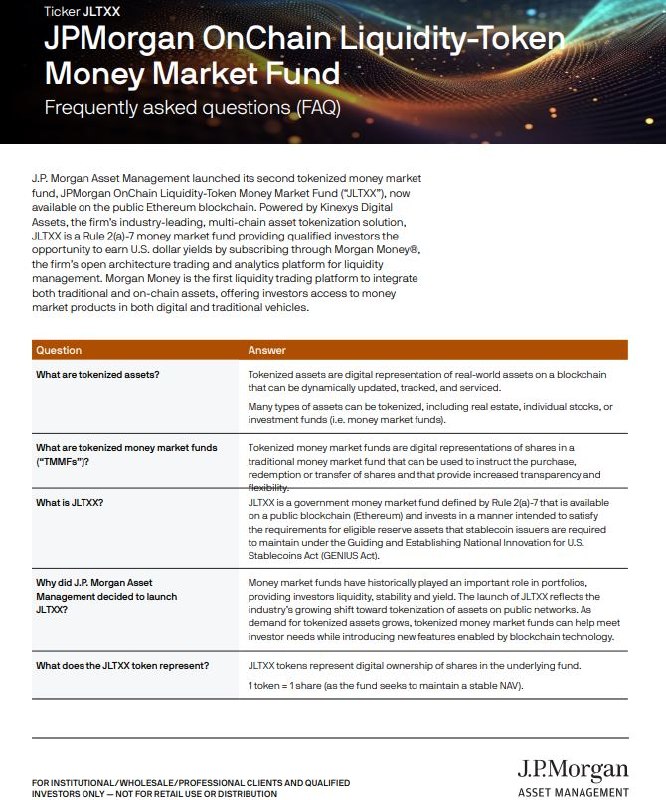 J.P. Morgan launches second tokenized money market fund on Ethereum2026-05
 Onchain money laid the foundation for tokenized assets, with Treasuries, money market funds and equities now following stablecoins onto blockchain rails2026-06
 BNP Paribas tests tokenised French money market fund shares on the public Ethereum blockchain via its AssetFoundry platform under a permissioned, regulated framework.2026-02
 JPMorgan is expanding its push into digital assets by launching a tokenized money-market fund called My OnChain Net Yield Fund, or “MONY,” on Ethereum, seeding the private vehicle with $100 million and opening it to qualified investors.2025-12
 Institutional DeFi adoption reaches inflection point as tokenized products see massive growth2026-04
 USYC has become the world’s largest tokenized money market fund, enabling 24/7 creation and redemption via USDC and smart contracts for real-time collateral2026-03
A tokenized money market fund (MMF) is a regulated fund holding short-term, high-quality assets—typically U.S. Treasury bills and overnight repurchase agreements—whose shares are issued and transferred as digital tokens on a blockchain rather than tracked solely on a transfer agent's ledger. The tokens represent legal ownership of fund shares, combining the yield and credit profile of a traditional cash-management vehicle with the programmability and near-instant settlement of onchain assets.
These products sit at the intersection of conventional asset management and the real-world asset (RWA) movement, and they have become one of the most visible ways that large financial institutions are putting regulated yield onchain.
How the structure works
A traditional money market fund pools investor cash into a portfolio of short-duration instruments and aims to maintain a stable value while passing through interest. Tokenization does not change that underlying portfolio; it changes the wrapper. Instead of recording shares only in a fund administrator's books, a tokenized fund mints blockchain tokens that map one-to-one to shares. Ownership, transfers, and—in some designs—subscriptions and redemptions are recorded on a public or permissioned chain.
Most current offerings are permissioned: only wallets that have passed know-your-customer (KYC) and accreditation checks can hold the tokens, and transfers are restricted to a whitelist. This lets issuers satisfy securities law while still using public infrastructure. BNP Paribas, for example, tested tokenized shares of a French money market fund on the public Ethereum blockchain through its AssetFoundry platform under exactly this kind of permissioned, regulated framework.
The yield reaches holders in one of two ways: through a rebasing or accruing token whose balance or price grows over time, or through periodic distributions. Because the assets are short-dated Treasuries and repo, the funds are designed for capital preservation and liquidity rather than capital appreciation.

J.P. Morgan launches second tokenized money market fund on Ethereum
Why it matters: collateral and "onchain cash"
The practical appeal is that a tokenized MMF share can move at the speed of a blockchain transaction while still earning a regulated yield. That makes these tokens attractive as collateral and as a yield-bearing alternative to idle stablecoins.
This collateral use case is driving much of the growth. Circle's USYC has become one of the largest tokenized money market funds, with reporting describing it surpassing $3 billion in assets under management and, in subsequent coverage, becoming the world's largest such fund—built to enable 24/7 creation and redemption against USDC via smart contracts for real-time collateral. The thesis is that trading desks, market makers, and DeFi protocols would rather hold an instrument that earns Treasury-bill yield and can be redeemed around the clock than park cash in a non-yielding token.
That collateral framing also explains the steady drumbeat of integrations. Uniform Labs' Multiliquid protocol, for instance, launched to offer instant swaps between tokenized money market funds and stablecoins, pitching itself as a fix for fragmented liquidity across these instruments. And Plume, together with Toku and WisdomTree, launched a payroll pilot letting eligible employees receive part of their wages in shares of WisdomTree's tokenized fund WTGXX—an early test of tokenized cash inside an everyday financial workflow rather than just a trading venue.
Readers click tokenized MMF stories not for yield mechanics but for legitimacy arbitrage: every TradFi name (BlackRock, Franklin Templeton, JPMorgan, BNP) signals to DeFi-native readers that on-chain money markets are winning the institutional credibility race, while DeFi protocol stories get traction only when they frame themselves as direct yield competitors to those same funds.
The institutional wave
What separates the current cycle from earlier RWA experiments is who is participating. The largest names in traditional finance are now issuing these products directly.
J.P. Morgan, a bank whose asset-management arm oversees roughly $4 trillion, moved into the category in two steps. It first launched MONY—the "My OnChain Net Yield Fund"—a private vehicle on Ethereum seeded with about $100 million and opened to qualified investors. It followed in May with JLTXX, the JPMorgan OnChain Liquidity-Token Money Market Fund, which trades under that ticker on Ethereum and is designed to invest exclusively in U.S. Treasury securities and overnight repurchase agreements fully collateralized by Treasuries. JPMorgan structured JLTXX specifically to meet reserve requirements for stablecoin issuers, reflecting how the regulated cash layer of crypto is increasingly being built by incumbent banks. The move is consistent with chief executive Jamie Dimon's April shareholder letter, which named blockchain and stablecoins as technologies the bank intends to engage with even amid his long-standing skepticism of crypto more broadly.
BlackRock, the world's largest asset manager with roughly $14 trillion under management, has pushed in the same direction. After its BUIDL tokenized fund became a flagship product for the sector, the firm filed with the SEC in May to launch additional tokenized funds, including a blockchain-native money market vehicle structured to hold stablecoin reserves. Fidelity has likewise developed a tokenized money market offering.
A meaningful validation arrived from the ratings agencies. Moody's awarded its top AAA rating to tokenized money market funds—covering products from issuers including Fidelity and BlackRock—a signal that the agency views the credit quality and liquidity of these onchain instruments as comparable to their traditional counterparts. Coverage tying that milestone to sector data placed the tokenized Treasury segment at roughly $15 billion in assets under management. WisdomTree, Franklin Templeton (an early mover with its onchain U.S. Government Money Fund), and Circle round out a field that now spans both crypto-native firms and legacy managers.

Franklin Templeton partners with HashKey to distribute its tokenized U.S. government money market fund to professional investors across Asia

Stablecoins, the GENIUS Act, and reserves
A key tailwind is regulation of stablecoins. In the United States, the GENIUS Act established a federal framework for payment stablecoins, including requirements that issuers back their tokens with high-quality, liquid reserves. Tokenized money market funds are being explicitly engineered as eligible reserve assets: J.P. Morgan structured JLTXX to satisfy those reserve requirements, and BlackRock's planned vehicle is likewise aimed at holding stablecoin reserves.
The logic is that a stablecoin issuer must hold reserves in safe, liquid instruments anyway. A tokenized Treasury fund lets the issuer hold those reserves in a form that is itself onchain, auditable in near real time, and transferable—potentially tightening the operational loop between the reserve asset and the stablecoin it backs. This has also drawn scrutiny: regulators are examining yield-bearing stablecoin models, where the line between a payment token and an investment product becomes blurry, which is part of why tokenized MMFs (clearly structured as securities) are emerging as the compliant way to deliver onchain yield.
To define the adjacent terms: a stablecoin such as USDC is a token pegged to a fiat currency and generally does not pass yield to ordinary holders; a tokenized money market fund is a registered security that does pay yield and is sold to qualified or accredited investors under securities law. The two are complementary—stablecoins for payments and settlement, tokenized funds for the reserve and collateral layer beneath them.
- 01TradFi giants going on-chain
BlackRock, Franklin Templeton, JPMorgan, Fidelity, and BNP Paribas each launching or filing tokenized MMF products reads as institutional validation events that DeFi readers treat as inflection-point signals.
- 02Stablecoin yield competition pressure
Readers engaged with the thesis that stablecoins without embedded MMF yields will lose market share, framing tokenized MMFs as an existential threat to yield-free stablecoins.
- 03DeFi protocol MMF convergence
Liquity v2 BOLD stability pool and 3Jane's 0%-collateral money market drew clicks by positioning DeFi-native constructs as structurally superior or complementary to tokenized TradFi funds.
- 04Multi-chain expansion races
Each new chain deployment (Arbitrum, Solana, XRP Ledger, Polygon) by Franklin Templeton, BlackRock, and Spiko signals a land-grab for institutional liquidity distribution rails.
- 05MMF tokens as DeFi collateral
The angle that BlackRock BUIDL and Franklin Templeton tokens were nearing approval as derivatives collateral unlocked a concrete use case beyond passive yield, pulling in DeFi power users.
- 06Risk parameter contagion
Nostra reducing DAI collateral caps to zero after MakerDAO added USDe collateral illustrated how MMF-adjacent risk changes propagate through DeFi money markets, drawing readers alert to systemic exposure.
The role of Ethereum and public chains
Most of the high-profile launches have chosen Ethereum as the issuance venue, including JPMorgan's MONY and JLTXX and BNP Paribas's pilot. Ethereum's deep tooling, established custody and compliance integrations, and large base of institutional infrastructure make it the default settlement layer for regulated tokenization, even when access to the tokens themselves is restricted to permissioned wallets. Other funds operate across multiple chains to reach different liquidity pools, but the pattern of "public chain, permissioned access" has become the dominant compliance model.
Onchain money laid the foundation for tokenized assets, with Treasuries, money market funds and equities now following stablecoins onto blockchain rails
Risks and open questions
The category is young and carries real caveats. Liquidity is one: tokenization promises 24/7 transfer, but underlying Treasury and repo markets do not trade around the clock, so redemption mechanics depend on the issuer's design and on intermediaries. Uniform Labs framed a multi-billion-dollar liquidity gap as the core problem its protocol exists to solve, underscoring that secondary markets for these tokens remain thin.
Smart-contract and custody risk add a layer not present in conventional funds, and the legal enforceability of token ownership relative to the official share register varies by jurisdiction and structure. Regulatory treatment is still settling: South Korea's Financial Services Commission planned to release detailed tokenized-securities rules in July covering tokenized stocks, bonds and money market funds, ahead of a fuller framework taking effect in February 2027—an example of how the rulebook is being written in real time across major markets.
There is also concentration risk. A small number of large issuers and a handful of underlying custodians and chains account for most of the assets, so the sector's resilience has not yet been tested through a serious market or liquidity stress.
- 2021-04launch
Franklin Templeton FOBXX launches on Stellar
- 2024-03launch
BlackRock BUIDL tokenized MMF launches on Ethereum
- 2024-05milestone
Franklin Templeton FOBXX expands to Arbitrum
- 2024-10regulatory
Fidelity files OnChain share class for Treasury MMF on Ethereum
- 2024-11regulatory
BlackRock files digital share class for $150B MMF using blockchain ownership tracking
- 2025-01launch
Circle acquires Hashnote and launches USYC tokenized MMF
- 2025-03milestone
BlackRock expands BUIDL to Solana
- 2025-06launch
JPMorgan seeds MONY OnChain Net Yield Fund on Ethereum with $100M
Outlook
Tokenized money market funds have moved from proof-of-concept to a multibillion-dollar segment in a short span, propelled by AAA ratings, the entrance of the world's largest asset managers and banks, and stablecoin reserve rules that give the products a clear institutional buyer. The near-term trajectory will likely be defined by three forces: regulatory clarity in the U.S. and Asia, the maturation of secondary-market liquidity and interoperability between funds and stablecoins, and the extent to which these tokens become standard collateral across both DeFi and traditional trading. If those pieces fall into place, tokenized MMFs could become the default "onchain cash" layer; if liquidity or regulation disappoints, growth may stay concentrated among a few institutional issuers. Either way, the building blocks are now being laid by some of the largest balance sheets in finance.
Latest Tokenized Money Market Fund news
J.P. Morgan launches second tokenized money market fund on EthereumFranklin Templeton partners with HashKey to distribute its tokenized U.S. government money market fund to professional investors across AsiaOnchain money laid the foundation for tokenized assets, with Treasuries, money market funds and equities now following stablecoins onto blockchain railsBNP Paribas tests tokenised French money market fund shares on the public Ethereum blockchain via its AssetFoundry platform under a permissioned, regulated framework.JPMorgan is expanding its push into digital assets by launching a tokenized money-market fund called My OnChain Net Yield Fund, or “MONY,” on Ethereum, seeding the private vehicle with $100 million and opening it to qualified investors.Institutional DeFi adoption reaches inflection point as tokenized products see massive growthCommunity notes
Spot something off or out of date? Drop a note. Editors review topic notes daily and roll accepted fixes into the explainer — contributors are recognized in the monthly $SQUID drop.
Loading notes…
Help improve this topic
Have a story or tip about this topic? Submit it. See something missing? Leave a note. Editors review daily; accepted submissions and fixes count toward the monthly $SQUID drop.