
Optimism is an Ethereum L2 using optimistic rollups and the OP Stack to power the Superchain—a network of interoperable chains including Base. Covers rollup mechanics, OP token governance, DeFi ecosystem, and stake-weighted ordering.
+13 sources across the wider coverage universe
 Scroll cuts costs after losing top protocol to Optimism, triggering $160M TVL outflows and $13M revenue hit as DAO moves to dissolve security council2026-04
 OP Mainnet logs largest TVL surge in history as Etherfi migrates $200M, bringing 70K cards and 300K users to Optimism to scale real-world crypto payments2026-04
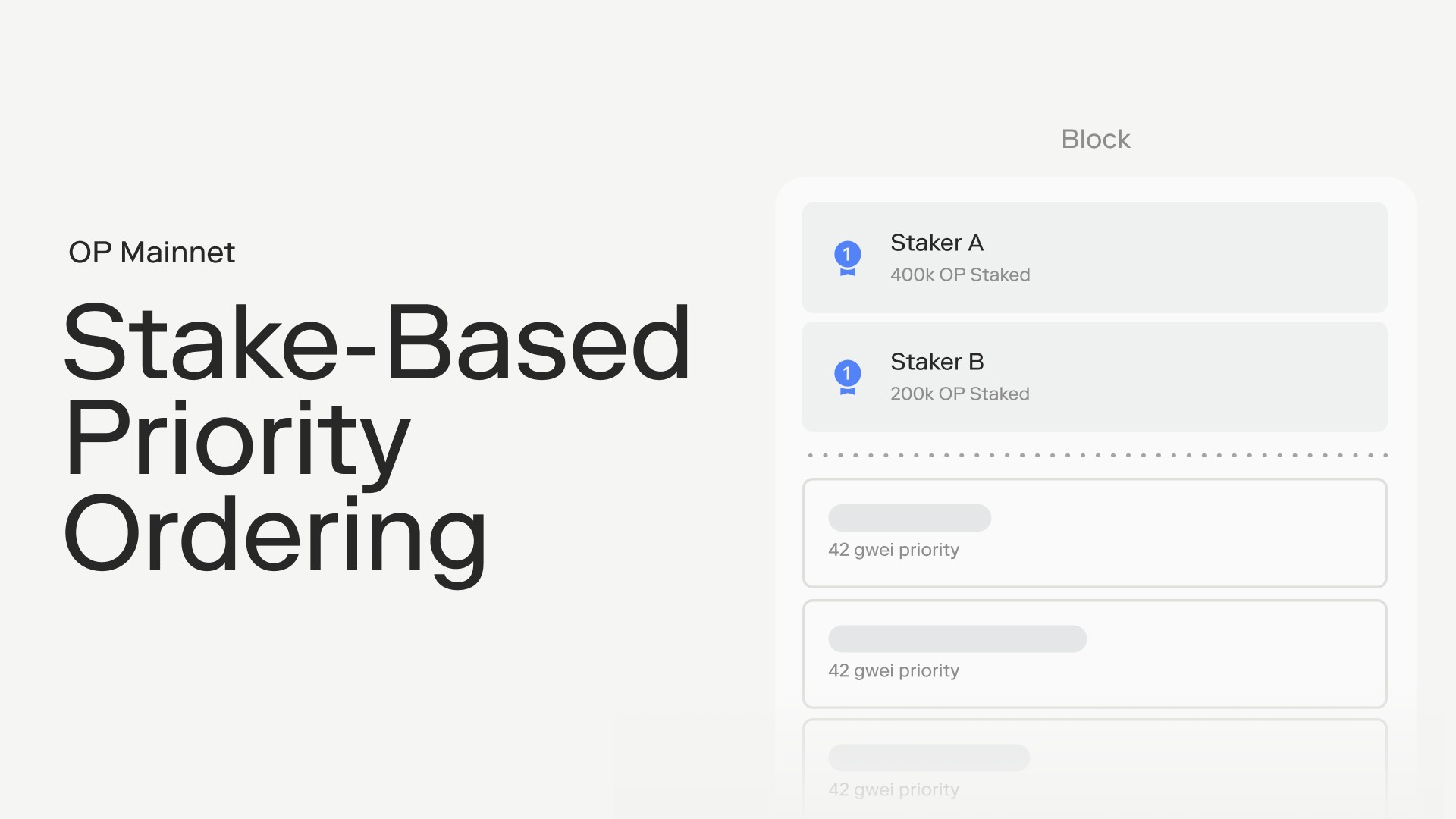 Optimism launches stake-based transaction ordering on OP Mainnet, with 100,000 OP staked unlocking priority block access2026-04
 Metal L2 unveils $MTL subnet on Metal Blockchain, advancing migration from Optimism2026-07
 Curve deploys Llamalend v2 on Optimism with a 250K OP grant, expanding lending beyond crvUSD pairs and enabling LP tokens as collateral2026-06
 Base, Optimism, Coinbase and WalletConnect launch Native Account Abstraction (EIP-8130), cutting transaction costs by over 2x and bringing smarter wallets to EVM chains2026-07
A layer-2 blockchain built on Ethereum, Optimism uses optimistic rollup technology to process transactions faster and cheaper than Ethereum's base layer while inheriting its security guarantees.
Ethereum's dominance in decentralized finance comes with a persistent cost: base-layer congestion drives transaction fees high enough to price out ordinary users during peak demand. Optimism launched on mainnet in 2021 as one of the primary answers to that problem, and in the years since it has grown from a single rollup into the nucleus of a multi-chain ecosystem called the Superchain.
How Optimistic Rollups Work
Optimism belongs to a family of scaling solutions called optimistic rollups. The name captures the core design assumption: transactions submitted to the rollup are assumed to be valid by default. A sequencer batches hundreds of transactions together, compresses them, and posts a summary to Ethereum's base layer (L1). Ethereum itself does not re-execute every computation—it trusts the summary is correct unless someone submits a fraud proof challenging it.
During a challenge window (historically seven days), any observer can post a fraud proof if they detect an invalid state transition. If the challenge succeeds, the fraudulent sequencer is slashed and the correct state is restored. If nobody challenges within the window, the batch is finalized on Ethereum. This model trades instant finality for dramatically cheaper computation: most of the heavy lifting happens off-chain, while Ethereum provides the settlement and data-availability layer.
The alternative approach—zero-knowledge rollups (ZK rollups)—generates cryptographic proofs of validity for every batch, eliminating the challenge window but requiring much more computation per batch. Optimism and its sister network Arbitrum chose the optimistic path for its relative implementation simplicity, though ZK proofs remain a long-term roadmap item for the OP Stack. Separately, Sunnyside Labs recently shipped a hybrid ZK-TEE privacy layer on OP Mainnet that enables confidential transfers and private smart contracts, suggesting the two approaches are increasingly complementary rather than mutually exclusive.

KB Securities partners with Optimism and Securitize to bring tokenized bonds to OP Mainnet
The OP Stack and the Superchain
The strategic pivot that separates Optimism from a simple rollup product is the OP Stack: an open-source, modular framework for building EVM-compatible L2 chains. Rather than operating a single network, the Optimism Collective released OP Stack under a permissive license so that any team could deploy their own rollup and plug into a shared sequencing and messaging layer.
The result is the Superchain—a growing network of OP Stack chains that share technical standards, upgrade governance, and interoperability infrastructure. The most consequential Superchain member is Base, Coinbase's L2, which launched in mid-2023 and quickly became one of the highest-throughput EVM chains by transaction count. Coinbase's institutional reach gave Base immediate distribution; Base's success, in turn, validates the OP Stack as a serious competitor to the alternative rollup ecosystems built on Arbitrum's Orbit framework.
Other Superchain members have included networks oriented toward gaming, payments, and compliance-specific use cases—though the Superchain model also introduces governance complexity. Metal L2, a banking-focused rollup that joined the Superchain, has proposed migrating away in MIP-002 ("Homecoming"), citing delayed timelines, gas-limit constraints, and a desire for sovereign control over upgrades with $MTL as the native gas token. The proposal illustrates a genuine tension in the Superchain model: member chains trade sovereignty for shared security and brand, but the calculus can shift as their own ecosystems mature.
Readers click Optimism stories not for its technology but for its political weight — the top headline is about Optimism capturing governance rights from UNI holders, revealing that readers treat OP as a power broker inside the broader L2 ecosystem rather than a neutral scaling solution.
The OP Token and Governance
OP is the native governance token of the Optimism Collective, which governs OP Mainnet and the broader protocol through a bicameral structure:
- Token House: OP holders vote on protocol upgrades, treasury grants, and sequencer parameters.
- Citizens' House: A separate body focused on public-goods funding, currently operating with soulbound "citizen" badges rather than transferable tokens.
This dual-house system is designed to separate economic interests (Token House) from long-term stewardship (Citizens' House), though the model remains an experiment in large-scale on-chain governance. The Optimism Foundation has funded ecosystem growth through a series of Retroactive Public Goods Funding (RetroPGF) rounds that distribute OP to builders and contributors judged to have created value for the ecosystem.
Token utility has been a recurring concern inside the community. Critics note that OP token holders do not directly capture sequencer revenue—profits flow to the Optimism Foundation and are then reallocated via grants. A vocal faction within the community has raised alarms about declining OP Mainnet metrics, weak token demand fundamentals, and persistent sell pressure from grant recipients liquidating OP allocations. These concerns are not unique to Optimism—most governance tokens face similar structurally weak demand—but they are increasingly central to how the Collective plans protocol economics.
Grants remain a primary growth lever. Curve Finance recently deployed Llamalend v2 on Optimism backed by a 250,000 OP grant, expanding its lending markets beyond crvUSD pairs and introducing LP tokens as collateral—a meaningful DeFi primitive addition.
DeFi Ecosystem and TVL
OP Mainnet has been a consistent top-five EVM chain by total value locked (TVL) in DeFi. Its ecosystem spans the major categories:
- Decentralized exchanges: Uniswap v3, Velodrome (native to Optimism, modeled on ve(3,3) mechanics), and others provide deep spot liquidity.
- Lending: Aave, Sonne Finance, and now Curve's Llamalend v2 offer borrowing and yield.
- Derivatives: Synthetix's perpetuals infrastructure launched on Optimism before expanding to other chains, making OP Mainnet an early center for on-chain perps.
- Cross-chain liquidity: SODAX recently integrated OP and WBTC on Optimism into its SDK, routing liquidity across 18+ networks. That development also surfaces a genuine risk: as aggregators route volume through more chains, sequencing and bridging risks compound in ways that are harder to audit.
The network recorded its largest single TVL surge in its history when Ether.fi migrated $200 million onto OP Mainnet, bringing approximately 70,000 linked payment cards and 300,000 users with it. That migration also caused cascading effects on competitor Scroll, which lost a major fee-generating protocol, triggering $160 million in TVL outflows and a $13 million revenue hit—demonstrating how migration decisions by large DeFi protocols now move markets across the L2 landscape.
- 01Uniswap governance power shift
The single most-clicked Optimism headline was Uniswap Labs sidelining UNI holders in favor of Optimism, framing OP as a force that reshapes governance at other protocols — a zero-sum read that drives outsized engagement.
- 02Superchain ecosystem expansion
Multiple headlines covering Layer 3 support via OP Stack, EigenDA integration, the Deployment Rebate, and Synthetix's SNAXchain collectively signal readers tracking whether Optimism can compound its ecosystem faster than rivals.
- 03DeFi protocol adoption race
Headlines about Clearpool, Idle, Curve OP distributions, and the $52B DeFi competition with Arbitrum and Base drew consistent clicks from readers watching which L2 wins liquidity migration.
- 04Fault Proofs technical milestone
The long-delayed Fault Proofs launch — described as a full system rewrite — clicked well because it resolved a multi-year credibility gap on decentralization and marked Optimism's entry into the Stage 1+ L2 tier.
- 05On-chain exploits and oracle attacks
The Exactly Protocol $7M exploit and the Moonwell rsETH oracle manipulation on Optimism drew readers focused on whether high-value DeFi deployments on the network are adequately secured.
- 06RetroPGF and OP token politics
Debate over 30M OP tokens flowing to VC-backed projects and the a16z $90M private OP purchase together expose a tension between Optimism's public-goods framing and its insider capital dynamics that readers found compelling.
Stake-Weighted Transaction Ordering
One of the more architecturally significant recent changes to OP Mainnet is the phased introduction of stake-weighted transaction ordering. Traditionally, Ethereum-compatible sequencers order transactions by gas price (a form of priority fee bidding). Optimism is experimenting with an alternative: users and protocols can stake OP tokens to obtain priority access to block space.
Phase 1 opened with 100,000 OP staked unlocking priority ordering. Phase 2, now live, introduces a 3× fee multiplier cap to limit how aggressively priority can be purchased. The system is designed to give long-term stakeholders—protocols and power users who commit OP—structural advantages over bots and arbitrageurs doing pure gas-price bidding. It also creates a demand sink for OP tokens, addressing some of the token-utility concerns raised by the community.
Critics argue that any priority ordering system risks reintroducing the MEV (maximal extractable value) dynamics that Ethereum's base layer has spent years trying to mitigate, just with a different mechanism. The Optimism Collective has framed stake-weighted ordering as an ongoing experiment with safety bounds rather than a permanent architecture choice.
Optimism vs. Arbitrum
The two dominant Ethereum L2s by TVL are Optimism and Arbitrum, and comparing them is a routine exercise in the L2 ecosystem.
Both use optimistic rollups with fraud-proof-based security models, though their execution environments differ at the bytecode level (Arbitrum uses AVM/Stylus; Optimism uses EVM equivalence). The more consequential difference today is strategic:
- Arbitrum has pursued ecosystem depth on a single flagship chain (Arbitrum One) while offering Orbit for permissioned L3s. Its governance token (ARB) has a broadly similar demand structure to OP.
- Optimism has bet heavily on the Superchain model—a horizontal scaling strategy where OP Stack chains interoperate rather than compete. Base's success is the clearest evidence this bet has paid off: Coinbase's adoption gave the OP Stack a distribution moat that Optimism alone could not have built.
Both networks periodically trade places on TVL rankings depending on which protocols are migrating, launching, or running incentive programs. The competition has been net positive for users, driving fees on both chains into the fractions-of-a-cent range for most operations.
- 2023-08exploit
Exactly Protocol exploited for ~$7M on Optimism
- 2023-11governance
a16z acquires $90M in OP tokens via private sale
- 2024-01launch
Synthetix launches SNAXchain on OP Stack via Conduit
- 2024-03milestone
Ethereum Dencun upgrade cuts Optimism and Base fees below one cent
- 2024-06milestone
Optimism Fault Proofs go live after full system rewrite
- 2024-07milestone
Optimism recognized as Stage 1+ L2 by Ethereum community
- 2024-09launch
Superchain adds Layer 3 chain support via OP Stack
- 2024-10exploit
Moonwell oracle exploit drains $1M+ on Base and Optimism via rsETH feed manipulation
Security and Trust Assumptions
Like all optimistic rollups, Optimism's security rests on a small set of assumptions that are worth stating clearly:
1. At least one honest verifier must monitor the chain and be willing to submit a fraud proof within the challenge window. If all verifiers collude or go offline, invalid state transitions could be finalized. 2. The sequencer is centralized: Optimism Labs runs the single sequencer for OP Mainnet. A malicious or compromised sequencer could censor transactions or front-run users—though it cannot steal funds without fraud proofs failing. Decentralizing the sequencer is an active roadmap item. 3. The upgrade key: The Optimism Foundation holds upgrade keys that can modify the protocol. This introduces a trusted-party assumption until governance matures enough to manage upgrades fully on-chain.
The Optimism Collective has published a "Law of Chains" policy intended to constrain how upgrade keys can be used across Superchain members, but the enforcement mechanism remains governance-based rather than technical.
Regulatory and Institutional Context
Optimism has attracted attention from institutional and regulatory circles. Kevin Warsh, a prominent Federal Reserve chair contender, disclosed early-stage investments in Optimism (alongside Compound, Blast, and Solana) through an employment-linked vehicle—a signal that crypto infrastructure is appearing in portfolios that historically stayed away from it.
Broader U.S. regulatory clarity, particularly if the proposed Clarity Act advances, is expected to reduce compliance uncertainty for teams building on Optimism and other L2s. The grant-based OP economy also sits in an ambiguous regulatory space: whether OP constitutes a security in various jurisdictions is an open question that the Collective's dual-house governance structure was partly designed to preempt.
Outlook
Optimism's near-term trajectory depends on whether the Superchain model can hold together as member chains grow large enough to consider sovereignty, and whether stake-weighted ordering can structurally improve OP token demand without introducing new MEV vectors. The EtherFi migration demonstrating multi-hundred-million-dollar TVL flows to OP Mainnet suggests the network remains competitive for large DeFi protocols—but the community's own concerns about token utility and declining metrics are a warning signal that ecosystem health cannot be taken for granted.
The longer arc runs through Ethereum itself. As Ethereum's base layer introduces Danksharding and cheaper data availability, rollup economics will improve further, making L2s like Optimism even cheaper to use. Whether the Superchain becomes the dominant EVM scaling architecture or one of several competing frameworks depends on execution, ecosystem retention, and whether the Collective can turn its governance experiments into durable coordination mechanisms that keep builders—and chains—from migrating elsewhere.
Latest Optimism news
Community notes
Spot something off or out of date? Drop a note. Editors review topic notes daily and roll accepted fixes into the explainer — contributors are recognized in the monthly $SQUID drop.
Loading notes…
Help improve this topic
Have a story or tip about this topic? Submit it. See something missing? Leave a note. Editors review daily; accepted submissions and fixes count toward the monthly $SQUID drop.