
Crypto dominance tracks market-cap share, chain activity, and issuer concentration across Bitcoin, stablecoins, and smart-contract networks — a key metric for reading cycles, regulatory risk, and where structural power is shifting.
+11 sources across the wider coverage universe
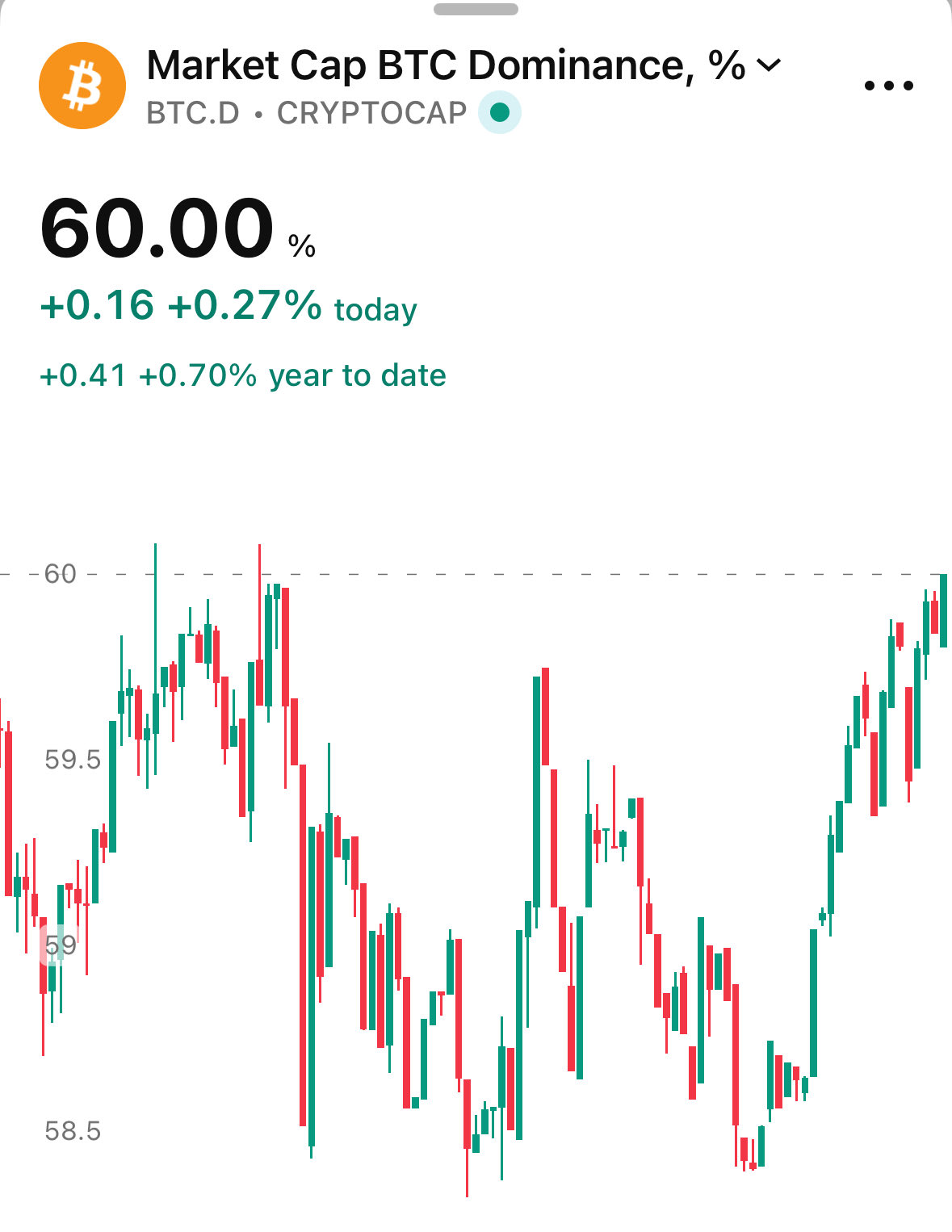 Bitcoin Dominance Hits 60% 2026 High as North Korea-Linked Hack Sends DeFi Into Freefall2026-04
 Ten major EU banks including BNP Paribas, ING, and UniCredit—are forming Qivalis to launch a MiCA-compliant euro stablecoin by 2026, aiming to challenge the dollar’s 99% dominance in the global stablecoin market.2025-12
 Stacy Muur outlines 11 themes that defined crypto in 2025, from institutional dominance and RWA expansion to L2 consolidation, prediction-market maturity, and AI-crypto infrastructure breakthroughs. She argues 2025 marked a structural shift toward institutionalized, regulated, utility-driven crypto.2025-12
 Stablecoins are rapidly evolving from a crypto niche into a core payments rail, with technologists forecasting tens of thousands of stablecoin-based systems emerging within five years and reshaping how money moves globally. By enabling faster, cheaper payments, challenging banks and card networks, and reinforcing U.S. dollar dominance through Treasury demand, they are forcing regulators and incumbents to confront a fundamental rewiring of financial infrastructure.2025-12
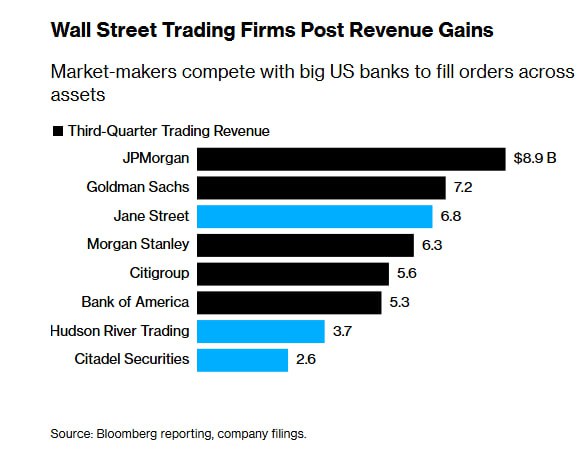 Jane Street and Citadel Securities are on track for record years, with Q3 trading revenue jumping 18% and 9% respectively as market volatility driven by Trump-era policy shifts boosts activity and erodes Wall Street’s dominance.2025-12
 MiCA compliance will sparks Europe’s crypto consolidation frenzy, rewarding prepared firms with dominance and driving M&A in a rapidly evolving market.2024-11
In crypto markets, dominance measures the share of total market value, activity, or infrastructure controlled by a single asset, chain, or issuer — a metric that shapes how traders read cycles, how regulators write rules, and how protocols compete for users.
What Dominance Actually Measures
The word gets used loosely across the industry. In practice it describes at least three distinct things:
Market-cap dominance is the oldest and most quoted variant. Bitcoin's share of total crypto market capitalisation — tracked by data aggregators as "BTC dominance" — has been a proxy for market sentiment since the altcoin boom of 2017. When risk appetite falls, investors consolidate into Bitcoin, pushing dominance up. When speculative appetite rises, capital rotates into smaller assets, pushing it down.
Network or chain dominance describes how much activity, total value locked (TVL), or issuance is concentrated on a single blockchain. Ethereum has held the largest developer base and DeFi TVL for years; Tron has captured a disproportionate share of USDT settlement volume despite having far fewer applications.
Issuer dominance is most visible in stablecoins, where Tether's USDT has accounted for roughly 70–75% of stablecoin market cap for the better part of five years, even as USDC, issued by Circle and backed partly by Coinbase, has expanded its institutional footprint.
Each variant matters for different reasons, and conflating them produces bad analysis.

Bitcoin Dominance Hits 60% 2026 High as North Korea-Linked Hack Sends DeFi Into Freefall
Bitcoin Dominance: The Market Cycle Indicator
Bitcoin dominance touching 60% in mid-2026 — a multi-year high — coincided with a period of elevated macro uncertainty and a high-profile hack that drained liquidity from DeFi protocols. That pattern is consistent with historical data: dominance tends to rise during drawdowns because Bitcoin is perceived as the lowest-counterparty-risk asset in crypto, and it tends to fall when liquidity conditions loosen and retail capital chases higher-beta tokens.
A few caveats matter here. Dominance calculations are sensitive to which assets aggregators include. When thousands of low-liquidity tokens are added to the denominator, Bitcoin's share appears to fall even if its price and on-chain activity are stable. This makes the metric noisy at the margins, though its broad directional signal remains useful.
Dominance also has a structural ceiling problem: as the stablecoin market grows, the stablecoin share of total crypto market cap rises, which mechanically compresses Bitcoin's percentage even if Bitcoin itself is doing nothing unusual. Analysts who track "BTC dominance ex-stablecoins" argue this gives a cleaner read on sentiment within the risk-asset universe.
Readers click 'dominance' stories not as market metrics but as power-struggle narratives — who controls stablecoin rails, who wins the regulatory land-grab, and whether BTC's gravitational pull is cannibalizing everything else.
Stablecoin Dominance: Tether vs. the Field
The stablecoin market crossed $200 billion in aggregate market cap in 2024 and has continued to expand. Stablecoin issuers collectively earned $5.4 billion in revenue over the past year, with Tether alone accounting for $4.5 billion of that — a reflection of both its scale and its strategy of holding short-duration US Treasuries against its USDT float.
Tether's dominance is structural in several respects. USDT launched in 2014, built liquidity on exchanges before Circle or other issuers existed, and embedded itself deeply into emerging-market payment corridors where US dollar access is otherwise difficult. Its dominance on Tron — a chain optimised for low-fee transfers — has made it the preferred rail for cross-border remittances across Southeast Asia, Latin America, and sub-Saharan Africa.
USDC has pursued a different market: regulated US institutions, DeFi protocols that require attestable reserves, and increasingly, payment processors like Stripe that need stablecoins with clear legal standing. Coinbase, as a co-founder of the Centre consortium that originally created USDC and now a strategic partner of Circle, benefits from USDC's growth through fee-sharing arrangements. That alignment has pushed Coinbase to promote USDC adoption across its exchange, wallet, and Base network products.
One important velocity-based framework for understanding which stablecoin gains or loses dominance: raw issuance matters less than how often each unit is used. A stablecoin that circulates rapidly through DeFi protocols or payment rails compounds its network effects faster than one that sits idle in cold wallets. Metrics like transfer volume per token (velocity) are increasingly used by analysts to distinguish genuine adoption from passive holding.
Ten major EU banks including BNP Paribas, ING, and UniCredit—are forming Qivalis to launch a MiCA-compliant euro stablecoin by 2026, aiming to challenge the dollar’s 99% dominance in the global stablecoin market.
Chain Dominance: Ethereum, Challengers, and the RWA Layer
Ethereum's dominance in smart-contract infrastructure has proven more durable than many predicted during the "Ethereum killers" cycle of 2021–2022. Its share of total DeFi TVL and of real-world asset (RWA) tokenisation has held firm even in bear market conditions. The reasons are network-effect driven: most institutional developers know Solidity, most auditors have Ethereum-stack expertise, and most bridging infrastructure is built Ethereum-outward.
Attempts to challenge Ethereum's RWA dominance — including from permissioned networks like Canton, which targets institutional asset managers — have not meaningfully shifted on-chain TVL. Analysts point out that permissioned chains offer control to incumbents but sacrifice composability, the property that lets DeFi protocols interlock in unpredictable, productive ways. Without composability, tokenised assets remain siloed.
Vitalik Buterin's "FOCIL" proposal (fork-choice imposed inclusion lists) reflects an internal challenge to a subtler form of dominance: the concentration of Ethereum block-building among a small number of MEV-sophisticated builders. Block-builder dominance is a censorship and centralisation risk that does not show up in market-cap statistics but matters significantly for the network's credibility as neutral infrastructure.
Hyperliquid, a decentralised perpetuals exchange, illustrates how fee dominance at the application layer can drive token appreciation independent of underlying chain dynamics. Its Coinbase partnership and record fee revenue in 2025 produced sharp price appreciation in its native HYPE token — a case where application-layer market share translated directly to asset value.
Geographic and Regulatory Dominance
The US dollar accounts for roughly 99% of stablecoin market cap, a figure that has drawn both praise and concern from different quarters. From a US policy perspective, stablecoin growth reinforces dollar dominance globally by creating demand for Treasury bills (which back most stablecoins) and by making dollar-denominated accounts accessible to anyone with a smartphone.
Senator Cynthia Lummis and other US legislators have explicitly framed stablecoin regulation as a tool to reinforce dollar hegemony, arguing that clear rules will accelerate adoption while keeping issuers onshore. The stablecoin legislative push in the US in 2025–2026 reflects this strategic framing.
European regulators see the same dynamic from the other side. The EU's Markets in Crypto-Assets framework (MiCA) includes provisions specifically designed to limit the circulation of non-euro stablecoins — a recognition that USDT dominance in European payment corridors poses monetary sovereignty questions. Ten major EU banks, including BNP Paribas, ING, and UniCredit, have formed a consortium called Qivalis to launch a MiCA-compliant euro stablecoin by 2026, explicitly framing their goal as challenging the dollar's 99% dominance in global stablecoin markets.
China's approach differs again: it has banned foreign stablecoins, promoted the digital yuan for domestic and Belt-and-Road transactions, and built state-supported AI and manufacturing capacity as a separate form of technological dominance insulated from dollar-denominated rails.

Stacy Muur outlines 11 themes that defined crypto in 2025, from institutional dominance and RWA expansion to L2 consolidation, prediction-market maturity, and AI-crypto infrastructure breakthroughs. She argues 2025 marked a structural shift toward institutionalized, regulated, utility-driven crypto.
Dominance in AI and Compute Infrastructure
The concept has migrated from crypto into adjacent technology sectors in ways that matter for the industry's future. NVIDIA's CUDA platform, launched in 2006, took roughly eight years to establish itself as the dominant programming framework for GPU compute. By 2014 it had locked in the deep-learning community; by the early 2020s, that position was effectively unassailable for training large models. Google's Ironwood chip, announced in 2025, is the most credible challenge yet, but it enters a market where CUDA's network effects — libraries, tooling, developer familiarity — function similarly to Ethereum's in smart contracts.
The relevance to crypto is direct. AI agent infrastructure is increasingly a battleground for payment-layer dominance. Coinbase, Cloudflare, and Stripe are each building systems to process micropayments from autonomous AI agents, and the winner will likely capture a structural position in the next generation of programmable money flows. Bittensor's validator ecosystem, where individual validators can achieve multi-percent subnet dominance by staking TAO tokens, is an early model for how AI compute markets may clear — through token-incentivised reputation rather than centralised contracting.
- 01Tether stablecoin dominance risk
Tether holding 75%+ of the stablecoin market while lacking third-party audits drew readers worried about systemic FTX-style contagion.
- 02Bitcoin dominance vs altcoins
BTC surging to 64.6% dominance while ETH/BTC hit five-year lows and the Altcoin Season Index dropped to 27 signaled a flight-to-safety trade readers wanted to track.
- 03Stablecoins and dollar hegemony
Competing narratives — stablecoins cementing USD global reach vs. de-dollarization fears — pulled readers into a geopolitical framing of crypto infrastructure.
- 04MiCA regulatory consolidation
Europe's compliance regime was framed as a winner-take-most event, making regulatory positioning a competitive moat readers found credible.
- 05DeFi dominance decline
DeFi share hitting a three-year low while Hyperliquid out-earned Ethereum in fees in a single day created a contradictory signal readers wanted resolved.
- 06Bank and fintech stablecoin entry
Bank of America, Stripe, and PayPal entering the stablecoin race threatened Tether and Circle's entrenched position, framing the story as an incumbent-disruption event.
Why Dominance Shifts: Structural vs. Cyclical Forces
Not all dominance is the same quality. Some is cyclical — Bitcoin dominance rising because risk is off, falling when it's back — and reverts predictably. Some is structural — Tether's payment-rail entrenchment in emerging markets — and is much stickier.
Structural dominance tends to shift when:
- Regulatory intervention changes the rules of the game. MiCA's caps on non-euro stablecoin usage, if enforced, could genuinely erode USDT's European market share in ways that competitive issuers alone have not.
- A technology discontinuity lowers switching costs. The expansion of EVM-compatible chains (Base, Arbitrum, Optimism) has not yet materially shifted TVL away from Ethereum mainnet, but it has broadened the developer base in ways that could matter over a five-to-ten-year horizon.
- Institutional capital routes around incumbents. Traditional finance players entering crypto — the Jane Streets and Citadel Securities of the world — often build on different rails than retail users, potentially creating parallel liquidity pools that erode the incumbents' network-effect advantages.
- Velocity shifts. When a newer stablecoin or chain begins turning over its supply faster than the incumbent, that is often an early signal of dominance transition before market-cap statistics catch up.
The Risks That Dominance Creates
Concentration is not costless. A $308 billion stablecoin market with heavy USDT concentration means that a run on Tether — whether triggered by reserve questions, regulatory action, or a broader liquidity crisis — would create systemic stress that ripples across every exchange, DeFi protocol, and payment corridor that relies on it. The EU has explicitly cited this risk in its calls for tighter MiCA redemption and reserve requirements.
Bitcoin dominance at 60% in a market downturn can mask the scale of altcoin liquidations occurring simultaneously. Traders who interpret rising BTC dominance as "Bitcoin strength" rather than "altcoin weakness" can misread the market's actual state.
Block-builder dominance on Ethereum creates censorship and MEV extraction risks that are harder to quantify but are the subject of active protocol research. Any single entity routing more than 30–40% of blocks has effective veto power over which transactions clear in a given period, a form of financial censorship risk that is antithetical to the permissionless-payments thesis.
- 2023-12milestone
Tether USDT supply surpasses 100B, 70%+ stablecoin share
- 2024-10milestone
Crypto.com surpasses Coinbase in North American trading volume at $112B
- 2024-12governance
Pantera Capital 2025 Blockchain Letter flags BTC DeFi rise and stablecoin USD dominance thesis
- 2025-01regulatory
David Sacks digital assets press conference links stablecoins to American dollar dominance
- 2025-03milestone
DeFi dominance hits three-year low as BTC market share climbs
- 2025-04milestone
Stablecoin market cap exceeds $250B; Tether holds 62% share
- 2025-06launch
Ethena secures $20M from UAE's M2 as TVL nears $15B
- 2025-11regulatory
MiCA compliance deadline drives European crypto M&A consolidation wave
Outlook
Dominance metrics will remain central to how the industry navigates its next phase, but the relevant metrics are shifting. Bitcoin's market-cap share will continue to function as a sentiment barometer, though its signal quality degrades as stablecoins and tokenised assets grow the denominator. The more consequential dominance battles are playing out at the stablecoin issuer level — between Tether's emerging-market entrenchment and USDC's regulated-institution push — and at the chain level, where Ethereum's composability advantage faces pressure from both permissioned institutional networks and high-throughput application-specific chains.
Regulatory geography will increasingly determine which forms of dominance are durable. A euro stablecoin backed by major EU banks, if it clears MiCA compliance hurdles, could genuinely dent USDT's European share for the first time. US stablecoin legislation, if it mandates onshore reserve custody, would structurally benefit USDC over Tether. And whatever payment rail wins the AI agent micropayment market will likely achieve a form of infrastructure dominance that compounds faster than anything seen in the consumer crypto era.
Latest Dominance news
Bitcoin Dominance Hits 60% 2026 High as North Korea-Linked Hack Sends DeFi Into FreefallTen major EU banks including BNP Paribas, ING, and UniCredit—are forming Qivalis to launch a MiCA-compliant euro stablecoin by 2026, aiming to challenge the dollar’s 99% dominance in the global stablecoin market.Stacy Muur outlines 11 themes that defined crypto in 2025, from institutional dominance and RWA expansion to L2 consolidation, prediction-market maturity, and AI-crypto infrastructure breakthroughs. She argues 2025 marked a structural shift toward institutionalized, regulated, utility-driven crypto.Stablecoins are rapidly evolving from a crypto niche into a core payments rail, with technologists forecasting tens of thousands of stablecoin-based systems emerging within five years and reshaping how money moves globally. By enabling faster, cheaper payments, challenging banks and card networks, and reinforcing U.S. dollar dominance through Treasury demand, they are forcing regulators and incumbents to confront a fundamental rewiring of financial infrastructure.Jane Street and Citadel Securities are on track for record years, with Q3 trading revenue jumping 18% and 9% respectively as market volatility driven by Trump-era policy shifts boosts activity and erodes Wall Street’s dominance. China is rapidly automating its economy with AI-driven factories, robot-powered ports, and “dark” production lines to safeguard its manufacturing dominance amid rising global pressure.
Community notes
Spot something off or out of date? Drop a note. Editors review topic notes daily and roll accepted fixes into the explainer — contributors are recognized in the monthly $SQUID drop.
Loading notes…
Help improve this topic
Have a story or tip about this topic? Submit it. See something missing? Leave a note. Editors review daily; accepted submissions and fixes count toward the monthly $SQUID drop.