
Tron is a high-throughput blockchain network and the dominant settlement layer for USDT stablecoins, processing billions in daily volume at near-zero fees while expanding into real-world asset tokenization and AI-agent commerce.
+42 sources across the wider coverage universe
 TRON integrates with Hyperlane to unlock cross-chain messaging across 150+ blockchains, enabling developers to move assets, data, and smart contract logic beyond traditional bridges2026-04
 Justin Sun reveals Tron’s post-quantum upgrade, targeting NIST-standard signatures to protect network from quantum computing risks and future-proof transactions2026-04
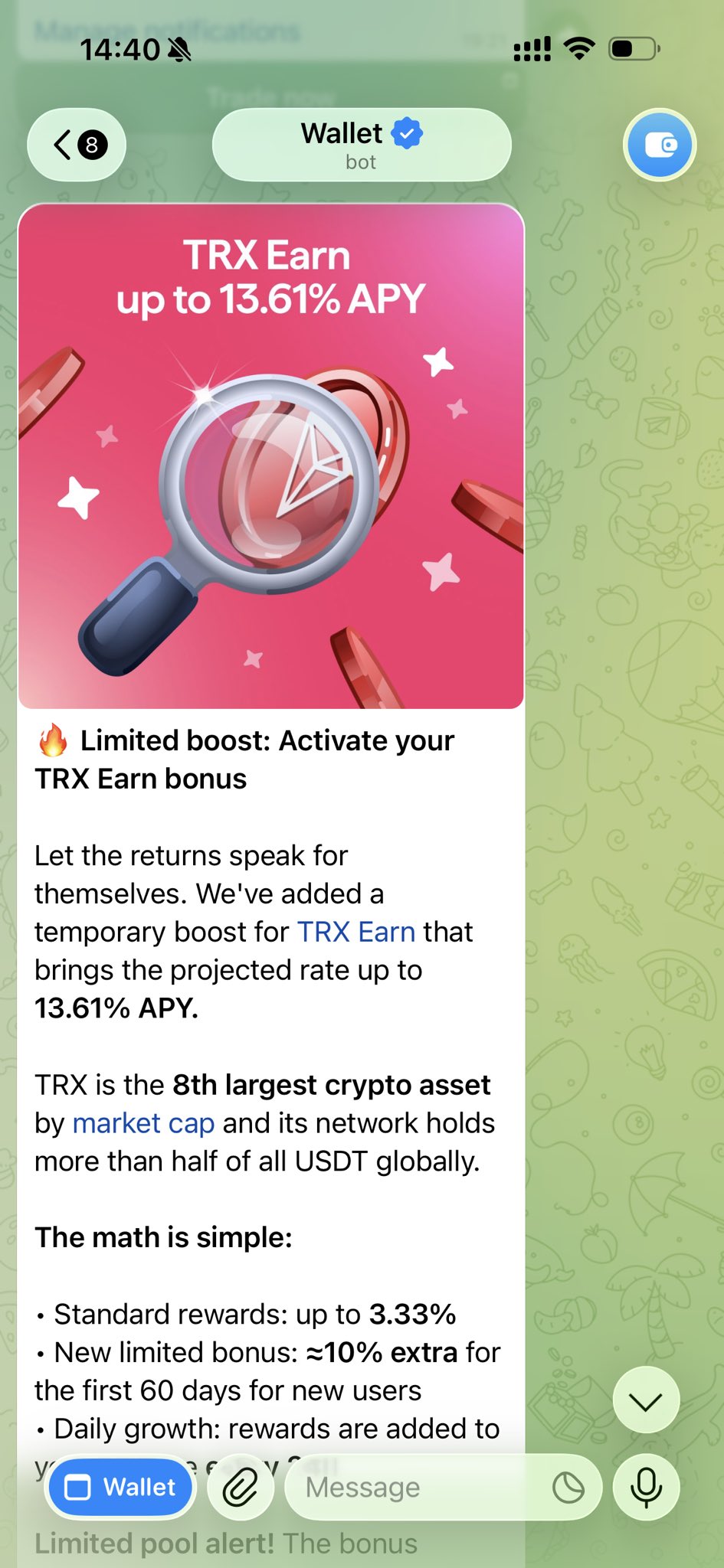 TRON’s Justin Sun launches TRX Earn on Telegram with boosted yields up to 13.61% APY, combining base rewards and a limited 60-day bonus for new users2026-04
 Securitize integrates with TRON to expand tokenized real-world assets across one of the largest blockchain ecosystems, unlocking broader access to onchain securities and DeFi liquidity2026-04
 Bank of AI goes live on TRON, building financial plumbing for autonomous agents atop $86B in USDT liquidity2026-04
 Aethir contains bridge exploit to under $90K, taps Binance to freeze funds as attacker flees to Tron2026-04
A public blockchain network optimized for high-throughput digital asset transfers, Tron has become one of the dominant settlement layers for stablecoins globally, processing billions of dollars in daily USDT volume at near-zero fees.
What Is Tron?
Tron is a layer-1 blockchain network founded by Justin Sun and launched on mainnet in May 2018. It uses a Delegated Proof-of-Stake (DPoS) consensus mechanism, in which 27 elected "Super Representatives" validate transactions in rotating slots, enabling the network to sustain roughly 2,000 transactions per second with average finality under three seconds.
The network's native token is TRX, used to pay for computational resources (measured in "bandwidth" and "energy"), participate in governance, and stake for network rewards. Unlike many blockchains where gas fees fluctuate with demand, Tron assigns resource costs to accounts based on staked TRX holdings, so frequent users can effectively transact free of charge by locking capital rather than burning fees per transaction.
Since mainnet launch, Tron has reported zero unplanned downtime—a claim the team continues to cite as a core infrastructure benchmark.

TRON integrates with Hyperlane to unlock cross-chain messaging across 150+ blockchains, enabling developers to move assets, data, and smart contract logic beyond traditional bridges

$86B+ of USDT and $25B TVL on TRON is the lever here, not the 150-chain badge; Hyperlane has already moved $10B+ since launch, so this can turn TRON from a self-contained settlement rail into inventory for Solana, Cosmos, and EVM apps that want cheap dollar liquidity. If Warp Routes start showing up in perps margin flows, exchange hot-wallet rebalancing, and merchant settlement, volume stops taking the dumb TRON -> CEX -> destination-chain detour. If that flow never shows up, the fragmentation problem is still there and this was just another interoperability press release.
Justin Sun and the Origin of the Network
Justin Sun launched Tron in 2017 via an initial coin offering, then moved the project from the Ethereum network to its own mainnet the following year. Sun also acquired BitTorrent in 2018, integrating the peer-to-peer file-sharing protocol into the Tron ecosystem and issuing the BTT token to its user base.
Sun stepped back from the CEO role in 2021, later becoming Grenada's ambassador to the World Trade Organization. He remains highly visible as a promoter of the ecosystem and has been involved in high-profile institutional moments, including a $6.2 million purchase of a banana duct-taped to a wall that drew widespread press attention in 2024. His involvement keeps Tron's public profile closely tied to his own, which has historically been a double-edged dynamic: large personal audiences drive awareness, while regulatory scrutiny of Sun (the SEC filed charges against him in 2023 related to market manipulation allegations) has created periodic headline risk for the network.
Readers click Tron not as a speculative asset but as contested infrastructure — they want to know whether its $86B USDT liquidity base makes it the default settlement rail for AI agents and cross-chain routing, or a compliance liability waiting to detonate.
Tron's Role in the Stablecoin Economy
The most consequential fact about Tron's current position in crypto is its dominance as a USDT settlement layer. Tether's USDT—the world's largest stablecoin by market cap—circulates on Tron in quantities that have consistently rivaled or exceeded the Ethereum deployment, despite Ethereum having a far larger DeFi ecosystem. The reason is straightforward: transaction fees on Tron for a USDT transfer often cost a fraction of a cent, compared to variable fees on Ethereum that can spike into dollars during congestion.
Recent data from the Tron ecosystem showed the network crossing $11.3 billion in USDT volume linked to its GasFree feature rollout—a mechanism allowing USDT transfers without requiring the sender to hold any TRX. GasFree effectively removes the onboarding friction that previously required new users to acquire the native token before they could move stablecoins. The practical implication is that Tron USDT addresses function more like bank account numbers: someone can receive USDT and immediately send it onward without touching TRX.
This makes the network particularly well-suited to remittance corridors and informal currency substitution in economies with weak local currencies. Coverage of Tron's use in Brazil illustrates the pattern: students and low-income workers are using USDT on Tron for cross-border transfers because the combination of dollar-denominated stability and minimal fees creates a viable alternative to wire transfers or exchange bureaus.
CoinZoom becoming the first U.S.-regulated exchange to support USDT simultaneously across Ethereum, Tron, and BNB Smart Chain signals that regulated entities are increasingly treating Tron parity as a compliance checkbox rather than an optional add-on.
Justin Sun reveals Tron’s post-quantum upgrade, targeting NIST-standard signatures to protect network from quantum computing risks and future-proof transactions
Financial Crime: The T3 Unit
Tron's status as a dominant USDT rail is a feature for legitimate users and an attack surface for illicit actors. The network has attracted scrutiny from regulators and blockchain analytics firms because the same properties—cheap, fast, pseudonymous transfers—that make it useful for remittances also make it attractive for sanctions evasion, fraud, and money laundering.
The network's response has been the T3 Financial Crime Unit, a joint initiative between Tether, Tron, and blockchain analytics firm TRM Labs. As of mid-2026, T3 has reportedly frozen over $450 million in illicit crypto funds and expanded investigations across 23 countries. Separately, the U.S. Treasury's Operation Economic Fury seized over $1 billion in Iranian crypto assets, a significant portion of which was USDT held on Tron.
The T3 unit represents an unusual arrangement: the issuer of an asset (Tether), the network it circulates on (Tron), and a commercial analytics firm coordinating enforcement actions—essentially private sector financial crime infrastructure filling a gap that blockchain's permissionless design creates. Critics note the model is centralized and opaque; supporters argue it demonstrates that major stablecoin issuers and host networks can take compliance seriously without waiting for comprehensive regulation.
- 01Cross-chain expansion push
The Hyperlane, LI.FI, deBridge, and Symbiosis integrations collectively drew the most clicks, signaling readers are tracking whether Tron can shed its walled-garden reputation and become a genuine interoperability hub.
- 02AI agent payment rails
The $1B AI fund scale-up and Bank of AI launch pulled readers who see Tron's low-cost, high-volume USDT throughput as the most credible candidate substrate for autonomous agent treasury flows.
- 03Justin Sun legal drama
The WLFI lawsuit and Eric Trump's public mockery attracted readers drawn to the governance-control subtext — who actually controls token projects when a founder turns litigious.
- 04USDT crime and seizures
The US Treasury's $1B+ seizure of Iranian USDT on Tron and the T3 crime unit's $450M freeze reveal that Tron's stablecoin dominance cuts both ways — it's the world's biggest sanctions-evasion vector as much as a payment network.
- 05Institutional RWA custody
Securitize's private credit fund launch and Anchorage Digital's regulated TRX custody showed readers that traditional-finance on-ramps are quietly treating Tron's liquidity depth as unavoidable, despite its reputational baggage.
- 06Post-quantum security upgrade
Sun's announcement of NIST-standard signature migration drew readers who want to know whether Tron's aging architecture can survive the next generation of cryptographic threats before a critical mass of USDT is at risk.
The DeFi and Developer Ecosystem
Tron's on-chain DeFi ecosystem centers on a small number of high-volume protocols. SUN.io is the primary decentralized exchange and liquidity hub on the network, analogous in positioning to Uniswap on Ethereum, and periodically runs incentive campaigns—the "TRON Eco Star" creator program being one recent example with prize pools distributed in USDT. JUST (JST) is the network's main lending and stablecoin protocol, enabling users to borrow against crypto collateral.
WINkLink is Tron's native oracle network, functionally similar to Chainlink in that it feeds external price data to on-chain smart contracts. Recent expansions include support for additional token price feeds (such as KGST/TRX), extending the set of assets that DeFi protocols can price reliably on-chain. Oracle coverage is a prerequisite for new tokens to become usable as collateral or trading pairs within the ecosystem.
On the infrastructure side, BitTorrent Chain (BTTC) has served as a cross-chain bridge connecting Tron to Ethereum and BNB Smart Chain. A phased shutdown of the BTTC Bridge was announced in mid-2026, with the project noting users should migrate assets. This is notable because cross-chain bridges have been a frequent exploit vector across crypto, and orderly shutdowns are preferable to security incidents.
Securitize, a digital securities platform, launched a tokenized private credit fund on the Tron blockchain in 2025—an example of real-world asset (RWA) tokenization using Tron as the underlying settlement layer. This signals institutional interest in the network beyond retail stablecoin transfers.
TRON’s Justin Sun launches TRX Earn on Telegram with boosted yields up to 13.61% APY, combining base rewards and a limited 60-day bonus for new users
13.61% APY on TRX when base staking yields sit around 3-4% — that ~10% delta is pure user acquisition subsidy that burns off after 60 days. Sun's running three parallel demand sinks right now: Telegram Earn, the Canary Capital staked TRX ETF filing (advertising 4.5% yield), and the sTRX→USDD dual-profit loop. All designed to lock up circulating supply while TRX price action stays flat despite growing network activity. Convenient timing too — this drops weeks after the $10M SEC settlement cleared Rainberry's regulatory overhang.
AI Integration and Agentic Commerce
A recurring theme in Tron's recent ecosystem communications is the intersection of artificial intelligence with on-chain infrastructure. Two distinct threads are emerging.
The first is AI agents as on-chain actors. Tron has highlighted integrations allowing AI agents to interact with cross-chain functionality via natural language—meaning a user or automated system could instruct an AI to execute transfers or swaps without manually constructing transactions. The practical stack involves protocols like the Agent Commerce Protocol (ACP) and x402 payment standards being layered on top of Tron's GasFree settlement, enabling what developers are calling "agentic checkout" flows: autonomous agents that can initiate, track, and complete purchases on-chain. A published technical walkthrough demonstrated this on the Tron Nile testnet.
The second thread is Tron's involvement in broader Web3 AI infrastructure. ChainGPT, an AI infrastructure project targeting Web3, counts Tron alongside Binance, Google Cloud, and Chainlink among its ecosystem partners—a positioning play that aligns the network with enterprise-grade AI tooling.
Neither of these is yet at the scale of Tron's stablecoin operations, but they represent the direction ecosystem development resources are pointing. The argument being made, implicitly, is that the same high-throughput, low-cost settlement layer that makes Tron good for USDT transfers makes it a logical base layer for machine-initiated micropayments.
- 2024-01milestone
T3 Financial Crime Unit launched by Tether, Tron, TRM Labs
- 2025-06regulatory
US Treasury seizes $1B+ Iranian USDT on Tron under Operation Economic Fury
- 2025-11milestone
Anchorage Digital launches regulated TRX custody and staking
- 2026-01launch
Securitize integrates with TRON for tokenized real-world assets
- 2026-02milestone
TRON DAO scales AI fund to $1B for agentic payment rails
- 2026-03governance
Justin Sun sues World Liberty Financial over frozen WLFI tokens
- 2026-03exploit
Aethir bridge exploit attacker flees to Tron; Binance freezes funds
- 2026-04launch
TRON integrates Hyperlane to enable cross-chain messaging across 150+ blockchains
Network Fundamentals and Governance
Tron uses a bandwidth/energy resource model rather than direct gas fees. Users who stake TRX receive bandwidth (used for simple transfers) and energy (used for smart contract execution). This creates a two-tier economy: stakers transact cheaply or for free, while non-stakers pay in TRX burned per transaction. The GasFree feature extends this by allowing sponsored transactions where a third party covers resource costs on behalf of a USDT sender.
Governance runs through Super Representative elections. Any TRX holder can vote for Super Representatives proportional to their stake; the top 27 by votes produce blocks, with the next tier (27 "Super Representative Candidates") receiving some voting rewards without producing blocks. This concentrates block production significantly and has drawn criticism for being less decentralized than proof-of-work networks or more open DPoS implementations.
Q1 2026 figures from the Tron team indicated continued growth in on-chain fundamentals—transaction counts, active addresses, and stablecoin volume—at a time when other networks were experiencing activity slowdowns.
- CentralizationHigh
Justin Sun's willingness to sue project partners over token control and governance rights demonstrates that founder concentration risk is not theoretical — it is actively litigated.
- RegulatoryHigh
Over $1 billion in Tron-based USDT has been seized by the US Treasury under sanctions enforcement, and the T3 crime unit has frozen $450M+ across 23 countries, making Tron the highest-profile stablecoin compliance flashpoint in the market.
- Smart-contractMedium
Tron's role as an escape route in the Aethir bridge exploit — where attacker funds fled specifically to Tron — highlights that its fast finality and exchange liquidity make it a preferred destination for stolen assets, increasing exploit contagion risk.
- LiquidityLow
With $86B in USDT settled on-chain and deep exchange integration, Tron's liquidity moat is among the largest in crypto, making a liquidity crisis structurally unlikely in the near term.
- MarketMedium
TRX price is tightly coupled to Justin Sun's public standing — a single lawsuit, regulatory action, or political controversy (as seen with the WLFI dispute and Eric Trump mockery) can materially reprice sentiment regardless of on-chain fundamentals.
Developer Tooling and Data Infrastructure
A practical consideration for builders on Tron is data extraction. Tron's historical data architecture has posed challenges for indexers and analytics tools, with the introduction of Substreams (a streaming data framework from StreamingFast/Pinax) flagged as introducing risks of slowdowns and incomplete data extraction. Developers building analytics, explorers, or protocol dashboards on Tron need to account for these infrastructure constraints when choosing their data pipeline architecture.
The network is EVM-adjacent but not EVM-identical: Tron's smart contract environment (TVM) shares Solidity syntax and significant compatibility with the Ethereum Virtual Machine, lowering the barrier for Ethereum developers to port contracts. However, differences in address encoding, resource models, and opcodes mean direct copy-paste deployments sometimes fail in non-obvious ways.
Outlook
Tron's near-term trajectory is shaped by a few durable forces. Its position as the lowest-friction USDT rail gives it structural relevance that is unlikely to erode quickly—too much liquidity, too many integrations, and too many users in emerging markets depend on it. The GasFree feature expands that advantage further by removing the TRX-holding requirement that previously gated new users.
The network's growth into tokenized real-world assets and AI-agent commerce represents genuine diversification, but both remain early-stage compared to stablecoin volume. Regulatory pressure—both on Justin Sun personally and on the broader question of what compliance obligations attach to a network processing billions in daily stablecoin flows—is an ongoing variable. The T3 unit's track record will likely influence how regulators in the U.S. and EU treat Tron as they finalize stablecoin frameworks.
For developers, Tron is a network where the use case dictates the decision: if the application involves USDT movement at scale with minimal fees and high throughput, Tron's infrastructure case is strong. For DeFi composability, liquidity depth, and ecosystem tooling, Ethereum and its L2s remain the benchmark.
Latest Tron news
TRON integrates with Hyperlane to unlock cross-chain messaging across 150+ blockchains, enabling developers to move assets, data, and smart contract logic beyond traditional bridgesJustin Sun reveals Tron’s post-quantum upgrade, targeting NIST-standard signatures to protect network from quantum computing risks and future-proof transactionsTRON’s Justin Sun launches TRX Earn on Telegram with boosted yields up to 13.61% APY, combining base rewards and a limited 60-day bonus for new usersSecuritize integrates with TRON to expand tokenized real-world assets across one of the largest blockchain ecosystems, unlocking broader access to onchain securities and DeFi liquidityBank of AI goes live on TRON, building financial plumbing for autonomous agents atop $86B in USDT liquidityAethir contains bridge exploit to under $90K, taps Binance to freeze funds as attacker flees to TronCommunity notes
Spot something off or out of date? Drop a note. Editors review topic notes daily and roll accepted fixes into the explainer — contributors are recognized in the monthly $SQUID drop.
Loading notes…
Help improve this topic
Have a story or tip about this topic? Submit it. See something missing? Leave a note. Editors review daily; accepted submissions and fixes count toward the monthly $SQUID drop.