
Post-quantum cryptography (PQC) refers to algorithms resistant to quantum computer attacks. This explainer covers why ECDSA-based blockchains like Bitcoin and Ethereum face structural risk, which chains are migrating first, and what the coordination challenge looks like in practice.
+17 sources across the wider coverage universe
 Grayscale says Bitcoin has post-quantum solutions but lacks governance to deploy them2026-04
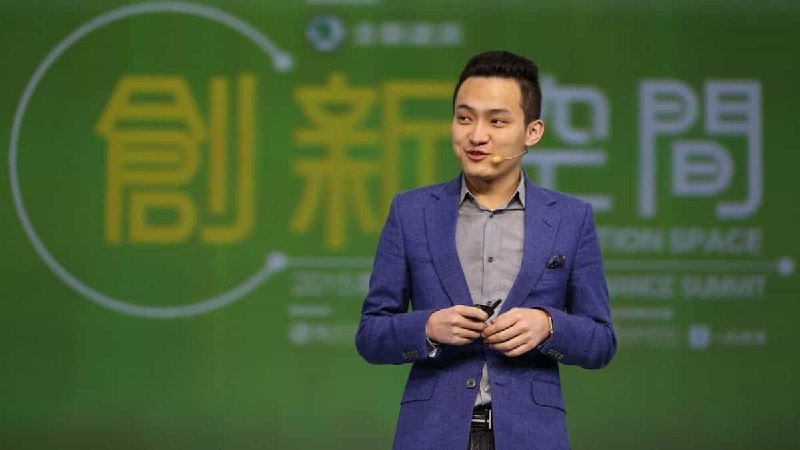 Justin Sun reveals Tron’s post-quantum upgrade, targeting NIST-standard signatures to protect network from quantum computing risks and future-proof transactions2026-04
 Cloudflare fast-tracks post-quantum roadmap to 2029 as researchers slash qubit requirements for breaking ECC 20-fold2026-04
 Ethereum researcher Nico says post-quantum account protection can be deployed today without a hard fork, costing roughly $0.07 per account and undergoing further audits2026-06
 Galaxy launches Bitcoin quantum readiness push with up to $5 million for post-quantum developer grants2026-07
 Aptos says post-quantum signatures are live as Coinbase council calls chain well-positioned2026-05
Cryptographic algorithms that underpin nearly every blockchain — from Bitcoin's secp256k1 signatures to Ethereum's ECDSA — are mathematically breakable by a sufficiently powerful quantum computer, making post-quantum cryptography the most consequential infrastructure upgrade the crypto industry has yet to fully attempt.
Why Quantum Computers Threaten Blockchain Security
Modern blockchains secure assets through public-key cryptography. When you hold Bitcoin or Ether, what you actually control is a private key — a large number whose corresponding public key can be derived mathematically, but whose reverse derivation is considered computationally infeasible for classical computers.
Quantum computers change that calculus. Peter Shor's algorithm, published in 1994, demonstrated theoretically that a quantum machine with enough stable qubits could factor large integers and solve discrete logarithm problems in polynomial time — breaking RSA, ECDSA, and elliptic-curve Diffie-Hellman, the three families of asymmetric cryptography that blockchain wallets overwhelmingly rely on.
The threat is not that quantum computers can do this today. They cannot. Current systems — including Google's Willow chip and IBM's Heron processors — operate in the range of hundreds to low thousands of physical qubits, and breaking a 256-bit elliptic curve key would require millions of error-corrected logical qubits. But the cryptographic community's concern is forward-looking: adversaries can harvest encrypted data or blockchain transactions now and decrypt them later, once sufficiently powerful hardware exists. For blockchains, where public keys are permanently on-chain, the exposure is structural.
Post-quantum cryptography (PQC) is the field of designing classical algorithms — running on today's hardware — that remain secure even against quantum attacks. It is distinct from quantum cryptography, which uses quantum physics itself to transmit keys.

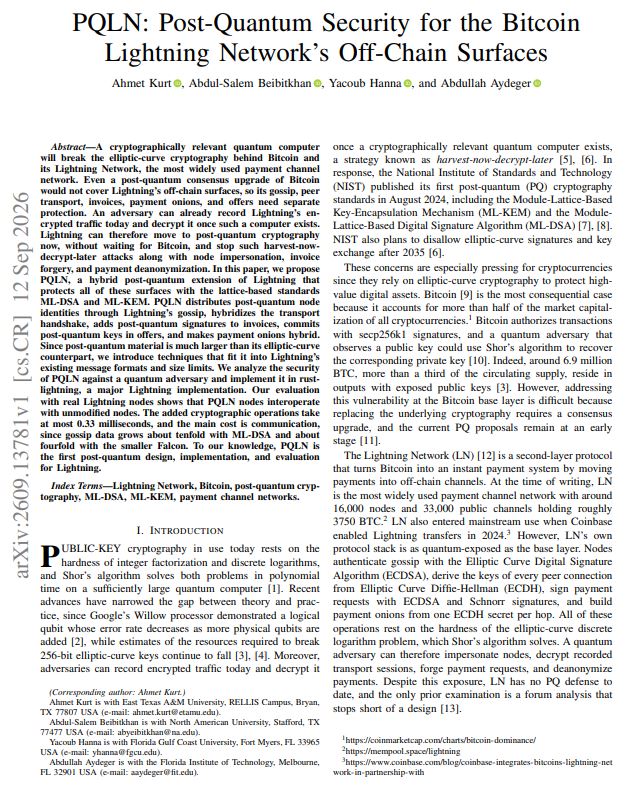
East Texas A&M students say they built first post-quantum security for Bitcoin Lightning
The NIST Standards: A Baseline for Migration
The clearest external forcing function for the crypto industry arrived in December 2025, when the U.S. National Institute of Standards and Technology (NIST) published its final crypto agility guidance. The core message: systems must be able to swap out their cryptographic primitives without breaking. NIST had previously standardized three post-quantum algorithms — CRYSTALS-Kyber for key encapsulation and CRYSTALS-Dilithium (now ML-DSA) plus SPHINCS+ for digital signatures.
These are not theoretical exercises. BNB Chain released a post-quantum cryptography migration report documenting a live testnet upgrade using ML-DSA-44 — the NIST-standardized lattice signature scheme — for transaction signatures, alongside pqSTARK for consensus vote aggregation. The design preserved backward compatibility with existing infrastructure, though BNB's own testing noted a roughly 40% reduction in transactions per second, illustrating that post-quantum upgrades carry non-trivial performance costs.
NIST's crypto agility framing has influenced how newer chains approach architecture. CKB (Nervos) has cited being designed from day one for cryptographic agility, able to support arbitrary signature schemes via a flexible virtual machine rather than hardcoding assumptions at the protocol layer — a structural contrast with most legacy blockchains.
Readers are not clicking post-quantum stories for abstract threat warnings — they click when a specific chain names a deadline, a real cost, or a concrete mechanism, revealing that urgency is only credible when it comes with a migration date or a line of code.
Bitcoin's Specific Exposure
Bitcoin presents a particularly stark version of the problem. An estimated 25–30% of all Bitcoin supply sits in addresses whose public keys are permanently exposed on-chain — either because the address reuses a P2PK format that reveals the public key directly, or because a transaction has already been broadcast that exposes it. Anyone who has ever spent from an address has revealed their public key.
Post-quantum security firm Project Eleven published a widely-discussed report warning that quantum computing could threaten BTC wallet security by 2030. BitGo CEO Mike Belshe pushed back, arguing the timeline is overstated and that the larger risk is coordination: even if a migration path exists technically, getting millions of users, exchanges, and custodians to move funds to quantum-resistant addresses in a coordinated window is an unprecedented social and logistical challenge.
MicroCloud Hologram has explored quantum key distribution approaches for Bitcoin, though upgrade uncertainties at the protocol level remain unresolved. Zcash has set a more concrete target, aiming for a post-quantum cryptography milestone by 2027.
The coordination problem Belshe identifies is real and underappreciated. Bitcoin governance moves by rough consensus, and any hard fork to mandate quantum-resistant signatures would need to address millions of dormant or abandoned coins — including those attributed to Satoshi Nakamoto — whose owners cannot migrate. Coinbase's Quantum Advisory Council addressed this directly, examining how a post-quantum migration should treat abandoned coins whose private key holders may no longer exist to participate in any migration.
Ethereum's Upgrade Path
Ethereum's post-quantum situation is technically better than Bitcoin's in one respect: the roadmap discussion is more active and the developer surface for experimentation is larger. Researcher "Nico" published a proposal arguing that post-quantum account protection can be deployed today without a hard fork, at a cost of approximately $0.07 per account, with the approach undergoing further security audits.
On the signature verification side, the SPHINCS+ algorithm — one of NIST's standardized schemes — has been demonstrated verifying post-quantum Ethereum signatures at 127,000 gas, without requiring any precompile or protocol change. This matters because it means applications could begin experimenting with PQC signatures within the existing EVM execution environment today, rather than waiting for a consensus-layer upgrade.
The deeper challenge is at the protocol level itself, where Ethereum's consensus and execution layers both rely on BLS12-381 elliptic curve operations. Migrating those is a harder problem. Succinct Labs released VEIL, a compiler designed to address one component: Succinct's SP1 proving system — the ZK infrastructure Google used for generating ZK proofs in certain workloads — relies on a Groth16 wrapper that has an elliptic-curve dependency. VEIL swaps that dependency for a hash-based post-quantum scheme, representing a meaningful step toward quantum-resistant ZK proof systems.
CertiK, the blockchain security firm, has published separate research on post-quantum signature schemes, focusing on practical risks in scaling from tree-based signature schemes like SPHINCS+ to larger forest-based constructions — a niche but important engineering concern as signature sizes in hash-based schemes are substantially larger than ECDSA, which has throughput implications at scale.
- 01Chain-specific migration roadmaps
Readers engaged most when Ethereum, Bitcoin, Solana, Ripple, and others put concrete timelines on post-quantum upgrades, making the abstract threat feel actionable and chain-specific.
- 02Performance cost of quantum-safe signatures
Solana's 90% speed drop and 40x signature size balloon made the engineering trade-off visceral and quantifiable, driving the highest single-headline click count.
- 03Bitcoin governance gap
The contrast between Bitcoin having known solutions and lacking coordination to deploy them struck readers as the most politically charged and unresolved tension in the space.
- 04No-fork, low-cost account protection
The finding that Ethereum accounts could be quantum-hardened today for roughly $0.07 without a hard fork reframed post-quantum migration from catastrophic to tractable.
- 05Hardware architecture shift to TPUs
The argument that TPUs — not GPUs — are the right engine for post-quantum math offered a non-obvious infrastructure angle that differentiated this story from standard cryptography coverage.
- 06Threat timeline calibration
Both a16z and Borderless Capital framing quantum risk as overstated-but-real, with harvest-now-decrypt-later as the genuine near-term vector, pulled readers looking for a credible risk framework rather than hype.
Chains That Have Moved First
Several chains have announced or shipped post-quantum capabilities ahead of the broader migration:
Aptos has gone furthest among large layer-1 networks in publicly claiming production readiness. Post-quantum signatures are reported live on Aptos, and Coinbase's Quantum Advisory Council characterized the chain as "well-positioned for the transition to post-quantum secure transactions." Aptos uses the Move language and was architected more recently than Ethereum or Bitcoin, giving its developers more design freedom.
NEAR Protocol has published a technical roadmap for post-quantum preparation, framing it as an infrastructure challenge the ecosystem is actively solving.
Blockstream has included a post-quantum security push in its Liquid Network roadmap, alongside zero-confirmation payment work and BitVM research, signaling that sidechains and second-layer systems are also in scope.
Algorand saw its token spike and then retrace during a brief "post-quantum rally" in mid-2025, illustrating how market participants have begun pricing post-quantum credibility into asset valuations — though such moves are often speculative and disconnected from technical delivery timelines.
BNB Chain completed testnet validation of its post-quantum upgrade but saw TPS decline approximately 40%, a result that will require engineering work before mainnet deployment.
At the application and wallet layer, a first-generation of post-quantum MPC wallets has launched — one developed with Eigen Labs as an early supporter — and crypto wallet providers broadly are accelerating post-quantum research in response to rising awareness of the risk.
The Crypto Agility Imperative
NIST's December 2025 guidance introduced "crypto agility" as a first-class design principle: the idea that systems should be upgradeable at the cryptographic layer without requiring wholesale replacement. This reframes the question from "which post-quantum algorithm should we use" to "can our system swap algorithms without breaking?"
For most legacy blockchains, the honest answer is no — or at least, not without significant coordination cost. Elliptic curve assumptions are baked into the signature scheme, the key derivation path, the address format, and sometimes the consensus mechanism. Unwinding those requires hard forks with all the governance friction they entail.
Newer chains with more flexible virtual machines, pluggable signature verification, or account abstraction (which can allow smart-contract wallets to define their own signature verification logic) are structurally better positioned. Ethereum's ERC-4337 account abstraction standard, for instance, creates a path where individual smart accounts can implement post-quantum signature verification without a protocol-level change.
NEAR's approach leverages a similar flexibility. STRK20s, a privacy-focused protocol launching with post-quantum security, represents the application layer beginning to ship PQC features to end users, not just researchers.
- 2024-08regulatory
NIST finalizes first post-quantum cryptography standards
- 2025-04milestone
Ethereum Foundation launches Post Quantum team led by Thomas Coratger
- 2025-05launch
Aptos deploys live post-quantum signatures; Coinbase council endorses readiness
- 2025-06milestone
Solana post-quantum tests reveal 90% speed drop and 40x signature size increase
- 2025-09launch
Starknet adds Falcon-512 wallet support without a hard fork
- 2026-01regulatory
Trump signs executive order mandating federal post-quantum migration by 2031
- 2026-04milestone
Ripple begins ML-DSA validator testing with Project Eleven, targets 2028 XRPL migration
- 2029-01milestone
Ethereum targets full post-quantum migration; Google sets same internal deadline
Sizing the Actual Risk Window
Honest estimates from cryptographers vary significantly on when a "cryptographically relevant" quantum computer might exist. Google's Willow chip in late 2024 was a genuine engineering milestone but operates in a regime far from breaking elliptic curve cryptography — by most technical estimates, a machine capable of attacking Bitcoin's secp256k1 would need fault-tolerant logical qubits in the millions, not the hundreds of physical qubits that exist today.
The relevant planning horizon is roughly a decade — long enough that acting now seems premature to some, short enough that infrastructure systems should be in migration by the end of the current decade. Bitcoin's blockchain and Ethereum's state are permanent; public keys revealed in 2015 are still on-chain in 2026 and will be in 2035. The asymmetry of that exposure is what makes the problem urgent despite the hardware being years away.
Outlook
The post-quantum transition in crypto is no longer hypothetical or distant — it is an active engineering and governance project across the industry. NIST's finalized standards provide the cryptographic foundation. Early movers like Aptos and BNB Chain have demonstrated that post-quantum signatures can be deployed in production blockchain environments, with documented trade-offs. Ethereum's research community has outlined low-friction near-term options, and zero-knowledge proof systems are beginning to shed their elliptic-curve dependencies.
The harder problems remain coordination and performance. Bitcoin's enormous installed base of exposed public keys, the throughput costs of larger post-quantum signature schemes, and the governance challenge of executing hard forks across decentralized networks are not solved by algorithm selection alone. Coinbase's advisory council framing — treating abandoned coins and coordination failure as the central risks, not hardware timelines — is likely the correct lens for the next five years.
Chains that have built cryptographic agility into their architecture from the start are best positioned. Those that did not face a decade of migration work, and the governance negotiations that come with it.
Latest Post-Quantum news
Community notes
Spot something off or out of date? Drop a note. Editors review topic notes daily and roll accepted fixes into the explainer — contributors are recognized in the monthly $SQUID drop.
Loading notes…
Help improve this topic
Have a story or tip about this topic? Submit it. See something missing? Leave a note. Editors review daily; accepted submissions and fixes count toward the monthly $SQUID drop.