
Comprehensive explainer on Algorand’s pure proof‑of‑stake blockchain, performance, state proofs, and post‑quantum roadmap, plus its role in tokenized finance, AI‑native settlement, and the wider crypto ecosystem.
+7 sources across the wider coverage universe
 Algorand Foundation cuts 25% of staff amid macro gloom, joining OP Labs and Messari in crypto layoff streak2026-03
 Algorand targets full quantum resistance by 2028, launching a multi-year cryptographic overhaul as blockchain networks race to prepare for future quantum threats2026-06
 Crypto hiring demand drops 80% year over year in early 2026 as job postings fall sharply, while firms like Algorand, Gemini and Crypto.com cut hundreds of roles due to AI integration2026-03
Algorand: Post‑Quantum Infrastructure for Tokenized Finance and the AI Economy
Algorand is a layer‑1 blockchain that uses a pure proof‑of‑stake consensus design to offer fast finality, low fees, and high throughput, while pursuing an aggressive roadmap to become one of the first broadly post‑quantum‑resistant public networks. It aims to serve as a foundational settlement layer for tokenized finance, real‑world assets, and autonomous AI agents by combining performance, formal cryptography research, and a growing focus on quantum‑secure primitives.
What is Algorand?
Algorand is a decentralized, self‑sustaining blockchain network built to support a wide range of applications, from payments and DeFi to tokenized real‑world assets and institutional finance. At a high level, it functions like other smart‑contract platforms: users send transactions, deploy applications, and issue tokens on a shared ledger secured by a distributed validator set. What distinguishes Algorand is its combination of pure proof‑of‑stake (PPoS) consensus, near‑instant transaction finality, and an explicit design focus on both security against today’s adversaries and resilience against tomorrow’s quantum threats. It positions itself not just as another crypto network, but as a piece of financial infrastructure meant to survive multiple technological eras, including the maturation of quantum computing.
From a market perspective, Algorand’s native token, ALGO, trades on major exchanges and ranks among the larger cryptoassets by market capitalization, though well below giants like Bitcoin and Ethereum. The token powers the network’s fee economy and governance, and it underpins the consensus mechanism that keeps the chain secure without traditional “mining.” Like most altcoins, ALGO has experienced sharp price cycles, rallying at times on narratives such as post‑quantum security or Google recognition, and falling during broader market drawdowns or altcoin slumps. This volatility reflects investors’ ongoing debate about the long‑term value of high‑performance layer‑1 chains in a crowded field.
Design goals and positioning among layer‑1 blockchains
Algorand was launched with an explicit ambition to address the “blockchain trilemma” of scalability, security, and decentralization, while avoiding the compromises seen in earlier networks. Bitcoin offers strong security and credible neutrality but limited throughput and slow probabilistic finality, while early proof‑of‑stake and delegated proof‑of‑stake systems often improved performance at the cost of more concentrated validator sets. Algorand’s PPoS design attempts to preserve decentralization by allowing any user who holds ALGO to participate in consensus, while using cryptographic sortition to keep block production fast and communication overhead low.
In practice, this means Algorand competes with other high‑throughput chains such as Solana, Avalanche, and newer Ethereum layer‑2s for the role of “high‑performance settlement layer.” It differentiates itself by emphasizing mathematically grounded protocol design, minimal downtime, deterministic finality, and a conservative approach to on‑chain complexity. These choices make it particularly attractive for use cases where settlement assurance and regulatory compatibility matter at least as much as raw throughput, such as tokenized securities, payments networks, and institutional DeFi. At the same time, the project must confront the same network‑effects problem as other alternative layer‑1s: developers and liquidity tend to cluster on a few dominant platforms, which can leave technically strong chains underutilized.
Genesis, supply, and the ALGO token
Algorand’s monetary and governance model centers on the ALGO token, which was fully minted at genesis rather than being minted continuously through proof‑of‑work mining. The genesis configuration specified a total supply of 10 billion ALGO, setting a hard cap that cannot be increased by protocol rules, though the pace and channels of distribution have been subject to Foundation policy and community scrutiny. Over time, allocations have been used to fund ecosystem development, staking‑style rewards, and the operational costs of the Foundation and related entities.
At any point in time, ALGO’s price provides only a snapshot of market sentiment, but it does influence how the broader crypto community perceives the project. Analysts have published a wide range of forward‑looking price predictions, with some research outlets suggesting potential ranges between roughly \(0.30\) and \(0.80\) USD in conservative scenarios and higher levels in optimistic, bull‑market environments. Such forecasts highlight that investors see both upside optionality—driven by quantum‑security narratives, institutional adoption, and tokenized finance—and significant downside risk if Algorand fails to achieve meaningful share in a highly competitive layer‑1 landscape.

Algorand reports zero downtime across 64 million blocks and 3.69 billion transactions, plus 1.5 million post-quantum transactions since 2022.

Core Technology: Pure Proof‑of‑Stake, Smart Contracts, and Atomic Settlement
Pure Proof‑of‑Stake and consensus
Algorand’s pure proof‑of‑stake (PPoS) consensus mechanism is central to its identity and often cited as one of its primary innovations. In PPoS, any user who holds ALGO can potentially participate in block proposal and voting; there is no minimum stake requirement that gates access to consensus. Selection of block proposers and committee members is performed using a verifiable random function (VRF), a cryptographic primitive that allows each participant to privately determine, in each round, whether they have been chosen to play a role, and to prove this selection to others without revealing any bias or centralized coordination.
This approach has several practical implications. First, because participants do not need to lock or delegate their stake to a validator pool, they maintain control of their ALGOs in their own wallets, which stay liquid even while contributing to network security. That stands in contrast to many other proof‑of‑stake systems in which staking requires locking funds, exposing them to slashing penalties, or trusting intermediaries. Second, the random, ephemeral nature of committee selection makes it much harder for an adversary to identify and target the nodes responsible for consensus at any given moment, increasing resilience against censorship or correlated failures.
From a performance perspective, PPoS is designed to support very fast block times and deterministic finality. The network is currently described as capable of processing up to around 6,000 transactions per second under real‑world conditions, with sub‑4‑second finality. Algorand’s own technical materials emphasize that the protocol architecture can handle over 10,000 transactions per second without sacrificing decentralization in principle, suggesting headroom for further optimization as hardware and network conditions improve. Taken together, these features make Algorand one of the higher‑throughput base layers in the public‑blockchain space.
Performance and reliability characteristics
Beyond raw throughput, Algorand places heavy emphasis on operational reliability and consistent finality. The network recently crossed a milestone of 60 million blocks and 3.5 billion transactions, and community communications highlight that this has been achieved with zero downtime since launch in 2019, with blocks produced roughly every 2.8 seconds and transactions finalized “instantly” in practical terms. While the word “instant” should be understood relative to traditional financial settlement times rather than literal instantaneity, the combination of sub‑three‑second blocks and deterministic finality is significant for real‑time financial workflows.
In user terms, this performance profile manifests as high responsiveness and predictable fee behavior. Transactions are typically included in the next block and considered final as soon as that block is confirmed, eliminating the need for users to wait for multiple confirmations as in Bitcoin’s probabilistic security model. This makes Algorand more suitable for applications like point‑of‑sale payments, order‑book‑style decentralized exchanges, and machine‑to‑machine micropayments, where latency and settlement risk are critical constraints. The network’s throughput capacity also reduces congestion risk relative to systems with lower ceilings, though like any public blockchain, Algorand remains exposed to demand spikes during market stress.
A simplified comparison helps illustrate Algorand’s positioning relative to more established networks:
| Feature | Algorand | Bitcoin | Ethereum (post‑Merge) |
|---|---|---|---|
| Consensus | Pure proof‑of‑stake (PPoS) | Proof‑of‑work | Proof‑of‑stake |
| Typical block time | ~2.8 seconds | ~10 minutes | ~12 seconds |
| Finality model | Deterministic, 1 block | Probabilistic (6+ blocks) | Economic finality after a few epochs |
| Real‑world TPS capacity | Up to ~6,000 TPS, target 10,000+ | ~7 TPS | Tens of TPS on L1 |
| Quantum‑ready primitives | Deployed state‑proof Falcon signatures and PQ accounts roadmap | None live; ECDSA vulnerable | None live; ECDSA/BLS vulnerable |
The Bitcoin and Ethereum figures are approximate and based on widely understood properties of those networks, whereas the Algorand values reflect explicitly documented platform targets and observed performance.
TEAL smart contracts and the application layer
Algorand’s programmable layer is built around TEAL (Transaction Execution Approval Language) and its higher‑level language abstractions. TEAL is a stack‑based scripting language designed to be compact, deterministic, and amenable to formal analysis, which helps reduce the attack surface relative to more expressive but complex virtual machines. Smart contracts on Algorand are often implemented as stateful applications plus stateless transaction logic, enabling developers to encode business rules that govern asset transfers, access control, and complex multi‑party workflows.
A key focus of Algorand’s platform evolution has been to strengthen TEAL’s expressiveness while preserving safety and verifiability. Upgrades to the protocol have introduced enhancements to the TEAL language and execution model, including better access to transactions within a group (a critical enabler for complex atomic transfers) and more nuanced application‑level permissioning. These improvements allow contracts to reason about entire transaction batches rather than individual operations in isolation, enabling constructs like escrowed trades, multi‑asset swaps, and conditional payments to be implemented directly at the protocol level.
Crucially, TEAL is tightly integrated with Algorand’s core assets and account primitives rather than being bolted on as an afterthought. This design choice enables developers to leverage layer‑1 features such as Algorand Standard Assets (ASAs), rekeyed accounts, and multisignature schemes alongside smart contracts in a unified environment. In the context of post‑quantum security, Algorand’s team highlights that TEAL already exposes primitives and patterns that support quantum‑safe account management and key rotation, forming part of its multi‑layer post‑quantum strategy.
Atomic transfers and tokenized finance
One of Algorand’s most distinctive features at the protocol level is its support for atomic transfers, which allow multiple transactions to be grouped in such a way that either all of them execute or none of them do. This capability is built into the core transaction model and is accessible to both application developers and end‑users, enabling complex multi‑party operations without requiring intermediaries or custom off‑chain coordination.
The International Monetary Fund’s landmark report on tokenized finance highlights “real‑time atomic settlement” as one of the key capabilities that can collapse multiple stages of the traditional financial value chain into a synchronized, programmable layer. By eliminating settlement risk and synchronization mismatches between trading, clearing, and settlement, atomic transactions can reduce counterparty risk and free up collateral, particularly in wholesale financial markets. Algorand’s design aligns strongly with this vision, offering atomic transfer functionality from its early releases and emphasizing its suitability for delivery‑versus‑payment (DvP), multi‑asset swaps, and complex structured‑product flows.
In practice, this means that tokenized securities, stablecoins, and other digital instruments on Algorand can be exchanged in a single, indivisible on‑chain operation, even when multiple assets, accounts, and conditions are involved. For regulated institutions, this deterministic behavior is attractive because it facilitates compliance, auditability, and risk management in ways that map more closely to existing financial‑market infrastructures than loosely coupled systems of custodians and off‑chain processes. As traditional finance experiments with tokenized treasuries, money‑market funds, and collateral management tools, atomic settlement on chains like Algorand could play a central role.
Algorand readers split sharply between institutional anxiety (layoffs, macro) and technical credibility (quantum readiness) — the Google citation converted a niche cryptography story into a price catalyst, revealing that Algorand's value proposition lives or dies on external validators, not organic adoption signals.
Interoperability and State Proofs
State proofs and trust‑minimized cross‑chain bridges
As the multi‑chain crypto ecosystem has evolved, cross‑chain bridges have emerged as critical yet fragile infrastructure, repeatedly targeted by large‑scale hacks and exploits. Many existing bridges rely on multisignature custodians or validator sets that sit outside the core consensus of the underlying chains, creating additional trust assumptions and points of failure. Algorand’s response is a cryptographic mechanism called State Proofs, designed to allow other chains and systems to verify Algorand’s state without trusting any intermediary.
State proofs can be thought of as compact, cryptographically verifiable summaries of the Algorand blockchain’s consensus decisions. In technical terms, they provide a way for light clients or external systems to verify that a particular block or state root is part of Algorand’s canonical chain, using only a small proof and without having to replay the entire history or trust a set of bridge validators. Algorand introduced these cryptographic state proofs on mainnet in 2022, making it one of the first major blockchains to deploy such a mechanism as a native feature.
This architecture enables trust‑minimized cross‑chain bridges, where an external chain (for example, an Ethereum smart contract) can accept state‑proof‑verified messages from Algorand as authoritative, without relying on a centralized oracle or separate validator network. The Algorand ecosystem has promoted State Proofs as a way to make cross‑chain bridges “a whole lot safer,” emphasizing the reduced need for trusted third parties and the ability to anchor proofs into multiple destination chains.
Falcon‑based state proofs and post‑quantum security
What makes Algorand’s state proofs particularly notable in the context of the broader crypto industry is their use of Falcon, a post‑quantum secure digital signature scheme. Falcon is a lattice‑based signature algorithm that has been selected in the U.S. National Institute of Standards and Technology (NIST) post‑quantum cryptography process, and it is believed to resist attacks by large‑scale quantum computers that would break classical elliptic‑curve signatures.
Algorand’s State Proofs are signed using Falcon‑1024 signatures, meaning that the authenticity of the proofs themselves remains robust even in a world where quantum adversaries can break traditional elliptic‑curve cryptography. In November 2025, Algorand went further by pioneering the use of Falcon‑based accounts on mainnet, allowing digital assets on a public blockchain to be protected directly by quantum‑resistant signatures rather than only securing the chain’s state history. This move pushed post‑quantum cryptography beyond experimental testnets into a mainstream public network, helping to validate performance characteristics and integration patterns.
By anchoring state proofs and accounts in Falcon, Algorand has created a multi‑layered posture in which both interoperability and asset custody can be secured against future quantum threats. This is particularly important for long‑lived assets and cross‑chain infrastructure, which may need to remain secure for decades. In effect, Algorand is trying to ensure that the same bridges and custody primitives being deployed today will not become liabilities once quantum computers reach the capability thresholds identified in academic and industry analyses.
Impact on multi‑chain crypto infrastructure
If State Proofs and post‑quantum signatures become widely adopted, they could meaningfully alter the risk profile of multi‑chain crypto infrastructure. Trust‑minimized bridges based on verifiable state proofs can reduce or eliminate reliance on centralized custodians that have been frequent points of failure, while simultaneously offering a clear upgrade path to post‑quantum security. Because Algorand’s State Proofs are designed to be chain‑agnostic, they can be consumed by a variety of destination networks, potentially making Algorand a secure “hub” for value and state movement in a heterogeneous ecosystem.
This approach meshes with broader tokenization and DeFi trends highlighted by institutions like the IMF, which stress the importance of atomic settlement and programmable compliance across assets that may reside on different ledgers or jurisdictions. In a future where regulated stablecoins, securities tokens, and real‑world assets circulate across multiple chains, the ability to move value safely between them will be critical. Algorand’s combination of fast finality, state proofs, and post‑quantum signatures positions it as a candidate infrastructure layer for this kind of interoperable, multi‑chain financial system, though adoption will depend on the willingness of other ecosystems and institutions to integrate its proofs and protocols.
Quantum Threat, Google, and Algorand’s Post‑Quantum Strategy
Why quantum computing is a threat to crypto
The quantum threat has shifted from theoretical curiosity to concrete strategic concern for public‑key cryptography, including the signature schemes that secure Bitcoin, Ethereum, and most other crypto networks. Large‑scale, fault‑tolerant quantum computers would be capable of running Shor’s algorithm, which can efficiently factor large integers and compute discrete logarithms, thereby breaking widely used cryptographic systems like RSA and elliptic‑curve cryptography. Because Bitcoin, Ethereum, and many other blockchains rely on elliptic‑curve signatures (for example, ECDSA and EdDSA) to authenticate transactions, a sufficiently powerful quantum computer could, in principle, derive private keys from public keys and steal funds from exposed addresses.
A whitepaper from Google Quantum AI and collaborators surveys these vulnerabilities across the cryptocurrency landscape, emphasizing that the account model and smart‑contract architectures used by many blockchains introduce additional quantum vulnerabilities beyond those present in Bitcoin’s UTXO model. In short, any system that routinely exposes large numbers of public keys, or embeds cryptographic assumptions in contract logic, increases the surface area that quantum adversaries could attack. The paper underscores that crypto networks need coordinated, multi‑layer migration plans rather than piecemeal upgrades.
Recognizing the urgency of this transition, Google has publicly introduced a 2029 timeline for organizations to migrate to post‑quantum cryptography (PQC), effectively signaling that the window for preparation is measured in single‑digit years rather than decades. While full‑scale quantum computers capable of breaking today’s cryptography at scale do not yet exist, the combination of increasing investment, rapid research progress, and long asset lifecycles has moved PQC from speculative to strategic. Long‑lived assets like Bitcoin holdings, tokenized securities, and infrastructure keys must be secure not only today but for many years into the future.
Google Quantum AI’s view and Bitcoin’s exposure
In the broader public conversation, Bitcoin often serves as the focal point for quantum discussions, both because of its prominence and its reliance on classical elliptic‑curve signatures. Google’s cryptocurrency vulnerability analysis underscores that elliptic‑curve cryptography used in Bitcoin and similar systems will become insecure once quantum computers reach sufficient scale, and it highlights specific ways in which reused or exposed public keys are at risk. This has led to increased attention on address‑reuse practices, “store now, decrypt later” threats, and the need for key‑management strategies that minimize the exposure window.
At the same time, the report stresses that more complex platforms, including smart‑contract ecosystems and account‑based networks, face additional challenges because cryptographic primitives are embedded deeply into application logic and interoperability layers. Migrating such systems to PQC involves not just swapping signature schemes, but redesigning business logic, upgrade paths, and user‑experience flows. The implicit message is that networks which begin this transition early, and treat PQC as a first‑class design concern, may be better positioned when large‑scale quantum computing becomes practical.
Algorand’s existing post‑quantum deployments
Against this backdrop, Algorand has become one of the most prominent examples of a public blockchain taking concrete steps toward post‑quantum security. The project has deployed PQ cryptography across multiple protocol layers, including Falcon signatures in State Proofs, native support for key rotation, and TEAL primitives designed to facilitate quantum‑safe scripting and account management. These features are not merely theoretical or confined to testnets; Algorand introduced Falcon‑based State Proofs on mainnet in 2022 and has since expanded PQ integration.
In November 2025, Algorand achieved a significant milestone by pioneering the use of Falcon‑based accounts on the mainnet of a mainstream blockchain network. This meant that digital assets on Algorand could be held in accounts secured directly by a post‑quantum signature scheme, rather than relying solely on classical cryptography at the transaction layer while protecting only the chain’s state history with PQ signatures. As the project’s own materials note, this extended quantum protection to the level of individual assets and users, something that remains rare across major public networks.
Algorand’s team and community have emphasized that these deployments are part of a broader, multi‑year post‑quantum journey rather than isolated features. By embedding PQ signatures in State Proofs, enabling PQ‑capable accounts, and exploring quantum‑resilient VRFs and consensus messaging, the network is effectively building a defense‑in‑depth posture. Google’s Quantum AI research and subsequent public recognition of Algorand’s post‑quantum protocols have reinforced this narrative, contributing to episodes where ALGO’s price surged on news of Google citing the network’s quantum readiness.
The roadmap to broad quantum resilience by 2027–2028
To move from isolated PQ features to broad quantum resilience, Algorand has published a detailed roadmap spanning multiple protocol releases. In June 2026, the project announced a plan to target broad quantum resilience by the end of 2027, with milestones including native PQ accounts, supporting SDKs and developer tooling, PQ multisignature schemes suitable for institutions and treasuries, and continued research into PQ‑resilient VRFs and consensus messaging signatures. The aim is to ensure that not only end‑user accounts, but also validator communications and bridging mechanisms, can withstand quantum threats.
A key step in this roadmap is the Q3 2026 protocol release, which is slated to introduce network‑level support for multiple concurrent signature schemes, including Falcon‑1024 account support. This will allow the chain to operate in a hybrid mode where classical and post‑quantum signatures coexist, easing migration and allowing different user groups to adopt PQ security at different paces. The same roadmap foresees native Falcon‑512 support by year’s end, expanding the range of PQ security‑performance trade‑offs developers and institutions can choose from.
Another major enhancement involves multi‑signature accounts that are no longer bound to a single signature scheme. Instead, Algorand plans to support flexible m‑of‑n quorums that can mix classical, pure‑Falcon, and hybrid keys across participants, enabling institutions to design governance structures that gradually incorporate PQ keys alongside legacy ones. This is particularly relevant for treasuries, DAOs, and custodians that must manage key rotation and access control over long horizons. External reporting and commentary have characterized this roadmap as a multi‑year cryptographic overhaul aimed at making Algorand quantum‑resistant by around 2028, placing it ahead of many peers in terms of concrete timelines.
Market reaction and evolving quantum narratives
Algorand’s post‑quantum strategy has increasingly shaped its market narrative. Episodes in which Google Quantum AI research or commentary highlighted Algorand’s PQ posture have coincided with notable ALGO price moves, including double‑digit surges as traders framed the project as an early beneficiary of the “quantum‑ready” theme. At other times, ALGO has declined alongside the broader altcoin market, with articles noting that even networks boasting advanced post‑quantum security features were not immune to macro‑driven sell‑offs and concerns about manipulation risks in smaller tokens.
This divergence between technological progress and short‑term price action is not unique to Algorand, but it underscores an important point for the crypto industry: quantum readiness is likely to be a long‑term differentiator rather than a quick speculative catalyst. While Bitcoin and Ethereum continue to dominate market capitalization despite their current reliance on vulnerable elliptic‑curve signatures, the combination of regulatory pressure, institutional risk management, and eventual quantum milestones may gradually increase the premium placed on PQ‑capable infrastructure. Algorand’s bet is that by the time that inflection point arrives, having a mature, battle‑tested post‑quantum stack will be a significant advantage.

Algorand Foundation cuts 25% of staff amid macro gloom, joining OP Labs and Messari in crypto layoff streak

It's a tough but right decision to keep the lights on. Hope Algorand offers sufficient support to the laid off staff.
Ecosystem, Use Cases, and Real‑World Adoption
DeFi, NFTs, and a growing application ecosystem
Like other smart‑contract platforms, Algorand hosts a diverse ecosystem of decentralized applications spanning DeFi, NFTs, gaming, and infrastructure tooling. Analytics and research outlets note that Algorand supports over 1,000 dApps, with key sectors including decentralized finance protocols, non‑fungible token marketplaces, and various utility applications. This growth has been steady rather than explosive, reflecting both the maturation of the technology and the challenges of bootstrapping liquidity and developer mindshare in a crowded field.
Algorand’s DeFi landscape includes automated market makers, lending platforms, and derivatives protocols built on top of its TEAL smart contract layer and ASA standard. The platform’s low, predictable fees and fast finality make it particularly appealing for applications that require frequent rebalancing or rapid liquidation, while its atomic transfer capability enables complex multi‑leg trades to be executed safely. NFT activity on Algorand has focused on both consumer‑oriented collectibles and more experimental real‑world asset representations, exploring use cases such as event tickets, music rights, and environmental credits.
Despite these strengths, Algorand’s share of total DeFi and NFT activity remains modest compared with ecosystems like Ethereum and its layer‑2s or newer high‑throughput chains that have aggressively pursued liquidity mining and incentive programs. The project’s emphasis on technical robustness and institutional‑grade features has sometimes translated into a more cautious go‑to‑market approach, which can be slower to generate headline‑grabbing metrics but potentially more aligned with conservative capital and regulatory environments.
Tokenized finance and alignment with IMF priorities
The IMF’s analysis of tokenized finance frames tokenization as an opportunity to deliver atomic settlement, programmable compliance, and fractional ownership, while warning that poorly designed systems could amplify risks. These themes map closely onto Algorand’s design choices. Atomic transfers and deterministic finality provide the basis for real‑time settlement of tokenized securities, while TEAL and application‑level permissioning enable rules around who can hold or trade particular assets, under what conditions, and with what disclosures.
As financial institutions experiment with tokenized government bonds, money‑market funds, and repo markets, they require infrastructure that can offer both the flexibility of programmable assets and the predictability of traditional settlement systems. Algorand’s advocates argue that its combination of high throughput, low latency, atomic settlement, and growing post‑quantum posture makes it a natural fit for this space, particularly for issuers who must worry about asset lifetimes measured in decades. The presence of State Proofs and trust‑minimized bridging also matters here, because institutional portfolios are unlikely to remain confined to a single chain.
While many tokenization pilots today still run on permissioned versions of Ethereum or private DLT systems, the long‑run trajectory appears to favor interoperable, public or public‑adjacent networks that can integrate with global liquidity. In that scenario, chains like Algorand that blend performance, formal security, and PQC could become attractive venues for both retail‑facing and wholesale financial instruments, though actual adoption will depend on regulatory approvals, integration costs, and how quickly competing chains adapt.
Sustainability, climate applications, and water credits
A notable strand of Algorand’s ecosystem focuses on sustainability and environmental markets. One recent example is the UK’s first blockchain water credit system, launched in partnership with the WTR token project and built on Algorand. This initiative aims to tokenise water‑efficiency credits and related environmental metrics, enabling more transparent tracking, trading, and financing of sustainable water usage and infrastructure. The choice of Algorand reflects both its performance characteristics and its positioning as an energy‑efficient, climate‑conscious blockchain.
By enabling granular, programmable representation of environmental assets such as water credits, carbon offsets, or biodiversity tokens, Algorand and similar platforms can support new financing models for climate adaptation and conservation. The combination of atomic settlement, low fees, and composable smart contracts allows, in principle, for the creation of markets where environmental outcomes are directly tied to financial incentives, with traceability anchored on a public ledger. For policymakers and NGOs, this offers the potential for more auditable and efficient allocation of sustainability funding, though the design of such systems remains complex and politically sensitive.
Algorand’s work in this area fits into a broader narrative in which public blockchains seek to counter criticisms about energy use and speculative activity by highlighting real‑world use cases with social or environmental benefits. Whether these projects scale beyond pilots will be an important indicator of Algorand’s ability to attract mission‑driven organizations and public‑sector partners.
Institutional and public‑sector collaborations
Beyond environmental projects, Algorand has been explored by various institutions and public‑sector entities for applications such as digital registries, tokenized assets, and potential central bank digital currency (CBDC) experiments. Its deterministic finality, configurable permissioning at the application layer, and growing PQ posture make it a natural candidate for pilots where legal certainty and long‑term security are paramount.
From an institutional perspective, the ability to use multi‑scheme multisignature accounts and hybrid classical/PQ security models is particularly relevant. Large asset managers, custodians, and central banks must plan for key management and access control over long horizons, which is difficult if the underlying cryptographic primitives are expected to become obsolete. By allowing governance structures that incorporate both today’s standards and tomorrow’s PQ schemes, Algorand offers a bridge between current operational realities and future security requirements.
However, institutional adoption depends as much on regulatory clarity, standardization, and ecosystem depth as on any single chain’s technical capabilities. Algorand’s success in this arena will hinge on its ability to demonstrate reliability, interoperability with existing systems, and a sufficiently rich tooling and service provider ecosystem to support enterprise‑grade deployments.
- 01Foundation layoffs, macro cuts↗
A 25% staff reduction at the nonprofit that stewards the protocol raised direct questions about ALGO's long-term development continuity during a broad crypto downturn.
- 02AI displacing crypto jobs
Readers connected Algorand's cuts to a sector-wide pattern of AI integration shrinking headcount, framing the layoffs as structural rather than isolated.
- 03Quantum resistance roadmap 2028↗
A concrete multi-year cryptographic overhaul with a named deadline gave readers a rare technically specific forward-looking commitment to evaluate.
- 04Google quantum paper price spike↗
Multiple headlines about the same event show readers tracking the price reaction to Google's citation of Algorand as a post-quantum exemplar — external validation driving short-term trading thesis.
- 05IMF tokenized finance recognition↗
The IMF spotlighting atomic settlement and programmable compliance mapped directly onto Algorand's existing tech stack, giving readers an institutional legitimacy signal.
Network Reliability, Performance, and Security
Zero downtime and operational track record
In a crypto landscape where some high‑performance chains have suffered from repeated outages and halts, Algorand’s emphasis on zero downtime has become a core part of its brand. Community updates highlight that since its launch in 2019, the network has produced a new block every 2.8 seconds, processing billions of transactions without recorded downtime. This track record is particularly important for financial institutions and application developers who must manage not only standard crypto risks but also operational and reputational risk if their services are disrupted by base‑layer instability.
Reliability derives from both protocol design and conservative engineering choices. Algorand’s PPoS mechanism minimizes the need for complex leader‑election processes or heavy communication patterns that can become brittle under extreme conditions. The use of VRFs to privately select proposers and committees reduces the risk of targeted attacks on consensus participants, while the system’s deterministic finality avoids the extended reorganization events that can occur in probabilistic‑finality chains under network stress. These attributes contribute to a perception of Algorand as “boring but reliable” infrastructure, which can be an asset in institutional contexts even if it attracts less retail excitement than chains known for dramatic throughput claims.
Throughput, fees, and user experience
Algorand’s throughput and fee structure directly shape the user experience. With a current capacity of around 6,000 transactions per second and architecture designed to support over 10,000 TPS, the network provides abundant headroom for typical application loads and can accommodate significant growth before congestion becomes a bottleneck. Combined with sub‑4‑second finality, this performance enables near‑real‑time interaction in wallets, exchanges, and applications, which is especially valuable for use cases like trading, gaming, and machine‑to‑machine payments.
Transaction fees on Algorand are designed to be predictable and low, typically amounting to fractions of a cent in fiat terms under normal market conditions. While precise fee levels depend on protocol parameters and ALGO’s price, the overall design seeks to minimize user friction and avoid the kind of fee spikes that have periodically made activity on other networks prohibitively expensive. For developers, this predictability simplifies business‑model design, as applications can assume that on‑chain actions will remain affordable even under moderate load.
From a user perspective, the combination of low fees and fast finality makes Algorand an attractive venue for smaller transactions and micro‑interactions that would be uneconomical on chains with higher gas costs. This becomes particularly important in the context of AI agents and automated systems that may generate large volumes of low‑value transactions, as discussed later. At the same time, low fees also mean that the network must rely on careful incentive design and economic analysis to ensure that validator participation and security remain robust.
Security model and decentralization considerations
Algorand’s security model is anchored in the economic and cryptographic properties of pure proof‑of‑stake. Because any user with ALGO can participate in consensus without staking lockups, the protocol aims to maximize the set of potential validators and reduce the concentration of power among a small number of large validators or stake pools. The VRF‑based selection process makes it difficult for adversaries to predict which users will be chosen for block proposal or voting in a given round, which in turn complicates attempts at censorship or targeted attacks.
However, as with any proof‑of‑stake system, the effective decentralization of Algorand depends not only on protocol design but also on actual stake distribution and the behavior of participants. If a small number of entities hold or control large portions of the supply, they may exercise outsize influence over governance or block production in practice, even if the protocol theoretically allows widespread participation. The absence of slashing in Algorand’s PPoS design simplifies user participation and avoids certain classes of accidental loss, but it also raises questions about how the protocol deters censorship or equivocation in extreme adversarial scenarios.
Research into the game‑theoretic properties of Algorand‑style consensus has generally concluded that it provides strong safety and liveness guarantees under realistic assumptions, but real‑world behavior is always more complex than models. For institutional users, the presence of post‑quantum roadmaps, transparent governance processes, and a track record of stable operation may matter as much as formal decentralization metrics. The network’s zero‑downtime history and proactive PQ strategy have become part of its de facto security brand.
Algorand, AI, and the Autonomous Economy
AI agents and high‑frequency, low‑value settlement
A striking development in recent years has been the rise of AI agents that can autonomously interact with digital services, including blockchain networks. A report cited by Algorand’s team from Goldman Sachs estimates that AI agent activity could increase by 2,300% by 2030, implying a future in which autonomous software agents conduct a large fraction of digital transactions. In accompanying commentary, Algorand argues that such agents will require fast, cheap, reliable settlement to operate at scale, and positions its network as well‑suited to this role due to instant finality, high throughput, predictable low fees, and zero downtime.
If this vision materializes, blockchains could evolve from primarily human‑driven systems to infrastructure over which AI agents pay for data, model access, compute, and services in real time. In such an environment, the constraints of high fees and slow confirmation times on some networks would be glaring bottlenecks. Algorand’s sub‑three‑second finality and thousands‑of‑TPS capacity could make it a natural home for AI‑driven micropayment flows such as API calls, model queries, or machine‑to‑machine IoT transactions.
Moreover, the combination of post‑quantum security and AI integration is strategic. The same advances in computing that drive AI progress also accelerate quantum computing research, raising the urgency of securing long‑lived cryptographic infrastructures. By working to ensure that AI‑native transaction systems are built on PQ‑resilient rails from the outset, Algorand is effectively trying to preempt a scenario in which a new wave of AI‑driven financial infrastructure must later undergo a painful cryptographic migration.
AI’s impact on the Algorand ecosystem and crypto labor markets
The growth of AI does not just create new demand for blockchain settlement; it also reshapes the labor markets that sustain crypto ecosystems. Industry‑wide, demand for traditional crypto hiring has fallen sharply, with some estimates suggesting an 80% year‑over‑year drop in job postings as AI tools automate tasks and macro conditions tighten. In parallel, data‑analytics firms such as Dune Analytics have laid off significant portions of their staff, explicitly citing the ability of teams and AI agents to build dashboards and workflows without needing specialized skills like SQL.
Algorand’s own ecosystem has not been immune to this trend. The Algorand Foundation confirmed that it cut around 25% of its staff, citing “macroeconomic uncertainty” and the need to streamline operations amid a broader streak of crypto layoffs. These reductions occurred alongside similar cuts at other crypto firms such as OP Labs and Messari, illustrating that even well‑funded infrastructure projects are re‑evaluating cost structures and human capital in light of AI automation and choppy markets. For Algorand, the challenge is to maintain sufficient ecosystem support, developer relations, and research capacity while operating with a leaner team.
This dynamic creates a paradox: AI may increase demand for high‑throughput, low‑fee blockchains like Algorand as settlement layers for autonomous agents, yet the same AI tools reduce the need for traditional roles within crypto organizations. Navigating this transition will require thoughtful workforce strategies, community engagement, and tooling that allows smaller teams and independent contributors to sustain and grow the ecosystem.
Intersection of AI, post‑quantum security, and crypto infrastructure
The intersection of AI, quantum computing, and crypto is becoming a central strategic theme for infrastructure projects. AI systems increasingly rely on cryptographic protocols and secure hardware enclaves to protect data and model integrity, while quantum computing threatens to undermine classical cryptography foundations. Algorand’s positioning explicitly recognizes this convergence: it aims to be a settlement layer that is both AI‑friendly in terms of performance and quantum‑resilient at the cryptographic level.
From a strategic perspective, the network’s post‑quantum roadmap can be seen as an attempt to future‑proof not only human‑oriented finance but also machine‑driven economies. If AI agents become major economic actors, controlling valuable keys and managing large flows of capital, the security assumptions underlying their transactions must hold against more powerful adversaries and computational tools. Algorand’s multi‑layer PQ approach—combining Falcon‑secured State Proofs, PQ accounts, and plans for quantum‑resilient consensus messaging—seeks to provide such a foundation.
In this sense, Algorand is betting that long‑term security and reliability will matter more as crypto infrastructure becomes deeply embedded in both human and machine economies. While short‑term market narratives may focus on throughput benchmarks or speculative cycles, the combination of AI and quantum computing could gradually elevate chains with credible, implemented PQ strategies relative to those still relying solely on classical cryptography.

Algorand releases v5.0.0 with native Falcon-1024 accounts, resource-based fees and doubled smart contract code capacity
Governance, Foundation, and Challenges
Role of the Algorand Foundation and ecosystem support
The Algorand Foundation plays a central role in stewarding the network’s development, ecosystem growth, and research agenda. It has historically managed substantial ALGO reserves allocated at genesis, using them to fund grants, research collaborations, developer education, and marketing initiatives aimed at bootstrapping usage and infrastructure. The Foundation also helps coordinate protocol upgrades, including the post‑quantum roadmap, and serves as a key interlocutor with regulators, institutions, and enterprise partners.
This governance model is similar to that of many other layer‑1 projects that rely on a non‑profit or foundation entity to guide early‑stage development before gradually decentralizing decision‑making. In Algorand’s case, the Foundation’s commitment to rigorous cryptography and formal protocol design has helped cultivate an image of the network as research‑driven and security‑oriented. However, it also means that the Foundation’s financial health, strategic choices, and staffing levels materially affect the ecosystem’s trajectory.
Layoffs, market cycles, and sustainability concerns
The decision by the Algorand Foundation to cut 25% of its staff underscores the challenges of sustaining large‑scale, grant‑driven ecosystems through prolonged bear markets and shifting macro conditions. Foundation representatives framed the move as a response to macroeconomic uncertainty and a step toward longer‑term sustainability, aligning with a broader pattern of cost optimization across the crypto industry. Similar reductions at other firms suggest that the exuberant hiring of prior cycles is giving way to leaner operational models.
For the Algorand ecosystem, these cuts raise questions about the pace at which new initiatives—such as post‑quantum tooling, institutional partnerships, and developer support programs—can be executed. On one hand, a leaner organization may focus more sharply on high‑priority objectives like the PQ roadmap and critical infrastructure. On the other, fewer people and reduced budgets can slow ecosystem expansion, especially in areas like marketing, community outreach, and third‑party integrations that are crucial for attracting developers and liquidity.
These challenges are compounded by market perception issues. During altcoin slumps and periods of heightened regulatory scrutiny, investors often reassess the long‑term viability of smaller layer‑1s relative to incumbents like Bitcoin and Ethereum. News about layoffs, even when framed as prudent cost control, can be interpreted as a sign of distress. The key question is whether Algorand can leverage its genuine technical strengths—particularly quantum readiness and reliability—to sustain momentum through down cycles and into the next phase of crypto adoption.
Competitive landscape and open questions
Algorand operates in a highly competitive layer‑1 environment alongside Ethereum, Solana, Avalanche, and many others, as well as a growing universe of Ethereum layer‑2s. While its technical fundamentals—PPoS, fast finality, atomic transfers, State Proofs, and a robust PQ roadmap—are strong, success will ultimately depend on network effects: developers choosing Algorand as their primary platform, users holding and transacting in ALGO, and institutions integrating Algorand into their core systems.
One open question is whether post‑quantum leadership will translate into tangible adoption before quantum computers become an immediate threat. It is possible that markets continue to discount PQC risks until a widely publicized breakthrough makes them impossible to ignore, at which point networks that have already deployed PQ features could see rapidly shifting demand. Conversely, if alternative chains successfully roll out their own PQ roadmaps in time, Algorand’s early‑mover advantage may be partially eroded.
Another challenge concerns liquidity and interoperability. Although State Proofs provide a cryptographically elegant bridge mechanism, actual capital flows will depend on integrations with major exchanges, custody providers, and cross‑chain protocols. If Algorand remains comparatively isolated from the deepest liquidity pools, its use cases may be constrained, regardless of its technical qualities. Resolving this will require both continued protocol innovation and pragmatic partnerships within the broader crypto ecosystem.
Algorand mainnet launch, zero downtime record begins
Post-quantum cryptography deployed on mainnet
TEAL smart contract language upgraded with quantum-safe primitives
Algorand Foundation cuts 25% of staff citing macro uncertainty
Google Quantum AI paper cites Algorand as post-quantum exemplar, ALGO surges 20%
IMF landmark report spotlights Algorand's atomic settlement and programmable compliance
Algorand announces full quantum resistance roadmap targeting 2028
Practical Considerations for Users and Developers
For holders and users of ALGO
For everyday users, ALGO functions as both a utility token and an investment asset. It is required for transaction fees, participation in protocol governance, and, in principle, for participation in the PPoS consensus process. Users who transact on Algorand benefit from low fees and fast confirmations, making it a practical choice for transfers, payments, and interacting with DeFi or NFT applications.
From an investment standpoint, ALGO’s price history reflects the broader volatility of the crypto market. Research sites have offered multi‑year price projections suggesting possible ranges from roughly \(0.30\)–\(0.50\) USD under conservative assumptions to higher values such as \(0.60\)–\(0.80\) or even \(1.50\)–\(2.00\) USD in more optimistic scenarios, with some analyses framing \(0.80\)–\(1.20\) USD by 2027 as a “most likely” band. These forecasts are speculative and contingent on a range of factors, including macro conditions, regulatory shifts, and Algorand’s ability to grow its ecosystem and differentiate through post‑quantum readiness.
Prospective holders must weigh the potential upside from narratives around quantum resistance, tokenized finance, and AI‑driven settlement against risks such as competition from other chains, uncertain regulatory trajectories, and the possibility that PQC advantages may not be priced in until much later. As with all cryptoassets, ALGO should be considered a high‑risk investment, and users should conduct their own research and risk assessments.
For builders: when Algorand makes sense
For developers, Algorand offers a distinct blend of performance, safety, and advanced cryptography. The TEAL smart contract language and associated SDKs provide a deterministic, analyzable environment suitable for applications where correctness and security are paramount. Atomic transfers, ASAs, and layer‑1 support for complex transaction groups reduce the need for custom, error‑prone contract logic, while State Proofs open the door to safer cross‑chain integrations.
Algorand is particularly attractive for builders focused on tokenized finance, real‑world assets, and institutional workflows, where deterministic finality, low latency, and strong security guarantees align with regulatory and operational requirements. It is also compelling for applications seeking to serve AI agents or machine‑to‑machine use cases, thanks to high throughput, low fees, and a roadmap that addresses long‑term cryptographic security.
At the same time, developers must consider ecosystem maturity. While Algorand’s tooling and documentation have improved, its ecosystem remains smaller than those of more established platforms. This may affect the availability of third‑party integrations, developer libraries, and community support. Builders who choose Algorand are often making a deliberate bet on its technical roadmap and institutional alignment rather than simply chasing the largest immediate user base.
Regulatory and compliance considerations
Regulatory and compliance concerns are increasingly front‑of‑mind for both crypto projects and traditional institutions. Features like programmable compliance, supported through TEAL and application‑level permissioning, make it possible to implement identity‑aware or jurisdiction‑specific controls directly in protocol logic. Combined with atomic settlement and deterministic finality, this enables structures that mirror traditional regulatory requirements while leveraging the efficiencies of on‑chain settlement.
For example, tokenized securities on Algorand can be programmed to be held only by whitelisted addresses that have passed KYC checks, with transfer restrictions enforced at the contract level. Delivery‑versus‑payment structures can be encoded as atomic transactions that either complete fully or not at all, eliminating principal risk. These capabilities align with guidance from institutions such as the IMF that emphasize the need for built‑in safeguards in tokenized finance infrastructures.
Algorand’s post‑quantum roadmap also intersects with regulatory concerns, since long‑term financial obligations and infrastructure keys must remain secure across technology shifts. Regulators and standard‑setting bodies are increasingly attentive to PQC issues, and networks that can demonstrate credible, implemented migration paths may be viewed more favorably in institutional contexts.
Conclusion
Algorand occupies a distinctive niche in the crypto landscape as a high‑performance, research‑driven layer‑1 that is aggressively pursuing post‑quantum security while targeting use cases in tokenized finance, real‑world assets, and AI‑native settlement. Its pure proof‑of‑stake consensus mechanism, VRF‑based committee selection, and deterministic finality provide a robust foundation for fast, low‑cost transactions, backed by an operational record that emphasizes zero downtime and stable performance. TEAL smart contracts, atomic transfers, and Algorand Standard Assets create a flexible yet analyzable application layer that aligns well with institutional and regulatory requirements.
On the cryptography front, Algorand stands out for having deployed Falcon‑based State Proofs and mainnet post‑quantum accounts, and for publishing a detailed roadmap to achieve broad quantum resilience by the end of 2027, with full quantum resistance targeted by around 2028. This multi‑layer PQ strategy addresses not only account keys but also consensus messaging and interoperability, making Algorand one of the most advanced public networks in terms of preparing for the quantum threat identified by Google Quantum AI and other researchers.
At the same time, Algorand faces significant challenges. It must compete for developers, users, and liquidity in a crowded layer‑1 ecosystem, navigate macroeconomic headwinds and staffing cuts at the Foundation, and translate its strong technical fundamentals into sustained real‑world adoption. Short‑term price movements around quantum narratives and Google citations highlight growing awareness of PQC issues, but they do not guarantee long‑term market success. Ultimately, Algorand’s trajectory will depend on its ability to convert its reliability, post‑quantum leadership, and institutional alignment into network effects and durable usage.
Outlook
Looking ahead, Algorand’s prospects hinge on three intertwined forces: quantum computing, AI‑driven economies, and the tokenization of finance. If quantum timelines unfold as Google and other experts anticipate, the value of having a mature, implemented post‑quantum stack could rise sharply, especially for long‑lived assets and critical infrastructure. If AI agents indeed drive a multi‑fold increase in autonomous digital activity by 2030, high‑throughput, low‑fee, reliable settlement layers like Algorand may see growing demand as rails for machine‑to‑machine commerce. And if tokenized finance continues to gain traction, the combination of atomic settlement, programmable compliance, and deterministic finality positions Algorand as a plausible venue for institutional experimentation and deployment.
None of these outcomes is guaranteed. Competing chains can and likely will develop their own post‑quantum strategies, AI‑oriented narratives, and institutional offerings. Regulatory frameworks may favor some architectures over others, and market cycles will continue to shape capital allocation and development priorities. Yet Algorand has carved out a clear strategic identity as a quantum‑aware, AI‑ready settlement platform grounded in formal cryptography and conservative engineering. For observers of the evolving intersection between Bitcoin, Ethereum, alternative layer‑1s, quantum computing, and AI, Algorand will remain an important project to watch.
Latest Algorand news
Algorand reports zero downtime across 64 million blocks and 3.69 billion transactions, plus 1.5 million post-quantum transactions since 2022.Algorand Foundation cuts 25% of staff amid macro gloom, joining OP Labs and Messari in crypto layoff streakAlgorand releases v5.0.0 with native Falcon-1024 accounts, resource-based fees and doubled smart contract code capacity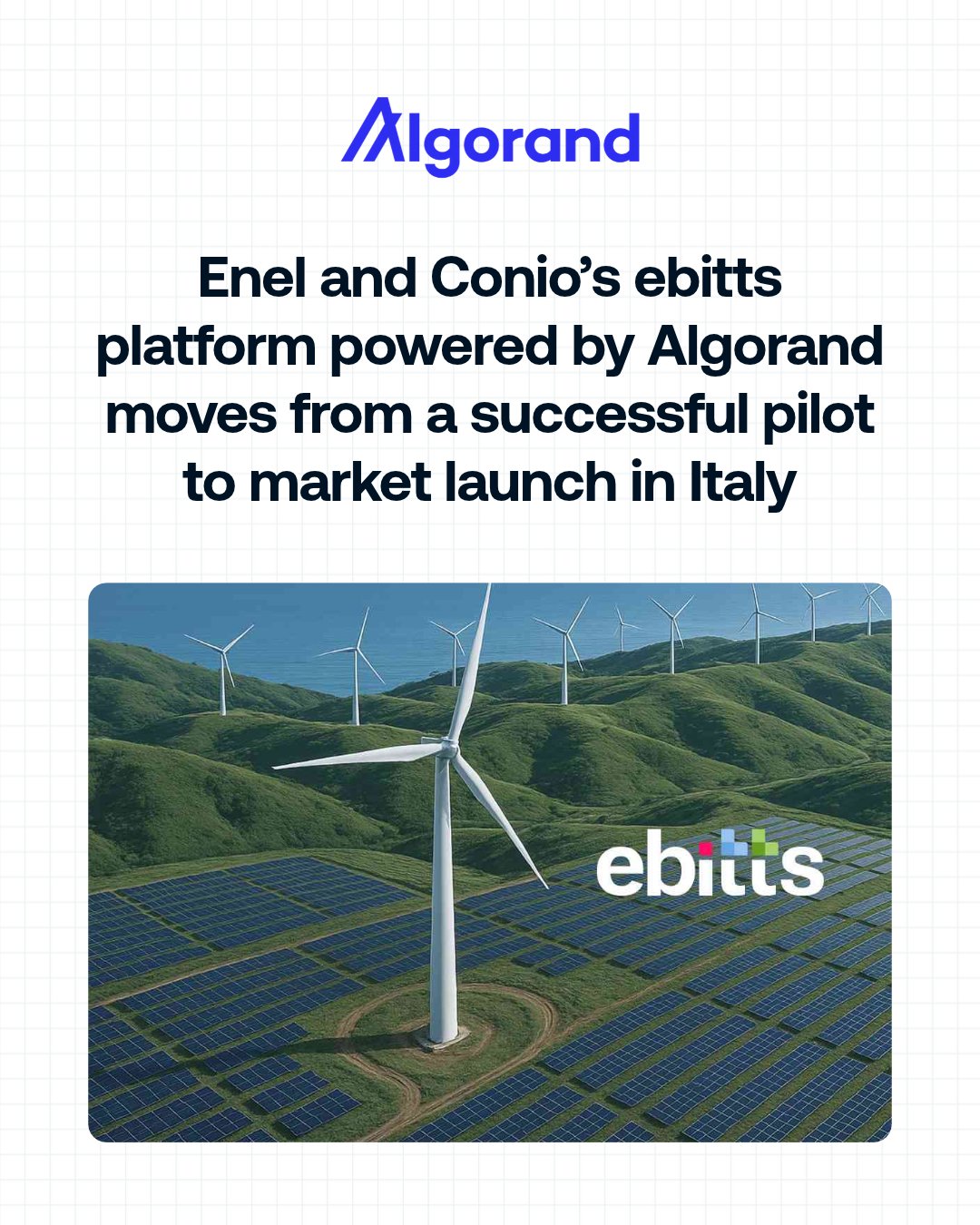 Italy’s Ebitts platform enters the market with Algorand, enabling customers to own tokenized renewable energy capacity from solar and wind farms and benefit from its outputAlgorand targets full quantum resistance by 2028, launching a multi-year cryptographic overhaul as blockchain networks race to prepare for future quantum threatsCrypto hiring demand drops 80% year over year in early 2026 as job postings fall sharply, while firms like Algorand, Gemini and Crypto.com cut hundreds of roles due to AI integration
Sources
17 records from 11 domains
coinmarketcap.com
algorand.co
blog.google
x.com
elibrary.imf.org
tradingview.com
quantumai.google
prnewswire.com
cryptorank.io
binance.com
youtube.com
Community notes
Spot something off or out of date? Drop a note. Editors review topic notes daily and roll accepted fixes into the explainer — contributors are recognized in the monthly $SQUID drop.
Loading notes…
Help improve this topic
Have a story or tip about this topic? Submit it. See something missing? Leave a note. Editors review daily; accepted submissions and fixes count toward the monthly $SQUID drop.