
Deep explainer on Stacks, the Bitcoin-settling smart contract layer powering self-custodial BTC yield, DeFi (Zest, sBTC, USDCx) and AI agents. Covers PoX, Bitcoin Staking, STX token, design trade-offs, and long-term outlook for Bitcoin-native finance.
+25 sources across the wider coverage universe
 Stacks 4.0 hard fork targets Bitcoin block 960,230 on July 29, activating Clarity 6 and Bitcoin Stacking2026-07
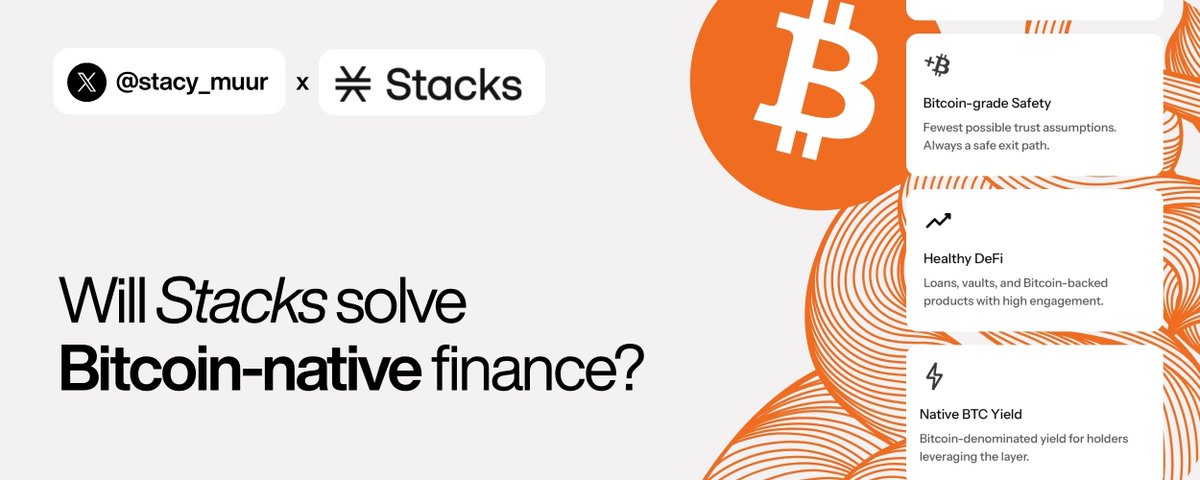 Stacks unveils 2026 roadmap to turn dormant Bitcoin into productive capital through self-custodial BTC staking, DeFi rails and institutional finance2026-05
 Nakamoto's UTXO Management joins Stacks' Bitcoin staking launch as inaugural institution2026-05
 Stacks 2026 roadmap targets self-custodial BTC staking, 100x throughput, and 10K AI agents2026-05
 Bitcoin Layer 2 Stacks rolls out SIP-034 upgrade, improving throughput by resetting only exhausted limits and unlocking higher efficiency for DeFi workloads2026-03
 AI agents are beginning to earn Bitcoin on Stacks as autonomous programs trade, run services, and transact on-chain without human input2026-03
Stacks: Bitcoin’s Programmable Layer for Yield, DeFi, and AI
Stacks is an open-source blockchain that extends Bitcoin with smart contracts, decentralized applications, and native yield, while anchoring security and settlement directly to the Bitcoin base layer. By combining a separate execution layer, a Bitcoin-linked consensus mechanism, and a native asset called STX, the network aims to turn dormant BTC into productive capital for DeFi, AI agents, and institutional-grade finance without requiring users to give up control of their coins.
What Is Stacks?
Stacks is best understood as a Bitcoin-focused smart contract layer that operates alongside Bitcoin but settles its activity back to the Bitcoin blockchain. Instead of attempting to modify Bitcoin’s base protocol, Stacks treats Bitcoin as a final settlement and consensus anchor, writing cryptographic commitments to Bitcoin so that Stacks transactions inherit Bitcoin’s proof-of-work security. The project positions itself as a distinct “layer” on top of Bitcoin that adds programmability, asset issuance, and complex transaction logic, all denominated ultimately in BTC and secured by Bitcoin’s hash power. In practice, users interact with Stacks much like any other smart contract chain, but every block they touch is immutably linked to Bitcoin’s ledger, giving it a unique hybrid of flexibility and conservative security.
Originally launched under the name Blockstack in 2017, the project later rebranded to Stacks and introduced its STX token as the network’s native asset for gas fees, incentives, and governance-related functions. Its founders, including Muneeb Ali and Ryan Shea, explicitly framed the project as a way to give Bitcoin Ethereum-like programmability without forking or replacing Bitcoin itself. That positioning has been reinforced by external commentators; for example, the crypto education outlet Coin Bureau described Stacks as “the most serious way to make Bitcoin programmable without touching Bitcoin,” highlighting the network’s focus on aligning with Bitcoin’s design constraints rather than competing with them. Over time, Stacks evolved from a comparatively slow, Bitcoin-synchronized chain into a fast-confirming, Bitcoin-final execution environment following a major “Nakamoto” upgrade, while retaining its reliance on Bitcoin for finality and security.
In the broader Bitcoin scaling landscape, Stacks occupies a distinctive niche. It is neither a payment-only network like Lightning nor a fully independent layer-one that merely happens to support wrapped BTC. Instead, Stacks aims to be a Bitcoin-native application layer, where smart contracts, lending markets, stablecoin rails, and even AI agents can operate using BTC as the primary reserve asset, underpinned by Bitcoin’s consensus rather than a separate proof-of-stake or permissioned federation. For a crypto news audience, this makes Stacks a key test case for whether Bitcoin’s trillions in stored value can be mobilized into on-chain finance without reintroducing the custodial and bridge risks that have plagued prior attempts at “Bitcoin DeFi.”

Anchorage Digital partners with Stacks to bring Bitcoin staking to institutions, with PoX-5 enabling BTC rewards while assets remain in secure Bitcoin L1 custody

Architecture: How Stacks Anchors to Bitcoin
Bitcoin settlement and block anchoring
The core architectural idea behind Stacks is that each block on the Stacks chain is cryptographically anchored to a corresponding block on the Bitcoin blockchain. This is achieved by having Stacks miners write commitments about Stacks blocks into Bitcoin transactions, effectively notarizing the Stacks chain’s history on Bitcoin’s immutable ledger. Because these commitments are secured by Bitcoin’s proof-of-work consensus, an attacker who wanted to rewrite finalized Stacks history would, in the general case, need to reorganize Bitcoin itself, which is economically and technically prohibitive at scale. This design allows Stacks to behave like a separate execution environment with its own virtual machine and smart contract language, while still inheriting Bitcoin’s settlement assurances instead of relying solely on its own validator set or federated signers.
From a user perspective, this means that Stacks is not just a sidechain with a loose peg; it is designed to be a layer that settles on Bitcoin. Stacks materials emphasize this distinction explicitly, arguing that unlike standalone chains that simply bridge assets from Bitcoin, Stacks transactions and assets are ultimately backed by Bitcoin’s consensus itself. In practical terms, this anchoring offers two key benefits. First, users who care about Bitcoin’s conservative security model can see the Stacks chain as an extension of Bitcoin’s trust assumptions rather than a replacement. Second, developers can build applications that reason explicitly about Bitcoin state, enabling cross-chain logic such as BTC-pegged assets and Bitcoin-timelocked yield products that are enforced both on Stacks and on Bitcoin.
Proof of Transfer (PoX) consensus
Stack’s consensus mechanism, Proof of Transfer (PoX), is the glue that binds the Stacks chain to Bitcoin’s base layer and drives its native yield mechanics. Rather than minting new coins out of nothing or relying on proof-of-stake, Stacks miners participate in PoX by spending real BTC in on-chain Bitcoin transactions for the chance to mine the next Stacks block and earn newly issued STX. These BTC commitments are visible on Bitcoin’s ledger and are distributed as rewards to holders who “Stack” their STX, locking the tokens for a defined period to support consensus. In effect, PoX reuses Bitcoin’s proof-of-work as a source of randomness and economic commitment, redistributing BTC from miners to STX participants as part of the block production process.
This mechanism gives PoX a dual character. On the one hand, it anchors Stacks to Bitcoin by requiring miners to transact on Bitcoin directly, creating a verifiable link between every Stacks block and a set of BTC spends. On the other hand, it transforms BTC into a yield-bearing asset for STX holders, since Stacking rewards are paid in BTC that miners commit in order to earn STX block subsidies. Since PoX went live in early 2021, the system has distributed thousands of BTC to Stackers, demonstrating that a consensus mechanism itself can be a source of native Bitcoin-denominated yield when properly structured. Unlike traditional yield products, this flow is embedded in the protocol’s monetary and validation rules, rather than being an off-chain lending scheme or a centralized promissory note.
PoX also introduces a distinctive economic feedback loop. Miners must weigh the BTC they are willing to spend against the expected value of STX rewards and transaction fees, while Stackers decide how much STX to lock and for how long based on anticipated BTC yields. This creates an interlinked BTC–STX market where protocol-level incentives shape both asset prices and on-chain activity. As PoX evolves, including its extension into the new Bitcoin Staking design, the relative attractiveness of mining, Stacking, and direct BTC staking will play a key role in determining how much capital flows into the Stacks ecosystem and how sustainable its yield mechanisms are over the long term.
The Nakamoto upgrade: fast blocks and Bitcoin finality
A major turning point for Stacks came with the activation of the Nakamoto release, a hard fork designed to substantially improve transaction speed, finality guarantees, and robustness against miner extractable value (MEV). Prior to Nakamoto, Stacks blocks were tightly coupled to Bitcoin’s ten-minute block cadence, leading to relatively slow confirmation times compared to modern smart contract chains. The upgrade decoupled block production from the underlying Bitcoin miner elections, allowing the elected Stacks miner to produce many Stacks blocks between successive Bitcoin sortitions, thereby reducing typical confirmation times from around ten minutes to roughly five seconds. For end users and applications, this transformed Stacks from a Bitcoin-synchronized chain into a fast L2-style environment that still settles its state changes back to Bitcoin.
Equally important, Nakamoto introduced what the team calls “Bitcoin finality.” Under the new rules, the Stacks chain no longer forks independently; instead, chain reorganizations are tightly bound to Bitcoin’s own consensus, and any attempt to revert finalized Stacks transactions would require a correspondingly deep reorg on Bitcoin. The protocol further hardens this by requiring that at least 70 percent of participating Stackers approve any fork, cementing the canonical chain and aligning validator incentives with Bitcoin’s settlement layer. From a security standpoint, this raises the bar for would-be attackers while offering users a mental model closer to Bitcoin itself: once a Stacks transaction is confirmed and anchored, reversing it is designed to be as hard as reversing a Bitcoin transaction.
Nakamoto also aimed to limit opportunities for Bitcoin miners to gain an unfair advantage as Stacks miners, which could otherwise introduce MEV-style distortions. By adjusting the sortition algorithm and separating block production cadence from election events, the upgrade tries to ensure that any miner—Bitcoin miner or not—must spend competitive amounts of BTC to participate meaningfully in PoX. In parallel, the Stacks roadmap frames Nakamoto as a foundational step toward “100x throughput,” positioning the network to support not only traditional DeFi and NFT-style activity, but also high-frequency use cases such as AI agents transacting autonomously in near real time.
Readers aren't clicking Stacks for its smart-contract novelty — they're clicking because it frames dormant Bitcoin as a yield-bearing asset you don't have to surrender custody of, and every sub-story (AI agents, institutional staking, throughput upgrades) is really a stress-test of whether that promise holds.
The STX Token and Stacking Mechanics
Utility and economic role of STX
STX is the native token of the Stacks network and plays several intertwined roles across execution, incentives, and security. It functions as the gas asset for paying transaction fees on Stacks, similar to how ETH is used on Ethereum, ensuring that smart contract execution and state updates are priced in a native unit. STX also acts as the reward asset for PoX miners, who receive STX block subsidies and fees in exchange for committing BTC to secure the chain and anchor it to Bitcoin. Beyond these core functions, STX is the asset that Stackers lock in order to receive BTC rewards generated by PoX, making it central to the network’s yield mechanics and economic alignment.
Because STX sits at the heart of both transaction processing and consensus, its market dynamics are deeply tied to the health of the Stacks ecosystem. A robust demand for block space and DeFi activity tends to translate into higher fee revenue, which can improve miner incentives, while attractive BTC yields on Stacking can increase demand to hold and lock STX. At the same time, the requirement to pair STX with BTC in the forthcoming Bitcoin Staking protocol bonds adds another layer of utility, as participants must acquire and lock STX to access self-custodial BTC yield capacity. This multifaceted role makes STX structurally different from pure governance tokens or gas-only tokens; its value proposition is intertwined with how effectively Stacks can attract Bitcoin capital and deliver sustainable Bitcoin-denominated returns.
Stacking: earning BTC by locking STX
“Stacking” in the Stacks ecosystem refers to the act of locking STX tokens for a preset number of Bitcoin “reward cycles” to support the PoX consensus and earn BTC payouts from miner commitments. When users Stack, they signal a Bitcoin address where they wish to receive rewards and commit their STX through on-chain transactions for the duration of the locking period. PoX then distributes a portion of the BTC that miners spend competing for blocks to these Stackers, pro rata based on the amount of STX locked and the number of cycles participated in. Over time, this has made Stacking a distinctive yield primitive: participants hold exposure to STX’s price while receiving yield denominated in BTC, sourced from a protocol-level mechanism rather than from off-chain lending.
The PoX mechanism has been active since January 2021, and by mid-2020s the network reports that it has distributed thousands of BTC in aggregate to Stackers. These flows are transparent and verifiable on Bitcoin, since the miner commitments and reward distributions are visible as on-chain BTC transactions rather than opaque internal database entries. The yield Stackers receive depends on miner behavior, overall network participation, and market conditions, and it is not risk-free: participants are exposed to STX price volatility over the locking period and to the possibility that miner BTC expenditures may decline if mining becomes unprofitable relative to STX rewards. Nonetheless, Stacking has established a track record as a protocol-native way to convert STX holdings into BTC income, laying the conceptual groundwork for the broader Bitcoin Staking design that extends similar ideas to BTC holders directly.
- 01STX price vs. BTC momentum↗
The highest-clicked headline framed Stacks as a Bitcoin-adjacent trade that could outperform BTC itself, which is a rare pitch for a L2 and pulled in traders scanning for leverage on Bitcoin cycles.
- 02Self-custodial BTC staking yield↗
Multiple mid-tier hits clustered around the whitepaper, $500M in prior payouts, and the specific custody question — readers want Bitcoin yield without a custodian, and Stacks is one of very few credible pitches for it.
- 03AI agents earning Bitcoin autonomously↗
The angle that software programs are already transacting on-chain and earning real BTC without human input hit a nerve at the intersection of two dominant 2025–26 narratives: AI agents and Bitcoin utility.
- 04SIP-034 throughput upgrade path↗
Readers engaged the technical milestone because it was framed as unlocking DeFi capacity constraints — a credible signal that the L2 is scaling rather than stalling.
- 05Institutional on-ramp (Fireblocks, UTXO Mgmt)↗
Fireblocks and UTXO Management headlines attracted clicks from readers who treat institutional custody integrations as a leading indicator of sustained liquidity rather than retail speculation.
- 062026 roadmap: 100x throughput, 10K agents↗
Concrete numeric targets in the roadmap (throughput multiple, agent count) gave readers something specific to evaluate rather than generic DeFi boosterism.
Bitcoin Staking: Native BTC Yield Under Self-Custody
Why Bitcoin-native yield matters
For much of Bitcoin’s history, BTC holders seeking yield had few options beyond centralized lenders, leverage-based trading strategies, or wrapping BTC onto non-Bitcoin chains, all of which introduced additional counterparty or bridge risk. The Stacks community has framed this as a missed opportunity: trillions of dollars in Bitcoin market value sit largely idle, while other ecosystems have developed rich lending, derivatives, and stablecoin markets. By building a Bitcoin-settling smart contract layer, Stacks aims to unlock BTC’s productive potential without forcing holders to abandon Bitcoin’s trust model or hand their keys to an intermediary.
Bitcoin Staking is Stacks’ most explicit attempt to square this circle by offering self-custodial BTC yield directly at the protocol layer. Rather than moving BTC into a custodial platform or wrapping it into a synthetic asset on another chain, participants keep their BTC on Bitcoin layer one, locked under their own keys using standard Bitcoin timelocks, while still earning yield generated by PoX miner activity. This structure is intended to address long-standing concerns that “Bitcoin DeFi” invariably requires sacrificing Bitcoin’s core property—sovereign self-custody—for the sake of yield.
Protocol bonds: pairing BTC timelocks with STX lockups
The mechanism at the heart of Bitcoin Staking is the “protocol bond,” which pairs a timelocked BTC position on Bitcoin with a corresponding STX lock on the Stacks chain for a six-month bonding period. To participate, users commit their BTC into a Bitcoin script that enforces a time delay under their own keys, ensuring that the BTC cannot be moved by anyone else until the timelock expires. In parallel, they lock a required amount of STX on Stacks—targeted at around 5 percent of the BTC position’s value—to secure capacity in the system’s yield-earning tranche. Together, these commitments form a protocol bond that entitles the participant to a fixed target BTC yield, subject to the actual BTC income generated by PoX miners over the bonding period.
Initial program parameters described in the Bitcoin Staking whitepaper and related materials target around 3,000 BTC of capacity at an approximately 3 percent BTC annual percentage yield (APY), with payouts arriving on a weekly cadence aligned with Bitcoin’s roughly seven-day “weeks.” Over a six-month period, that target implies about 1.44 percent of locked BTC returned as yield to bond participants, although the realized rate may fluctuate depending on miner behavior and protocol economics. Crucially, the BTC itself never leaves Bitcoin layer one and is not wrapped, bridged, or held by any third party during the bonding period. The timelock script ensures that only the original key holder can move the BTC once the bond matures, preserving self-custody even as the position accrues yield.
Reward waterfall and tranching
Bitcoin Staking introduces a structured “waterfall” to determine how PoX-generated BTC rewards are allocated among different types of participants. At the top of the waterfall are the BTC-plus-STX protocol bonds, which form the primary tranche. These positions receive priority access to the target yield, with the protocol aiming to fulfill their BTC yield obligations first out of miner-paid BTC flows. If miner commitments are sufficient to cover the protocol bond obligations, any excess BTC is then split between STX-only Stackers—who participate without locking BTC—and a reserve fund designed to buffer payouts in periods when miner revenue falls short of expectations.
This tranching structure is intended to balance incentives across different stakeholders. BTC holders who commit both BTC and STX receive the most predictable and prioritized yield stream, reflecting the higher economic weight and duration risk of their bonds. STX-only Stackers, by contrast, continue to earn BTC yield but now function more like a residual tranche, benefiting from upside when miner revenue is strong but bearing more variability when it is weak. The reserve fund smooths this volatility over time, accumulating surplus in favorable conditions and distributing it to support payouts when miner commitments dip, improving the system’s resilience to market cycles.
Self-custody, risk, and institutional participation
The defining feature of Bitcoin Staking is that BTC stays on Bitcoin, under the holder’s own keys, for the entire duration of the bond. There is no custodian or bridge smart contract that holds pooled BTC; instead, each participant creates their own timelocked UTXOs on Bitcoin L1, which can be independently verified by anyone observing the chain. This design aligns closely with Bitcoin’s preference for self-custody and minimizes additional trust assumptions: participants must trust the correctness of the Stacks protocol and its smart contracts to account for rewards and STX lockups properly, but they do not have to trust any entity to safeguard or redeem their BTC itself.
That said, Bitcoin Staking is not risk-free. Participants are exposed to protocol risk on the Stacks side, including potential smart contract bugs, implementation errors in PoX extensions, or unanticipated economic dynamics that could lead to lower-than-target yields. They also face market risk on the STX portion of their bond, since STX is locked for six months and its price may fluctuate significantly over that period, potentially affecting the overall risk–reward profile even if BTC yield targets are met. Finally, there is still reliance on Bitcoin’s own consensus and on the assumption that miners continue to find it profitable to commit BTC in PoX, though these are aligned with Bitcoin’s broader security and economic model.
Despite these caveats, early institutional interest suggests that Bitcoin Staking’s self-custodial architecture is appealing to professional asset managers exploring BTC yield strategies. UTXO Management, the Bitcoin-native asset management subsidiary of Nakamoto Inc., was announced as an inaugural institutional participant, committing a portion of its BTC holdings to the Stacks Bitcoin Staking protocol. This move underscores a broader narrative: if conservative, Bitcoin-focused institutions can earn yield on BTC without surrendering custody or depending on centralized lenders, on-chain Bitcoin finance could begin to resemble traditional fixed-income allocations, with protocol bonds and BTC-backed instruments forming a new asset class.
Nakamoto upgrade activates on mainnet
SIP-034 upgrade resets exhausted throughput limits, lifting DeFi capacity up to 30x
USDCx launches on Stacks; Allbridge Core cross-chain integration goes live
AI agents begin autonomously earning Bitcoin via STX rails on mainnet
Bitcoin staking whitepaper published; $500M in prior PoX payouts cited
UTXO Management (Nakamoto subsidiary) joins as inaugural institutional BTC staking participant
2026 roadmap published: self-custodial BTC staking, 100x throughput target, 10K AI agent goal
Bitcoin-Native DeFi: sBTC, Zest, USDCx, and Beyond
sBTC: a Bitcoin-backed asset for programmable finance
While Bitcoin Staking keeps BTC on the base layer, many DeFi applications require a BTC-pegged asset that can move quickly and interact with smart contracts on the execution layer. Stacks addresses this need with sBTC, a Bitcoin-backed asset designed to maintain a one-to-one correspondence with BTC and enable users to deploy their Bitcoin into DeFi, dApps, and other programmable use cases. By representing BTC as a token on Stacks that is backed by actual BTC locked under defined rules, sBTC allows users to participate in lending, trading, and complex smart contract interactions without leaving the Bitcoin-centric environment.
Conceptually, sBTC functions similarly to other tokenized BTC representations, but with two key differences emphasized by the Stacks design. First, the asset is integrated into a Bitcoin-settling layer that anchors its state transitions to Bitcoin itself, rather than to an independent chain with weaker security. Second, sBTC is designed to plug directly into Stacks-native primitives like Bitcoin Staking and other DeFi protocols, so users can, for example, pair sBTC with STX via L2 smart contracts to access pooled bond participation or other yield strategies. This nesting of BTC representations—native BTC on Bitcoin, sBTC on Stacks, and Bitcoin Staking protocol bonds—illustrates how the network aims to build a coherent Bitcoin-first financial system rather than merely hosting generic ERC-20 style tokens.
Lending and borrowing: Zest Protocol and BTC markets
Among the most prominent DeFi applications on Stacks is Zest Protocol, a lending and borrowing platform built specifically around Bitcoin liquidity. Zest allows users to deposit BTC and earn yield, with advertised rates around the mid-single digit percentage range in BTC terms, and to borrow against BTC collateral, effectively turning Bitcoin into a productive, loan-backed asset. Its smart contracts run on Stacks and are open-source, enabling on-chain verification of risk parameters and governance decisions in line with the transparency ethos of DeFi.
Zest has been described as one of the largest DeFi protocols on any Bitcoin L2, highlighting both the relative nascency of Bitcoin-native DeFi and the scale Zest has achieved within that niche. A Q1 2026 report cited by Stacks marketing noted that the ecosystem offers “one of the clearer yield dashboards and one of the most active BTC lending venues,” reflecting how protocols like Zest help make BTC yield opportunities more legible to both retail and institutional participants. Over time, Zest has introduced its own token, ZEST, to underpin protocol incentives and governance, with founders framing the launch as a way to deepen community participation and unlock new features for borrowers and lenders. While the details of that token’s economics evolve, the broader picture is that Zest positions Stacks as a credible home for BTC-denominated debt markets, where users can keep value anchored to Bitcoin while enjoying familiar DeFi functionality.
USDCx: stablecoin rails for the Bitcoin economy
Stablecoins are essential infrastructure for modern crypto finance, serving as units of account, trading collateral, and liquidity bridges between fiat and digital assets. Stacks has sought to bring “top-tier” stablecoin liquidity directly into the Bitcoin economy through the introduction of USDCx, a representation of Circle’s USDC stablecoin on the Stacks chain. With USDCx live, users can lend, borrow, and trade using a widely recognized dollar-pegged asset, without needing to step out of the Bitcoin-centered Stacks environment. This opens the door to BTC–USDCx trading pairs, yield farming strategies that combine BTC and stablecoins, and more sophisticated risk management for borrowers and lenders who want to denominate liabilities in dollars rather than in volatile crypto assets.
The presence of USDCx on Stacks enhances the network’s positioning as a hub for Bitcoin-native finance rather than a niche sidechain. BTC holders can collateralize loans in stablecoins, hedge exposure, or park liquidity in dollar-pegged instruments while still benefiting from Bitcoin finality and Stacks’ programmability. At the same time, stablecoin liquidity can flow into BTC-centric markets like Zest or sBTC-based pools, creating deeper order books and tighter spreads, which are prerequisites for institutional participation. In combination with Bitcoin Staking and PoX-driven BTC rewards, USDCx gives Stacks a full stack of monetary primitives—BTC as reserve asset, USDCx as dollar unit, STX as native gas and incentive token—from which a comprehensive, Bitcoin-rooted DeFi ecosystem can be built.
AI agents and autonomous BTC-native activity
One of the more forward-looking themes in the Stacks ecosystem is the intersection of Bitcoin, smart contracts, and AI agents. Stacks materials explicitly highlight that AI agents are beginning to “earn Bitcoin” by using the chain as a high-speed, programmable environment where autonomous software agents can execute complex, conditional transactions using BTC as the underlying asset. Because transactions on Stacks settle to Bitcoin and assets on Stacks are secured by Bitcoin’s proof of work, AI agents operating on the network can benefit from Bitcoin-grade security while still enjoying confirmation times under five seconds, a cadence that fits the responsive, event-driven nature of AI systems.
In this vision, AI agents could perform tasks ranging from market making and arbitrage in BTC and stablecoin markets to real-world asset management and on-chain governance decisions, all while maintaining transparent, verifiable logs of their actions anchored to Bitcoin. The Stacks roadmap even references ambitions to support on the order of ten thousand AI agents, suggesting a future where autonomous systems are first-class citizens within the Bitcoin economy. Security remains a central concern in such scenarios, and initiatives like Ledger’s AI security stack—which proposes hardware-anchored safeguards and human-in-the-loop approval for AI-driven transactions—could become important complements to Stacks-based AI deployments, helping ensure that agent autonomy does not come at the cost of key compromise or unauthorized asset movement.
Taken together, the combination of Bitcoin Staking, sBTC, Zest, USDCx, and AI agent capabilities illustrates Stacks’ broader strategy: to evolve from “a chain that builds on Bitcoin” into a comprehensive Bitcoin economy, where capital formation, credit, risk management, and even machine-run services are all rooted in BTC and secured by Bitcoin itself.
Clarity is a decidable, non-Turing-complete language which eliminates entire classes of reentrancy bugs, but the sBTC peg contracts and AI-agent interaction surfaces are novel enough that meaningful unaudited attack surface remains.
The Nakamoto upgrade shifted block production to a miner+signer set, improving throughput but concentrating liveness risk in a relatively small set of stackers who must co-sign blocks.
The $160M+ trading volume milestone and cross-chain USDCx bridging via Allbridge are growth signals, but total locked value is still small relative to Ethereum L2s, making large exits price-disruptive.
PoX stacking carries documented risks of reward skips, dynamic minimum threshold changes, and lock-up losses during missed cycles — real BTC yield is not guaranteed per cycle.
Stacking yields paid in BTC could be classified as securities income in multiple jurisdictions, and self-custodial staking whitepapers do not insulate the protocol from enforcement actions targeting yield products.
STX is doubly leveraged — it inherits Bitcoin's volatility while also pricing in speculative DeFi and AI-agent adoption curves that remain unproven at scale, making drawdowns sharper than BTC itself.
Governance, Ecosystem, and Development Dynamics
Open-source ethos and community participation
Stacks is structured as an open-source project, with its core protocol, smart contract tools, and many ecosystem applications developed in publicly accessible repositories. The sBTC implementation, for example, is maintained in an open GitHub repository, enabling developers and security researchers to inspect and contribute to the code that underpins Bitcoin-backed assets on Stacks. This openness aligns with Bitcoin’s own development culture and is particularly important for a system that aspires to host institutional-scale Bitcoin finance and AI agents, as transparency is a key factor in security audits and regulatory due diligence.
Community participation extends beyond code contributions into grants, ecosystem programs, and public roadmapping. Stacks’ 2026 roadmap emphasizes a multi-phase plan to “drive Bitcoin growth by building Bitcoin-native finance” for both individuals and institutions, framing the network’s mission as one of extending Bitcoin’s capabilities without compromising its fundamental values and security model. Alongside this, Stacks organizations have run grant programs—for example, Q2 2026 grants focused on DeFi, perpetuals, real-world assets, agentic applications, and privacy—aimed at seeding new projects and teams that can expand the network’s utility. These efforts cultivate a diverse ecosystem spanning lending protocols, stablecoin platforms, AI infrastructure, and experimental financial primitives, making Stacks less dependent on any single application or stakeholder group.
Regular ecosystem updates and public communications further support coordination among core developers, application teams, and the broader community. Stacks-hosted sessions highlight recent launches, upcoming features, and roadmap milestones, providing a venue where users can hear directly from protocol leadership and project founders about progress on initiatives like Bitcoin Staking, sBTC integrations, or AI-focused tooling. For a Bitcoin-aligned network that hopes to attract both retail users and professional investors, this mixture of open-source code, grant-backed innovation, and public accountability is crucial in building trust over time.
Roadmap: from anchoring capital to scaling AI agents
Stacks’ roadmap is organized into phases that reflect a strategic progression from anchoring capital to scaling transactional capacity and enabling advanced application domains. The first phase, often described as “Anchor Capital,” centers on Bitcoin Staking as a foundational mechanism for bringing long-term BTC holdings on-chain under self-custody, offering a compelling reason for conservative Bitcoin holders to engage with the Stacks ecosystem. By framing protocol bonds as a kind of Bitcoin-native fixed-income instrument, Stacks aims to capture a portion of the vast pool of BTC that has historically remained dormant, providing it with yield opportunities that are consistent with Bitcoin’s ethos.
Subsequent phases focus on scaling throughput and enabling more complex applications. The combination of the Nakamoto upgrade’s fast blocks and Bitcoin finality with planned enhancements to the execution environment targets orders-of-magnitude improvements in transaction capacity, allowing Stacks to handle not only DeFi protocols and basic transfers but also high-frequency AI agent activity and rich, cross-asset interactions. The roadmap references an ambition to support tens of thousands of autonomous agents, multiple major stablecoins and RWA platforms, and a broad spectrum of institutional participants, from asset managers deploying BTC into protocol bonds to fintechs building Bitcoin-native payment and savings products.
Underpinning this roadmap is a conceptual shift: Stacks is not merely a scaling solution for Bitcoin in the narrow sense of cheaper transactions, but a platform for a Bitcoin-centric financial system that can rival the programmability of Ethereum-based DeFi while adhering to Bitcoin’s conservative security and self-custody principles. Whether this vision is realized will depend on adoption by users, developers, and institutions, as well as on the network’s ability to navigate regulatory environments and technical challenges without compromising on its stated values.
Risks, Trade-offs, and Open Questions
No discussion of Stacks as a pillar of Bitcoin-native finance would be complete without examining its risks and trade-offs. At the technical level, the PoX consensus and Bitcoin Staking mechanisms introduce additional complexity relative to Bitcoin’s base protocol. Smart contracts that manage STX lockups, BTC reward accounting, and sBTC issuance must be correct and secure, as bugs or design flaws could lead to loss of funds or misallocation of rewards. While open-source development and audits mitigate these risks, they cannot eliminate them entirely, and users must evaluate whether the potential yield and functionality gains justify exposure to a more complex protocol surface than simply holding BTC on-chain or in cold storage.
Economically, the interdependence of BTC, STX, and PoX miner behavior creates feedback loops that may amplify volatility. If STX prices fall sharply, miners may find it less profitable to commit BTC, which could reduce BTC flows into Stacking and Bitcoin Staking, making yield less attractive and potentially pushing some participants to unwind positions. Conversely, if Bitcoin Staking proves highly attractive and capacity is limited, demand for STX to secure protocol bond participation could inflate STX prices, with associated risks if expectations overshoot actual yield delivery. Managing these dynamics responsibly—through transparent parameters, conservative capacity ramp-ups, and clear communication about risk—is vital for maintaining confidence among both retail and institutional participants.
There are also broader ecosystem and competitive considerations. Stacks is not the only attempt to bring smart contracts or yield to Bitcoin; federated sidechains, roll-up style constructions, and alternative L2 visions all vie for Bitcoin’s attention and liquidity. Some Bitcoin purists may remain skeptical of any system that introduces a separate token like STX or that relies on complex smart contract logic, preferring instead to keep BTC offline or within strictly Bitcoin-native constructs. Others may argue that Ethereum and other L1s already provide mature DeFi environments with deep liquidity, and that bridging BTC to those ecosystems is a simpler route than adopting a new chain. Stacks’ answer is that by settling on Bitcoin, avoiding custodial bridges, and enabling self-custodial BTC yield, it minimizes additional trust assumptions and aligns more closely with Bitcoin’s foundational principles, but this argument will continue to be debated in the broader community.
Finally, regulatory uncertainty looms over any project that offers yield on cryptoassets, especially when institutions are involved. Bitcoin itself is generally treated as a commodity or non-security in several major jurisdictions, but yield-bearing products, protocol bonds, and native tokens like STX may attract scrutiny depending on their structure and marketing. Stacks’ emphasis on protocol-level mechanisms, transparent on-chain flows, and self-custody may prove advantageous relative to opaque, centralized yield schemes, yet legal interpretations can vary and may evolve over time. Institutions considering participation in Bitcoin Staking or Stacks-based DeFi will need to conduct their own legal and compliance assessments, and the network’s long-term success may hinge in part on how regulators come to view on-chain yield mechanisms that blur the line between protocol incentives and investment products.
Outlook
Stacks has emerged as one of the most ambitious attempts to turn Bitcoin from a largely passive store of value into the foundation of a programmable, yield-bearing financial system. By anchoring every block to Bitcoin, leveraging PoX to distribute BTC rewards, and designing Bitcoin Staking so that BTC remains on L1 under users’ own keys, the network offers a vision of Bitcoin-native finance that does not require abandoning Bitcoin’s core self-custody ethos. The addition of sBTC, Zest Protocol, USDCx, and AI-agent-oriented tooling deepens this vision, suggesting a future where lending, stablecoin liquidity, and autonomous services all operate within a Bitcoin-settling execution environment rather than on distant chains.
Whether Stacks ultimately becomes “the Bitcoin economy” it aspires to be will depend on execution across several fronts. Technically, the chain must continue to demonstrate robust performance, security, and scalability in the wake of the Nakamoto upgrade, while carefully rolling out complex features like Bitcoin Staking and sBTC at increasing scale. Economically, it must deliver sustainable BTC yields that reflect real miner activity and on-chain demand, avoiding the unsound practices that undermined prior yield schemes, and cultivating an ecosystem of DeFi and AI applications that create organic demand for block space and capital. Institutionally, it must build trust with asset managers, custodians, and regulators, showing that Bitcoin-native yield and programmability can be achieved without introducing unacceptable levels of new risk.
For a crypto news audience tracking the evolution of Bitcoin beyond its base layer, Stacks is likely to remain a central story. It encapsulates many of the sector’s most pressing questions: Can Bitcoin support rich DeFi and AI-driven applications without sacrificing its conservative design? Can yield on BTC be both meaningful and self-custodial? And can a Bitcoin-settling smart contract layer attract enough users, developers, and institutions to rival the gravity of Ethereum-centric DeFi? As Bitcoin Staking rolls out, Zest and USDCx deepen liquidity, and AI agents begin to transact in BTC at machine speed, Stacks will provide real-world data points on how far Bitcoin-native finance can go while still standing on Bitcoin’s bedrock.
Latest Stacks news
Sources
17 records from 9 domains
stacks.co
youtube.com
chainwire.org
ledger.com
zestprotocol.com
x.com
github.com
docs.stacks.co
markets.businessinsider.com
Community notes
Spot something off or out of date? Drop a note. Editors review topic notes daily and roll accepted fixes into the explainer — contributors are recognized in the monthly $SQUID drop.
Loading notes…
Help improve this topic
Have a story or tip about this topic? Submit it. See something missing? Leave a note. Editors review daily; accepted submissions and fixes count toward the monthly $SQUID drop.