
In‑depth explainer on Katana’s KAT token, a DeFi‑native Ethereum Layer‑2 asset powering chain‑level ve(3,3) incentives, staking via vKAT/avKAT, and revenue‑backed yields, plus trading, risk, and governance dynamics across CEX and DeFi.
+26 sources across the wider coverage universe
 Katana launches KAT and its chain-wide ve(3,3) engine - stakers earn from the pools they vote to direct incentives to.
Early stakers get founding staker status.2026-03
Katana launches KAT and its chain-wide ve(3,3) engine - stakers earn from the pools they vote to direct incentives to.
Early stakers get founding staker status.2026-03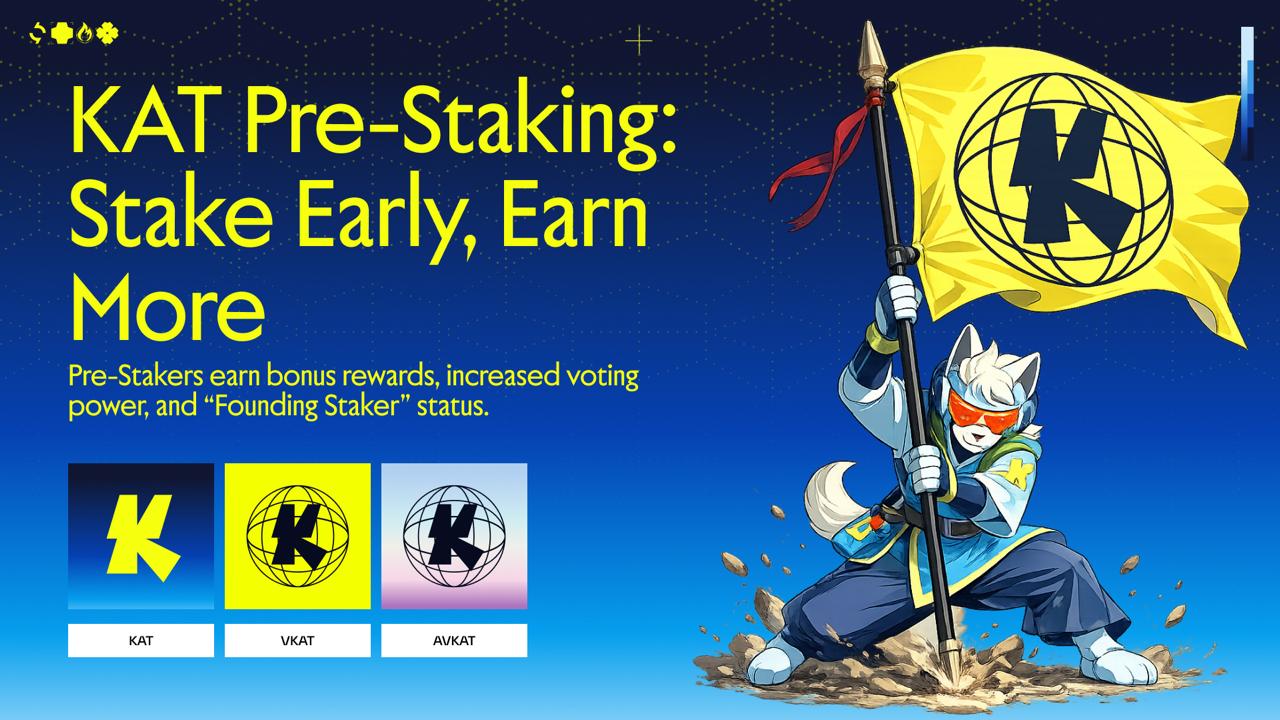 Katana KAT Pre-staking is live. vKAT pre-stakers can earn 3x voting power and rewards for the first 8 weeks. The chain-wide ve(3,3) economy is coming soon2026-03
 Katana's Binance Wallet Earn Campaign starts on March 3rd. With 50,000,000 KAT bonus rewards for depositors.2026-02
 DeFi Llama Research on Katana's chain-wide veTokenomics model for KAT2025-10
 Katana mainnet launches with $1 billion in KAT incentives, backed by Polygon Labs and GSR2025-06
 Kensei’s gamified and reputation-based memecoin launchpad is now live on Katana, with 200,000 in KAT rewards for memecoin creators2025-10
Katana (KAT): DeFi-Native Ethereum Layer‑2 and Its Incentive Engine
Katana’s KAT token is the native asset of an Ethereum Layer‑2 blockchain purpose‑built for decentralized finance, where users stake KAT into a chain‑wide ve(3,3)-style system to direct liquidity incentives and earn a share of protocol revenue. In practice, KAT functions less as a simple “gas token” and more as a coordination lever that routes real fees and emissions toward a curated DeFi stack, with vKAT and avKAT staking at the center of the model.
Origins and Design of the Katana Network
Katana was launched as a DeFi‑specialized Layer‑2 on Ethereum with the explicit goal of addressing long‑standing issues in on‑chain finance, notably fragmented liquidity and unsustainable, inflation‑driven yield models. Rather than positioning itself as a general‑purpose smart contract platform, Katana is described by its backers as an “opinionated” chain: it concentrates user activity into a focused set of core applications for trading, lending, bridging, and stablecoins. The project has been incubated and supported by Polygon Labs and the trading firm GSR, and it graduated from Polygon’s Agglayer Breakout Program with technical support from Rollup‑as‑a‑Service provider Conduit for deployment. This combination of design choices and institutional backing situates Katana as a kind of purpose‑built liquidity engine sitting on top of Ethereum, rather than merely another generalized execution environment.
Conceptually, the network’s architecture attempts to turn the Layer‑2 itself into a yield‑generating machine whose revenues are recycled back into liquidity incentives for its users. On many DeFi‑heavy chains, protocol incentives are funded predominantly through inflationary token issuance, which can erode long‑term value if not paired with durable revenue streams. Katana instead aims to route sequencer fees, bridge yields, and stablecoin revenues into an emissions budget that is actively steered by KAT stakers. The result is a model in which liquidity incentives are not only more targeted but also increasingly underpinned by “real yield” from ongoing network activity, at least in theory.
A key element of this approach is the deliberate narrowing of Katana’s core DeFi stack. Rather than hosting a sprawling, uncurated ecosystem of competing applications, Katana emphasizes a limited set of primitives, including Sushi as the primary decentralized exchange and Morpho as a preferred lending market, among others. This structure is intended to minimize liquidity fragmentation within the chain, ensuring that trading and lending depth accumulate in a small number of robust markets. The KAT token and its derivatives then act as the coordination mechanism that directs emissions toward these central venues, reinforcing their depth and competitiveness relative to other chains.
By design, the Katana network positions itself as a place where DeFi activity is not only concentrated but also algorithmically guided by a chain‑level incentive engine. The project’s public materials describe Katana as a DeFi blockchain “built to generate real revenue and recycle it into deep liquidity and sustainable yield for its users,” a framing that signals both the centrality of fee recycling and an emphasis on long‑term sustainability over short‑term emissions “farming.” Whether this model can scale without devolving into the same hyper‑inflationary dynamics seen elsewhere in DeFi will depend on the continued growth of underlying fee streams and the governance behavior of KAT stakers over time.
DeFi Pain Points Katana Targets
Katana is explicitly framed as a response to three recurring problems in DeFi: fragmented liquidity, idle capital, and unsustainable incentive schemes. Fragmented liquidity arises when multiple chains and protocols compete for the same capital, leading to shallow order books, high slippage, and unreliable execution for larger trades. Katana attempts to mitigate this by concentrating liquidity within a single Layer‑2 and a small number of core applications, so that trading and lending volumes reinforce each other rather than splintering across dozens of venues. This concentration model is intended to benefit both traders, through better pricing and execution, and liquidity providers, through higher fee capture per dollar of liquidity supplied.
Idle capital is another persistent issue, as liquidity providers often deploy assets into pools or lending markets that see little actual usage, diluting returns. Katana’s network‑level design seeks to align incentives so that emissions flow preferentially to pools where actual activity and fee generation are occurring. The vKAT Armory allows stakers to reallocate emissions via gauge voting each epoch, responding dynamically to shifts in on‑chain demand. If a particular trading pair or lending market becomes more active, rational voters have reason to direct emissions there, deepening liquidity where it is most needed and improving capital efficiency.
Finally, many DeFi protocols have relied heavily on inflationary token rewards to attract liquidity, leading to a cycle in which new tokens are emitted to sustain yields even as their value declines. Katana’s materials emphasize that its model is anchored in “real revenue” rather than purely inflationary issuance, with sequencer fees and other chain‑level revenues funneled back to users. While KAT emissions remain an important component of the incentive structure, the long‑term vision is one where the network’s fee income plays an increasingly significant role in financing rewards. This is meant to reduce dependence on perpetual token inflation, although in practice the balance between emissions and fee revenue will remain a key metric for assessing the sustainability of the system.
Architectural Overview: An Opinionated DeFi Layer‑2
Technically, Katana is an Ethereum Layer‑2 that uses rollup‑style infrastructure to batch and post transactions to Ethereum, inheriting the base chain’s security guarantees while offering lower transaction fees and higher throughput. It was deployed with support from Conduit, a Rollup‑as‑a‑Service provider, suggesting the network is built on modern rollup tooling rather than a bespoke stack. Katana’s integration into Polygon’s Agglayer ecosystem indicates that it is designed to interoperate with other Polygon‑aligned chains while still settling to Ethereum, potentially expanding its reach and bridging options as that ecosystem matures.
The most distinctive aspect of Katana’s architecture, however, is not the rollup machinery itself but the way the chain’s economics are wired into its DeFi stack. Core applications such as Sushi (for swaps), Morpho (for lending), and VaultBridge (for yield routing) are treated as first‑class citizens, with KAT emissions and chain revenues specifically structured to support their liquidity. Agora USD, a stablecoin‑related revenue stream mentioned in project materials, also feeds into this system, suggesting that stablecoin usage and associated fees will be a key component of Katana’s “real yield” narrative. This curated architecture treats the chain not as a neutral substrate but as an actively managed capital allocator for its own DeFi stack.
On the operational side, the Katana sequencer collects fees from transactions executed on the Layer‑2, just as other rollups do. Where Katana differs is in how it proposes to allocate these sequencer revenues back into its ecosystem. Rather than routing fees solely to validators, sequencers, or a foundation treasury, Katana’s design envisions a portion of these revenues being recycled into KAT staking rewards or liquidity incentives. This effectively ties the health of the chain’s fee market directly to the attractiveness of staking and liquidity provision, creating a feedback loop in which more on‑chain activity can translate into higher yields and deeper liquidity.
Revenue Recycling and the Chain-Level Flywheel
The core economic narrative around Katana centers on a “flywheel” in which on‑chain activity drives fee revenue, which in turn finances yields that attract more liquidity and users, further boosting activity. Katana’s website and documentation emphasize that the network is “built to generate real revenue and recycle it into deep liquidity and sustainable yield,” suggesting that this flywheel is not just marketing language but a fundamental design principle. In contrast to models that primarily rely on new token emissions to sustain yields, Katana seeks to ground its incentives in revenues from sequencer fees, yield from VaultBridge strategies, and income associated with the Agora USD stablecoin. These income streams are intended to serve as the engine that powers both KAT staking rewards and liquidity incentives on the network.
In practice, this means that the KAT token is positioned not merely as an asset whose value is expected to appreciate but as an instrument that channels real economic flows back to participants. Stakers who lock KAT into vKAT or avKAT positions participate in the distribution of protocol fees and emissions, earning yields that reflect both newly issued tokens and fee‑derived rewards. Liquidity providers on core applications, especially those pools favored by gauge voting in the vKAT Armory, can receive KAT incentives that are ultimately funded or supplemented by chain‑level revenues, not just by dilutive inflation. When these mechanisms function as intended, the result can be a positive feedback loop: better liquidity leads to more volume and fees, which finance higher yields, which draw in more capital and users.
This flywheel is also evident in the network’s epoch‑based reward system. Each epoch, gauge voting and trading activity determine how emissions and fees are allocated across pools, and data from recent epochs show millions of KAT being auto‑compounded into avKAT positions. Internal coverage has highlighted that in Epoch 4, roughly four million KAT were compounded into avKAT, with subsequent epochs such as Epoch 6 surpassing that mark, demonstrating growing engagement with the auto‑compounding vault and the recycling of rewards back into voting power. While these figures fluctuate from epoch to epoch, they illustrate how KAT rewards, once earned, can be reinvested to deepen a user’s stake in the system and amplify their influence over future emissions.
At the same time, the flywheel is not risk‑free. If external markets or on‑chain sentiment were to deteriorate, liquidity could withdraw, trading volumes could fall, and fee revenues could contract, reducing the yield available to KAT stakers and liquidity providers. In such an environment, the system might lean more heavily on token emissions to sustain yields, potentially undermining the long‑term sustainability it seeks to achieve. The success of Katana’s flywheel thus depends not only on its mechanism design but also on the broader market’s appetite for DeFi activity and the chain’s ability to remain an attractive venue for that activity over time.
Katana launches KAT and its chain-wide ve(3,3) engine - stakers earn from the pools they vote to direct incentives to. Early stakers get founding staker status.
The KAT Token: Supply, Distribution, and Core Functions
The KAT token is the central asset of the Katana ecosystem, serving as the medium through which users stake, vote, and capture a share of chain‑level economics. It is not strictly required to pay transaction fees or to interact with smart contracts on Katana, but it is the key instrument for participating in the network’s incentive engine and governance processes. KAT’s design intentionally blurs the line between a conventional network token and a ve‑style governance asset by embedding a one‑way path from liquid KAT into non‑transferable vKAT and liquid avKAT, both of which carry voting power and claim rights over rewards. Understanding KAT therefore requires examining not only its supply and distribution but also its transformation into derivative forms that drive behavior on the chain.
Token Supply and Initial Distribution
According to Katana’s tokenomics documentation, a total of 10 billion KAT were minted at genesis, establishing a fixed supply ceiling for the token. The project’s materials emphasize that there was no presale and that there are no venture capital investors with preferential unlocks ahead of users, positioning the token’s launch as comparatively community‑oriented. To align incentives between the network’s early adopters and its long‑term liquidity goals, the initial distribution was structured around several major buckets, including allocations for community vKAT, core application incentives, pre‑deposit rewards, TVL commitments, public sale, and ecosystem support.
One of the largest explicit allocations is a 1.5‑billion‑unit tranche of vKAT earmarked for the community, which is designed to seed voting power across a broad user base rather than concentrating it solely in the hands of a foundation or insiders. Another significant slice, amounting to one billion KAT, is reserved exclusively for incentivizing users of core applications once the mainnet is live, ensuring that trading and lending venues on Katana can be bootstrapped with substantial emission support. On top of these, about 70 million KAT are dedicated to pre‑deposit “krates,” rewarding users who supplied assets ahead of full mainnet functionality, while approximately 930 million KAT are assigned to TVL commitments that reward early capital providers with token exposure. A further 100 million KAT are earmarked for a public sale, allowing both retail and institutional users to acquire tokens on transparent terms.
The remaining portion of the 10‑billion KAT supply supports the Katana foundation, core contributors, and broader ecosystem initiatives, with vesting schedules and lockups designed to align these stakeholders with the network’s long‑term growth. Importantly, KAT was initially minted as non‑transferable, with a planned no‑transfer period of up to nine months following minting, expected to end around March 2026. During this period, users could earn and accumulate KAT through various early‑stage programs but could not freely trade it on secondary markets, a design intended to allow the network’s core infrastructure and incentive systems to mature before subjecting the token to full market dynamics. Once transferability was enabled, KAT became tradable on major exchanges while also becoming stakeable into vKAT and avKAT positions, marking the beginning of the token’s full economic life cycle.
A simplified view of the main, disclosed allocation categories can be expressed as follows, noting that the precise percentages of the remaining ecosystem and foundation allocations are not fully detailed in public summaries:
| Category | Allocation (approx.) | Share of Total Supply | Notes |
|---|---|---|---|
| Community vKAT | 1.5 billion | 15% | Distributed as voting power to community participants |
| Core app incentives | 1.0 billion | 10% | Reserved to incentivize DeFi usage on Katana’s core apps |
| Pre‑deposit rewards (“krates”) | 70 million | 0.7% | Rewards for users who pre‑deposited before full mainnet |
| TVL commitment incentives | 930 million | 9.3% | Allocated to early capital providers and liquidity commitments |
| Public sale | 100 million | 1% | Offered to retail and institutional participants |
| Foundation, contributors, others | Remaining | ~64% | Supports team, foundation, ecosystem funds, and other initiatives |
These figures illustrate how Katana attempts to balance incentives between early liquidity, community governance, and long‑term ecosystem development. Notably, the large community vKAT allocation and the lack of a VC presale underscore a strategic choice to distribute voting power relatively widely, though real‑world concentration will depend on how these allocations are claimed and used.
Utility: Governance, Staking, and Rewards
KAT’s primary role is to act as the entry point into Katana’s governance and incentive system, rather than serving merely as a transactional currency. Holders who keep KAT in its liquid form can transfer and trade it freely on exchanges or use it within the Katana DeFi stack, but they do not gain direct voting power over emissions or governance decisions. To participate in these processes, users must stake KAT into the network’s staking contracts, where it is converted into vKAT or avKAT depending on the chosen strategy. This staking step is the gateway to both governance and the lion’s share of rewards.
From a governance perspective, vKAT represents a user’s ability to influence where KAT emissions flow within the ecosystem, particularly across liquidity gauges associated with trading and lending pools. Each unit of vKAT corresponds to a locked KAT position, with voting power scaling in proportion to the amount locked. Holders can allocate their votes during weekly epochs to support specific pools, thereby directing more emissions to those venues and helping shape the network’s liquidity landscape. This mechanism allows KAT stakers to align emissions with their preferred strategies, whether that means deepening stablecoin liquidity, supporting riskier long‑tail assets, or favoring certain core DeFi venues.
On the rewards side, KAT stakers receive a combination of KAT emissions and protocol fee shares, distributed according to the voting outcomes and the performance of supported pools. The Katana documentation notes that vKAT holders can choose the composition of their rewards among several tokens, including stablecoins like USDC, major assets like WETH and WBTC, and KAT itself, or even custom mixes. This flexibility allows users to tailor their yield profile to their risk tolerance, opting for more conservative stablecoin payouts or more speculative exposure to KAT or other assets. Over time, as more chain‑level revenues are routed into the Armory, fee‑derived rewards are expected to play an increasing role alongside emissions, reinforcing the system’s “real yield” positioning.
From KAT to vKAT and avKAT: Token Derivatives
The transformation of KAT into vKAT and avKAT is central to how the ecosystem functions. When a user locks KAT through Katana’s staking app, they receive a non‑transferable NFT called vKAT, which represents their locked position and its associated voting power. Each vKAT NFT is unique, corresponding to a specific lock amount and conditions, and users can hold multiple vKAT positions, allowing for flexible management of staking commitments. Because vKAT is non‑transferable, it cannot be sold or traded on secondary markets; instead, it is designed to bind voting power and reward claims to long‑term participation in the network’s governance.
For users who prefer a more hands‑off approach, Katana offers avKAT, a liquid, transferable token that wraps vKAT and automates much of the governance and compounding logic. When users deposit KAT into the avKAT vault, the vault itself locks that KAT into the staking contracts, receives vKAT, and then manages gauge voting and reward harvesting on the user’s behalf. The vault automatically votes for what it deems the highest‑yield pools, claims rewards, and compounds them back into additional vKAT, causing the avKAT to KAT exchange rate to increase over time as value accrues. Users hold liquid avKAT tokens that represent their proportional share of this growing pool, effectively delegating both their voting power and compounding strategy to the vault in exchange for convenience and liquidity.
This structure creates a spectrum of participation options. Active, strategy‑driven users may prefer direct vKAT holdings, where they can fine‑tune their gauge votes, select reward tokens, and potentially engage with bribing markets or other advanced tactics. More passive participants can opt for avKAT, relying on the vault’s auto‑vote logic and auto‑compounding design while still benefiting from the system’s overall flywheel. Internal epoch data, such as the millions of KAT auto‑compounded into avKAT in epochs four through six, suggests that the avKAT route has attracted significant interest among users seeking a simpler way to tap into Katana’s incentive engine without micromanaging weekly votes.
Locking, Cooldown, and Exit Fees
The staking system also incorporates mechanisms to align incentives over time and discourage short‑term, mercenary behavior. When a user decides to unlock their KAT, they initiate a withdrawal process that triggers a 60‑day cooldown period, during which their vKAT position loses its voting power and ceases to earn rewards. The user’s active votes are reset at this point, and they must wait for the entire cooldown to elapse before they can reclaim their underlying KAT. This delay is designed to smooth out liquidity shocks and make it more costly for participants to exit abruptly following a period of high yields or favorable emissions.
At the end of the cooldown, a 2.5% exit fee is applied to the withdrawn KAT, and the collected fees are redistributed to remaining vKAT holders, effectively rewarding participants who maintain their stake while others exit. This exit fee serves as both a deterrent against short‑term speculative inflows and an additional source of yield for long‑term stakers. Users do retain the option to cancel a withdrawal during the cooldown period, restoring their voting power and reward accrual if they decide to remain in the system after all. These parameters collectively create a staking environment that favors patient capital and aims to discourage opportunistic “in‑and‑out” behavior that could destabilize liquidity.
During the token’s initial launch phase, Katana added an extra layer of incentives for early participants through the concept of “Founding Stakers.” Project communications indicated that users who staked KAT within roughly 72 hours of the token generation event (TGE) could obtain Founding Staker status, making them eligible for a share of exit fees accumulated during the first 60 days after launch. Exit fees collected during this initial “stabilization window” were directed exclusively to these early stakers, providing a temporary boost to their yields and recognizing their role in seeding early liquidity. While this specific window is a one‑off event tied to the launch, it illustrates Katana’s tendency to use time‑bounded incentives layered on top of its baseline staking design.
Readers clicked KAT overwhelmingly on its chain-wide ve(3,3) incentive engine and founding-staker perks, not on price or exchange listings — signaling that DeFi natives are evaluating Katana as a liquidity-coordination primitive, not a speculative token.
The vKAT Armory and ve(3,3) at the Chain Level
Beyond the token mechanics, the vKAT Armory represents Katana’s attempt to elevate ve(3,3) tokenomics from the level of individual protocols to the scale of an entire blockchain ecosystem. The Armory encompasses the vKAT and avKAT staking contracts, the gauge voting system, relayer infrastructure, and the mechanism by which rewards are distributed each epoch. In practical terms, it is the coordination engine through which KAT holders collectively decide where emissions and, increasingly, protocol revenues should flow within the network’s curated DeFi stack. By implementing a modified ve(3,3) design at the chain level rather than for a single application, Katana is experimenting with a broader form of incentive governance.
From Curve’s veCRV to Chain‑Wide ve(3,3)
The conceptual roots of the vKAT Armory lie in earlier experiments with vote‑escrowed tokens, especially Curve’s veCRV model and later “ve(3,3)” systems popularized by Solidly and related projects. In those designs, users lock their tokens to receive non‑transferable governance assets that grant both voting power over gauge emissions and boosted rewards, often with lock duration influencing voting weight. While Katana’s precise lock mechanics differ, the core idea of tying voting power to long‑term commitment is consistent. Where Katana innovates is in making this model a chain‑wide primitive rather than a protocol‑specific feature.
Instead of each DeFi protocol on the chain issuing its own ve‑style token to govern emissions, Katana centralizes this function into vKAT and the Armory. Liquidity gauges correspond not only to pools within a single DEX but to multiple pools and applications deemed core to the network. KAT stakers, via vKAT or avKAT, therefore exercise influence over an entire ecosystem’s emissions landscape in one place rather than fragmenting their governance efforts across many tokens. This consolidation is intended to simplify governance for users, reduce cognitive overhead, and ensure that chain‑level incentives remain coherent with the network’s broader strategic goals.
Gauge Voting and Emissions Allocation
Each epoch, vKAT and avKAT holders can allocate their voting power across a set of gauges representing various liquidity pools and strategies, including pools for assets like KAT, USDC, WETH, and WBTC, as well as core DeFi pairs on the network. The proportion of votes a particular gauge receives determines its share of KAT emissions for that epoch, which in turn affects the yield available to liquidity providers in that pool. This structure enables both direct governance by KAT stakers and a market for influence, where protocols and liquidity providers may offer external incentives (“bribes”) to attract votes toward their preferred gauges.
Rewards for each epoch are distributed through infrastructure such as the Merkl platform, which aggregates data on voting outcomes and on‑chain activity to calculate entitlements. vKAT holders claim these rewards manually through the Katana app, while avKAT holders see rewards automatically compounded within the vault, reflected in the rising exchange rate of avKAT to KAT. This two‑track system ensures that both active and passive participants can share in rewards, with the main trade‑off being control versus convenience.
The emergent behavior of this gauge voting system has been visible in early epochs. Coverage of epochs four through six, for example, has highlighted that millions of KAT per epoch have been auto‑compounded into avKAT as the vault directs votes toward pools that generate high trading fees and voting incentives. Such patterns suggest that the Armory is already functioning as a dynamic allocator, channeling emissions where they are most competitively rewarded, even as governance remains in its early stages. Over time, the distribution of votes across gauges will provide an important signal about where the community perceives the highest value opportunities within the Katana ecosystem.
Rewards Distribution and Auto‑Compounding Flywheel
The combination of gauge voting, flexible reward types, and avKAT’s auto‑compounding behavior reinforces the broader flywheel that Katana is attempting to build. When liquidity providers earn attractive yields in a particular pool due to strong gauge support and trading fees, they may deepen their positions, which further improves liquidity and volume and thereby increases fee revenues for the network. Meanwhile, KAT rewards earned by stakers and LPs can be re‑staked into vKAT or avKAT, increasing their voting power and reinforcing their preferred strategies in subsequent epochs. As more KAT is locked, float declines and governance becomes increasingly anchored in long‑term participants, at least under the intended design.
avKAT in particular plays a crucial role in making this process accessible to a broad audience. By abstracting away the need to manage weekly votes, claim rewards manually, and decide how to reinvest them, avKAT lowers the barrier to participating in the Armory’s flywheel. Users who might otherwise keep KAT idle on exchanges can instead delegate it to avKAT, trusting the vault’s strategy to chase the best combination of trading fees and voting incentives. The growth in avKAT’s auto‑compounded balances across early epochs underscores how attractive this set‑and‑forget model can be, especially for participants who are more interested in aggregate yield than in the nuances of gauge politics.
Governance, Risks, and Game Theory
While the vKAT Armory is designed to align incentives between KAT holders, liquidity providers, and the network’s long‑term health, it also introduces governance and game‑theoretic risks that are important to recognize. Because voting power is tied to KAT stakes, large holders or entities that accumulate significant vKAT positions can exercise substantial influence over emissions, potentially directing disproportionate rewards to pools that benefit them, even if those pools are not optimal for the ecosystem as a whole. This concentration risk is especially salient in the early stages of a network when supply is still consolidating and governance norms are not yet fully established.
The existence of external incentive markets, such as “bribes” offered by protocols to attract gauge votes, can further complicate the picture. While such markets can increase efficiency by rewarding voters for directing emissions where they are most wanted, they can also encourage short‑termism if participants chase the highest bribe yields regardless of underlying pool quality or systemic risk. Internal commentary around the launch of the vKAT system has noted that governance risks may emerge as the Armory matures, particularly if large stakeholders prioritize their own interests at the expense of broader network resilience.
Katana’s design includes some safeguards intended to mitigate these dynamics, such as lockups, cooldowns, and exit fees that favor long‑term commitment over rapid churn. Nonetheless, the system’s stability will ultimately depend on social and economic factors beyond pure mechanism design, including the diversity of KAT holders, the transparency of governance processes, and the willingness of the community to coordinate around sustainable strategies. As with other ve(3,3) systems, ongoing monitoring of voting patterns, emissions distribution, and liquidity outcomes will be critical for assessing whether the Armory is delivering on its promise of chain‑level alignment or drifting toward entrenched interests.
Katana KAT Pre-staking is live. vKAT pre-stakers can earn 3x voting power and rewards for the first 8 weeks. The chain-wide ve(3,3) economy is coming soon
Trading KAT: Exchanges, Pairs, and Market Structure
As KAT transitioned from a non‑transferable launch asset into a freely tradable token, it was listed on a range of centralized exchanges and became available on multiple fiat and crypto pairs. Binance announced a listing of KAT in mid‑March 2026, applying its Seed Tag and enabling trading on pairs such as KAT/USDT, KAT/USDC, and KAT/TRY. KuCoin similarly lists KAT, with materials describing it as the native token of a DeFi‑focused Layer‑2 and providing KAT/USDT spot trading. In the Korean market, Upbit, the country’s largest exchange, added KAT to its KRW, BTC, and USDT markets, while Bithumb introduced a KAT/KRW pair, giving the token broad exposure to Korean won liquidity. Coinbase has also listed KAT on its spot platform, making it available to buy, sell, convert, send, receive, or store for eligible customers via its website and app.
These listings mean that KAT now trades against a wide range of base assets, including BTC, USDT, USDC, TRY, and KRW, with liquidity concentrated in different pairs depending on region and venue. For many users, centralized exchanges will serve as the primary on‑ramp to KAT exposure, particularly where fiat pairs like KAT/KRW or KAT/TRY are available. At the same time, on‑chain liquidity pools—such as KAT/USDC pairs on decentralized exchanges within the Katana ecosystem—provide additional venues for trading and can be tightly integrated into the network’s gauge and incentive systems. Market participants therefore need to navigate both centralized and decentralized liquidity, taking into account factors like depth, spreads, fees, and the interplay between CEX and DEX pricing.
Spot Trading Basics: Order Types and Best Practices
On exchanges like Coinbase Advanced, Binance, and KuCoin, KAT is typically traded via standard spot order types, including market, limit, stop‑limit, and, on some platforms, bracket orders. A market order instructs the exchange to buy or sell KAT immediately at the best available prices on the order book, prioritizing execution speed over price precision. This type of order is simple to use but can result in slippage if liquidity is thin or the order size is large relative to the depth at the top of the book. In volatile conditions, market orders may fill at prices meaningfully worse than the last traded price, especially on newly listed or lower‑liquidity tokens.
A limit order, by contrast, allows a trader to specify the maximum price they are willing to pay when buying or the minimum price they are willing to accept when selling. The order will only execute at this price or better, and it will sit on the order book until matched by a counterparty or canceled by the user. Limit orders are particularly useful for trading KAT in markets where liquidity or volatility is uncertain, as they provide greater control over execution price, albeit at the cost of potential non‑execution if the market does not reach the specified level.
More advanced strategies can incorporate stop‑limit and bracket orders. A stop‑limit order allows a trader to define a stop price that, once reached, will trigger the placement of a limit order at a specified limit price. This combination can help manage risk by, for example, placing a sell stop‑limit below the current KAT price to protect against downside, without guaranteeing execution at any price below the stop. Bracket orders extend this idea by enabling traders to set both a take‑profit limit and a stop‑loss limit around an existing position, effectively bracketing the trade with predefined exit levels in either direction. For participants dealing with KAT’s sometimes volatile price action, especially around major news or listing events, such tools can be valuable for risk management.
Regardless of order type, traders should consider liquidity conditions, spreads, and potential slippage when transacting in KAT. Newly launched pairs, pairs against less common bases, or on‑chain pools without deep TVL can all be more vulnerable to large price impacts from modest order sizes. Using limit orders, staggering entries and exits, and monitoring order book depth across multiple venues are all prudent practices in such environments, particularly for larger trades.
Perpetual Futures and Leverage Considerations
Beyond spot trading, KAT has also been introduced on some derivatives platforms in the form of perpetual futures, providing leveraged exposure to the token’s price movements. Perpetual futures—or “perps”—are derivatives contracts that track the price of an underlying asset, such as KAT, without a fixed expiry date, typically using funding payments between long and short traders to keep the contract price anchored near spot. Derivatives venues that offer crypto perps often allow significant leverage, amplifying both gains and losses, and they maintain risk engines that liquidate positions if collateral becomes insufficient.
Coverage has noted that Coinbase, for example, has launched perpetual futures products and has rolled out new instruments such as stock perps for eligible non‑US traders, with around‑the‑clock trading and leverage. While KAT‑specific perpetuals are not described in Coinbase’s general derivatives documentation, internal reporting has highlighted phases where KAT‑PERP markets moved between full trading, limit‑only modes, and even temporary halts on certain venues as liquidity fluctuated. This kind of operational variability underscores a key risk of trading newly listed or lower‑liquidity perps: order books can be thin, and exchanges may adjust trading modes to manage volatility or protect their risk engines.
For traders, the main takeaway is that leveraged KAT exposure via perps is materially riskier than unlevered spot positions. Liquidation risk, funding rate dynamics, and the possibility of rapid price moves in either direction can all lead to outcomes that deviate significantly from simple spot price changes. Perps can be powerful tools for hedging or expressing directional views, but they demand robust risk management, including careful sizing, the use of limit orders in illiquid books, and a clear understanding of how funding and liquidation thresholds work on the chosen platform. They are generally most appropriate for experienced traders who fully understand these mechanics and the potential for total loss of margin.
Liquidity, Slippage, and Cross‑Market Dynamics
KAT’s liquidity profile is shaped by its presence across both centralized exchanges and on‑chain pools, with cross‑market dynamics that can sometimes introduce complexity. On CEXs like Binance and Upbit, KAT trades against BTC, USDT, USDC, TRY, and KRW, with each pair potentially having different depth and activity. On‑chain, KAT pairs—particularly KAT/USDC pools within the Katana ecosystem—are subject to gauge voting and emissions, which can attract or repel liquidity depending on the relative yields on offer. In some cases, pools may also be eligible for external incentives from other protocols, such as AERO emissions in certain KAT/USDC configurations, adding another layer to the incentive stack.
This multi‑venue structure can create opportunities for arbitrage but also risks of slippage and instability. For example, if a KAT/USDC pool on Katana were heavily incentivized by both KAT emissions and external rewards like AERO, liquidity might flood in seeking yield, only to exit rapidly if incentives change or if there is significant selling pressure on KAT. Such flows could strain the on‑chain flywheel, especially if liquidity withdraws faster than gauge voting and emissions can adjust. Internal commentary has described KAT‑USDC pools that are eligible for external emissions as “risky waters,” pointing to the potential fragility of flywheels that depend on multiple incentive sources and the possibility of abrupt shifts in behavior if those incentives wane.
Moreover, price discovery can be fragmented across venues, with CEX and DEX markets influencing each other through arbitrage but sometimes diverging temporarily during volatility spikes or liquidity imbalances. Traders and liquidity providers need to be mindful of these dynamics, monitoring not just KAT’s price on a single exchange but also its behavior across BTC, USDT, USDC, and fiat pairs and within on‑chain pools, particularly during events such as new listings, staking epoch transitions, or changes in external reward programs. In an ecosystem as intertwined as Katana’s, liquidity decisions in one corner—such as a large withdrawal from a KAT/USDC pool—can ripple outward through both on‑chain yields and centralized market pricing.
- 01ve(3,3) chain-wide flywheel↗
The novel application of ve(3,3) at the chain level — where stakers vote to direct incentives across all pools — drew the most clicks as readers assessed whether Katana's model could sustainably bootstrap deep liquidity.
- 02founding staker early advantages↗
vKAT pre-stakers earning 3x voting power for the first 8 weeks and 'founding staker' status created urgency that drove strong engagement before token transferability.
- 03Binance Wallet Earn campaign↗
The 50M KAT bonus pool for vbUSDC depositors represented a concrete, time-bounded yield opportunity that retail readers clicked to evaluate as a low-barrier entry point.
- 04mainnet launch backing and scale↗
The $1 billion KAT incentive pool with Polygon Labs and GSR backing signaled institutional credibility, pulling in readers sizing up whether the chain had staying power.
- 05protocol integrations and LP rewards↗
Frax and Kensei deployments with explicit KAT reward pools attracted readers looking for the first productive use cases beyond native staking.
- 06perp and exchange listings↗
Coinbase KAT-PERP and Korean exchange listings drew minimal clicks relative to DeFi mechanics, confirming the audience skews toward on-chain participants over traders.
How Katana’s DeFi Stack Works in Practice
While KAT and the vKAT Armory form the coordination layer, the practical utility of the network depends on its core DeFi applications and the ways users can deploy capital across them. Katana’s design philosophy emphasizes a relatively small, curated stack of protocols centered around trading, lending, bridging, and stablecoins, with KAT emissions and fee recycling structured to support these venues. In day‑to‑day use, this means that traders, liquidity providers, and borrowers interact with familiar primitives—decentralized exchanges, money markets, vaults, and stablecoins—while KAT, vKAT, and avKAT operate behind the scenes as the incentive and governance substrate.
Core Applications: Trading, Lending, and Stablecoins
On the trading side, Katana leans on Sushi as its primary decentralized exchange, concentrating swap and liquidity provision activity into a well‑known AMM design rather than fragmenting it across numerous competing DEXs. This focus seeks to ensure that KAT pairs and other key assets like USDC, WETH, and WBTC enjoy deeper liquidity and more consistent pricing than they might on a chain with many small pools scattered across multiple exchanges. Liquidity in these pools is heavily influenced by gauge voting and KAT emissions, aligning the chain’s incentive engine with its trading infrastructure.
For lending, Katana emphasizes Morpho, a lending protocol that can offer efficient borrowing and lending markets with a blend of pooled and peer‑to‑peer characteristics. By designating Morpho as a core money market, Katana channels emissions and fee support into a single lending venue, aiming to avoid the dilution that can occur when liquidity is split across multiple lending protocols. Borrowers and lenders interacting with Morpho on Katana thus benefit not only from interest rates determined by supply and demand but also from KAT‑denominated incentives and, potentially, a share of chain‑level revenues as the network evolves.
VaultBridge, mentioned in project materials, plays a role in routing capital into yield‑generating strategies, such as external yield sources or cross‑chain opportunities, with the resulting returns contributing to the network’s revenue pool. Agora USD, a stablecoin‑related product referenced in Katana’s documentation, is another important component, as stablecoin usage and associated fees can form a substantial and relatively sticky source of income for the protocol. Together, these components form a stack in which trading, lending, yield strategies, and stablecoins are all wired into the same KAT‑centric incentive system, with sequencer fees and vault yields recycling through the vKAT Armory.
Yield Sources Beyond Inflation
A central claim of Katana’s economic design is that it aspires to generate yields from actual economic activity rather than relying solely on inflationary KAT emissions. The network’s risk documentation notes that sequencer fees from L2 transactions, yields from VaultBridge strategies, and revenues from stablecoin products like Agora USD all contribute to a pool of “real yield” that can be shared with KAT stakers and liquidity providers. When the network’s throughput and DeFi usage are healthy, these revenues can provide a meaningful supplement to emissions, improving the sustainability of the system and reducing reliance on token inflation.
In practice, this means that the attractiveness of staking KAT or providing liquidity on Katana is tied not only to tokenomics parameters but also to the network’s success in attracting and retaining real economic activity. Higher transaction volumes generate more sequencer fees, more capital in VaultBridge strategies increases yield potential, and broader adoption of Agora USD boosts stablecoin revenues. All of these inputs feed into the reward mechanisms that vKAT and avKAT holders tap into, so that the more useful the network becomes as a DeFi venue, the more robust its yield offerings should be.
However, Katana’s own documentation acknowledges that this model entails specific risks. For example, if the network scales up gas capacity—that is, the supply of transaction throughput—faster than demand materializes, sequencer fees may slow, and the fee‑derived portion of yields may underperform expectations. In such scenarios, KAT emissions may need to shoulder more of the burden of maintaining attractive yields, which could strain the long‑term sustainability narrative. This tension between fee‑based and emission‑based rewards is a critical metric for evaluating Katana’s progress: a healthy evolution would see fee revenue gradually accounting for a larger share of yields, while an unhealthy one would see emissions continually propping up yields in the absence of genuine DeFi usage.
Example Flows: A Liquidity Provider’s Journey
To make these mechanics more concrete, consider the experience of a hypothetical liquidity provider who wishes to participate in Katana’s ecosystem. Suppose this user holds USDC and KAT and decides to provide liquidity to a KAT/USDC pool on Sushi deployed on Katana. By depositing both assets into the pool, they begin earning trading fees generated by swaps between KAT and USDC, with the fee rate determined by the AMM parameters. At the same time, if the pool is supported by a liquidity gauge in the vKAT Armory, it may receive KAT emissions based on how much voting power vKAT and avKAT holders have allocated to it in the current epoch.
If KAT emissions to this pool are substantial, the liquidity provider’s yield may include both trading fees in USDC and KAT rewards, which can be claimed periodically. As they accumulate KAT, the provider faces several choices. They could sell KAT on a centralized exchange like Binance or Coinbase, swap it for stablecoins or other assets on Sushi, or stake it into vKAT or avKAT to gain voting power and additional yield. By opting to stake into avKAT, for example, they delegate the responsibility of voting and compounding to the vault, which uses their staked KAT to participate in gauge voting and auto‑compounds rewards back into more vKAT, increasing their avKAT’s value over time.
Over multiple epochs, the provider’s position becomes more tightly integrated into Katana’s flywheel. Their liquidity provision helps sustain trading activity and fee generation in the KAT/USDC pool. Their staked KAT, whether via vKAT or avKAT, participates in governance decisions that influence how much emission support the pool receives in future epochs. Their earned rewards, if re‑staked, increase their voting power and deepen their alignment with the network’s long‑term trajectory. At each step, they are exposed not only to price risk in KAT and USDC but also to governance risk, smart contract risk, and the potential for shifts in emissions or external incentives.
Risk Management and Protocol Safeguards
Given the complexity of these flows, risk management is a significant concern, both for individual users and for the protocol as a whole. Katana’s risk documentation highlights several types of risk, including liquidity risk that can arise when the network increases gas capacity faster than user demand, potentially leading to lower sequencer fee revenues and weaker fee‑based yields. There are also the usual smart contract risks associated with any DeFi platform, ranging from bugs in protocol code to vulnerabilities in cross‑chain bridges used by VaultBridge or other components. While audits and formal verification can mitigate some of these concerns, they cannot eliminate them entirely.
On the user side, KAT staking carries specific risks related to lockups, cooldowns, and exit fees. Participants who lock KAT into vKAT or avKAT positions must be comfortable with the 60‑day cooldown and 2.5% exit fee that apply when they choose to withdraw, as these parameters can limit flexibility in responding to market shocks or governance controversies. Similarly, liquidity providers in KAT pairs can face impermanent loss if KAT’s price moves significantly relative to their paired asset, especially in volatile markets or around major events such as exchange listings or governance changes. Where pools are eligible for external incentives from other protocols, there is additional risk from cross‑protocol dependencies: the withdrawal of those incentives or a crisis in the external protocol can destabilize yields and liquidity in the affected pools.
Katana’s mechanism design—particularly the use of lockups, exit fees, and chain‑level gauge voting—is intended to promote more stable, long‑term participation and to align KAT holders with the network’s health. However, these same features mean that users must approach the ecosystem with a clear understanding of their time horizons, risk tolerance, and reliance on external incentives. Tools like diversified portfolio allocation, careful sizing of leveraged positions (where used), and a cautious approach to chasing the highest yields can all help mitigate some of the risks inherent in a complex, incentive‑rich environment like Katana.
Katana's Binance Wallet Earn Campaign starts on March 3rd. With 50,000,000 KAT bonus rewards for depositors.

Let's get the party started
Regulatory, Security, and Ecosystem Considerations
As a Layer‑2 blockchain with a native token, complex DeFi incentives, and listings on major exchanges, Katana operates in a regulatory and security landscape that is still evolving. While specific regulatory categorizations will vary by jurisdiction, the project’s structure raises questions common to many DeFi‑centric networks, including treatment of the KAT token, oversight of derivatives products, and the responsibilities of centralized venues that list or support KAT. At the same time, the network’s reliance on rollup infrastructure and curated protocol integrations raises distinct security and ecosystem concerns that merit attention.
Legal and Regulatory Context
In most jurisdictions, KAT is likely to be treated as a cryptoasset or token, with regulatory treatment depending on local securities, commodities, and financial instruments laws. Its listings on exchanges like Binance, KuCoin, and Coinbase suggest that these platforms have conducted internal assessments and due diligence, but such listings do not constitute formal regulatory approvals and are not guarantees of future compliance outcomes. For users, this means that access to KAT markets can be influenced by changing regulatory conditions, including potential restrictions on trading or on offering derivatives products linked to KAT.
On the derivatives side, regulatory oversight tends to be stricter, particularly for leveraged instruments like perpetual futures. Coinbase’s derivatives business, for example, offers perps to eligible traders outside the United States and emphasizes that such products are subject to regional eligibility rules and carry distinct risks. While KAT‑specific perps are not described in Coinbase’s general derivatives literature, any venue listing KAT perps must manage both market risk and regulatory obligations, potentially adjusting margin requirements, leverage caps, or trading modes in response to volatility or supervisory expectations. Traders should be aware that derivatives markets may be more prone to changes in access or rules than spot markets, especially in jurisdictions with active financial regulators.
KAT’s use as a governance and reward token in a complex DeFi system also raises potential questions about the classification of staking rewards, fee shares, and liquidity incentives, though precise regulatory interpretations will vary widely. Users should consult local guidance and, where appropriate, seek professional advice on tax treatment, reporting obligations, and any restrictions on participation in staking or DeFi activities involving KAT.
Security Posture and Infrastructure
From a security standpoint, Katana inherits some of Ethereum’s assurances by virtue of being a Layer‑2, but it also introduces its own attack surface in the form of sequencer infrastructure, rollup logic, and integrated DeFi protocols. The involvement of Conduit and alignment with Polygon’s Agglayer program suggest that Katana uses established rollup technology rather than experimental custom designs, which can be a mitigating factor in terms of base‑layer security. Nonetheless, any rollup faces potential risks around data availability, sequencer censorship or downtime, and the correctness of proof mechanisms.
The curated DeFi stack on Katana—anchored by Sushi, Morpho, VaultBridge, and Agora USD—also concentrates risk in a small number of protocols. While this concentration can simplify security auditing and reduce combinatorial complexity, it also means that a critical vulnerability in one of these core components could have outsized impact on the ecosystem. Cross‑chain bridges used by VaultBridge or by users moving assets between Katana and other networks are another well‑known risk zone in the crypto industry, as a significant share of historical exploits have targeted bridge contracts or their governance. Users and developers should monitor the audit status and security disclosures of these protocols and be cautious when relying on novel or lightly tested components.
At the chain level, Katana’s economic security is tied to the distribution and behavior of KAT and vKAT holders. If governance were to become heavily concentrated or captured, key decisions about emissions, protocol integrations, or treasury allocations could be made in ways that compromise security or fairness. This is not unique to Katana—many governance token systems face similar issues—but the chain‑level scope of the vKAT Armory amplifies its importance. Transparent governance, clear documentation, and a culture of public scrutiny are therefore important complements to purely technical forms of security.
Community, Governance, and External Partnerships
Katana’s ecosystem has benefited from high‑profile backers and partnerships, including incubation and support from Polygon Labs and GSR, and deployment assistance from Conduit. These relationships provide both technical and reputational capital, helping the project gain traction among developers, liquidity providers, and exchanges. Exchange campaigns—such as Binance’s KAT listing with Seed Tag and associated promotional activities, or Korean exchanges’ airdrop events and trading competitions for KAT in KRW, BTC, and USDT markets—have further boosted awareness and trading activity in the early stages.
Within the community, launch‑phase initiatives like the 25‑million KAT prize pool and early trading competitions have served to attract attention and bootstrap user participation, particularly around key events such as the token’s transferability and the opening of the vKAT Armory. Internal coverage has highlighted, for instance, a $30,000 trading competition in KAT and BTC markets hosted on an integrated derivatives venue, underscoring Katana’s strategy of plugging into multiple trading platforms while keeping underlying liquidity coordinated through its own infrastructure. Such campaigns can accelerate adoption but also introduce bursts of speculative activity that may not reflect long‑term fundamentals.
Governance is still in its formative stages, with early epochs of gauge voting and staking providing initial data points on how the community allocates emissions and responds to incentives. The absence of a VC presale and the sizeable allocation of vKAT to the community are structural decisions that, if realized in practice, could foster a more distributed governance landscape. Over time, the health of Katana’s community and governance will be measured by the diversity of engaged participants, the transparency and quality of decision‑making, and the ecosystem’s ability to self‑correct in the face of market or security challenges.
KAT pre-staking launch with 3x vKAT multiplier
Binance Wallet Earn campaign opens, 50M KAT pool
Katana mainnet live, $1B KAT incentives announced
KAT token goes transferable, vKAT Armory opens
Coinbase launches KAT-PERP, then halts to limit orders
Upbit and Bithumb list KAT on KRW markets
Frax and Kensei deploy on Katana with KAT LP rewards
Conclusion
Katana and its KAT token represent a concerted attempt to design a DeFi‑native Layer‑2 where the blockchain itself functions as a coordinated liquidity engine. By concentrating activity into a curated set of core applications and wiring sequencer fees, vault yields, and stablecoin revenues into a chain‑level ve(3,3) system, Katana seeks to move beyond purely inflationary incentive models toward a more sustainable, “real yield”‑oriented approach. The KAT token is central to this vision, serving as the gateway to governance through vKAT and avKAT, the medium of emissions and rewards, and a key driver of the network’s liquidity dynamics.
Mechanisms such as the vKAT Armory, gauge voting, epoch‑based reward distribution, and auto‑compounding via avKAT collectively create a sophisticated incentive landscape where users can choose between active strategy management and passive participation. Early data from staking epochs suggest that millions of KAT are being locked and compounded into avKAT, indicating engagement with the system’s design and a willingness among users to tie their capital to the network’s longer‑term evolution. At the same time, the presence of cooldowns, exit fees, and the absence of a VC presale point to a deliberate attempt to align incentives with patient capital and broad community participation.
Yet the very complexity that makes Katana’s model innovative also introduces significant risks. Governance capture, volatile external incentive programs, liquidity imbalances across CEX and DEX venues, and the inherent dangers of leveraged derivatives all pose challenges to the stability and resilience of the ecosystem. The network’s aspiration to ground yields in real revenue is admirable, but it will be tested by market cycles, competition from other chains, and the actual growth trajectory of on‑chain activity and fee generation. Users considering participation in KAT—whether through staking, liquidity provision, or trading—must therefore pair an understanding of the upside with a clear appreciation of the downside risks.
Ultimately, Katana’s success will hinge on its ability to sustain a virtuous cycle where robust DeFi usage generates fees, fees support attractive yet disciplined yields, and KAT holders use their governance power to reinforce productive, long‑term strategies. If the network can navigate the game‑theoretic, regulatory, and security challenges that accompany such an ambitious design, it has the potential to become a notable case study in chain‑level incentive engineering. If not, it will provide valuable lessons on the limits of ve(3,3) models and the difficulties of orchestrating sustainable yield at scale.
Katana's ve(3,3) engine coordinates chain-wide liquidity incentives through interconnected staking and voting contracts; a logic flaw in vote-weight accounting or reward distribution could drain protocol-wide TVL.
Polygon Labs and GSR hold significant early backing and the $1B incentive pool is protocol-controlled, meaning early large vKAT holders can dominate gauge votes and direct disproportionate emissions to their own pools.
The AERO-style emissions model risks sell pressure from mercenary LPs farming KAT rewards without long-term commitment, particularly if epoch-by-epoch auto-compounding volume drops.
KAT launched with a Seed Tag warning on Binance, perp trading was halted on Coinbase within days of launch, and Korean exchange listings arrived with airdrop bounty events — indicating thin initial liquidity and high short-term volatility.
KRW market listings on Upbit and Bithumb bring Korean regulatory exposure, but Katana's DeFi-native structure does not yet present obvious securities classification triggers beyond standard token listing risk.
The vKAT voting system controls which pools receive chain-wide incentives; without robust participation minimums, low-turnout epochs could allow coordinated actors to redirect emissions unilaterally.
Outlook
Looking ahead, Katana’s trajectory will likely be defined by three intertwined factors: adoption of its DeFi stack, the evolution of its fee‑to‑emissions balance, and the maturation of its governance culture. On the adoption front, continued listings on major exchanges, integration with trading venues offering BTC, USDT, and USDC pairs, and the deepening of on‑chain liquidity in key KAT and stablecoin pools will be crucial markers. As more capital and users test the network, the robustness of its sequencer infrastructure, bridges, and core protocols will also come under greater scrutiny.
The fee‑to‑emissions balance will be equally important. A shift toward a larger share of yields coming from sequencer fees, VaultBridge strategies, and stablecoin revenues would validate Katana’s “real yield” thesis and support more durable KAT economics. Conversely, prolonged reliance on high emissions in the absence of growing fee revenue could undermine the sustainability narrative and put pressure on token value. Close observers will watch how quickly protocol revenues grow relative to emissions and how governance responds to these dynamics.
Finally, governance culture will play a decisive role in determining whether the vKAT Armory becomes a genuine coordination engine or a venue for short‑term rent‑seeking. Diverse participation, transparent decision‑making, and a willingness to refine mechanisms in light of observed behavior will all be key to keeping the system aligned with its long‑term goals. In that sense, Katana is not just an experiment in DeFi infrastructure but also in on‑chain social organization—one whose outcomes will be instructive for the broader crypto ecosystem, whatever path it ultimately takes.
Latest KAT news
Katana launches KAT and its chain-wide ve(3,3) engine - stakers earn from the pools they vote to direct incentives to.
Early stakers get founding staker status.Katana KAT Pre-staking is live. vKAT pre-stakers can earn 3x voting power and rewards for the first 8 weeks. The chain-wide ve(3,3) economy is coming soonKatana's Binance Wallet Earn Campaign starts on March 3rd. With 50,000,000 KAT bonus rewards for depositors.DeFi Llama Research on Katana's chain-wide veTokenomics model for KATKensei’s gamified and reputation-based memecoin launchpad is now live on Katana, with 200,000 in KAT rewards for memecoin creators Frax is live on Katana. earn KAT and SUSHI rewards when you LP frxUSD and sfrxUSD.
Sources
18 records from 9 domains
katana.network
x.com
rootdata.com
kucoin.com
coinbase.com
github.com
binance.com
phemex.com
docs.katana.network
Community notes
Spot something off or out of date? Drop a note. Editors review topic notes daily and roll accepted fixes into the explainer — contributors are recognized in the monthly $SQUID drop.
Loading notes…
Help improve this topic
Have a story or tip about this topic? Submit it. See something missing? Leave a note. Editors review daily; accepted submissions and fixes count toward the monthly $SQUID drop.