
Morpho is a modular DeFi lending protocol with $11B+ in deposits, a $175M raise from Paradigm and a16z, and integrations with Coinbase, enabling isolated credit markets and curated yield vaults for institutional and retail users.
- x.com63
- theblock.co7
- dlnews.com2
- forum.morpho.org2
- snapshot.org1
- coindesk.com1
- leviathannews.substack.com1
+15 sources across the wider coverage universe
 Morpho launches Agents beta, enabling AI systems to read, simulate, and execute lending actions across Ethereum and Base with machine-native interfaces for onchain finance2026-04
 Fireblocks launches Earn, enabling institutions to generate yield on stablecoins via Aave and Morpho2026-04
 Morpho signs its first major Hong Kong partnership with HashKey Group and HSK Chain to expand compliant onchain credit infrastructure across APAC2026-07
 Resolv exploit ripples through Morpho ecosystem, hitting Gauntlet, MEV Capital, and Steakhouse USDC vaults2026-03
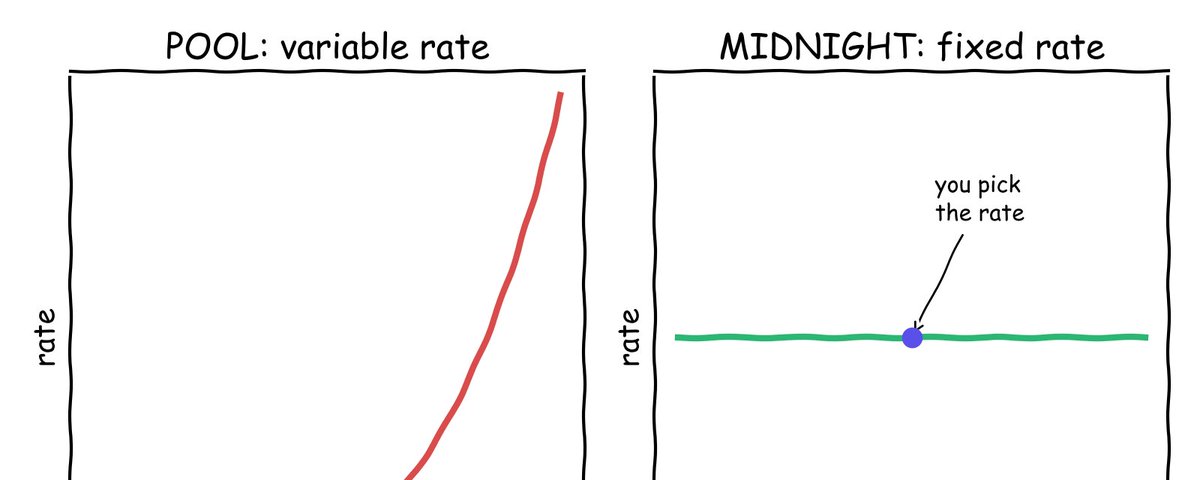 Morpho Midnight's fixed-rate credit markets shift risk to lenders through socialized bad debt, making LLTV, maturity and liquidation incentives critical parameters2026-06
 Standard Chartered initiates coverage on Morpho with a $60 price target by 2030, projecting the DeFi lending token will outperform both Bitcoin and Ethereum2026-07
A modular DeFi lending protocol that replaces shared liquidity pools with isolated, permissionless credit markets, Morpho has emerged as one of the most capitalized and institutionally integrated infrastructure layers in decentralized finance.
What Morpho Is and How It Works
Traditional DeFi lending protocols like Aave and Compound route deposits into shared pools governed by a single set of risk parameters. Every asset added to the pool is exposed to every other asset's risk. A bad debt event in one corner of the pool can socialize losses across all depositors.
Morpho takes a structurally different approach. At its core is Morpho Blue, a minimal, immutable smart contract layer that allows anyone to deploy an isolated lending market for any pair of collateral and loan assets, at any loan-to-value ratio, with any price oracle and interest rate model. Each market is self-contained. A liquidation cascade in a BTC/USDC market cannot touch an ETH/USDC market. Risk is isolated by design rather than pooled and averaged.
This architecture makes Morpho closer to a credit primitive than a monolithic lending protocol. The base layer itself is deliberately thin — fewer than 650 lines of Solidity — which reduces attack surface and makes formal verification tractable. Governance over the core contracts is minimal; the risk decisions that matter are pushed up to the vault layer.

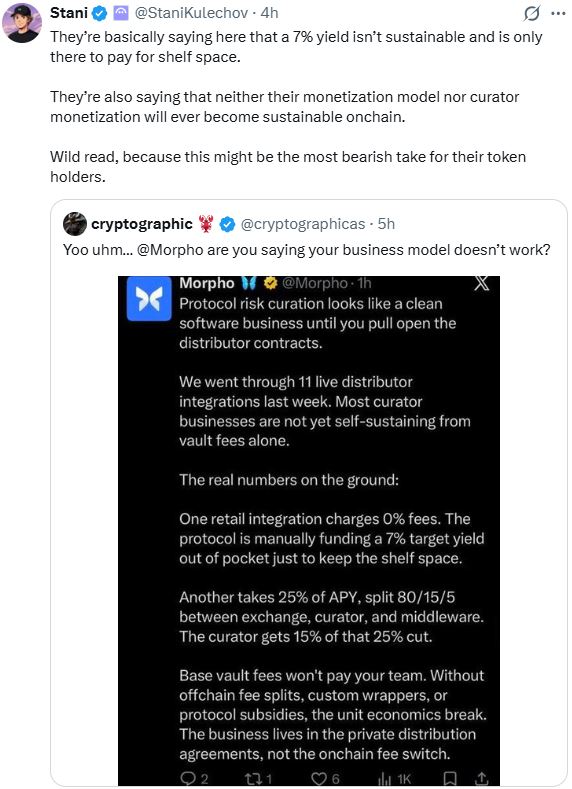
Morpho curator model faces sustainability questions as analysis finds offchain deals and subsidies
Vaults: The Risk Management Layer
Isolated markets solve the risk-pooling problem but create a new one: most depositors do not want to evaluate the creditworthiness of fifty different collateral assets and oracle configurations. That is where MetaMorpho vaults come in.
A MetaMorpho vault is a yield-aggregating contract that sits on top of Morpho Blue markets. A vault curator — typically a risk management firm like Gauntlet, Steakhouse Financial, or a protocol treasury team — sets an allocation strategy: which markets to supply liquidity to, in what proportions, and under what risk thresholds. Depositors interact only with the vault, receiving a single yield-bearing token. The curator is responsible for ongoing risk monitoring and rebalancing.
This creates a clear separation of concerns:
- Morpho Blue provides the immutable settlement layer.
- Vault curators provide the risk intelligence.
- Depositors choose a curator whose risk appetite matches their own.
The model is functionally similar to how ETF providers sit above an exchange's matching infrastructure. The plumbing is shared; the portfolio construction is differentiated.
Readers engage with Morpho through two competing narratives that expose the same tension: the curator-based architecture that makes Morpho attractive to fintechs, Coinbase, and institutional capital is the identical mechanism that propagates losses when a vault's collateral implodes — trust in the model and fear of it are inseparable.
The $175 Million Funding Round and Institutional Validation
In 2024, Morpho raised $175 million in a round co-led by Paradigm, a16z crypto, and Ribbit Capital — one of the larger DeFi-specific raises on record. The round valued Morpho's vision of an open credit network: a global, permissionless credit layer where any institution, protocol, or individual can originate, supply, or borrow against any asset without routing through a centralized intermediary.
By the time of the raise, the protocol had accumulated more than $11 billion in deposits and counted Coinbase, Binance, and Kraken among its institutional users and integration partners. That exchange-level adoption is notable: it signals that regulated, compliance-aware venues are comfortable with Morpho's architecture as a backend for yield products they surface to retail customers.
The Wall Street interest extends beyond venture. Morpho's funding history and institutional integrations have positioned it as infrastructure that traditional finance players — who need onchain credit rails with auditable, isolated risk — can build on top of without exposure to the tail risks of shared-pool protocols.
Coinbase, Retail Access, and Vault Distribution
One of the most consequential partnerships in Morpho's recent history is its integration with Coinbase. Coinbase launched a SteakhouseFi High Yield Vault directly inside the Coinbase app for U.S. users — the vault is powered by USDe (Ethena's synthetic dollar) and runs on Morpho. For many retail users, this is invisible infrastructure: they see a yield rate in a familiar interface, with Morpho handling the onchain settlement.
This distribution model — where a consumer app surfaces a Morpho-backed product without users necessarily knowing the underlying protocol — is central to the open credit network thesis. Coinbase's user base is enormous and largely non-technical. Getting Morpho-powered yield into that funnel represents a qualitative shift from DeFi-native users to mainstream retail.
Separately, Wintermute's Armitage desk launched a USDC vault on Morpho that includes allocations to Pendle principal tokens, illustrating how sophisticated market-makers are using the vault layer to construct structured yield products onchain.
Morpho proposes classifying vaults as noncustodial or discretionary as institutional interest grows

Expanding Beyond Ethereum: Citrea, LATAM, and Multi-Chain Credit
Morpho's architecture is chain-agnostic, and recent deployments reflect an ambition to become the credit layer for any blockchain ecosystem that can support EVM contracts.
Citrea integration brought what developers are calling the first trust-minimized BTC-backed lending market — a market where users can borrow against native Bitcoin without relying on custodial wrapped BTC representations like wBTC. Citrea is a Bitcoin ZK-rollup; by running Morpho Blue on Citrea, users can collateralize BTC in a fully programmable environment while keeping the trust assumptions of Bitcoin itself.
LATAM stablecoin markets on Base: Juno by Bitso, curated by Gauntlet, launched Mexican Peso (MXNB) credit markets on Morpho. Users can borrow MXNB against USDC and BTC collateral, or earn yield on MXNB deposits. This is a concrete example of how Morpho's permissionless market creation can serve regional demand — a LATAM stablecoin credit market would have been operationally infeasible on a governance-gated monolithic protocol.
- 01Fintech and institutional onboarding
Headlines featuring Revolut, Robinhood, Coinbase, World App, and SG Forge framed Morpho as the plumbing for mainstream DeFi adoption, a narrative that drew the single highest click total in the dataset.
- 02Vault contagion and exploit ripple
The Resolv exploit spreading across Gauntlet, MEV Capital, and Steakhouse vaults showed readers that curator-level failures can cascade systemically, making cross-vault contagion a recurring anxiety.
- 03Risk curator alliance shifts
Gauntlet's defection from Aave to Morpho — framed as a billion-dollar partnership split — made the curator market feel like a power struggle with real protocol-level stakes.
- 04Yield infrastructure and rate mechanics
Headlines about USDC yields, fixed-rate lending, stablecoin strategies, and the hard-kink rate-rigging allegation signaled readers are actively deploying capital and need edge on the mechanics.
- 05USD0++ depeg and leveraged unwinding
Usual Money's abrupt redemption rule change trapping Morpho leveraged farmers illustrated how a single stablecoin policy shift can spike borrow rates and freeze positions across the ecosystem.
- 06Protocol expansion and multichain reach
Deployments on HyperEVM, TON via TAC, and the Morpho-Yearn REIT stack showed readers that Morpho's primitive is being grafted onto every emerging execution environment, expanding both opportunity and surface area.
Confidential DeFi: The Zama Collaboration
One of the more forward-looking recent developments is the joint vault launched by Zama, Morpho, and Steakhouse Financial — described as Ethereum's first confidential DeFi yield vault. The vault accepts Zama's cUSDC (a fully homomorphically encrypted USDC token), allowing depositors to earn yield while keeping their position sizes and transaction details encrypted on-chain.
For institutional users, encrypted position sizes matter. A large fund depositing into a public vault signals its strategy to every onchain observer; competitors can front-run or reverse-engineer allocation decisions from public ledger data. Confidential tokens eliminate that signal leakage. The vault opened in late June 2026, with the cUSDC mechanism enabled by Zama's FHEVM (fully homomorphic encryption for the EVM).
This is an early-stage feature — fully homomorphic encryption at scale carries compute overhead, and the ecosystem of confidential DeFi primitives is nascent. But the collaboration establishes a proof of concept for privacy-preserving yield that does not require centralized intermediaries.
Risk Incidents: The MSUSD Depeg
Morpho's modular design reduces systemic risk across markets but does not eliminate risk within a single market. In a high-profile incident, MSUSD — a stablecoin pegged to the USD — lost approximately 85% of its value after the Morpho msY/USDC lending market reached full utilization. When utilization hits 100%, withdrawals are blocked because there is no liquidity to return; this created a liquidity trap that triggered a confidence collapse in MSUSD.
The episode illustrates a structural risk in isolated lending markets: a specific market can be perfectly designed and still suffer from utilization-driven liquidity crises if the underlying asset or the curator's parameters are miscalibrated. Full utilization in a pool isn't inherently a Morpho-specific failure — it can occur on any lending protocol — but the isolated market structure means the failure is contained to that market rather than spreading. The MSUSD market's collapse did not materially affect other Morpho markets.
RedStone, a key oracle provider that has supplied price feeds to Morpho for three years, has highlighted rising systemic risks in DeFi lending more broadly as TVL scales and market complexity grows. The tension between capital efficiency (high utilization) and liquidity (withdrawals available) is a core unsolved problem across the sector.

Coinbase adds fixed-rate bitcoin-backed loans through Morpho Midnight

Morpho vs. Aave and Euler: The Architecture Competition
DeFi's institutional lending layer is contested. Aave v4 has introduced a unified liquidity layer that partially borrows from Morpho's isolated risk logic while maintaining backward compatibility with Aave's governance and existing liquidity depth. Euler Finance, rebuilt after its 2023 exploit, also ships a modular architecture with some similar properties.
The competitive differentiation Morpho emphasizes is minimalism at the base layer: the fewer variables a core contract has, the smaller the attack surface and the more credibly immutable the protocol can be. Aave's governance complexity and Euler's additional features are, from Morpho's perspective, risks that belong at the vault layer — not the settlement layer.
IOSG Ventures, which doubled down on Morpho in 2026, argued publicly that Morpho's architecture is better positioned for institutional adoption precisely because it separates risk management from execution — institutions that need to customize risk parameters can do so at the vault level without waiting for protocol governance votes.
- 2023-09launch
Morpho Blue white paper published, removing DAO bottlenecks
- 2023-10exploit
Frontend JavaScript hack exposes supply-chain vulnerability
- 2024-07milestone
$50M raise led by Ribbit Capital; a16z, Coinbase Ventures, Pantera join
- 2024-09governance
Gauntlet exits Aave, signs billion-dollar curator partnership with Morpho
- 2025-01exploit
USD0++ depeg traps Morpho leveraged farmers; interest rates spike
- 2025-02exploit
Resolv exploit cascades through Gauntlet, MEV Capital, Steakhouse vaults
- 2025-03milestone
Coinbase launches consumer USDC lending product powered by Morpho
- 2025-05launch
Morpho contracts deployed on HyperEVM; Vaults V2 open-source standard announced
The Open Credit Network Vision
Morpho's stated long-term goal is an open credit network — a global permissionless layer where credit can flow to any borrower with acceptable collateral, at market-determined rates, without a central lender or governance committee approving each market's existence. In practice, this means:
- Any asset can be a collateral or loan asset if someone deploys a market for it.
- Any risk curator can manage a vault without permission from Morpho governance.
- Any distribution partner (Coinbase, Kraken, regional fintechs) can surface Morpho-backed yield to their users.
The a16z investment thesis, published as "Investing in Morpho Part III," frames this as replacing correspondent banking relationships with onchain credit rails — an ambitious framing that is still largely aspirational at current TVL levels, but one that is more grounded in working infrastructure than most DeFi whitepapers.
The Crypto Council for Innovation's Vault Coalition, which includes Morpho, Galaxy, and a16z among its backers, is lobbying for clearer U.S. regulatory treatment of yield-generating crypto vaults. The regulatory clarity question is non-trivial: whether a MetaMorpho vault constitutes a security, a banking product, or something new determines which compliance frameworks Coinbase and others must satisfy before integrating.
Outlook
Morpho enters the 2026–2027 period with strong institutional backing, a growing multi-chain footprint, and a distribution surface that extends into mainstream consumer apps. The modular architecture has proven its resilience under stress — the MSUSD incident was contained, not contagious — and the confidential vault collaboration with Zama points toward a longer-term market in privacy-preserving institutional yield.
The risks are real: regulatory uncertainty around vault products in the U.S. could slow Coinbase-style distribution deals; oracle and utilization failures in individual markets will continue to occur as the asset universe expands; and competition from Aave and Euler for institutional mindshare is intensifying. But the structural bet — that DeFi credit should be settled on minimal, immutable infrastructure rather than governed monolithic pools — has attracted enough capital and talent to become a serious contender for the backbone of onchain credit.
Latest Morpho news
Community notes
Spot something off or out of date? Drop a note. Editors review topic notes daily and roll accepted fixes into the explainer — contributors are recognized in the monthly $SQUID drop.
Loading notes…
Help improve this topic
Have a story or tip about this topic? Submit it. See something missing? Leave a note. Editors review daily; accepted submissions and fixes count toward the monthly $SQUID drop.