
Aave is DeFi's largest lending protocol, enabling permissionless overcollateralized borrowing via smart contracts. V4's hub-and-spoke design, GHO stablecoin, AAVE buybacks, and the Horizon institutional market define its 2026 strategy.
- x.com225
- governance.aave.com46
- theblock.co17
- aavechan.notion.site15
- coindesk.com13
- dlnews.com10
- youtube.com6
+21 sources across the wider coverage universe
 Aave Labs secures SOC 2 Type II attestation across security, availability, and confidentiality2026-04
 Aave founder Stani unveils “Aave Will Win” roadmap after historic proposal passes, outlining strategic direction to scale DeFi dominance and ecosystem expansion2026-04
 Fireblocks launches Earn, enabling institutions to generate yield on stablecoins via Aave and Morpho2026-04
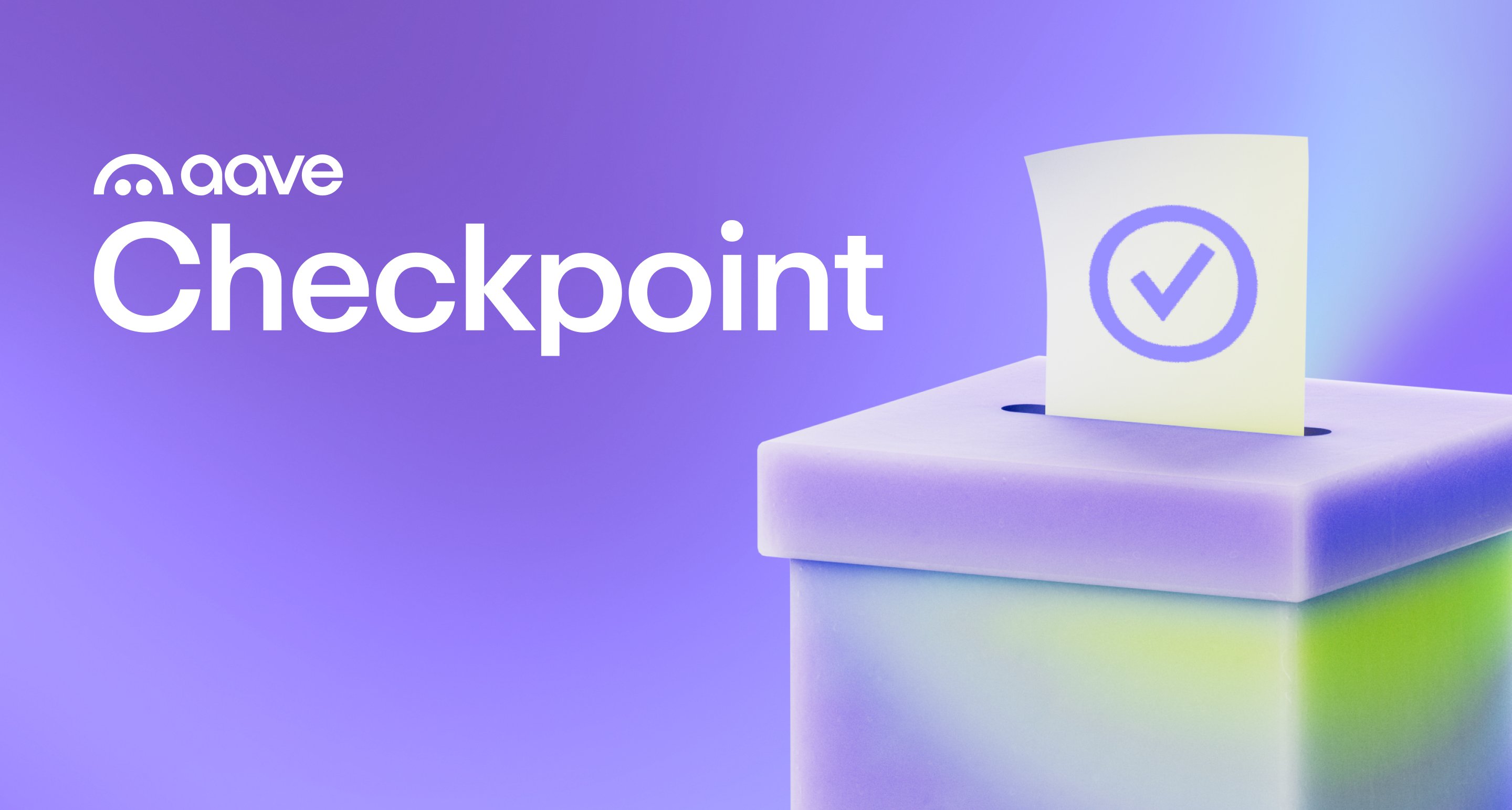 Aave Labs unveils Aave Checkpoint, a verification tool that audits governance proposals by cross-referencing onchain data with forum specs before execution2026-04
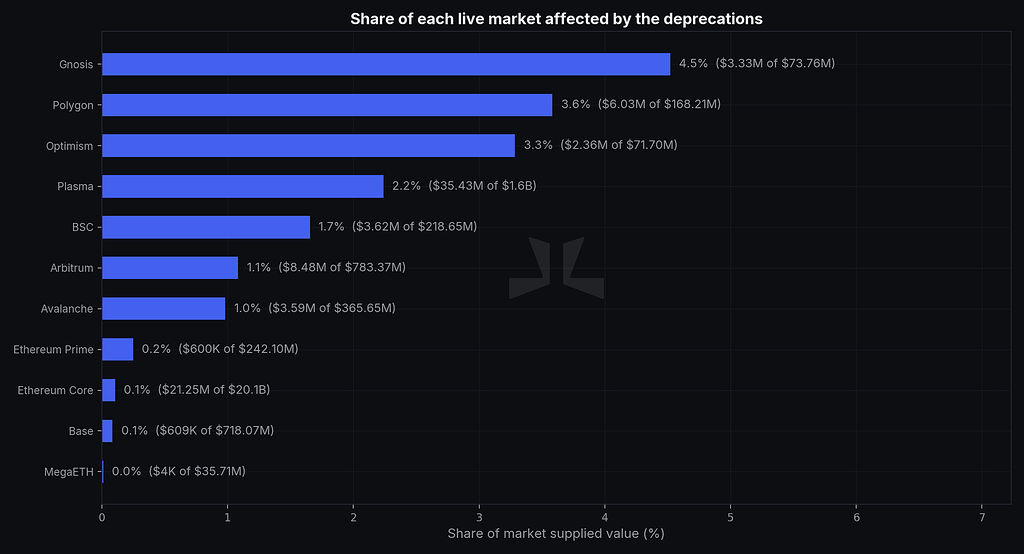 Aave to deprecate 50 low‑adoption assets and wind down multiple chain deployments, cutting risk exposure on $98.1M supply and $15.6M debt under its new risk frameworks.2026-07
 Justin Sun calls for talks with KelpDAO attacker over $300 million exploit, highlighting risks of cascading impact on Aave and major DeFi protocols2026-04
The largest decentralized lending protocol by total value locked, Aave lets anyone supply crypto assets to earn yield or borrow against their holdings — all governed by a DAO and enforced by smart contracts, with no intermediaries.
What Aave Does and Why It Matters
Traditional lending requires a bank, a credit check, and days of paperwork. Aave replaces that with a set of Ethereum smart contracts. Lenders deposit assets into shared liquidity pools; borrowers lock up collateral worth more than what they want to borrow and draw funds immediately. Rates adjust algorithmically based on how much of each pool is in use — when utilization rises, borrowing rates climb to attract more deposits and discourage excess borrowing.
This model is called overcollateralized lending: borrowers must post collateral exceeding the loan value, which is why no credit check is needed. If a borrower's collateral falls below a protocol-defined threshold — typically because its price drops — automated liquidators repay the loan and claim the collateral at a discount. That liquidation machinery, not trust, is what keeps the system solvent.
The practical scope is enormous. Aave founder Stani Kulechov has framed V4 as the onchain pathway for markets that today total roughly $12.6 trillion in repo finance, $1.3 trillion in margin lending, and $4.6 trillion in securities lending.

Aave V4 on Base adds Coinbase tokenized stocks as collateral for USDC loans

From V1 to V4: A Brief History
Aave launched in 2020, originally as ETHLend — a peer-to-peer model where individual lenders and borrowers had to be matched. The pivot to pooled liquidity in V1 removed that friction. V2, released later that year, introduced the aToken system (interest-bearing tokens that accrue yield in real time), debt tokenization, and flash loans — uncollateralized loans that must be borrowed and repaid within a single transaction block.
V3, launched in 2022, expanded aggressively to other EVM chains — Polygon, Arbitrum, Optimism, Avalanche, and others — and introduced isolation mode (limiting new or riskier assets so they can't be used as cross-collateral), efficiency mode (higher loan-to-value ratios for correlated asset pairs like ETH and stETH), and supply and borrow caps per asset.
V4, which launched on Ethereum mainnet in early 2026 after receiving a near-unanimous governance vote (more than 645,000 AAVE tokens in support), represents the most significant architectural change yet.
Aave readers click for political drama at the protocol layer — who controls risk parameters, which risk firm just quit, whether a single whale's CRV position can hold governance hostage — revealing that the audience treats Aave as a live power struggle, not a yield product.
How V4 Rearchitects Risk
V3's core limitation was a shared-pool model: all assets in a given deployment pooled risk together. A bad debt event in one market could affect the entire pool, and governance had to approve every parameter change through slow DAO votes.
V4 replaces this with a hub-and-spoke architecture. A central Liquidity Hub on each network holds the consolidated reserves and handles accounting. Individual lending markets — called spokes — draw credit lines from the hub while maintaining their own collateral rules, risk parameters, and liquidation logic. Three hubs serve distinct risk appetites: Core (blue-chip assets), Prime (higher-yield/higher-risk), and Plus (specialized or experimental).
Spokes can be built by external teams with domain expertise, not just the core Aave development group. A team specializing in liquid staking tokens or real-world assets can launch a spoke that taps into Aave's liquidity network without having to replicate the entire protocol stack. This design reduces governance overhead dramatically: spoke-level changes no longer require a full DAO vote if they stay within the hub's credit parameters. Aave V4 already hit $1 million in cumulative liquidations shortly after launch — a signal the liquidation engine is functioning under real market conditions.
GHO: Aave's Native Stablecoin
In 2023, the Aave DAO introduced GHO, an overcollateralized stablecoin pegged to the US dollar. Unlike USDC, which is issued by a regulated custodian holding reserve dollars, GHO is minted directly through the Aave protocol when users lock collateral — meaning the protocol, rather than a third party, captures the interest spread.
That interest flows back to the DAO treasury, which has used it partly to fund a $50 million annual AAVE buyback program (a governance vote formalized this in 2026, redirecting 100% of protocol revenue to token holders). GHO also gained a savings vault (sGHO) in April 2026, offering holders a fixed 4.25% APR — positioning it as a yield-bearing dollar alternative in the vein of Sky's sDAI or Ethena's sUSDe.
The stablecoin market also attracted outside integration: Frax launched its frxUSD ReserveLink directly on Aave in 2026, routing reserve yield back to Aave lenders rather than retaining it at the issuer layer — an experiment in collapsing the gap between stablecoin issuers and the lending protocols that distribute them.
- 01CRV loan governance standoff
Michael Egorov's massive CRV-collateralized position forced repeated DAO votes on freezing, liquidating, or buying CRV — turning one whale's debt into a multi-month governance crisis readers tracked obsessively.
- 02Fee switch and token buybacks
Mark Zeller's temp check on redistributing protocol revenue and buying back AAVE triggered a 45% price surge, making the fee switch the clearest direct link between governance action and token price readers had seen from Aave.
- 03Risk provider power and exits
Gauntlet's abrupt departure and Llama Risk's contested onboarding exposed how much protocol safety depends on a small number of specialized firms, and what happens when those relationships collapse publicly.
- 04Chain politics and Polygon exit threat
Aave threatening to leave Polygon over the PoS Bridge Liquidity Program — and entertaining a Sonic migration — showed readers that Aave's presence is a bargaining chip, not a permanent commitment.
- 05Umbrella safety module redesign
The replacement of the original Safety Module with Umbrella represented a fundamental change to how protocol bad debt is absorbed, drawing readers who track systemic risk backstops in DeFi.
- 06Vitalik and whale validation signals
Vitalik's 1,900 ETH deposit and a $118M BTC-vs-ETH leveraged bet on Aave functioned as high-profile endorsements that readers treat as sentiment indicators for the entire protocol.
AAVE Token and DAO Governance
AAVE is both the governance token and the backstop asset. Holders vote on protocol parameters, asset listings, risk framework changes, and treasury allocation. The Safety Module lets AAVE stakers earn rewards in exchange for being the last line of defense if the protocol has a bad-debt shortfall — their staked AAVE can be slashed up to 30% to cover losses.
That backstop was nearly tested in April 2026 when attackers drained $292 million in rsETH from the KelpDAO bridge and used the stolen tokens as collateral on Aave V3 before the exploit was detected. Aave survived $8.45 billion in withdrawals over 48 hours and avoided a $300 million emergency bailout, but the incident exposed the real cost of accepting bridged liquid staking tokens as collateral across many chains simultaneously. The DAO subsequently initiated a formal review through LlamaRisk, which proposed a unified risk framework spanning V3, V4, and Horizon — standardizing how asset risk, bridge risk, and chain risk are evaluated protocol-wide.
Governance has also been revising supply caps in response: V4 raised its caps multiple times in rapid succession as the market rebounded, a signal that the DAO can now move faster than legacy V3 required.
From a market perspective, Grayscale Research estimated in 2026 that AAVE appears undervalued at current prices, projecting roughly $60 million in 2026 protocol revenue and placing fair value at $80–$100 using a 20–25x fintech earnings multiple — with a bull-case target near $175 within twelve months. The token buyback program, direct revenue sharing, and V4 growth all feed that thesis, consistent with a broader DeFi trend documented by Delphi Digital in which protocols routing fees to token holders (Aave, Hyperliquid, Uniswap, Jupiter) have outperformed those that don't.
Horizon: Bridging DeFi and Institutional Finance
One structural limitation of all previous Aave versions was KYC: regulated institutions can't participate in anonymous lending pools. Aave Horizon, launched in 2025 and scaling through 2026, resolves this with a separate, permissioned lending market on Ethereum. Qualified institutional investors deposit tokenized real-world assets — US Treasury funds from VanEck (VBILL) and Bitwise (the rebranded Crypto Carry Fund), money-market products from Franklin Templeton and Superstate, credit instruments from Centrifuge — as collateral and borrow stablecoins like USDC against them.
The structure is significant: institutions unlock liquidity from RWA holdings without selling them, and the yield flows onchain to public stablecoin suppliers who don't need to meet KYC requirements themselves. BitGo has formalized access to both Horizon and the Spark protocol as part of its regulated DeFi offering, and Bitwise received formal approval as an asset issuer on Horizon. Horizon had approximately $550 million in net deposits by late 2025 and was targeting over $1 billion through 2026 partnerships.
- 2023-01launch
Aave V3 deploys on Ethereum mainnet
- 2023-07launch
GHO stablecoin launches on Ethereum
- 2023-11governance
Gauntlet recommends freezing CRV and zeroing LTV on V2
- 2024-03governance
Aave DAO rejects proposal to freeze Egorov CRV loan
- 2024-07governance
Gauntlet terminates Aave risk provider relationship
- 2024-10governance
Mark Zeller fee switch temp check triggers 45% AAVE rally
- 2024-11milestone
Umbrella Safety Module introduced as replacement for original SM
- 2025-02exploit
Chaos Labs oracle error causes ~$21M in wrongful liquidations
Competitive Landscape
Aave is the market-share leader in DeFi lending, but the category is actively contested. Morpho has built a competing modular architecture, allowing anyone to deploy isolated lending pairs without governance approval. Euler relaunched after its own 2023 exploit with a similarly modular design. The competitive dynamics increasingly favor protocols that can offer institutional-grade risk isolation without sacrificing liquidity depth — exactly the tension V4's hub-and-spoke model was designed to resolve.
DeFi lending, as a category, is converging on a common design pattern: shared liquidity for efficiency, isolated risk units for safety. Aave, starting from the largest TVL base (~$14.5 billion across all deployments in mid-2026, down from a $30 billion peak before the KelpDAO stress event), has more to protect and more to leverage than its competitors.
How Risk Is Actually Managed
Risk management on Aave runs across several layers:
- Collateral parameters: Each asset has a loan-to-value ratio (how much can be borrowed per dollar of collateral), a liquidation threshold (when liquidation is triggered), and a liquidation bonus (the discount offered to liquidators).
- Supply and borrow caps: Hard limits on how much of any asset can be deposited or borrowed, reducing concentrated exposure.
- Oracle dependencies: Aave relies on Chainlink price feeds to determine collateral values. Oracle manipulation is one of the protocol's primary attack vectors.
- Bridge risk: The KelpDAO incident demonstrated that wrapped or bridged assets inherit the security assumptions of their source chains and bridge contracts — a category Aave's new risk framework now explicitly models.
- The Safety Module: The last-resort backstop, funded by staked AAVE and staked GHO, providing a slashable insurance pool.
Automated monitoring services — including those run by governance-mandated risk teams like Gauntlet and Chaos Labs — continuously adjust parameters based on on-chain conditions and can execute emergency changes faster than a governance vote allows.
Outlook
Aave enters the second half of 2026 with a more resilient architecture (V4), a maturing stablecoin (GHO), and a credible institutional on-ramp (Horizon) — three products that address distinct market segments while sharing the same DAO and liquidity network. The KelpDAO episode was a genuine stress test; the protocol absorbed it without a bailout, though the aftermath triggered the most comprehensive risk framework overhaul in its history.
The larger ambition — bringing repo markets and securities lending onchain — remains speculative, but the infrastructure to pursue it is more complete than it has ever been. Whether Aave can capture a meaningful slice of traditional credit markets depends on regulatory clarity for permissioned DeFi, the continued maturation of tokenized asset markets, and its ability to maintain its TVL and security lead as Morpho and Euler close the architectural gap.
Latest Aave news
Community notes
Spot something off or out of date? Drop a note. Editors review topic notes daily and roll accepted fixes into the explainer — contributors are recognized in the monthly $SQUID drop.
Loading notes…
Help improve this topic
Have a story or tip about this topic? Submit it. See something missing? Leave a note. Editors review daily; accepted submissions and fixes count toward the monthly $SQUID drop.