
LlamaRisk is a DeFi risk research firm holding active mandates across Aave and Ethena, and a former Curve Finance mandate — producing governance proposals, incident analysis, oracle infrastructure, and regulatory research to protect protocol users.
- x.com51
- llamarisk.com6
- cryptorisks.substack.com4
- governance.aave.com4
- gov.curve.finance3
- youtube.com2
- hackmd.io1
+1 sources across the wider coverage universe
 LlamaRisk expands its risk management mandate across the full Aave protocol fleet2026-04
 LlamaRisk proposes a unified risk framework for Aave V3, V4 and Horizon, aiming to standardize asset evaluation and protocol-wide risk oversight2026-06
 rsETH Incident Report by LlamaRisk
Aave details the rsETH bridge exploit, models up to $230M in potential bad debt across L1/L2 scenarios, and outlines freezes, rate changes, and coverage plans to contain protocol risk and protect users.2026-04
rsETH Incident Report by LlamaRisk
Aave details the rsETH bridge exploit, models up to $230M in potential bad debt across L1/L2 scenarios, and outlines freezes, rate changes, and coverage plans to contain protocol risk and protect users.2026-04 LlamaRisk models $123M-$230M Aave bad debt from Kelp rsETH exploit as WETH reserves hit 100% utilization2026-04
 LlamaRisk's renewal bid for Curve Finance faces scrutiny amid DeFi risk landscape2026-03
 LlamaRisk post-mortem pins LlamaLend sDOLA exploit on unsmoothed vault oracle reads; $190K donation inflated PPS 13.79%, hard-liquidating 27 borrowers2026-03
A specialized DeFi risk research firm operating at the intersection of protocol governance and quantitative finance, LlamaRisk has become one of the most influential independent risk managers in the Ethereum ecosystem — holding mandates across Aave and Ethena, and formerly Curve Finance.
What LlamaRisk Does
Risk management in decentralized finance is not a single discipline. It spans collateral assessment, oracle integrity, liquidity modeling, regulatory analysis, and governance participation. LlamaRisk positions itself as a full-stack risk partner: it produces public research, submits governance proposals, sits on risk committees, and in some cases builds the infrastructure — oracles, monitoring tools, analytical frameworks — that protocols use to protect themselves.
The firm operates differently from a traditional auditing shop. Rather than one-time code reviews, LlamaRisk embeds in protocol governance over multi-month or multi-year terms, giving it longitudinal visibility into how risk evolves as markets, collateral types, and code change. That continuity is a meaningful structural advantage in an industry where the threat surface shifts constantly.
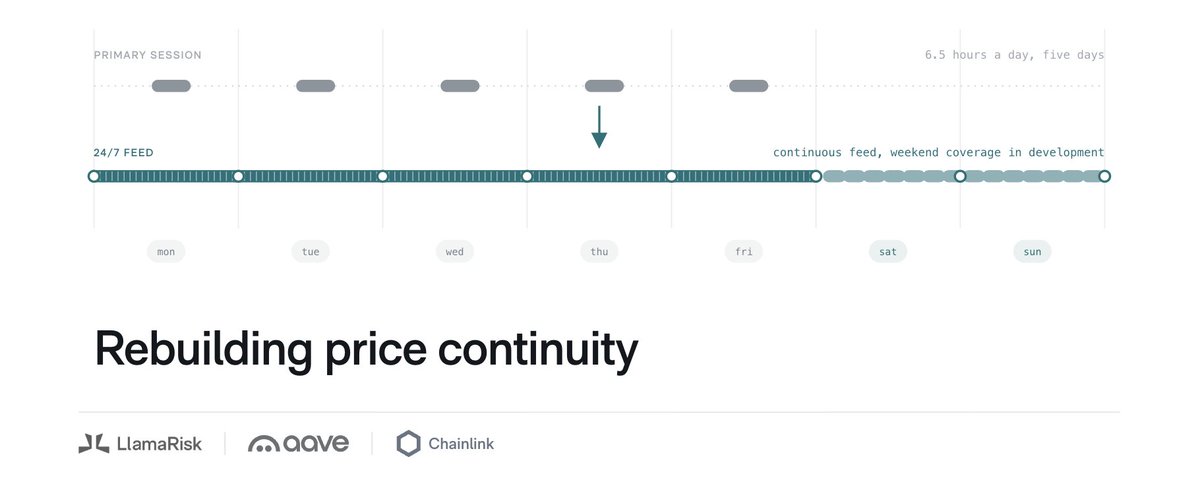
Chainlink and LlamaRisk are rebuilding price continuity for tokenized stocks
The Curve Finance Partnership
LlamaRisk's longest-running mandate was with Curve Finance, Ethereum's stablecoin and pegged-asset liquidity protocol. Curve was the firm's first client, in 2022, and became its longest continuous engagement. The Curve DAO renewed the partnership in April 2026 with the intent to serve through April 2027, but LlamaRisk concluded the engagement early, effective June 30, 2026 (announced May 29), to concentrate on its expanded, sole-provider mandate at Aave — "a structural decision about where LlamaRisk concentrates its resources going forward, not a reflection of our view of Curve." The transition covered five workstreams: LlamaLend v1 deprecation, impaired-market resolution including sDOLA, LlamaLend v2 preparation, emergency-control recommendations, and knowledge handoff to Swiss Stake; and LlamaRisk returned unused crvUSD and post-June CRV vesting to the DAO treasury. The Curve DAO opened a call for successor risk teams that July.
The scope is broad. In Q3–Q4 2024 alone, LlamaRisk drove 26 active governance proposals and helped administer a 250,000 OP grant from the Optimism ecosystem. On the product side, the firm worked directly on crvUSD — Curve's native stablecoin — including reviewing peg-defense mechanisms during periods of "unusually severe" market conditions and publishing analysis on which monetary policy configurations best protect borrowers.
A notable example of applied research: LlamaRisk's examination of Curve's LlamaLend platform identified that the Quadratic variant of the Semilog Monetary Policy best balanced market performance with user protection — a recommendation grounded in empirical market data rather than theoretical preference. The firm also produced a post-mortem on the LlamaLend sDOLA exploit, attributing the incident to unsmoothed vault oracle reads. A $190,000 donation inflated the price-per-share by 13.79%, triggering hard liquidations for 27 borrowers. The technical specificity of that finding — tracing the damage to a single oracle design choice — illustrates the depth LlamaRisk brings to incident analysis.
LlamaRisk was also active on crvUSD expansion, formally proposing the onboarding of Frax's frxUSD stablecoin as a PegKeeper asset for crvUSD with an initial $3 million debt ceiling, and separately proposing disabling all gauges in the Elixir marketplace. Each proposal represents a direct governance action with protocol-level consequences, not just advisory commentary.
Jointly with Pangea, LlamaRisk identified that structural flows from Curve's YieldBasis product tightly coupled the crvUSD system to Bitcoin price movements, with a 1% BTC move able to trigger roughly $3.51 million in crvUSD sales. LlamaRisk proposed scaling the credit line from $300 million toward $1 billion in phased increments, starting with an $80 million initial tranche, to balance YieldBasis's growth against Curve's credit exposure.
Readers click LlamaRisk content most when it signals a concrete shift in who controls risk parameters for billions in live DeFi TVL — the Aave provider vote and Curve forum posts outperform pure incident reports because the governance power question is more consequential than the technical finding.
Aave: Scaling the Mandate
The other major pillar of LlamaRisk's work is Aave, the dominant decentralized lending protocol. What began as advisory engagement has grown into a formal, renewed mandate covering the full Aave protocol fleet — including Aave V3, V4, and Aave Horizon, the protocol's institutional lending product.
The scope of the Aave relationship reflects how protocols think about risk as they scale. Rather than treating each deployment independently, LlamaRisk has proposed a unified risk framework designed to standardize asset evaluation and provide protocol-wide oversight across all versions. That kind of systemic view matters especially as Aave operates across multiple chains and serves increasingly heterogeneous collateral types.
The firm's incident modeling has been particularly prominent. When the Kelp rsETH bridge was exploited, LlamaRisk modeled potential bad debt exposure between $123 million and $230 million across Layer 1 and Layer 2 scenarios — a range that reflected genuine uncertainty about how the exploit would propagate through Aave's liquidation mechanics. The analysis informed emergency freezes, rate changes, and coverage planning. A full incident report followed, detailing the exploit mechanics, Aave's response, and recommendations to contain protocol risk and protect users.
On the product development side, LlamaRisk published research on the Aave V4 Reinvestment Controller — a mechanism designed to improve capital efficiency by deploying idle reserves into yield-generating strategies. The firm also analyzed GHO, Aave's native stablecoin, examining its backing composition and its growing integration with real-world assets. Separately, LlamaRisk released a preliminary analysis of the GENIUS Act, a proposed U.S. stablecoin regulatory framework, concluding that GHO does not qualify as a "payment stablecoin" under the act's statutory definition — and recommending that Aave maintain GHO's current architecture rather than restructure it to fit the regulatory category.
Aave Horizon and Real-World Assets
One of the more forward-looking areas of LlamaRisk's work is Aave Horizon, the protocol's dedicated lending environment for tokenized real-world assets (RWAs). Horizon reached $550 million in deposits as RWA lending surged, and LlamaRisk has been building risk infrastructure alongside that growth.
The centerpiece is LlamaGuard NAV, a next-generation oracle for tokenized RWAs built in collaboration with Chainlink and Aave Labs. Traditional price oracles are designed for liquid, continuously traded assets. Tokenized RWAs — which might represent treasury bills, private credit, or real estate — have different pricing dynamics: infrequent valuations, legal risk dimensions, and redemption mechanics that don't map cleanly onto spot price feeds. LlamaGuard NAV addresses this by delivering dynamic, risk-adjusted net asset value feeds with automated safeguards, setting a new technical standard for how DeFi lending can safely accept RWA collateral.
The firm also published a legal risk cartography of tokenized RWAs — a taxonomy of the legal risks embedded in different asset structures, jurisdictions, and issuer arrangements. That kind of cross-disciplinary work, combining legal analysis with DeFi protocol design, is relatively rare and speaks to the breadth of competency LlamaRisk has built.
- 01Curve governance parameter control
LlamaRisk's repeated forum posts recommending Llama Lend and crvUSD adjustments showed readers that a single firm's analysis directly moves protocol dials on billions in collateral.
- 02Aave risk provider selection
The multi-headline arc — vote announced, vote live, vote passed, mandate expanded — gave readers a rare real-time window into how a major DAO assigns institutional risk authority.
- 03WBTC collateral risk limits
LlamaRisk recommending LTV reduction to zero on WBTC amid the BitGo custodian transition framed a familiar asset as a live counterparty risk, not just a price risk.
- 04Exploit post-mortems and bad debt modeling
The rsETH bridge exploit report quantifying up to $230M in potential bad debt and the sDOLA oracle exploit pin-point attracted readers who want accountability math, not just incident summaries.
- 05Ethena USDe risk oversight
LlamaRisk joining the Ethena risk committee and launching a dedicated dashboard tied the firm's credibility to the fastest-growing stablecoin's risk governance at a moment of peak reader anxiety about yield-backed pegs.
- 06Monetary policy model optimization
The Semilog Quadratic policy research and ArcadiaSim simulator launches showed readers LlamaRisk moving from passive auditor to active protocol designer, broadening the firm's perceived role.
The Ethena Risk Committee
Beyond Aave, and following its former Curve engagement, LlamaRisk has secured a fourth consecutive term on the Ethena Risk Committee. Ethena is the issuer of USDe, a synthetic dollar backed by hedged crypto positions rather than fiat reserves. The risk profile of USDe is meaningfully different from collateral-backed stablecoins: it depends on funding rate dynamics, derivative market liquidity, and custodian counterparty risk.
LlamaRisk's continued presence on the committee reflects both Ethena's complexity and the market's recognition that the firm has developed relevant domain expertise. Sitting on multiple risk committees across different protocol architectures also gives LlamaRisk a cross-protocol view of systemic risk that few single-protocol teams can match.
Emerging Research Areas
LlamaRisk's research agenda in 2025–2026 has pushed into several new areas that reflect where DeFi risk is evolving.
Risk oracles. LlamaRisk has expanded its LlamaGuard oracle stack, interpreting observable on-chain and market data as risk signals that trigger automated safeguards — freeze-at-last-good states, circuit breakers — rather than manual governance intervention. The stack is accessible through the firm's research portal.
RWA integration to DeFi. Each category of tokenized financial instrument — treasury bills, private credit, real estate — carries unique features requiring adjustment to pricing strategy, risk management, and often protocol design and parameter changes. LlamaRisk's Aave Horizon work, detailed above, is one expression of this research area.
Regulatory analysis. The GENIUS Act analysis demonstrates that LlamaRisk is tracking legislative developments that could materially affect protocol design. As stablecoin regulation advances in the U.S. and Europe, protocols will increasingly need formal legal-technical analysis to guide architecture decisions. LlamaRisk appears to be positioning itself to provide that.
- 2024-02milestone
Ethena USDe surpasses Dai at $5.8B supply
- 2024-04exploit
LlamaRisk publishes rsETH bridge exploit report modeling $230M bad debt
- 2024-06exploit
UwU lend incident triggers crvUSD upward depeg; LlamaRisk issues report
- 2024-08governance
Aave DAO votes to onboard LlamaRisk as second risk provider
- 2024-09governance
LlamaRisk recommends WBTC LTV reduced to zero over BitGo custodian transition
- 2024-11milestone
LlamaRisk joins Ethena risk committee; launches USDe risk dashboard
- 2025-01milestone
LlamaRisk expands mandate across full Aave protocol fleet
- 2025-04exploit
sDOLA oracle exploit post-mortem: unsmoothed vault reads hard-liquidated 27 borrowers; $190K loss
How LlamaRisk Gets Paid and Governed
LlamaRisk's engagements are structured as governance proposals — typically multi-month or annual terms approved by token holder votes. The firm submits renewal proposals, subject to community scrutiny. The Aave community renewed LlamaRisk for a year; the Curve DAO's mandate concluded on June 30, 2026, after which the DAO opened a call for proposals for a successor risk provider. LlamaRisk's April 2026 Curve renewal itself faced scrutiny amid a broader DeFi risk landscape debate — governance-based contracting is not automatic, and the firm must continuously demonstrate value to token holders who control the budget.
This model has meaningful implications for how LlamaRisk operates. Its research and proposals are public by design, since the community needs to evaluate them. Transparency is structural, not optional. That differs from how traditional risk consulting firms work, where analysis is typically client-confidential.
Limitations and Criticisms
No risk management process eliminates risk, and LlamaRisk's track record includes incidents that occurred on protocols under its watch. The LlamaLend sDOLA exploit, the rsETH event's potential for Aave bad debt, and the crvUSD peg stress events all occurred during active engagement. The firm's post-mortems on these incidents are valuable precisely because they acknowledge failures honestly — but it is worth being clear that risk management is a mitigation discipline, not a prevention guarantee.
The governance-based funding model also creates potential tensions. A firm that depends on community votes for revenue has incentives to maintain good relationships with protocol teams, which can create subtle pressure against strongly critical assessments. Whether LlamaRisk navigates this tension successfully is a question that community observers continue to monitor.
Outlook
LlamaRisk enters the second half of 2026 with its current mandate centered on the full Aave fleet — including V4 and Horizon — and a fourth term on the Ethena Risk Committee, following the June 2026 conclusion of its four-year Curve engagement, historically its most significant mandate. Its research surface has expanded from collateral evaluation into oracle infrastructure, regulatory analysis, and cross-system correlated risk modeling.
The structural trends driving demand for its work are durable: more complex collateral types (RWAs, synthetic assets, prediction market positions), more cross-chain deployments creating arbitrage and liquidation complexity, and a regulatory environment demanding more formal documentation of risk frameworks. LlamaRisk's multi-protocol positioning also means it accumulates pattern recognition across ecosystems that single-protocol risk teams cannot develop internally.
The open question is whether a governance-funded model can sustain the staffing and analytical depth required as DeFi's risk surface keeps expanding — and whether the firm can maintain critical independence as its revenue becomes more dependent on the goodwill of the communities it advises.
Latest LlamaRisk news
Sources
8 records from 6 domains
gov.curve.finance
blog.pangea.foundation
governance.aave.com
gov.ethenafoundation.com
llamarisk.com
portal.llamarisk.com
Community notes
Spot something off or out of date? Drop a note. Editors review topic notes daily and roll accepted fixes into the explainer — contributors are recognized in the monthly $SQUID drop.
Loading notes…
Help improve this topic
Have a story or tip about this topic? Submit it. See something missing? Leave a note. Editors review daily; accepted submissions and fixes count toward the monthly $SQUID drop.