
Explainer on “Horizon” across crypto and tech, focusing on Aave Horizon’s institutional RWA market, Bitcoin’s Horizon NFT marketplace, Meta’s VR worlds, and emerging agentic AI platforms, with context on risk, RWAs, USDC, AAVE and onchain finance.
+10 sources across the wider coverage universe
 LlamaRisk expands its risk management mandate across the full Aave protocol fleet2026-04
 Kontor Protocol launches permanent file storage on Bitcoin for NFTs; Horizon Market first to integrate.2026-04
 Aave welcomes Bitwise's rebranded Crypto Carry Fund to Horizon, with more than $120M deposited into the tokenized fund leveraging market-neutral crypto yield opportunities2026-06
 LlamaRisk proposes a unified risk framework for Aave V3, V4 and Horizon, aiming to standardize asset evaluation and protocol-wide risk oversight2026-06
 Aave Labs proposes standardized technical framework for V3, V4, and Horizon asset listings2026-05
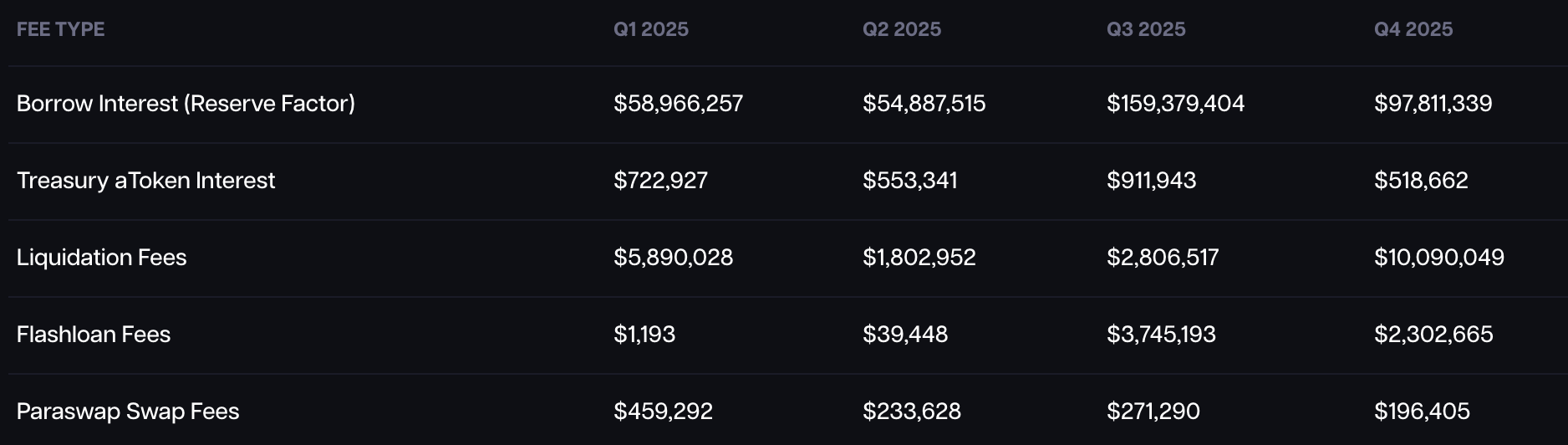 Aave Chan Initiative Accuses Aave Labs of Diverting DAO Revenues and Privatizing Protocol Economics, Demands Clarity on CowSwap Integration, Vault Fees, Horizon Deals, and V4 Liquidation Engine Incentives.2025-12
Horizon in Crypto and Web3: From Institutional DeFi to Metaverse and AI
In digital asset markets and adjacent technologies, “Horizon” has become a shorthand for new frontiers, from Aave’s institutional real‑world asset lending market on Ethereum to a Bitcoin NFT marketplace, Meta’s social VR world, and emerging agentic AI platforms. At the same time, the term still carries its traditional financial meaning of a time horizon for risk and return, which quietly underpins how investors think about onchain portfolios, tokenized treasuries, and crypto basis trades.
Why “Horizon” Keeps Appearing in Crypto and Tech
The word “horizon” is attractive branding for crypto and Web3 projects because it evokes both distance and possibility: a boundary that marks the edge of what is visible today and hints at what might emerge next. In traditional finance, an investor’s time horizon determines which assets are appropriate, how much volatility they can tolerate, and what sorts of strategies are viable. That same logic now permeates digital asset markets where participants are asking what the next three, five, or ten years of onchain infrastructure will look like, whether that means tokenized U.S. Treasuries, Bitcoin‑based NFTs, or AI‑driven autonomous trading.
In crypto news coverage, the term is frequently used metaphorically to frame these transitions. Headlines describing a “golden horizon” for real‑world asset infrastructure, a multichain treasury “voyage” charting a new horizon, or Coinbase’s move from startup exchange to S&P 500 constituent as a milestone on the industry’s horizon all rely on this imagery. The recurring motif helps readers situate developments like RWAs, privacy protocols, and AI tooling as part of a broader arc rather than isolated announcements. It is not simply a stylistic tic: it reflects how market participants genuinely think about phase shifts in technology and regulation.
At the product level, “Horizon” has become a favored name for platforms trying to embody that forward‑looking stance. Aave Horizon, for example, positions itself as the institutional bridge between tokenized real‑world assets and permissionless stablecoin liquidity, explicitly pitched as the next stage in DeFi’s evolution from pure crypto‑collateralized lending to onchain representations of bonds and funds. Horizon Market, a Bitcoin NFT marketplace, similarly brands itself as a discovery layer for Ordinals and other experimental inscription‑based assets, at the frontier of what the Bitcoin base layer can support. Meta’s VR environment, Horizon Worlds, and Topia’s Horizon AI platform for global mobility inhabit parallel frontiers in immersive social platforms and agentic enterprise software.
For a crypto news audience, this proliferation can create confusion. A headline about “Horizon TVL,” “Horizon NFTs,” or “Horizon’s AI agents” might refer to very different systems, chains, and user bases. Understanding the main “Horizon” projects, and the narratives they plug into, makes it easier to parse which stories are about institutional DeFi risk frameworks, which are about Bitcoin blockspace, and which are about metaverse or AI ventures that may or may not connect directly to onchain finance.

LlamaRisk expands its risk management mandate across the full Aave protocol fleet
Aave Horizon: Institutional DeFi’s RWA Landing Zone
Among all the uses of the name, Aave Horizon is the most consequential for DeFi and onchain finance. Aave Labs launched Horizon as a new lending market on Ethereum designed specifically for institutions and other qualified users to borrow stablecoins against tokenized real‑world assets (RWAs). Built on Aave Protocol version 3.3, the market sits alongside Aave’s more familiar retail‑facing pools, but it differs in one crucial respect: collateral is made up of permissioned RWA tokens that enforce compliance rules at the token level, while liquidity comes from permissionless stablecoin deposits like USDC, Ripple’s RLUSD, and Aave’s native over‑collateralized stablecoin GHO. This architecture lets institutional portfolios interact with the open liquidity of DeFi without compromising issuer requirements around know‑your‑customer checks, transfer restrictions, and jurisdictional limits.
Launch, Scale, and Positioning within Aave
Horizon officially launched in August 2025, backed by a roster of tokenization and stablecoin issuers including Circle, Ripple, Superstate, Centrifuge, and others focused on bringing traditional assets onchain. Within a matter of months it grew from a new product line to a sizable institutional venue: by late Q4 2025, Horizon had reportedly cleared around 440 million dollars in net deposits, and by early 2026 it spent time in the 550 to 600 million dollar range as the team calibrated supply and borrow caps. Those figures are modest compared with the total value locked across the entire Aave ecosystem, but they are significant for a market that exclusively targets qualified investors posting permissioned RWA collateral.
This growth has helped cement Aave’s positioning as a front‑runner in institutional DeFi and RWA integration. The core Aave protocol—governed by the AAVE token, with longstanding pools for crypto assets and stablecoins—already serves as a backbone of onchain money markets on multiple networks. Horizon extends that footprint into a segment of the market that was historically inaccessible to DeFi: regulated funds, asset managers, and corporate treasuries that need more than a generic public pool with anonymous liquidity providers. By offering a dedicated RWA venue with governance, risk management, and issuer relationships tailored to those needs, Aave is effectively building a second layer of product on top of its base protocol.
Horizon’s launch also aligns with broader market commentary that onchain finance is maturing from simple token swaps and undifferentiated lending pools into something closer to a full financial stack. Commentators focused on institutional DeFi have pointed to the combination of compliant collateral, standardized risk frameworks, and verifiable data infrastructure as the prerequisites for more complex products like structured credit, tokenized private funds, and onchain securitizations. Horizon’s trajectory thus serves as a case study in how a DeFi blue‑chip protocol can adapt its architecture to this new landscape while still preserving key properties like non‑custodial smart contract execution.
Permissioned Collateral Meets Permissionless Liquidity
Horizon’s most distinctive feature is its hybrid permissioned–permissionless model. On the collateral side, only whitelisted RWA tokens that encode KYC rules and transfer restrictions directly in their ERC‑20 logic can be posted. Examples include tokenized short‑term U.S. Treasury funds like Superstate’s USTB, Centrifuge‑originated pools such as JAAA and JTRSY, Circle’s yield‑bearing USYC, and VanEck’s tokenized bill product VBILL, which collectively represent diversified exposure to government debt and high‑grade fixed income instruments. These tokens restrict ownership to qualified investors and often enforce geography‑specific constraints, which means only those entities can hold them and, by extension, use them as collateral in Horizon.
On the liquidity side, however, Horizon operates much like a conventional Aave market: anyone with compatible assets can supply stablecoins to earn a variable yield paid by institutional borrowers, subject to the usual risk parameters of supply caps and interest rate curves. USDC, RLUSD, and GHO are among the primary funding assets in the market, and they remain permissionless ERC‑20s that can be held by retail wallets, DAOs, and treasury managers without special whitelisting. This design preserves the open, composable liquidity layer that defines DeFi while ensuring that the riskier side of the market—collateral composed of legally encumbered RWAs—is segregated and controlled.
For borrowers, the result is access to 24/7 stablecoin liquidity against portfolios of tokenized bonds and funds, a service that traditional prime brokers and banks cannot yet match in terms of around‑the‑clock operations. A U.S.‑domiciled asset manager holding tokenized Treasuries, for instance, can post those positions as collateral and draw down USDC or RLUSD over the weekend to rebalance exposures, meet margin calls elsewhere, or deploy into new strategies without waiting for banking rails to open. For lenders, Horizon provides a path to yield derived from institutional credit profiles and underlying RWA portfolios, rather than the purely crypto‑native collateral that dominates many other money markets.
Bitwise’s Crypto Carry Fund and the USCC Milestone
A central plank in Horizon’s growth story has been the integration of Bitwise’s Crypto Carry Fund, known onchain through the USCC token. Bitwise, a large crypto asset manager, became the official asset issuer for Horizon for this product, taking over management of the tokenized yield fund and rebranding it as the Bitwise Crypto Carry Fund. The strategy behind USCC is to capture returns from basis trades—commonly known as cash‑and‑carry or crypto carry strategies—where the fund goes long the spot price of a crypto asset while shorting its futures, plus exposure to U.S. Treasury securities to manage risk and optimize yield. The goal is to generate market‑neutral returns driven primarily by the spread between spot and futures markets and yields on short‑duration government debt.
Within Horizon, USCC functions as a yield‑bearing RWA‑like instrument that can be posted as collateral by qualified purchasers, allowing them to unlock liquidity against a diversified, professionally managed strategy. CryptoTimes reported that USCC deposits on Aave Horizon crossed 120 million dollars, making it one of the most significant individual RWA positions in the market. That milestone was symbolically important because it demonstrated that institutional‑grade, tokenized funds could not only be issued and held onchain, but also widely adopted as collateral in a flagship DeFi protocol.
Bitwise’s role as an approved asset issuer also underscores the institutionalization of asset onboarding processes at Horizon. Rather than simply listing any token that meets technical ERC‑20 standards, Aave governance and its risk partners vet issuers, review strategies, and align on compliance representations before adding new RWA instruments to the market. This mirrors how traditional prime brokers conduct due diligence on structured products and hedge funds before allowing clients to post them as collateral. In Horizon’s case, the process is formalized through governance proposals, risk reports, and technical listing frameworks rather than bilateral contracts alone.
Risk Management, NAV Oracles and Data Infrastructure
As Horizon’s RWA book has grown, risk management and data infrastructure have become as important as the mechanics of lending and borrowing themselves. Aave has leaned heavily on LlamaRisk, an independent risk service provider, to define loan‑to‑value ratios, liquidation thresholds, and supply and borrow caps for each RWA asset in the market. LlamaRisk’s mandate has expanded from Horizon to cover risk across Aave V3 and the forthcoming V4, creating a unified framework that treats institutional RWA exposure and crypto‑native collateral within a single cohesive model. This cross‑market approach is critical for preventing situations where leverage in one pool could have knock‑on effects in another.
On the data side, Horizon relies on Chainlink‑powered pricing and net asset value (NAV) feeds so that loans remain properly collateralized even though many underlying RWA instruments only price once per day in traditional markets. LlamaRisk’s LlamaGuard NAV product, integrated with Chainlink oracle networks, provides safeguards against stale or manipulated NAV data, enabling the protocol to liquidate or restrict borrowing when RWA values move beyond pre‑defined bounds. This is a non‑trivial problem: tokenized bond funds and carry strategies may hold a mix of OTC derivatives, Treasuries, and centralized exchange positions that are far harder to observe than a simple spot crypto pair. Robust oracles and NAV checks are therefore essential to institutional comfort with Horizon’s design.
Recognizing the need for standardized data, researchers have also proposed cross‑chain, event‑driven datasets for the Aave protocol, including Horizon, that make it easier for academics and risk analysts to reconstruct positions, liquidations, and user behavior. A recent paper introduced a standardized, event‑driven dataset covering Aave activity, designed explicitly to address gaps in DeFi research and risk modeling. While this work is not specific to Horizon, it provides the analytical backbone for understanding how RWA markets behave compared with purely crypto‑collateralized pools, which is essential as institutional allocations grow.
Governance has likewise moved toward standardization. Aave Labs has published an ARFC proposing a Technical Asset Listing Framework to define consistent technical requirements for assets seeking listing, continued listing, or major parameter changes on Aave V3, V4, and Horizon. The framework covers ERC‑20 compatibility, oracle integration, risk parameter monitoring, and criteria for parameter expansion, creating a uniform process across the protocol family. Coupled with LlamaRisk’s broader risk oversight, this marks a shift from ad hoc listing debates to a more methodical, policy‑driven approach that is easier for institutional compliance teams to evaluate.
Taken together, these developments illustrate why Aave Horizon has become a reference point in discussions of onchain RWAs and institutional DeFi. It is not just a new market; it is a template for how permissioned collateral, permissionless liquidity, and independent risk oversight can coexist within a non‑custodial, smart contract‑based system.
Readers clicked Aave Horizon governance conflict at nearly 3x the rate of its TVL milestones, revealing that the real story is not institutional DeFi adoption but whether Aave Labs is privatizing protocol economics that should flow to the DAO.
Horizon Market: Bitcoin NFTs and the Edges of Blockspace
Beyond Ethereum and DeFi, Horizon Market represents a different kind of frontier: a Bitcoin‑native NFT marketplace focused on Ordinals and other inscription‑based assets. Operating on the premise that Bitcoin’s blockspace can host more than simple payments, Horizon Market lets users buy, sell, and inscribe Bitcoin NFTs such as Ordinals, Rare Pepes, and assets originating from early experiments like Spells of Genesis and Counterparty. The platform emphasizes trustless trading with one‑confirmation settlement, meaning users do not need to cede custody to a centralized intermediary while still benefiting from an order‑book‑like experience.
Bitcoin NFTs, especially Ordinals, emerged from the idea that individual satoshis can be “inscribed” with arbitrary data, effectively turning them into unique digital artifacts tied directly to the Bitcoin main chain. Horizon Market leans into this concept by positioning itself as a hub for cultural and historical artifacts within the Bitcoin ecosystem, from classic meme tokens to experimental art. For NFT collectors, the appeal lies in combining Bitcoin’s perceived durability and neutrality with the creative flexibility previously associated with Ethereum and other smart contract platforms.
Horizon Market has also integrated emerging infrastructure like permanent file storage on Bitcoin for NFTs, for example through early partnerships with protocols designed to store NFT metadata and media directly or indirectly onchain. Coverage highlighting Kontor Protocol’s launch of permanent file storage on Bitcoin noted that Horizon Market was among the first marketplaces to integrate that functionality, underscoring a shared interest in preserving the durability of NFT content across decades rather than years. This emphasis on persistence echoes the “horizon” theme in a literal sense: creators want their works to remain accessible across long time horizons even as infrastructure and wallets evolve.
At the same time, trading NFTs on Bitcoin raises blockspace and congestion concerns. As Ordinals activity surged, observers warned that NFT inscription could compete with payments and other use cases for limited blockspace, potentially driving fees higher, especially in times of mempool backlog. Horizon Market, by encouraging active trading and inscription, inevitably participates in that dynamic. Its framing as a “sole NFT hub” for Bitcoin underscores both its ambition and the risk: if a large share of NFT transactions funnel through a single venue, network effects may reinforce congestion during peak periods. For crypto readers, the key tension is whether Bitcoin’s cultural and collectible layer should share the same blockspace as its hard‑money narrative, or whether ecosystem development will push more experimentation to layers and sidechains.
From an institutional lens, Horizon Market is far more speculative than Aave Horizon’s bond‑backed lending. It plays at the intersection of culture, speculation, and infrastructure experimentation, where regulatory clarity is less developed and institutional participation remains limited. Yet it contributes to the broader understanding of “Horizon” as the edge of what a chain can support, whether that means embedding NFTs into the world’s largest proof‑of‑work ledger or turning U.S. Treasuries into yield‑bearing ERC‑20s.

Kontor Protocol launches permanent file storage on Bitcoin for NFTs; Horizon Market first to integrate.
Meta Horizon: Closed Metaverse vs Open Onchain Worlds
In the Web2 and VR domain, Meta’s Horizon Worlds is another highly visible use of the name. Meta positions Horizon as a social VR environment where users can explore virtual worlds, attend live events, and engage with games and entertainment experiences through devices like the Meta Quest headset. The platform is part of Meta’s broader metaverse strategy, which also encompasses 3D avatars, digital goods, and integration with its social apps. For most crypto users, Horizon Worlds is a walled garden: it is not natively built on public blockchains, and ownership of assets is governed by Meta’s centralized infrastructure and terms of service rather than smart contracts.
Nevertheless, there are thematic overlaps between Meta’s Horizon and blockchain‑based metaverse projects. Both aim to create persistent digital spaces where users can interact, transact, and express identity through avatars and virtual goods. Meta has taken steps to consolidate parental supervision and safety tools across Facebook, Instagram, Messenger, and Horizon via a unified Family Center, reflecting concerns about user protection and platform governance that also surface in NFT and gaming projects with younger audiences. While these tools are not onchain, the regulatory and reputational pressures driving them mirror the conversations happening around KYC, content moderation, and consumer protection in blockchain games and metaverse tokens.
For Web3 projects, Meta’s Horizon serves as both a competitor and a potential bridgehead. On one hand, its scale and integration with existing social networks could crowd out smaller, more interoperable metaverse experiments that rely on NFTs and crypto rails. On the other hand, its very limitations—closed asset standards, limited portability, centralized moderation—highlight the value proposition of open, onchain worlds where ownership is cryptographically verifiable and composability is not controlled by a single corporate platform. As AI‑generated content, digital fashion, and user‑generated experiences become more sophisticated, the question of whether they live primarily in closed platforms like Horizon Worlds or open metaverse protocols becomes an important part of the broader “horizon” debate.
For a crypto news audience, Meta Horizon mainly enters the conversation when big tech’s metaverse ambitions intersect with onchain components, such as NFTs or tokens used for digital goods. At present, those intersections remain limited, but the coexistence of Meta’s Horizon with Horizon Market and Aave Horizon underscores how the same branding can signify very different governance and ownership models. Readers would do well to note whether a “Horizon” story is about a closed platform with account‑based access controls, a Bitcoin‑native NFT marketplace, or an Ethereum RWA venue secured by smart contracts and governance tokens.
- 01DAO vs. Aave Labs control↗
Marc Zeller's public opposition to the Horizon RWA temperature check and ACI's formal accusations of revenue diversion made this a governance legitimacy fight, not a product debate.
- 02Protocol revenue privatization↗
ACI's demand for clarity on CowSwap integration, vault fees, and Horizon deal economics hit readers as evidence that Aave Labs may be extracting value from the DAO's balance sheet without consent.
- 03Institutional RWA asset onboarding↗
The sequential additions of USYC, Bitwise's Crypto Carry Fund, and Midas mGLOBAL showed a live pipeline of TradFi assets entering permissioned DeFi, making Horizon a concrete proof-of-concept rather than a roadmap.
- 04TVL growth milestones↗
The $300M and $550M TVL surges anchored the institutional adoption narrative with verifiable numbers, giving readers a scoreboard to track whether the product was succeeding despite governance friction.
- 05Risk infrastructure build-out↗
LlamaRisk's expanding mandate and the LlamaGuard NAV oracle launch signaled that the risk layer for RWA collateral was being constructed in public, which readers recognized as the unglamorous plumbing that determines whether Horizon survives a stress event.
- 06Unified protocol risk framework↗
Proposals to standardize asset evaluation across V3, V4, and Horizon raised the question of whether three structurally different products can share a single risk rulebook without creating dangerous blind spots.
Agentic AI Horizons and Autonomous Onchain Finance
A newer and rapidly evolving usage of “Horizon” lies in the world of agentic AI platforms, where vendors are building software that does not merely respond to prompts but proactively takes actions on behalf of users or organizations. Topia’s Horizon platform is a concrete example in the global mobility space. Described as an “agentic AI platform that finally gets global mobility right,” Topia Horizon is built as an AI‑native system for managing employee relocation and cross‑border assignments, integrating embedded AI agents, a natural‑language policy builder, and deep integration into existing HR and compliance workflows. Rather than simply hosting data, Horizon is designed to work alongside mobility teams, surfacing insights, automating tasks, and suggesting actions within users’ existing tools.
Although Topia Horizon itself is not a DeFi protocol, its design illustrates a trend that is highly relevant to crypto: autonomous or semi‑autonomous agents operating within complex regulatory environments. Deloitte’s analysis of agentic AI in wealth management suggests that AI‑driven productivity gains could reach 30 to 100 percent by 2032, as advisers offload routine tasks and leverage AI for better advice delivery and client experience. At the same time, Deloitte emphasizes the importance of building in compliance and supervision from the start, including approved use‑case inventories, vendor due diligence, recordkeeping, and disciplined external claims about AI capabilities. These concerns mirror those faced by DeFi protocols integrating AI‑based tooling for trading, risk management, or customer support.
Crypto‑native narratives have already seized on the concept of an AI “horizon” for autonomous wealth, where onchain agents manage portfolios, execute yield strategies, and interact with DeFi protocols without constant human oversight. Our own coverage has highlighted examples of agentic AI setting sail as Web3’s promising horizon, pointing to experiments in autonomous vaults, robo‑governance delegates, and AI‑guided wallet interfaces that help users navigate complex ecosystems. The promise is that AI can not only parse documentation across multiple protocols but also simulate risk scenarios, select optimal liquidity pools, and rebalance positions in real time.
But as stories around projects like PoB IV’s Horizon Prime show, the risks are significant. In that case, student teams explored AI systems that parsed legal documents and auto‑generated complex zero‑knowledge smart contracts on networks such as Syscoin, bundling KYC/AML features with live dashboards for real‑time deployment. While technically impressive, the experiment raised questions about whether AI agents might inadvertently create regulatory liabilities, introduce exploitable vulnerabilities, or deploy financial instruments that no human had fully reviewed. This underscores Deloitte’s warning that agentic AI must be framed within strict guardrails, not unleashed without clear supervision.
Aave Horizon’s own risk architecture is, in some sense, a human‑governed precursor to what more AI‑driven systems might look like: independent risk providers, standardized data feeds, and governance frameworks governing which assets can be listed and how parameters change over time. As agentic AI tools mature, one can imagine them helping risk teams simulate the impact of parameter changes across V3, V4, and Horizon, or assisting compliance departments in validating that tokenized RWA issuers meet regulatory standards before onboarding. The challenge is to ensure that AI augments, rather than replaces, the informed human judgment that underpins protocol safety.
In this way, the AI “horizon” intersects with the RWA and DeFi “horizon” at a conceptual level. Both are about extending existing infrastructures—whether financial or computational—into domains that require tighter coupling with regulation, data quality, and human governance. The branding overlap is coincidental, but the underlying drivers are similar: efficiency gains, new types of products, and a push to map complex offchain realities into programmable systems.

Tokenized credit fund HINC is being proposed as collateral on Aave Horizon, with Aave reviewing its legal structure, redemption path and risk parameters
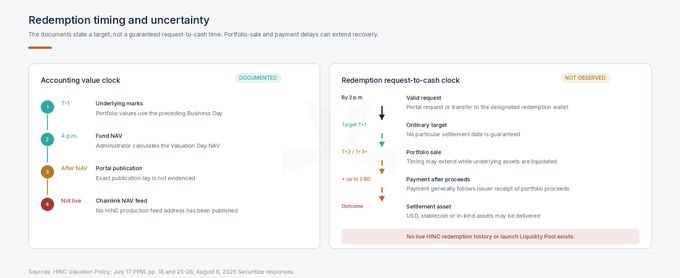
“Horizon” as Narrative in RWAs, Exchanges, and Infrastructure
Stepping back, it is useful to recognize how “horizon” functions as a narrative device across crypto and adjacent industries. Our newsroom’s coverage has used the term in stories about RWA infrastructure, exchange maturation, and privacy‑preserving protocols. Titles referencing a “golden horizon” for RWA infrastructure, for example, have accompanied coverage of projects like Lumia that move from synthetic benchmarks to tokenized cash flows, framing them as milestones in the journey toward onchain versions of traditional fixed‑income markets. Similarly, discussions of multichain treasury management platforms have invoked the idea of charting a treasury “voyage” toward a new horizon where corporate cash sits across multiple chains, strategies, and custody options.
On the exchange and corporate side, Coinbase’s trajectory from a simple trading app to an S&P 500 company has been described as a five‑year voyage to a new horizon, signaling that crypto businesses can join the ranks of large, publicly traded firms despite cycles of volatility and regulatory scrutiny. In traditional industries, stories about Tesla’s Semi factory nearing completion and heralding a “golden horizon” for electric freight show how the same metaphor applies to physical infrastructure transitions. When placed side by side with Aave Horizon or Horizon Market, these headlines underscore that “horizon” is a cross‑sector language for phase changes rather than a crypto‑specific neologism.
Privacy and security projects have likewise been cast in horizon‑themed narratives. Coverage of Zama’s homomorphic encryption‑based developer programs, COTI’s dual‑mainnet architecture using garbled circuits and Nightfall, and Flux’s encrypted operating systems has highlighted how each charts a privacy or security “horizon” where confidential finance becomes practical on public chains. These stories directly relate to DeFi and RWAs because institutional participation often hinges on strong assurances about data protection and transaction confidentiality, especially when dealing with sensitive credit or identity information.
Finally, some of the more playful or speculative corners of crypto keep using the term to emphasize potential upside. Protocols inviting users to hoist the sails for rewards “on the horizon” or early‑access events promising “booty of rewards on the horizon” play into crypto’s enduring penchant for nautical metaphors. While these marketing lines are far removed from the sober tone of Aave risk frameworks or Deloitte AI reports, they contribute to a shared vocabulary where the horizon is always a place where opportunity might be found, provided the risks are understood.
For readers, recognizing these narrative patterns helps distinguish between substantive horizon references—like the technical architecture of Aave Horizon’s RWA lending or the mechanics of Bitcoin NFT inscription on Horizon Market—and purely rhetorical uses meant to signal optimism or novelty.
Aave Labs launches Horizon institutional RWA lending platform
Aave Horizon re-launches with USDC, RLUSD, and GHO borrowing against tokenized RWAs
Marc Zeller publicly opposes Horizon RWA temperature check proposal
ACI formally accuses Aave Labs of diverting DAO revenues via Horizon and other deals
LlamaGuard NAV oracle goes live on Horizon with Chainlink and LlamaRisk
Aave Horizon TVL reaches $550M as RWA lending surges
Bitwise Crypto Carry Fund exceeds $120M deposited on Horizon
Midas launches mGLOBAL private credit product on Aave Horizon
How to Read “Horizon” in Crypto News and Documentation
Given the term’s widespread use, a practical question arises: when you see “Horizon” in a crypto context, what should you assume it refers to? The answer depends heavily on the domain, chain, and user base. In DeFi, especially when combined with references to Aave, USDC, RLUSD, GHO, RWAs, or tokenized Treasuries, it is almost certainly about Aave Horizon, the institutional RWA lending market on Ethereum. In Bitcoin‑oriented NFT discussions, especially those mentioning Ordinals, Rare Pepes, Counterparty assets, or one‑confirmation trading, “Horizon” usually refers to Horizon Market. In VR and metaverse commentary, particularly in connection with Meta, Family Center, or Quest headsets, it nearly always points to Horizon Worlds, which is largely offchain. Meanwhile, in enterprise AI discussions around global mobility, policy automation, and agentic workflows, Horizon typically refers to Topia’s AI platform rather than anything onchain.
The following table summarizes the main “Horizon” products and contexts relevant to a crypto news audience:
| “Horizon” Name | Domain / Stack | Chain / Platform | Core Function | Onchain Role | Primary Users |
|---|---|---|---|---|---|
| Aave Horizon | Institutional DeFi, RWAs | Ethereum (Aave v3.3) | Non‑custodial lending market for borrowing stablecoins vs RWAs | Fully onchain smart contracts | Qualified institutions; stablecoin LPs |
| Horizon Market | Bitcoin NFTs, Ordinals | Bitcoin | Marketplace for Ordinals, Rare Pepes, and inscriptions | Onchain inscriptions, trading | NFT collectors, traders |
| Meta Horizon Worlds | Social VR / Metaverse | Meta Quest / Meta apps | Virtual worlds, events, games in centralized VR environment | Mostly offchain | Consumers, creators, gamers |
| Topia Horizon | Agentic AI for global mobility | Enterprise SaaS | AI‑native platform for managing employee mobility and compliance | Indirect; may use APIs | HR and mobility teams |
| “AI horizon” | Autonomous agents, AI in finance | Multi‑platform | Conceptual frontier for agentic AI in wealth and DeFi | Emerging integrations | Developers, advisers, protocols |
For crypto practitioners, the most direct implications lie with Aave Horizon and, to a lesser extent, Horizon Market, because they involve real capital flows and onchain risk. When reading Aave governance discussions or LlamaRisk research referencing Horizon, it is useful to pay attention to whether proposals concern risk parameters, asset listings, or broader cross‑protocol frameworks. For example, the “Aave Will Win” framework proposal explicitly mentions Horizon in the context of asset onboarding and driving total value locked and borrow growth, as well as providing resources for institutional integrators. Similarly, risk continuity discussions from LlamaRisk emphasize that models already implemented on Horizon will be extended to V3 and V4, standardizing risk management across the protocol suite.
Understanding that Horizon’s collateral is composed of permissioned RWAs while its liquidity is permissionless stablecoins helps clarify who is affected by different changes. An increase in supply caps for a tokenized Treasury fund, for instance, primarily impacts qualified investors and RWA issuers, whereas adjustments to USDC or GHO borrow rates influence retail and DAO treasuries providing liquidity. Governance debates around oracle providers, NAV safeguards, and data infrastructure should likewise be interpreted against this backdrop: they are not mere technicalities but key pillars supporting institutional confidence in onchain markets.
Meanwhile, coverage of Horizon Market should be read with an eye toward Bitcoin’s evolving role beyond digital gold. Articles describing Horizon Market as adding support for new classes of Ordinals or integrating permanent storage solutions signal not just marketplace feature updates but also deeper questions about how far Bitcoin should stretch toward NFTs, gaming, or metaverse‑like experiences. For long‑time Bitcoin advocates, this may appear as a departure from the chain’s original ethos, while for others it represents a natural expansion of what “programmable scarcity” can mean on the oldest blockchain.
Finally, when encountering AI‑ and metaverse‑related uses of Horizon, it is worth noting whether there are explicit onchain tie‑ins or whether the project exists entirely in Web2 or enterprise domains. Meta’s Horizon Worlds and Topia’s Horizon AI are primarily offchain platforms, but their approaches to user experience, compliance, and safety may foreshadow practices that Web3 protocols will need to adopt as they seek broader adoption. Reports from firms like Deloitte on agentic AI in wealth management offer a blueprint for how similar tools might be deployed in DeFi—subject to careful risk controls and transparency.
Aave Labs controls Horizon deal origination and fee structures with DAO oversight lagging; ACI's formal accusation of revenue diversion is an unresolved governance crisis, not a resolved one.
Horizon is a permissioned deployment with new oracle infrastructure (LlamaGuard NAV) and cross-product integrations with V3 and V4 that have not yet been stress-tested at scale.
RWA collateral (tokenized money market funds, private credit) carries redemption queues that can decouple from on-chain liquidation timelines, creating a liquidity mismatch risk during market dislocations.
LlamaGuard NAV feeds are newly live and deliver dynamic risk-adjusted valuations for illiquid RWAs; a stale or manipulated NAV feed could enable undercollateralized borrowing before automated safeguards trigger.
Permissioned institutional lending against tokenized real-world assets sits squarely in the securities and banking regulatory perimeter in multiple jurisdictions, and no formal safe harbor exists yet for this structure.
Collateral quality depends entirely on tokenized fund issuers (Bitwise, Midas, Circle) maintaining NAV integrity and redemption windows; a single issuer failure would test whether Horizon's liquidation path is real or theoretical.
Outlook
Looking ahead, the Horizon brand and metaphor are likely to remain prominent across crypto, DeFi, NFTs, and AI. In the near term, Aave Horizon will continue to serve as a bellwether for institutional participation in onchain RWAs, especially as more tokenized funds, treasury products, and basis‑trade strategies seek to become usable collateral inside DeFi. The success or struggle of Horizon’s hybrid model—permissioned collateral married to permissionless liquidity, governed by independent risk frameworks and robust data infrastructure—will influence how other protocols design their own institutional offerings. If Horizon can safely scale into the billions while maintaining low default rates and avoiding governance shocks, it will reinforce the case that RWAs, stablecoins, and non‑custodial protocols can coexist in a regulated, institution‑friendly way.
On the cultural and infrastructure front, Horizon Market and Bitcoin NFTs will test the outer limits of Bitcoin blockspace and community tolerance for non‑payment use cases. Depending on fee dynamics and the evolution of layer‑two solutions, Bitcoin may either solidify a parallel identity as a home for durable digital artifacts or retrench toward monetary transactions, pushing most experimentation to other chains. Meta’s Horizon Worlds will continue developing largely in parallel to onchain metaverse projects, but its scale and resource base mean that any eventual integration of crypto‑native assets or wallets could have significant ripple effects.
Agentic AI platforms like Topia Horizon, along with the broader AI “horizon” in finance, will pose both opportunities and governance challenges for onchain systems. DeFi protocols may increasingly rely on AI for simulation, parameter tuning, and user guidance, but they will need to adopt the kind of compliance‑first mindset recommended by firms like Deloitte if they wish to avoid unintended consequences. Experiments such as Horizon Prime, where AI agents autonomously generate and deploy smart contracts, will likely proliferate; the key question is whether the industry can build robust oversight, auditing, and kill‑switch mechanisms before those systems are entrusted with large pools of capital.
For crypto readers, the practical takeaway is simple: when you see “Horizon” in a headline or governance thread, pause to identify which horizon you are dealing with. Is it the institutional RWA frontier on Ethereum, the cultural frontier of Bitcoin NFTs, the closed metaverse of a tech giant, or the emerging frontier of AI‑driven automation? Each carries its own risk profile, regulatory context, and set of opportunities. Understanding those distinctions is essential to navigating the next stage of onchain finance, where RWAs, stablecoins like USDC and GHO, governance tokens like AAVE, and AI agents may all converge on platforms that, quite appropriately, frame themselves as the next horizon.
Latest Horizon news
LlamaRisk expands its risk management mandate across the full Aave protocol fleetKontor Protocol launches permanent file storage on Bitcoin for NFTs; Horizon Market first to integrate.Tokenized credit fund HINC is being proposed as collateral on Aave Horizon, with Aave reviewing its legal structure, redemption path and risk parametersAave welcomes Bitwise's rebranded Crypto Carry Fund to Horizon, with more than $120M deposited into the tokenized fund leveraging market-neutral crypto yield opportunitiesLlamaRisk proposes a unified risk framework for Aave V3, V4 and Horizon, aiming to standardize asset evaluation and protocol-wide risk oversightAave Labs proposes standardized technical framework for V3, V4, and Horizon asset listingsSources
16 records from 14 domains
aave.com
bitwiseinvestments.com
governance.aave.com
x.com
arxiv.org
horizon.market
meta.com
prnewswire.com
deloitte.com
cryptotimes.io
binance.com
orochi.network
llamarisk.com
blockeden.xyz
Community notes
Spot something off or out of date? Drop a note. Editors review topic notes daily and roll accepted fixes into the explainer — contributors are recognized in the monthly $SQUID drop.
Loading notes…
Help improve this topic
Have a story or tip about this topic? Submit it. See something missing? Leave a note. Editors review daily; accepted submissions and fixes count toward the monthly $SQUID drop.