
In-depth explainer on crypto volatility, covering Bitcoin and Ethereum cycles, realized vs implied volatility, CME’s new Bitcoin Volatility futures, DeFi and AI token risks, and how traders and institutions measure, trade, and manage crypto market swings.
+17 sources across the wider coverage universe
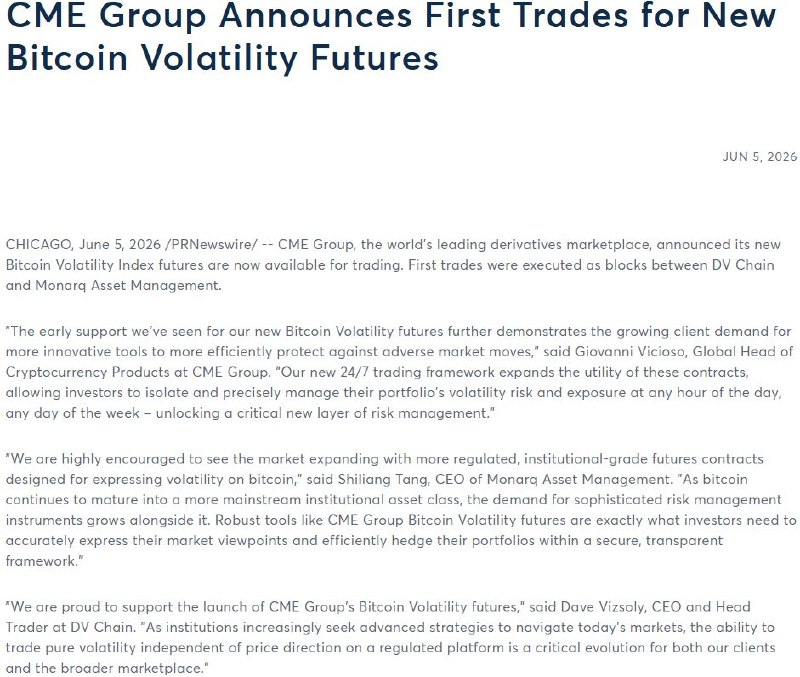 CME's Bitcoin Volatility futures go live as DV Chain and Monarq execute first block trades2026-06
 Visualized strategy reveals how Polymarket’s smartest bot turns volatility into guaranteed payouts.2025-12
 Volatility Shares launches 2x leveraged ETFs for Cardano, Stellar, and Chainlink2026-04
 Inside crvUSD borrow rate.2025-12
 Brazil’s largest bank recommends allocating 1–3% of portfolios to Bitcoin, citing diversification and protection against currency devaluation. Itaú says BTC offers uncorrelated returns and long-term value amid FX volatility.2025-12
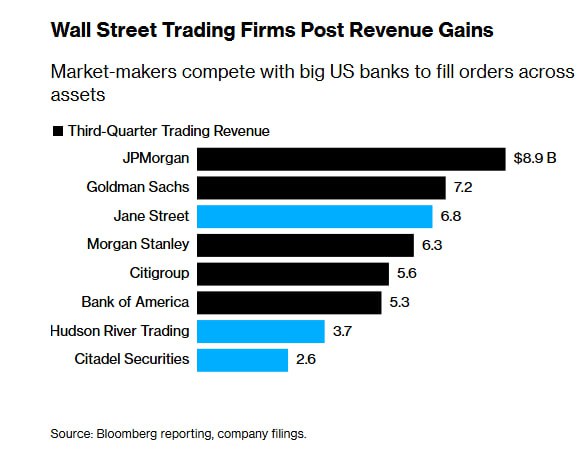 Jane Street and Citadel Securities are on track for record years, with Q3 trading revenue jumping 18% and 9% respectively as market volatility driven by Trump-era policy shifts boosts activity and erodes Wall Street’s dominance.2025-12
Volatility in Crypto Markets: An Evergreen Explainer
In digital asset markets, volatility refers to the magnitude and speed of price changes over time, and it is the single most important quantitative proxy for risk in crypto trading and investing. High volatility means prices can move sharply in either direction over short periods, while low volatility signals calmer conditions and narrower trading ranges.
What Volatility Means in Crypto
In financial economics, volatility is usually defined as the statistical dispersion of returns around their mean, most commonly expressed as the annualized standard deviation of an asset’s price changes over a given period. In crypto markets, this same concept applies, but it is amplified by structural features such as 24/7 trading, high leverage, fragmented liquidity, and an evolving regulatory environment that can change expectations quickly. The practical consequence is that assets like Bitcoin (BTC) and Ethereum (ETH) routinely exhibit day-to-day swings that would be considered extreme in traditional equity or bond markets, and smaller DeFi or AI-linked tokens can be more volatile still.
Academically, realized volatility for Bitcoin has often been measured by computing the variance of daily returns over monthly windows and then annualizing it to compare with traditional assets. One widely cited study groups potential drivers of Bitcoin’s volatility into categories such as market microstructure, speculative activity, macroeconomic variables, technological factors, and regulatory news, finding that no single category fully explains its behavior over time. This underscores why volatility in crypto should be viewed as a multi-causal phenomenon rather than a simple function of “speculation,” even if speculative flows remain a central ingredient.
From the perspective of market participants, volatility serves different roles depending on the strategy. Long-term investors may see volatility as a source of risk that needs to be managed through position sizing, diversification, and time horizon. Active traders, by contrast, often view volatility as the raw material that makes short-term strategies viable, since sharp moves create opportunities for arbitrage, market making, and directional trades. For risk managers and derivatives desks, volatility is an input to models that determine margin requirements, options pricing, and hedging programs. In crypto, where leverage and derivatives are heavily used, understanding volatility is therefore central to both risk control and alpha generation.
Crucially, volatility is direction-agnostic: it measures the size of moves, not whether prices are rising or falling. An asset can be highly volatile while trending upward, downward, or going nowhere on net. This is why derivatives such as Bitcoin volatility futures have emerged as separate instruments that allow traders to position directly on anticipated volatility itself, independent of whether they are bullish or bearish on BTC’s price level. As the market matures, volatility is increasingly treated as its own tradable asset class, particularly in Bitcoin.

CME's Bitcoin Volatility futures go live as DV Chain and Monarq execute first block trades
How Volatility Is Measured
The Mathematical Basics
At its core, volatility is a statistical measure. If we denote the log return of an asset on day \(t\) as \(r_t = \ln(P_t) - \ln(P_{t-1})\), where \(P_t\) is the price at time \(t\), then the sample variance of returns over \(N\) days is:
\[ \sigma^2 = \frac{1}{N-1} \sum_{t=1}^{N} (r_t - \bar{r})^2 \]
where \(\bar{r}\) is the average daily return over the same period. The daily volatility is the square root of this variance, and the annualized volatility is commonly obtained by multiplying by \(\sqrt{T}\), where \(T\) is the number of trading days in a year. In crypto markets, it is common to use \(T \approx 365\), reflecting 24/7 trading, whereas in equity markets one might use \(T \approx 252\).
This historical, or realized volatility, tells us how much prices have actually moved in the past over the specified window. For Bitcoin, researchers have calculated monthly realized volatility by aggregating daily returns, and then relating that realized volatility to potential causal variables such as on-chain activity, exchange-traded volume, or macroeconomic proxies. Realized volatility can be computed over any horizon, from intraday intervals to multi-year periods; shorter horizons will be more sensitive to market microstructure noise, whereas longer horizons smooth out idiosyncratic shocks.
In practice, crypto analysts often speak of “30-day realized volatility” or “90-day realized volatility,” referring to the standard deviation of daily returns over those windows. These metrics are used to compare assets and to benchmark regime changes. For instance, a drop in Bitcoin’s 30-day realized volatility to multi-month lows can signal the market has entered a consolidation phase, even if prices remain elevated or depressed relative to historical levels. Conversely, spikes in realized volatility can indicate stress, breakout moves, or liquidations cascading through leveraged positions.
Realized Versus Implied Volatility
While realized volatility is backward-looking, implied volatility (IV) is forward-looking and derived from options prices rather than from historical returns. In options markets, traders pay a premium for the right, but not the obligation, to buy or sell an asset at a fixed strike price in the future. The price of that option depends heavily on the market’s expectation of future volatility: the more uncertainty about where the price might be at expiration, the more valuable the option, all else equal.
Mathematically, if we assume a pricing model such as Black–Scholes or a more crypto-specific variant, we can treat volatility as an unknown input and solve for the level of volatility that would make the model’s theoretical price equal to the actual observed market price of the option. This solved-for value is the implied volatility. As one crypto analytics firm explains, implied volatility “is a forward-looking measure of the expected volatility of an asset over a specified time period, derived from the market price of the option contract.” In other words, it encodes what the marginal buyer and seller of options jointly believe about future price swings when they transact.
In Bitcoin and Ethereum options markets, implied volatility has become a central gauge of risk sentiment. Industry coverage notes that implied volatility measures how sharply the market expects an asset’s price to move and that it has become one of the most important indicators for BTC and ETH, given how leverage and options trading can amplify price swings. When demand for options rises, premiums increase and implied volatility tends to climb with them; when demand falls and markets are calm, implied volatility generally declines. The difference between implied and realized volatility is also informative: a large positive gap suggests traders are pricing in turbulence not yet visible in spot price behavior, whereas a negative gap can indicate complacency.
Volatility Indices and Benchmark Measures
To make volatility more observable and tradable, crypto markets have developed specialized indices analogous to the VIX in equities. On the options side, Deribit’s DVOL is a prominent benchmark that measures 30-day expected volatility for Bitcoin and Ethereum based on options markets. DVOL condenses information from the entire options surface into a single number, allowing traders to monitor shifts in expectations without modeling options themselves.
Other providers have built similar products. The Bitcoin Volmex Implied Volatility Index, for example, tracks 30-day implied volatility derived from real-time crypto options prices. Recent market reports have highlighted that this index fell to around 36 in late May, marking its lowest reading in roughly nine months and close to its weakest since 2023, as subdued trading and a rotation of speculative interest away from BTC dampened demand for options protection. Such readings suggest markets are pricing in relatively modest near-term swings, even if longer-term uncertainty remains significant.
On the futures and listed derivatives side, the CME CF Bitcoin Volatility Index forms the basis for newly launched Bitcoin Volatility futures at CME Group. This index measures forward-looking 30-day implied volatility of Bitcoin, using a methodology based on BTC options traded on major venues, and allows CME to settle volatility futures in cash against a transparent benchmark. As CME notes, these contracts enable participants to “trade on the magnitude of upcoming price movements (volatility), regardless of direction,” distinguishing them from traditional futures that track the underlying Bitcoin price. The existence of these indices and contracts reinforces the idea that volatility is no longer merely a statistic; it is a tradable dimension of the crypto market.
Readers click volatility stories not to understand risk in the abstract but to find who captured it as profit — yield farmers collecting 40% APR during drawdowns, Polymarket bots converting price swings into guaranteed payouts, and MEV bots front-running oracle lag all outperform stories about volatility as a generic warning.
Why Crypto Is So Volatile
Structural Drivers in Digital Asset Markets
Digital assets tend to exhibit higher volatility than most traditional asset classes, and this is true even for the largest cryptocurrencies like Bitcoin and Ethereum. Several structural features of the market help explain this pattern. First, crypto trades around the clock, across hundreds of exchanges with varying liquidity and transparency, which can accentuate order-book imbalances and lead to abrupt price gaps. Second, the use of high leverage—both through derivatives on centralized venues and through borrowing in DeFi protocols—means that small moves can trigger liquidations that reinforce the initial direction, a dynamic often called a liquidation cascade.
Third, the investor base remains a mix of retail traders, hedge funds, proprietary trading firms, and specialist crypto funds, with participation by long-horizon institutional investors still developing. A higher share of short-term and speculative capital can heighten sensitivity to sentiment and news flows. Fourth, valuation anchors for many tokens are less well-established than for equities or bonds, since cash flows and legal claims can be uncertain, particularly for governance tokens and some DeFi and AI-related assets. The absence of widely agreed valuation frameworks tends to increase dispersion in expectations and, in turn, volatility.
Empirical studies of Bitcoin volatility confirm that a wide array of factors matter. One research project categorized determinants into groups such as economic and financial variables, technical factors, speculative behavior, and regulatory events, finding that realized monthly volatility responds to indicators in each group over time. For example, higher speculative activity and exchange-traded volume can coincide with elevated volatility, as can periods of macroeconomic stress or uncertainty about regulation. However, the relative importance of each factor varies with market regimes, and sometimes volatility spikes occur without a clear fundamental catalyst, driven instead by market microstructure or positioning.
News, Macro Conditions, and Regulatory Shocks
Beyond structural factors, news and macro events are key volatility triggers. Bitcoin and other major cryptocurrencies have, at times, traded with high correlation to growth-sensitive tech stocks, as both are perceived as speculative, long-duration assets. When markets begin to question the sustainability of technology valuations, or when real yields rise, this can ripple into BTC and broader crypto, raising volatility as correlations increase. Conversely, as some recent analyses have suggested, there are periods when Bitcoin’s correlation to tech stocks weakens, leading to divergent paths and idiosyncratic volatility in digital assets.
Geopolitical or policy shocks can also spill over into crypto volatility. For instance, renewed trade war fears and tariff threats have coincided with significant flows in Bitcoin ETFs, including multi-day stretchs of large outflows or inflows, as investors reposition in anticipation of broader market turbulence. Reports of several-day ETF sell-offs amid tariff concerns highlight how traditional risk-off narratives can amplify volatility risks in BTC, even if outright price crashes are mitigated by lower leverage and active hedging. Such episodes illustrate the growing entanglement between crypto and macro, especially as Bitcoin ETFs become integrated into mainstream portfolios.
Regulatory actions and legal developments are similarly potent volatility catalysts. When new legislation or enforcement actions alter the perceived risk of owning or trading certain tokens, markets can reprice quickly. Coverage of proposed US market structure legislation has noted that institutional price targets for ETH—ranging from bearish scenarios near USD 3,175 to bullish scenarios above USD 7,500—hinge heavily on legislative outcomes. This wide dispersion in projections reflects the volatility premium investors assign to regulatory uncertainty.
DeFi, AI Tokens, and Cross-Asset Contagion
While Bitcoin and Ethereum anchor the crypto market, DeFi tokens, AI-linked assets, and privacy coins often exhibit even greater volatility. A recent digital assets report highlighted increased volatility in DeFi, AI, and privacy sectors, noting that these coins tend to experience outsized swings due to lower liquidity, concentrated holdings, and heightened sensitivity to narrative shifts. For AI-related tokens in particular, the overlap between hype cycles in both AI and crypto can produce sharp booms and busts as narratives evolve faster than revenue or usage fundamentals.
DeFi introduces additional volatility channels through leverage, yield strategies, and composability. Protocols that enable leveraged staking or perpetual swaps can amplify market moves, especially when collateral is volatile and risk management is underdeveloped. If collateral values drop quickly, automatic liquidations can accelerate selling, driving volatility higher. Composability creates additional pathways for contagion, as the failure or stress in one protocol can propagate to others via on-chain dependencies, affecting token prices across a broader ecosystem.
Cross-asset dynamics further complicate the picture. Articles examining systemic contagion have emphasized that sharp drops in Bitcoin often spark broader market selloffs as altcoins tumble through liquidity shocks and collapsing market confidence. When BTC sells off, market makers may reduce inventory across the board, liquidity can thin, and leveraged positions in multiple assets can be liquidated simultaneously. Conversely, when Bitcoin volatility subsides and capital rotates into smaller tokens, volatility can compress in BTC while spiking in DeFi, AI, or other niche sectors. This rotation effect has been observed in recent months, with options-based implied volatility indices for Bitcoin hitting multi-month lows even as smaller-cap sectors remained turbulent.

Visualized strategy reveals how Polymarket’s smartest bot turns volatility into guaranteed payouts.

"Gabagool never predicts whether Bitcoin will go up or down. He simply waits for cheap opportunities on either side of the binary market. He buys: YES when YES becomes unusually cheap. NO when NO becomes unusually cheap. He doesn’t buy them together. He buys them asymmetrically, at different timestamps, when the market temporarily misprices one side. His entire objective is to reach this simple condition: Keep the average cost of YES + the average cost of NO < $1.00 Once this happens, he has mathematically locked in profit."
Trading and Managing Volatility
Derivatives: Options, Futures, and Volatility Futures
Crypto derivatives markets have evolved rapidly, and they now play a central role in both generating and managing volatility. Traditional Bitcoin futures allow traders to express views on the direction of BTC’s price, taking long or short positions that profit from upward or downward moves. These contracts are widely used by miners, brokers, and funds to hedge exposure or to take leveraged bets on price trends. Ethereum and other major tokens now also have deep futures markets on offshore derivatives venues and, increasingly, on regulated exchanges.
Options extend this toolkit. By buying or selling calls and puts, traders can construct payoff profiles that are convex in the underlying price, gaining exposure to volatility itself. For example, buying a straddle—simultaneously purchasing a call and a put at the same strike—can profit from large moves in either direction, essentially a pure volatility trade. Implied volatility, as embedded in option premiums, is thus both a pricing input and a tradable quantity, since positions can gain or lose value if actual realized volatility diverges from what was implied at entry.
The latest stage in this evolution is the emergence of volatility futures that reference volatility indices rather than the underlying asset price. CME Group’s Bitcoin Volatility Index futures are a prominent example. These are USD-settled futures that allow participants to trade the forward-looking 30-day implied volatility of Bitcoin, as measured by the CME CF Bitcoin Volatility Index. Unlike Bitcoin price futures, which settle to a BTC reference rate, volatility futures settle to a volatility index value and are designed to give traders a capital-efficient tool to hedge or express a view on volatility itself.
CME’s press materials emphasize that these new Bitcoin Volatility futures provide a regulated mechanism to use volatility as a gauge of market sentiment and to trade expectations of market stress, stability, or upcoming price swings. The contracts are cash-settled to the CME CF Bitcoin Volatility Index – Settlement (often labeled BVXS), which is calculated at a fixed time on the final settlement day, ensuring a transparent process. Early trading has included block trades between professional firms such as DV Chain and Monarq Asset Management, signaling growing institutional interest in volatility as a separate asset class.
Hedging Versus Speculating on Volatility
From a portfolio perspective, volatility instruments can be used defensively or offensively. A Bitcoin miner, for example, may use options to cap downside risk to future production, effectively hedging against a sharp fall in BTC prices. If the miner purchases put options, the implied volatility embedded in those options represents an insurance premium against adverse moves. Similarly, funds with large BTC holdings might use Bitcoin Volatility futures to hedge the risk of a volatility spike that could increase margin requirements or disrupt market liquidity. In this sense, volatility is a form of risk exposure that can be managed like any other.
Speculators, on the other hand, seek to profit from changes in volatility itself. A trader who expects volatility to rise ahead of a major event—such as a regulatory decision, a protocol upgrade, or macro data release—might buy options or go long volatility futures. If implied volatility increases, the value of these positions can rise even if the underlying BTC price is unchanged. Conversely, if a trader believes that the market is overpricing future volatility relative to what is likely to be realized, they can sell options or go short volatility futures, aiming to capture the difference when volatility compresses.
These strategies involve significant risks. When traders are short volatility, they can be exposed to large losses if volatility spikes sharply, as option prices or volatility indices surge. The phenomenon known as “short vol blow-ups” in traditional markets can occur in crypto as well, especially given the structural propensity for large, sudden moves. Conversely, long volatility positions can lose value rapidly if implied volatility collapses—often called “IV crush”—after a widely anticipated event passes without incident. Managing these positions requires active risk monitoring and an understanding of how volatility interacts with underlying price dynamics, leverage, and liquidity.
Risk Management for Traders and Institutions
For both retail traders and institutions, volatility is a key input into risk management frameworks. Position sizing strategies such as volatility targeting adjust exposure inversely to recent volatility: when realized volatility rises, target position sizes shrink, and when volatility falls, they expand. In principle, this can help maintain more stable risk levels through time. In practice, if many participants follow similar rules, volatility targeting can amplify moves, as widespread de-leveraging during volatility spikes may exacerbate price declines.
Institutional investors increasingly incorporate digital assets into diversified portfolios, and firms such as State Street Global Advisors have framed crypto as part of the “next frontier” of markets and investors. For these allocators, understanding the volatility characteristics of Bitcoin and other assets is crucial for portfolio construction, particularly when assessing correlations with equities, bonds, and other alternatives. They must also consider operational and regulatory risks, margin and collateral requirements, and the behavior of volatility during market stress episodes.
Retail participants, including users on large exchanges such as Binance, often confront volatility indirectly through structured products, staking programs, or educational campaigns. Binance’s “Learn & Earn” initiatives, for instance, have offered token rewards locked into yield products, while explicitly warning users about the volatility risks of the underlying digital assets and the consequences of lock-up periods. These campaigns underscore that volatile assets can generate attractive yields but also substantial drawdowns, especially when tokens are illiquid or newly launched. Managing such risks requires not only quantitative tools but also user education and clear disclosures.
- 01liquidation cascade mechanics
Multiple headlines quantifying exact liquidation figures ($138M, $500M, $651M) drove repeated clicks, signaling readers treat these as real-time loss scorecards rather than background noise.
- 02derivatives basis and institutional de-risking↗
Bitcoin futures basis turning negative for the first time since August — tied to DeepSeek-triggered CME de-risking and a record OI drop — pulled readers seeking early signals of institutional positioning shifts.
- 03yield opportunities during drawdowns↗
Liquity V2 BOLD pools offering 40%+ USD yields and AAVE's tail-risk statistics during volatile periods attracted readers hunting actionable DeFi opportunities, not just risk alerts.
- 04options expiry and implied volatility signals↗
The April BTC/ETH options expiry with $8B notional and the ETH implied volatility analysis both attracted readers interpreting derivatives markets as forward-looking price indicators.
- 05stablecoin and RWA resilience under stress↗
The crvUSD peg deviation after Yield Basis, Morpho's resilience during USD0+ volatility, and RWA demand collapsing 37% in risk-on conditions showed readers actively tracking which stability mechanisms actually hold.
- 06Bitcoin's volatility vs. store-of-value narrative↗
JPMorgan's digital gold skepticism and the 59.4% annualized volatility figure even post-strategic-reserve announcement kept readers engaged with the unresolved macro identity debate around BTC.
Case Studies in Bitcoin and Ethereum Volatility
Bitcoin’s Volatility Cycles and Recent Lulls
Bitcoin’s volatility has historically moved in cycles, often clustering around major bull or bear markets, regulatory milestones, and macro events. During speculative booms, realized and implied volatility tend to climb as prices accelerate and leveraged participation increases. Bear markets and deleveraging phases can also produce extreme volatility, especially near capitulation lows. Between these regimes, Bitcoin has sometimes experienced extended periods of relatively subdued volatility, even while prices consolidate at high absolute levels.
Recent coverage has highlighted such a lull. Bloomberg reporting noted that Bitcoin’s expected volatility fell to the lowest level in nine months as quiet trading and a shift in speculative interest away from BTC dampened demand for options protection. The Bitcoin Volmex Implied Volatility Index, which captures 30-day expected volatility based on options markets, dropped to roughly 36, its weakest reading since September of the prior year and near its lowest since 2023. This suggested that, despite ongoing debates about regulation, macro risks, and ETF flows, the options market was pricing in relatively calm conditions.
These low-volatility phases present both challenges and opportunities. For volatility sellers, compressed implied volatility may mean option premiums are thinner, but if realized volatility remains low, short volatility strategies can still be profitable. For volatility buyers, lower implied volatility reduces entry costs but also implies that markets do not expect large moves, potentially dampening upside from long volatility positions. The introduction of Bitcoin Volatility futures at CME adds another dimension, as traders can explicitly position for a reversion of volatility from subdued to more typical levels, independent of direction on BTC’s spot price.
Mixed flows in Bitcoin ETFs and structured products can also affect volatility. Reports of BTC ETFs experiencing multi-day stretches of inflows or outflows amid macro uncertainty—such as heightened trade war risks—illustrate how capital allocation decisions in traditional vehicles can translate into underlying market moves and volatility threats. At the same time, some analyses note that lower leverage and more active hedging by institutional players may help keep liquidations in check, muting the most extreme volatility spikes even when sentiment is fragile. This interplay between spot, derivatives, and ETF flows is now central to understanding Bitcoin’s evolving volatility regime.
Ethereum’s Volatility Bets and Leverage Risks
Ethereum offers a slightly different volatility profile from Bitcoin, influenced by its role as the dominant smart contract platform and the base layer for DeFi and many AI-related tokens. ETH tends to be more volatile than BTC, reflecting higher beta to overall crypto sentiment and sensitivity to network-specific factors such as gas fees, staking incentives, and protocol upgrades. Options and futures markets for ETH have grown significantly, making implied volatility a key indicator of risk and positioning.
Recent market data show how positioning around Ethereum options can shape volatility expectations. At the end of May, ETH closed the month near USD 1,983, marking its lowest monthly close since late 2024 and representing a significant drawdown from its February peak. Aggregate ETH options open interest on Deribit declined sharply, signaling a positioning reset as traders reduced exposure following the sell-off. Yet open interest remained concentrated at out-of-the-money call strikes for a major quarterly expiry, indicating that remaining participants were still positioning for a potential recovery rather than a prolonged decline. This skew towards upside calls reflects a nuanced volatility outlook: the market expects continued swings, but with a bias towards mean reversion higher if certain macro and regulatory conditions improve.
Fundamental and structural factors further complicate Ethereum’s volatility. Institutional targets for ETH in 2026 from major banks such as Citi and Standard Chartered span a wide range—from around USD 3,175 in bearish scenarios to approximately USD 7,500 in bullish cases—with both emphasizing that the trajectory depends heavily on US market structure legislation for crypto. This wide dispersion underscores how legal and regulatory uncertainty feeds directly into volatility, as investors must price multiple scenarios with very different implications for adoption and flows.
Leverage and cross-asset risks add another layer. One analysis described how a large institutional actor, Bitmine, accumulated approximately USD 450 million of ETH in early 2025, while a dormant Bitcoin “whale” wallet posed an estimated USD 8.6 billion liquidation risk if it were to sell into the market. Together, these factors created a volatile environment where institutional accumulation could function as a stabilizing force but concentrated holdings and latent selling pressure could also trigger explosive moves if conditions shifted. The same analysis warned that Ethereum’s volatility in 2025 had become less a function of its own fundamentals and more a product of macro forces, institutional strategies, and leveraged positioning imbalances, emphasizing how a single macro shock or large asset sale could ignite a volatility explosion.
These examples illustrate that ETH volatility is shaped by a broader ecosystem that includes DeFi protocols, AI-related tokens, staking yields, and cross-hedging with Bitcoin and other majors. When volatility rises in Ethereum, it can spread through collateral channels to the DeFi and NFT sectors, affecting liquidity and risk premia across the digital asset landscape. Conversely, when ETH volatility subsides, risk-taking can migrate into more speculative DeFi and AI tokens, where thinner liquidity and higher narrative sensitivity can sustain elevated volatility even as ETH and BTC calm.
Volatility Shares launches 2x leveraged ETFs for Cardano, Stellar, and Chainlink
Volatility, ETFs, Market Structure, and AI
The maturation of market structure around digital assets has both stabilized and reshaped volatility dynamics. The advent of spot and futures-based exchange-traded funds for Bitcoin and other tokens has integrated crypto more deeply into traditional portfolios, increasing its sensitivity to macro sentiment while also providing more direct channels for price discovery and hedging. When Bitcoin ETFs see large net inflows, this can support prices and potentially dampen short-term volatility by increasing buy-side depth; conversely, sustained outflows can pressure prices and exacerbate volatility, especially if they coincide with deleveraging in derivatives markets.
New ETF launches in other major tokens, including XRP and prospective Ethereum products, have similarly raised questions about how these instruments affect volatility, particularly around listing dates, initial flows, and fee competition. Coverage of XRP ETFs, for instance, has noted that post-hype price drops and fee considerations can raise investor risks, highlighting that volatility often spikes during speculative run-ups to a new product launch and then normalizes—sometimes sharply lower—once the product is live. These patterns mirror behaviors seen in equities around IPOs and index inclusions, further underscoring the convergence of crypto and traditional market dynamics.
Regulated derivatives venues such as CME and Cboe play an increasingly important role in shaping volatility. CME’s expansion into Bitcoin volatility futures, alongside its existing BTC and ETH futures and options, reflects a recognition that volatility itself is a core risk dimension institutional investors want to manage. Commentators have described 2025 as an eventful year in derivatives, with the rise of crypto derivatives and ongoing regulatory change as major themes, indicating that crypto volatility products are becoming integral to the broader derivatives ecosystem. Similarly, Cboe’s work on Ethereum ETF rule amendments illustrates how traditional exchanges are adapting their rulebooks and risk frameworks to accommodate volatile digital assets.
Artificial intelligence intersects with volatility in multiple ways. First, AI-themed tokens and AI infrastructure plays (such as those related to data centers or GPU provisioning) have become some of the most volatile segments of the digital asset market, reflecting both the underlying boom in AI and the speculative overlay that characterizes new crypto narratives. Reports highlighting increased volatility in AI-linked coins emphasize that these tokens can experience rapid repricing based on technological breakthroughs, regulatory developments around data and privacy, or shifts in AI funding cycles. Second, AI-driven trading and risk models are increasingly applied to crypto, where they can analyze large volumes of on-chain, order-book, and derivatives data to forecast volatility or detect stress signals.
AI-driven risk systems can potentially help exchanges and large trading firms anticipate liquidation cascades, quantify liquidity holes, and model cross-asset contagion, thereby improving margin and risk controls. However, if many participants rely on similar AI models, procyclical behaviors could emerge, where model-driven de-risking amplifies volatility during stress episodes. In this sense, AI is both a tool for managing volatility and a new variable in the volatility equation, especially as AI-driven strategies scale in Bitcoin, Ethereum, and smaller tokens.
Finally, centralized exchanges like Binance sit at the intersection of these developments. Binance’s broad product suite—perpetual futures, options, structured yield, and educational campaigns—exposes retail users to a wide spectrum of volatility-linked opportunities and risks. The exchange’s own communications frequently highlight volatility risks in promotional and educational materials, such as Learn & Earn campaigns that lock token rewards for fixed periods and warn users about the potential impact of price swings during lock-ups. This reflects a growing recognition that volatility management and user education are essential components of sustainable market growth.
DeepSeek AI release triggers CME de-risking; Bitcoin futures basis turns negative for first time since August 2024
- 2025-01launch
Liquity V2 BOLD stablecoin pools launch, attracting $10M in 24 hours at 40%+ USD yields during market volatility
- 2025-04milestone
78,000 BTC options ($7.18B notional) and 461,000 ETH options expire; realized volatility exceeds 55%, implied volatility above 45%
- 2025-04regulatory
Upbit flags SNX as investment warning asset after sUSD loses dollar peg under high volatility
- 2025-04governance
Enterprise Ethereum Alliance releases comprehensive DeFi risk assessment framework covering volatility, MEV, credit, and legal dimensions
Bitcoin annualized volatility hits nine-month low as price stabilizes above $100K
CME Group records first trades on new Bitcoin Volatility Futures product, marking institutional-grade vol derivatives debut
Outlook
Volatility will remain a defining feature of crypto markets for the foreseeable future. Structural factors such as 24/7 trading, leverage, evolving regulation, and rapid innovation in DeFi and AI tokens ensure that price dispersion and regime shifts will continue to be more pronounced than in most traditional asset classes. At the same time, the market’s ongoing institutionalization—through products like Bitcoin ETFs and CME Bitcoin Volatility futures—should gradually deepen liquidity, improve risk management, and make volatility a more quantifiable and tradable dimension of digital asset exposure.
For Bitcoin and Ethereum, the next phase likely involves alternating cycles of volatility compression and expansion, driven by macro conditions, regulatory milestones, network upgrades, and shifts in derivatives positioning. Low implied volatility episodes, such as the recent nine-month lows in Bitcoin’s Volmex index, may present opportunities for traders who anticipate future catalysts, while high-volatility phases will continue to test the resilience of leveraged structures and market infrastructure. In parallel, sectors such as DeFi, AI, and privacy coins are poised to remain volatility outliers, reflecting both their growth potential and their sensitivity to narrative and regulatory swings.
For investors, the key is not to fear volatility indiscriminately but to understand it, measure it, and incorporate it explicitly into risk and allocation decisions. Volatility is both a risk and a resource: it can erode capital for the unprepared, but it also underpins the return potential that draws capital to Bitcoin, Ethereum, and the broader digital asset ecosystem. As tools like volatility indices, options, and volatility futures proliferate, market participants will have more sophisticated ways to hedge, speculate, and structure exposure, bringing crypto markets closer to the complexity and maturity of traditional derivatives markets while retaining their distinctive dynamism.
Latest Volatility news
CME's Bitcoin Volatility futures go live as DV Chain and Monarq execute first block tradesVisualized strategy reveals how Polymarket’s smartest bot turns volatility into guaranteed payouts.Volatility Shares launches 2x leveraged ETFs for Cardano, Stellar, and ChainlinkInside crvUSD borrow rate.Brazil’s largest bank recommends allocating 1–3% of portfolios to Bitcoin, citing diversification and protection against currency devaluation. Itaú says BTC offers uncorrelated returns and long-term value amid FX volatility.Jane Street and Citadel Securities are on track for record years, with Q3 trading revenue jumping 18% and 9% respectively as market volatility driven by Trump-era policy shifts boosts activity and erodes Wall Street’s dominance.Sources
19 records from 14 domains
sciencedirect.com
cmegroup.com
kaiko.com
marketsmedia.com
bitcoinfoundation.org
financefeeds.com
ssga.com
portalberita.co.id
crowdfundinsider.com
bloomberg.com
treeofalpha.com
x.com
facebook.com
ainvest.com
Community notes
Spot something off or out of date? Drop a note. Editors review topic notes daily and roll accepted fixes into the explainer — contributors are recognized in the monthly $SQUID drop.
Loading notes…
Help improve this topic
Have a story or tip about this topic? Submit it. See something missing? Leave a note. Editors review daily; accepted submissions and fixes count toward the monthly $SQUID drop.