
In‑depth explainer on CME Group’s role in crypto: how its regulated futures, options, index and volatility products work, how institutions use them, and why its clash with the CFTC over perpetual futures matters for digital asset markets.
+9 sources across the wider coverage universe
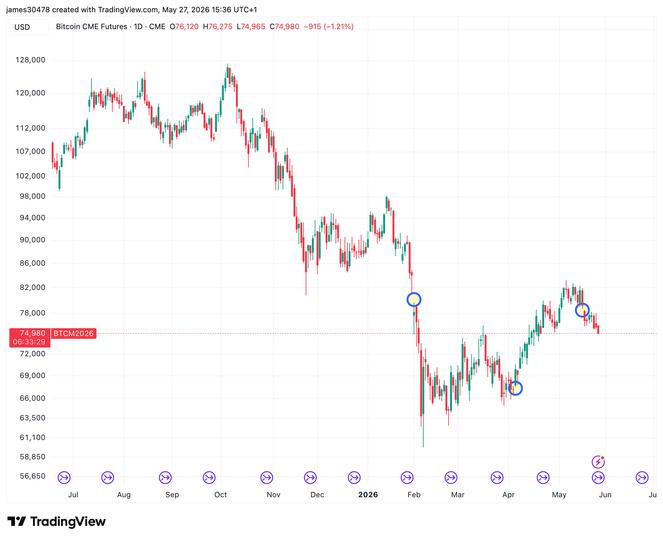 CME’s shift to 24/7 bitcoin futures trading could erase the market’s famous weekend price gaps, tightening crypto’s integration with institutional finance2026-05
 CME Group to launch cash-settled Bitcoin volatility futures on June 1, enabling traders to hedge or speculate on BTC price swings without directional exposure2026-05
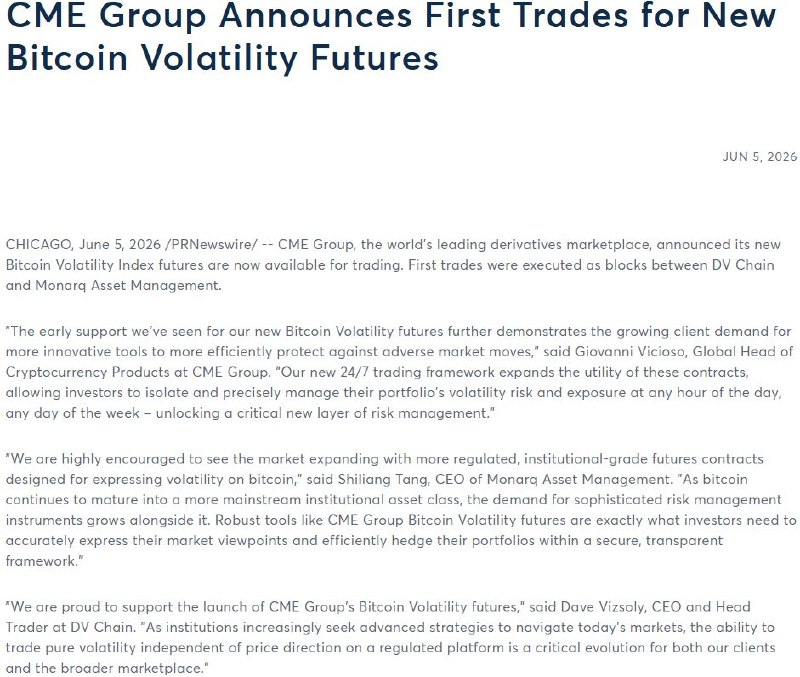 CME's Bitcoin Volatility futures go live as DV Chain and Monarq execute first block trades2026-06
 CME CEO Terry Duffy warns newly approved U.S. perpetual futures could become a "disaster waiting to happen," citing excessive leverage and rising retail speculation risks2026-06
 CFTC and SEC seek comments on swap definitions as CME sues over crypto perps2026-06
 CME Group to sue CFTC over perpetual futures approval, arguing perps qualify as swaps under Dodd-Frank and warning of 2008-style speculation risks2026-06
CME Group and Crypto Derivatives: An Evergreen Explainer
The world's largest regulated derivatives exchange group, CME Group has become a central gateway for institutions seeking exposure to Bitcoin, Ether and other digital assets through futures, options and index products. For a crypto audience, CME sits at the intersection of traditional finance, regulation and on‑chain markets, shaping how professional capital enters and manages risk in the digital asset economy.
What CME Group Is And Why Crypto Cares
CME Group describes itself as the world’s leading and most diverse derivatives marketplace, listing futures and options across interest rates, equity indexes, foreign exchange, energy, metals, agriculture and, increasingly, cryptocurrencies. The firm’s core business is providing regulated venues where participants can hedge risk, express macro views and transfer price exposure under the supervision of U.S. regulators and with central clearing standing between buyers and sellers. This combination of liquidity, legal certainty and institutional infrastructure is precisely what many large crypto market participants had been waiting for before taking digital asset exposure at scale.
The modern CME Group is the product of consolidation across Chicago’s historic exchanges, capped by the acquisition of NYMEX Holdings in 2008, which added energy and metals franchises to CME’s portfolio and cemented its status as a multi‑asset derivatives powerhouse. By absorbing NYMEX, CME extended its reach into crude oil, natural gas and other commodities that already sat at the heart of global macro trading and hedging flows. This history matters for crypto because it shows that digital assets are not an isolated experiment for CME but another asset class being slotted into a decades‑old framework for managing risk in everything from grain and electricity to equity indexes and interest rates.
Legally, CME Group’s primary exchanges operate as U.S. designated contract markets under the oversight of the Commodity Futures Trading Commission (CFTC), which maintains and supervises the roster of DCMs as part of its broader industry oversight. DCM status entails adherence to core regulatory principles around fair trading, market integrity, risk management, and extensive rule and product filings with the CFTC. For institutional crypto users, this means CME’s Bitcoin and other digital asset contracts sit inside a familiar CFTC‑regulated framework, rather than the more fragmented or offshore regulatory regimes that govern many crypto‑native perpetual futures platforms.
The mechanics of trading at CME also differ from many spot crypto exchanges. All CME futures and options are centrally cleared, with the clearinghouse acting as the legal counterparty to every trade, collecting margin collateral and marking positions to market each day. This structure, which has been used in futures markets for well over a century, is designed to mutualize default risk and prevent a failure at one participant from cascading through the system, a feature Dodd‑Frank later sought to extend into the swaps market as well. For crypto traders who have seen exchange collapses and opaque balance sheets in the digital asset space, clearinghouse‑backed exposure can be a meaningful contrast to bilateral leverage on offshore platforms.
From a crypto‑specific perspective, CME matters less as a retail trading venue and more as the main regulated derivatives hub through which institutional investors, hedge funds, market makers and corporations can access Bitcoin, Ether and a growing roster of digital asset exposures. Its products are structured to fit into existing risk, collateral and compliance workflows inside banks, funds and corporations, while referencing prices and indices drawn from the underlying crypto markets. Understanding CME is therefore essential to understanding how “TradFi” capital interacts with crypto and how regulatory policy shapes that interaction.
Origins And Structure Of CME Group
The Chicago Mercantile Exchange began life in the nineteenth century as a venue for agricultural products, evolving into a pioneer of financial futures that allowed markets to hedge interest rates, currencies and equity indexes. Over time, CME merged with or absorbed other iconic exchanges, notably the Chicago Board of Trade, and then pushed beyond Chicago through the acquisition of NYMEX Holdings, which was completed in August 2008. That deal brought the New York Mercantile Exchange and the COMEX metals exchange under the CME umbrella, dramatically expanding CME’s franchise in energy, metals and other commodities and making it a truly multi‑asset group.
Structurally, CME Group operates several exchange subsidiaries, each with their own rulebooks but tied together by a common clearing corporation and shared technology. Trading is conducted electronically on the CME Globex platform, with a central limit order book matching bids and offers across time zones and client types. While a handful of legacy pit‑traded contracts persisted for years, CME’s crypto offerings were built natively for the electronic era and integrate with the same infrastructure used by macro futures traders worldwide.
The group’s business model blends transaction fees from trading, clearing fees, and revenue from market data and connectivity. For crypto, this means that CME’s incentives are aligned with building liquid, transparent contracts that attract meaningful volume, as liquidity and open interest are key drivers of both fee income and benchmark significance. The link between well‑designed benchmarks and broader market use is evident in equity and interest‑rate products and is now being replicated in digital assets through CME’s reference rates and index products.
CME As A Designated Contract Market And Clearinghouse
As a designated contract market, CME lists standardized futures and options that must comply with CFTC regulations around contract design, position limits, anti‑manipulation protections and disclosure. Each new contract, including crypto products, is either self‑certified or submitted for CFTC approval, and can become the subject of regulatory scrutiny if its design raises policy questions. That process has become especially salient in the context of crypto perpetual futures, where CME and the CFTC now disagree over whether certain contracts should be classified as futures or swaps, with significant implications for how they are regulated under the Dodd‑Frank Act.
The clearing side of CME’s business is equally important. Clearinghouses stand between counterparties, collect margin and guarantee performance, and have long been credited with lowering systemic risk in futures markets by absorbing counterparty failures before they propagate. After the 2008 financial crisis, the Dodd‑Frank Act directed that standardized swaps be moved into central clearing, borrowing from the futures model and extending it to a far larger over‑the‑counter derivatives market. CME’s crypto futures, options and volatility contracts plug directly into this clearing infrastructure, giving participants exposure to digital assets without relying on the solvency of a crypto exchange or broker‑dealer.
For institutions subject to strict capital and risk‑management rules, CME’s status as both a DCM and a systemically important clearinghouse under U.S. oversight can make the difference between being able to trade crypto derivatives at all or being constrained to spot markets and ETFs. That is part of why CME’s crypto volumes tend to grow during periods when institutional interest in digital assets rises, and why the exchange has continued to build out its crypto suite despite broader market volatility. It also explains why CME is so sensitive to how the CFTC interprets statutes like Dodd‑Frank in areas such as perpetual futures, where regulatory categorization can reshape the competitive landscape.
Asset Classes, Global Reach And Crypto’s Place
CME Group’s product set spans virtually every major macro asset class, from eurodollar and Treasury futures to S&P 500 and Nasdaq index contracts, FX pairs, crude oil, electricity and metals. Energy products inherited from NYMEX, such as crude and refined products, make CME a vital risk‑management hub for commodity producers, refiners and airlines, while agricultural contracts serve farmers, food companies and commodity funds. This breadth means that most large banks, asset managers and corporations already connect to CME for non‑crypto business, making the addition of digital asset contracts a relatively incremental step in terms of operational integration.
Crypto, in this context, is treated as one more asset class with its own reference rates, contract specifications and risk parameters. Bitcoin and Ether futures sit alongside crude oil and Eurodollars on the same trading screens, are margined against the same pool of collateral and are governed by the same rulebooks, though with crypto‑specific adjustments around volatility and position limits. That framing implicitly positions digital assets as part of the broader derivatives ecosystem rather than a curiosity relegated to specialist venues.
For crypto‑native traders, this integration cuts both ways. On one hand, CME’s contracts can appear conservative compared to high‑leverage perpetual swaps on offshore platforms, with larger contract sizes, stricter margin requirements and more extensive reporting. On the other hand, CME’s role in global derivatives markets means that macro funds, pensions and corporates who might never open an account at a crypto exchange can nonetheless add or hedge Bitcoin exposure by trading contracts on an exchange they already know. As CME adds altcoin, index and volatility products, the scope of what can be traded in this regulated environment continues to expand.

CME Group plans to launch Bitcoin Cash and Uniswap futures on Oct. 19, adding BCH and UNI to its growing lineup of regulated crypto derivatives
Futures, Options And Swaps: Building Blocks For CME’s Crypto Push
Futures, options and swaps are the core instruments through which CME connects investors to crypto markets, each with different payoff profiles and regulatory treatments. A futures contract is a standardized agreement to buy or sell an underlying asset at a specified price on a future date, with positions typically margined and settled daily via the clearinghouse. Options confer the right, but not the obligation, to buy or sell at a given strike price, introducing convexity that can be used for hedging or speculative purposes. Swaps, by contrast, are derivative agreements in which counterparties exchange cash flows based on underlying variables, and they have traditionally been traded over the counter rather than on exchanges.
From a regulatory perspective, these distinctions matter because the CFTC’s authority over futures pre‑dates Dodd‑Frank, while its expanded authority over swaps stems from that statute’s response to the 2008 crisis. Dodd‑Frank directed that standardized swaps be traded on regulated platforms and centrally cleared, bringing them closer in spirit to exchange‑traded futures, but it preserved differences in reporting, dealer obligations and margin rules. Crypto perpetual futures, which combine aspects of futures and swaps and typically have no fixed expiry, sit uneasily within this framework and are now at the center of CME’s legal dispute with the CFTC.
How Futures Work In Practice
In a CME futures contract, two parties agree on a price for a notional quantity of an underlying asset, such as 1 Bitcoin or a fixed number of barrels of oil. Neither side pays the full notional up front; instead, each posts initial margin, a good‑faith deposit calibrated to expected price volatility, and then varies their margin daily as the position is marked to market. If the futures price moves in a trader’s favor, they receive variation margin; if it moves against them, their margin account is debited, and they may have to post additional funds to maintain the position.
For institutional crypto users, the key feature is that CME’s Bitcoin and Ether futures are cash‑settled, meaning that at expiry, gains and losses are settled in cash based on a reference index rather than through physical delivery of coins. This design allows participants to take price exposure without touching on‑chain settlement, private keys or custody arrangements, which remains a major operational and regulatory hurdle for many institutions. It also allows CME to avoid providing wallet infrastructure or acting as a custodian, focusing instead on price discovery and risk management.
Futures pricing reflects expectations about the future spot price plus or minus a “basis” that incorporates funding costs, storage, convenience yield and other factors. In the case of Bitcoin, carrying costs may include the cost of capital, any yield on holding coins (through staking, lending or other means) and market perceptions of risk. This relationship between futures and spot is central to many institutional strategies in crypto, including basis trades that arbitrage the difference between the two markets.
Options, Volatility And Convexity
Options on CME’s crypto futures, including monthly and quarterly expiries on standard contracts and shorter‑dated options on micro futures, give traders the ability to structure more nuanced payoff profiles. A call option on Bitcoin futures allows a trader to participate in upside above the strike while limiting downside to the premium paid, while a put option can protect against crashes in the underlying futures price. For institutions that must manage downside risk while maintaining some upside participation, options provide important flexibility.
Beyond traditional options, CME has introduced Bitcoin Volatility Index futures, whose underlying index is calculated using a variance swap‑style methodology designed to isolate pure implied volatility exposure. According to CME, the volatility indices are constructed by applying a standard variance swap pricing model to a strip of Bitcoin options, yielding a measure of expected volatility independent of price direction. The associated futures enable participants to hedge or speculate directly on volatility, in much the same way that VIX futures allow equity traders to trade S&P 500 volatility without constructing complex option portfolios.
The launch of Bitcoin volatility futures, which quickly saw first block trades between firms such as DV Chain and Monarq Asset Management, signals that crypto derivatives markets have matured to the point where volatility itself is an object of trading for specialized funds. For crypto market structure, this matters because volatility products can influence hedging, risk‑parity strategies and even structured products that embed volatility exposures. It also raises questions about whether additional layers of derivatives could amplify market stress during periods of extreme price swings, a concern that echoes debates around VIX products in equity markets.
Swaps, Perpetuals And The Dodd‑Frank Boundary
Swaps occupy a distinct regulatory category under U.S. law as a result of the Dodd‑Frank Act, which brought the more than \( \$400 \) trillion swaps market under CFTC oversight after the 2008 crisis. Dodd‑Frank empowered the CFTC to regulate swap dealers, impose capital and margin requirements, require robust recordkeeping and reporting, and mandate trading on regulated exchanges or swap execution facilities for standardized products. It also aimed to move standardized swaps into central clearinghouses, echoing the risk‑mitigation role clearinghouses had played in futures markets since the late nineteenth century.
Crypto perpetual futures complicate this landscape because they typically have no expiry, rely on continuous funding payments rather than fixed settlement dates, and can be structured to look more like swaps than traditional futures. Crypto‑native exchanges usually treat perps as futures for marketing and user‑experience purposes, but their economic characteristics often resemble total‑return swaps on the underlying asset, especially when the contract is cash‑settled and non‑deliverable. CME’s lawsuit against the CFTC effectively argues that classifying certain crypto perpetual contracts as futures, rather than as swaps, may undercut the Dodd‑Frank framework and reintroduce the type of speculative, lightly regulated derivatives that contributed to the 2008 crisis.
In response to these tensions, the CFTC and the Securities and Exchange Commission have jointly sought public comment on how “swaps” should be defined for purposes of federal securities and commodities law, explicitly citing the emergence of products like crypto perpetual futures as a reason to revisit interpretations. While the outcome of that consultation remains uncertain, the exercise underscores how the boundary between futures and swaps is not purely academic; it shapes who can list contracts, what capital and conduct standards apply, and how systemic risks are monitored. For CME, which straddles both futures and cleared swaps businesses, the classification of perps goes directly to its competitive position and to its view of how Dodd‑Frank should be applied in the digital asset era.
Readers click CME stories not for the derivatives mechanics but for the power-shift narrative: every new contract, lawsuit, and Google Cloud deal is evidence that CME is annexing crypto's institutional layer while simultaneously fighting to block the decentralized competitors that threaten its clearing monopoly.
CME’s Entry Into Crypto: From Bitcoin Futures To A Multi‑Asset Suite
CME’s formal entry into crypto derivatives began with its announcement in late 2017 that it intended to launch cash‑settled Bitcoin futures, pending regulatory review. The timing coincided with Bitcoin’s first major bull run into mainstream awareness and with growing concern among regulators about unregulated leverage in crypto markets. By listing Bitcoin futures as a regulated contract on a CFTC‑supervised exchange, CME offered institutional investors a way to go long or short Bitcoin within familiar legal and operational boundaries, including central clearing and standard margining.
The initial Bitcoin futures launch was followed by a steady expansion of CME’s crypto offerings. Ether futures and options were added as interest in Ethereum and its role in decentralized finance grew, giving market participants a second large‑cap crypto asset to trade in regulated derivatives form. Over time, CME introduced micro‑sized contracts in both Bitcoin and Ether, designed to make the products accessible to more types of accounts, allow finer‑grained hedging and enable more precise risk management. Each step represented a further normalization of crypto alongside other CME asset classes.
By the mid‑2020s, CME’s crypto franchise had evolved into a broader suite that included altcoin futures, market‑cap‑weighted index futures and volatility futures, positioning the exchange as a full‑spectrum provider of regulated crypto derivatives. The launch of Avalanche (AVAX) and Sui (SUI) futures, in both standard and micro sizes, signaled CME’s willingness to go beyond Bitcoin and Ether and list contracts on additional layer‑1 and ecosystem tokens, subject to CFTC review. At the same time, the push for round‑the‑clock trading for crypto contracts, with plans to offer 24/7 trading in cryptocurrency futures and options from late May 2026, reflected an effort to align CME’s operational hours with the always‑on nature of crypto spot markets.
Launching Bitcoin Futures
When CME announced in October 2017 that it planned to launch cash‑settled Bitcoin futures in the fourth quarter of that year, subject to regulatory review, it framed the move as a natural extension of its role in providing risk‑management tools across asset classes. The listing of Bitcoin futures on a major U.S. derivatives exchange was seen as a milestone in crypto’s maturation, as it allowed institutions to short Bitcoin, hedge exposures and gain synthetic long positions without interacting with unregulated spot exchanges. For CME, the product tapped demand from hedge funds, proprietary trading firms and commodity trading advisors looking for a regulated on‑ramp to crypto.
The contract’s cash‑settled design drew on CME’s experience with non‑deliverable futures in other markets, where physical delivery is impractical or undesirable. By settling to a reference rate calculated from underlying spot Bitcoin markets, CME could tie its futures to the economic reality of Bitcoin prices without ever moving coins on‑chain. Clearinghouse margining, position limits and CFTC oversight were intended to mitigate some of the risks associated with crypto’s volatility, though they could not eliminate market risk or ensure that prices would behave any more “rationally” than spot Bitcoin trading.
Bitcoin futures quickly became a core leg in a variety of institutional strategies, from directional bets to relative‑value plays against spot markets, ETFs or OTC swaps. The emergence of large U.S. spot Bitcoin exchange‑traded funds later deepened those linkages, as several of the largest ETFs use CME CF reference rates to calculate their net asset value and increasingly rely on CME futures as hedging instruments. This convergence between spot ETFs and CME futures has, in turn, driven growth in basis trading strategies that exploit the spread between spot and futures prices.
Expansion To Ether, Micro Contracts And Options
Following Bitcoin, CME introduced futures and options on Ether, recognizing Ethereum’s importance as the foundation of much of decentralized finance and as a distinct risk factor in institutional digital asset portfolios. Ether futures allow traders to hedge or take positions on the ETH price in a regulated environment, while options provide additional flexibility for managing tail risks or constructing structured exposures. Over time, CME added monthly and quarterly options on Ether futures, mirroring the evolution of its Bitcoin options complex.
The introduction of micro contracts marked another turning point. Micro Ether futures were launched as smaller‑sized versions of the standard ETH contract, explicitly designed to complement existing Ether futures and options and to accommodate more granular hedging. On the Bitcoin side, CME added Tuesday and Thursday options on Micro Bitcoin futures, offering traders a wider range of expiries and enabling short‑term strategies tied to events like economic data releases, ETF flows or crypto‑specific developments. Micro contracts have also appealed to proprietary trading firms and smaller institutional accounts that want to calibrate exposure precisely without taking on the large notional amounts embedded in standard contracts.
These product expansions occurred against a backdrop of rising volumes and open interest in CME’s crypto derivatives. By the third quarter of 2025, CME reported average daily volume of around 340,000 cryptocurrency futures and options contracts, representing roughly \( \$14.1 \) billion in notional value per day across its crypto suite. Those figures underscore how tightly integrated crypto has become with CME’s broader derivatives complex and how significant regulated crypto derivatives have become for institutional market structure.
Broadening To Altcoins And 24/7 Trading
In April 2026, CME announced plans to extend its regulated crypto derivatives suite by launching futures on Avalanche (AVAX) and Sui (SUI), again in both standard and micro sizes and subject to regulatory review. The choice of AVAX and SUI reflected interest in layer‑1 networks and novel ecosystems beyond Bitcoin and Ethereum, as well as CME’s assessment that there was sufficient institutional demand and spot market depth to support regulated futures. For market participants, the listing of altcoin futures at CME signaled that the exchange was prepared to treat a subset of non‑Bitcoin, non‑Ether assets as suitable underlyings, provided they met liquidity, custody and regulatory criteria.
The same announcement revealed CME’s intention to move its cryptocurrency futures and options markets to a full 24/7 trading schedule, aligning operational hours more closely with the continuous nature of crypto spot trading. That shift contrasted with traditional asset classes such as crude oil, where a separate proposal to offer 24/7 trading had reportedly drawn CFTC scrutiny and potential pushback, highlighting how regulators remain wary of extending around‑the‑clock trading to all commodity markets. In crypto, however, 24/7 trading is the norm rather than the exception, and CME’s move was widely seen as necessary to remain competitive with offshore derivatives venues.
The combination of additional underlyings and 24/7 trading presents both opportunities and challenges. On one hand, it brings more of the crypto risk universe into a regulated, centrally cleared framework and makes CME’s markets more accessible to global participants operating outside U.S. business hours. On the other hand, extended hours increase operational demands on risk systems, clearing and market surveillance, and they may complicate coordination with regulators who are still accustomed to some downtime in traditional futures markets. How CME and the CFTC navigate these operational and policy questions will shape the future trajectory of regulated crypto derivatives.
CME’s Current Crypto Product Suite
By the mid‑2020s, CME’s crypto lineup encompasses Bitcoin and Ether futures and options, micro‑sized contracts, altcoin futures, volatility derivatives and broad‑market index futures. Each category targets a different set of user needs, from directional hedging and speculation to volatility management and diversified exposure. For a crypto audience, it is helpful to understand these contracts not as isolated products but as a toolkit that can be combined with spot holdings, ETFs and OTC instruments to build complex strategies.
At a high level, CME’s crypto products share two key design features: they are cash‑settled, and they are listed on a regulated, centrally cleared exchange. Cash settlement allows exposure without the operational complexities of digital custody, while central clearing and margining aim to mitigate counterparty risk and systemic vulnerabilities. Within those constraints, CME has pushed to replicate, in crypto, many of the instrument types that have long existed in equities, rates and commodities.
Bitcoin And Ether Futures And Options
Bitcoin futures remain the flagship of CME’s crypto offerings, providing standardized exposure to BTC price movements in a regulated format. The standard‑sized Bitcoin futures contract is complemented by micro contracts that reduce the notional size and allow for more granular position sizing, making the market accessible to a wider range of participants. Ether futures follow a similar pattern, with standard and micro contracts that reference Ethereum’s native token and are widely used by funds with exposure to Ethereum‑based portfolios or DeFi strategies.
Options overlay this futures backbone, enabling strategies that range from simple protective puts to complex spread and volatility trades. CME offers monthly and quarterly options on its Ether futures, and a variety of expiries, including shorter‑dated Tuesday and Thursday contracts, on its Micro Bitcoin futures. These options can be used to hedge volatility around events such as ETF launches, protocol upgrades or macroeconomic announcements, as well as to generate income through covered call writing or volatility risk premia strategies. Because the options settle into futures, they integrate seamlessly into existing margin and risk frameworks used for other CME options markets.
Liquidity and open interest in Bitcoin and Ether futures are monitored closely by market participants and are reported daily by CME, including detailed volume and open interest statistics. By Q3 2025, the combined average daily volume in CME’s crypto futures and options reached hundreds of thousands of contracts, highlighting the depth of participation from institutional and professional traders. These metrics matter not only for traders considering slippage and execution risk but also for ETF issuers and structured product manufacturers who depend on liquid futures markets for hedging and replication.
Altcoin Futures: AVAX, SUI And Beyond
The introduction of AVAX and SUI futures marked CME’s first foray into listing regulated futures on altcoins beyond the Bitcoin and Ethereum ecosystems. Each contract is cash‑settled and sized both in standard and micro formats, mirroring the approach used for Bitcoin and Ether. In practice, these contracts are likely to be used by funds that hold AVAX or SUI tokens on‑chain or through custodians and seek to hedge directional exposure, as well as by traders running relative‑value strategies across layer‑1 tokens or between spot and futures markets.
Altcoin futures at CME face distinct challenges compared to Bitcoin and Ether. Liquidity in underlying spot markets can be shallower, price discovery may be more fragmented across exchanges, and regulatory scrutiny around token classification can be heavier. Nevertheless, CME’s willingness to bring AVAX and SUI futures to market, subject to CFTC review, suggests that the exchange sees durable institutional demand and is comfortable with the underlying market structure and legal status of those tokens. Over time, if these contracts prove successful, they may pave the way for futures on other large‑cap tokens, provided they meet CME’s listing criteria and regulatory expectations.
For a crypto‑native audience, one important difference between CME’s altcoin futures and those on offshore venues is the governance and transparency around reference pricing, margin and risk controls. CME’s contracts are supported by published methodologies for price indices and by conservative margin requirements calibrated to historical volatility. While this can make leverage lower and trading more capital‑intensive than on some crypto‑only platforms, it also aims to reduce the likelihood of extreme liquidation cascades and exchange‑level failures.
Index And Volatility Products
Among CME’s newer crypto offerings, two stand out for their potential to reshape how investors gain broad market exposure and trade volatility: the Nasdaq CME Crypto Index futures and the Bitcoin Volatility Index futures. The Nasdaq CME Crypto Index futures are based on a market‑cap‑weighted index jointly developed with Nasdaq, designed to track the performance of a basket of leading cryptocurrencies. CME has described these contracts as its first market‑cap‑weighted futures, available in both micro and larger sizes, and positioned them as a way for market participants to hedge or gain exposure to a diversified crypto portfolio through a single, cash‑settled trade.
From a portfolio‑construction standpoint, index futures can be used to implement beta exposure to the crypto market, hedge systematic risk in a basket of tokens or express views on crypto as an asset class relative to equities, bonds or commodities. Because the underlying index is market‑cap‑weighted, larger tokens such as Bitcoin and Ether dominate, but the inclusion of additional large‑cap coins provides broader coverage than a single‑asset futures position. The index’s methodology and composition, overseen jointly by CME and Nasdaq, are intended to provide transparent and governance‑driven exposure rather than ad hoc token selection.
Bitcoin Volatility Index futures, discussed earlier, serve a different function. The underlying volatility indices are calculated using a standard variance swap pricing model applied to options on Bitcoin, and are designed to isolate pure volatility exposure with transparent pricing. Traders can use these futures to hedge volatility risk in their portfolios, to take views on whether implied volatility is too high or too low, or to construct relative‑value trades between crypto volatility and volatility in other asset classes such as equities. The first trades in these futures, executed as blocks between DV Chain and Monarq Asset Management, highlighted how specialized firms are already exploring these products to refine their risk management.
Together, index and volatility products push CME’s crypto suite beyond simple price tracking and into areas of market structure historically seen in more mature asset classes. They also underscore the degree to which CME views crypto as a permanent part of its offering rather than a transient fad, investing in the sort of benchmark and volatility infrastructure that tends to support long‑term institutional participation.
- 01CME institutional volume dominance↗
The 29.8M contracts/day record and $11.3B crypto notional signal that CME has become the indisputable price-discovery venue for institutional crypto, pulling readers who track where real money flows.
- 02Crypto futures suite expansion↗
Sequential launches of Solana, XRP, Cardano, Chainlink, and Stellar futures — now covering 75%+ of total crypto market cap — represent a deliberate land-grab that readers see as CME locking in the regulated derivatives layer before competitors can.
- 03Tokenization via Google Cloud↗
The Universal Ledger partnership and BMO's tokenized cash platform showed readers a concrete path for CME to extend its clearing infrastructure into on-chain collateral, making it a DeFi story as much as a TradFi one.
- 0424/7 trading and CME gap elimination↗
The shift to continuous crypto futures trading on Globex closes the weekend price-gap arbitrage that retail traders had exploited for years, signaling full crypto-TradFi schedule integration and drawing readers interested in market structure change.
- 05Perps regulation battle↗
CME's lawsuit against the CFTC over perpetual futures approval — framing perps as Dodd-Frank swaps and warning of 2008-style risk — attracted readers who see it as incumbents using regulation as a competitive weapon against newer venues.
- 06DeFi and Hyperliquid competition
Headlines about Hyperliquid targeting CME's commodities turf and DeFi options protocols struggling to attract market makers despite CME's dominance framed CME as both the benchmark and the bottleneck in the on-chain derivatives race.
Regulation, The CFTC And Dodd‑Frank: The Perpetuals Fight
CME’s crypto business cannot be separated from its relationship with the CFTC and the broader regulatory framework created by the Dodd‑Frank Act after the 2008 financial crisis. Dodd‑Frank’s central premise was that unregulated, opaque derivatives markets, particularly in swaps, had amplified systemic risk and contributed to the crisis. In response, Congress expanded the CFTC’s authority to oversee swaps, mandated central clearing for standardized contracts, and pushed derivatives trading onto regulated platforms with robust reporting and risk management. Many of the safeguards that had long existed in futures markets, such as clearinghouses and position limits, were thereby extended into the swaps world.
Under Dodd‑Frank, the CFTC was tasked with regulating swap dealers, imposing capital and margin requirements, business conduct standards, and recordkeeping and reporting obligations designed to support market integrity and give regulators better visibility into risks. Standardized derivatives were to be traded on exchanges or swap execution facilities, and moved into central clearinghouses wherever feasible, bringing greater transparency and competition and, in theory, lower costs for end users. These reforms have shaped how CME designs, lists and clears both futures and swaps, and they inform its objections to how the CFTC now treats certain crypto perpetual futures.
Dodd‑Frank’s Legacy And Crypto
The CFTC’s Dodd‑Frank implementation treated swaps as products that had historically escaped regulation, especially in over‑the‑counter credit default and interest‑rate derivatives that were central to the 2008 crisis. The agency’s goal was to bring these instruments into sight, with electronic trading, clearing and data reporting enabling regulators and market participants to monitor concentrations of risk. Futures markets, including those run by CME, were held up as examples of how clearinghouses can reduce systemic risk by standing between counterparties and mutualizing losses from defaults.
Crypto derivatives emerged after this framework was established, and so did not fit neatly into pre‑existing regulatory boxes. Cash‑settled Bitcoin futures at CME were relatively easy to categorize as futures: they were standardized, centrally cleared, traded on a DCM, and linked to a transparent reference rate. But perpetual futures, especially those designed to mimic total‑return swaps on an underlying asset and traded with continuous funding mechanisms rather than fixed expiries, blur the line between futures and swaps.
Dodd‑Frank’s text and implementing rules define “swap” broadly, and many legal analysts have argued that certain perps may fall within that definition, especially if they are functionally equivalent to swaps that would otherwise be subject to more stringent dealer and clearing requirements. CME’s concern is that by treating some crypto perpetual futures as if they were ordinary futures contracts, the CFTC may be undermining the Dodd‑Frank regime and creating a class of leveraged derivatives that evade swap‑level oversight while still posing systemic risks reminiscent of 2008.
CME’s Relationship With The CFTC
As a long‑standing DCM and clearinghouse, CME is deeply embedded in the CFTC’s regulatory ecosystem. The exchange files new contract listings, rule changes and disciplinary actions with the agency, and is subject to ongoing supervision, examinations and enforcement. Historically, CME and the CFTC have worked collaboratively on issues ranging from market surveillance to margining and default management, even when they have not always agreed on policy details.
In the crypto context, CME has often positioned itself as a responsible steward of regulated digital asset derivatives, emphasizing conservative contract design, robust clearing and coordination with the CFTC. This posture has helped differentiate CME from offshore crypto exchanges that have faced enforcement actions or been accused of lax compliance. At the same time, it means that when the CFTC authorizes other platforms to list novel crypto derivatives, particularly in the U.S. market, CME pays close attention to how those contracts are classified and regulated.
The current friction between CME and the CFTC over crypto perpetual futures reflects this dynamic. CME has publicly argued that the agency “suddenly” changed course by allowing certain platforms, including those associated with crypto exchanges and prediction markets, to list perpetual futures as if they were standard futures rather than swaps. From CME’s perspective, this shift not only puts it at a competitive disadvantage but may also contravene Dodd‑Frank’s intention to subject swap‑like instruments to enhanced oversight. The CFTC, for its part, has dismissed CME’s legal challenge as frivolous and has signaled its intent to defend its interpretive latitude in court.
The Perpetual Futures Dispute And Swap Definitions
The heart of CME’s lawsuit concerns whether certain crypto perpetual contracts approved by the CFTC should instead be treated as swaps under Dodd‑Frank. CME’s argument hinges on the economic substance of these instruments: perpetual, cash‑settled contracts with continuous funding can look more like total‑return swaps, especially when they reference a single underlying asset and allow for high leverage. Under Dodd‑Frank, such instruments would typically be subject to swap‑dealer regulations, clearing mandates and additional reporting requirements.
This dispute has prompted both the CFTC and the SEC to seek public comment on how to clarify the definition of “swaps” in light of emerging products such as crypto perps. The agencies have asked market participants, academics and other stakeholders to weigh in on the economic characteristics that should determine whether a derivative is treated as a futures contract, a swap, a security‑based swap or something else. The outcome could have far‑reaching implications not only for crypto but for other innovative derivatives that blur asset classes or embed complex features.
CME’s position reflects a broader concern that regulatory arbitrage could allow some platforms to list highly leveraged, swap‑like products under a lighter futures regime, potentially recreating the kind of opaque, under‑regulated risk buildup that Dodd‑Frank was meant to prevent. Critics, however, argue that CME also has a commercial interest in limiting competition from rivals that might innovate more aggressively around product design and user experience, including 24/7 trading and crypto‑specific features. Whatever the motivations, the lawsuit underscores that digital asset derivatives are now central enough to warrant high‑stakes legal battles over how foundational statutes should be interpreted.
How Crypto Market Participants Use CME
For practitioners in crypto markets, CME’s derivatives are tools that can be woven into broader strategies involving spot holdings, ETFs, OTC products and positions on offshore exchanges. The most common uses fall into three broad categories: hedging existing exposures, exploiting spreads between related instruments, and trading volatility or relative value. Each use case draws on specific features of CME’s contracts and on the interplay between regulated and unregulated markets.
Because CME’s products are cash‑settled and centrally cleared, they are especially attractive to institutions that either cannot hold crypto directly or prefer not to for regulatory, operational or risk‑management reasons. For crypto‑native firms that do hold coins on‑chain or at custodians, CME futures and options provide a way to hedge or enhance those exposures while diversifying counterparty risk away from crypto‑only venues. The growth in volumes and open interest over time reflects the increasing sophistication with which market participants integrate CME products into their crypto portfolios.
Hedging Spot And ETF Exposures
One of the primary reasons institutional investors use Bitcoin futures is to hedge against the inherent price volatility of Bitcoin. By taking a position in CME’s Bitcoin futures that is opposite to their spot exposure, they can lock in a price or limit downside while retaining some upside participation. For example, a Bitcoin miner holding inventory can short Bitcoin futures to protect against a decline in BTC prices, effectively fixing the revenue from future coin sales. Similarly, a fund that holds spot Bitcoin or a Bitcoin ETF can short futures to reduce net exposure during periods of heightened uncertainty.
Academic research and industry practice both highlight how futures can be used to manage crypto risk. In a simple hedging strategy, the hedge ratio might be set so that changes in the value of the futures position offset changes in the value of the underlying spot holdings, minimizing portfolio variance. In practice, basis risk—the risk that futures and spot prices do not move in perfect lockstep—means hedges are rarely perfect, but they can substantially reduce volatility and drawdown risk. For ETFs that track Bitcoin using CME CF reference rates, CME futures offer a convenient hedging instrument, as both are anchored to similar pricing benchmarks.
Hedging is not limited to Bitcoin. Ether futures allow funds exposed to Ethereum, whether through spot holdings, staking strategies or DeFi protocols, to manage directional risk in a regulated environment. Altcoin futures such as AVAX and SUI open the door for similar strategies in other ecosystems, though lower liquidity and higher idiosyncratic volatility can make hedging more complex. In each case, the use of CME futures for hedging reflects a desire to manage crypto risk within the same risk and compliance infrastructure used for other asset classes, rather than relying only on crypto‑native derivatives.
Basis Trades And Cash‑And‑Carry Strategies
A second major use case for CME crypto futures is basis trading, in which traders take simultaneous, opposing positions in the spot and futures markets to capture the price difference between them. As CME explains, a basis trade involves going long in one market and short in the other to profit from the convergence of futures and spot prices over time. The basis can be defined mathematically as \( \text{basis} = F - S \), where \( F \) is the futures price and \( S \) is the spot price. A positive basis, where futures trade above spot, can be harvested by going long spot and short futures; a negative basis can be exploited with the opposite positioning.
The growth of U.S. spot Bitcoin ETFs has amplified the importance of basis trading. Several of the largest ETFs use CME CF reference rates to calculate their daily net asset value, reinforcing the link between spot ETF prices and CME’s futures markets. When ETF demand pushes spot prices up relative to futures, or vice versa, basis traders step in to arbitrage the difference, often using CME futures as the derivatives leg of the trade. These strategies can provide liquidity and help align prices across markets, but they also depend on access to leverage, collateral and efficient execution across venues.
Cash‑and‑carry strategies, where traders finance long spot positions and hedge them with short futures, are a specific form of basis trading frequently employed by hedge funds and proprietary trading firms. In traditional commodities, these strategies take into account storage and financing costs; in crypto, they must consider funding rates on perps, staking yields and lending rates on coins. By anchoring the derivatives leg in CME’s regulated futures, some firms aim to reduce counterparty and legal risk relative to using only offshore perpetual swaps, though they may still use perps for cross‑exchange arbitrage.
Volatility And Relative‑Value Strategies
CME’s crypto options and volatility futures enable a third category of strategies focused on volatility rather than purely on price direction. Traders can use options to construct delta‑neutral positions that profit from changes in implied volatility, such as straddles and strangles, or to hedge volatility risk in portfolios of spot and futures positions. The existence of a tradable Bitcoin Volatility Index future allows for more direct volatility exposure, enabling strategies analogous to equity volatility arbitrage or variance trading.
Relative‑value strategies can span different CME crypto contracts or bridge between CME and other markets. For example, a trader might go long Bitcoin volatility futures and short implied volatility in Ethereum options if they believe Bitcoin volatility is underpriced relative to Ether. Alternatively, they might trade the relative basis between Bitcoin and Ether futures or between CME futures and offshore perps, exploiting discrepancies driven by regulatory, funding or liquidity differences. Because CME’s markets are deeply integrated into global macro trading, some funds also position crypto against other asset classes, using CME contracts to express views on correlations between Bitcoin, equities or interest rates.
The availability of micro contracts further supports sophisticated strategies by allowing fine‑tuning of positions and more efficient hedging of residual exposures. Smaller contract sizes make it easier to adjust deltas, hedge gamma or construct multi‑leg strategies without oversizing the trade relative to the underlying risk. As CME continues to expand its crypto suite, the space of possible relative‑value trades grows, attracting specialized funds and market‑making firms to its order books.
CME launches Bitcoin futures
Options on Bitcoin Friday Futures approved, launch Feb 24
Cash-settled Solana futures launch Mar 17
SOL and XRP options launch Oct 13
XRP futures launch; crypto suite exceeds 75% market-cap coverage
CME sues CFTC over perpetual futures classification
24/7 crypto futures and options trading begins May 29
Bitcoin volatility futures go live; Nasdaq CME Crypto Index futures launch Jun 8
CME Versus Offshore Crypto Derivatives Venues
CME’s crypto derivatives coexist with a vast ecosystem of offshore platforms offering high‑leverage perpetual swaps, options and structured products. For crypto traders, one of the key strategic decisions is whether to use CME, offshore venues or a combination of both. The differences span regulation, leverage, liquidity, product design, user base and trading hours, and they influence everything from strategy selection to operational and legal risk.
From a regulatory standpoint, CME is squarely under CFTC oversight as a designated contract market and clearinghouse, while many offshore exchanges operate under lighter or more fragmented regulatory regimes, often outside the U.S. This divergence affects who can trade: many U.S. institutions are restricted by policy or regulation from using unregistered offshore platforms, whereas they can typically access CME through existing broker relationships. For non‑U.S. crypto‑native traders, offshore venues might offer fewer compliance burdens and higher leverage, but also greater counterparty risk and legal uncertainty.
A simplified comparison can be captured in the following table, which highlights key structural differences between CME and typical offshore crypto derivatives platforms:
| Feature | CME Group (Crypto) | Offshore Perpetual Swap Platforms |
|---|---|---|
| Regulation | CFTC‑regulated DCM and clearinghouse | Often lightly regulated or offshore |
| Contract type | Dated futures, options, index & vol futures | Perpetual swaps, options, structured products |
| Settlement | Cash‑settled via reference indices | Often cash‑settled in crypto; funding‑rate mechanics |
| Leverage | Conservative, margin‑based | Frequently high leverage (e.g., 50x–100x) |
| Trading hours | Historically near‑24h; moving to 24/7 for crypto | 24/7 |
| User base | Institutions, banks, funds, corporates | Crypto‑native traders, retail, proprietary firms |
| Clearing | Central clearinghouse mutualizes risk | Bilateral exposure to the exchange |
While this table simplifies a complex landscape, it underscores why CME is not a direct substitute for offshore perps in all cases. Traders seeking extreme leverage, small ticket sizes and minimal KYC often gravitate to offshore venues, whereas institutions prioritizing legal certainty and systemic safeguards lean toward CME. Some sophisticated firms straddle both, using CME for core hedging and offshore platforms for tactical or cross‑venue arbitrage.
The regulatory classification of perpetual futures, now at the heart of CME’s lawsuit against the CFTC, may affect this balance. If certain perps were reclassified as swaps and subjected to Dodd‑Frank‑level regulation, some offshore platforms might need to alter their offerings or face enforcement, potentially pushing more activity toward regulated futures like those at CME. Conversely, if the CFTC’s current approach is upheld, competition between CME and other U.S.‑based venues offering perps could intensify, prompting CME to innovate within its regulatory lane.
Risk Considerations And Criticisms
Although CME’s crypto derivatives are often framed as safer or more conservative than offshore alternatives, they are not without risks. The most obvious is market risk: futures, options and volatility products are leveraged instruments, and adverse price movements can quickly erode margin and trigger forced liquidations. Crypto’s historically high volatility amplifies these dynamics, even when margin requirements are calibrated conservatively.
Leverage risk is particularly acute for traders who treat CME’s institutional pedigree as a substitute for risk management. While central clearing reduces counterparty risk, it does not shield traders from losses on their own positions. Margin calls, variation margin payments and potential liquidation can occur rapidly if the market moves sharply against a leveraged position. For funds that use CME as part of complex, multi‑venue strategies, liquidity or operational disruptions on one leg of a trade can spill over into positions at CME, forcing deleveraging or disorderly exits.
From a systemic perspective, critics worry that layering derivatives on top of an already volatile asset class could amplify market stress. Dodd‑Frank’s emphasis on moving standardized derivatives into central clearing was meant to lower systemic risk by making exposures more transparent and manageable. Yet concentration of risk in clearinghouses has also raised questions about what happens if a major participant fails and default resources are strained. CME’s clearinghouse has long been seen as robust, but as crypto derivatives volumes grow, regulators and market participants must continually reassess margin models, default waterfalls and stress scenarios.
Volatility products, such as Bitcoin Volatility Index futures, introduce additional layers of complexity. While they can be valuable tools for hedging and price discovery, volatility derivatives have a history of contributing to market dislocations when mis‑used or when feedback loops develop between underlying markets and derivatives. In equities, episodes involving VIX‑linked products have prompted calls for tighter controls; similar debates may emerge in crypto if volatility futures grow large relative to underlying options markets or if complex structured products are built on top of them.
CME’s opponents in the perpetual futures lawsuit also accuse the exchange of using regulatory arguments to protect its commercial interests. They contend that perps, especially when offered with appropriate safeguards, can provide useful risk‑management tools and that restricting their classification could stifle innovation in crypto derivatives. Supporters of CME’s position counter that Dodd‑Frank was designed precisely to prevent lightly regulated, swap‑like products from proliferating and that crypto perps, if misregulated, could recreate pre‑crisis dynamics in a new asset class. The debate reflects broader tensions over how to balance innovation, competition and systemic safety in financial markets.
Finally, data quality and benchmark integrity remain ongoing concerns. Crypto spot markets are fragmented across exchanges with varying levels of oversight, and reference indices must be carefully constructed to avoid manipulation and to reflect genuine liquidity. CME’s Bitcoin volatility indices, for example, rely on transparent pricing and robust methodology using variance swap models. Its reference rates for futures and index products likewise aim to aggregate data responsibly. But as the range of underlying tokens and derivatives expands, the challenge of maintaining high‑quality benchmarks will grow, particularly for altcoins with less mature market structure.
Outlook
CME Group’s trajectory in crypto reflects the broader institutionalization of digital assets. What began as a single Bitcoin futures contract in 2017 has evolved into a multi‑asset, multi‑instrument suite encompassing Bitcoin, Ether, selected altcoins, market‑cap‑weighted indices and volatility futures. This expansion has been driven by demand from hedge funds, proprietary trading firms, ETF issuers and other institutions seeking regulated exposure and hedging tools, as illustrated by the growth in average daily volumes and notional value across CME’s crypto products.
Looking ahead, the outcome of CME’s lawsuit against the CFTC over the classification of crypto perpetual futures will shape the contours of U.S. digital asset derivatives regulation. A ruling that sides with CME could steer more swap‑like products into the Dodd‑Frank framework, potentially constraining some platforms while reinforcing the primacy of centrally cleared, exchange‑traded derivatives. A ruling favoring the CFTC’s current interpretation would affirm the agency’s discretion and may spur further innovation in perpetual contracts, possibly prompting CME itself to explore new product designs within its regulatory remit. In either case, the joint CFTC‑SEC effort to clarify swap definitions suggests that crypto has forced a re‑examination of foundational legal categories.
On the product front, CME is likely to continue expanding its crypto offerings cautiously, adding new underlyings where there is demonstrable institutional demand, robust spot market infrastructure and regulatory comfort. Additional altcoin futures, more granular options expiries, cross‑asset derivatives linking crypto to equities or rates, and further index products are all plausible avenues. At the same time, crypto’s inherent volatility and the lessons of past financial crises mean that margining, clearing and risk controls will remain central to CME’s value proposition, differentiating it from venues that prioritize speed of innovation over systemic safeguards.
For crypto market participants, CME will remain a key bridge between on‑chain assets and traditional capital markets. Its contracts will continue to shape how Bitcoin and other tokens are hedged, how basis and volatility are traded, and how institutional portfolios integrate digital assets alongside stocks, bonds and commodities. As regulatory debates over perps, swaps and 24/7 trading play out, CME’s role—as both a commercial actor and a symbol of the regulated derivatives model—will be at the heart of how the next phase of crypto market structure is built.
Latest CME Group news
Sources
17 records from 4 domains
cmegroup.com
- cmegroup.com
- cmegroup.com· media-room / press-releases / 2017 / 10 / 31 / cme_group_announceslaunchofbitcoin…
- cmegroup.com· markets / cryptocurrencies / ether / micro-ether.html
- cmegroup.com· markets / cryptocurrencies / bitcoin / bitcoin.volume.html
- cmegroup.com· media-room / press-releases / 2026 / 5 / 14 / cme_group_to_launchnasdaqcmecryptoi…
- cmegroup.com· media-room / press-releases / 2026 / 6 / 05 / cme_group_announcesfirsttradesforne…
- cmegroup.com· media-room / press-releases / 2026 / 4 / 07 / cme_group_to_continueexpansionofreg…
- cmegroup.com· markets / cryptocurrencies / indices / nasdaq-cme-crypto-index.html
- cmegroup.com· markets / cryptocurrencies / volatility.html
- cmegroup.com· openmarkets / equity-index / 2025 / Spot-ETFs-Give-Rise-to-Crypto-Basis-Trading.html
- cmegroup.com· markets / cryptocurrencies.html
- cmegroup.com· newsletters / quarterly-cryptocurrencies-report / 2025-october-cryptocurrency-ins…
- cmegroup.com· media-room / press-releases / 2008 / 8 / 22 / cme_group_inc_completesacquisitiono…
interactivebrokers.com
cftc.gov
ijnrd.org
Community notes
Spot something off or out of date? Drop a note. Editors review topic notes daily and roll accepted fixes into the explainer — contributors are recognized in the monthly $SQUID drop.
Loading notes…
Help improve this topic
Have a story or tip about this topic? Submit it. See something missing? Leave a note. Editors review daily; accepted submissions and fixes count toward the monthly $SQUID drop.