
In‑depth explainer on the U.S. CFTC’s mandate, history, and evolving role in crypto: from Dodd‑Frank swaps rules and SEC turf battles to perps, prediction markets, tokenized collateral and what it all means for exchanges, DeFi, and traders.
+24 sources across the wider coverage universe
 DOJ and CFTC move to block Arizona’s prosecution of Kalshi, arguing its sports and election event contracts qualify as regulated financial swaps under federal law2026-04
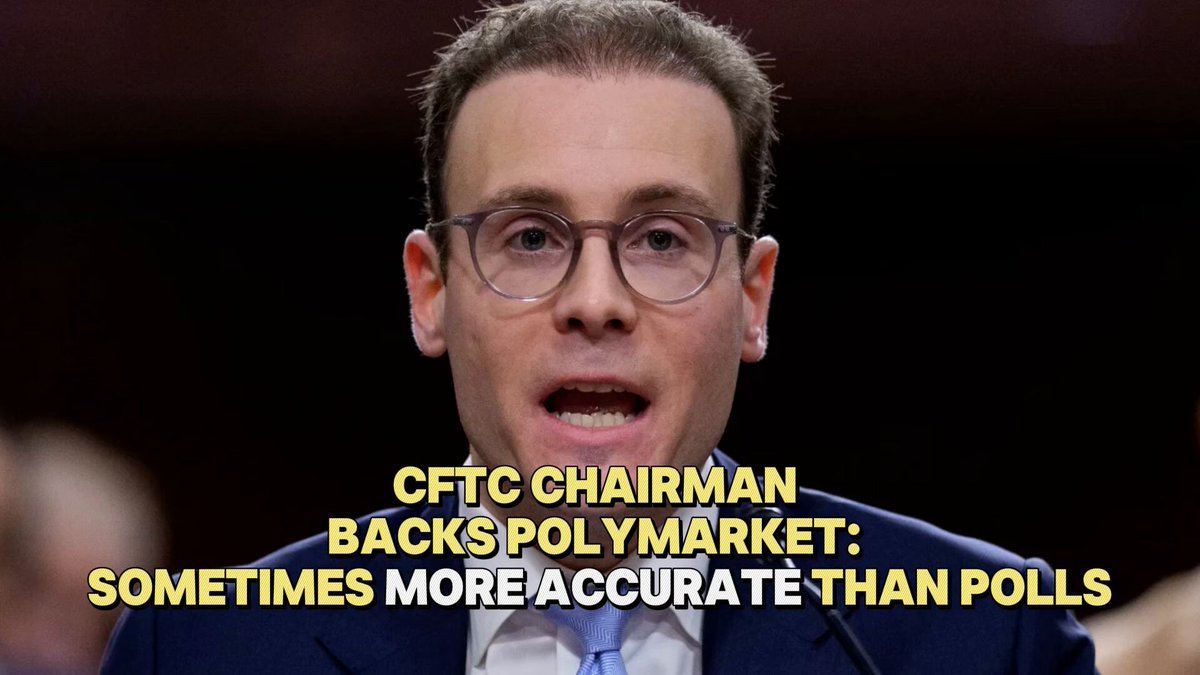 CFTC Chair Michael Selig says prediction markets like Polymarket outperform polls and help fight fake news, urging US rules to support innovation and keep jobs onshore2026-04
 CFTC secures $1.3M penalty and trading ban against Florida resident in commodity pool fraud case, reinforcing crackdown on market abuse2026-04
 Former CFTC chair 'Crypto Dad' Giancarlo leaves Willkie Farr for crypto advisory and private investing2026-04
 Polymarket paid creators to stage $900K in fake winning bets on cloned sites, courting American users it's banned from serving2026-06
 Binance’s American arm plans to seek CFTC DCM status in August to offer prediction markets2026-07
The CFTC, Crypto, and the Future of U.S. Derivatives Regulation
The Commodity Futures Trading Commission (CFTC) is the primary U.S. regulator of derivatives markets, overseeing futures, options, and most swaps on commodities, and increasingly setting the rules of the road for crypto derivatives and some spot‑market conduct. As crypto trading migrates into regulated venues and new products like perpetual futures, prediction markets, and tokenized collateral proliferate, understanding how the CFTC works—and where it overlaps and clashes with the SEC and the states—has become central to navigating the evolving digital asset landscape.
What is the CFTC?
The CFTC is an independent U.S. federal agency charged with regulating derivatives markets, which historically focused on agricultural commodities but now encompass interest rates, foreign exchange, digital assets, and more. Its core jurisdiction covers futures, options on futures, and most swaps on any “commodity,” a term defined broadly enough to include cryptocurrencies like bitcoin and ether. In addition to this product‑specific oversight, Congress has given the CFTC anti‑fraud and anti‑manipulation authority over spot commodity markets in certain circumstances, which the agency has used to police misconduct in Bitcoin and other virtual asset markets even when no CFTC‑regulated derivatives are involved.
Within this remit, the CFTC authorizes and supervises trading venues such as designated contract markets (DCMs) for futures, swap execution facilities (SEFs), clearinghouses known as derivatives clearing organizations (DCOs), and intermediaries such as futures commission merchants (FCMs) and introducing brokers. These entities handle the core infrastructure of margining, clearing, and execution for derivatives markets, including an expanding suite of crypto futures and options contracts. The CFTC’s regulatory framework is built around risk management, market integrity, and customer protection, emphasizing capital requirements, segregation of customer assets, recordkeeping, and surveillance.
The Commission itself is led by a chair and a panel of commissioners, each nominated by the President and confirmed by the Senate, with no more than three commissioners from the same political party. This structure is meant to insulate the CFTC from short‑term political pressure while allowing shifts in policy direction as administrations change. In the crypto era, leadership matters: chairs and commissioners have substantial discretion in determining enforcement priorities, approving novel products like crypto perpetual futures, and interpreting ambiguous statutory terms such as “swap,” “security‑based swap,” and “event contract.”
In public messaging, the CFTC repeatedly emphasizes that its rules are technology‑neutral, a theme that has become particularly prominent as the agency addresses tokenization and on‑chain markets. The idea is that the same core principles—such as segregation of customer funds, robust collateral management, and accurate recordkeeping—apply whether an asset is represented in a traditional database or as a token on a blockchain. This technology‑neutral stance underpins the CFTC’s recent guidance on tokenized collateral and supports its contention that it can handle novel products like decentralized perpetual swaps and prediction markets without entirely rewriting the Commodity Exchange Act.

CFTC says U.S. commodities firms can invest in tokenized assets and use blockchain records, signaling broader acceptance of blockchain in financial markets

Historical Evolution and the Dodd‑Frank Pivot
From agricultural futures to global derivatives watchdog
The CFTC traces its origins to the early 20th‑century effort to tame speculation and manipulation in grain markets, but its modern form dates to the Commodity Futures Trading Commission Act of 1974, which spun derivatives oversight out of the Department of Agriculture into a standalone agency. For decades, the CFTC’s principal focus was standardized exchange‑traded futures contracts on commodities such as wheat, corn, and energy products, alongside financial futures on interest rates and equity indexes. These contracts were overwhelmingly traded on centralized exchanges like the Chicago Mercantile Exchange (CME) and cleared through well‑capitalized clearinghouses.
By the early 2000s, however, the derivatives landscape had shifted dramatically. Over‑the‑counter (OTC) swaps on interest rates, credit, and foreign exchange grew into a multi‑hundred‑trillion‑dollar market, much of it outside the purview of exchange‑style regulation and clearing. The 2008 global financial crisis exposed severe weaknesses in that system, including opaque counterparty exposures, inadequate collateralization, and a lack of central transparency into complex structured products such as credit default swaps. Policy makers concluded that leaving such a massive part of the financial system largely unregulated had amplified systemic risk.
The CFTC entered the post‑crisis period with a relatively narrow toolkit and jurisdiction focused on exchange‑traded futures. It did not have explicit, comprehensive authority over the bulk of OTC swaps that had fueled the crisis. This gap set the stage for a radical expansion of the agency’s mandate under the Dodd‑Frank Wall Street Reform and Consumer Protection Act of 2010, which reshaped the architecture of U.S. derivatives regulation and remains the legal framework within which today’s crypto derivatives debates—especially over perpetual futures—are playing out.
Dodd‑Frank and the rise of swaps regulation
Dodd‑Frank added a new, detailed regulatory regime for swaps and divided responsibility between the CFTC and the Securities and Exchange Commission (SEC). In broad terms, the CFTC was given authority over swaps based on most commodities, interest rates, and broad‑based indices, while the SEC was assigned “security‑based swaps,” such as derivatives referencing a single security or narrow‑based equity index. To make this split workable, Congress directed the two agencies to jointly further define what counts as a “swap” versus a “security‑based swap,” including how to treat mixed or complex products.
Under Dodd‑Frank, standardized swaps are supposed to trade on regulated exchanges or SEFs and be centrally cleared when possible, mirroring the futures model. Swap dealers and major swap participants must register, hold capital, post and collect margin, and adhere to business conduct standards designed to reduce counterparty risk and protect clients. The law also required robust trade reporting and recordkeeping, enabling regulators to see aggregate exposures across the system in a way that was impossible before 2008.
These reforms dramatically increased the CFTC’s reach: the agency gained oversight over more than \$400 trillion in swaps, roughly measured by notional value, creating a vast new regulatory frontier. The same statutory provisions now sit in the background of current disputes over whether certain crypto derivatives—especially perpetual futures—should be classified as futures or swaps. If an instrument is deemed a swap, it may face a different regulatory treatment, including more stringent dealer and reporting obligations, than if it is treated as a futures contract traded on a DCM and cleared through a DCO.
Technology neutrality and tokenization
Dodd‑Frank was enacted before Bitcoin or Ethereum had become mainstream, and certainly before tokenized treasuries, stablecoins, or on‑chain derivatives were conceivable policy questions. Yet the CFTC has argued that its core principles and rules are technology‑neutral, enabling it to apply the same regulatory framework to tokenized or blockchain‑based assets that it uses for traditional financial instruments. This philosophy came to the fore in December 2025, when the CFTC’s Market Participants Division and other divisions issued guidance on the use of tokenized assets as collateral in futures and swaps markets.
That guidance, issued alongside a broader digital assets pilot program, highlighted how existing requirements such as legal enforceability, segregation and custody, haircuts and valuation, and operational risk management can be applied to tokenized collateral, including tokenized U.S. Treasury securities and money market fund shares. The CFTC emphasized that firms should analyze tokenized assets on an individual basis within the existing regulatory framework and their own risk policies, rather than expecting a bespoke regime for each new technology. The guidance also underscored the Commission’s view that non‑securities digital assets, including payment stablecoins like USDC, can be used as customer margin collateral at FCMs under carefully defined conditions.
This attempt to treat tokenization as an incremental evolution rather than a separate category has important implications for crypto markets. It suggests that the CFTC envisions a future in which tokenized collateral, on‑chain clearing, and smart‑contract‑based risk management can be folded into its current supervisory model, rather than forcing a wholesale redesign of derivatives laws. At the same time, operational and legal questions—such as control over private keys, settlement finality on public blockchains, and the treatment of forks—pose novel challenges that Dodd‑Frank’s drafters did not anticipate. The digital assets pilot is, in effect, an experiment in how far the technology‑neutral vision can stretch before new legislation becomes necessary.
Readers click CFTC stories not for regulatory theory but for live scorekeeping — who got subpoenaed, who settled for how much, and whether DeFi protocols or prediction markets survive the agency's next jurisdictional expansion.
CFTC, SEC, and the Struggle for Crypto Jurisdiction
Different statutory missions and tools
The CFTC and SEC have complementary but distinct missions. The SEC’s core focus is on investor protection in securities markets, covering stocks, bonds, mutual funds, and securities‑based derivatives. The CFTC, by contrast, is tasked with maintaining the integrity, resilience, and transparency of derivatives markets on commodities, broadly construed. In practice, this means the SEC regulates securities offerings, broker‑dealers, and securities exchanges, while the CFTC regulates commodity futures exchanges, swap dealers, and related intermediaries.
Crypto assets have complicated this neat divide. The SEC has asserted that many tokens are securities under the Howey test for investment contracts, putting their issuance and secondary trading under SEC jurisdiction. The CFTC, however, has consistently maintained that Bitcoin and certain other crypto assets are commodities and that derivatives referencing them fall squarely within its mandate. Moreover, the CFTC has exercised enforcement authority over fraud and manipulation in underlying spot markets for virtual currencies, leveraging its broader commodity‑market powers.
This overlapping jurisdiction has created what many in the industry describe as a “turf war” between the agencies, with market participants facing potentially conflicting interpretations of whether an asset is a security, a commodity, or something in between. Legal analysis from firms such as K&L Gates underscores that the CFTC has full regulatory authority over derivatives, including swaps, futures, and options on commodities and, in some contexts, virtual currencies, while the SEC retains primary oversight over securities offerings and securities‑based derivatives. The result is a complicated regulatory mosaic that can be difficult for crypto projects and exchanges to navigate.
Turf battles and the search for clarity
Recognizing these challenges, members of Congress have introduced various bills to delineate SEC and CFTC responsibilities over digital assets. Senator Cynthia Lummis has been a leading proponent of legislative efforts to provide “regulatory certainty” for crypto markets via a Digital Asset Market Structure Clarity Act or similar framework. Public statements about this initiative emphasize that it is designed to give both the SEC and CFTC clear lanes, reducing jurisdictional overlap and the uncertainty that has plagued the industry. Even the label “Clarity Act” signals an intent to end crypto’s jurisdictional limbo, although the precise statutory language and implementation details remain critical.
From the industry’s perspective, clear allocation of authority could reduce the risk that the same token is treated as a security in one context and a commodity in another, or that exchanges face simultaneous SEC and CFTC scrutiny without coherent guidance. From the agencies’ perspective, however, any reallocation of jurisdiction raises questions about resources, expertise, and institutional identity. Both regulators have invested significant enforcement and policy capital asserting their roles in the crypto space, and any legislative settlement must account for already‑pending litigation and legacy rulemakings.
In this context, recent commentary has highlighted the importance of inter‑agency comity. SEC Chair Paul Atkins, for example, has publicly supported CFTC Chair Michael Selig’s ability to oversee prediction markets and other innovative products, suggesting that the Commission has the capacity to handle burgeoning market segments despite concerns over funding and staffing. Such statements may be read as an implicit endorsement of a more robust CFTC role in certain areas, especially where products resemble traditional derivatives rather than capital‑raising instruments.
Joint work on defining “swaps” and perps
Even as Congress debates structural reforms, the SEC and CFTC are working together within existing authority to clarify key definitions. One prominent example is their joint request for public comment on further refining the definition of “swap,” “security‑based swap,” and “mixed swap” under Dodd‑Frank. This process is highly salient to crypto because many digital asset derivatives, especially perpetual futures and options, may straddle the line between futures and swaps, or between commodity‑based and security‑based derivatives.
The joint request, formalized in a Commission release, solicits input on how to categorize a subset of swaps that are based on one or more interest or other rates, currencies, or similar underlyings. Although not limited to crypto, this inquiry intersects directly with CME Group’s lawsuit against the CFTC over the classification of crypto perpetual futures, in which CME argues that the agency may have violated Dodd‑Frank by treating certain perpetual contracts as futures rather than swaps. If a court were to agree, it could force regulators to revisit existing approvals and potentially apply swap‑level oversight—including different margin rules and dealer requirements—to a broad class of perpetual products.
By seeking public comment, the CFTC and SEC appear to be signaling openness to adjusting how they draw these lines, while also attempting to shore up their legal footing amid high‑stakes litigation. For crypto exchanges and DeFi protocols, the outcome of this definitional debate will determine whether a given product can be listed on a CFTC‑regulated futures exchange, must be treated as a swap subject to different rules, or falls under SEC jurisdiction as a security‑based derivative. The stakes are particularly high for onshore perpetuals, which sit at the heart of a rapidly growing segment of crypto trading.
- 01Named-entity enforcement actions↗
Headlines naming specific firms — BitBoy, Jump Crypto, FTX, KuCoin — drew the highest clicks because readers treat each case as a canary: if this firm got caught, who is next.
- 02Prediction markets legal battle↗
The Kalshi court win and Polymarket's CFTC settlement created a live jurisdictional drama over whether event contracts are legal products or illegal gambling, pulling in readers tracking that line.
- 03DeFi protocol crackdowns↗
Enforcement against Uniswap, ZeroEx, Opyn, Deridex, and OokiDAO forced readers to confront whether simply deploying a smart contract triggers CFTC liability.
- 04Trump-era leadership shift↗
The pivot from an adversarial posture to Brian Quintenz and Caroline Pham signaled a potential regime change in crypto enforcement philosophy, making personnel news unusually trade-relevant.
- 05CFTC vs SEC jurisdiction turf war↗
Whether ETH is a commodity or security, and whether CFTC or SEC leads crypto oversight, has direct legal consequences for every protocol, so readers tracked each agency statement closely.
- 06Perpetual futures registration fight↗
CME's 2026 lawsuit against the CFTC over perpetual futures approval crystallized the tension between incumbent exchange interests and crypto-native product structures.
CFTC and Crypto Markets: From Crackdowns to Integration
Virtual currency as a “commodity”
The CFTC was one of the first major U.S. regulators to explicitly classify Bitcoin and other virtual currencies as commodities, bringing them within its remit for derivatives and anti‑fraud enforcement. This classification does not mean the CFTC regulates all crypto activity; instead, it allows the Commission to regulate derivatives based on these assets and to pursue fraud and manipulation in spot markets where there is a nexus to interstate commerce. In practice, this has allowed the CFTC to sue actors engaged in schemes ranging from unregistered leveraged trading platforms to misleading representations about token features.
Empirical analysis of CFTC enforcement actions in virtual currency markets from 2015 to 2021 shows that Bitcoin was involved in the vast majority of cases. A report by Cornerstone Research found that 31 CFTC cases involved Bitcoin alone and another 11 cases involved Bitcoin alongside at least one other virtual currency. Only a handful of cases focused on specific tokens without including Bitcoin, involving assets such as ATM Coin, Compcoin, My Big Coin, and USDt. This concentration reflects Bitcoin’s centrality to the early crypto derivatives ecosystem and the CFTC’s prioritization of high‑volume, systemically relevant markets.
As Ethereum and other networks gained prominence, the CFTC also brought actions involving ether‑based derivatives and alleged frauds, reinforcing the idea that a wide range of tokens can be treated as commodities depending on context. At the same time, the Commission has generally deferred to the SEC on questions of whether particular token offerings are unregistered securities offerings, focusing instead on market integrity and derivatives‑related misconduct. This division of labor underscores how the two agencies’ mandates intersect rather than duplicate one another.
Enforcement waves: trading platforms and lending
One major theme of CFTC crypto enforcement has been action against offshore trading platforms serving U.S. customers without proper registration or compliance with U.S. law. A landmark case was the CFTC’s action against BitMEX, a major crypto derivatives platform, which culminated in a 2021 federal court order imposing a \$100 million civil monetary penalty for operating an unregistered trading facility and violating CFTC regulations. The order allowed up to \$50 million of the penalty to be offset by payments BitMEX made under a parallel enforcement action by the Financial Crimes Enforcement Network (FinCEN), reflecting coordinated regulatory scrutiny.
The BitMEX case also involved criminal charges brought by the U.S. Attorney’s Office for the Southern District of New York against several of the platform’s executives, alleging violations of the Bank Secrecy Act and related offenses. While the criminal charges were not brought by the CFTC, the case highlighted how derivatives regulation, anti‑money‑laundering law, and sanctions enforcement can converge in the crypto context. For the CFTC, the core message was that offering leveraged crypto derivatives to U.S. persons without registering as a DCM or SEF, and without implementing adequate know‑your‑customer (KYC) and anti‑money‑laundering controls, is unacceptable.
More recently, the CFTC has turned its attention to crypto lending platforms and yield products, sometimes in parallel with state and SEC actions. A notable example is its settlement with Celsius founder Alex Mashinsky, which resulted in a permanent trading ban and resolved the agency’s first case against a crypto lending platform. According to public reporting, the CFTC alleged that Celsius and Mashinsky misrepresented the safety and regulatory status of the platform’s yield‑bearing products and engaged in deceptive practices that harmed customers. The permanent trading ban underscores the Commission’s willingness to seek severe penalties against individuals it views as responsible for major crypto‑related frauds.
These cases illustrate the CFTC’s evolving enforcement posture: from predominantly targeting trading platforms like BitMEX, the agency has expanded into lending, yield products, and other crypto financial services that intersect with derivatives or fall under its anti‑fraud authority. For market participants, the lesson is that the CFTC is not confined to classic futures exchanges—it can and will reach into broader segments of the crypto ecosystem where leverage, derivatives, or misrepresentations about regulatory status are present.
The digital assets pilot and tokenized collateral
Even as it pursues enforcement, the CFTC has launched initiatives aimed at integrating digital assets into regulated derivatives markets in a controlled fashion. In December 2025, Acting Chair Caroline Pham announced a digital assets pilot program for certain digital assets, including bitcoin, ether, and USDC, to be used as collateral in derivatives markets. The program included new guidance on tokenized collateral and a no‑action position related to FCMs accepting non‑securities digital assets as customer margin collateral or holding proprietary payment stablecoins in segregated accounts.
The guidance clarified that CFTC regulations are technology‑neutral and encouraged firms to evaluate tokenized assets individually under existing frameworks and internal policies. It addressed topics such as eligible tokenized assets, legal enforceability of tokenized collateral arrangements, segregation and custody, haircut methodologies and valuation, and operational risks such as smart contract bugs and key management failures. Importantly, the guidance applied not only to native digital assets like bitcoin, but also to tokenized real‑world assets, including U.S. Treasury securities and money market funds, signaling the Commission’s openness to tokenized finance more broadly.
The no‑action letter issued by the Market Participants Division provided regulatory clarity for FCMs willing to accept non‑securities digital assets, including payment stablecoins, as margin collateral. Under this pilot framework, FCMs could, for the first three months of reliance on the no‑action position, accept only bitcoin, ether, and USDC as customer margin collateral, with strict conditions such as weekly reporting of digital asset holdings by account class and prompt notification of any significant issues. This cautious approach allowed the CFTC to monitor risks while facilitating responsible financial innovation.
Legal commentators have described these moves as part of a broader “crypto sprint” by U.S. regulators, in which the CFTC is overhauling and modernizing its guidance on digital assets while attempting to expand their legitimate use in derivatives markets. The pilot program does not radically rewrite the rules for crypto, but it does create pathways for digital assets to become embedded in mainstream derivatives infrastructure, particularly in the areas of collateral management and clearing. For crypto market structure, this is significant: using bitcoin, ether, or stablecoins as margin at CFTC‑regulated FCMs and clearinghouses can deepen liquidity and reduce the need to hold fiat cash, making regulated futures more attractive relative to offshore venues.
CFTC staff updates FAQs on crypto and blockchain activities for registrants
Perpetual Futures: The CME–CFTC Clash and On‑Chain Perps
What makes a perpetual different?
Perpetual futures, often called “perps,” are derivative contracts that resemble conventional futures but have no fixed expiration date. Instead of settling at a specific maturity, they are designed to trade around the spot price of the underlying asset indefinitely, usually through a funding‑rate mechanism that transfers value between long and short positions to keep the contract price anchored to spot. This structure has become enormously popular in offshore crypto markets, where platforms like Binance, Bybit, and various decentralized exchanges built large businesses around highly leveraged BTC and ETH perps.
From a legal perspective, the question is whether these instruments should be treated as futures, swaps, or some hybrid. Traditional futures involve standardized contracts with set expiration dates traded on DCMs, while swaps are typically more flexible, often OTC or SEF‑traded, and can have bespoke terms. Perps blur this line: they are exchange‑traded and standardized, like futures, but their perpetual nature and funding mechanisms resemble some forms of swaps. This ambiguity lies at the heart of current regulatory and legal debates in the United States.
Are perps futures or swaps? The CME lawsuit
The CFTC has begun to approve perpetual futures contracts for trading on U.S. registered venues, including platforms associated with Coinbase and Kalshi, under a futures‑style regime. These approvals have opened the door for U.S. retail and institutional investors to access onshore perps, albeit with lower leverage and more stringent risk controls than on many offshore exchanges. However, CME Group—the dominant U.S. derivatives exchange—has filed a lawsuit challenging the CFTC’s approach, arguing that the agency may have improperly treated certain perps as futures rather than swaps under Dodd‑Frank.
According to public reports, CME’s outgoing CEO Terry Duffy has alleged that by classifying crypto perps as futures contracts, the CFTC has effectively sidestepped swap regulations and allowed rivals to offer products that should be subject to more stringent oversight. CME contends that these instruments function like swaps and that Dodd‑Frank requires them to be regulated as such, warning that misclassification could lead to excessive speculation and systemic risks reminiscent of the pre‑2008 swaps market. TD Cowen and other analysts have suggested that CME may have a strong legal position, in part because the statutory text and prior joint rulemakings contemplated a clear distinction between futures and swaps.
The CFTC, for its part, has characterized the lawsuit as “frivolous” and expressed confidence that its approvals comply with the law. The agency’s position implies that it views perpetual futures—at least in certain configurations—as sufficiently similar to conventional futures to justify treating them as such. This may hinge on factors such as how the funding rate is structured, how the contracts are margined and cleared, and whether they are standardized and exchange‑traded. Regardless of the outcome, the litigation highlights how product innovation in crypto derivatives is forcing regulators and courts to revisit foundational definitions embedded in Dodd‑Frank.
The classification of perps is not just a technical issue. If courts or regulators ultimately deem most crypto perps to be swaps, some existing and planned U.S. offerings might have to migrate from futures exchanges to SEFs, and platforms offering them could face new registration categories and business conduct rules. Conversely, a clear endorsement of the futures classification could spur a wave of new exchangetraded perps, as both incumbent players like CME and newer entrants race to capture demand that has until now gone largely to offshore venues.
Selig’s vision: Hyperliquid‑style markets onshore
While the CME–CFTC judicial clash plays out, current CFTC Chair Michael Selig has articulated a vision for bringing sophisticated, Hyperliquid‑style perpetual derivatives markets onshore under tailored U.S. rules. In a widely discussed interview on the Bankless podcast, Selig noted that the CFTC has already approved the first U.S.‑regulated Bitcoin perpetual futures contract and suggested that the era of “regulation by enforcement” is giving way to a more constructive approach involving ex ante approvals and clearer rulemaking.
Selig has argued that decentralized or on‑chain perpetual markets need not be excluded from U.S. regulation, provided they can be designed to meet core CFTC requirements around customer protection, risk management, and surveillance. This could entail hybrid models in which smart contracts handle execution and some aspects of risk management, but key functions such as KYC, onboarding, and oversight are managed by registered intermediaries or front‑end operators. The chair has also highlighted potential areas of expansion beyond crypto, including 24/7 trading of real‑world assets and equity perps, as examples of how derivatives markets might evolve under CFTC oversight.
Market structure is beginning to reflect this pivot. For example, Kraken has launched CFTC‑regulated U.S. crypto perpetuals on its Kraken Pro platform via a partnership with Bitnomial, a registered derivatives exchange and clearinghouse, signaling that major centralized exchanges see a viable path to offering perps within the U.S. regulatory perimeter. Coinbase and Kalshi have also sought and, in some cases, obtained approvals to list perpetual futures and other novel derivatives, though these moves are now entangled in CME’s legal challenge.
If Selig’s vision is realized, the U.S. might develop a robust, regulated onshore perp market that competes with offshore venues while imposing stricter leverage limits, margining standards, and transparency requirements. For DeFi projects like Hyperliquid, this raises the possibility of launching compliant U.S.‑facing versions of their protocols or collaborating with registered entities to provide liquidity and technology, even as fully permissionless versions of the same protocols continue to operate globally. The challenge will be translating the composability and openness of DeFi into a framework that satisfies CFTC expectations about knowable counterparties, dispute resolution, and systemic risk.
CFTC files first DAO enforcement action (BitMEX precedent era)
CFTC charges OokiDAO, asserting governance token holders are liable
CFTC orders Opyn, Deridex, and ZeroEx for illegal crypto derivatives
- 2024-08regulatory
Judge rules CFTC exceeded authority blocking Kalshi election contracts
- 2024-10regulatory
CFTC fines Uniswap Labs $175K under Commodity Exchange Act
- 2024-10regulatory
FTX and CFTC agree to $12.7B settlement
CFTC overhauls digital asset derivatives guidance, removes separate treatment
CME sues CFTC over perpetual futures approval authority
Prediction Markets, Trump Trades, and CFTC Authority
Event contracts under the Commodity Exchange Act
Prediction markets, also known as event contracts, allow traders to buy and sell contracts that pay out based on the occurrence of future events, such as election outcomes, macroeconomic data releases, or sporting results. Under the Commodity Exchange Act (CEA), the CFTC has authority over event contracts that qualify as futures or swaps, but Congress has imposed special constraints on contracts tied to certain sensitive topics, including terrorism, assassination, and unlawful gaming.
Section 5c(c)(5)(C) of the CEA and CFTC Regulation 40.11 empower the Commission to prohibit or disallow event contracts that involve activity considered contrary to the public interest, such as gaming or illegal conduct under state law. The CFTC has used this authority to scrutinize political prediction markets, including binary options contracts asking whether a specific party will control a chamber of Congress after an election. If the agency determines that such contracts constitute prohibited gaming rather than legitimate hedging or price discovery, it can bar them from being listed on U.S.‑regulated exchanges.
This framework has come under increasing strain as blockchain‑based platforms like Polymarket have popularized prediction markets tied to political events, economic indicators, and other real‑world outcomes. In 2022, the CFTC settled charges against Polymarket’s operator, Blockratize, Inc., for offering off‑exchange event‑based binary options without registering as a designated contract market or swap execution facility. The settlement required Polymarket to pay a \$1.4 million civil penalty, wind down non‑compliant markets, and cease violating the CEA and CFTC regulations.
The Polymarket case underscored that even innovative, blockchain‑based prediction markets must comply with CFTC registration and product‑approval rules if their contracts fall within the agency’s jurisdiction. It also highlighted unresolved policy questions about how to distinguish harmful “gaming” from socially useful prediction markets that provide information and hedging opportunities.
Polymarket, Kalshi, and the legality of political markets
Beyond Polymarket, the CFTC has grappled with whether to permit large‑scale political event contracts on regulated exchanges. In 2023, the Commission disapproved KalshiEX LLC’s self‑certified “congressional control” contracts, which were cash‑settled binary contracts asking whether a particular party would control a chamber of Congress for a specified term. After reviewing the record, the CFTC concluded that the contracts involved “gaming” and activity unlawful under state law and were contrary to the public interest, citing its authority under the CEA and Regulation 40.11.
The Kalshi disapproval signaled a cautious approach to political prediction markets, particularly when contracts could be perceived as betting on election outcomes rather than hedging economic or commercial risks. For traders seeking to express views on elections—such as the chances of Donald Trump or another candidate winning the presidency—this created a fragmented landscape in which some offshore or unregistered platforms offered such markets, while CFTC‑regulated venues faced stricter constraints.
Nonetheless, the policy landscape is evolving. The CFTC recently issued an Advanced Notice of Proposed Rulemaking (ANPRM) to help identify areas of confusion in applying the CEA and CFTC regulations to prediction markets, with the stated intention of moving forward with regulation that reinforces the agency’s obligations. This ANPRM indicates that the Commission is considering more explicit and perhaps more nuanced rules about which event contracts are permissible, including those related to elections and politics.
The interplay between prediction markets and Trump‑related trades illustrates the stakes. Markets on questions like “Will Trump win the 2024 election?” or “Will Trump be convicted in a particular case?” can attract significant volume and public attention. For the CFTC, the challenge is to decide whether such contracts are akin to sports betting, which many state laws regulate as gambling, or whether they serve a legitimate hedging or informational role that justifies treatment as derivatives. The Kalshi disapproval and Polymarket settlement suggest a leaning toward the former in many cases, but the ANPRM and subsequent lawsuits could reshape that boundary.
Federal–state fights and the Michigan decision
Prediction markets also sit at the intersection of federal and state authority. While the CFTC claims “exclusive jurisdiction” over derivatives markets under the CEA, states regulate gambling, lotteries, and many consumer‑protection issues. This has led to tensions, particularly when state regulators view event‑contract trading as unauthorized gambling even if the CFTC considers the contracts lawful derivatives.
In a high‑profile move, the CFTC filed lawsuits challenging actions by Arizona, Connecticut, and Illinois that sought to outlaw, regulate, or otherwise restrain activities of CFTC‑registered DCMs facilitating event‑contract trading. The Commission argued that these state actions infringed its clear and longstanding exclusive jurisdiction to regulate event contracts under the CEA. CFTC Chair Michael Selig stated that the agency would continue to safeguard its exclusive authority over these markets and defend market participants against “overzealous state regulators.” The lawsuits underscore the Commission’s view that once an event contract is approved and traded on a registered derivatives market, states cannot simply reclassify it as illegal gambling.
At the same time, federal courts have begun to weigh in on the scope of CFTC authority. A Michigan federal judge recently ruled that certain sports prediction markets are not under CFTC purview, suggesting that not all event‑based contracts fall within the agency’s jurisdiction. Although the detailed reasoning of that decision is still being digested, it points to the possibility that some event markets may escape both CFTC and state gambling‑law oversight, or at least fall into gray areas.
SEC Chair Paul Atkins has publicly downplayed concerns about whether the CFTC has sufficient resources to oversee prediction markets, describing CFTC Commissioner Mike Selig as “very capable” and expressing confidence in the agency’s ability to supervise a growing sector. Yet resource constraints remain a practical constraint: as prediction markets proliferate across topics from elections to sports to macroeconomic data, the CFTC must prioritize which products to scrutinize or approve. The ongoing litigation with states and the ANPRM process will shape the future of these markets, with implications for platforms like Polymarket, Kalshi, and any new entrants seeking to list politically sensitive contracts.
The CFTC has pursued enforcement against DeFi protocols, DAOs, and centralized crypto firms simultaneously, creating broad and unresolved legal exposure across the sector.
CFTC and SEC both claim authority over major crypto assets including ETH, leaving firms navigating contradictory compliance requirements with no statutory resolution yet in place.
The OokiDAO and Uniswap actions established that immutable protocol deployments and governance token holders can be held liable under the Commodity Exchange Act.
Prediction market legality remains in flux — Kalshi's court win opened election contracts while the CFTC simultaneously launched 200 insider-trading investigations into the sector.
Enforcement priorities shift sharply with leadership: the Quintenz/Pham transition reversed aggressive DeFi enforcement posture, exposing firms to unpredictable policy reversals tied to a single appointment.
Penalties have ranged from a $175K Uniswap fine to a $12.7B FTX settlement, with no consistent proportionality framework, making fine exposure difficult to model in advance.
Market Structure: How CFTC‑Regulated Crypto Products Work
Key registrants: DCMs, SEFs, FCMs, DCOs
To understand how the CFTC shapes crypto markets, it is essential to grasp the core categories of registrants it oversees. DCMs are exchanges that list futures and options on futures for trading by market participants, subject to core principles around fair access, transparency, and market surveillance. In the crypto context, DCMs list standardized Bitcoin and Ether futures and options, as well as, increasingly, perpetual futures contracts and other derivatives.
SEFs are platforms for trading swaps, which may include certain crypto derivatives that are classified as swaps rather than futures. While crypto swap trading remains less developed than futures trading, SEFs could become more important if courts or regulators determine that particular perpetuals or structured products must be treated as swaps. DCOs provide clearing services, standing between counterparties to guarantee performance and manage margin calls and default processes.
FCMs act as intermediaries between customers and exchanges or clearinghouses, handling customer orders, collecting and holding margin, and ensuring compliance with rules on segregation of customer assets and risk management. In the CFTC’s digital assets pilot, FCMs are central, as they are the entities that may accept bitcoin, ether, and stablecoins like USDC as customer margin collateral under specific conditions. These intermediaries, along with introducing brokers and other registrants, form the backbone of the CFTC‑regulated market structure in which crypto derivatives now trade.
Launching CFTC‑regulated crypto derivatives
Launching a CFTC‑regulated crypto derivative involves several layers of approval and oversight. A DCM or SEF must design the contract, including its underlying index or reference rate, contract size, tick value, margin requirements, and—in the case of perps—the funding mechanism. The venue must then list the contract either through self‑certification, affirming that it complies with the Commodity Exchange Act and CFTC regulations, or through a more formal approval process, depending on the product’s novelty and sensitivity.
The CFTC reviews whether the contract is susceptible to manipulation, whether the underlying market is sufficiently liquid and robust, and whether the exchange has adequate surveillance and risk‑management procedures. For crypto contracts, these considerations include the reliability of spot price indices, the presence of wash trading or spoofing in underlying markets, and potential for cross‑market manipulation. The BitMEX case and other enforcement actions have made clear that the CFTC will scrutinize platforms that offer high leverage without appropriate controls, especially to U.S. retail customers.
Platforms like Kraken, Coinbase, and Kalshi have pursued different strategies to enter the CFTC perimeter. Kraken, for example, has partnered with Bitnomial, a CFTC‑regulated exchange and clearinghouse, to offer U.S. customers access to regulated crypto perps through the Kraken Pro interface, leveraging Bitnomial’s licenses and infrastructure. Coinbase has acquired or built its own derivatives entities, such as Coinbase Derivatives, to list futures and options contracts. Kalshi has focused on event contracts, including macroeconomic releases and political outcomes, prompting intense dialogue with the CFTC about the boundaries of permissible products.
For DeFi protocols seeking to interface with U.S. users, the path is more complex. They may need to create permissioned front‑ends or partner with registered intermediaries who handle KYC, anti‑money‑laundering compliance, and reporting, while leaving the core protocol’s smart contracts accessible globally. Chair Selig’s comments about on‑chain markets coming onshore suggest that the CFTC is open to such models, but the precise compliance architecture remains a work in progress.
Implications for exchanges like Coinbase, Kraken, CME
The current regulatory environment presents both opportunities and constraints for major crypto and traditional exchanges. CME, with its longstanding CFTC licenses and deep experience in futures, has been a key player in institutional Bitcoin and Ether futures trading but is now challenging the CFTC’s handling of perps, arguing that misclassification could distort competition and undermine regulatory consistency. If CME prevails, it may have to adapt its own product roadmap but could also benefit from an environment in which competitors face stricter swap‑regulation hurdles.
Coinbase and Kraken, by contrast, are actively seeking to expand into CFTC‑regulated derivatives, including perps, to diversify revenue and capture traders who might otherwise go offshore. Their ability to do so hinges on CFTC approvals, leverage limits, and the outcome of definitional fights over futures versus swaps. Their push into regulated perps also interacts with SEC oversight of spot markets and token listings; a token considered a security by the SEC may not be easily referenced in a CFTC‑regulated derivative without complex coordination.
For investors and traders, CFTC‑regulated platforms can offer greater legal certainty, more robust safeguards around collateral and custody, and clearer recourse in cases of fraud or insolvency. However, they may also impose tighter margin requirements, lower leverage, stricter KYC, and limited asset coverage compared to offshore alternatives. The overall trajectory suggests a gradual migration of at least some perp and options volume toward onshore venues, especially if product diversity and liquidity improve and if legislative initiatives like the Clarity Act reduce jurisdictional frictions.
CFTC Chair Michael Selig says markets must prepare for “mass tokenization” as onchain finance, AI and 24/7 trading reshape financial markets
Enforcement Priorities and Risk Management in the Crypto Era
Fraud, manipulation, and customer protection
The CFTC’s enforcement record in virtual currencies underscores its focus on fraud, manipulation, and registration violations, often in cases where customers were misled about risks or where platforms evaded U.S. regulatory requirements. Cases involving Bitcoin and other crypto assets have typically alleged misrepresentations about trading strategies, false claims about regulatory oversight, or abusive practices like wash trading and spoofing designed to manipulate prices.
The BitMEX and Polymarket cases illustrate how registration and compliance obligations can serve as anchors for enforcement. In BitMEX, the absence of adequate KYC and anti‑money‑laundering programs and failure to register the platform as a DCM or SEF were central to the CFTC’s complaint. In Polymarket, the operator’s failure to obtain designation as a DCM or registration as a SEF for event‑based binary options markets was dispositive. By targeting unregistered activity, the CFTC reinforces the idea that serious, leveraged trading in crypto derivatives must occur within regulated environments.
Customer protection also extends to segregation of funds and proper collateral management. The digital assets pilot’s emphasis on custody, segregation, and control arrangements for tokenized collateral shows that the CFTC is acutely aware of risks posed by on‑chain custody and smart contracts. The no‑action letter’s requirement that FCMs provide frequent reporting on the amount and type of digital assets held in customer accounts, especially during the pilot phase, reflects a desire for early warning signals if something goes wrong.
Stablecoins, RWAs, and collateral risks
Stablecoins and tokenized real‑world assets (RWAs) pose unique challenges. When used as collateral for derivatives, questions arise about their legal enforceability, redemption mechanisms, and exposure to issuer or counterparty risk. The CFTC’s guidance on tokenized collateral explicitly addresses eligible assets, legal enforceability, and valuation haircuts, indicating that stablecoins like USDC and tokenized Treasuries may be acceptable collateral under certain conditions but require careful risk analysis.
Payment stablecoins, which purport to maintain a one‑to‑one peg with fiat currency, can mitigate volatility risk compared to holding bitcoin or ether as collateral, but they create dependencies on the issuer’s reserves and operational integrity. Tokenized Treasuries and money market funds may offer greater legal and credit certainty but raise questions about settlement finality across different custodial infrastructures and blockchains. For the CFTC, the challenge is to ensure that tokenized collateral integrates coherently with its existing rules on margin, segregation, and capital adequacy, without introducing hidden systemic vulnerabilities.
In practice, FCMs and DCOs may adopt conservative haircuts and eligibility criteria for digital assets, limiting the proportion of margin that can be posted in crypto or stablecoins and insisting on robust legal opinions regarding the enforceability of tokenized collateral arrangements. The CFTC’s emphasis on technology neutrality means that it is not banning such collateral, but it is insisting on thorough risk assessment, including operational risks such as smart contract bugs, oracle failures, and key‑management errors.
Data, surveillance, and cross‑border challenges
Crypto markets are global, fragmented, and often opaque, complicating the CFTC’s surveillance and enforcement efforts. Many underlying spot markets for Bitcoin and other assets are located offshore or operate through decentralized protocols with no obvious jurisdictional nexus. Yet derivatives traded on U.S. DCMs and SEFs may rely on prices from these markets, creating potential channels for cross‑border manipulation or contagion.
The CFTC relies on trade reporting, large trader reporting, and market surveillance conducted by exchanges to detect suspicious activity, but these tools can be strained when underlying liquidity is thin or concentrated on unregulated venues. Cooperation with foreign regulators and data‑sharing arrangements are increasingly important, as evidenced by coordinated actions in cases like BitMEX, where U.S. authorities worked with counterparts in other jurisdictions.
Decentralized exchanges and on‑chain derivatives pose further challenges. While blockchains offer transparent transaction data, identifying beneficial owners, linking addresses to legal entities, and distinguishing legitimate trading from manipulation requires sophisticated analytics and, often, off‑chain information. The CFTC’s willingness to envision on‑chain markets coming onshore suggests it expects registered intermediaries to help bridge this gap, providing the agency with the data and oversight it needs without abandoning the composability and programmability that make DeFi attractive.
Global Context and Lessons for Crypto
Although the CFTC is a U.S. regulator, its approach influences global crypto markets, both directly—through the centrality of U.S. dollar‑denominated derivatives—and indirectly, as other jurisdictions observe and sometimes emulate its policies. The European Union’s Markets in Crypto‑Assets (MiCA) framework and ongoing work on market abuse and derivatives rules, as well as the United Kingdom’s evolving approach to crypto and tokenized assets, illustrate how regulators worldwide are grappling with similar questions about classification, custody, and systemic risk.
Compared with some peers, the CFTC’s stance can be characterized as cautiously open to innovation in derivatives and tokenization, so long as core safeguards are preserved. The digital assets pilot, tokenized collateral guidance, and willingness to approve onshore crypto perps demonstrate a pragmatic approach: rather than banning novel products outright, the agency seeks to bring them within a risk‑managed, transparent framework. At the same time, robust enforcement actions against platforms like BitMEX, Polymarket, and Celsius show that the CFTC is prepared to act aggressively when it perceives significant consumer harm or evasion of U.S. law.
For DeFi builders and crypto exchanges, the U.S. environment under the CFTC offers both constraints and opportunities. Products must be carefully structured to fit within existing legal categories, whether futures or swaps, and platforms must decide whether to seek registration as DCMs, SEFs, or intermediaries. Nonetheless, obtaining CFTC oversight can confer legitimacy, access to institutional capital, and integration with the broader regulated financial system. As tokenization of treasuries, money market funds, and other RWAs accelerates, the CFTC’s approach to collateral and clearing will help determine how quickly on‑chain finance can merge with traditional markets.
Outlook
The coming years will be pivotal for the CFTC’s role in crypto, prediction markets, and tokenized finance. Several trajectories bear watching. First, the outcome of CME Group’s lawsuit over the classification of crypto perpetual futures will shape how far exchanges can push product innovation within a futures framework and whether swap rules will become more central to crypto derivatives. Second, the joint SEC‑CFTC process to refine “swap” and “security‑based swap” definitions, alongside legislative efforts like Senator Lummis’s Clarity Act, will influence how jurisdiction over digital assets is divided and how much regulatory overlap remains.
Third, the CFTC’s ANPRM on prediction markets, combined with its lawsuits against states seeking to restrict event contracts, will set important precedents for the future of political and economic prediction markets, including high‑profile Trump‑related trades. Whether the Commission ultimately carves out a stable, regulated space for such markets or continues to treat many of them as prohibited gaming will have significant implications for information markets, hedging instruments, and the intersection of finance and politics.
Finally, the digital assets pilot program and ongoing guidance on tokenized collateral are likely to expand, gradually normalizing the use of bitcoin, ether, stablecoins, and tokenized treasuries as building blocks of mainstream derivatives markets. If Chair Selig’s vision of on‑chain markets coming onshore is realized, we may see a new generation of hybrid platforms that combine DeFi’s programmability with the CFTC’s regulatory protections, reshaping how derivatives are traded, cleared, and collateralized. For crypto participants, staying attuned to CFTC rulemakings, enforcement trends, and inter‑agency collaborations is no longer optional; it is central to understanding where the next phase of crypto market structure will be built.
Latest CFTC news
CFTC says U.S. commodities firms can invest in tokenized assets and use blockchain records, signaling broader acceptance of blockchain in financial marketsCFTC staff updates FAQs on crypto and blockchain activities for registrantsCFTC Chair Michael Selig says markets must prepare for “mass tokenization” as onchain finance, AI and 24/7 trading reshape financial markets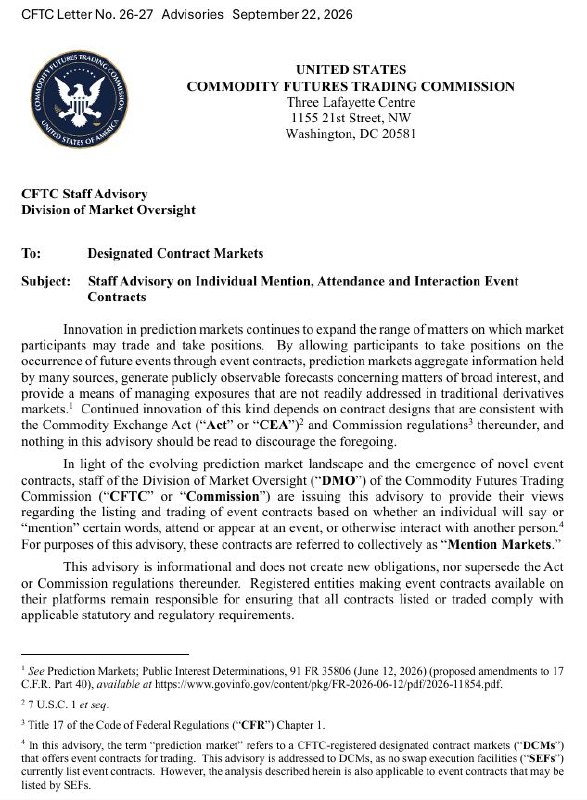 CFTC staff advisory flags heightened manipulation risk in mention market event contracts
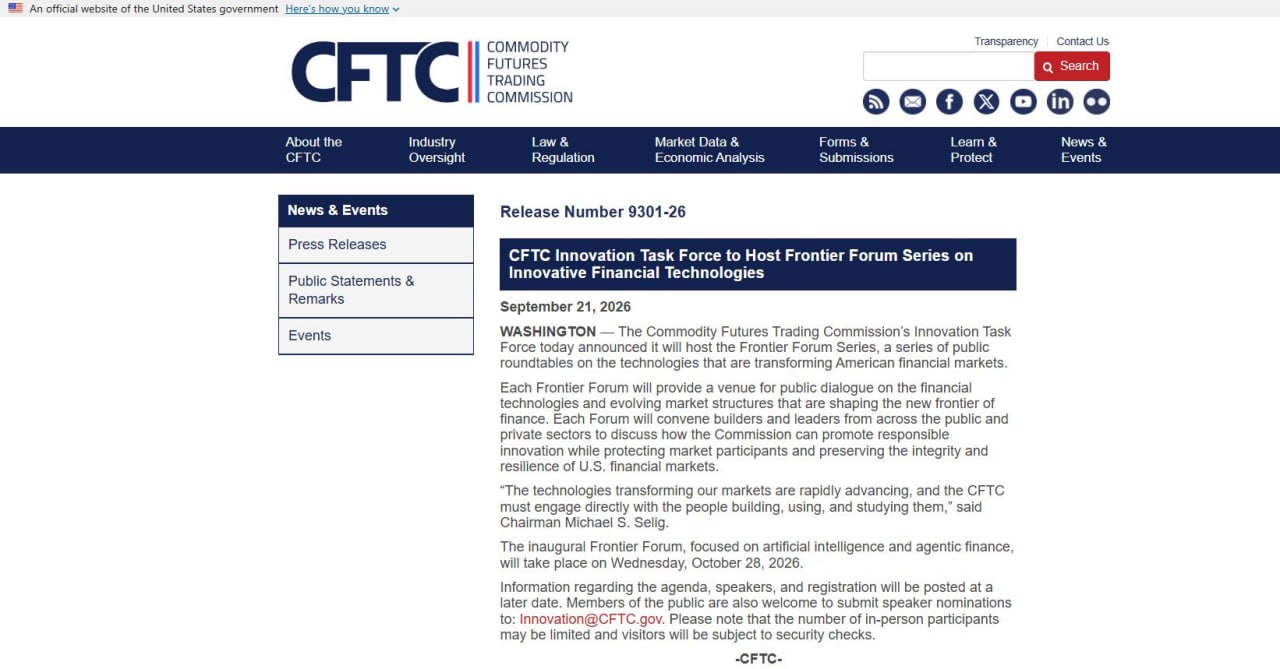 CFTC innovation task force to launch Frontier Forum series on financial technologies
Sources
19 records from 12 domains
cftc.gov
bloomberg.com
sec.gov
youtube.com
x.com
tradingview.com
morganlewis.com
klgates.com
cornerstone.com
telemetr.io
es.tradingview.com
en.bloomingbit.io
Community notes
Spot something off or out of date? Drop a note. Editors review topic notes daily and roll accepted fixes into the explainer — contributors are recognized in the monthly $SQUID drop.
Loading notes…
Help improve this topic
Have a story or tip about this topic? Submit it. See something missing? Leave a note. Editors review daily; accepted submissions and fixes count toward the monthly $SQUID drop.