
A Pythonic, security-first smart-contract language for the EVM. Vyper's founding austerity carried Curve-scale DeFi; its second act pairs formal verification (Venom IR, machine-checked semantics) with a measured, maintainer-acknowledged return of expressive power.
+1 sources across the wider coverage universe
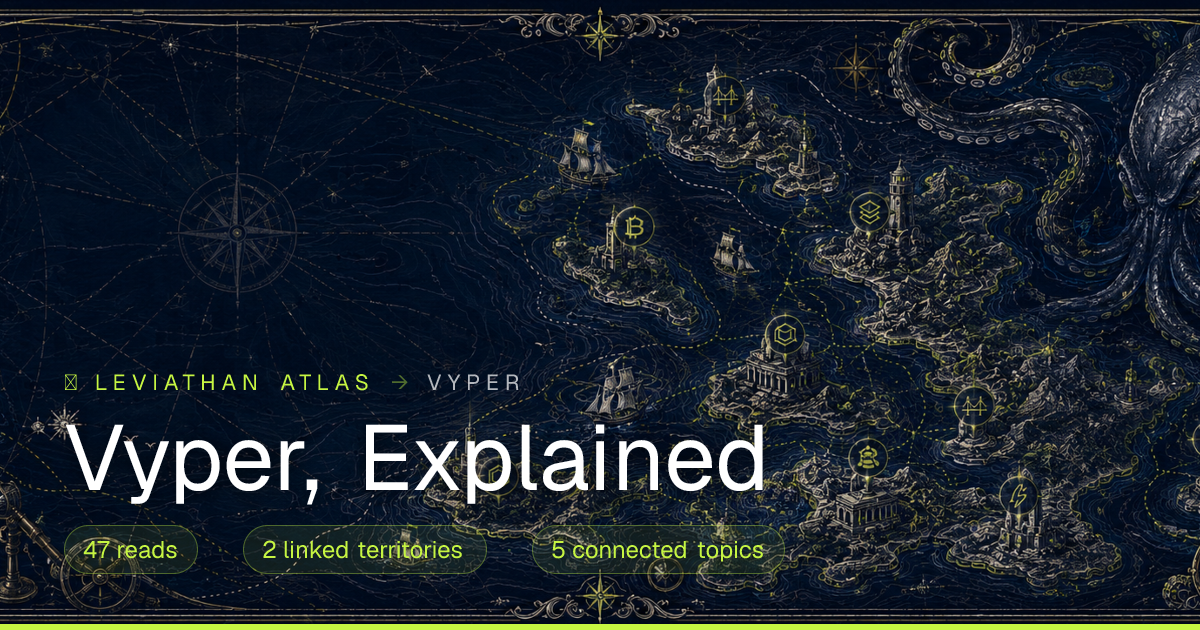 Leviathan Atlas is now charting Vyper, the security-first smart contract language behind Curve2026-07
 Vyper releases open-source agentic payment tools for Ethereum and layer-2 networks2026-04
 Vyper frontend is now directly emitting Venom IR, improving performance and paving the way for formal verification2026-02
 How Vyper's design supports a depth of formal verification that could lead to improvements in smart contract security2026-04
 Vyper releases public, machine-checked formal semantics in HOL4, building on Verifereum’s EVM proofs2026-05
 Launch a memecoin in under five minutes with Vyper's boa library - this Titanoboa tutorial, first in a new series from Curve Llama Lend, teaches you how2024-05
Vyper is a smart-contract language built on a wager most languages refuse to make: that what you leave out matters more than what you put in. Pythonic on the surface, austere underneath, it compiles to Ethereum Virtual Machine bytecode and carries a disproportionate share of DeFi's most capital-sensitive machinery — Curve's pools, crvUSD, LlamaLend — for a language with a fraction of Solidity's ecosystem. Its history divides cleanly into two acts: a decade of deliberate restriction, and a newer, more interesting phase in which the maintainers have begun adding expressiveness back — carefully, and on the record about the trade.
The Wager: Legibility Over Power
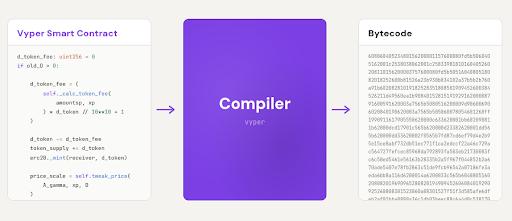
Vyper compiles human-readable source into EVM bytecode, and its syntax deliberately resembles Python — a courtesy to the enormous pool of developers who already think in it. The resemblance ends at philosophy. Python's culture is permissive; Vyper's founding culture was the opposite. The language shipped without modifiers, class inheritance, inline assembly, function overloading, recursion, or unbounded loops, and the documentation is explicit about why: every omitted feature is a category of bug, or of audit ambiguity, that can never occur in a Vyper contract.
The subtlety that separates this from mere minimalism is who the language considers its user. Most languages optimize for the person writing the code. Vyper optimizes for everyone downstream of them: the auditor reading it under deadline, the counterparty deciding whether to trust it, the people whose funds sit behind it for years. A contract is written once and reviewed many times, and Vyper spends its design budget on the reviews. Curve developer Alberto has compressed the case into three points — simpler syntax, enhanced security, leaner bytecode — the last of which is not cosmetic: smaller output is cheaper to execute, so the discipline pays a gas dividend.

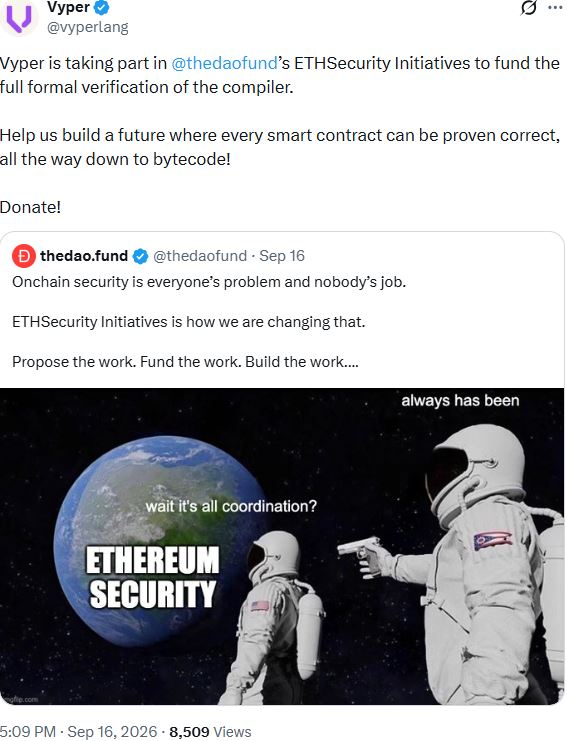
Vyper joins The DAO Fund's ETHSecurity Initiatives to fund full formal verification of its compiler
Curve, and the Gravity of Capital
Vyper's prominence is inseparable from Curve. Michael Egorov chose it when he began building the exchange, and his stated reason has stayed consistent across years of retellings: he could read the language well enough to be confident the mathematics of his pricing curves would behave exactly as written. When Egorov was later named an Ethereum "torchbearer," he used the platform to argue other DeFi teams should evaluate the same trade.
The gravitational pull is visible in what came after. LlamaLend, Curve's lending market built on the LLAMMA soft-liquidation mechanism, is Vyper throughout, as are the crvUSD stablecoin contracts. Yield Basis shipped its autoleverage AMM and leveraged-liquidity token as a suite of Vyper contracts; community tutorials like "SnekBeraLlama" walk developers through standing up a collateralized-debt-position stablecoin on Berachain from Curve primitives. The pattern repeats too often to be coincidence: teams building machinery where a mispriced edge case costs eight figures keep arriving at the language whose pitch is fewer surprises.
Readers engage with Vyper simultaneously as builders and as advocates: the top clicks are how-to tutorials for shipping real things with Vyper tooling, but the second-tier clicks are all about whether the language survives institutionally — revealing a community that has already placed its technical bet and is now watching the funding politics decide the outcome.
July 2023: When the Compiler Lied
No honest account of Vyper skips this chapter, and the language's credibility rests partly on the fact that its community doesn't try. In July 2023, several Curve pools — aETH/ETH, msETH/ETH, pETH/ETH, CRV/ETH — were drained for an estimated $47–70 million in what first looked like textbook reentrancy. It wasn't. The contracts were correct. The compiler was not.
Vyper's @nonreentrant decorator promises to lock a function against re-entry. In versions 0.2.15 through 0.3.0, the compiler mis-allocated the storage slot backing that lock, so the protection silently did nothing. The forensic detail that stings most: the flaw had been fixed in 0.3.1 back in late 2021 — but logged as an optimization ("we allocate more slots than we actually need"), not recognized as a broken security guarantee. For nearly two years, nobody connected the dots.
A contract bug wounds one protocol. A compiler bug is systemic — it invisibly contaminates everything built with the affected versions, and no amount of source-level auditing can see it. That reframing is the single most important thing 2023 did to Vyper: it converted "the compiler must be trustworthy" from an assumption into a research program. Reentrancy protection is now on by default in modern releases rather than left to a decorator someone might forget; the deeper answer took longer, and is the subject of the next two sections.
Leviathan Atlas is now charting Vyper, the security-first smart contract language behind Curve
Venom: Building a Substrate You Can Reason About
The most consequential shift in modern Vyper is invisible to most users: the compiler now targets Venom, an intermediate representation inspired by LLVM IR. An IR is the middle layer between source and bytecode, and its quality determines what the compiler can know about your program. An ad-hoc code generator can be tested; a structured IR with defined semantics can be analyzed — optimized aggressively, and, crucially, proved correct.
The practical result first: in published benchmarks, Venom-compiled contracts match or beat hand-optimized Yul, the low-level language Ethereum engineers reach for when tuning gas by hand. Developers write clear, high-level Vyper and get bytecode that competes with artisanal assembly — available today behind the --experimental-codegen flag (aliased --venom) as it matures toward default. The strategic result matters more. The 2023 incident proved that trusting a compiler on reputation is unacceptable for financial infrastructure. A clean IR is the precondition for doing better than trust.
- 01Vyper tooling accessibility
The boa/Titanoboa library lowering the barrier to deploy contracts in Python-like syntax pulled in the most clicks by far, signaling readers want hands-on entry points, not just theory.
- 02Compiler exploit accountability
The reentrancy bug that drained Curve pools generated multiple top-clicked pieces — preliminary post-mortem, official post-mortem, and the exploit address list — showing readers tracking who explains what went wrong and what changes followed.
- 03Ecosystem funding politics
The Ethereum Foundation's rejection of Vyper fundraising while launching Argot Collective for other niche EVM languages struck readers as a revealing institutional snub worth scrutinizing.
- 04Technical architecture rationale
Readers clicked the EOF rejection piece, the EVM memory model deep-dive, and the Venom IR emission article, showing appetite for the deliberate design choices that distinguish Vyper from Solidity.
- 05Education ecosystem growth
Cyfrin/Patrick Collins courses, Curve stableswap Vyper classes, and FreeCodeCamp tutorials clustered in the mid-tier clicks, reflecting a reader base actively learning rather than just observing.
- 06Formal verification roadmap
The pieces on Venom IR enabling formal verification and Vyper's design supporting deep formal proofs attracted consistent engagement from readers betting on provable smart contract safety.
Formal Verification: The Long Answer to 2023
Click to load the YouTube player. YouTube will set its own cookies once loaded.
Formal verification means proving, mathematically, that a program satisfies its specification — as opposed to testing, which samples behavior and hopes. Vyper's austerity, the same property that makes some contracts verbose, makes the language unusually tractable for proof: no inline assembly to escape the semantics, no inheritance graph to flatten, loops that provably terminate.
Two efforts define the frontier. The Verifereum project has published machine-checked formal semantics for Vyper in the HOL4 theorem prover, including a Vyper-to-Venom lowering with correctness proofs, in collaboration with researchers behind verified compilers like CakeML. The ambition is a fully verified compilation pipeline — a compiler that cannot lie the way the 2023 compiler did, because its faithfulness to source semantics is itself a theorem. Separately, Curve has worked with Certora and the HEVM tooling to prove optimized and unoptimized builds of a contract equivalent — dissolving the old tension between gas efficiency and trustworthiness, where teams previously had to pick one.
Vyper releases open-source agentic payment tools for Ethereum and layer-2 networks

Safety-first framing for agent payments lands oddly from the team whose July 2023 compiler reentrancy bug drained ~$70M from Curve pools — the exploit's still the language's most expensive footnote. x402 already occupies this lane with 165M+ transactions and 85% of settlement parked on Base. On-chain spend caps are cleaner than HTTP 402 challenges in theory, but payment rails get decided by distribution, not architecture.
The Second Act: Adding Power Back, Eyes Open
For most of its life, Vyper's identity was subtraction. The current 0.4.x line complicates that story — deliberately. The language has begun admitting features its younger self would have refused: a module system for composing code across files, abstract methods, containers without fixed bounds, a raw_return decorator (0.4.3) that emits raw bytes without ABI encoding for modern proxy patterns. The maintainers describe these plainly as less safe but more expressive — a characterization from inside the project, not a critic's.
The sequencing is the point. These features arrive after the safety substrate matured, not instead of it: default-on reentrancy protection, the Venom IR, published formal semantics, and the hard lessons of 2023 are the footing that makes selective expressiveness a calculated position rather than drift. The founding austerity was a blunt instrument — the right one for a young language holding other people's money. A decade in, with proof machinery replacing philosophy, the maintainers judge that some of that bluntness can be traded for range, and they say so in exactly those terms. Whether each individual trade lands is precisely the kind of question the language's transparency invites its users to ask. Alongside the expressiveness work, 0.4.3 updated the default EVM target to the Prague hardfork, and nightly builds carry the CREATE3 deployment pattern for deterministic contract addresses.
- 2023-07exploit
Curve Finance pools exploited via Vyper reentrancy compiler bug
- 2023-08milestone
Vyper preliminary post-mortem published with bug bounty and audit recommendations
- 2023-11milestone
Vyper Day developer event held at Devconnect Istanbul
- 2023-12milestone
Vyper official detailed technical post-mortem and roadmap released
- 2024-03governance
Ethereum Foundation decline of Vyper funding draws public criticism alongside Argot Collective announcement
- 2024-10launch
Vyper v0.4.0 'Nagini' released with module system and Venom optimization pipeline
Tooling, Money, and the Means of Survival
Languages die of undermaintenance more often than of bad design, so Vyper's funding structure is a real part of its story. The Ethereum Foundation supplies a portion of the project's budget as a matching grant — every contribution from a protocol that depends on Vyper is amplified, which aligns the language's survival with the survival of the systems built on it. Around the compiler, the working environment has filled in: a Visual Studio Code extension brings language-server diagnostics into the mainstream editor, and scaffolding projects like Scaffold-Yeet ship Vyper as a first-class path from zero to running application.
Education compounds the effect. Cyfrin's Patrick Collins released a 31-hour course on FreeCodeCamp spanning Python, Vyper, and algorithmic trading, and Cyfrin Updraft teaches an advanced course built directly on Curve's StableSwap mechanics — the exact patterns securing billions in live liquidity, taught as curriculum. Community builders keep the language honest at street level; fubuloubu's "Purse" smart wallet and agentic-payment experiments carry Vyper into account-abstraction territory ahead of the tooling.
The scope is worth stating precisely. Crypto's fast lane — memecoins, launch-week tokens — mostly doesn't touch Vyper, and the language doesn't court it. Its center of gravity is code that must stay correct for years while holding sums that make a single bug catastrophic. The community's half-joking refrain that "2025 is the year of the Vyper" is best read not as a market call but as a claim about the maturity curve: the verification roadmap is arriving.
Outlook
Vyper is attempting something rarer than language success: replacing its own founding philosophy with proof. The first act bet that constraint plus legibility yields safety, and won Curve-scale adoption on it. The second act — Venom, machine-checked semantics, verified lowering, and a measured reintroduction of expressive power the maintainers themselves label less safe — bets that mathematics can carry the guarantees austerity once carried alone. The open question is reach: whether formal verification becomes routine practice rather than research milestone, and whether teams outside the Curve orbit adopt the language at scale against Solidity's vastly larger ecosystem. But for contracts that must hold large sums, indefinitely, without surprises, the value proposition has never been clearer — and the post-2023 insistence on proving compilers correct is a gift to every chain and every language, whether or not they ever write a line of Vyper.
Latest Vyper news
Vyper joins The DAO Fund's ETHSecurity Initiatives to fund full formal verification of its compilerLeviathan Atlas is now charting Vyper, the security-first smart contract language behind CurveVyper releases open-source agentic payment tools for Ethereum and layer-2 networksVyper frontend is now directly emitting Venom IR, improving performance and paving the way for formal verificationHow Vyper's design supports a depth of formal verification that could lead to improvements in smart contract securityVyper releases public, machine-checked formal semantics in HOL4, building on Verifereum’s EVM proofsSources
10 records from 9 domains
vyperlang.org
ethereum.org
docs.vyperlang.org
curve.finance
docs.curve.finance
halborn.com
medium.com
github.com
youtube.com
Community notes
Spot something off or out of date? Drop a note. Editors review topic notes daily and roll accepted fixes into the explainer — contributors are recognized in the monthly $SQUID drop.
Loading notes…
Help improve this topic
Have a story or tip about this topic? Submit it. See something missing? Leave a note. Editors review daily; accepted submissions and fixes count toward the monthly $SQUID drop.