
Deep dive on wstETH, Lido’s DeFi‑optimized wrapper for staked ETH. Explains mechanics, DeFi use cases, bridges, risks, TVL, and integrations with Aave, Spark, f(x) Protocol, crvUSD and more, plus what to watch as Ethereum staking matures.
+5 sources across the wider coverage universe
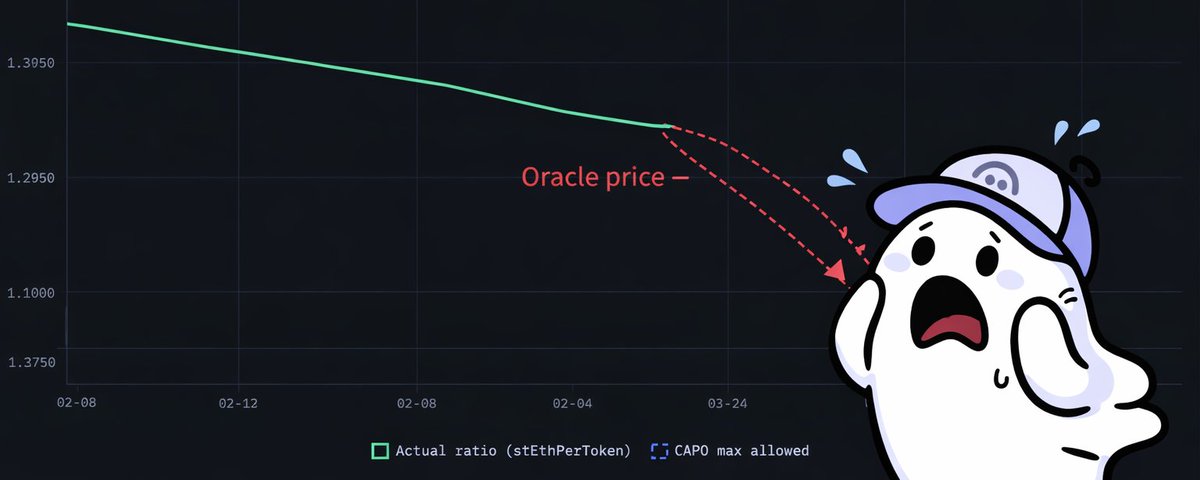 Aave suffered about $21M dollars in wrongful liquidations after an automated wstETH oracle cap update from Chaos Labs’ system underpriced collateral, briefly making healthy positions appear undercollateralized2026-03
 Lido contributors detail why Chainlink CCIP became wstETH’s official bridge framework, citing decentralization, rate limiting and protection from exploit vectors2026-05
 Lido revokes canonical wstETH bridge support on nine networks following DAO vote2026-06
 Lido pauses the ZKsync wstETH bridge after discovering a potential security weakness2026-03
 Li.Fi integrates Chainlink CCIP for one-click cross-chain staking of wstETH2026-04
 Aave DAO votes to convert 1600 ETH to wstETH and rETH 2023-07
Wrapped Staked Ether (wstETH): An Evergreen Guide to Ethereum’s Dominant Liquid Staking Primitive
Wrapped Staked Ether, or wstETH, is a non‑rebasing ERC‑20 token that represents a claim on Lido’s staked Ether (stETH), designed so that balances stay constant while value accrues over time through an increasing exchange rate to stETH and, ultimately, to ETH. By fixing token balances and routing yield into the price instead of the balance, wstETH has become the DeFi‑optimized form of Lido’s liquid staking token, underpinning lending markets, stablecoin protocols, cross‑chain bridges and complex structured products across the Ethereum ecosystem.
Origins: From Ethereum Staking to wstETH
The story of wstETH begins with Ethereum’s transition to proof‑of‑stake and the practical challenges of staking at scale. In Ethereum’s native design, staking requires a minimum of 32 ETH and technical competence to run and maintain validator infrastructure, which created a barrier for smaller holders and institutions that prefer passive exposure. Liquid staking protocols emerged as middleware, pooling ETH deposits and delegating them to professional validators, while issuing transferable receipts that represent claims on the pooled stake and its rewards. Lido Finance became the largest of these protocols on Ethereum, allowing users to deposit ETH and receive stETH, a liquid staking token that tracks the value of staked ETH plus rewards.
Lido’s stETH is a rebasing token, meaning that its total supply and each holder’s balance increase periodically, typically once per day, as the protocol accrues staking rewards from Ethereum and distributes them proportionally across all holders. If the underlying validator set earns a positive return, the protocol mints new stETH and credits it across balances, so a user might see their stETH balance grow from, for example, 10.0 to 10.01 without any explicit transaction. This design offers a smooth user experience for simple holding, since “your balance goes up” is intuitive, but it introduces substantial complexity for smart contracts built on standard ERC‑20 assumptions.
As ChainSecurity and other auditors have detailed, rebasing tokens like stETH deviate from the usual ERC‑20 pattern in several important ways: token balances can change without transfers, the sum of all user balances is not strictly constant due to rounding, and operations like “send my full balance” or “split a balance across multiple recipients” can behave subtly differently than for non‑rebasing assets. For DeFi protocols that were designed around fixed‑balance tokens, especially lending markets, DEXs, and cross‑chain bridges, these deviations require extra care and bespoke logic to avoid accounting errors or, in worst cases, loss of funds.
To solve this integration problem, Lido introduced wrapped stETH (wstETH) as a DeFi‑friendly abstraction over stETH. Conceptually, wstETH is a share token: each unit of wstETH represents a fixed share of the total stETH pool, and instead of the balance rebasing, the exchange rate between wstETH and stETH increases over time as staking rewards accrue. Lido’s official documentation describes wstETH as an ERC‑20 “value‑accruing token wrapper” around stETH whose balance does not change across oracle reports, even though its value in stETH terms does. From the perspective of DeFi protocols that just need a stable ERC‑20 interface, this means they can treat wstETH like any other fixed‑balance collateral token, while still exposing users to the underlying staking yield.
The decision to build wstETH was also shaped by the rise of layer‑2 networks and cross‑chain deployments. Rebases do not propagate automatically across chains, because each chain maintains its own local view of token balances and does not natively “see” supply changes on another chain. Bridging a rebasing token can therefore cause state divergence or unpredictable accounting unless the bridge implements complicated synchronization logic. Lido’s wstETH solves this by representing stETH ownership in shares that are stable across environments, making it especially suitable as the canonical cross‑chain representation of Lido’s staked ETH. As Lido’s ecosystem grew beyond Ethereum mainnet into L2s and other networks, wstETH became the backbone that allowed staked ETH liquidity to move safely and predictably across chains.

Aave suffered about $21M dollars in wrongful liquidations after an automated wstETH oracle cap update from Chaos Labs’ system underpriced collateral, briefly making healthy positions appear undercollateralized

Woah woah, that's crazy How did that come to happen
How wstETH Works Under the Hood
Rebasing versus non‑rebasing: why the wrapper exists
To understand wstETH’s mechanics, it is useful to contrast it explicitly with stETH. stETH is a rebasing token: when Lido’s oracle reports updated validator balances, the protocol adjusts the stETH total supply and scales all user balances upward (or, in the case of penalties, slightly downward) to reflect net rewards on the underlying ETH. For example, if the global rebase factor for a given day is \(1 + r\), then a user holding \(B\) stETH before the report will hold \(B \times (1 + r)\) stETH afterwards, even without any transfer taking place. This allows the token’s unit price to remain close to 1 ETH over time (ignoring secondary market fluctuations), with yield expressed through balance growth.
In contrast, wstETH is explicitly non‑rebasing: its total supply and individual balances do not change in response to staking rewards. Instead, rewards are reflected in the value of each wstETH relative to stETH. If we denote the total stETH backing the wstETH contract by \(S\) and the total wstETH supply by \(W\), then at any given moment the conversion rate between wstETH and stETH can be expressed as:
\[ \text{stETH per wstETH} = \frac{S}{W}. \]
As the Lido protocol accrues more staking rewards, \(S\) grows while \(W\) is fixed (absent new wrapping or unwrapping), so the ratio \(S/W\) increases over time, and with it the stETH value of each wstETH.
From a user’s perspective, holding stETH means your balance increases while the token’s unit price hovers around 1 ETH, whereas holding wstETH means your balance stays the same while the amount of stETH (and ultimately ETH) you can redeem per wstETH slowly rises. Both provide exposure to the same underlying staking rewards, but they express those rewards through different observable quantities: stETH via balance, wstETH via exchange rate. For DeFi protocols, the latter is often much easier to work with.
Auditors and protocol developers highlight that performing all internal accounting in shares rather than balances is the safest way to interact with rebasing tokens. Since wstETH already encodes stETH ownership as shares, it effectively “bakes in” this best practice at the token level. This means that integrators who do not want to implement their own share‑based accounting for stETH can instead integrate wstETH, treating it like a typical ERC‑20 while relying on Lido’s wrapper contract to handle the complexities of rebasing in the background.
Wrapping, unwrapping, and value accrual
Technically, wstETH is implemented as a trustless wrapper contract around stETH. Users can wrap either stETH or ETH itself, and they can unwrap wstETH back into stETH at any time, subject only to normal network conditions and protocol limits. When a user wraps stETH, they send stETH to the wstETH contract, which credits them with a corresponding amount of wstETH based on the current stETH‑per‑wstETH exchange rate. When they later unwrap, the contract burns their wstETH and transfers back the appropriate amount of stETH, again using the up‑to‑date exchange rate.
Lido has also designed the contract so that users can send ETH directly to the wstETH contract, which then calls Lido’s staking function under the hood, obtains stETH, and immediately wraps it into wstETH on behalf of the user. This makes the user experience more seamless: a single transaction can turn ETH into wstETH, with the staking step abstracted away. Lido’s documentation explicitly describes the wstETH contract as accepting ETH or stETH, staking ETH via Lido’s submit method and wrapping the resulting stETH in one integrated flow. For many users and integrators, this “stake and wrap” shortcut is the default path into wstETH.
The value accrual is continuous rather than discrete from the perspective of secondary markets. As Lido validators earn rewards, the stETH supply backing wstETH rises, and so does the conversion rate. If a user wraps 1 stETH into wstETH today, in a year that same wstETH might unwrap to, say, 1.04 stETH, reflecting compounded staking rewards net of any validator penalties and Lido fees, even though the user’s wstETH balance never changed. Because stETH itself can deviate slightly from 1 ETH on secondary markets, especially during periods of stress, the wstETH/ETH price in DEX pools and CEX order books reflects both the staking yield and the market’s confidence in the underlying Lido staking infrastructure.
Crucially, the wrapper is designed to be reversible at the protocol level: unwrapping does not depend on off‑chain liquidity but purely on the contract’s stETH reserves and the deterministic exchange rate. The real exit bottleneck lies deeper, at the level of unstaking ETH from Ethereum, which is governed by the consensus‑layer exit queue and Lido’s internal processes, but wstETH’s conversion to stETH is governed entirely by on‑chain logic. This separation helps mitigate some liquidity risks, as wstETH holders can always move back to the more widely integrated stETH without relying on external secondary markets.
ERC‑20 compatibility and integration benefits
From an interface perspective, wstETH is a standard ERC‑20 token: it exposes the usual functions such as balanceOf, transfer, and approve, and it does not perform any surprise rebases that modify user balances outside of explicit transfers. Staking rewards are a purely off‑balance‑sheet phenomenon from the standpoint of the ERC‑20 standard, embedded in the conversion logic rather than recorded as balance changes. This is what makes wstETH highly compatible with a broad range of DeFi protocols that assume fixed balances and do not implement special handling for rebasing assets.
Aave’s integration illustrates the benefits. In Aave’s case study with Lido, the team notes that wstETH, being non‑rebasing and having its value increase instead of its balance, is simpler to integrate as collateral because it behaves like a conventional yield‑bearing token whose market price can be tracked by oracles. Instead of re‑engineering Aave’s accounting to accommodate stETH’s rebases, the protocol can treat wstETH as standard collateral, allowing users to deposit wstETH, borrow against it, and even create leveraged staking loops without the system having to handle dynamic balance changes at each rebase.
Similarly, ChainSecurity recommends that DeFi builders who want exposure to Lido’s staking without dealing with rebasing arithmetic use the official wstETH token as a “non‑rebasing counterpart” that maps 1:1 to Lido pool shares. This choice minimizes surprises around balance changes, rounding, and unit tests, significantly reducing the surface for integration bugs. As liquid staking has become more central to DeFi, this architectural separation—stETH as the native rebasing token, wstETH as the DeFi wrapper—has allowed Lido to serve both simple holders and complex protocols with distinct but interoperable representations of staked ETH.
Readers' clicks reveal that wstETH's DeFi risk concentrates at the oracle translation layer — not at the staking level — because a single automated exchange-rate cap misconfiguration produced $21M in wrongful liquidations on healthy positions, showing that correct rebasing-to-non-rebasing conversion in downstream protocols is where systemic failure actually originates.
wstETH Across DeFi: Lending, Stablecoins, and Structured Yield
Lending markets and leveraged staking
wstETH has grown into one of the dominant collateral assets in DeFi lending markets. Governance discussions at Compound describe wstETH as “the DeFi usable version of stETH,” noting that it is one of the largest holdings across major lending protocols and, at one point, had a market capitalization around 12 billion dollars. A separate Aave proposal to list wstETH on Arbitrum highlights a combined daily volume for stETH and wstETH of roughly 50 million dollars and reports a wstETH market capitalization of around 7.7 billion dollars at that time, underscoring the scale and liquidity of the asset. These figures reflect how central wstETH has become to on‑chain credit markets.
On Aave, wstETH is widely used not only as a passive collateral asset but also as a building block for leveraged staking strategies. A typical loop might involve depositing wstETH as collateral, borrowing ETH against it, swapping borrowed ETH for more wstETH, and repeating the cycle several times. Because wstETH already embeds staking yield and, often, additional incentive rewards, these loops can amplify returns in bullish or stable markets, while significantly increasing liquidation risk during drawdowns. Aave’s collaboration with Lido is often framed as a step toward “capital efficient staking,” where users can extract maximum economic utility from their staked ETH without unbonding it.
Spark Protocol, the lending market aligned with the Sky (formerly MakerDAO) ecosystem, has also positioned wstETH at the center of its strategy. Spark is a fork of Aave v3 deployed under Sky governance, with a mission focused on deepening USDS and DAI liquidity and distributing the DAI Savings Rate (now Sky Savings Rate) onchain. According to Sky’s documentation, as of April 2026 Spark held about 6.8 billion dollars in TVL across Ethereum, Gnosis, and Base, making it the second‑largest DeFi lending venue by that metric. Public messaging from Spark emphasizes that SparkLend holds more wstETH than any venue in DeFi and that its wstETH market is designed to treat this single liquid staking token distinctly rather than as part of a blended basket of LSTs and restaking assets. That distinction matters because, in stress scenarios, different LSTs and LRTs often share the same ETH exit bottleneck even if they appear diversified on paper; a wstETH‑focused market can manage risk parameters more directly around Lido’s staking profile rather than around a synthetic basket.
Beyond general‑purpose money markets, protocols like Gearbox have built structured lending and leverage products around wstETH. In collaboration with risk manager karpatkey, Gearbox has launched curated WETH and wstETH “Earn Pools” that bundle risk management frameworks and continuous monitoring, aiming to offer enhanced yields to depositors while managing the hazards of leverage and market volatility. Although the precise APYs and risk levels fluctuate over time, the choice of wstETH as a core asset reflects its perceived robustness, liquidity, and compatibility with automated strategies. As with many wstETH‑based products, the yield stack can include the Ethereum staking return, lending interest, protocol incentives, and sometimes external sponsorship rewards.
Episodes of liquidity stress have further underscored wstETH’s role in the lending stack. When ETH utilization on Aave spikes to 100%, depositors in aWETH (Aave’s interest‑bearing ETH token) can find themselves unable to withdraw, exposed to additional risks if markets move sharply. In response, builders have designed redemption mechanisms that allow aWETH lenders to exit into alternative assets such as wstETH or other LSTs, instantaneously regaining liquidity and reducing direct exposure to ETH borrowing congestion. In practice, these designs treat wstETH as a liquid escape hatch backed by staked ETH, illustrating how the token functions not only as collateral but also as a system‑level pressure valve during liquidity crunches.
Stablecoins and LSD‑backed borrowing
wstETH’s utility extends beyond straightforward lending into the realm of decentralized stablecoins and borrowing protocols. The f(x) Protocol is a prominent example: it mints fxUSD, a scalable stablecoin, against collateral such as wstETH and wrapped Bitcoin (WBTC). According to its documentation, f(x) employs a rebalancing mechanism to minimize liquidation risk, continuously adjusting collateral positions across market conditions. This design aims to keep collateralization ratios healthy even during volatility, reducing the probability that users are force‑liquidated. In periods when the broader market has seen millions of dollars of ETH‑collateral liquidations, f(x) has pointed to its ability to rebalance positions backed by wstETH and other assets without incurring liquidations as evidence of the resilience of its mechanism and collateral mix.
Liquity V2 offers another lens into how protocols integrate wstETH as collateral to avoid forced selling of ETH. Liquity’s original design focused on ETH‑backed loans that provided interest‑free borrowing against overcollateralized positions, using on‑chain stability pools to absorb liquidations. The V2 evolution introduces more flexible borrowing at user‑chosen rates and supports a range of high‑quality collateral assets, including LSTs such as wstETH and rETH. Governance communications have highlighted that treasuries can borrow against ETH at loan‑to‑value ratios up to about 91%, and against wstETH and rETH at around 83.33%, while enjoying borrowing rates that, on a 365‑day average, sit well below many alternatives in DeFi. In practice, this enables DAOs and long‑term holders to fund operations or invest without selling their ETH exposure, instead locking wstETH to mint stablecoins that can be deployed elsewhere.
Curve’s crvUSD ecosystem provides a complementary illustration. crvUSD is a native stablecoin of the Curve protocol that uses an automated market maker design called LLAMMA to manage collateral liquidations more gradually rather than via instantaneous auctions. While crvUSD can be backed by various assets, liquid staking tokens such as stETH and wstETH have become significant components of some collateral configurations. During periods of heightened volatility, traders have watched wstETH liquidity in Curve pools closely, and in at least one instance a wstETH liquidity scare was ultimately resolved through arbitrage and LLAMMA’s stabilization mechanics, while scurvUSD yield—crvUSD deposited into certain Curve strategies—peaked around 9%. These episodes highlight a feedback loop: wstETH’s depth and stability support LSD‑backed stablecoins like crvUSD, while those stablecoins, in turn, become major demand sinks for wstETH collateral.
In the Maker/Sky ecosystem, wstETH’s role is similarly foundational even when it is not always directly visible. Maker has long supported stETH and other LSTs as collateral for DAI, and SparkLend extends this support by offering leveraged wstETH borrowing and lending markets tightly integrated with Sky’s stablecoins and savings products. When users deposit wstETH into SparkLend and borrow DAI or USDS, they are effectively plugging their staked ETH into a broader multi‑asset credit system governed by Sky, with the DAI Savings Rate or Sky Savings Rate channeled through sDAI and sUSDS vaults. In this way, wstETH becomes one leg in a triad of staking yield, stablecoin issuance, and on‑chain savings.
Restaking, incentive programs, and structured products
As the restaking narrative has grown, wstETH has often served as the base collateral for new layers of tokenization. Many restaking protocols wrap LSTs such as stETH or wstETH into new “liquid restaking tokens” (LRTs), adding additional yield streams tied to providing security for middleware oracles, bridges, or rollups. When things go smoothly, holders of wstETH‑derived LRTs enjoy layered yields; when issues arise, as seen in the rsETH ecosystem where community groups such as DeFi United have worked to close exploiter positions during recovery efforts, the risk can cascade back toward the underlying LSTs. Even when wstETH itself is not impaired, its centrality means that events in downstream restaking tokens can drive flows back into or out of wstETH markets as participants de‑lever or seek safety.
Incentive programs and sponsorships further amplify wstETH’s prominence. Campaigns like Treehouse Booster seasons, which have required users to subscribe or lock wstETH positions by specific dates to earn TREE token rewards, illustrate how wstETH becomes the anchor asset for promotional yield programs. Similarly, f(x) Protocol has sponsored third‑party initiatives like Leviathan, framing its zero‑liquidation rebalancing as a selling point for wstETH‑backed strategies. These sponsorships are often layered on top of the base staking yield and lending returns, temporarily pushing effective APYs for wstETH strategies well above the underlying ETH staking rate. While attractive, such incentive‑driven yields are inherently time‑limited; once sponsorships end, yields typically revert closer to the combination of staking rewards and organic borrow demand.
Structured products and asset management DAOs such as karpatkey have increasingly incorporated wstETH into curated portfolios, arguing that its combination of staking yield, deep liquidity, and composability make it a natural “core holding” for on‑chain treasuries. In many cases, wstETH‑heavy strategies are presented as a way to keep long‑term ETH exposure while monetizing it through lending, options, or delta‑neutral strategies. This mirrors traditional finance’s treatment of blue‑chip equities as core holdings around which more active strategies are constructed, but with DeFi‑native mechanics like lending, liquidity provision, and leveraged staking replacing traditional margin accounts and derivatives.
Trading, whales, and market structure
Because wstETH is deeply integrated into DeFi, it is also actively traded by sophisticated market participants and whales. Onchain data and analytics narratives have highlighted episodes where large holders—sometimes described as Ethereum “OGs”—sold significant amounts of ETH, wstETH, and WBTC ahead of market crashes, only to buy back at lower prices, using wstETH liquidity as part of their tactical positioning. These maneuvers underscore that for large portfolios, wstETH is not just a passive staking position but a liquid, tradable instrument that can be used to express macro views on Ethereum’s price and staking risk.
Similarly, during turbulent periods for restaking protocols such as KelpDAO, some OTC whales have reportedly swapped into large positions in wstETH and assets like cbBTC, seeking refuge in what they perceive as “higher quality” collateral after losing confidence in more experimental LRT structures. These flows reinforce wstETH’s status as a kind of flight‑to‑quality asset within the broader landscape of Ethereum yield products: when uncertainty rises in more exotic layers, capital often rotates back into plain staked ETH exposure, with wstETH as a preferred wrapper thanks to its liquidity and integration depth.
At the same time, wstETH’s heavy use as collateral and in leverage loops means that its markets can be a locus of systemic risk when conditions turn. Sharp moves in ETH’s price, or sudden shifts in Lido’s perceived risk profile, can trigger deleveraging cascades across multiple protocols simultaneously. Understanding those risks requires looking not only at wstETH’s internal mechanics but also at bridging, oracle design, and the consensus‑layer dynamics of Ethereum itself.
Cross‑Chain Expansion, CCIP, and Bridging Risks
Why wstETH is the cross‑chain representation of Lido stake
Bridging liquid staking tokens is inherently challenging. When a token like stETH rebases on Ethereum mainnet, the total supply and account balances on that chain change, but any bridged representation on another chain will not automatically reflect those updates. If the bridge simply locks stETH on mainnet and mints a synthetic stETH on an L2 or sidechain, the synthetic token’s supply and balances will diverge from the canonical stETH over time unless the bridge tracks and replays rebases across chains, which is technically complex and error‑prone.
Lido’s wstETH sidesteps this difficulty by anchoring representation in stable shares rather than in a balance that rebases. The wstETH contract on Ethereum keeps track of how much stETH each wstETH represents through the exchange‑rate formula, and each wstETH is simply a fixed share of the total stETH pool. This share abstraction is chain‑agnostic: a wstETH on mainnet and a wstETH on an L2 can both be defined as representing the same fraction of the underlying pool, even if they reside in different contract instances linked by a bridge. As a result, wstETH is “mainly used as a layer of compatibility to integrate stETH into other DeFi protocols that do not support rebasing tokens, especially bridges to L2s and other chains, as rebases do not work for bridged assets by default.”
In practice, when users bridge wstETH to another network, a bridging protocol locks or burns wstETH on the source chain and mints or unlocks an equivalent wstETH (or a canonical wrapped representation) on the destination chain. Because the token is non‑rebasing, there is no need to replay daily supply adjustments across chains; bridge logic only needs to track transfers and burns. This is a major reason why wstETH, rather than stETH, has become the canonical representation of Lido stake beyond Ethereum mainnet.
Chainlink CCIP as the official wstETH bridge framework
Recognizing the importance and risk of bridging infrastructure, Lido has moved to standardize and harden wstETH’s cross‑chain connectivity. Lido contributors announced that the protocol would adopt Chainlink Cross‑Chain Interoperability Protocol (CCIP) as the official cross‑chain infrastructure for wstETH, using Chainlink’s Cross‑Chain Token (CCT) standard for token transfers. Under this arrangement, all cross‑chain transfers of wstETH through official channels are secured by CCIP’s decentralized oracle network and risk controls.
Chainlink CCIP is designed to provide secure messaging and token transfer between chains, supporting features such as configurable rate limits, explicit token pools, and fine‑grained control over which chains and applications can interact. Lido’s blog post on the partnership emphasizes properties such as decentralization, rate limiting, and protection against exploit vectors as key reasons for choosing CCIP as wstETH’s official bridge framework. Rate limits, for example, can prevent massive, sudden cross‑chain drains in the event of a compromise, while the use of well‑audited, standardized token pools reduces the need for bespoke, potentially fragile custom bridges.
The integration of CCIP with DeFi routers like LI.FI has further streamlined user experience, enabling “one‑click” cross‑chain staking flows where users can move assets such as ETH or stables into wstETH positions on various chains via a single interface. While the underlying routing is complex—often involving swaps, bridges, and staking interactions—users see a simplified flow, reinforcing wstETH’s role as a portable, chain‑agnostic representation of staked ETH.
Other bridging routes, chain sunsets, and operational risk
wstETH is also present in other ecosystems through alternative routing frameworks. For example, in the Cosmos‑aligned Neutron ecosystem, users interact with wstETH.axl, an Axelar‑wrapped representation of wstETH. Official guidance for bridging wstETH from Neutron back to Ethereum directs users to go to Squid Router, connect both their Neutron and Ethereum wallets, and set a swap from wstETH.axl on Neutron to wstETH on Ethereum, confirming the route and signing the transaction to complete the bridge. This illustrates a multi‑layered architecture where wstETH is wrapped by Axelar on Cosmos and then connected back to canonical wstETH via cross‑chain routing.
However, these layers introduce operational risk. Chains and bridging frameworks can change direction, rebrand, or even sunset. In some cases, foundations have advised users to bridge wstETH back to Ethereum or another supported network before specific deadlines as they wind down dedicated support for a given chain. Similarly, the shutting down of smaller environments like Swellchain, with warnings that any wstETH remaining after a termination date may be unrecoverable, illustrates that cross‑chain positioning in wstETH is not risk‑free even if the underlying Lido staking remains sound. Users must track not only Lido’s status and Ethereum’s consensus health but also the governance and roadmaps of the chains and bridges where their wstETH resides.
Security incidents and cautious responses
Bridging is a prime target for attackers, and wstETH’s cross‑chain footprint has not been entirely without incident, even if major losses have so far been averted. Lido disclosed a potential security weakness in the ZKsync wstETH bridge endpoint contract, prompting the team to pause new deposits out of an abundance of caution. Lido emphasized that there was no indication the weakness had been exploited, and that existing wstETH holders on ZKsync were not affected; moreover, no other bridges were impacted. The episode nonetheless underscores how critical bridge endpoint contracts are as security choke points for assets like wstETH that span multiple networks.
The prudent response—immediate pause, investigation, and clear communication—aligns with a broader recognition that cross‑chain LSD tokens carry multi‑layered risk. Even if the underlying staked ETH is safe in Ethereum’s consensus layer and Lido’s validator set performs correctly, a bug in a bridge contract or oracle configuration on another chain can create catastrophic outcomes for users of those wrapped representations. For wstETH holders using cross‑chain strategies, evaluating risk means looking beyond Lido’s contracts to the security posture of every bridge, router, and intermediary layer that touches the token.
In this sense, wstETH’s role as a cross‑chain primitive is double‑edged: it extends the reach of staked ETH into many environments, unlocking composability and yield, but it also entangles wstETH in the vulnerabilities and governance choices of those environments. The adoption of CCIP as a canonical framework is one attempt to reduce that complexity surface through standardization and battle‑tested infrastructure.
Lido contributors detail why Chainlink CCIP became wstETH’s official bridge framework, citing decentralization, rate limiting and protection from exploit vectors
Risk Profile: Smart Contracts, Oracles, Leverage, and Ethereum Consensus
Protocol and smart contract risk
wstETH inherits all of the protocol‑level risks of Lido’s liquid staking system plus its own wrapper and bridging logic. At the base layer, Lido manages a large set of validators on Ethereum, pooling stake from users and distributing rewards and penalties proportionally via stETH. Bugs or design flaws in Lido’s contracts, misconfigurations in the validator infrastructure, or governance failures in the Lido DAO could all affect the value of stETH and, by extension, wstETH. While Lido’s contracts are open‑source and have undergone multiple audits, and the protocol has operated at massive scale for years, residual risk can never be reduced to zero.
wstETH’s wrapper contract adds another critical component. It must correctly track shares, execute wrapping and unwrapping operations, and expose ERC‑20 functions in a way that is robust against re‑entrancy, rounding issues, and other attack vectors. A severe bug here could lead to incorrect accounting of wstETH shares, enabling theft or causing under‑ or over‑redemption of stETH. Lido’s design minimizes complexity by keeping the wrapper relatively straightforward, delegating most staking logic to the stETH side, but the contract’s importance still demands ongoing audits and monitoring.
When wstETH is bridged or integrated into other protocols, their contracts become part of the extended attack surface. Lending markets, stablecoin protocols, restaking layers, and cross‑chain bridges that hold wstETH in their treasuries or user vaults can be compromised even if Lido itself is secure. Thus, from an end‑user standpoint, “holding wstETH” may actually mean holding a claim on wstETH in a series of nested contracts, each with its own risk profile. Evaluating wstETH exposure therefore requires a compositional view: how much of your position is in your self‑custody wallet versus locked in lending markets, restaking pools, or bridges?
Oracle and pricing risk
Because wstETH is not hard‑pegged 1:1 to ETH, but rather reflects the value of staked ETH plus yield and secondary market conditions, protocols must rely on accurate price oracles to manage liquidations and risk. Typically, a wstETH/ETH price feed combines information about the stETH/ETH rate and the wstETH/stETH exchange rate, or directly observes on‑chain DEX prices with robust smoothing and outlier rejection. If oracles underprice wstETH, they may prematurely liquidate healthy positions; if they overprice it, they may allow unsafe positions to persist, exposing protocols to bad debt.
The dangers of misconfiguration have been made concrete in the Aave ecosystem. A detailed governance post‑mortem describes an oracle bug that caused an exchange‑rate misalignment on wstETH in certain Aave instances, resulting in about 141.5 ETH in wrongful liquidations. Although “multiple layers of safeguards” were in place, they did not prevent the bug from causing real user losses before being fixed. Later reporting has pointed to additional incidents, including a CAPO risk oracle misconfiguration that underpriced wstETH collateral and triggered roughly 21–27 million dollars in unfair liquidations over a short period, with Aave subsequently confirming no impact to the core protocol and working with risk managers like Chaos Labs to reimburse affected users.
These episodes underscore that oracle risk is not theoretical: even well‑audited, blue‑chip protocols can misconfigure oracles for complex assets like wstETH, especially when there are multiple layers—wstETH to stETH to ETH, plus cross‑chain price feeds and liquidity fragmentation. Protocols that integrate wstETH need to invest heavily in robust oracle architectures, including decentralized feeds, sanity checks, and circuit breakers that can pause liquidations if prices move in implausible ways.
Leverage, liquidations, and correlation risk
Because wstETH is both yield‑bearing and widely accepted as collateral, it is heavily used in leveraged positions. Users can lever up their staking exposure by borrowing ETH against wstETH and re‑staking or re‑wrapping, achieving effective leverage on their ETH holdings. While such strategies can be profitable in stable or bullish markets, they are acutely vulnerable to rapid ETH drawdowns, spikes in borrowing rates, or sudden changes in LTV parameters. When the market turns, leveraged wstETH positions across multiple protocols can be liquidated at once, creating a cascade of selling pressure and further depressing prices.
Moreover, the proliferation of liquid staking tokens (LSTs) and liquid restaking tokens (LRTs) does not guarantee true diversification. As observers from SparkLend have noted, most lending markets treat LSTs and restaking assets as if they were a diversified basket of collateral types, but in reality “they’re not”: they share the same ETH exit path. In a stress scenario where Ethereum’s price plummets or slashing risks materialize, multiple LSTs and LRTs are likely to become distressed simultaneously because they are all claims on broadly similar validator sets. Spark’s dedicated wstETH market, which isolates wstETH rather than blending it with a basket, reflects a recognition of this correlation risk.
Protocols like f(x) attempt to mitigate liquidation risk through active rebalancing mechanisms that adjust user positions as markets move. In at least one highly volatile period, f(x) reported that while millions of dollars of ETH‑backed positions were liquidated elsewhere, its wstETH‑ and WBTC‑backed positions experienced zero liquidations thanks to timely rebalancing and a well‑capitalized stability pool. This illustrates how protocol design can meaningfully affect liquidation outcomes even when the underlying collateral (wstETH) is the same; risk is a function not only of asset choice but also of leverage, monitoring, and rebalancing logic.
Consensus‑layer and slashing risk
At the most fundamental level, wstETH’s value is tied to Ethereum’s consensus layer and to Lido’s validator set performance. If validators behave honestly and the network runs smoothly, stakers earn positive rewards that flow through stETH to wstETH. If validators are slashed for misbehavior, go offline for extended periods, or otherwise underperform, those penalties reduce the net rewards or even the principal over time. Liquid staking protocols like Lido spread stake across many validators to minimize correlated failure, but they cannot fully eliminate slashing risk.
Research by risk firms such as Chaos Labs has highlighted how Ethereum’s slashing and inactivity leak mechanisms create systemic implications for LSTs and LRTs: a large‑scale outage or coordinated attack could lead to material reductions in the underlying staked ETH backing tokens like stETH and wstETH, affecting not only holders but also any protocols that use them as collateral. While such scenarios are extreme and have not materialized at scale, they frame wstETH as carrying an embedded validator risk premium on top of pure ETH price risk.
There is also a broader systemic concern about staking centralization. As of late 2024, Lido controlled a very substantial share of Ethereum’s staked ETH, with reports citing over 38.5 billion dollars in total value locked across its liquid staking products. This concentration has sparked debates about whether Ethereum’s consensus could become overly dependent on a single liquid staking protocol. For wstETH holders and integrators, this raises the possibility that tail‑risk events involving Lido—either technical or governance‑related—could have outsized effects on the value of their positions and on DeFi collateral health more broadly.
Liquidity, depegs, and market structure risk
While wstETH is designed to track the value of staked ETH plus rewards, its market price can deviate from theoretical parity due to liquidity and sentiment. In benign conditions, wstETH typically trades close to its intrinsic value relative to ETH, with deviations smoothed out by arbitrageurs using DEXs and lending markets. However, in periods of acute stress—such as during fears about Ethereum’s long‑term viability, concerns about Lido’s governance, or chain‑specific incidents—wstETH can trade at a discount similar to or slightly different from stETH’s discount, reflecting frictions in unwinding, exit queue delays, or constrained bridge capacity.
Curve’s LSD pools and crvUSD collateral markets have at times been focal points for such liquidity stress. On at least one occasion, a large wstETH swap in Curve sparked concerns about shallow liquidity and potential depegging, only for the market to stabilize as arbitrage and LLAMMA’s gradual liquidation mechanics absorbed the shock. The resilience of these markets depends on deep, distributed liquidity and on the presence of sophisticated participants willing to arbitrage small deviations. If those participants withdraw or if liquidity fragments across too many venues, wstETH markets could become more fragile, increasing slippage and exacerbating liquidation cascades in lending protocols during downturns.
Operational and UX risks
Finally, there are operational risks that are easy to overlook but can materially affect wstETH users. When chains or protocols hosting wstETH positions change their governance plans or sunset products, users may need to take action by specific deadlines to avoid losing access to their assets. The sunsetting of Swellchain and warnings that wstETH left on the network after a certain date may be unrecoverable, as well as guidance to Neutron users to bridge wstETH back to Ethereum before long‑term chain support changes, are concrete examples. Even if Lido and Ethereum are functioning perfectly, failure to act on such notices can lead to stranded positions.
User‑experience complexity also plays a role. Many users hold wstETH through layers of protocols—restaking wrappers, yield aggregators, money markets—without fully understanding which contracts actually control their funds. Misconfiguring a bridge, sending wstETH to an incompatible address, or misunderstanding the difference between stETH and wstETH can lead to loss. As wstETH’s composability increases, so does the importance of clear UX, documentation, and education to mitigate these non‑technical but very real risks.
- 01Oracle-triggered wrongful liquidations↗
The Aave $21M incident — where a Chaos Labs automated cap update underpriced wstETH collateral and flagged solvent positions as undercollateralized — pulled readers who wanted to understand both the mechanism and who bore the loss.
- 02Aave governance wstETH adoption↗
Back-to-back high-traffic Aave DAO stories — converting 1,600 ETH to wstETH/rETH and launching the first custom V3 Lido pool — show readers treating institutional DeFi endorsement of wstETH as a directional market signal.
- 03f(x) Protocol TVL growth↗
Repeated milestone coverage from 9K to 18K wstETH TVL drew consistent clicks across many articles, with readers apparently using sponsored concentration data as a live proxy for protocol-level wstETH risk appetite.
- 04Lido bridge security and revocation↗
Lido pausing the ZKsync wstETH bridge over a discovered vulnerability — and then revoking canonical bridge support across nine networks — attracted readers tracking where wstETH is and is not safely movable cross-chain.
- 05wstETH as stablecoin collateral
Launches of wstETH backing on crvUSD, Curve DAO ($150M quorum), Liquity V2, and Raft showed readers following the token's expansion from yield asset to foundational DeFi collateral layer.
- 06Lending yield on wstETH
Gearbox (up to 19% APY), Prisma Finance vaults, and Term Finance fixed-rate pairs drew clicks from readers comparing yield-on-staked-ETH across risk profiles, particularly for shorter-duration borrow strategies.
Market Scale, TVL, and Incentive Dynamics
TVL, market capitalization, and adoption metrics
Lido’s growth has been central to wstETH’s rise. As of December 2024, Lido was reported to have over 38.5 billion dollars in total value locked, making it the largest liquid staking protocol globally by a wide margin. A substantial portion of that TVL corresponds to ETH staked and represented onchain as stETH, which in turn forms the backing for wstETH. While precise proportions fluctuate, governance documents and third‑party analyses consistently describe wstETH as a multi‑billion‑dollar asset by market capitalization, deeply embedded in DeFi’s collateral layer.
Compound’s governance discussion about adding a wstETH market on mainnet notes that wstETH is “one of the largest holdings on a majority of lending protocols” and pegs its market capitalization at around 12 billion dollars at that time, emphasizing its status as a blue‑chip DeFi asset. The Aave proposal for wstETH on Arbitrum cites a slightly lower market cap estimate of roughly 7.7 billion dollars and mentions combined daily trading volume of about 50 million dollars across stETH and wstETH markets, highlighting significant and sustained liquidity. The fact that multiple major lending markets independently size wstETH in the multi‑billion‑dollar range underscores its centrality to onchain finance.
Beyond raw numbers, adoption breadth matters. wstETH is present on Ethereum mainnet, prominent L2s, and several alternative ecosystems via bridges like Axelar and CCIP. It serves as collateral in major lending protocols such as Aave and SparkLend, underpins stablecoin issuance in systems like f(x) Protocol and crvUSD, and appears in curated strategies of asset management DAOs and funds. In many dashboards, wstETH ranks among the top few assets by TVL within individual protocols, often alongside WETH, USDC, and other core primitives.
Trading venues, liquidity depth, and whale behavior
Liquidity for wstETH is distributed across centralized exchanges, onchain DEXs like Uniswap and Curve, and money markets where it can be borrowed and lent. Lido’s own help documentation notes that wrapping stETH into wstETH was partly motivated by the need for a DeFi‑compatible token that could integrate easily with protocols like Uniswap and MakerDAO. On Uniswap, wstETH pairs against ETH and stablecoins provide key price discovery, while on Curve and similar AMMs, specialized LSD pools aggregate wstETH with other staked ETH derivatives, offering low‑slippage swaps under normal conditions.
Whale activity contributes to both liquidity and volatility. Large holders executing trades in the tens or hundreds of millions of dollars—such as the Ethereum OG who sold 60,000 ETH and over 9,000 wstETH ahead of a major market crash before buying back at lower prices—can temporarily distort markets, move prices away from fundamentals, and accelerate liquidations in leveraged positions. OTC deals, like the whale who pivoted into around 272 million dollars worth of wstETH and 222 million dollars of cbBTC during KelpDAO‑related turbulence, may not always appear on public DEXs but influence supply and demand dynamics nonetheless. These behaviors underline that wstETH is deeply embedded in the strategies of both retail users and systemically important whales.
Incentives, sponsorships, and the yield stack
The effective yield on wstETH positions often exceeds the raw Ethereum staking reward because of incentives and sponsorships layered on top of base yield. Protocols seeking to bootstrap liquidity or attract users frequently direct token incentives, fee rebates, or governance rewards to wstETH depositors. SparkLend, for example, can route DAI Savings Rate–derived yields to users who supply wstETH as collateral and borrow DAI, effectively stacking staking yield with interest spreads funded in part by Maker/Sky’s monetary policy. Gearbox’s curated wstETH pools may offer additional protocol incentives on top of lending yields for liquidity providers.
Campaigns like Treehouse Booster seasons, which allocate substantial token budgets—on the order of hundreds of thousands of dollars in TREE tokens—to users who lock or subscribe wstETH by a certain date, further showcase how sponsorships can temporarily inflate returns. Similarly, f(x) Protocol’s sponsorship of external initiatives like Leviathan both promotes its fxUSD stablecoin and highlights wstETH‑backed strategies that emphasize low liquidation rates. While these incentive programs are important for user acquisition and ecosystem growth, they also create a dynamic where headline yields can be misleading if investors do not differentiate between sustainable, protocol‑native yield (staking and interest) and time‑limited incentive emissions.
From a risk‑adjusted perspective, wstETH’s base yield tracks Ethereum’s staking rewards net of Lido fees and validator performance, and is thus relatively well constrained by protocol economics and network usage. Everything above that baseline comes with implicit caveats: it may be driven by token inflation, strategic subsidies, or leveraged structures that increase the potential downside in exchange for higher nominal APYs. For treasuries and long‑term investors, understanding this yield stack is crucial to making informed decisions about wstETH allocation.
Integrator Perspective: Designing Safely with wstETH
Choosing between stETH and wstETH
For builders, the first design choice is whether to integrate stETH, wstETH, or both. stETH offers the most direct representation of Lido’s staking pool and may be attractive for applications that explicitly want rebasing behavior, such as simple wallets or savings products that emphasize “your balance goes up every day.” However, stETH’s rebasing and share‑based accounting can complicate integration, requiring careful handling of balance changes, rounding, and invariants.
wstETH, by contrast, is tailored for DeFi protocols that prioritize ERC‑20‑like behavior. Its non‑rebasing design, stable balances, and share‑based internal accounting align with expectations of lending markets, DEXs, and cross‑chain bridges, and its value accrual via exchange rate is easier to capture with oracles and pricing logic. Lido’s own documentation emphasizes that wstETH is mainly used as a compatibility layer for protocols that do not support rebasing tokens, particularly L2 bridges. Aave’s experience further supports the view that wstETH is the more straightforward integration path for complex protocols that must handle multiple assets and collateral types.
In many ecosystems, the pragmatic answer is to treat stETH as the canonical representation for simple holding and wstETH as the canonical representation for DeFi composability and cross‑chain movement. Some protocols support both, allowing users to deposit stETH and having the protocol internally wrap it into wstETH for downstream integrations, abstracting away the difference from the end user. This pattern leverages the strengths of each token without forcing users to choose manually.
Accounting, testing, and the “shares not balances” principle
ChainSecurity’s analysis of rebasing tokens offers important guidance for developers integrating wstETH and stETH. Even though wstETH itself does not rebase, it still represents shares of an underlying pool, and integrators who perform internal accounting directly in wstETH units should be aware that the underlying stETH and ETH claims per wstETH change over time. For many use cases, it is sufficient to treat wstETH as a standard ERC‑20 whose market price reflects these dynamics. In more sophisticated settings, especially where protocols must calculate intrinsic values or perform NAV accounting, integrators may need to pull onchain data about the current stETH‑per‑wstETH exchange rate and adjust their internal models accordingly.
The broader lesson from audits and integration case studies is that unit tests and simulations should explicitly model the non‑static nature of value for wstETH and related assets. For example, tests should not assume that the sum of user balances multiplied by a fixed price equals the total underlying value; instead, they should consider how that value changes over time as staking rewards accrue. Approximate equality checks may be needed when rounding and small deviations are expected, and integration with oracles should be thoroughly fuzzed to catch edge cases before deployment.
Oracle design and risk parameters
For protocols that use wstETH as collateral, careful oracle design is essential. A robust wstETH oracle typically aggregates multiple sources of data—onchain DEX prices for wstETH/ETH pairs, offchain price feeds for ETH/USD, and knowledge of the wstETH/stETH exchange rate—while applying safeguards such as time‑weighted averages, deviation limits, and, ideally, decentralized reporting by multiple providers. The Aave oracle incidents demonstrate that misalignments or stale data can cause wrongful liquidations or under‑collateralization, even when the underlying asset is behaving normally.
Risk parameters such as loan‑to‑value ratios, liquidation thresholds, and liquidation penalties must be calibrated with an understanding of wstETH’s volatility relative to ETH, as well as the liquidity available to absorb liquidations without excessive slippage. Protocols like Liquity V2 that allow higher LTVs on ETH than on wstETH or rETH recognize that LSDs introduce additional layers of protocol and liquidity risk, justifying more conservative treatment despite their generally blue‑chip status. Monitoring tools that track wstETH’s discount or premium to ETH across markets can inform dynamic adjustments to these parameters over time.
Cross‑chain design and CCIP integration
For cross‑chain integrators, Lido’s adoption of CCIP as the official wstETH bridge framework simplifies some decisions but not all. Protocols that wish to support wstETH on multiple chains can integrate with CCIP’s CCT standard, leveraging Chainlink’s security guarantees and rate‑limiting features, instead of building bespoke bridges. However, application‑level logic must still account for the possibility of bridge downtime, chain‑specific forks, and governance actions that might pause or change wstETH flows between networks.
Developers working with wrapped representations like wstETH.axl on Cosmos chains must be mindful of differences between canonical and non‑canonical tokens, ensuring that redemption paths are clear and that users understand which representations can be bridged back to Ethereum and under what conditions. Mechanisms for chain sunsets or migrations should be built early, not as afterthoughts, to avoid situations where wstETH becomes stranded on under‑maintained networks.

Lido revokes canonical wstETH bridge support on nine networks following DAO vote
Regulatory, Accounting, and Treasury Considerations
Classification and regulatory treatment
From a legal and regulatory standpoint, wstETH is a derivative claim on staked ETH managed by Lido rather than a direct holding of ETH itself. Depending on jurisdiction, regulators may classify wstETH as a form of collective investment scheme interest, a security, a derivative, or simply as a crypto asset with specific disclosure and custody requirements. The lack of global harmonization complicates matters: some regimes are more focused on the underlying staking activity and whether it constitutes a regulated service, while others focus on the wrapper token’s tradability and potential investor protection concerns.
For centralized intermediaries—exchanges, custodians, funds—offering wstETH to clients, this classification question affects licensing, capital requirements, and disclosure obligations. Some may opt to treat wstETH exposures as indirect staking arrangements, with additional due diligence on Lido’s governance, validator set diversity, and slashing risk. Others may refrain from listing wstETH directly, preferring to offer staking products that abstract away the specific liquid staking protocol. Over time, as regulators become more familiar with LSTs and their wrappers, clearer guidance is likely to emerge, but for now the regulatory treatment of wstETH remains heterogeneous.
Accounting for treasuries and funds
On the accounting side, organizations holding wstETH—particularly DAOs, corporate treasuries, and funds—must decide how to recognize and measure its value. Because wstETH is a tradable token with observable market prices, it is often treated similarly to other digital assets for fair‑value measurement, with changes in value recognized through profit and loss or other comprehensive income depending on the applicable accounting standards. However, the embedded staking yield complicates distinctions between interest income, unrealized gains, and principal appreciation.
For treasuries seeking to avoid selling ETH to fund operations, wstETH‑backed borrowing options like Liquity V2 present an attractive alternative. Borrowing stablecoins against wstETH allows organizations to raise runway while keeping ETH exposure and staking yield on their balance sheet. The accounting treatment of such arrangements—whether as secured borrowings, derivative liabilities, or something else—depends on the jurisdiction and governing standards, but the economic reality is that wstETH becomes both an income‑generating asset and a collateralized liability driver.
For funds, wstETH offers a straightforward way to implement a staked ETH benchmark. Instead of separately staking ETH and managing validator operations, funds can hold wstETH as a liquid, rebalancable proxy for staked ETH exposure, then overlay other strategies such as lending, covered calls, or basis trades. This modularity makes wstETH attractive for portfolio construction, but it also raises questions about concentration risk if many funds adopt the same underlying exposure through Lido.
Tax considerations for individuals
Individual users face tax questions around wstETH that are still being worked out in many jurisdictions. Key issues include whether staking rewards embedded in wstETH’s exchange rate are taxed upon accrual or only upon disposition, whether wrapping and unwrapping between stETH and wstETH are taxable events, and how to treat yields from secondary activities like lending or liquidity provision that are funded by wstETH holdings. Because wstETH’s value accrues without explicit “distribution” transactions, some users may be tempted to think of it as tax‑neutral until sale, but tax authorities may take a different view.
Given the diversity of approaches to crypto taxation worldwide, users are generally advised to consult local guidance and professional advisors rather than rely on informal interpretations. What is clear is that wstETH complicates tax reporting relative to simple spot ETH ownership, and accurate record‑keeping—tracking acquisition cost, exchange rates over time, and the nature of yields—is essential for compliance where tax obligations exist.
Lido introduces wstETH wrapper to make rebasing stETH composable with DeFi protocols
Aave V3 launches first-ever custom pool deployment for stETH and wstETH
- 2024-04exploit
ZKasino rug: wstETH returned to team multi-sig after Dutch police arrest founder and seize personal assets
Lido adopts Chainlink CCIP as official cross-chain bridge framework for wstETH, citing rate limiting and exploit protection
- 2025-04exploit
Lido pauses ZKsync wstETH bridge after discovering potential security weakness
Aave suffers ~$21M in wrongful wstETH liquidations caused by Chaos Labs automated oracle exchange-rate cap misconfiguration
Lido DAO votes to revoke canonical wstETH bridge support across nine networks
Conclusion
wstETH has evolved from a practical wrapper for Lido’s rebasing stETH into a core primitive of Ethereum’s DeFi stack. By providing a non‑rebasing, ERC‑20‑compatible representation of staked ETH that accrues value through an increasing exchange rate rather than balance changes, wstETH solves key integration challenges and enables composability across lending markets, stablecoin protocols, DEXs, restaking layers, and cross‑chain bridges. Its design builds on the principle that shares, not balances, are the fundamental unit of accounting for rebasing tokens, abstracting that complexity away from most integrators and users.
The token’s ubiquity in DeFi is reflected in its multi‑billion‑dollar market capitalization, deep liquidity, and presence in virtually every major protocol that deals with collateralized lending and yield‑bearing assets. It underpins leveraged staking strategies on Aave, anchors collateral for stablecoins like fxUSD and crvUSD, and sits at the heart of SparkLend’s lending markets. Cross‑chain, wstETH’s share‑based architecture has made it the natural vehicle for moving Lido stake between networks, a role that Lido and Chainlink have formalized through the adoption of CCIP and the CCT standard as the official bridge framework.
At the same time, wstETH’s centrality brings risks. Its value depends on Ethereum’s consensus health, Lido’s validator performance and governance, the security of wrapper and bridge contracts, and the robustness of oracles that feed its price into lending and liquidation logic. Incidents like Aave’s wstETH oracle misconfigurations and the ZKsync bridge weakness demonstrate that even blue‑chip infrastructure is not immune to bugs and missteps, although timely responses and user compensation can mitigate long‑term damage. The proliferation of leverage and restaking on top of wstETH magnifies systemic risk, especially when multiple LSTs and LRTs share a common ETH exit path yet are treated as diversified collateral in risk models.
For builders and users alike, the key is to approach wstETH not as a risk‑free yield asset but as a powerful, composable tool whose benefits and hazards must be carefully balanced. Used prudently—whether as unlevered staked ETH exposure, conservative collateral, or part of well‑managed yield strategies—wstETH can be a robust building block for long‑term participation in Ethereum’s proof‑of‑stake economy. Pushed to extremes through leverage, complex restaking chains, or fragile cross‑chain arrangements, it can become a vector for cascading liquidations and systemic stress.
As Ethereum, Lido, and DeFi more broadly continue to mature, wstETH is likely to remain a central reference point for how staked ETH is represented, traded, and integrated into onchain finance. Understanding its mechanics, integrations, and risk profile is therefore essential for anyone who wants to engage seriously with the staking and DeFi ecosystems built on top of Ethereum.
Outlook
Looking ahead, wstETH’s trajectory will be shaped by three main forces: Ethereum’s staking dynamics, DeFi’s evolving risk management, and cross‑chain infrastructure maturation. On Ethereum, shifts in staking participation, fee markets, and consensus‑layer penalties will directly affect the baseline yield and risk of wstETH; debates about Lido’s market share and staking centralization may spur diversification, but wstETH is likely to remain a dominant channel for liquid staking exposure. In DeFi, continued refinement of oracles, liquidation mechanisms, and leverage limits—driven in part by hard‑learned lessons from past incidents—should make wstETH‑based lending and stablecoin systems more resilient, even as new structured products push the envelope of what is possible.
On the cross‑chain front, the formalization of CCIP as wstETH’s canonical bridge framework and the gradual consolidation around more secure interoperability standards should reduce some of the fragmentation and security risk that currently characterize LSD bridging. At the same time, the potential for chain sunsets, governance shifts, and new interoperability paradigms ensures that wstETH’s cross‑chain story will remain dynamic. For a crypto news audience, wstETH will continue to sit at the intersection of some of the industry’s most important narratives—staking economics, DeFi leverage, interoperability, and protocol governance—making it a bellwether asset to watch in the coming years.
Latest wstETH news
Aave suffered about $21M dollars in wrongful liquidations after an automated wstETH oracle cap update from Chaos Labs’ system underpriced collateral, briefly making healthy positions appear undercollateralizedLido contributors detail why Chainlink CCIP became wstETH’s official bridge framework, citing decentralization, rate limiting and protection from exploit vectorsLido revokes canonical wstETH bridge support on nine networks following DAO voteLido pauses the ZKsync wstETH bridge after discovering a potential security weaknessLi.Fi integrates Chainlink CCIP for one-click cross-chain staking of wstETH Gearbox launches lending pools curated by karpatkey with up to 19% APY on wstETH
Sources
17 records from 12 domains
help.lido.fi
stakingrewards.com
docs.lido.fi
okx.com
chainsecurity.com
aave.com
comp.xyz
governance.aave.com
blog.lido.fi
x.com
eco.com
fx.aladdin.club
Community notes
Spot something off or out of date? Drop a note. Editors review topic notes daily and roll accepted fixes into the explainer — contributors are recognized in the monthly $SQUID drop.
Loading notes…
Help improve this topic
Have a story or tip about this topic? Submit it. See something missing? Leave a note. Editors review daily; accepted submissions and fixes count toward the monthly $SQUID drop.