
Lido Finance is Ethereum's largest liquid staking protocol, issuing stETH and wstETH in exchange for pooled ETH. V3 stVaults, institutional integrations, and Dual Governance define its current trajectory.
 DeFi’s UX problem takes center stage as blocmates hosts Cannes roundtable with LI.FI, Lido, Gearbox, and Jumper to tackle fragmentation and user friction2026-04
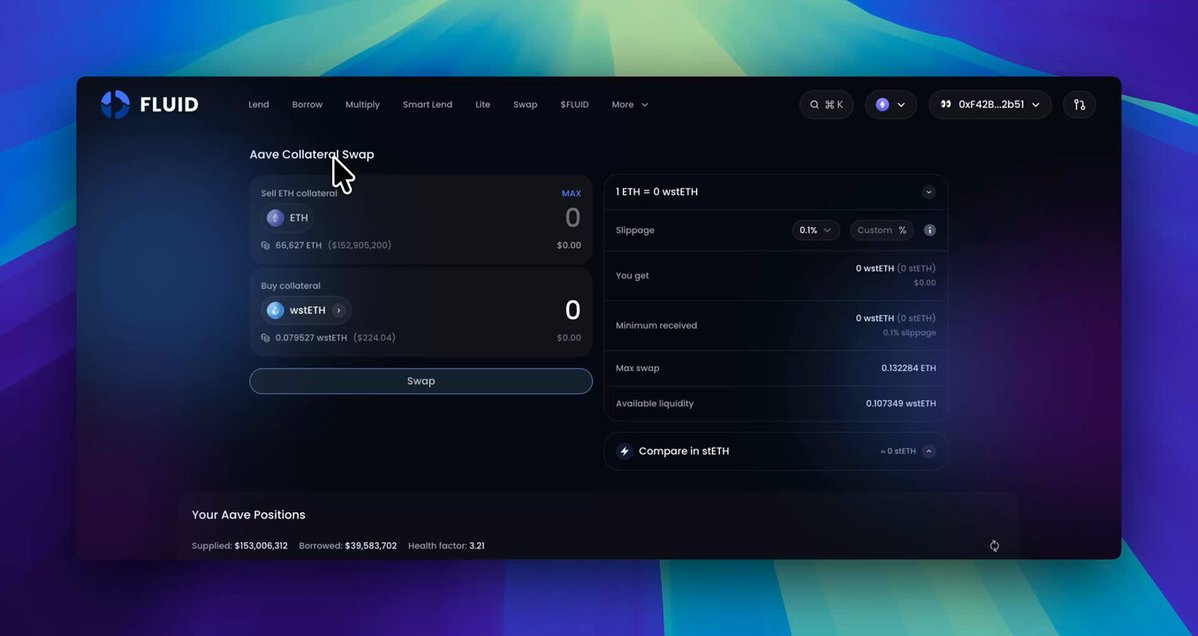 Fluid rolls out $1B-cap aWETH Redemption Protocol with Lido Finance, EtherFi, and 1inch to reduce systemic DeFi risk and unlock trapped ETH liquidity on Aave2026-04
 Lido finance unveils “Financial Metrics 101” guide detailing TVL, rewards, treasury, and grants, reinforcing transparency as it leads Ethereum staking with 9.4M ETH locked2026-05
 WisdomTree Launches First Fully-Staked Ethereum ETP Backed by Lido stETH, Bringing Institutional-Grade Staking Directly to TradFi Markets2025-12
 The onchain vote to activate Lido V3 Phase 1 (Soft Launch) on mainnet is now live2025-12
 Lido DAO withdraws support from LayerZero, throws weight behind Wormhole and Axelar for crypto bridge.2024-01
Lido Finance is the largest liquid staking protocol on Ethereum, allowing users to stake ETH and receive a tradeable token representing their staked position — without locking up capital or running validator infrastructure themselves.
What Liquid Staking Solves
Ethereum's proof-of-stake consensus requires validators to lock 32 ETH as collateral. That threshold excludes most retail participants outright, and even those who meet it face a practical problem: staked ETH is illiquid, unavailable to use in the rest of DeFi while it earns staking rewards.
Liquid staking solves both constraints. A user deposits any amount of ETH into Lido's smart contracts; Lido pools that ETH and delegates it to a curated set of node operators who run validators on the depositor's behalf. In return, the depositor receives stETH — a token that represents their staked ETH plus accruing rewards — and can use that token freely across lending protocols, liquidity pools, and other DeFi applications.
This mechanism unlocked a new category of DeFi primitive, turning an illiquid consensus-layer commitment into a composable, yield-bearing asset.

DeFi’s UX problem takes center stage as blocmates hosts Cannes roundtable with LI.FI, Lido, Gearbox, and Jumper to tackle fragmentation and user friction

$20B routed through LI.FI across 62 chains and 23 bridges — the cross-chain plumbing mostly works now. Yet every protocol at that table is independently building the same product: Jumper launching Earn with personalized yield discovery across 60+ chains, Lido shipping Vaults as staking yields compress, Gearbox offering composable leverage into stETH without touching a DEX. They're sitting together to diagnose UX fragmentation at the infrastructure layer while simultaneously creating a new fragmentation at the product layer — four competing "deposit here, we handle everything" frontends targeting the same user.
stETH and wstETH: The Core Tokens
stETH (staked ETH) is a rebasing token. Its supply adjusts daily to reflect Ethereum staking rewards; a holder's balance increases automatically without any transaction required. As of mid-2026, Lido holds approximately 9.4 million ETH in its contracts, making stETH one of the largest single assets in decentralized finance by total value locked.
wstETH (wrapped stETH) is a non-rebasing wrapper. Rather than adjusting the holder's balance, wstETH accumulates value in its exchange rate against ETH — 1 wstETH is always redeemable for more stETH than it was when first wrapped. This makes wstETH more compatible with smart contracts that cannot handle rebasing mechanics, which is why it has become the preferred form for use in lending markets like Aave and as collateral across Layer 2 networks. Projects like f(x) Protocol have built entire structured-product ecosystems on top of wstETH.
Readers click Lido not for yield mechanics but for power-structure stress tests: every top story is really about who controls $30B in staked ETH — enterprise clients, DAO members facing personal liability, regulators, or rival protocols eating its market share.
Protocol Architecture and Governance
Lido is governed by the Lido DAO, a decentralized autonomous organization whose governance token, LDO, gives holders the ability to vote on node operator whitelists, fee structures, treasury allocations, and protocol upgrades. Day-to-day decisions flow through on-chain proposals; major parameter changes require DAO vote.
A persistent tension in Lido's governance is that stETH holders — the protocol's end users — previously had no direct voice in DAO decisions affecting their staked assets. The Dual Governance mechanism, now active, addresses this. It introduces a dynamic timelock that allows stETH holders to signal dissent on contentious governance motions and, in extremis, exit the protocol before a disputed change takes effect. The mechanism is designed to prevent a scenario in which LDO holders could vote for actions that harm stakers.
Governance is not purely theoretical. In 2026, Lido conducted an emergency DAO vote after a Chorus One oracle address was compromised. The vote rotated the affected address to a new safe one; stakers were unaffected and the protocol remained secure, but the incident illustrated how rapid DAO response mechanisms function in practice.
A California court ruling added a different kind of governance risk to the picture: a 2025 judgment found Lido DAO members personally liable under partnership laws, rejecting the argument that decentralization confers legal immunity. The ruling has implications across the DAO landscape.
Fluid rolls out $1B-cap aWETH Redemption Protocol with Lido Finance, EtherFi, and 1inch to reduce systemic DeFi risk and unlock trapped ETH liquidity on Aave
Lido V3: stVaults and Modular Staking
The most significant recent architectural change is Lido V3, which introduces stVaults — modular smart contracts that let solo validators and institutions configure customized staking setups. Rather than routing all deposits through a single pooled mechanism, stVaults allow operators to define their own risk parameters, operator selection, and fee structures, while optionally integrating stETH liquidity.
The on-chain vote to activate Lido V3 Phase 1 (Soft Launch) on mainnet passed in 2026. The upgrade is designed to expand Lido's addressable market beyond retail depositors to institutional operators with specific compliance or risk requirements. Linea, an Ethereum Layer 2, announced plans to use Lido V3 for automatically staking ETH bridged to its network — a sign that stVaults could become infrastructure embedded in other protocols rather than a user-facing product alone.
Lido also raised the cap on its Community Staking Module from 2% to 3% of TVL, expanding permissionless access for smaller, independent validators who don't meet the whitelisted node operator standard. The move reflects ongoing pressure to decentralize the validator set after years of criticism that Lido's curated operator model concentrates staking influence.
DeFi Integrations: Aave, Lending, and Yield Strategies
stETH and wstETH are foundational collateral assets across DeFi. Aave lists wstETH as a core collateral type, enabling users to borrow stablecoins or other assets against their staked ETH position. The combination — earn staking yield on ETH, borrow against it to deploy capital elsewhere — is one of the most common leveraged strategies in decentralized finance.
A notable 2026 development is the aWETH Redemption Protocol, a joint initiative between Fluid, Lido, EtherFi, and 1inch that introduced a $1 billion cap for redeeming aWETH. The protocol is designed to reduce systemic risk from illiquid ETH positions trapped in Aave's money market and restore fungibility between staked and unstaked ETH. It reflects how deeply Lido's infrastructure is now entangled with Aave's risk architecture.
Lido also launched the GG Vault, a one-click product that automatically allocates user deposits across a basket of DeFi protocols to earn composite yield. The vault abstracts away the complexity of managing multiple positions — a response to DeFi's persistent UX fragmentation problem, which Lido openly acknowledged at a 2026 Cannes roundtable alongside LI.FI, Gearbox, and Jumper.
Lido finance unveils “Financial Metrics 101” guide detailing TVL, rewards, treasury, and grants, reinforcing transparency as it leads Ethereum staking with 9.4M ETH locked
Institutional Adoption and Traditional Finance
Institutional interest in Lido has accelerated materially. WisdomTree launched the first fully-staked Ethereum ETP backed by Lido stETH, giving traditional finance investors exposure to staking rewards through a regulated wrapper. VanEck filed for the first U.S. ETF tied to stETH, following SEC guidance confirming liquid staking does not qualify as a securities transaction — a clarification the industry had sought for years.
Hex Trust enabled custody and liquid staking for stETH, noting it represents nearly a quarter of all staked ETH. Crypto Finance AG integrated with Lido to enable ETH liquid staking for its wallet infrastructure clients. These integrations collectively suggest that stETH is transitioning from a DeFi-native instrument into institutional-grade infrastructure.
Lido's institutional contributors have positioned this as "low-risk staking" — a framing that emphasizes the protocol's long operating history, audited contracts, and multi-oracle design relative to newer entrants.
- 01Institutional capture via stVaults
Lido Institutional and V3 stVaults signal a deliberate pivot toward regulated enterprise clients, which readers recognized as a potential governance realignment away from retail DeFi values.
- 02EigenLayer competitive erosion
The $2.5bn ETH withdrawal headline tied outflows directly to liquid restaking rivals, framing Lido's dominance as structurally threatened rather than temporarily dented.
- 03Regulatory and legal liability
The California partnership-liability ruling and the SEC's securities allegation both attacked the fiction that a DAO shields participants from legal accountability, which readers found existentially novel.
- 04Governance architecture experiments
Dual governance, the L1do blockchain proposal, LDO staking, and the LayerZero-to-Wormhole bridge pivot collectively showed readers that Lido's governance is actively unsettled and consequential.
- 05stETH as DeFi reserve collateral
Aave V3 pools, crvUSD collateral proposals, and ARK's federal-funds-rate analogy positioned stETH as systemic infrastructure, not just a yield token, which raised the stakes of any protocol risk.
- 06Smart-contract and operational failures
The $24M trapped Lido staked SOL story and the attack-vector analysis piece attracted readers who wanted to understand whether Lido's scale amplifies rather than absorbs code risk.
Market Position and Competitive Pressure
Lido's dominant position is real but has eroded. Its liquid staking share has dropped from approximately 32% in 2023 to around 24% by mid-2026, with competitors like EtherFi, Rocket Pool, and Figment capturing meaningful ground. Figment in particular has outpaced rivals in Ether staking growth, and centralization concerns — Lido at peak held roughly one-third of all staked ETH, raising questions about its influence over Ethereum consensus — created reputational friction that competitors exploited.
The protocol's response has been multi-pronged: V3's modular architecture targets institutional segments not previously served; the Community Staking Module expansion broadens the validator base; and the Dual Governance mechanism addresses the governance legitimacy gap. Lido also trimmed 15% of its team in a cost-restructuring move, framed as building toward long-term sustainability rather than a performance issue.
Transparency has become an explicit strategic emphasis. Lido published a "Financial Metrics 101" guide detailing TVL accounting, rewards flow, treasury management, and grants — an unusual level of disclosure for a DeFi protocol, aimed at institutional audiences accustomed to audited financials.
On policy, Lido joined Aave, Uniswap, and other major Ethereum protocols in launching a collective Ethereum policy group to engage regulators. It is also winding down non-core deployments: Lido began a phased shutdown of its Polygon PoS staking product in 2025, ending deposits and allowing withdrawals through June 2025.
Risk Factors
Several risk dimensions are worth understanding before interacting with the protocol:
Smart contract risk. Lido's contracts are extensively audited, but all smart contract systems carry residual exploit risk. The oracle compromise in 2026 did not result in fund loss, but demonstrated that auxiliary infrastructure can be targeted.
Validator performance risk. Lido delegates ETH to a set of node operators. Slashing events — penalties for validator misbehavior — would reduce stETH balances. Lido maintains an insurance fund to cover slashing losses, but coverage limits apply.
Regulatory risk. The California partnership liability ruling established that DAO participation can carry personal legal exposure. VanEck's ETF filing and the SEC's liquid staking guidance create a clearer path in the U.S., but regulatory treatment of liquid staking tokens varies across jurisdictions.
Governance risk. Concentration of LDO governance power remains a concern. Dual Governance partially addresses this by giving stETH holders an exit option, but does not resolve the fundamental asymmetry between token holders and protocol users.
Peg risk. stETH trades on secondary markets and can deviate from its ETH redemption value in periods of stress. The June 2022 stETH depeg — when stETH briefly traded at a significant discount amid the broader market collapse — remains the canonical example.
- 2024-05milestone
KelpDAO enables rsETH withdrawals into stETH
- 2024-06regulatory
SEC sues Consensys, names Lido staking as unregistered security
- 2024-08regulatory
California court holds Lido DAO members personally liable
- 2024-09milestone
$2.5B ETH withdrawn from Lido as EigenLayer rivalry intensifies
- 2024-11launch
Lido Restaking Vaults launched with Symbiotic and Mellow Finance
- 2025-01governance
Lido begins phased shutdown of Polygon PoS staking
- 2025-03launch
Lido Institutional middleware announced for enterprise staking
- 2025-05launch
Lido V3 launches with customizable stVaults
Outlook
Lido enters the second half of the 2020s as the established leader in Ethereum liquid staking, but in a more competitive and regulated environment than when it launched. V3's stVaults architecture represents the clearest strategic bet: that institutional demand for customizable, compliant staking infrastructure is the next growth frontier, and that Lido's protocol maturity gives it a durable advantage in serving it.
Whether that bet pays off depends partly on execution and partly on factors outside the protocol's control — Ethereum's staking economics, regulatory treatment of stETH in major jurisdictions, and whether the validator decentralization critics have enough leverage to erode institutional trust. The convergence of TradFi products (WisdomTree ETPs, VanEck ETF filings), DeFi integrations (Aave, Fluid, Linea), and governance reforms (Dual Governance, Community Staking Module) suggests a protocol actively managing multiple stakeholder demands simultaneously rather than optimizing for any single constituency.
Latest Lido Finance news
DeFi’s UX problem takes center stage as blocmates hosts Cannes roundtable with LI.FI, Lido, Gearbox, and Jumper to tackle fragmentation and user frictionFluid rolls out $1B-cap aWETH Redemption Protocol with Lido Finance, EtherFi, and 1inch to reduce systemic DeFi risk and unlock trapped ETH liquidity on AaveLido finance unveils “Financial Metrics 101” guide detailing TVL, rewards, treasury, and grants, reinforcing transparency as it leads Ethereum staking with 9.4M ETH lockedWisdomTree Launches First Fully-Staked Ethereum ETP Backed by Lido stETH, Bringing Institutional-Grade Staking Directly to TradFi MarketsThe onchain vote to activate Lido V3 Phase 1 (Soft Launch) on mainnet is now live Aave, Lido, Uniswap, and other top ETH protocols launch Ethereum policy group.
Community notes
Spot something off or out of date? Drop a note. Editors review topic notes daily and roll accepted fixes into the explainer — contributors are recognized in the monthly $SQUID drop.
Loading notes…
Help improve this topic
Have a story or tip about this topic? Submit it. See something missing? Leave a note. Editors review daily; accepted submissions and fixes count toward the monthly $SQUID drop.