
In crypto, "claims" span three domains: token collection mechanics, legal/bankruptcy assertions, and unverified founder or political statements — each requiring different evaluation frameworks and carrying distinct risks.
+24 sources across the wider coverage universe
 Pavel Paramonov argues crypto cards have no long-term future, saying they rely on banks, add fees, lack privacy, and contradict crypto’s permissionless ethos. He claims most will die out, with only models like EtherFi aligning with real crypto values.2025-12
 JPMorgan’s Jamie Dimon Tells Coinbase CEO Brian Armstrong “You Are Full of Sh*t” in Davos Clash Over Claims Banks Are Undermining US Crypto Market Structure Bill [cryptonews](2026-01
 Another day, another headline. Now it’s the White House’s AI & crypto czar, David Sacks, pushing back on conflict-of-interest claims. Politics, power, crypto, always the perfect storm.2025-12
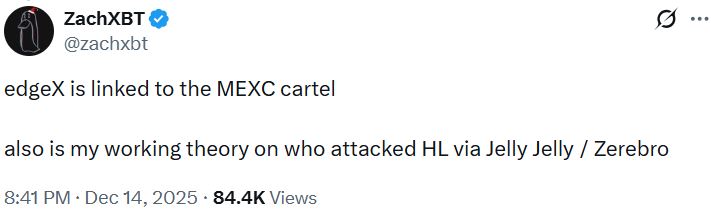 ZachXBT accuses edgeX of MEXC cartel ties in DeFi clash. The on-chain investigator pointed to suspicious volume surges on edgeX, suggesting fake trading activity and connections to manipulative networks tied to the MEXC exchange. edgeX co-founder KF.edge quickly denied the claims, stressing their partnership with Amber Group and commitment to professional standards.2025-12
 Crypto-focused AI startup Surf raised $15 million from Pantera Capital, Coinbase Ventures, and Digital Currency Group. Surf claims its platform outperforms ChatGPT and Grok on crypto tasks, aiming to reduce trading errors and improve investor decision-making.2025-12
 Fetch.ai says its AI agents will overcome online retail barriers faced by today’s tools. The AI developer claims the system, set to launch in January 2026, allows agents to complete payments with credit cards, stablecoins, and FET tokens. Fetch.ai says they’ve been working on the new feature for at least five years as society is moving from a web-based economy to an AI-first economy.2025-12
In crypto, a "claim" can mean three distinct things simultaneously: a user action to collect earned tokens, a legal assertion in regulatory or bankruptcy proceedings, or an unverified statement made by a founder, politician, or protocol — each carrying very different risks and consequences.
The Three Lives of a Claim in Crypto
The word "claim" has become one of the most overloaded terms in the industry. A trader claiming an airdrop reward, a bankruptcy creditor claiming lost funds from the FTX estate, and Binance founder Changpeng Zhao claiming he was targeted by the Biden administration for political reasons are all described with the same word — yet they inhabit entirely different legal and technical universes.
Understanding which kind of claim is being discussed, and how much weight it deserves, is a core literacy skill for anyone operating in crypto markets.

Pavel Paramonov argues crypto cards have no long-term future, saying they rely on banks, add fees, lack privacy, and contradict crypto’s permissionless ethos. He claims most will die out, with only models like EtherFi aligning with real crypto values.

"Well, the problem is: selling your crypto is a taxable event, sometimes even more taxable than daily purchases. And with most cards, each of your operations is taxed, so you have to pay more to the government (again, using a crypto card doesn’t mean going bankless). EtherFi kind of fixes this because you don’t really sell your crypto; you just get a loan against it. Just because of this reason alone (on top of no FX fees in USD, cashback, and different perks), it makes EtherFi the best example of the DeFi × TradFi intersection. "
Token Claims: The Mechanics of Earning and Collecting
The most common use of "claim" in day-to-day crypto refers to the act of executing a blockchain transaction to transfer earned or allocated tokens into a user's wallet. Protocols use claimable reward structures rather than automatic distributions for several reasons: gas efficiency (batching unclaimed rewards avoids sending thousands of microtransactions), compliance flexibility (users self-certify eligibility by signing), and liquidity management (not all eligible addresses will ever claim, reducing immediate sell pressure).
Ondo Finance's recent points campaign illustrates the standard flow. The protocol ran closed campaigns where users accumulated points by providing liquidity or engaging with the platform. When the claim window opened in 2026, eligible wallets had to connect, verify ownership via signature, and execute a claim transaction — the points did not arrive automatically. This opt-in model is now the industry default for retroactive distributions.
Expiry risk is the underappreciated danger in most claim structures. Projects like the Velvet Gems Epoch 10 campaign make this explicit: daily claims carry expiry windows, and ranked dilution means early claimers receive proportionally more than late ones. Unclaimed allocations are typically returned to a treasury or burned, meaning passive holders often receive nothing even if they were technically eligible.
Key mechanics to understand:
- Merkle proofs: Most airdrop claims use a Merkle tree — a cryptographic data structure that lets the contract verify your eligibility without storing every address on-chain. Your wallet generates a proof from a published snapshot; the contract checks it.
- Snapshot dates: Eligibility is frozen at a specific block. Activity after the snapshot date does not increase your allocation.
- Claim windows: Some distributions are permanent; others expire in 90 days, 180 days, or at protocol discretion.
- Gas costs: Claiming is an on-chain transaction. On Ethereum mainnet during congested periods, the gas fee can exceed the value of small allocations, making claims economically irrational for smaller wallets.
Readers click 'claims' stories most when a dollar figure is in dispute — bankruptcy recovery rates, hack repayment guarantees, or creditor OTC pricing — revealing that 'claim' functions as a financial alarm, not merely a rhetorical one, and that the real draw is who ends up holding the bag (or the windfall).
Legal Claims: Regulators, Courts, and the FTX Estate
The second major domain is legal claims — formal assertions of rights or liability in regulatory, civil, or bankruptcy proceedings.
Bankruptcy Claims: FTX as the Defining Case
The collapse of FTX in November 2022 produced one of the largest customer claim processes in financial history. Creditors filed claims asserting the exchange owed them funds; the estate's administrators then worked to verify, dispute, and ultimately settle those claims. The FTX bankruptcy became a reference point for how crypto customer assets are treated under traditional insolvency law — spoiler: not as segregated property, but as unsecured claims against the estate, meaning customers became creditors with no guaranteed priority.
The FTX proceedings also demonstrated how "claims" in bankruptcy can trade as financial instruments. Distressed debt funds purchased creditor claims at discounts, betting on eventual recovery rates. This secondary market in claims is now a standard feature of large crypto bankruptcies.
SEC Claims and Regulatory Assertions
The Securities and Exchange Commission has brought claims against virtually every major crypto exchange and many token issuers, asserting that their assets constitute unregistered securities. The SEC's case against Coinbase — the largest US exchange — centered on the claim that tokens listed on the platform were securities subject to federal registration requirements. Coinbase contested the claim, arguing the SEC lacked clear statutory authority.
The Digital Chamber of Commerce's rejection of claims made by Senator Elizabeth Warren about crypto trust charters reflects how contested the regulatory framing itself remains. Warren's claims that crypto-friendly bank charters posed systemic risks were disputed point-by-point by industry groups, illustrating that in crypto policy, "claims" function as opening positions in a political negotiation rather than settled fact.
Political Claims and Crypto PACs
The 2024 and 2026 US election cycles have made crypto claims a campaign tool. Fairshake PAC — funded substantially by Coinbase, Andreessen Horowitz, and Ripple — claimed primary victories for crypto-friendly candidates across both parties. The PAC's claims about electoral influence are themselves contested: critics argue it buys access rather than shifts genuine public opinion; supporters claim it demonstrates mainstream political viability for the industry.
Trump's personal relationship with crypto has generated a separate stream of claims. His administration's shift toward lighter-touch regulation was framed by supporters as fulfilling campaign promises; critics claimed the pivot coincided with personal financial interests, including the Trump-affiliated World Liberty Financial (WLFI) project. WLFI itself became the subject of competing claims when disputes with partner Justin Sun produced public denials and threatened litigation.

JPMorgan’s Jamie Dimon Tells Coinbase CEO Brian Armstrong “You Are Full of Sh*t” in Davos Clash Over Claims Banks Are Undermining US Crypto Market Structure Bill [cryptonews](
Irrespective of their differences...they should remain professional in exchanging harsh eords
On-Chain Claims: Transparency as a Double-Edged Sword
Blockchains are public ledgers, which means anyone can analyze transaction history and make claims about what they observe. This creates a unique epistemological situation: the underlying data is verifiable, but the interpretation of that data is not.
The controversy over Cardano co-founder Charles Hoskinson illustrates the pattern. NFT creator Masato Alexander published on-chain analysis in 2026 claiming Hoskinson had sold approximately 1.5 billion ADA during the 2021 bull market peak. The analysis traced wallet movements and correlated them with known addresses; Hoskinson disputed the attribution. Neither side's claim can be definitively proven without private key disclosure, yet the on-chain data is publicly available for anyone to examine.
This tension — verifiable data, contested interpretation — is structurally inherent to public blockchains. On-chain analysis firms like Chainalysis, Nansen, and Arkham Intelligence have built businesses around making defensible claims from transaction data. But "defensible" is not the same as "correct," and attribution errors have caused significant reputational damage when misattributed.
What makes an on-chain claim credible?
- Multiple independent analysts reaching the same conclusion
- Cluster analysis rather than single-wallet attribution
- Transparent methodology that others can replicate
- Absence of financial incentive to reach a particular conclusion (short sellers making on-chain fraud claims are not neutral analysts)
Reputational Claims: Founders, Executives, and the Misuse of Authority
Crypto has a particular vulnerability to unverified claims made by prominent figures. The asymmetry between a founder's platform and the average investor's ability to verify statements creates persistent information hazards.
CZ's claim that the Biden administration targeted Binance due to his ethnicity and the exchange's market dominance — made in a Fox News interview and later in his memoir "Freedom of Money" — is an example of a claim that is neither easily verified nor dismissed. The DOJ's case against Binance resulted in a $4.3 billion settlement and CZ's guilty plea; whether prosecutorial motivation was legitimate or politically inflected is a separate question that the legal record alone does not resolve.
Similarly, Bitcoin's growing cultural footprint has generated a category of extraordinary claims — some true, some false. The reported case of a Bitcoin owner using Claude AI to crack a forgotten wallet password, recovering $400,000 in BTC, circulated widely. Such claims are difficult to verify independently but serve as cultural artifacts illustrating the high stakes of key management.
A framework for evaluating crypto claims:
1. Who benefits? Claims made by parties with financial stakes in the outcome deserve elevated skepticism. 2. Is it falsifiable? A claim that cannot, even in principle, be tested is not evidence. 3. What is the track record? Trump's documented 30,573 false or misleading claims during his first term, catalogued by fact-checkers, establishes a base rate relevant to evaluating any political claim about crypto policy. 4. Is there corroborating on-chain evidence? For claims about blockchain activity, the ledger should be the first check, not the last.
Another day, another headline. Now it’s the White House’s AI & crypto czar, David Sacks, pushing back on conflict-of-interest claims. Politics, power, crypto, always the perfect storm.
Security Claims: Fraud Prevention and Adversarial Assertions
A growing category of claims comes from exchanges asserting the effectiveness of their security infrastructure. Binance claimed its AI fraud detection systems blocked 22.9 million scam attempts in the first quarter of 2026 — a figure that is simultaneously a genuine security milestone, a marketing assertion, and an impossible number to verify externally.
At the same time, Kraken disclosed that a criminal group was claiming access to some customer data — a claim the exchange treated seriously enough to notify users even though the breach's scope was disputed. This illustrates how adversarial claims (from attackers) require immediate response regardless of their verifiability, because the cost of treating a false claim as real is much lower than treating a real breach as false.
Scams frequently weaponize the claim format itself. CZ's memoir release was accompanied by fake book scam operations using his name to solicit payments. The credibility of a real claim (book exists, author is famous) was exploited to launder a fraudulent one (buy here to get a copy).
- 01Bankruptcy creditor claim recovery
FTX and Celsius creditors receiving at or above par on distressed claims turned catastrophic collapses into an ongoing money story, with readers tracking real dollar recoveries across years of proceedings.
- 02Protocol denial after exploit
When hacks or unexpected liquidations occur, readers click the official guarantee or denial — DMM Bitcoin pledging full repayment, Pac Finance blaming an unauthorized parameter change — because those assurances are the highest-stakes moment of any incident.
- 03Pump-and-dump market structure claims
The Chainalysis finding that ERC-20 pump-and-dump attackers average only $2,672 challenged the dominant narrative that such schemes are highly profitable, making it a compelling counter-claim that reframes market manipulation as atomized noise.
- 04Airdrop claim windows going live
Time-sensitive claim openings for LayerZero, ether.fi, and Orbiter Finance drive clicks because they carry immediate financial action — missing the window means missing tokens.
- 05Insider wealth during regulatory reckoning
Forbes claiming CZ made billions while incarcerated captured the moral incongruity of crypto's enforcement era, merging celebrity finance with criminal justice in a single headline.
- 06Legal and IP disputes against crypto
Telegram's court-ordered suspension, Unstoppable Domains patent claims against ENS, and the Kansas City Fed opposing Custodia's banking charter showed readers how incumbent institutions use legal claims as competitive weapons against crypto infrastructure.
When Claims Signal Market Stress
Project failures frequently arrive preceded by contested claims. Satori Finance's shutdown — attributed to crypto bear market conditions — followed a period in which the project made claims about its resilience that the market ultimately tested to destruction. Rezolve AI, facing short-seller claims about its financial health while attempting a $700 million acquisition, hosted what analysts described as a risky investor call — attempting to make counter-claims under adversarial conditions.
The pattern is consistent: when a project's claims about its own fundamentals become the primary subject of discussion, that is itself a signal worth weighting. Healthy projects are usually discussed in terms of their products; distressed ones are discussed in terms of their founders' assertions.
Regulatory and Geopolitical Claims About Crypto
Nations and regulatory bodies increasingly make competing claims about crypto's legal status and their own leadership in the space. Switzerland's claim to European crypto leadership — supported by a VC report — reflects a genuine regulatory arbitrage: the country's clear framework has attracted significant institutional capital. The UK's Nigel Farage claiming "no obligation" to declare a $6.7 million gift from a Tether billionaire reflects a different dimension of the same phenomenon: the intersection of crypto wealth and political systems that were not designed to account for it.
- 2022-06regulatory
Three Arrows Capital collapses; Davies allegedly solicited LayerZero treasury days prior
- 2022-07regulatory
Celsius Network files Chapter 11; creditor claims process begins
- 2022-11regulatory
FTX collapses; creditor claims filed and OTC secondary market for distressed claims emerges
- 2023-07exploit
Curve Finance reentrancy exploit; ChainLight publishes postmortem disputing whether it could have been halted
- 2024-05exploit
DMM Bitcoin hacked for 4,502 BTC (~$305M); exchange claims it will guarantee full amount to users
- 2024-06milestone
LayerZero $ZRO token claims open June 20; FTX reorganization plan projects 118%+ creditor recovery
- 2024-10milestone
FTX bankruptcy plan confirmed; hedge funds holding accumulated claims positioned for 9-figure payouts
Outlook
Claims in crypto are multiplying faster than the systems for evaluating them. The maturation of the industry is producing more sophisticated tools on multiple fronts: on-chain analytics for blockchain-level claims, bankruptcy administration frameworks for legal claims (refined painfully through FTX, Celsius, and BlockFi), and better-funded fact-checking infrastructure for political and reputational claims.
The underlying dynamic, however, remains unchanged: asymmetric information between insiders and retail participants means claims will continue to be the primary vector for both legitimate communication and manipulation. The most durable skill in crypto remains the ability to identify who is making a claim, what they stand to gain from it being believed, and what evidence — on-chain or otherwise — would actually resolve the question.
Regulatory clarity, particularly from the SEC and its evolving stance on digital assets, will gradually shift some claims from contested interpretations to settled law. Until then, treating unverified claims as starting points for investigation rather than conclusions remains the appropriate posture for anyone operating in the space.
Latest Claims news
Pavel Paramonov argues crypto cards have no long-term future, saying they rely on banks, add fees, lack privacy, and contradict crypto’s permissionless ethos. He claims most will die out, with only models like EtherFi aligning with real crypto values.JPMorgan’s Jamie Dimon Tells Coinbase CEO Brian Armstrong “You Are Full of Sh*t” in Davos Clash Over Claims Banks Are Undermining US Crypto Market Structure Bill [cryptonews](Another day, another headline. Now it’s the White House’s AI & crypto czar, David Sacks, pushing back on conflict-of-interest claims. Politics, power, crypto, always the perfect storm.ZachXBT accuses edgeX of MEXC cartel ties in DeFi clash. The on-chain investigator pointed to suspicious volume surges on edgeX, suggesting fake trading activity and connections to manipulative networks tied to the MEXC exchange. edgeX co-founder KF.edge quickly denied the claims, stressing their partnership with Amber Group and commitment to professional standards.Crypto-focused AI startup Surf raised $15 million from Pantera Capital, Coinbase Ventures, and Digital Currency Group. Surf claims its platform outperforms ChatGPT and Grok on crypto tasks, aiming to reduce trading errors and improve investor decision-making.Fetch.ai says its AI agents will overcome online retail barriers faced by today’s tools. The AI developer claims the system, set to launch in January 2026, allows agents to complete payments with credit cards, stablecoins, and FET tokens. Fetch.ai says they’ve been working on the new feature for at least five years as society is moving from a web-based economy to an AI-first economy.Community notes
Spot something off or out of date? Drop a note. Editors review topic notes daily and roll accepted fixes into the explainer — contributors are recognized in the monthly $SQUID drop.
Loading notes…
Help improve this topic
Have a story or tip about this topic? Submit it. See something missing? Leave a note. Editors review daily; accepted submissions and fixes count toward the monthly $SQUID drop.