
Binance is simultaneously a dominant exchange, derivatives venue, token-distribution platform, Web3 gateway, and regulatory test case. Its scale creates deep liquidity and broad access, but also concentrates custody, compliance, and market-structure risk.
+49 sources across the wider coverage universe
 Binance senior compliance staff flee financial crime roles as CCO Perlman eyes exit amid DOJ Iran probe2026-04
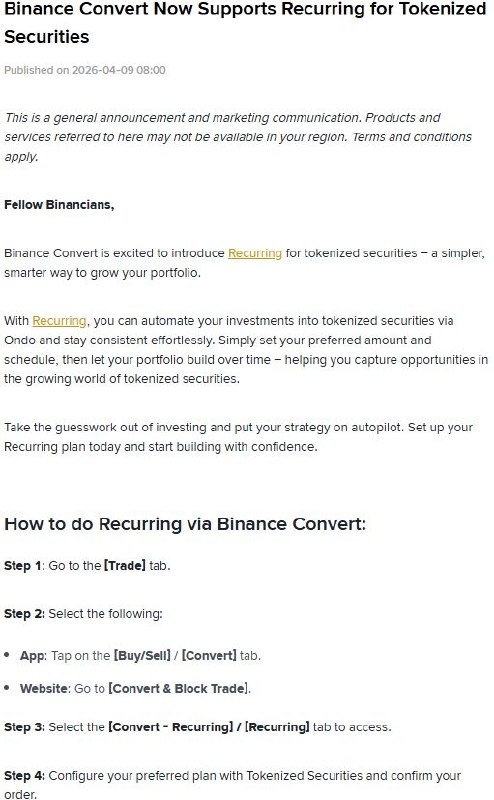 Binance Convert adds recurring buys for Ondo tokenized securities across app and web2026-04
 CZ accuses rival US exchanges of spending millions to block his Trump pardon, fearing Binance's US return2026-04
 Binance publishes report revealing crypto evolving into full-stack financial system as neobanks, cross-chain activity and weekend trading volumes surge across integrated markets2026-04
 Bybit and Bitget churn reserves 3-5x faster than Coinbase and Binance as top CEX holdings hit $225B2026-04
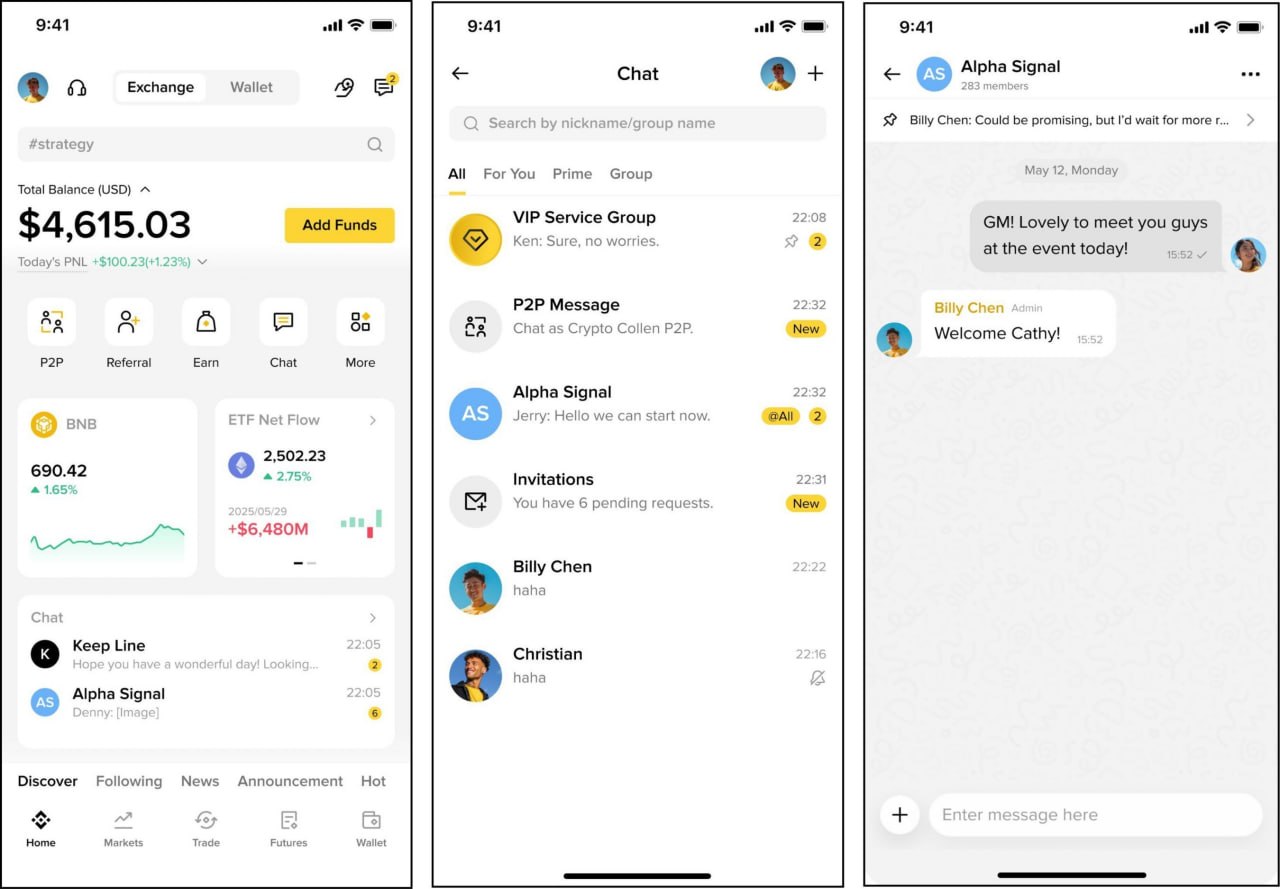 Binance launches in-app chat feature, moving closer to a financial super app2026-04
Binance: A Comprehensive Evergreen Explainer
The world’s largest cryptocurrency exchange by reported trading volume, Binance is a multifaceted platform spanning spot and derivatives markets, token launches, savings products, and a growing Web3 and tokenization stack. Its rise from a 2017 startup to a systemically important crypto institution has been accompanied by intense regulatory scrutiny, major enforcement actions, and efforts to demonstrate solvency and compliance through mechanisms such as on-chain Proof of Reserves.
For traders and builders, Binance functions simultaneously as a liquidity venue, a launch platform for new tokens, and an on-ramp from fiat and stablecoins into the wider digital-asset ecosystem. For regulators and policymakers, it has become a case study in how global crypto infrastructure should be supervised, particularly around derivatives, stablecoins, sanctions, and cross-border flows. Understanding Binance therefore requires examining not only its product lineup, but also its governance, risk management, role in emerging markets, and shifting relationship with national and supranational authorities.
What Binance Is and Why It Matters
From exchange startup to global infrastructure
Binance launched in 2017 as a cryptocurrency trading platform founded by Changpeng Zhao, widely known as CZ, a Chinese-Canadian entrepreneur with experience building trading systems for traditional finance and working at blockchain projects such as Blockchain.info. It initially concentrated on spot trading of crypto-to-crypto pairs, including its own BNB token. BNB was issued through an initial coin offering and later became central both to the Binance ecosystem and to regulatory scrutiny in the United States.
Relatively low trading fees, a rapid asset-listing cadence, and aggressive user acquisition helped Binance overtake exchanges founded years earlier. It subsequently expanded from a spot venue into an ecosystem encompassing derivatives, staking and savings products, token launch platforms, an on-chain smart-contract network under the BNB brand, tokenized securities, and Web3 wallet services.
That expansion changed Binance’s category. It is still an exchange, but it is better understood as a vertically integrated distribution system for digital assets: fiat and stablecoin access at one end, custody and trading in the middle, and token launches, yield products, derivatives, wallets, and on-chain applications around the edges. The integration reduces friction for users, while increasing the consequences of operational, compliance, or solvency problems at any one layer.
For many assets, particularly during their first months of exchange trading, liquidity on Binance helps anchor price discovery elsewhere. Its order books, derivatives funding rates, and liquidation activity influence how the wider market perceives fair value and positioning. Binance’s derivatives business is especially important because perpetual swaps combine leverage, continuous trading, and no fixed expiration date. That makes them efficient speculative and hedging instruments, but also creates conditions in which forced liquidations can propagate quickly across venues.
The benefit of Binance’s scale is straightforward: deep markets can reduce slippage, improve execution, and allow traders to move risk efficiently. The corresponding cost is concentration. When one venue becomes a reference point for pricing and leverage, its listing policies, margin systems, technical reliability, and regulatory status matter to people who never open an account there.
An ecosystem spanning centralized and decentralized finance
Although Binance is usually described as a centralized exchange, it increasingly operates across the boundary between centralized finance and decentralized finance. Its core remains custodial: Binance controls the wallets holding exchange assets, matches trades on an internal order book, and represents customer claims through account balances. Deposits and withdrawals touch public blockchains, but most trading and balance changes occur inside Binance’s own systems.
The company also offers an integrated Web3 Wallet that lets users interact with decentralized exchanges and on-chain protocols. A user can buy a stablecoin through Binance’s centralized infrastructure, move it into the wallet, and then swap it for an asset unavailable on the main exchange. This arrangement makes Binance both a destination and a bridge. The centralized account supplies fiat access, liquidity, and convenience; the wallet supplies access to permissionless applications and self-directed on-chain activity.
That convenience does not make the two environments equivalent. Assets in a Binance exchange account expose the user primarily to custodial, operational, and counterparty risk. Assets in a non-custodial wallet introduce private-key, smart-contract, bridge, and protocol risk. Moving between the two changes who controls the assets and which failure modes matter, even when both experiences appear inside one application.
The same hybrid structure appears in token distribution. Launchpad and Launchpool use assets held through the centralized platform to distribute new tokens. Binance Alpha offers selected assets in an early-access environment. BNB Chain hosts decentralized applications whose users may still depend on Binance for liquidity or fiat conversion. Binance therefore sits at a junction between traditional payment rails, centralized custody, and permissionless networks rather than occupying only one side of the CeFi-DeFi divide.

Anoma launches private tokenized stocks on Anomapay for BNB Chain bStocks

Corporate Evolution, Leadership, and Governance
Founding, early growth, and the role of CZ
Binance’s early identity was inseparable from CZ. His public visibility, rapid product decisions, and direct engagement with crypto markets reinforced the impression of a founder-led organization. The original BNB sale funded expansion, while the token initially served as a fee-discount mechanism. BNB later became the native asset of BNB Chain and an important participation asset for products such as Launchpool.
Binance moved its operational base as regulatory conditions changed and at times emphasized that it lacked a conventional centralized headquarters. That posture offered flexibility during crypto’s lightly regulated expansion, but it also made accountability harder to map. Regulators overseeing an exchange serving users across borders wanted identifiable legal entities, responsible officers, reliable records, and clear answers about which jurisdiction governed particular activities.
CZ’s approach favored speed and a willingness to enter product categories ahead of more cautious competitors. Binance expanded rapidly into leveraged futures, yield-bearing products, token distribution, and elaborate promotional campaigns. The gain was a broad, active ecosystem with unusually strong distribution. The cost was that regulators could view the same speed as evidence that growth had outrun licensing, customer-protection, and market-conduct controls.
That tension is more useful than a simple innovation-versus-regulation story. Many Binance products reproduce functions already familiar in finance: brokerage, custody, leveraged derivatives, savings-like accounts, asset issuance, and market making. Crypto changes the technology and distribution model, but it does not remove the underlying questions about disclosures, conflicts, leverage, surveillance, and legal responsibility.
Leadership transition and governance reforms
Richard Teng rose through senior roles at Binance before becoming chief executive. His prior experience included regulatory and exchange work, which Binance presented as relevant to operating under tighter global oversight. The transition represented an attempt to move from a founder-centric structure toward a more institutional model built around documented controls, compliance personnel, and formal engagement with regulators.
Governance cannot be inferred from a chief executive’s résumé alone. The practical tests are observable: whether legal entities and decision rights are clear, whether compliance systems prevent prohibited access, whether suspicious activity is escalated, whether customers receive consistent disclosures, and whether regulators can obtain reliable records. Leadership symbolism matters, but repeatable controls matter more.
Binance has emphasized the growth of its compliance teams, know-your-customer procedures, anti-money-laundering controls, and cooperation with law enforcement. Some of these changes followed regulatory settlements rather than emerging voluntarily. That does not make them irrelevant; it means the reforms should be judged by their durability and effectiveness rather than treated as proof that the underlying governance questions have disappeared.
The exchange remains less transparent than a publicly listed financial institution whose ownership, board structure, audited statements, and material risks are disclosed through standardized filings. Binance’s private structure gives it flexibility, but leaves users and counterparties with fewer conventional tools for evaluating governance. Proof of Reserves and public announcements partly address that information gap, though neither substitutes for a complete view of the corporate balance sheet and control environment.
Regulatory perimeter and operating jurisdictions
Binance serves users across jurisdictions with different definitions of exchanges, brokers, securities, derivatives, virtual assets, and payment services. Its corporate footprint therefore involves multiple legal entities, licenses, partnerships, and local restrictions. A Binance-branded service available in one country may not offer the same products, legal protections, or contracting entity as a similarly branded service elsewhere.
This patchwork is not a minor administrative detail. It determines which regulator can hear a complaint, what happens if a service fails, whether customer assets receive special protection, and which products may legally be offered. A global interface can create the impression of a single uniform platform even when the legal relationship underneath it changes by location.
The Philippines illustrates the tension. The Philippine SEC warned in 2023 that Binance was not authorized to sell or offer securities in the country. Later discussion of a possible route involving BlockShoals and a regulatory sandbox suggested a different model: limited, supervised access through a locally monitored arrangement. A sandbox can provide a path toward compliance, but it is not equivalent to unrestricted authorization. It allows regulators to observe operations and impose conditions before deciding whether broader access is justified.
Europe presents the same issue at a larger scale. MiCA is intended to create a harmonized framework for crypto-asset service providers across the European Union, yet authorization still depends on satisfying regulatory requirements through an eligible jurisdiction. Binance’s European position therefore turns on more than customer demand. It depends on whether regulators accept its governance, controls, legal structure, and ability to operate consistently across the bloc.
The durable lesson is that availability and authorization are different facts. A platform can remain technically accessible while lacking a license that would permit the full range of services. Users should identify the entity serving them, the products that entity is permitted to offer, and the regulator responsible for it rather than assuming the global Binance brand supplies the same legal status everywhere.
Readers engage with Binance not as a product story but as a personal accountability drama — the three highest-clicked angles all track what happens to specific named individuals (CZ, Gambaryan, Anjarwalla) as a result of Binance's legal exposure, dwarfing clicks on market, product, or investment news.
Core Exchange Products: Spot, Margin, Derivatives, and Options
Spot and margin trading
Binance’s foundational product is its spot exchange, which hosts pairs among cryptocurrencies, stablecoins, and tokenized representations of fiat currencies. Traders can buy and sell major assets such as bitcoin and ether as well as smaller tokens. Stablecoins including USDT and USDC commonly operate as base currencies, allowing users to convert local money into a crypto-native unit of account before entering other positions.
A typical user might buy USDT using a bank transfer or card and then trade BTC/USDT. This looks simple, but several distinct risks sit behind the interface: the user depends on the stablecoin issuer, on Binance’s custody and internal ledger, on the liquidity of the selected market, and on continued access to withdrawals through a supported blockchain network.
Binance also offers margin trading, which lets users borrow assets against collateral. Borrowing amplifies gains when a position moves in the expected direction and accelerates losses when it does not. Liquidation is the defining risk: if collateral falls below required thresholds, Binance can close a position automatically, potentially during a fast market in which execution is unfavorable.
Spot and margin balances remain custodial. Binance holds the assets, matches orders, and adjusts internal balances. On-chain settlement normally occurs only when funds enter or leave the exchange. This design makes trading fast and inexpensive, but grants the operator substantial discretion over listings, withdrawals, collateral treatment, and emergency controls.
Binance uses measures such as monitoring tags to identify tokens presenting elevated volatility or project-level risk. Such labels are warnings, not guarantees that Binance has solved the underlying problem. A tagged asset can still be illiquid, manipulated, technically compromised, or eventually delisted. The practical test is whether a trader understands both the asset and the venue’s rules for changing its status.
Perpetual futures and other derivatives
Derivatives are among Binance’s defining products. The platform offers USD-margined and coin-margined futures, including perpetual swaps and contracts with fixed quarterly expirations. Perpetuals replicate much of the economic exposure of a leveraged spot position without a fixed maturity date. Funding payments between long and short positions help keep the contract price aligned with the underlying market.
The perpetual swap is not merely another contract type; it is one of crypto’s central market-structure inventions. It allows continuous leveraged exposure without the rollover process associated with conventional futures. That convenience attracts liquidity and makes hedging easier, while the same leverage creates liquidation cascades when prices move sharply.
Funding rates offer a rough indication of positioning pressure. Positive funding generally makes longs pay shorts, while negative funding reverses the direction. Open interest shows the quantity of outstanding positions but does not reveal, by itself, whether those positions are speculative, hedged, or distributed safely. Both figures are useful signals only when read alongside price, liquidity, collateral, and concentration.
Binance adds and retires contracts in response to demand and risk assessments. It can alter specifications, leverage limits, settlement rules, or special protections. These changes matter to traders running strategies that assume consistent contract behavior. A contract announcement is therefore operational information, not marketing copy: missing a change can alter liquidation risk or invalidate a hedge.
The exchange’s derivatives scale gives it a dual role. In normal conditions, deep liquidity can absorb large trades and allow risk to be transferred efficiently. Under stress, concentrated leverage can transmit shocks. Liquidations on Binance may affect spot prices, other derivatives venues, arbitrage portfolios, and DeFi markets whose pricing systems reference centralized exchanges.
Options analytics and market data
Binance also supports options markets for selected assets, including BTC, ETH, and XRP. Options give traders nonlinear exposure: the buyer pays a premium for a right, while the seller accepts a contingent obligation. Strikes, expirations, implied volatility, and open interest reveal how the market prices possible future moves, but interpreting them requires more than identifying the largest number on a chart.
Open-interest concentrations near a strike can matter around expiration because dealers and market makers may adjust hedges as prices move. Yet a large concentration does not prove that price will be drawn to that level. The effect depends on whether participants are net long or short options, how positions are hedged, and whether spot liquidity can absorb the resulting trades.
Binance’s market data feeds into quantitative strategies, media narratives, and risk systems beyond the platform. Funding rates, open interest, options volume, and liquidation data can become feedback mechanisms: traders act on a positioning signal, those trades change the signal, and the resulting narrative attracts further activity.
This is why Binance’s systemic importance cannot be reduced to reported volume. Its prices and risk indicators are inputs into decisions made across centralized and decentralized markets. Reliability, resistance to manipulation, and transparent contract rules therefore matter even to observers who use Binance only as a data source.
Launch Platforms, Token Listings, and Binance Alpha
Launchpad, Launchpool, and BNB
Launchpad and Launchpool give Binance influence over the pipeline through which new tokens reach users. Launchpad has hosted token sales, commonly using BNB holdings or commitments to determine access. Launchpool distributes newly issued tokens to users who stake designated assets, allowing participation without a direct token purchase during the farming period.
These products turn distribution into a form of infrastructure. A project gains immediate access to a large audience and potential liquidity. Binance gains engagement and reinforces demand for assets used to participate. Users gain early access but accept the uncertainty of new projects, including limited operating histories, changing token economics, and potentially extreme post-launch volatility.
BNB’s role extends beyond exchange-fee discounts. It functions as a gas asset on BNB Chain, a participation asset in launch programs, and a component of Binance’s broader incentive system. That produces real utility within the ecosystem, but also couples BNB’s value to expectations about Binance activity, regulation, and future token launches.
Launchpool’s connection with Binance Earn deepens that coupling. BNB committed to certain Earn products may participate automatically in token farming. The convenience rewards passive holding and reduces the need to manage separate positions. It also makes the product stack harder to analyze in isolation because one balance can simultaneously support savings, promotional, and token-distribution functions.
For projects, a Binance launch can transform visibility and valuation. The trade-off is dependence on a powerful gatekeeper whose listing conditions, allocation design, and later risk assessments can influence the token’s market. Distribution at scale is valuable, but it does not establish product-market fit, decentralization, or durable demand.
Binance Alpha and early access
Binance Alpha provides early access to selected assets through an environment that resembles spot trading while retaining special eligibility and reward mechanics. Examples in the standing record include Arcium and GAIB, with access linked to Alpha Points or time-limited airdrop windows. GAIB also appeared in Binance Futures with high permitted leverage.
Alpha is best understood as a staging layer between discovery and a conventional exchange listing. Binance can curate assets, observe liquidity, and engage active users before making a broader commitment. Users receive earlier access, while accepting that an Alpha appearance does not necessarily mean the asset has cleared the same process or obtained the same status as a full spot listing.
Points and airdrops add a loyalty system to this staging layer. Activity elsewhere in the Binance ecosystem can affect eligibility, encouraging users to trade, hold assets, or engage with promotions. The gain is a more integrated user experience; the cost is that incentives can blur the line between genuine investment demand and behavior motivated primarily by rewards.
Early-access markets can improve price discovery by creating a venue before a full listing. They can also concentrate attention around assets with limited histories and uncertain liquidity. Traders should distinguish between access, endorsement, and durability. Binance can supply the first without proving the other two.
Listings, monitoring tags, and network support
Binance evaluates listed tokens using factors such as liquidity, development activity, disclosure, and regulatory risk. When concerns rise, it may apply a monitoring tag. The tag tells users that the asset faces enhanced review and possible delisting, but the exchange still leaves the trading decision with the user.
Listing policy has consequences beyond the Binance interface. Projects may depend on exchange liquidity for treasury operations, investor access, and price discovery. A monitoring tag or delisting can reduce liquidity and trigger reactions on other venues. Binance’s private risk decision can therefore become a market-wide event.
Network support is a separate issue from token listing. A token may exist on several networks, but Binance can support only some of them or discontinue a particular route. Users sending assets must match the network selected by the sending wallet with the network Binance currently accepts. A correct token sent through an unsupported network can still fail to reach the credited balance.
This is one of the clearest areas in which users can apply an observable test: check the deposit interface immediately before transferring, confirm the chain and address format, and use a small test transaction when the value is material. Familiarity with a token is not enough because the supported route can change.

Binance takes $100 million stake in Circle as part of five-year USDC partnership

Earn, Savings, and Structured Products
Simple Earn and promotional yields
Binance Earn groups flexible and locked savings, staking, liquidity products, and structured offerings. Simple Earn lets users subscribe with supported tokens and receive variable returns, sometimes with flexible redemption and sometimes under a fixed-term arrangement. Promotional campaigns can increase headline annual percentage rates for limited balances, regions, or periods.
A promotional APR is not the same thing as a durable yield. It may combine a base rate with a temporary bonus, apply only up to a balance cap, or distribute rewards on a different schedule from ordinary interest. The attractive headline should be compared with the amount actually eligible, the campaign duration, and the risks of the asset being deposited.
The standing record includes a promotion for U Simple Earn Flexible Products offering up to 8 percent APR through real-time and bonus components, subject to a promotional limit. It also includes region-specific campaigns with much higher headline rates. Those figures show how Binance uses targeted incentives, but they do not establish that all users can obtain the advertised rate or that it will persist beyond the campaign.
Earn products are often described with the language of savings, yet they do not necessarily carry the protections associated with a regulated bank deposit. Users remain exposed to the token, the platform, the product terms, and any underlying staking or lending activity. A familiar interface and daily reward credit do not eliminate those distinctions.
The trade-off is the same across much of Binance: integration makes idle assets easier to deploy, but also encourages users to consolidate custody and risk in one ecosystem. Yield should therefore be evaluated together with withdrawal terms, counterparty exposure, token volatility, and the user’s need for liquidity.
Stablecoins and structural incentives
Stablecoins are central to Binance’s trading and Earn systems. USDT and USDC act as quote currencies, collateral, savings assets, and transfer instruments. In countries with volatile currencies or limited access to dollar banking, they can function as practical dollar substitutes for saving and cross-border exchange.
The current article records Binance data indicating that roughly 36 percent of its users in emerging economies kept at least half of their funds in stablecoins. That figure comes from the platform rather than an independent census, so it is best read as evidence about the behavior Binance observed among its users, not as a complete measure of emerging-market finance.
Stablecoin use offers access and introduces dependencies in the same transaction. Users can gain dollar-denominated exposure without a United States bank account, but rely on the stablecoin issuer, the exchange, the relevant blockchain, and the continued legality of the access route. A failure or restriction at any layer can interrupt the apparent simplicity of holding digital dollars.
Binance strengthens these incentives through reward programs, including discount-buy structures and Earn promotions denominated in stablecoins or vouchers. These programs can subsidize participation and deepen liquidity. They can also make it difficult to separate organic demand from balances attracted by temporary rewards.
Concentration matters here. A user who keeps savings in one stablecoin on one exchange may perceive diversification because the balance can be deployed across many Binance products. Economically, however, the same custody and issuer risks may remain underneath each allocation.
Gamified campaigns
Trading competitions and themed promotions extend Binance beyond execution and custody. Traders League campaigns reward volume or performance in selected assets, while football-themed events have combined daily picks, referrals, platform tasks, and prize boxes. These programs turn participation into a game with visible milestones and rewards.
Gamification can make a complex product easier to approach and can build community around an exchange. The cost is that it may encourage users to trade more frequently than their strategy warrants. A prize pool changes the payoff only for eligible winners, while every participant still pays spreads, fees, and the cost of adverse price moves.
The correct comparison is not between a reward and zero. It is between the expected reward and the incremental risk and cost required to pursue it. A user who would not otherwise trade a token may be taking a new market position merely to qualify for a voucher or leaderboard.
Campaigns also serve issuers and Binance by directing attention toward selected assets. That does not make them inherently deceptive, but it means their economic purpose is promotional. Readers should distinguish product education from incentives designed to increase deposits, turnover, referrals, or retention.
- 01CZ imprisonment and sentencing↗
The founder's personal legal fate — prison extension fears, DOJ's push for 36 months, and the $4.3B settlement — made Binance's accountability story uniquely personal and high-stakes.
- 02Nigeria executive hostage crisis↗
The detention of Tigran Gambaryan and the dramatic escape of Nadeem Anjarwalla turned a regulatory dispute into a geopolitical standoff, with Nigeria simultaneously seeking $10B in damages.
- 03SEC regulatory war↗
Multiple rounds of SEC filings, amended complaints targeting token listings, and full court document releases gave readers a serialized legal thriller with real market consequences.
- 04Stablecoin ecosystem unwinding↗
BUSD's termination alongside Paxos, USDC Tron delisting, and Philippine users dumping USDT at a 7% discount showed readers a live unraveling of Binance's stablecoin infrastructure.
- 05Malware and user security threats
Cthulhu malware targeting Binance wallets and Clipper clipboard attacks directly threatened readers' own funds, making these clicks self-protective rather than spectator interest.
- 06Post-CZ leadership transition↗
Richard Teng's appointment as CEO and Binance's push past 170 million users signaled whether the exchange could survive its founder's exit — a binary most readers had a stake in.
Infrastructure: Accounts, Wallets, Tokenized Assets, and Fiat Rails
Centralized accounts and the Web3 Wallet
Most users begin with a centralized Binance account. Registration and identity verification unlock access according to jurisdiction, account type, and product eligibility. Users can fund accounts through crypto deposits, bank transfers, cards, or payment partners where those routes are available.
Assets deposited to the exchange are held under Binance’s custody rather than under keys controlled by the user. The application displays balances across spot, derivatives, and Earn products, but those balances are claims recorded in Binance’s internal ledger. Users regain direct blockchain control only after a successful withdrawal to an address they control.
The integrated Web3 Wallet offers a different custody model and access to decentralized applications. Users can move funds from the exchange, connect to supported networks, and interact with decentralized exchanges, lending protocols, liquidity pools, and other applications. The unified interface reduces friction, but the legal and technical character of the assets changes when they leave the custodial account.
Private-key responsibility is central to non-custodial use. If a user loses the relevant recovery credentials or authorizes a malicious transaction, Binance may be unable to reverse the result. Self-custody removes dependence on the exchange for control of the asset, while assigning more security responsibility to the individual.
Binance’s wallet integrations also shape discovery. Networks and protocols surfaced in the interface are easier for users to reach than those that are not. The wallet is therefore not a neutral window onto all of Web3; it is an access layer whose design and integrations influence user behavior.
Tokenized securities and bStocks
Binance’s bStocks offering extends the platform toward tokenized exposure to stocks and exchange-traded funds. The standing article records trading pairs representing assets such as AMD, a South Korean equity ETF, Intel, and MicroStrategy, quoted against USDT. This allows equity-linked exposure to sit alongside crypto assets inside a familiar trading environment.
Tokenized securities are not merely altcoins with recognizable names. Their value depends on legal and operational links to an underlying security, including custody, issuance, redemption, trading rights, and jurisdictional restrictions. Users need to understand whether they own a direct claim, a contractual representation, or a synthetic exposure, because those structures behave differently if an intermediary fails.
The attraction is clear: tokenization can extend trading hours, make assets interoperable with crypto settlement, and allow stablecoins to serve as the quote currency. The cost is an additional layer between the investor and the underlying security. That layer may introduce issuer, custodian, redemption, and regulatory risk not present in direct ownership through a conventional broker.
Binance’s expansion into stock-linked products reclassifies it again. It is no longer only a venue where crypto assets trade against one another; it is becoming an interface through which traditional market exposure is repackaged in crypto-native form. That convergence may broaden access, while inviting the same securities-law and investor-protection questions that govern the underlying markets.
Fiat rails and regional currencies
Fiat access remains a bottleneck for global crypto exchanges. A user may have access to a Binance account but lack a reliable bank-transfer route, or may face higher fees and more intermediaries when buying stablecoins. Binance has addressed this through regional entities, payment partners, cards, peer-to-peer markets, and localized deposit and withdrawal arrangements.
The standing article includes a regulated deposit and withdrawal route for the United Arab Emirates dirham. Such a rail can reduce friction and clarify how money moves between a bank account and the exchange. Its availability still depends on eligibility, local rules, banking partners, and the particular Binance entity serving the user.
Where direct rails are unavailable, stablecoins can act as bridges. Users may acquire USDT or USDC through another provider or a peer-to-peer market before transferring the assets to Binance. This extends access, but adds counterparties and transaction steps. The route may be technically effective without offering the same consumer protections as a direct regulated bank transfer.
Binance’s access model is therefore layered rather than uniform. Direct fiat rails serve some users, third-party partners serve others, and stablecoin transfers fill remaining gaps. That flexibility supports global reach; it also makes the user’s actual legal and operational pathway more important than the brand displayed at the top of the application.
Risk Management, Compliance, and Proof of Reserves
CFTC, SEC, and major enforcement actions
United States regulators have treated Binance as a major test of how existing commodities, derivatives, and securities laws apply to global crypto businesses. In 2023, the CFTC alleged that Binance and CZ operated an unregistered derivatives platform that allowed United States customers to trade without required registration and controls.
The resulting order required Binance to disgorge approximately $1.35 billion and pay a civil monetary penalty of the same size, producing a total of $2.7 billion. CZ was ordered to pay a $150 million civil penalty. The order also required compliance undertakings involving surveillance, reporting, and controls over access by United States users.
The scale of those penalties matters beside the conduct alleged. The case was not simply about whether a token qualified as a particular asset class; it concerned the responsibilities attached to operating leveraged markets and serving prohibited customers. The settlement placed compliance architecture—identity checks, access controls, recordkeeping, and supervision—at the center of Binance’s operating model.
The SEC brought a separate action in 2023 involving Binance entities and CZ. Its allegations included unregistered offers and sales involving BNB, BUSD, and yield-bearing products, as well as statements about trading controls and separation between Binance’s global platform and its United States affiliate. The complaint treated the 2017 BNB sale and certain lending products as securities-law issues.
In May 2025, the SEC and Binance jointly stipulated to dismissal of the civil action with prejudice. That dismissal closed the case rather than producing a final judicial determination resolving every underlying classification question. It establishes the litigation’s outcome, but does not by itself create a comprehensive rule for every exchange token, stablecoin, or Earn product.
Taken together, the CFTC and SEC episodes show why Binance cannot be assessed through a single label such as compliant or noncompliant. Different agencies brought different theories under different statutes, and the cases ended differently. The useful questions are product-specific: who can access the service, what legal category applies, which entity operates it, and what controls govern the activity.
Sanctions, AML, and geopolitical sensitivity
Binance has also faced scrutiny over sanctions and anti-money-laundering obligations. United States lawmakers cited reports involving transactions connected with Iranian entities, while regulatory allegations challenged the adequacy of controls designed to identify and prevent illicit activity. Binance has emphasized investment in compliance tools and cooperation with law enforcement.
A global exchange faces a structural problem: blockchains can move assets across borders continuously, while sanctions and financial-crime rules depend on identity, jurisdiction, and prohibited counterparties. The exchange must connect blockchain activity with customer records and risk signals quickly enough to block or investigate suspect flows.
This is an area where scale cuts both ways. Large exchanges can afford sophisticated analytics, specialized investigators, and formal law-enforcement channels. Their liquidity and broad user base also make them attractive to illicit actors seeking conversion or obfuscation. Investment in controls is therefore necessary evidence of capacity, not proof that misuse has been eliminated.
Public discussion of sanctioned or extremist-linked finance requires careful attribution. A report, allegation, or filing establishes what the named source said and what evidence it presented; it does not automatically prove every inference about the exchange’s knowledge or intent. The appropriate test is whether Binance’s systems detected prohibited activity, acted promptly, preserved records, and met the obligations applying to the relevant entity.
Geopolitical sensitivity also arises when sovereign actors use Binance. The standing article describes on-chain analysis attributing large bitcoin transfers to the Royal Government of Bhutan, including deposits to Binance addresses. Such activity demonstrates the exchange’s capacity to provide liquidity for very large holders. It does not disclose the complete purpose, execution method, or policy rationale behind every transfer.
Proof of Reserves
After major exchange failures undermined trust in custodial platforms, Binance adopted regular Proof of Reserves reporting. The system is intended to show that on-chain assets controlled by the exchange are sufficient to cover customer liabilities for supported coins at a particular snapshot.
The liability side uses a Merkle tree. Individual account balances are represented as hashed leaves, which are combined through repeated hashing until they produce a Merkle root summarizing the dataset. A user can obtain information associated with the account’s leaf and check that it was included in the published root without exposing every other customer’s balance.
Binance also identifies on-chain addresses used to demonstrate control of reserves. Comparing those reserves with aggregate included liabilities can show that the designated assets met or exceeded customer balances at the snapshot. Zero-knowledge techniques, including zk-SNARKs, can help prove properties of the liability calculation without publishing individual account information.
This is a meaningful improvement over a purely opaque claim of solvency. It gives users an observable test: retrieve the account record for a snapshot, verify inclusion in the Merkle structure, and compare the published liabilities with the identified reserves. The mechanism makes falsification harder and gives technically capable users direct evidence that their balance entered the calculation.
Proof of Reserves is not a full audit. It is point-in-time evidence, may cover only specified assets and liabilities, and does not automatically reveal off-balance-sheet obligations, corporate debt, pledged collateral, or claims held by parties outside the published tree. Control of an address also does not, by itself, establish that every asset is unencumbered.
The distinction is important because reserves and solvency are related but not identical. A platform may demonstrate assets against selected customer balances while leaving unanswered questions about the wider corporate group. Proof of Reserves should therefore be read as a verification tool with a defined scope, not as a universal certificate of financial health.
Surveillance and network controls
At exchange scale, risk management includes monitoring trading patterns, token behavior, network conditions, and account activity. Automated systems can flag unusual volume, wash-trading patterns, rapid price movements, or connections to risky addresses. Human teams then need procedures for investigation, escalation, and account restriction.
Monitoring tags make one part of that process visible. They warn users that Binance considers an asset unusually risky or believes continued listing requires closer review. The tag can improve disclosure while still leaving users exposed to rapid repricing or delisting. It is a signal to investigate, not a substitute for investigation.
Network-level controls address a different risk. Binance may pause deposits and withdrawals during upgrades, security incidents, or liquidity problems, or permanently discontinue a route. These controls can protect users and the exchange from a compromised network. They can also strand users temporarily or make an expected transfer path unavailable.
The gain and cost are inseparable: centralized intervention can contain damage faster than a permissionless protocol, but users must trust Binance to apply that discretion fairly and communicate it clearly. Operational risk management is therefore one of the central services supplied by the exchange and one of the central powers users grant it.
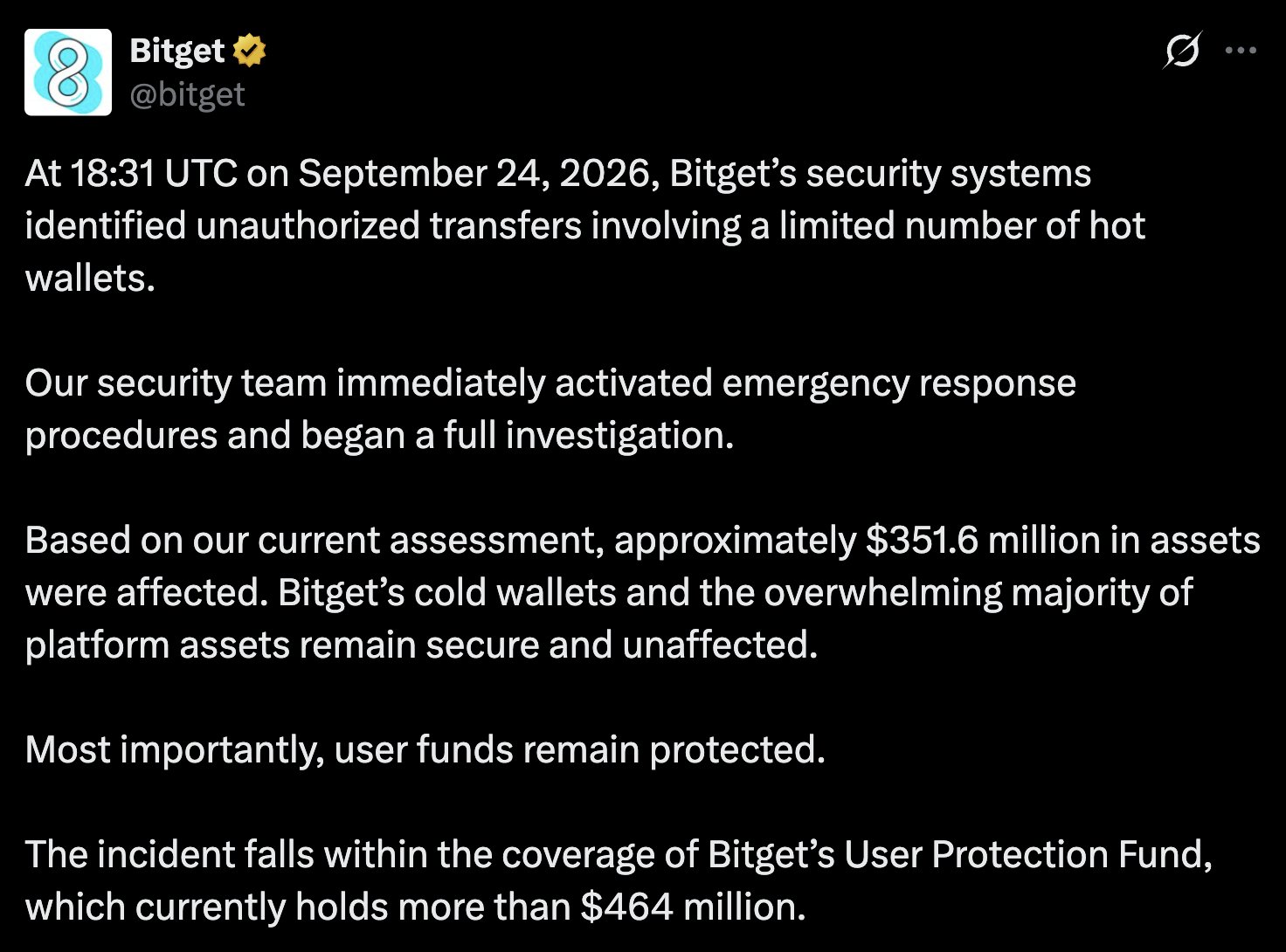
CZ pledges support, says Binance alongside BNB Chain and community will help Bitget after tough day
Binance in Global Crypto Markets
Market dominance, liquidity, and competition
Binance remains a dominant venue across spot and derivatives markets. The standing article records that global perpetual-futures volume fell substantially from its October 2025 peak while Binance retained an estimated share of roughly 40 percent, ahead of OKX and Bybit. Those figures describe a market in which overall activity contracted without dislodging Binance from its leading position.
The comparison matters more than the standalone percentage. Retaining share during a broad contraction suggests that traders continued to value Binance’s liquidity, product breadth, or execution environment even as total speculative activity declined. It also means that concentration did not disappear merely because the market became quieter.
Deep liquidity can stabilize ordinary trading by reducing slippage and allowing market makers to offset risk. In a crisis, the same concentration can focus liquidations and technical dependencies in one place. Binance is therefore both a shock absorber and a possible transmission channel, depending on market conditions.
Competition comes from centralized exchanges and increasingly usable decentralized venues. Centralized platforms can offer integrated custody, fiat access, customer support, and high-throughput order books. Decentralized protocols can offer transparent settlement and user-controlled custody. Binance’s Web3 strategy is partly a response to that competition: if trading moves on-chain, Binance can remain the gateway and interface even when it is no longer the matching venue.
This shifts the strategic question from whether Binance remains the largest centralized exchange to whether it can remain the dominant distribution layer across both centralized and decentralized markets. Liquidity, regulatory access, wallet design, and tokenization all feed into that contest.
Sovereign and institutional flows
The standing article’s Bhutan example shows how Binance can serve actors far larger than ordinary retail traders. Arkham-attributed addresses transferred substantial bitcoin quantities to Binance deposit addresses, including a transaction of 929 BTC valued at approximately $66.1 million at the time described. Further analysis suggested a broader pattern of transfers and sales.
On-chain attribution can establish that specified addresses moved assets to known exchange infrastructure. It cannot, without additional evidence, reveal every internal execution decision, beneficial arrangement, or policy motive. Deposit activity is strong evidence of exchange interaction, but a transfer to Binance does not necessarily mean the entire amount was sold immediately.
For markets, sustained deposits by a large holder may create potential supply. Whether that supply moves prices depends on execution, timing, liquidity, hedging, and demand elsewhere. Large exchange inflows are therefore indicators to investigate rather than mechanical predictions.
For policymakers, sovereign participation raises governance questions about who authorizes trades, how public holdings are valued, and what disclosures citizens receive. Binance’s role is infrastructural: it can supply liquidity and settlement access, but it does not determine whether a state’s crypto strategy is prudent or democratically accountable.
Stablecoins and emerging markets
In emerging markets, Binance can resemble a dollar-access platform as much as a speculative exchange. Stablecoins allow users to preserve value in a dollar-linked unit, pay across borders, receive remittances, and enter global digital-asset markets without maintaining a United States bank account.
That function explains why stablecoin balances should not be interpreted solely as trading collateral. For some users, they are working capital or savings. Binance Earn then adds a yield layer, while spot and peer-to-peer markets add conversion. The platform bundles functions that conventional finance may distribute among a bank, remittance provider, broker, and foreign-exchange dealer.
The bundle can be empowering where local alternatives are expensive or unstable. It can also create concentrated dependency on a foreign platform and privately issued tokens. A regulatory restriction, withdrawal interruption, stablecoin depegging, or account freeze can affect money being used for everyday purposes rather than discretionary speculation.
This is why stablecoins are a macroeconomic issue as well as a crypto product. When dollar-linked tokens become easier to hold than local currency, individual hedging decisions can interact with capital flows and monetary policy. Binance sits inside that transmission mechanism because it supplies liquidity, conversion, custody, and market-making infrastructure.
Europe, MiCA, and the digital euro
MiCA seeks to harmonize rules for crypto-asset service providers across the European Union, including authorization, governance, consumer protection, and stablecoin requirements. For Binance, approval would offer a clearer route to serving a large market, while imposing more conventional expectations around organizational accountability and compliance.
The standing article described reports of high-level opposition to Binance’s European authorization and uncertainty about which jurisdiction might provide a path. Those reports should be understood as evidence of political and regulatory resistance, not as a final licensing decision unless the responsible authority acts.
A license would not merely restore a website or application. It would identify the regulated entity, define permitted services, and place Binance within a supervisory framework. Conversely, continued technical access without bloc-wide authorization would leave users navigating a more fragmented legal position.
The digital euro adds a competitive dimension. A central-bank-backed digital payment instrument could coexist with private stablecoins, but would offer a different risk structure and governance model. Binance’s European role will therefore depend not only on crypto licensing, but also on how public and private digital money systems interact.
Southeast Asia and sandbox approaches
The Philippines provides a useful model for understanding regulatory sandboxes. After warning that Binance lacked authorization, regulators could evaluate a limited partnership or locally supervised service without immediately granting unrestricted market access. The sandbox creates an environment in which products, controls, and customer outcomes can be observed under conditions set by the regulator.
For Binance, this offers a path back into a market through demonstrable compliance. For regulators, it supplies operational evidence that abstract rulemaking may not capture. The cost is uncertainty: participation does not guarantee a permanent license, and users may receive only a restricted product set during the test.
Sandbox arrangements are therefore neither bans nor approvals. They are controlled experiments in institutional trust. Their value depends on transparent conditions, enforceable customer protections, and clear criteria for success or termination.
United Kingdom: an application is not a return
The United Kingdom has sat outside Binance’s regulatory map for years. In June 2021 the FCA ordered Binance Markets Limited, the exchange’s UK-authorised entity, to stop regulated activity and required it to warn customers that “Binance Markets Limited is not permitted to undertake any regulated activity in the UK”. The regulator also said no other Binance Group entity held UK authorization, registration, or a licence at that time.
The standing article later described reports that Binance might apply through a future cryptoasset gateway, while Binance declined to confirm a potential application. The crucial distinction is between seeking authorization and receiving it. An application begins review; it does not establish approval, permission to relaunch, or acceptance of every proposed product.
That distinction gives readers a simple test. Look for an entry in the responsible regulator’s public register, identify the legal entity and permissions, and compare those permissions with the product being offered. Reports of an intended filing or relaunch are not substitutes for authorization.
If Binance ultimately secures permission, the result would represent a regulated re-entry after its earlier exclusion. If it does not, the attempt would establish only that the company sought access. The variable that settles the question is a formal regulatory decision, not the ambition described in advance.
SEC files 13 charges against Binance entities and CZ
CFTC enforcement action against Binance for AML and KYC violations
Binance pleads guilty to AML charges; $4.3B DOJ settlement, CZ resigns
Richard Teng appointed CEO following CZ's departure
Binance terminates BUSD support alongside Paxos wind-down
Nigeria detains Binance executives Gambaryan and Anjarwalla; Anjarwalla escapes
CZ sentenced to four months in US federal prison
Binance global user base surpasses 170 million under Richard Teng
How Users Engage With Binance
Onboarding, verification, and funding
A user generally begins by creating an account and completing identity verification. The information and documents required depend on jurisdiction and account type. Additional checks may apply to higher limits, institutional accounts, fiat services, or products carrying greater regulatory sensitivity.
Funding can occur through bank transfers, cards, payment partners, peer-to-peer transactions, or cryptocurrency deposits. Each route has a different cost, settlement time, and risk profile. A card purchase may be convenient but expensive; a bank transfer may be cheaper but unavailable; a crypto deposit may be fast but irreversible if the wrong address or network is used.
Network selection deserves special attention. Tokens with the same ticker can exist on multiple chains, and deposit addresses may be valid only for a selected route. Users should confirm the asset, chain, address, and any required memo or tag before sending. A small test transfer is often worth the extra fee when the intended amount is large.
Verification also affects privacy and account access. Binance collects identity information to meet regulatory obligations and manage fraud. Users gain access to a broader product set, but entrust sensitive personal data to a global platform. Account security therefore includes protecting both assets and identity records.
Trading behavior and incentives
After funding an account, users encounter spot, margin, futures, Earn, launch, and promotional products in the same interface. This integration makes it easy to move from a stablecoin balance into a leveraged position or a time-limited campaign. Ease of movement is a product advantage and a behavioral risk.
Competitions and reward programs may influence which assets users trade and how frequently they trade them. A leaderboard can turn turnover into a goal even when additional transactions do not improve the trader’s underlying strategy. Token vouchers and points can feel like gains while obscuring the spread, fees, and market risk incurred to earn them.
Users can counter that pressure by defining the purpose of a position before entering it: investment, hedge, transfer, yield, or speculation. They can then judge whether leverage, lockups, or campaign requirements serve that purpose. If the only reason for a trade is eligibility for a promotion, the expected reward should exceed the full incremental cost and risk.
Bridging CeFi and DeFi
Users treating Binance as a Web3 gateway may buy ETH, BNB, or a stablecoin centrally and then move it to the integrated wallet. From there, they can connect to decentralized exchanges, liquidity pools, lending markets, and other protocols.
This workflow compresses several difficult steps into one application. Binance supplies identity verification, fiat conversion, asset purchase, wallet creation, and protocol discovery. That can make DeFi accessible to users who would otherwise struggle with separate exchanges, wallets, and bridges.
The unified interface can also hide boundaries. A transaction approved in the Web3 Wallet may interact with third-party code that Binance does not control. A displayed token may have low liquidity or malicious transfer logic. A bridge may introduce another smart-contract and validator layer. Users should identify which party controls each step rather than assuming Binance guarantees everything visible inside the app.
The distinction between custody modes is especially important during incidents. Binance may be able to freeze a centralized account, reverse an internal credit, or pause a withdrawal. It generally cannot reverse a valid blockchain transaction from a non-custodial wallet. Greater control means fewer recovery options.
Security practices and user protections
Security depends on both platform controls and user behavior. Binance employs hot- and cold-wallet arrangements and other operational safeguards, while users can reduce account risk through strong unique passwords, multifactor authentication, withdrawal controls, and careful verification of communications.
Phishing remains effective because attackers imitate urgent security alerts. A message may claim that an account is compromised and direct the user to a fake login page or support number. The safest response is to avoid the embedded link, open Binance through a known application or manually verified address, and inspect the account directly.
Users should also treat unexpected requests for seed phrases, passwords, or authentication codes as hostile. Recovery credentials for a non-custodial wallet should not be entered into a site reached through an unsolicited message. Centralized-account support and wallet recovery are different processes, and legitimate support does not need the secret that controls a self-custodied wallet.
Proof of Reserves adds a separate verification layer. Users can inspect whether their balances were included in a published snapshot, but should understand the scope of the evidence. Account-level inclusion answers one question about liabilities; it does not answer every question about corporate solvency, security, or future withdrawal access.
How to Evaluate Binance
A durable assessment of Binance should begin with classification. It is not simply an exchange. It is a custodial balance sheet, a high-leverage derivatives venue, a token-distribution channel, a stablecoin gateway, a Web3 interface, and an increasingly important bridge between crypto and traditional assets.
Each function has a different test. Exchange quality depends on liquidity, execution, uptime, surveillance, and withdrawal reliability. Custody depends on asset control, liabilities, operational security, and legal structure. Derivatives depend on margin design, liquidation systems, and contract integrity. Wallet access depends on key management and protocol risk. Tokenized assets depend on enforceable links to underlying securities.
Users should also separate company-level evidence from product-level evidence. A regulatory settlement may require organization-wide reforms but does not establish that every product carries the same risk. A successful Proof of Reserves snapshot may support confidence in specified asset backing but does not validate a high-leverage futures strategy. A licensed local entity may protect users of certain services without authorizing the entire global product catalogue.
Concentration should be evaluated in both directions. Binance’s scale supplies liquidity, distribution, and resources for security and compliance. The same scale makes outages, enforcement actions, and policy changes more consequential. A user can benefit from the liquidity while limiting exposure by controlling leverage, withdrawing long-term holdings, diversifying fiat routes, and understanding which legal entity provides each service.
Conclusion
Binance evolved from a crypto-to-crypto exchange into a multi-layered financial and technological platform. Its products now include spot and derivatives trading, Launchpad and Launchpool, early-access environments such as Binance Alpha, Earn products, a Web3 wallet, BNB Chain connectivity, stablecoin rails, and tokenized traditional-market exposure.
That breadth makes Binance useful and difficult to assess. It can reduce friction across trading, saving, token discovery, and on-chain participation. It also joins risks that users might otherwise distribute among several institutions. Custody, leverage, stablecoin exposure, promotional incentives, and wallet access can all sit behind one login.
Regulation has become part of the product rather than an external constraint. CFTC action, SEC litigation and dismissal, regional warnings, prospective licensing paths, and local partnerships all affect which users can access which services and under what protections. The Binance name is global, but authorization remains jurisdictional.
Proof of Reserves offers a meaningful but bounded transparency mechanism. It lets users verify inclusion in a liability snapshot and compare specified liabilities with controlled on-chain assets. It does not disclose every obligation or replace a complete audit of the corporate group. Its value lies in the questions it can answer precisely, not in treating it as proof of everything.
Binance’s role in stablecoins and emerging markets may be as consequential as its role in speculation. For users lacking reliable dollar banking, the platform can combine savings, payments, conversion, and market access. That utility is real, as are the dependencies on private issuers, exchange custody, regulatory access, and digital security.
The exchange’s future turns on several observable variables: whether it converts regulatory engagement into durable licenses, whether governance reforms survive beyond settlement deadlines, whether Proof of Reserves expands without overstating its scope, whether tokenized assets obtain robust legal structures, and whether users continue to prefer an integrated platform over increasingly capable decentralized alternatives.
If Binance can preserve liquidity and product breadth while making its legal entities, controls, and balance-sheet assurances easier to verify, it can move closer to becoming regulated global financial infrastructure with crypto roots. If those controls remain fragmented or opaque, the same integration that made Binance powerful will remain its central source of systemic and user risk.
Latest Binance news
Anoma launches private tokenized stocks on Anomapay for BNB Chain bStocksBinance takes $100 million stake in Circle as part of five-year USDC partnershipCZ pledges support, says Binance alongside BNB Chain and community will help Bitget after tough day Binance Wallet now lets users pay gas fees with USDT on BNB Chain, Ethereum, Solana and TRON
 Binance to list Hyperliquid's HYPE token with Seed Tag applied
 Binance expands 24/7 trading with 77 tokenized stocks and 196 TradFi perpetual contracts
Sources
23 records from 12 domains
binance.com
- binance.com· en / how-to-buy / 2026-memes
- binance.com· en / launchpool
- binance.com· en / proof-of-reserves
- binance.com· en / square / post / 310673971107937
- binance.com· en-TR / square / post / 336444392434146
- binance.com· en / support / announcement / 79bfc2e1c5f943e79d485c8ea87b2794
- binance.com· en / support / announcement / detail / d4bfeee372e84c9e9fa70558c547a510
- binance.com· en / support / announcement / detail / a6f02526afd1466ab72fe29af4c84c67
- binance.com· en / support / announcement / detail / d7a82549cf41442c8654e720eee656ad
- binance.com· eoptions-data / XRPUSDT / oi-volume
en.wikipedia.org
cftc.gov
sec.gov
facebook.com
cryptonews.net
info.arkm.com
x.com
fr.tradingview.com
fca.org.uk
cointelegraph.com
crypto.news
Community notes
Spot something off or out of date? Drop a note. Editors review topic notes daily and roll accepted fixes into the explainer — contributors are recognized in the monthly $SQUID drop.
Loading notes…
Help improve this topic
Have a story or tip about this topic? Submit it. See something missing? Leave a note. Editors review daily; accepted submissions and fixes count toward the monthly $SQUID drop.