
Bitget is a top-ten crypto exchange known for copy-trading, a 90M-user self-custodial wallet, and an aggressive push into tokenized stocks, pre-IPO assets, and AI-driven trading tools.
+12 sources across the wider coverage universe
 MEXC names ex-Bitget exec Vugar Usi CEO to add compliance without losing its memecoin listing edge2026-04
 Bybit and Bitget churn reserves 3-5x faster than Coinbase and Binance as top CEX holdings hit $225B2026-04
 Bitget opens tokenized pre-IPO trading with SpaceX as first asset on new IPO Prime platform2026-04
 Binance and Bitget investigate RAVE token spike as ZachXBT claims insiders orchestrated massive short squeeze, wiping out $44M in leveraged positions2026-04
 Bitget teases major April 10 launch with “New Opportunity Awaits” campaign, hinting at upcoming product or ecosystem expansion2026-04
 Bitget partners Republic to launch IPO Prime, bringing pre-IPO tokens like SpaceX to retail users on Solana and expanding access to private market investments2026-04
Founded in 2018 and headquartered in Seychelles, Bitget is a centralized cryptocurrency exchange and wallet provider that has grown into one of the top-ten spot and derivatives venues by volume, serving more than 100 million registered users across 100-plus countries.
What Bitget Is and How It Operates
Bitget began as a derivatives-focused platform and built its early reputation on copy-trading — a feature that lets retail users automatically mirror the positions of experienced traders. That product differentiation helped it carve out market share against older incumbents such as Binance and OKX during the 2020–2021 bull market.
Today the exchange operates two largely distinct products under the same brand:
- Bitget Exchange — a centralized order-book venue offering spot trading, perpetual and quarterly futures, options, and structured earn products. Its native token, BGB, is used for fee discounts and staking rewards.
- Bitget Wallet — a self-custodial, multi-chain wallet (formerly known as BitKeep) that the company acquired and rebranded. With roughly 90 million users as of mid-2025, it functions as a standalone Web3 gateway rather than a simple extension of the exchange.
Revenue comes primarily from trading fees, though the exchange also earns from listing fees, staking services, and increasingly from the tokenized-asset products described below.

CZ pledges support, says Binance alongside BNB Chain and community will help Bitget after tough day
Regulatory Standing and Company Structure
Bitget holds licenses or registrations in several jurisdictions, including Poland, Lithuania, Canada (as a Money Services Business), and Australia (AUSTRAC). Like most offshore exchanges, it does not hold a US broker-dealer or exchange license and is not available to customers in the United States.
The company is privately held. While no confirmed IPO timeline has been announced, Bitget launched a "Pre-IPO Zone" on its exchange in 2025 that lets users trade tokenized allocations in private companies expected to go public — a product that blurs the line between its own potential future listing and the broader pre-IPO token market it is building.
Readers click Bitget stories most when the exchange is simultaneously the crime scene and the sheriff — the VOXEL manipulation saga drew 580+ combined clicks precisely because readers wanted to know whether a CEX can credibly investigate, freeze, and roll back its own market.
The Pre-IPO and Tokenized-Asset Push
One of the most consequential strategic bets Bitget has made in the current cycle is the tokenization of real-world assets (RWA), with a specific focus on pre-IPO equity and listed stocks.
In 2025, Bitget partnered with Republic — the retail investment platform — to launch IPO Prime, which brings pre-IPO token exposure, including allocations in companies like SpaceX, to retail users via the Solana blockchain. The thesis is that tokenization can democratize access to private markets that were historically restricted to accredited investors and venture funds.
That ambition ran into an early test when Bitget, along with Binance and Bybit, listed tokenized SpaceX IPO allocations in mid-2025. The campaigns were cancelled and users were refunded after a shortage of underlying shares made it impossible to maintain the products at the advertised terms. The episode illustrated a structural tension in pre-IPO tokens: the underlying private-market supply is finite and controlled by insiders, while demand from retail crypto users can be far larger, creating price fragmentation. At the time, SpaceX perpetual prices varied significantly across platforms — OKX's perpetual traded near $2,000 while Bitget's preSPAX quoted at different levels — precisely because each platform used different market makers and different underlying instruments with no cross-platform interoperability.
Beyond pre-IPO products, Bitget launched its own RWA platform called Reality in 2025, designed to bring tokenized financial instruments on-chain. Simultaneously, Bitget Wallet integrated xStocks — a tokenized equities product backed in part by Kraken — giving its 90 million self-custodial users access to more than 130 tokenized stocks and ETFs including major US-listed names. The Wallet also partnered with Enso, a DeFi routing aggregator, to enable best-execution swaps into and out of these tokenized positions.
These moves position Bitget as a vertically integrated RWA venue: the exchange handles centralized order flow and listings while the Wallet captures the self-custody segment.
Bitget details plan to use it's 5,500 BTC Protection Fund to cover assessed losses from the latest hot wallet incident

Listings Strategy and the AI Zone
Bitget's listing cadence is high by industry standards. The exchange regularly adds new tokens across thematic zones it maintains — an AI Zone, a Pre-IPO Zone, and a Meme Zone among them. Recent additions include AIVIVE (AVV) in the AI Zone and Nexus (NEX), as well as KAIO, described as institutional RWA infrastructure. The Pre-IPO Zone has listed tokens like preOPAI.
The thematic zone structure serves a dual purpose: it groups similar assets for discovery and signals to project teams that Bitget has a dedicated retail audience for their category. Critics argue that high listing velocity carries risks — new and illiquid tokens are more susceptible to manipulation, which the exchange has had to confront directly.
Market Integrity: The RAVE Investigation
In mid-2025, the RAVE token — associated with RaveDAO — surged approximately 4,500% before collapsing. On-chain analyst ZachXBT alleged that insiders orchestrated a short squeeze, with RaveDAO-linked wallets depositing roughly 23 million RAVE tokens (worth approximately $24 million) into Bitget. The spike triggered around $43–44 million in leveraged liquidations across the market.
Bitget and Binance both opened formal investigations into the trading activity. RaveDAO denied involvement in any manipulation. The episode put both platforms' market surveillance capabilities in the spotlight and raised questions about how quickly centralized exchanges can intervene when on-chain behavior suggests coordinated pumping ahead of on-exchange liquidations.
The RAVE incident is a case study in a recurring challenge for high-listing-velocity exchanges: the faster a platform lists assets, the larger its surface area for manipulation events. Bitget's response — opening an investigation alongside Binance rather than acting unilaterally — reflects the cooperative norm that has emerged among major CEXs when high-profile manipulation is suspected.

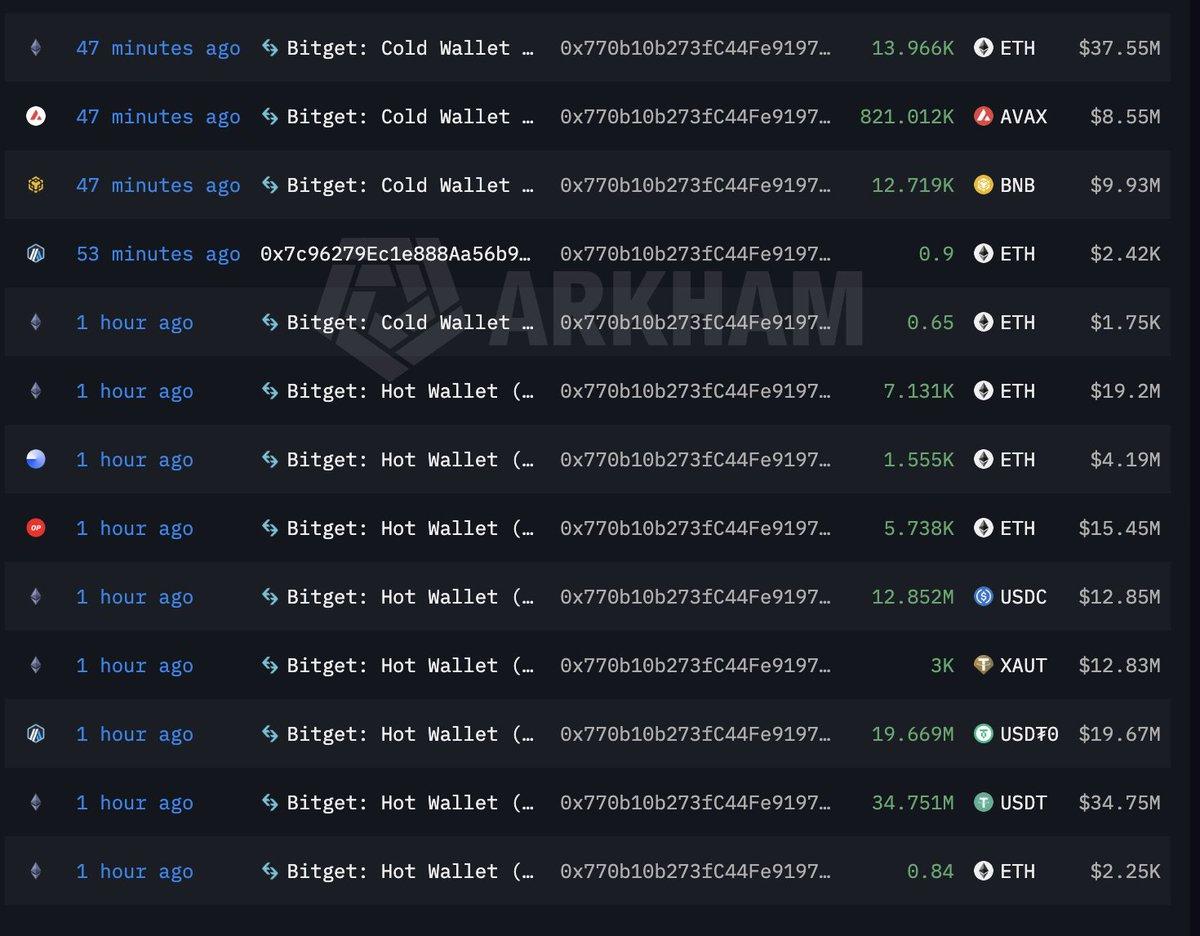
Bitget hot and cold wallets may have been hacked, with $174M moved across multiple chains in an hour
AI Integration Across Operations and Products
Bitget has made artificial intelligence a stated organizational priority. The company purchased enterprise access to Anthropic's Claude for all 2,167 of its employees at a reported cost of $200 per person per month — signaling that AI tooling is being treated as standard infrastructure rather than an experiment.
On the product side, Bitget expanded its AI trading co-pilot from a single feature into a broader ecosystem. AI agents are being embedded across crypto spot trading, derivatives, and its tokenized-markets products. The company has run hackathons and published tutorials to attract third-party developers building on top of these agent interfaces. Bitget Wallet also integrated AI-powered insights into its partnership with Polymarket, the prediction market platform, giving Polymarket access to Bitget Wallet's 90 million users alongside analytical tooling.
This combination — AI tooling internally for staff efficiency and externally as a product differentiator — tracks a pattern seen across major exchanges in 2024–2025, though Bitget's enterprise-wide Claude deployment is notable for its scale relative to its headcount.
- 01VOXEL manipulation and rollbacks
A rogue algorithm generating $12.7B in artificial volume, followed by account freezes and threatened rollbacks, raised the highest-stakes question in CEX trust: can an exchange unilaterally rewind trades.
- 02CEX integrity and ethics debate
Bitget CEO Gracy's public attack on Hyperliquid over the JELLY incident inverted readers' scrutiny back onto Bitget, making the story about which exchange deserves less trust rather than which one deserves more.
- 03RAVE insider pump investigation
ZachXBT's allegations of 90%-supply concentration moving through Bitget, Binance, and Gate turned a token dump into an exchange-accountability story with a bounty attached.
- 04Pre-IPO tokenized asset access
IPO Prime launching SpaceX as its first asset signaled a structural product bet that retail readers could participate in private-market investments through a crypto exchange for the first time.
- 05Exchange volume competition rankings
Readers tracking where Bitget sits in the derivatives and spot-volume pecking order behind Binance reveals interest in whether it can sustain second-tier status against Bybit and others.
- 06Wallet DeFi and RWA expansion
A string of integrations — Hyperliquid perps, EIP-7702 gas abstraction, tokenized stocks, Aave yields, Polymarket — positioned Bitget Wallet as a superapp play, drawing consistent mid-tier clicks from readers tracking self-custody convergence.
Bitget Wallet as a Standalone Web3 Product
It is worth treating Bitget Wallet separately from the exchange because the two products compete in different markets. The Wallet is self-custodial, meaning Bitget cannot access or freeze user funds; it generates revenue through swap fees and aggregator partnerships rather than order-book trading fees.
With 90 million users, the Wallet has grown large enough to function as a distribution channel rather than just a wallet. When Polymarket wanted to expand its user base, it integrated with Bitget Wallet. When xStocks wanted self-custodial distribution for tokenized equities, Bitget Wallet was a natural partner. The Wallet also supports USDC and other major stablecoins across multiple chains, and its routing layer (enhanced by the Enso integration) is designed to find best execution when users swap between assets including tokenized stocks, ETFs, and RWAs.
This makes the Wallet increasingly comparable to MetaMask or Trust Wallet in scope, with the added strategic benefit that Bitget can cross-sell between the custodial exchange and the self-custody product.
Competitive Position
Bitget competes directly with Binance, Bybit, OKX, and to a lesser extent with Coinbase in specific verticals. Its copy-trading feature remains a differentiator in retail derivatives. In the emerging tokenized-equities race, it is moving in parallel with Bybit (which launched 20 US stock perpetuals in 2025) and Coinbase, all of which are trying to capture demand from crypto-native users who want equity exposure without leaving the blockchain ecosystem.
The SpaceX token episode illustrated that Bitget is willing to move quickly on new product categories — sometimes ahead of the supply-side infrastructure being ready. That aggressiveness has helped it gain market share but also creates execution risk, as the refund episode showed.
On the custody side, the self-custodial wallet market is less concentrated than the exchange market, and Bitget Wallet's 90 million users represent genuine scale, though active monthly users are a better metric than registered accounts for assessing real competitive weight.
- 2025-03exploit
VOXEL/USDT manipulation: $12.7B volume, account freezes, rollback threat
- 2025-03governance
CEO Gracy publicly accuses Hyperliquid of being 'FTX 2.0' after JELLY incident
- 2025-03regulatory
Bitget files legal action against alleged VOXEL futures manipulators
- 2025-04launch
IPO Prime launched with SpaceX as first tokenized pre-IPO asset, partnered with Republic
- 2025-05milestone
Bitget Wallet adds EIP-7702 support for stablecoin gas fees across 8 chains
- 2025-07milestone
Crypto exchange spot volume hits $1.7T monthly high since February; Bitget ranks second tier behind Binance
- 2025-07exploit
ZachXBT alleges RAVE insider pump through Bitget, Binance, Gate; RaveDAO wallets dump $24M
- 2025-08milestone
Bitget Wallet reaches 90M users with tokenized stocks, ETFs, and RWA integrations via Enso and xStocks
Outlook
Bitget's trajectory points toward becoming a multi-product financial platform rather than a pure crypto exchange. The convergence of tokenized stocks and ETFs, pre-IPO tokens, RWA infrastructure, prediction markets, and AI-driven trading tools suggests the company is building toward a position where the distinction between crypto assets and traditional financial instruments is minimized at the product layer — even if the regulatory distinction remains sharp.
The key variables to watch are: whether the Pre-IPO Zone and Reality RWA platform can maintain adequate liquidity and legitimate underlying assets; how its market surveillance capabilities evolve following incidents like RAVE; and whether the self-custodial Wallet can sustain engagement as Web3 user growth normalizes. A potential public market listing — whether via IPO or token-based mechanism — would introduce a new layer of accountability and capital access that could accelerate or constrain these ambitions.
Latest Bitget news
CZ pledges support, says Binance alongside BNB Chain and community will help Bitget after tough dayBitget details plan to use it's 5,500 BTC Protection Fund to cover assessed losses from the latest hot wallet incidentBitget hot and cold wallets may have been hacked, with $174M moved across multiple chains in an hour Bybit offers support to Bitget after security incident, updates Lazarus Bounty to trace stolen funds
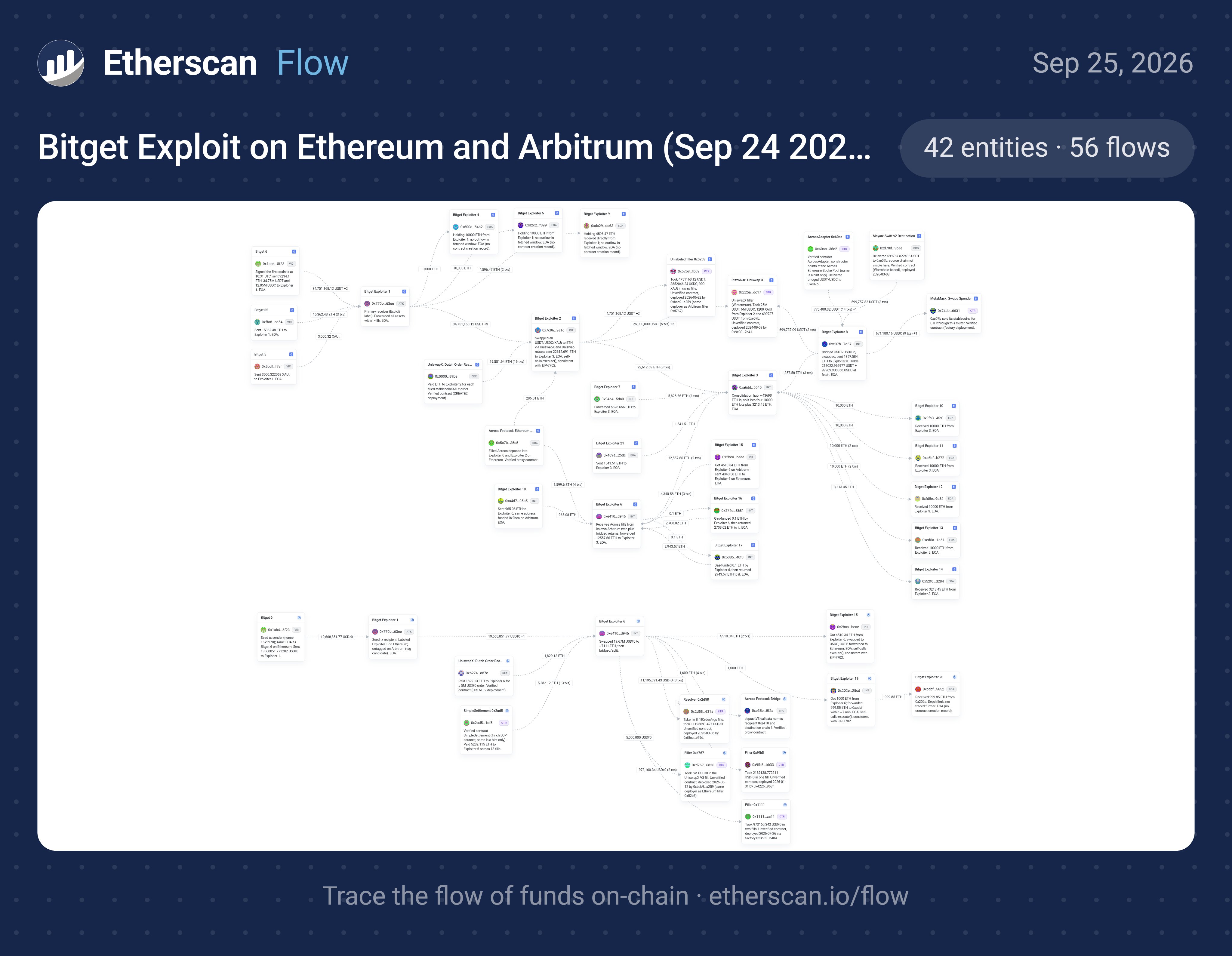 Etherscan maps transaction flows linked to the Bitget incident across Ethereum and Arbitrum, incorporating onchain references from multiple blockchain analysts
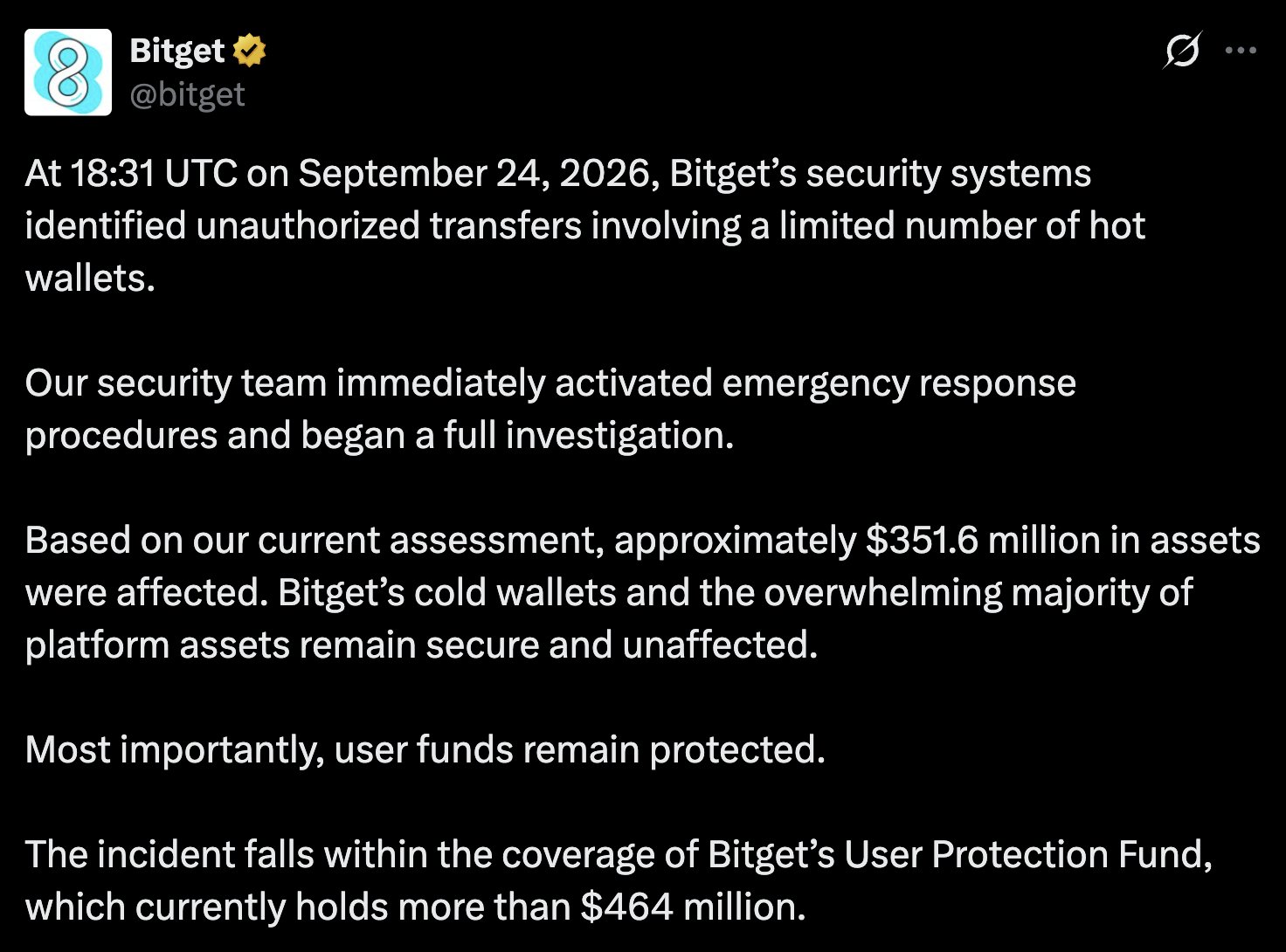
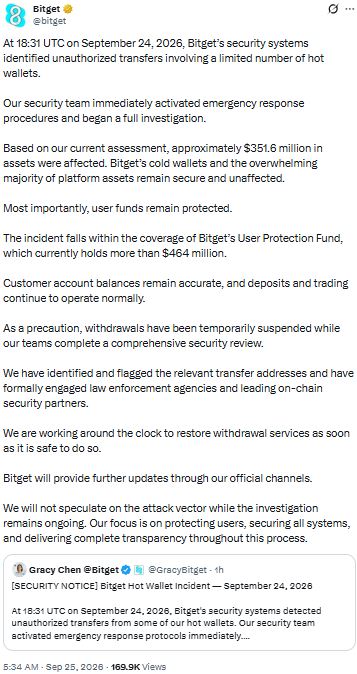 Bitget reports $351.6M in unauthorized hot wallet transfers, suspends withdrawals
Community notes
Spot something off or out of date? Drop a note. Editors review topic notes daily and roll accepted fixes into the explainer — contributors are recognized in the monthly $SQUID drop.
Loading notes…
Help improve this topic
Have a story or tip about this topic? Submit it. See something missing? Leave a note. Editors review daily; accepted submissions and fixes count toward the monthly $SQUID drop.