
In-depth explainer on centralized crypto exchanges (CEXs), covering how they work, market structure, products, stablecoin yields, risks, regulation, and how they compare with DEXs as crypto trading shifts toward hybrid on/off-chain models.
+36 sources across the wider coverage universe
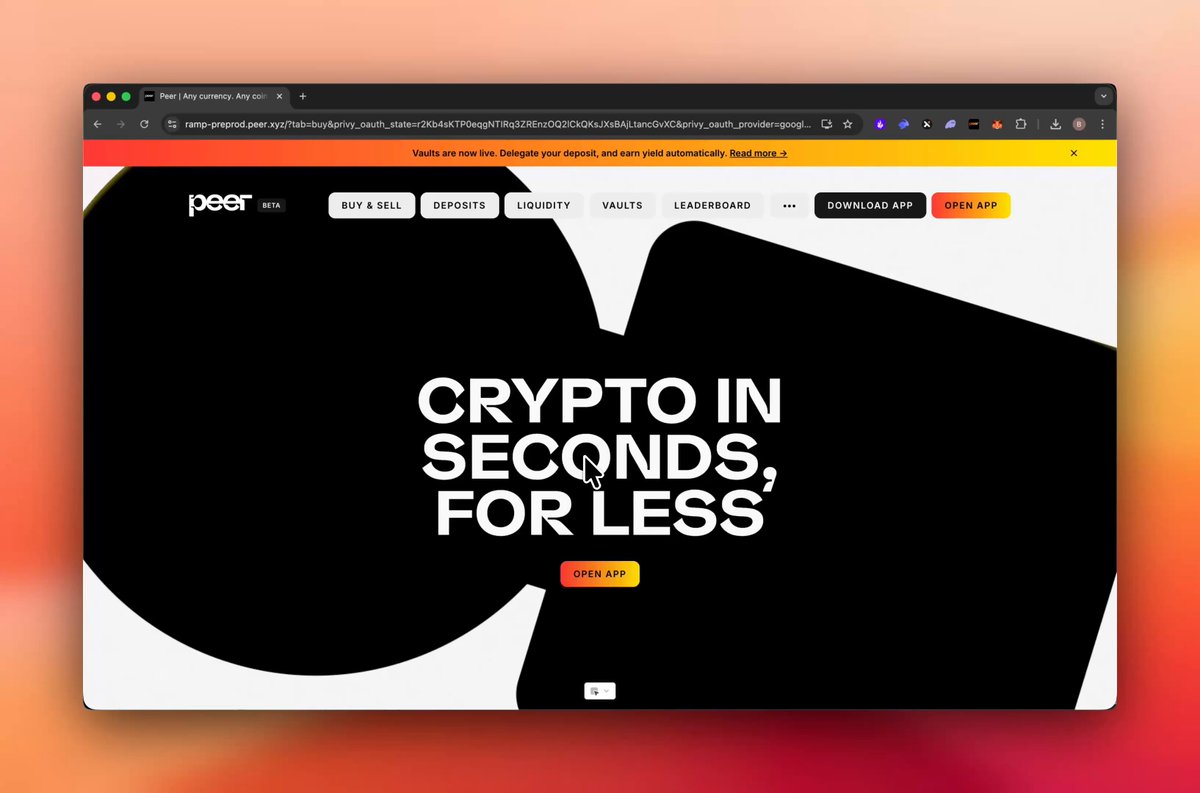 Peer launches direct fiat-to-Zcash onramp without KYC or intermediaries2026-04
 Bybit and Bitget churn reserves 3-5x faster than Coinbase and Binance as top CEX holdings hit $225B2026-04
 Ondo unveiled the Ondo Network, a new execution layer delivering CEX-like trading speeds with self-custody, private execution and onchain settlement as an evolution of Ondo Chain2026-07
 BULK unveils a SPAN-inspired portfolio margin engine that cuts collateral needs by up to 69%, bringing CEX-grade risk management fully onchain for DeFi traders2026-07
 Microsoft-backed Space and Time launches virtual vaults for institutional lending, enabling real-time, cryptographically verified collateral tracking across CEX and DeFi2026-05
 Crypto winter deepens in 2026 Q1 as total market cap drops 20% to 2.4T, BTC falls 22%, CEX volume sinks 39%, while stablecoins stay flat at 310B and oil surges 77% on war tensions.2026-04
Centralized Crypto Exchanges (CEX): Architecture, Risks, and Role in Digital Asset Markets
A centralized exchange, or CEX, is a crypto trading venue operated by a company that custodies customer assets, maintains internal ledgers, and uses an off-chain matching engine to connect buyers and sellers, rather than executing trades directly on a blockchain. In practice, CEXs sit at the center of today’s digital asset markets, handling the bulk of spot and derivatives volume, concentrating liquidity in a handful of large venues such as Binance, Coinbase, Bybit, and newer derivatives specialists like Hyperliquid, even as they face cyclical downturns, regulatory scrutiny, competition from decentralized exchanges (DEXs), and structural questions about custody, token listings, stablecoin yields, and systemic risk.
Defining Centralized Exchanges: Core Concepts and Context
Centralized exchanges emerged as the crypto-native analogue to stockbrokers and FX venues, providing a familiar order book, account-based environment for trading digital assets such as bitcoin and ether. Unlike decentralized exchanges, which rely on smart contracts to match trades directly between self-custodied wallets, CEXs are run by a company that sits in the middle of every transaction, maintaining a centralized database of user balances and orders. Users deposit fiat or crypto into an exchange-controlled wallet, the exchange credits their internal account, and trades occur within that internal ledger, with only withdrawals and deposits touching public blockchains. This architecture sacrifices some of the censorship resistance and self-custody ethos of on-chain trading in exchange for higher throughput, more traditional user interfaces, and integration with banking rails.
The degree of centralization in a CEX is both a technical and governance reality. Technically, CEXs control the private keys to pooled customer funds and operate closed-source or partially closed-source matching engines that are not directly auditable via public blockchains. From a governance perspective, they are typically organized as private or publicly listed corporations with identifiable management, shareholders, and regulatory obligations. Britannica’s summary captures this succinctly, describing a centralized exchange as being controlled by a singular entity such as a private company or publicly traded corporation, which sets the rules, lists assets, and operates the infrastructure. This central control enables rapid product iteration, responsive customer support, and compliance with local regulations, but also concentrates failure modes in a single platform.
The contrast with decentralized exchanges highlights why the CEX model continues to dominate volumes despite periodic crises of confidence. DEXs rely on smart contracts and automated market-making algorithms to pool liquidity on-chain, allowing users to trade directly from self-custodied wallets without relinquishing control of their private keys. This design makes DEXs more transparent and composable with other DeFi protocols, but can suffer from network congestion, gas costs, and latency, especially on proof-of-work chains where high gas prices have historically hampered DEX efficiency. CEXs, by comparison, operate high-speed matching engines off-chain, allowing trades to be executed in microseconds without waiting for block confirmations, which translates into tighter spreads and deeper order books in most market conditions.
Over time, CEXs have expanded beyond simple spot trading into derivatives, staking, lending, tokenized assets, and even synthetic dollars, creating vertically integrated platforms that resemble a blend of brokerage, prime broker, and clearinghouse in traditional finance. Binance’s educational materials emphasize that a CEX not only acts as a trading intermediary but also manages custody, order books, and increasingly a suite of ancillary services ranging from earn products to launchpads. As this product set has widened, so has the regulatory perimeter around exchanges and the systemic significance of their risk management, especially when they issue or distribute stablecoins that can function as near-money substitutes.

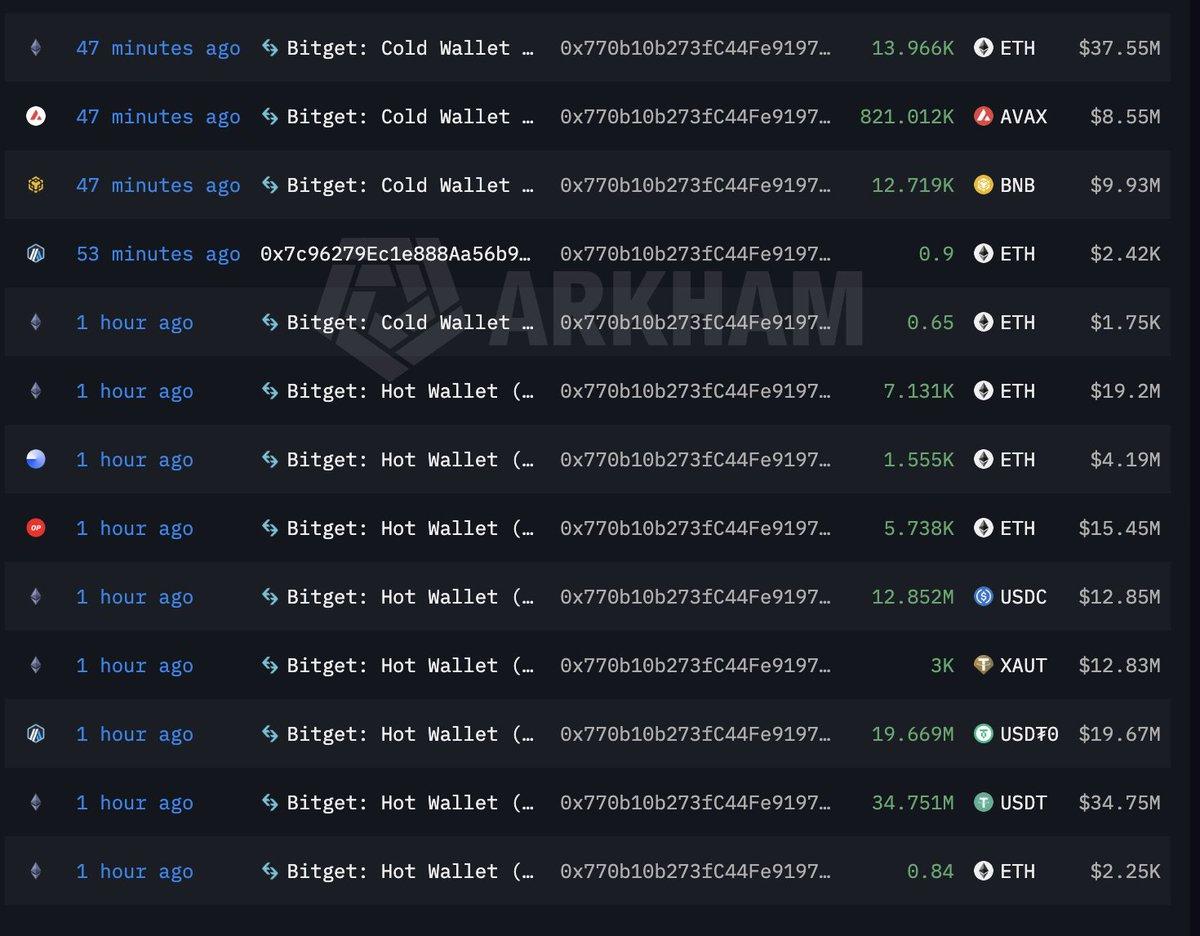
Bitget hot and cold wallets may have been hacked, with $174M moved across multiple chains in an hour
Market Structure: Size, Concentration, and Cycles
To understand the role of CEXs, it is useful to start with their share of global crypto trading activity. Even as decentralized exchanges grow, centralized venues still handle the majority of spot and derivatives flows in most periods, particularly for large-cap assets and leveraged products. CoinGecko’s industry reports show that in the first quarter of 2025, the top ten spot centralized exchanges recorded roughly \(5.4\) trillion dollars in trading volume, even after a double-digit percentage decline from the prior quarter. By the first quarter of 2026, amid a deepening “crypto winter,” spot volumes on the top ten CEXs had fallen to about \(2.7\) trillion dollars, a roughly \(39\%\) drop from the previous quarter’s \(4.5\) trillion, underscoring both the cyclicality of crypto markets and the extent to which CEX revenues are tied to volatility and risk appetite.
This downturn in volume coincided with a broader market drawdown. Over that same early-2026 window, CoinGecko data summarized by industry coverage indicates that bitcoin’s price fell around \(22\%\) while the aggregate crypto market capitalization declined by roughly \(20\%\) to approximately \(2.4\) trillion dollars, leaving the market significantly below its 2021 peak. Yet despite the retracement in prices and volumes, the stock of stablecoins in circulation remained relatively flat at around \(310\) billion dollars, suggesting that much of the “dry powder” remained parked in dollar-linked instruments, often on centralized venues. This divergence between trading activity and stablecoin supply is one of the structural reasons why CEXs’ management of stablecoin reserves and remuneration models has drawn increasing attention from central banks and regulators.
CEX market share is highly concentrated, with a small cluster of platforms accounting for the majority of activity. CoinMarketCap data show that the top five exchanges collectively control on the order of two-thirds of global spot volume, with one venue—Binance—alone representing roughly a third of trading in many snapshots. A 2024 update from CoinMarketCap’s social channels noted that Binance’s spot market share had declined from over \(50\%\) to around \(39.5\%\) year-on-year, even as Bybit climbed into the number two spot with roughly \(8.5\%\) of spot share, illustrating how shifts in derivatives leadership and regulatory pressures can reshape the leaderboard without fundamentally changing the oligopolistic nature of CEX markets. Coinbase, Kraken, and other long-standing regulated platforms continue to play outsized roles in specific jurisdictions and for institutional flows, particularly in regions with stringent licensing regimes.
Derivatives markets further magnify this concentration dynamic. A growing share of CEX revenue comes from perpetual futures and other leveraged products, where notional volumes can be several times larger than spot turnover. Hyperliquid has emerged as a notable upstart in this space: industry tracking indicates that in May of a recent year, Hyperliquid’s perpetuals volume reached a record \(6.63\%\) of total global CEX perpetual futures volume and approximately \(14.4\%\) relative to Binance’s perpetual volume, marking a new high for the platform. FalconX analysis highlights that Hyperliquid’s HIP-3 framework—an architecture for novel index-like futures markets such as the “XYZ100” contract, which has attracted tens of millions of dollars in daily volume and substantial open interest—has been a driver of its growth. This illustrates how innovation in product design can allow specialist venues to gain share even in a market dominated by giants.
At the same time, the relative weight of DEXs and alternative on-chain venues is clearly rising. CoinGecko’s 2025 Q1 report noted that Solana had become the dominant chain for DEX trading, capturing close to \(40\%\) of on-chain DEX volume in that quarter, thanks to its high-throughput architecture and the emergence of sophisticated “prop AMM” designs that offer CEX-like spreads and sub-second quotes. The combination of CEX-tight pricing on-chain, agentic trading tools that blur the line between exchange interfaces and smart wallets, and hybrid venues that combine CEX-style speed with on-chain settlement is gradually eroding the monopoly of centralized order books for certain types of flow. Nonetheless, as of today, the majority of new capital still enters the crypto ecosystem via centralized fiat on-ramps, and large institutions tend to favor CEXs for block liquidity, derivatives, and custody integrations with existing trading systems.
Readers click CEX stories not for trading mechanics but for the accountability gap — when a CEX fails, collapses, or claims decentralization it doesn't practice, readers want to know who gets punished, who gets exposed, and whether 'decentralized' is just marketing cover for the same old custodial risk.
Inside the Machine: How CEX Infrastructure Works
At a technical level, a CEX is essentially a set of databases, risk engines, and network connections wrapped in a regulatory perimeter. When a user opens an account, passes know-your-customer (KYC) checks, and deposits funds, the assets are moved to wallets controlled by the exchange and the user is credited with an internal balance. These internal balances are recorded in the exchange’s ledger system rather than directly on-chain, which means that most trades simply consist of debiting and crediting entries between users on this ledger, leaving the public blockchain untouched except when net deposits or withdrawals occur. This design allows exchanges to batch withdrawals, optimize on-chain fees, and provide real-time account updates without waiting for block confirmations.
Trade execution on a CEX is handled by an off-chain matching engine that maintains one or more central limit order books (CLOBs) for each trading pair. Exchanges like Mercuryo describe how their high-speed engines match compatible orders based on price-time priority in microseconds, reflecting the logic of traditional electronic markets. Market makers and takers place limit and market orders, which the engine continuously matches as prices change, updating users’ internal balances in real time. This architecture can handle tens of thousands of orders per second with low latency, enabling complex strategies such as high-frequency market making, arbitrage across venues, and dynamic hedging of derivatives positions. It also allows for familiar order types, including stop-loss, take-profit, and iceberg orders, which are more challenging to implement fully on-chain.
Custody practices vary across exchanges but typically involve a mix of “hot” wallets connected to the internet for operational needs and “cold” or “warm” storage arrangements that hold the bulk of customer funds offline or in multi-signature setups. Users have a single balance per asset, but under the hood, exchanges manage multiple addresses and signing arrangements to mitigate theft and operational risk. If, however, the venue becomes insolvent, the legal status of those pooled funds becomes critical. As Mercuryo’s educational materials note, if a centralized platform fails, customers generally become unsecured creditors in the bankruptcy process, as they did in the collapse of FTX in 2022, with no automatic segregation or insurance of their assets unless specific regulatory regimes apply. This custodial risk is the core trade-off that users accept in exchange for the convenience and liquidity of a CEX.
Risk management engines are another critical component of CEX infrastructure. For margin and derivatives trading, exchanges continuously compute the value of each user’s positions, collateral, and unrealized profit and loss, using real-time price feeds and stress scenarios. They set initial and maintenance margin requirements, automatically liquidating positions when collateral falls below thresholds to protect the exchange’s capital and other users from losses. These liquidation mechanisms often rely on internal insurance funds or backstop liquidity providers, and their design can strongly influence how orderly or chaotic market sell-offs become. Because all this happens inside the exchange’s own systems, transparency into exact algorithms and risk parameters is limited, although some regulated venues publish portions of their methodologies.
Finally, fiat rails and stablecoin integrations knit CEXs into the broader financial system. Many exchanges offer bank transfers, card payments, and local payment methods for depositing fiat currencies, which are then converted into stablecoins or crypto within the platform. Others have moved toward “crypto-only” models but still rely on stablecoin liquidity that is itself tightly linked to regulated custodians and cash-like securities. From a user’s perspective, fiat and stablecoins are often interchangeable on an exchange; from a systemic vantage point, however, the way those stablecoins are backed, remunerated, and rehypothecated inside CEX treasury functions has important implications for both investor protection and macro-financial stability.
Product Spectrum: From Spot Crypto to Tokenized Equities and Gold
The product mix of leading CEXs has expanded dramatically since the early days of bitcoin-only trading. At the core remain spot markets for major tokens such as BTC, ETH, and SOL, along with an expanding universe of altcoins, memecoins, and protocol tokens. CoinMarketCap’s rankings show hundreds of listed pairs across exchanges like Binance, Coinbase, Huobi, Kraken, and others, covering everything from blue-chip layer-one networks to highly speculative new launches. Spot markets are how most users first engage with a CEX: they deposit fiat or stablecoins, buy a token at the prevailing market or limit price, and hold it either on the platform or in self-custody. Liquidity in these spot pairs, particularly for top assets, tends to be deepest on centralized venues, which in turn anchors price discovery across the crypto ecosystem.
Derivatives have become an even more important pillar of the CEX product stack. Perpetual futures, or “perps,” are now available on most large exchanges, offering leveraged exposure to a wide range of assets with funding rates that keep the contract price anchored near spot. Bitcoin and ether perps account for a large share of derivatives volume, but altcoin perps and novel indices are increasingly significant. Hyperliquid’s HIP-3 framework, as analyzed by FalconX, demonstrates how CEXs can design bespoke composite perpetual markets like the “XYZ100” index contract, which attracted around 80 million dollars in daily volume and tens of millions in open interest within months of launch. WuBlockchain data indicate that these innovations helped Hyperliquid reach roughly \(6.6\%\) of global CEX perpetual volume and over \(14\%\) relative to Binance’s perps activity, a remarkable figure for a relatively young venue. Options, structured notes, and event contracts—such as those emerging from collaborations between exchanges and prediction market platforms—further expand the risk-transfer toolkit.
Tokenized real-world assets are another frontier where CEXs are increasingly active. Coinbase’s CEO has publicly discussed the launch of tokenized U.S. stocks on the platform, positioning these instruments as a way to provide global users with access to U.S. equity exposure via blockchain-based representations. Other exchanges such as Bybit, Bitget, and OKX have pursued similar strategies, offering perpetual futures or synthetic contracts tied to U.S. stocks, which functionally allow users to trade equity exposure around the clock and often with leverage. Industry reporting has also highlighted the role of third-party providers like xStocks that source allocations in pre-IPO offerings, such as SpaceX shares, and then distribute these through multiple CEX partners; when the allocation delivered by underwriters is smaller than user demand across exchanges, this can lead to oversubscription, allocation scaling, and debates about transparency and fair access. These developments blur the line between crypto derivatives venues and multi-asset trading platforms.
Tokenized commodities, particularly gold, show how CEX infrastructure can support more traditional financial exposures. Recent data from industry trackers indicate that tokenized gold products cleared roughly \(90.7\) billion dollars in spot volume in the first quarter of 2026, already surpassing their total of about \(84.6\) billion for the preceding year. Much of this activity occurs on centralized venues that list gold-linked tokens redeemable for physical metal or backed by bullion held with custodians, reflecting demand for a blockchain-native hedge that still taps into the deep liquidity and price anchoring of the traditional gold market. At the same time, concentration of tokenized gold on a small set of exchanges, combined with the underlying volatility of gold and crypto markets, creates idiosyncratic risks if any single venue or issuer experiences distress.
Stablecoins and synthetic dollars are perhaps the most structurally significant products coursing through CEX infrastructure today. Many exchanges list reserve-backed stablecoins that hold cash and short-term securities, as well as more experimental instruments that rely on on-chain collateral and derivatives hedging strategies. Ethena Labs’ USDe is a widely discussed example of a synthetic dollar whose backing consists not of fiat reserves but of a delta-neutral basis trade: long positions in staked ether and other restaking collateral paired with short perpetual futures of equivalent notional, with a goal of minimizing net price exposure while harvesting funding and staking yields. USDe can be minted by authorized participants who deposit stablecoins or staked ETH, while its staked form, sUSDe, accrues variable yield through an exchange-rate model that reflects the funding income from short perp positions. Ethena’s reported realized annualized yields ranged from low single digits to as high as roughly \(30\%\) in certain periods between 2024 and 2025, though more recently they have compressed into the high single digits as funding markets cooled.
The proliferation of such designs brings into focus the distinction between reserve-based and activity-based stablecoin remuneration models highlighted by the Bank for International Settlements (BIS). In a recent bulletin, the BIS characterizes reserve-based stablecoins as those that invest backing assets in safe, interest-bearing instruments such as Treasury bills, with yields passed through to holders much like money market funds, closely tracking policy rates. By contrast, activity-based models derive income from market activities such as liquidity provision, leveraged basis trades, or other strategies that expose the issuer and potentially the holders to market risk, often resulting in more volatile returns. On centralized exchanges, both types of stablecoins can function as de facto cash substitutes; as they grow, the BIS warns that their remuneration structures could influence the transmission of monetary policy and the risk profile of the broader financial system if they siphon deposits from banks or become a funding source for risky exchange activities. These macro-financial implications are no longer abstract when billions in user balances sit in yield-bearing stablecoins parked on CEXs.
CEX versus DEX: Execution, Control, and User Experience
The emergence of decentralized exchanges has reshaped the competitive landscape for CEXs and forced clearer articulation of trade-offs between custody, performance, and composability. Conceptually, the distinction is straightforward: a CEX is managed by a centralized company that holds user funds, runs an internal order book, and intermediates trades, while a DEX uses blockchain-based smart contracts to allow users to trade directly from their own wallets, with code enforcing the rules of the market. In practice, however, the boundaries increasingly blur, as CEXs add more on-chain services and DEXs adopt off-chain components such as off-chain order books with on-chain settlement.
From a custody standpoint, CEX users entrust their assets to the exchange, bearing counterparty risk in exchange for convenience and access to services that are difficult to replicate in pure DeFi, such as direct fiat rails. DEX users, by contrast, retain full control over their private keys and typically interact with the exchange via wallets like MetaMask or hardware devices, with trades settling atomically on-chain. This self-custody significantly reduces the risk of loss due to exchange insolvency or misappropriation but introduces its own operational risks, such as key loss or smart contract vulnerabilities. For many retail users, especially newcomers, the ease of recovery and customer support on a CEX remains a compelling advantage.
Execution quality is where CEXs have historically excelled. Off-chain order books eliminate gas costs per trade and enable high-frequency order placement, cancellation, and modification without congesting underlying networks. Academic work comparing CEXs and DEXs has found that centralized venues generally offer tighter spreads and better market depth, particularly in volatile conditions, partly because high gas fees on proof-of-work chains deter rapid rebalancing and discourage small arbitrage trades that would otherwise enhance DEX efficiency. This gap has narrowed on newer high-throughput chains such as Solana and rollup-based ecosystems, where DEXs can offer near-CEX latency and spreads, but for now, large block orders and leveraged positions still predominantly route through centralized books.
User experience and product breadth further differentiate the models. CEXs provide account dashboards, one-click conversions, mobile apps, and often integrated earn, lending, and card products, creating an all-in-one financial portal. Education materials from exchanges like Binance and Mercuryo emphasize this simplicity, walking users through account opening, KYC, spot trading, and even peer-to-peer (P2P) marketplaces where they can buy crypto directly from other users with local payment methods. DEXs, by comparison, require users to manage gas fees, network selection, and wallet security, and although aggregators and “smart wallets” are abstracting much of this complexity, the full composability of DeFi remains more appealing to power users than to novices.
The most interesting frontier lies in hybrid architectures that blend CEX and DEX characteristics. Some projects aim to deliver CEX-speed execution with on-chain settlement, particularly in areas like foreign exchange, where daily volumes in traditional markets reach around 9.5 trillion dollars and on-chain venues seek to tap that flow by combining centralized matching with blockchain-based clearing and custody. Others, including certain emerging trading platforms, integrate agentic “AI traders” that operate across both centralized and on-chain venues, blurring the line between a “wallet,” an “exchange,” and a “strategy engine.” As these experiments mature, the distinction between “CEX” and “DEX” may become less binary, with users primarily caring about latency, trust guarantees, regulatory status, and interoperability rather than whether matching happens on or off-chain.
Comparative Overview: CEX and DEX
The following table summarizes key differences between CEXs and DEXs as discussed above.
| Dimension | Centralized Exchange (CEX) | Decentralized Exchange (DEX) |
|---|---|---|
| Custody | Exchange-controlled wallets; users are unsecured creditors on failure | Self-custody via user wallets; smart contracts hold pooled liquidity |
| Trade execution | Off-chain order books and matching engines, microsecond latency | On-chain AMMs or on-chain order books, latency tied to block times |
| Gas and fees | No gas per trade; exchange charges maker/taker fees | Users pay network gas plus protocol fees; costs depend on chain conditions |
| Fiat integration | Direct bank transfers, cards, local payment rails on many venues | Typically crypto-only; fiat requires separate on/off-ramps |
| Transparency | Closed-source matching, limited on-chain visibility of flows | Trades and liquidity pools visible on-chain; smart contracts auditable |
| Regulation | Subject to licensing, KYC/AML, and securities/derivatives rules | Often permissionless; regulation focuses on interfaces and participants |
This comparison underscores why both models coexist. CEXs remain indispensable for onboarding, large-scale liquidity, and complex derivatives, while DEXs advance the frontier of self-custody, composability, and transparent market structure.
- 01CEX fraud sentencing and collapse
The Thodex story — 11,196-year sentence — dominated clicks because it answered the question readers most want resolved after an exchange collapse: does anyone actually go to prison?
- 02Hyperliquid centralization exposé↗
The JellyJelly manipulation and Bitget's FTX-2.0 comparison drew readers hungry for proof that 'decentralized' derivatives venues retain CEX-style chokepoints and can unilaterally delist markets to protect insiders.
- 03DEX volume closing the gap↗
The DEX-to-CEX spot ratio crossing 20% for the first time marked a structural shift readers treat as a scoreboard, tracking whether onchain trading is genuinely eating CEX share.
- 04Binance dominance and listing power↗
Binance's $21.6B deposit lead, broken listing process, and four-hour pre-CEX DEX price surges collectively expose how much market-moving power still sits inside one exchange.
- 05CEX opacity on liquidations and data↗
Repeated references to unreported or undercounted liquidation figures resonated because readers understand CEX black-box data means true systemic risk is always understated.
- 06CEX-speed tech migrating onchain↗
Projects like GTE, Rysk v2, Hibachi, and Wagyu 3.0 pitching 'CEX-level performance on decentralized rails' attracted readers looking for exits from custodial risk without sacrificing execution quality.
Listings, Token Markets, and the Role of CEXs in Price Discovery
One of the most visible and controversial functions of CEXs is their role in token listings and early price discovery. A listing on a major exchange like Binance or Coinbase can dramatically increase a token’s visibility, liquidity, and perceived legitimacy, often triggering sharp price moves as new retail and institutional users gain access. Yet empirical evidence suggests that, at least in recent cycles, the economics of these listings have been far from favorable for buy-and-hold investors. Delphi Digital’s “State of Token Markets” report, as summarized in a public thread, analyzed returns from buying every major CEX listing since early 2025 and found that a strategy of purchasing at listing and holding would have roughly halved a 1,000 dollar investment, with the median token down around \(82\%\) and only about \(12\%\) of listings trading above their initial levels. The same research highlighted that scheduled token unlocks—often benefiting insiders and early backers—imposed an average excess return drag of about \(7\%\) around each event.
These findings point to structural issues in how token supply, insider incentives, and exchange listings intersect. CEXs have strong incentives to list new tokens that generate speculative trading volume and listing fees, while project teams may view a major CEX listing as a mark of success, even if underlying fundamentals or token economic design are weak. When large insider or team allocations remain locked and then gradually unlock into thin liquidity, retail investors who bought at or after listing can find themselves absorbing persistent sell pressure. In response, some of the more mature DeFi protocols are experimenting with alternative models in which protocol fees are routed back to token holders via buybacks, and token unlocks are gated on performance metrics such as revenue or on-chain usage, aligning incentives more closely between insiders and public investors. Exchanges, too, are under growing pressure from users and regulators to vet projects more rigorously and to disclose listing criteria and potential conflicts of interest.
Hyperliquid’s HIP-3 index markets offer a different angle on listings. Instead of listing a long tail of illiquid tokens, HIP-3 creates index-like perpetual contracts that bundle exposures into composite products. The inaugural “XYZ100” market attracted substantial volume and open interest by offering traders a way to bet on or hedge baskets of assets through a single instrument, rather than trading each token individually. WuBlockchain’s reporting that Hyperliquid reached over \(6\%\) share of global CEX perps volume and over \(14\%\) relative to Binance underscores how a focus on innovative market structures and indices, rather than simply listing more spot tokens, can win market share. Whether these index markets ultimately improve risk-adjusted outcomes for traders depends on how well they are constructed and how transparent their methodologies are, but they do represent an alternative path beyond the “more listings” race.
The interplay between CEX and DEX liquidity complicates the picture further. Many new tokens are first launched on DEXs through liquidity pools, fair launches, or initial DEX offerings, with CEX listings coming later once sufficient organic volume has developed. In these cases, CEX order books may initially rely on arbitrage with on-chain pools to establish prices, with DEXs acting as the “ground truth” for value. Over time, as centralized liquidity deepens, CEXs may take over price discovery for that token, especially if derivatives products like perps are introduced. Conversely, for tokens that launch directly on CEXs, follow-on DEX listings may be seeded by market makers who arbitrage between the centralized book and on-chain pools, but if on-chain liquidity remains shallow, CEX prices and funding dynamics dominate. This feedback loop between CEX and DEX venues is central to modern token market structure and suggests that evaluating “CEX listings” in isolation can miss the broader context.
Risk Landscape: Custody, Liquidity, and Systemic Concerns
The custodial nature of CEXs makes them both powerful and fragile nodes in the crypto ecosystem. The most obvious risk is the possibility of insolvency, whether due to mismanagement, fraud, hacks, or extreme market moves. As educational resources from payment and exchange providers stress, customer funds on centralized platforms are typically not segregated in the manner of client assets at regulated broker-dealers or custodians; instead, they are held in omnibus wallets, and if the exchange fails, customers become unsecured creditors in bankruptcy proceedings. The collapse of FTX in 2022 provided a stark, real-world illustration of this risk, with billions in customer deposits entangled in legal and recovery processes, and it has since become a reference point in both regulatory debates and user risk assessments.
Market manipulation and liquidity risks are subtler but equally important. Some exchanges have historically tolerated or even incentivized practices such as wash trading, artificially inflating reported volumes to climb ranking tables or attract listings. Others rely heavily on “paid market makers,” where projects or issuers pay for liquidity provision and order-book depth, which can evaporate when subsidies end or when market conditions deteriorate. Industry coverage of episodes where certain exchanges faced probes into unusual liquidity events, while a handful of projects prided themselves on “natural volume” without such arrangements, highlights the growing scrutiny on how sustainable and transparent CEX liquidity really is. For traders, this raises questions about slippage, the reliability of apparent depth, and the integrity of reported metrics.
Derivatives and stablecoin-linked strategies add layers of systemic risk to the CEX landscape. Synthetic dollars like Ethena’s USDe, whose backing relies on short perp positions on centralized exchanges, inherently embed exchange risk into their stability mechanism. If funding markets behave unexpectedly, if liquidity dries up in perp markets, or if a major venue suffers a hack or operational failure, the hedge underlying the synthetic dollar can break down, threatening its peg. March’s discussions around USDe integrations and potential depeg and funding risks underscored how intertwined some on-chain assets are with the health of CEX derivatives markets. Further, as the BIS has emphasized, activity-based stablecoin remuneration models that depend on such strategies can amplify pro-cyclicality: yields may spike when leverage and speculative activity surge, encouraging inflows, and then collapse during downturns, potentially destabilizing both stablecoins and the venues that host their strategies.
Liquidity cascades and arbitrage dynamics across exchanges are another concern. As academic work on market quality notes, CEXs generally provide better spreads and depth than DEXs, but this strength can become a vulnerability when liquidity providers pull back simultaneously across multiple venues. In extreme sell-offs, automated liquidation engines, cross-exchange arbitrage bots, and correlated margin calls can feed into each other, driving prices far below fundamental value, especially for long-tail tokens with concentrated listings. Events at conferences such as TERSE 2026, where risk experts have warned about arbitrage pitfalls and liquidity risks amid CEX hacks and outages, reflect a growing awareness that cross-venue dynamics, rather than any single platform’s risk engine, may be the real locus of systemic risk.
Operational, legal, and jurisdictional risks round out the picture. CEXs operate across multiple legal regimes, often via complex corporate structures, and face evolving rules around securities classification, derivatives licensing, sanctions compliance, and consumer protection. Regulatory actions can lead to forced delistings, shutdowns of products like interest-bearing accounts, or restrictions on serving certain user segments, impacting liquidity and user access overnight. Differences in insolvency regimes across jurisdictions can also affect recovery prospects in a failure scenario. For users and institutions, evaluating CEX risk therefore involves not only technical considerations but also legal and regulatory analysis.
Regulation, Proof of Reserves, and Transparency Initiatives
Regulators have increasingly focused on CEXs as systemically important gateways between traditional finance and crypto markets. Many jurisdictions now require exchanges to implement robust know-your-customer (KYC) and anti-money laundering (AML) programs, report suspicious activity, and comply with sanctions lists, effectively turning major CEXs into regulated financial intermediaries rather than purely crypto-native platforms. Licensing regimes vary widely, from lightly regulated registration processes to fully fledged exchange and derivatives licenses subject to capital, governance, and disclosure requirements. Exchanges like Coinbase have emphasized their status as public companies subject to securities law disclosures, while offshore venues have sometimes relied on more permissive regulatory environments, a divergence that has drawn increasing scrutiny from policymakers.
In this environment, proof of reserves (PoR) has emerged as a key tool for rebuilding trust in CEX custody practices. Academic work on PoR describes it as a framework in which an exchange cryptographically demonstrates that it holds sufficient assets to cover its customer liabilities, typically by publishing signed messages from wallets and allowing users to verify inclusion of their account balances in a Merkle tree of liabilities. The “double-helix” model discussed in recent research emphasizes weaving together on-chain asset proofs and off-chain liability attestations, possibly involving independent auditors and regulatory oversight. While PoR can increase transparency and make certain types of misappropriation harder to conceal, it is not a panacea: it may not capture hidden liabilities, off-balance-sheet arrangements, or the quality and rehypothecation status of assets. Nonetheless, in a post-FTX environment, many users and institutions view robust PoR as a baseline expectation for major CEXs.
On-chain transparency initiatives extend beyond PoR. Some exchanges now collaborate with crypto compliance and analytics platforms to share data on hot wallets, withdrawal flows, and suspicious patterns, effectively crowdsourcing and incentivizing monitoring of exchange activity. Programs that reward users for submitting data about CEX withdrawal addresses or transaction patterns aim to boost on-chain transparency and fight illicit activity, while simultaneously enhancing risk analytics for both exchanges and regulators. These efforts reflect a broader convergence between centralized and decentralized paradigms: on-chain data is used to audit and monitor centralized entities, while centralized compliance rails help legitimize and de-risk on-chain activity.
The institutionalization of crypto trading further pushes CEXs toward traditional financial standards. Initiatives such as Microsoft-backed data platforms offering virtual vaults and real-time, cryptographically verified collateral tracking across both CEX and DeFi venues illustrate the demand for unified, auditable infrastructure that can support institutional lending, margining, and risk management. By anchoring collateral records in verifiable cryptographic proofs and integrating with both centralized and on-chain venues, such systems aim to reduce disputes, margin shortfalls, and hidden leverage. For exchanges, plugging into these frameworks may become a competitive necessity as institutional clients demand stronger assurances around custody, rehypothecation, and collateral segregation.
- 2021-04exploit
Thodex halts withdrawals; CEO Faruk Özer flees Turkey
- 2022-11exploit
FTX collapse; Sam Bankman-Fried arrested, $8B customer shortfall revealed
- 2023-09regulatory
Thodex CEO sentenced to 11,196 years in Turkish court
Binance becomes first CEX to cross $100T in lifetime trading volume
Monthly CEX spot + derivatives volume hits $11.3T, shattering monthly record
JellyJelly manipulation forces Hyperliquid to delist JELLYJELLY market mid-trade
DEX-to-CEX spot volume ratio crosses 20% for the first time
- 2025-06exploit
CoinDCX exploited for $44.2M; Indian CEX security under scrutiny
CEX Business Models, Competition, and Strategic Directions
Understanding why CEXs behave the way they do requires examining their business models. At a high level, exchanges generate revenue from trading fees, spreads (in some cases), funding rates on derivatives, interest on customer balances, staking commissions, listing and market-making arrangements, and sometimes proprietary trading or venture investments. Trading fees, typically charged on a maker/taker basis, remain the primary revenue source, which is why exchanges go to great lengths to attract and retain active traders, including through aggressive listing of new tokens, incentive programs, and margin and derivatives offerings that amplify volume per unit of capital.
Stablecoin and reserve management has become an increasingly important revenue pillar. BIS analysis distinguishes between reserve-based models, where stablecoin issuers and, in some cases, exchanges earn a spread between the yield on safe assets (like Treasury bills) and the non-interest-bearing liabilities they issue to users, and activity-based models, where returns come from market activities such as liquidity provision or leveraged basis trades. In a low-rate environment, the incentive may be to seek activity-based yield; in a higher-rate environment, the temptation is to scale reserve-based models that behave like high-margin cash-management businesses. Some exchanges explicitly pass through a portion of these yields to users via “earn” products, while retaining the rest as profit; others embed the economics into proprietary stablecoins or structured products. The BIS warns that as reserve-based stablecoins scale, they may compete with bank deposits for funds, while activity-based models may transmit market risk into supposedly safe instruments, raising policy concerns.
Data on exchange reserves and turnover sheds light on how aggressively different venues manage these balances. Industry research has noted that certain exchanges churn reserves several times faster than their peers, suggesting more active use of customer funds in yield-generating strategies or internal markets. For example, analysis of on-chain holdings has indicated that Bybit and Bitget rotate reserves three to five times faster than Coinbase and Binance, even as aggregate holdings across the top CEXs reached around 225 billion dollars, highlighting diverse risk appetites and treasury strategies within the centralized exchange sector. While such activity is not inherently problematic, it underscores why transparency and governance around reserve management are increasingly material to assessing CEX risk.
Competition also plays out along the dimension of product innovation and technological sophistication. Exchanges are racing to integrate AI and “agentic” trading tools that help users navigate both centralized and on-chain markets, sometimes positioning the exchange interface as a kind of intelligent orchestrator that can route orders, manage DeFi positions, and farm yields under the hood. Marketing language from platforms like MEXC speaks of “shattering the barrier between CEX efficiency and on-chain intelligence,” hinting at a future where the distinction between using an exchange and managing a wallet becomes less visible to end-users. In such a world, exchanges that can seamlessly bridge CEX and DEX liquidity, abstract away gas and network complexity, and offer smart, risk-aware automation may gain a competitive edge.
Cross-asset expansion is another strategic frontier. Bybit’s launch of U.S. stock perpetuals, alongside similar moves by Coinbase, Bitget, and OKX toward tokenized equities and stock-linked derivatives, reflects a view that CEXs can evolve into global multi-asset trading platforms that happen to use blockchain rails. If these products gain mainstream traction, CEXs could become venues where users trade crypto, tokenized equities, FX, and commodities within a single environment, with 24/7 markets and novel cross-margining capabilities. However, this vision collides with complex regulatory regimes governing securities, derivatives, and cross-border distribution, meaning that execution will likely be uneven across jurisdictions.
Finally, competitive dynamics between CEXs and DeFi protocols are evolving. Delphi Digital’s analysis that CEX listings produced poor returns in recent years, while major DeFi protocols like Uniswap, Aave, Jupiter, and Hyperliquid have started to channel more value directly to token holders through buybacks and fee-sharing, suggests that exchanges may need to revisit how they align with their own users and token stakeholders. Some CEXs already issue native tokens that offer trading fee discounts, revenue shares, or governance influence, but these arrangements vary widely in transparency and durability. As the token asset class matures and institutional adoption grows—evidenced by rising holdings of BTC ETFs and tokenized exposures in traditional portfolios—the pressure on CEXs to adopt more sustainable, user-aligned models is likely to increase.
Outlook
Centralized exchanges sit at a paradoxical point in the crypto ecosystem. They are both the primary on-ramp for new capital and a locus of many of the risks and frictions that crypto was meant to solve. They provide unmatched liquidity, product breadth, and integration with fiat systems, yet ask users to trust opaque custody, treasury, and risk-management practices. They power innovative products such as perpetuals, tokenized gold, synthetic dollars, and tokenized stocks, yet their listing incentives and fee models have contributed to cycles of speculative excess and disappointing investor outcomes. In parallel, DEXs and on-chain venues are steadily eroding some of their core advantages in speed and price quality, especially on high-throughput chains and with advanced automated market makers.
Looking ahead, the most likely trajectory is not a simple displacement of CEXs by DEXs, but a hybridization of the trading stack. CEXs will increasingly expose on-chain hooks, participate in proof-of-reserves and real-time collateral attestation frameworks, and integrate agentic tools that route user flows across centralized and decentralized liquidity. Stablecoin and synthetic dollar models will continue to evolve, with regulators and market participants paying closer attention to whether remuneration comes from safe reserves or risky market activities, and what that implies for macro-financial stability. Exchanges that can demonstrate conservative, transparent management of reserves and liabilities may enjoy a premium in institutional trust, while those that push the envelope on activity-based yields will face both opportunity and regulatory risk.
For users, the practical implications are clear. CEXs will remain central to crypto markets for the foreseeable future, particularly for fiat on-ramps, large-cap liquidity, derivatives, and complex cross-asset products. But the bar for due diligence is rising. Evaluating an exchange now means examining not only fees and listed tokens, but also proof-of-reserves practices, stablecoin and treasury strategies, regulatory posture, and the quality of integration with on-chain ecosystems. As markets cycle and infrastructure matures, the exchanges that combine CEX-grade liquidity and performance with DeFi-grade transparency and alignment are best positioned to endure, while those that lean too heavily on opaque leverage, aggressive token listings, or unstable yield models may find themselves on the wrong side of the next market stress.
Latest CEX news
Sources
20 records from 17 domains
britannica.com
bitcoinfoundation.org
coinmarketcap.com
coingecko.com
members.delphidigital.io
falconx.io
instagram.com
x.com
youtube.com
mexc.com
facebook.com
eco.com
binance.com
mercuryo.io
sciencedirect.com
ideas.repec.org
bis.org
Community notes
Spot something off or out of date? Drop a note. Editors review topic notes daily and roll accepted fixes into the explainer — contributors are recognized in the monthly $SQUID drop.
Loading notes…
Help improve this topic
Have a story or tip about this topic? Submit it. See something missing? Leave a note. Editors review daily; accepted submissions and fixes count toward the monthly $SQUID drop.