
Hyperliquid is a fully on-chain perpetual futures DEX running its own high-speed L1, with $10B+ open interest, HYPE token buybacks, pre-IPO equity markets, and growing regulatory engagement in the US.
+28 sources across the wider coverage universe
 Coinbase acquires Hyperliquid's USDH deployer, Native Markets, to switch All USDH into USDC2026-05
 Beyond the sky: The story of how Jeff built Hyperliquid, a blockchain and crypto trading exchange, into the most profitable startup per employee on earth.2026-04
 From Mt. Gox to Hyperliquid: How crypto trading finally solved the trust problem2026-04
 Hyperbeat brings “liquid banking” to Nigeria with NGN offramp on Hyperliquid, offering near-instant fiat withdrawals and bridging crypto with local banking rails2026-04
 Is building a complex delta neutral trading bot in an hour with Claude code and Synth too good to be true?2026-04
 Hyperliquid oil perps surge 7% after Trump orders naval blockade of Strait of Hormuz2026-04
A fully on-chain perpetual futures exchange built on its own purpose-built Layer-1 blockchain, Hyperliquid has grown from a niche DeFi experiment into one of the highest-volume derivatives venues in crypto—rivaling centralized exchanges on several metrics.
What Hyperliquid Is
Hyperliquid is a decentralized exchange (DEX) that runs a central limit order book (CLOB) entirely on-chain. Most DEXs use automated market makers (AMMs)—liquidity pools governed by an algorithm—because maintaining a real order book on a general-purpose blockchain is too slow and expensive. Hyperliquid sidesteps that constraint by operating on HyperEVM and HyperBFT, a custom consensus layer purpose-built for low-latency financial matching. Block times run in the low-millisecond range, making the trading experience feel closer to a centralized platform than to Ethereum mainnet.
The platform launched its perpetual futures product in 2023 and added spot markets in 2024. Its native token, HYPE, launched in November 2024 via an airdrop—notable for having no venture-capital allocation, a deliberate design choice that has since become a significant part of the platform's identity and marketing.

DoubleZero launches uncapped Hyperliquid market data feeds on Edge

How the On-Chain Order Book Works
Traditional on-chain order books failed because every order placement, amendment, and cancellation required a gas-paying transaction on a congested network. Hyperliquid solves this by running its own validator set under HyperBFT consensus, which is optimized for throughput rather than general-purpose computation.
Key mechanics:
- Perpetual contracts are the primary product—derivatives that track an asset price without expiry, settled in USDC.
- Vault liquidity: A protocol-owned vault called HLP (Hyperliquidity Provider) acts as the primary market maker and counterparty. Third-party users can deposit into the vault and share in its profits and losses.
- Cross-margin and portfolio margining: Traders can post collateral once and use it across multiple positions. The platform is moving toward near-total portfolio margining (reportedly 99%), which allows more capital-efficient position management.
- HIP-3 (Hyperliquid Improvement Proposal 3): A permissionless listing standard that allows any asset—including pre-IPO equity derivatives and AI company prediction markets—to be listed as a perpetual contract without a centralized gating process.
Hyperliquid readers click hardest when the platform's decentralization claims are stress-tested — whether by North Korean probers, the JellyJelly manipulation that forced a market shutdown, or fee revenues that outpace Ethereum — revealing that the core tension is whether a hyper-performant perp DEX can survive its own success without becoming the CEX it claims not to be.
The HYPE Token
HYPE is the native token of the Hyperliquid ecosystem. Its distribution model—no VC allocation, no team pre-sale in the traditional sense, with a substantial portion airdropped to early users—was unusual enough that it drew comparisons to how early internet protocols distributed ownership.
The token's economic model includes:
- Buybacks: Protocol fees fund open-market purchases of HYPE, creating sustained demand tied to platform activity.
- Governance rights over protocol parameters.
- Staking to participate in validator economics.
Following the launch, HYPE appreciated significantly alongside growth in the platform's open interest. In mid-2026, open interest on Hyperliquid surpassed $10 billion, with weekly growth rates of around 32% reported by market analysts. Some price targets for HYPE in the $80 range began circulating in crypto media, though these reflect speculative analysis rather than fundamental valuation.
Spot HYPE ETF products have also emerged, with volumes approaching $900 million, suggesting institutional demand for regulated exposure to the token—a path that mirrors early Bitcoin and Ether ETF dynamics.

Binance to list Hyperliquid's HYPE token with Seed Tag applied

Pre-IPO and Equity-Linked Markets: A New Use Case
One of the most significant developments in 2026 has been Hyperliquid's emergence as a venue for pre-IPO price discovery. Using the HIP-3 permissionless listing framework, traders have been able to take leveraged positions on private-company perpetuals before those companies reach public markets.
SpaceX (ticker: SPCX) became the clearest test case. In the days surrounding its IPO, cumulative trading volume on the SPCX perpetual reached approximately $3.1 billion over nine days, including roughly $1.4 billion on IPO day alone. One trader deposited $16.6 million USDC to build an $18.5 million long position—described at the time as the largest SPCX long on record. Separately, a roughly $4.4 billion USDC transfer—reported as the largest single USDC transfer in history—was sent to the Coinbase Hyperliquid deployer around this period, illustrating the scale of capital flowing through the platform.
SpaceX became the second most-traded asset on Hyperliquid at its peak, behind only Bitcoin.
This use case matters beyond headline numbers. Traditional equity markets have a closing bell and are geographically and institutionally gated. Hyperliquid's on-chain structure means trading is continuous, global, and permissionless, enabling a form of pre-IPO price formation that previously didn't exist in a liquid, transparent market. As Talos research noted, the growth in equity-linked markets on Hyperliquid coincides with the broader $10 billion open interest surge.
Not every experiment has succeeded: Hyperliquid lost its Anthropic and OpenAI AI-company prediction markets, and Ventuals, a platform for private-company perps built on Hyperliquid, shut down its private-company derivatives offering. The space is iterating rapidly.
- 01JellyJelly centralization expose
A coordinated three-wallet manipulation forced Hyperliquid to manually shut down a market, directly contradicting its decentralized branding and triggering a high-profile CZ response.
- 02DEX perp volume dominance
Hyperliquid's climb from 28% to over 50% onchain perpetuals market share, record $157B monthly volume, and fees exceeding Ethereum's in a single day made it the most compelling growth story in DeFi trading.
- 03HYPE airdrop and token launch
A $1.6B airdrop ranked among the largest ever drew readers curious about eligibility, Genesis Event terms, and token distribution mechanics.
- 04North Korea security threat
Reports of DPRK-linked traders probing the platform raised existential compliance and security questions for a venue with no KYC path.
- 05HLP liquidation risk events
Billion-dollar liquidation cascades and the $17M tokenized crude oil liquidation exposed how the HLP vault socializes losses onto passive LPs under stress.
- 06EVM and ecosystem expansion
Native EVM support, Morpho deployments, Ethena integration proposals, and Pendle's interest signaled Hyperliquid's pivot from a single-product perp DEX to a composable L1 ecosystem.
Regulatory Landscape
Hyperliquid's growth has coincided with a shifting U.S. regulatory posture on decentralized derivatives. In June 2026, CFTC Chairman Mike Selig stated on the Bankless podcast that Hyperliquid-style perpetual contract platforms could come under U.S. regulatory jurisdiction through tailored rules—essentially arguing that the agency's framework could accommodate on-chain markets without requiring them to operate like traditional futures exchanges. This represented a notable departure from prior enforcement-first rhetoric.
That tailored-rules framing escalated sharply on August 19, when President Trump, addressing a White House gathering of crypto executives and regulators that included Selig and SEC Chair Paul Atkins, said "I understand that Mike is also working to bring Hyperliquid into the United States in a fully compliant and legal fashion, working very hard on that," and HYPE rallied sharply over the following day, though reported figures for the move varied widely—a reaction to a remark that, on its own, committed the agency to nothing specific.
The next day, Selig gave the line teeth at the CFTC's inaugural Innovation Advisory Committee meeting, telling attendees that if the CLARITY Act keeps stalling in Congress, "the CFTC will utilize its existing authorities to begin establishing a regime for crypto asset markets," directing staff toward a new designated-contract-market category built for leveraged on-chain trading and toward working directly with on-chain protocol developers on legal paths into the U.S. What that push doesn't yet resolve is who is accountable when the protocol itself is permissionless: registered-operator identity, where KYC happens—interface, broker, or wallet—and how stablecoin collateral gets custodied and cleared are all still open questions, unresolved by either the White House remark or the staff directive. A presidential name-check and a staff directive are not a registration; as of this writing no Hyperliquid entity has filed an application and no CFTC timeline has been set, and incumbent regulated venues such as CME Group and ICE are the ones most exposed if on-chain platforms like Hyperliquid get a clear path onshore.
The platform has also engaged directly in U.S. policy debates. The Hyperliquid Policy Center, alongside Paradigm (a crypto venture firm), formally pushed back on a proposed GENIUS Act stablecoin AML rule that would have imposed money-transmission-style compliance obligations on on-chain stablecoin issuers. Their argument: applying bank-style AML requirements to smart contract infrastructure that cannot make discretionary decisions would either be technically impossible to comply with or would require centralized chokepoints that undermine the architecture. The joint filing urged Treasury to narrow the rule's scope.
This kind of regulatory participation—submitting formal comments, working with legislative staff—marks a maturation from the early DeFi posture of simply ignoring regulators.
Hyperliquid open interest hits an all-time high of $18B, marking a new record for the decentralized derivatives trading platform

Competitive Position and Industry Reactions
Hyperliquid occupies an unusual competitive position: it is faster and more transparent than centralized exchanges (CEXs), while being far more liquid than most DEXs. Binance founder CZ acknowledged this directly in a Galaxy Brains podcast appearance, praising Hyperliquid's innovation and conceding that Binance cannot effectively compete in the platform's niche—partly because Hyperliquid does not require the kind of compliance infrastructure that CEXs must maintain.
Former skeptics have also shifted. Analyst Pavel Paramonov, who had previously doubted the platform, publicly reversed his position in 2026, calling HYPE one of crypto's few genuinely investable assets—citing the no-VC structure, token buybacks, and competitive pressure on Binance's perpetuals dominance as the core investment thesis.
The platform's integrations are expanding. Near Protocol integrated Hyperliquid to offer high-speed perpetual futures to its users. Infinex, a trading interface, launched spot markets running on Hyperliquid's on-chain order book, with the HYPE/USDC pair recording $138 million in volume. The protocol is increasingly functioning as financial infrastructure that other applications build on top of, rather than purely as a standalone exchange.
- 2024-11launch
HYPE token Genesis Event announced; $1.6B airdrop distributed
- 2024-12regulatory
North Korean traders begin probing Hyperliquid
- 2025-01milestone
Hyperliquid tops $1.39B daily perp volume, leads decentralized perp platforms
- 2025-02milestone
Record $157B monthly perps volume achieved
- 2025-03exploit
JellyJelly manipulation: $7.1M three-wallet attack forces market shutdown, HLP takes eight-figure loss
- 2025-03exploit
FRIEND-USD oracle vulnerability disclosed by whitehats; index restructured
- 2025-04launch
Native EVM mainnet testnet launch announced with HIP-1 composability
- 2025-05milestone
Morpho deployed on HyperEVM; Felix Protocol and Hyperbeat launch frontends
Risks and Limitations
No explainer of a high-growth DeFi platform would be complete without noting the risk profile:
- Smart contract risk: On-chain infrastructure can contain exploitable bugs. Hyperliquid has not suffered a major exploit as of this writing, but the risk is structural to any on-chain system.
- Oracle dependence: Perpetual contracts require reliable price feeds. If an oracle is manipulated, the settlement price can be gamed—a known attack vector in DeFi derivatives.
- HLP vault risk: Users who deposit into the protocol's liquidity vault share in its losses. In stressed market conditions, the vault can be the counterparty to large adverse moves.
- Regulatory risk: Despite positive signals from CFTC Chair Selig, U.S. regulatory treatment of on-chain derivatives remains unsettled. A shift in policy or enforcement posture could affect access for U.S. users.
- Concentration: Much of the platform's volume is in a small number of assets. The SPCX episode demonstrated that single-asset events can dominate activity; a reversal or removal of popular markets can affect overall metrics materially.
- Permissionless listing risks: HIP-3's open listing standard means low-quality or manipulable markets can appear alongside legitimate ones. Users bear the due-diligence burden.
Outlook
Hyperliquid enters the second half of 2026 at an inflection point. Open interest at $10 billion, HYPE ETF volumes approaching $900 million, and a president publicly crediting the CFTC chair with working to bring the platform onshore all suggest the platform is transitioning from a DeFi novelty to a serious piece of market infrastructure.
The pre-IPO and equity-linked market thesis is unproven at scale—Ventuals' shutdown is a reminder that private-company derivatives face structural challenges around price anchoring and liquidity—but SpaceX's $3 billion in volume suggests real demand exists for continuous, global price discovery on high-profile private assets.
Portfolio margining improvements, SPX and SPCX options, and growing integrations via Near and Infinex point to a roadmap aimed at feature parity with sophisticated centralized derivatives venues, while retaining the on-chain transparency that neither Binance nor the CME can offer. The regulatory variable has tilted toward accommodation rather than confrontation: a sitting president naming the platform from the White House, followed within a day by a CFTC chair directing staff toward a bespoke on-chain designation, is a different order of signal than a podcast remark. But a signal is not a rulebook—the accountability, KYC, and custody questions Selig's own staff are still working through are exactly the ones that will decide whether Hyperliquid can operate for U.S. users at all, and CME and ICE are the incumbent venues with the most to lose if that question resolves in Hyperliquid's favor. For now, Hyperliquid is the strongest evidence yet that a fully on-chain order book can compete at institutional scale, with a regulatory path that looks newly plausible but remains unbuilt.
Latest Hyperliquid news
DoubleZero launches uncapped Hyperliquid market data feeds on EdgeBinance to list Hyperliquid's HYPE token with Seed Tag appliedHyperliquid open interest hits an all-time high of $18B, marking a new record for the decentralized derivatives trading platform Elysium testnet launches as a general-purpose chain built for Hyperliquid, settling to HyperEVM
 Hyperliquid adds trailing stops to perpetual markets, letting traders automatically trigger market orders after the mark price retraces by a set distance or percentage
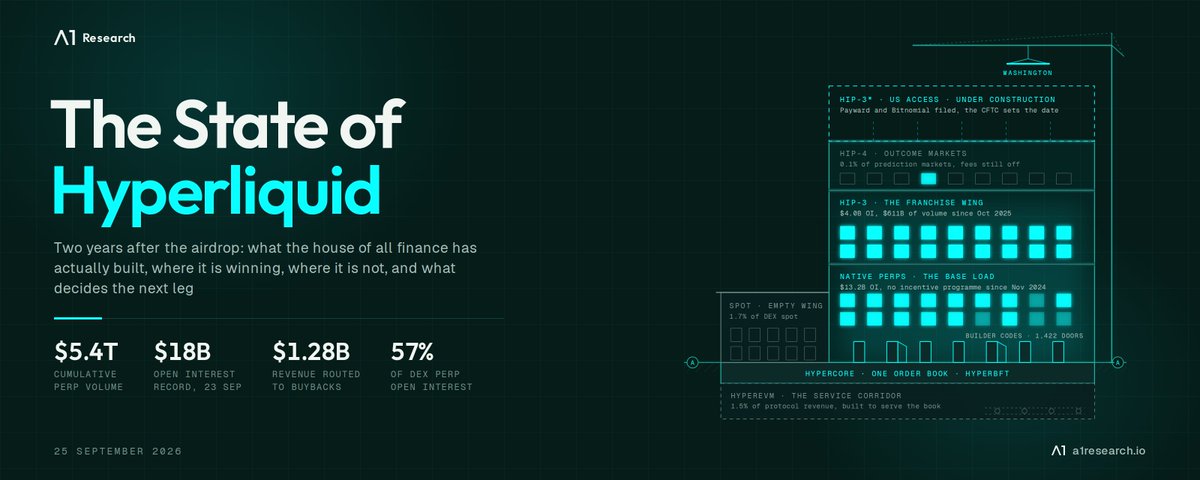 Two years after Hyperliquid's airdrop: $5.4T in perp volume, $1.28B in HYPE buybacks, and rooms still empty
Sources
4 records from 4 domains
thedefiant.io
coindesk.com
cryptoslate.com
finance.yahoo.com
Community notes
Spot something off or out of date? Drop a note. Editors review topic notes daily and roll accepted fixes into the explainer — contributors are recognized in the monthly $SQUID drop.
Loading notes…
Help improve this topic
Have a story or tip about this topic? Submit it. See something missing? Leave a note. Editors review daily; accepted submissions and fixes count toward the monthly $SQUID drop.