
Open interest tracks live, unsettled derivative contracts—a core gauge of leverage and positioning in crypto. Learn how to read it across perps, futures, and options, plus Hyperliquid, HIP-3, and liquidation risk.
+7 sources across the wider coverage universe
 Hyperliquid HIP-3 surpasses $2B in open interest as tokenized equities displace metals2026-04
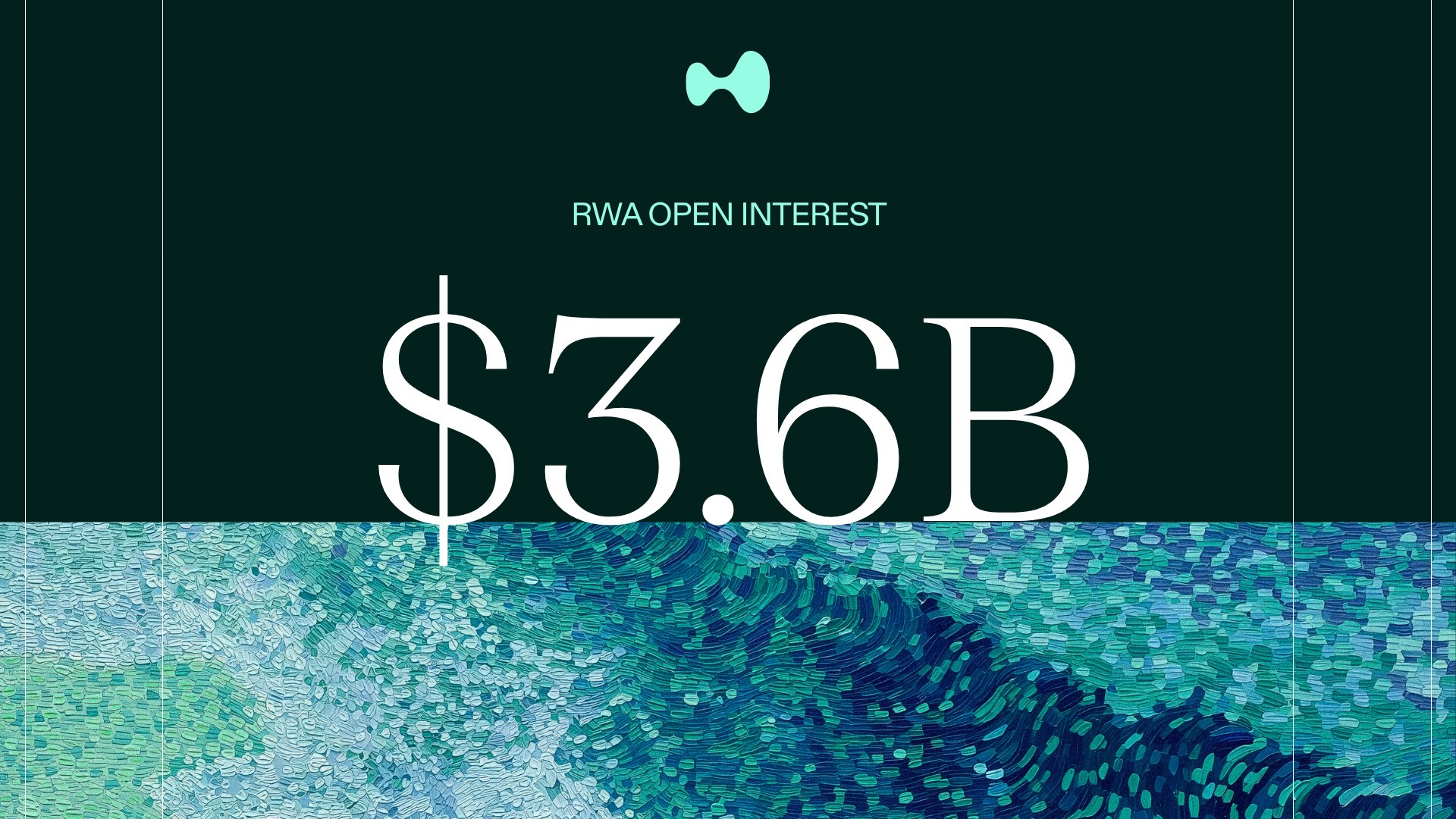 Hyperliquid RWA open interest hits record $3.6B as total OI reaches 2026 high of $11B2026-07
 Hyperliquid hits $820M annual revenue, capturing 41% of all decentralized perp open interest2026-04
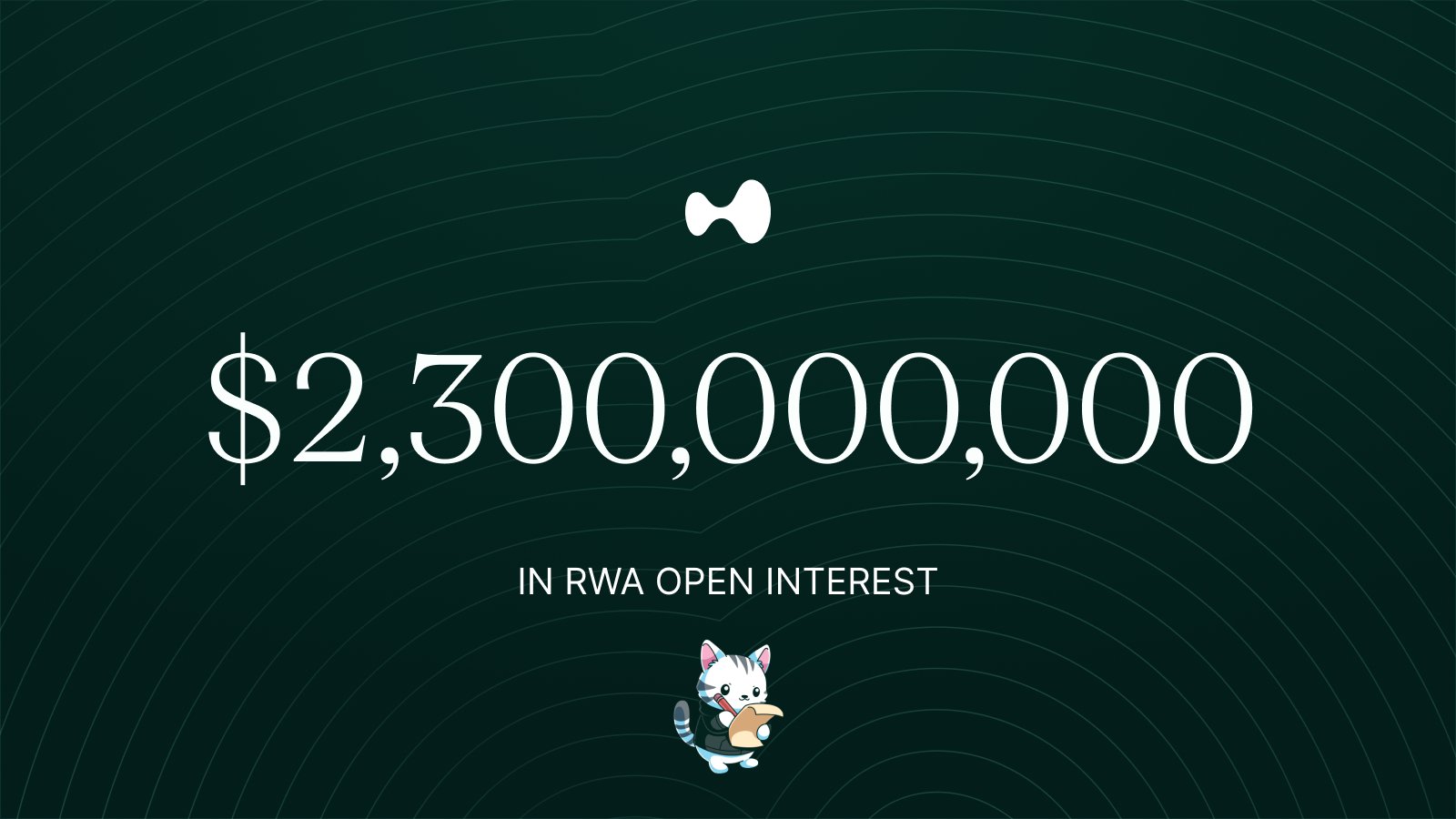 Hyperliquid RWA open interest surpasses $2.3B as HIP-3 commodity perps hit new all-time high2026-04
 The crypto market sell-off intensified as liquidations surged past $1.6B, driven by rising geopolitical risk, falling futures open interest, and macro uncertainty around US policy and the Fed. Analysts like Tom Lee expect continued volatility before a potential recovery later this year as valuations reset.2026-02
 Hyperliquid HIP-3 markets hit $1.2B open interest ATH as Bloomberg spotlights 24/7 price discovery and HSI rings NASDAQ opening bell2026-03
Open interest measures the total number of derivative contracts—futures, perpetual swaps, or options—that remain open and unsettled at a given moment. It is one of the most widely watched gauges of how much capital and leverage is committed to a market, and it sits alongside price and volume as a core input for reading trader positioning.
What Open Interest Actually Counts
Every futures or options contract has two sides: a buyer (long) and a seller (short). Open interest counts each contract pair once, reflecting the number of positions that have been opened but not yet closed, exercised, or expired. It is not a measure of trading turnover. Volume tallies how many contracts changed hands over a period; open interest is a running snapshot of how many are still live.
The distinction matters. If one trader sells an existing long position to another trader who is opening a new long, ownership transfers but open interest is unchanged—volume rises while open interest stays flat. Open interest only increases when new money creates a fresh contract (a new long matched with a new short) and only decreases when both sides of a contract close out. Because of this, analysts treat rising open interest as new capital entering a market and falling open interest as capital leaving or positions being unwound.
Open interest is typically quoted two ways. In contract or coin terms, it reflects the raw number of units. In notional terms—the figure most headlines use—it is the dollar value of those open positions, calculated by multiplying contracts outstanding by the underlying price. Notional open interest therefore moves both when traders add or remove positions and when the underlying asset's price changes, a subtlety that complicates direct comparisons across time.

Hyperliquid open interest hits an all-time high of $18B, marking a new record for the decentralized derivatives trading platform

Reading Open Interest Alongside Price
Traders combine open interest with price direction to infer the strength and conviction behind a move. The classic four-quadrant framework runs as follows:
- Price up, open interest up: new longs are driving the rally; the trend is considered well-supported by fresh capital.
- Price up, open interest down: the move is fueled by shorts covering rather than new buyers, often read as a weaker advance.
- Price down, open interest up: new shorts are pressing the market lower, suggesting conviction behind the decline.
- Price down, open interest down: longs are capitulating and exiting; the selloff may be a deleveraging event rather than fresh bearish bets.
These are heuristics, not laws. Open interest describes positioning, not intent, and large institutional hedges can grow open interest without expressing a directional view. Still, the framework is durable enough that it underpins most desk commentary, and recent newsroom coverage echoes it: reports that Bitcoin and Ethereum open interest "surges like a rising tide" are routinely framed as a return of risk appetite, while a 30% drop in Solana open interest during an altcoin slump is read as leverage flushing out.
Readers click open interest not for the number itself but for what a sudden move reveals: either a venue power shift (CME overtaking Binance, Hyperliquid eating DEX share) or an imminent forced-unwind cascade — OI functions as a crowdsourced leverage-stress gauge, and the audience treats record highs as danger signals as often as bullish ones.
Open Interest, Leverage, and Liquidations
Because much of crypto derivatives trading is leveraged, rising open interest is closely linked to rising systemic leverage. A market with swollen open interest has more positions that can be force-closed if price moves against them, which is why open interest concentrations are a leading indicator of liquidation risk.
This dynamic was visible in commentary that Solana futures open interest rose roughly 20% "amid rising leverage risks and potential $100 pullback"—more open positions meant more fuel for a cascade if price reversed. Liquidation cascades occur when forced closures push price further in one direction, triggering still more liquidations; the size of open interest helps estimate how violent such an unwind could be.
A related tool is the open-interest-weighted funding rate, used in perpetual futures markets. Perpetuals have no expiry, so exchanges use periodic funding payments between longs and shorts to keep the perp price tethered to spot. Positive funding means longs pay shorts (crowded long positioning); negative funding means shorts pay longs. Reading funding alongside open interest reveals not just how much leverage exists but which direction it leans—context that desks increasingly package into products like third-party "Based Research" dashboards offering funding-rate arbitrage and open-interest-change analytics.
Perpetuals Versus Term Futures Versus Options
Open interest behaves differently across instrument types, and conflating them produces misleading conclusions.
Perpetual swaps dominate crypto. They never expire, so their open interest reflects continuously held leveraged exposure and is governed by funding rather than settlement dates. Term (dated) futures expire on a set calendar, so their open interest naturally decays into expiry and rebuilds in later-dated contracts. Options open interest is distributed across strikes and expiries, and its interpretation hinges on where positions cluster.
A recent month illustrated the divergence: perp and options open interest rose month-over-month while term futures open interest softened, even as spot, perp, term, and options volumes all declined. The takeaway analysts drew—more risk being held on balance sheet despite less trading—shows why open interest and volume must be read together rather than as substitutes.
Options open interest carries its own signaling weight because strikes act as price "magnets" and risk thresholds. Coverage of a Deribit executive noting more than $1.2 billion in notional open interest tied to Bitcoin put options at the $60,000 strike framed that level as a liquidation trigger zone. Similarly, a reported $13.5 billion in Bitcoin options expiring in a single session—nearly 40% of open interest, with "max pain" near $75,000—shows how expiry-driven open interest can concentrate attention on specific prices. ("Max pain" is the strike at which the largest dollar value of options expires worthless, theoretically the point of maximum loss for option buyers.)

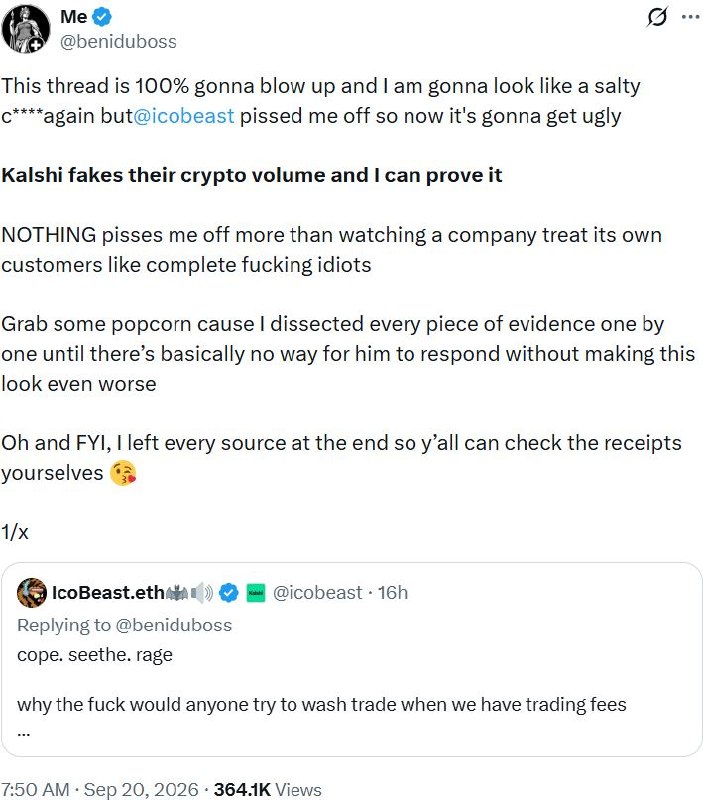
Trader accuses Kalshi of wash trading as ETH perp volume hits 174x open interest; Kalshi's crypto lead disputes claim
Where Open Interest Sits Across Venues
Open interest is also a market-share and health metric for exchanges. The CME, the regulated U.S. derivatives venue, is watched as a proxy for institutional demand; reports that CME Bitcoin futures open interest sank to a 14-month low were attributed to a "basis trade unwind"—the closing of cash-and-carry arbitrage positions that pair long spot with short futures—draining institutional participation.
On the decentralized side, Hyperliquid has become the dominant on-chain perpetuals venue. Newsroom coverage has tracked its open interest crossing $10 billion, the platform reportedly capturing 41% of all decentralized perp open interest, and roughly $820 million in annualized revenue. Other ecosystems compete on the same metric: Arbitrum's perp venues collectively support more than $1.2 billion in open interest, with platforms like variational reportedly holding around $921 million individually—open interest serving as the headline scoreboard for venue scale.
Centralized exchanges remain reference points too. Reports that XRP open interest on Binance hit a 2026 high, framed as a precursor to a "bigger move," reflect the convention of treating concentrated venue open interest as a positioning signal for a specific asset.
- 01CME institutional OI ascent
CME displacing Binance as #2 in BTC futures and posting records in Solana/XRP contracts signals regulated-venue adoption by institutions, which readers track as a macro-legitimacy indicator.
- 02Hyperliquid DEX perp dominance
Multiple ATH milestones and Hyperliquid capturing 41% of all decentralized perp OI while closing in on Binance made it the single most-covered venue shift in the dataset.
- 03BTC options vs futures balance
Deribit options OI hitting $15B and surpassing futures OI caught readers because it implies a structural shift toward hedging and directional bets via options rather than leveraged futures.
- 04Forced-unwind liquidation cascades
Bybit wiping 10,000 BTC in long OI in two hours and the DeepSeek-triggered record 17,225 BTC drop at CME pulled readers who use OI collapse as a real-time leverage-flush signal.
- 05ETH leverage cycle resets
Repeated ETH OI resets — including one of the sharpest since early 2024 with Binance shedding $3B in a single day — attracted readers watching whether ETH can sustain rallies without excess leverage.
- 06Altcoin OI milestone breakouts
XRP crossing $1B OI alongside RLUSD news, CRV hitting a record $132M, and CME Solana/XRP futures reaching $3B showed readers that OI expansion is spreading beyond BTC/ETH as a sign of maturing altcoin derivatives markets.
HIP-3 and Tokenized, Real-World Markets
A notable structural development is the growth of open interest in markets beyond native crypto assets. Hyperliquid's HIP-3 framework—which allows permissionless deployment of new perpetual markets, including those tracking real-world assets (RWAs) like tokenized equities and commodities—has set successive open interest records since its October 2025 launch. Coverage has tracked HIP-3 open interest climbing past $1.74 billion, then $2 billion, then $2.3 billion, with RWA open interest on Hyperliquid reaching a reported all-time high (ATH) of $3 billion as tokenized equities displaced metals as the largest category.
This matters for the concept itself: open interest is migrating from a metric about Bitcoin and Ethereum leverage toward a broader gauge of capital committed to programmable, 24/7 markets spanning equities, commodities, and other assets. The phrase "all-time high" applied to open interest signals not just bullish positioning in a single asset but expanding adoption of an entire market structure.
Limitations and Common Misreadings
Open interest is informative but easy to misuse. Several caveats recur:
- Notional figures embed price. A rising dollar open interest can reflect a higher underlying price rather than new positions. To isolate genuine inflows, analysts often watch coin-denominated open interest or open interest relative to market cap.
- It is directionless on its own. Open interest alone cannot say whether the marginal participant is long or short; it must be paired with funding rates, long/short ratios, or price action.
- Venue fragmentation. Aggregated open interest across dozens of exchanges can double-count or omit venues with poor reporting, and self-reported decentralized figures vary in methodology.
- Hedging noise. A meaningful share of open interest—especially in regulated futures and options—represents hedges and arbitrage (such as the basis trade), not directional speculation, which blunts naive sentiment reads.
Treating open interest as a single oracle of market direction is the most common error. Its value lies in confirmation and context: validating the conviction behind a price move, flagging when leverage is building toward fragile extremes, and tracking where capital is concentrating across assets and venues.
- 2021-11milestone
BTC futures OI cycle peak near $21B as BTC hits all-time high
- 2024-09milestone
ETH OI sharp reset; Binance sheds $3B in a single day on Sept 23
- 2025-01milestone
DeepSeek volatility triggers record 17,225 BTC OI drop at CME; futures basis turns negative
- 2025-01milestone
Deribit BTC options OI hits $15B, surpassing futures OI for the first time
- 2025-03milestone
CME Solana and XRP futures reach $3B OI, fastest-growing CME crypto products
- 2025-05milestone
Hyperliquid captures 41% of all decentralized perp OI; HIP-3 RWA perps surpass $2.3B
- 2025-06milestone
Hyperliquid OI hits $13.8B ATH after seven consecutive record days; HYPE lists on Bybit
- 2025-06milestone
BTC stalls below $110K as options OI reaches record highs; analysts flag fragile conviction-phase rally
Outlook
Open interest will remain a first-look metric for crypto traders, but the questions it answers are widening. As perpetuals dominate volume, as options expiries increasingly anchor near-term price discussion, and as frameworks like HIP-3 extend derivatives into tokenized equities and commodities, open interest is becoming less a Bitcoin-and-Ethereum leverage gauge and more a broad readout of capital committed to programmable markets. The durable practice is unchanged: read open interest together with price, volume, and funding rather than in isolation, and distinguish notional growth from genuine new positioning before drawing conclusions.
Latest Open Interest news
Community notes
Spot something off or out of date? Drop a note. Editors review topic notes daily and roll accepted fixes into the explainer — contributors are recognized in the monthly $SQUID drop.
Loading notes…
Help improve this topic
Have a story or tip about this topic? Submit it. See something missing? Leave a note. Editors review daily; accepted submissions and fixes count toward the monthly $SQUID drop.