
An all-time high (ATH) in crypto tracks peak prices, volumes, open interest, or supply — here's how to read each type, from Bitcoin price discovery to stablecoin supply records and on-chain RWA milestones.
+77 sources across the wider coverage universe
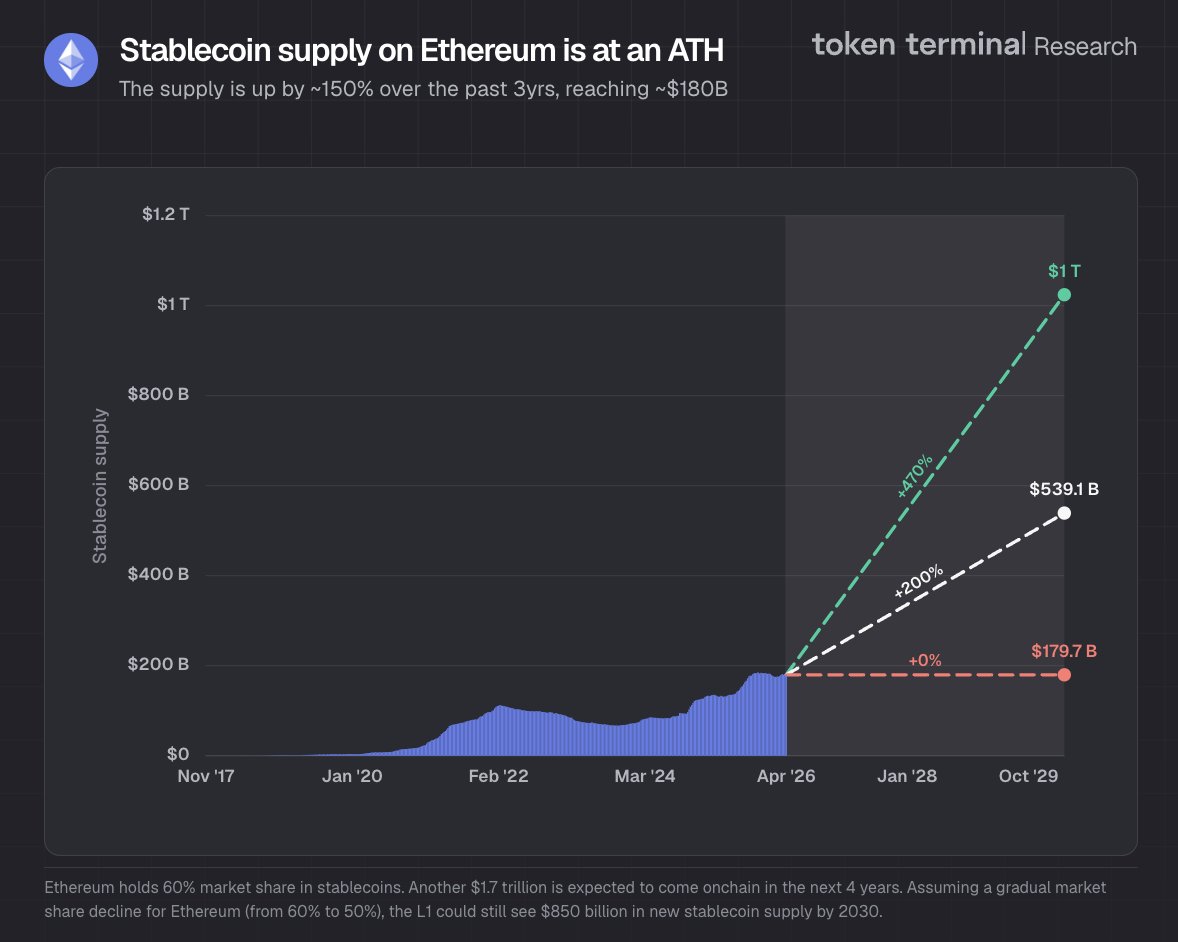 Ethereum stablecoin supply hits $180B ATH with 60% market share, up 150% in three years2026-04
 Aave V4 hits new ATH with no incentives or points, Kulechov touts safety-first approach2026-04
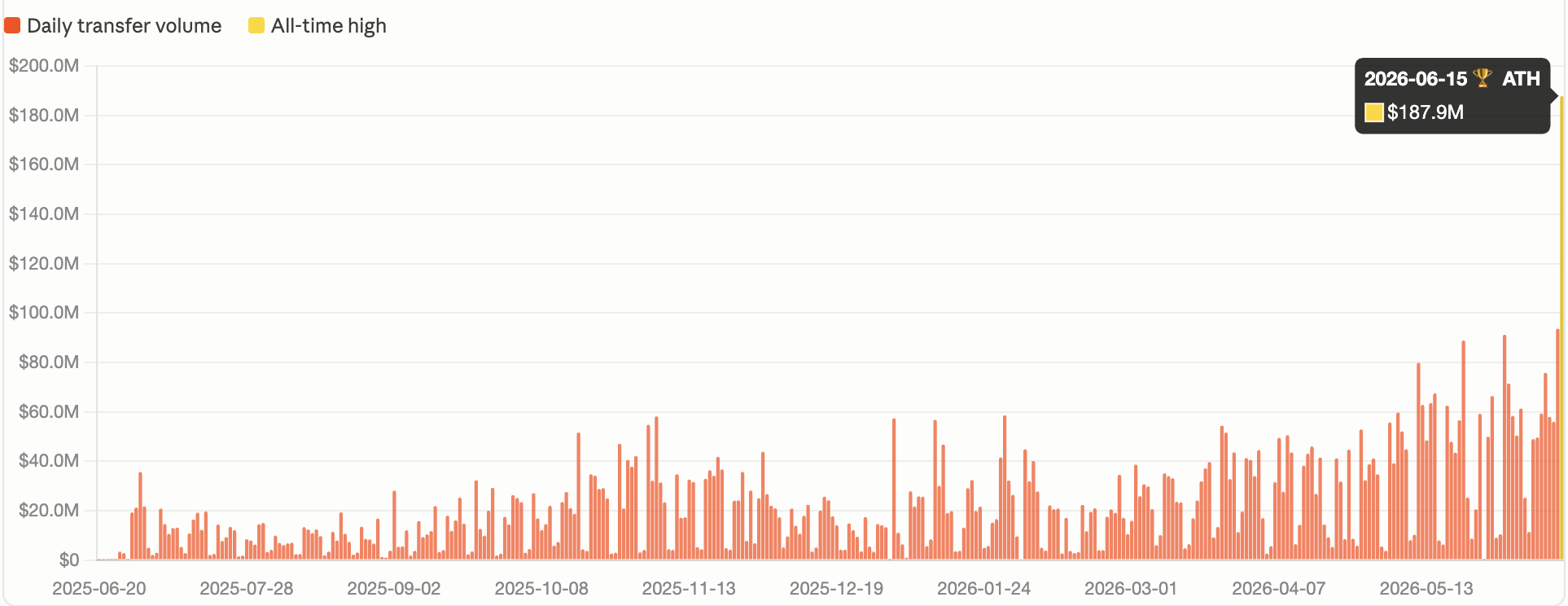 Solana tokenized equities hit $187.9M 24h spot volume ATH as $SPCX clears $105M2026-06
 Tether hits $188B ATH as Drift's $285M hack and Kelp DAO exploits drive DeFi flight from USDC2026-04
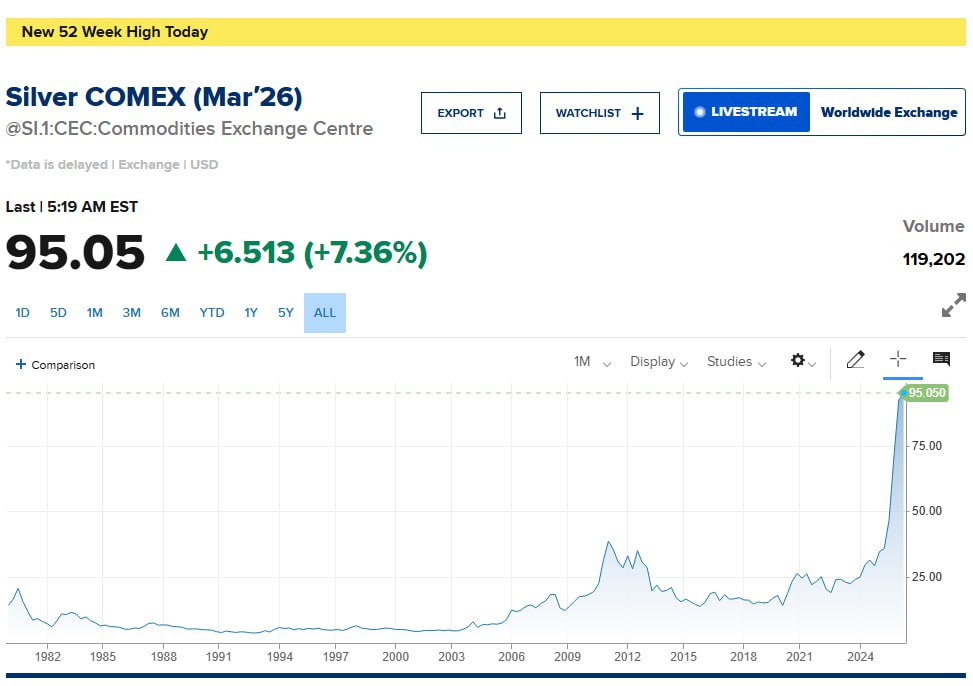 SILVER HITS $95/OZ FOR THE FIRST TIME IN HISTORY2026-01
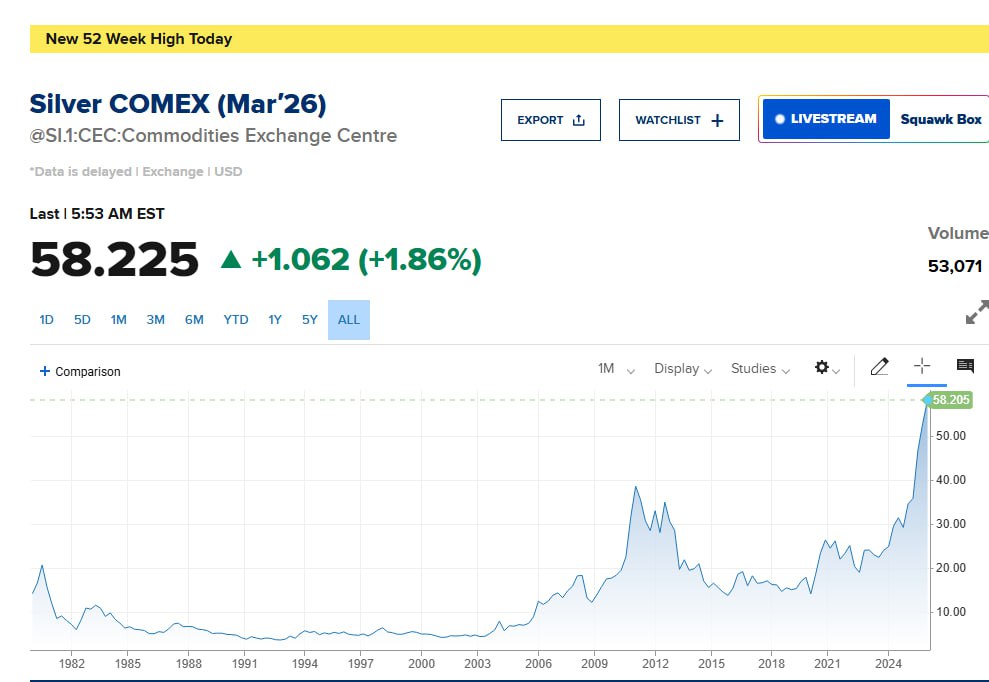 Silver is hitting another ATH $58.612025-12
An all-time high (ATH) marks the highest price, volume, market capitalization, or other metric a crypto asset or on-chain category has ever reached — a single number that compresses an asset's entire history into one data point.
What an ATH Actually Measures
The term sounds simple, but the metric being measured matters enormously. Price ATHs get most of the headlines — Bitcoin (BTC) crossing $100,000, for instance — but the crypto industry tracks ATHs across a much wider surface: total value locked, open interest, stablecoin supply, tokenized asset volumes, protocol revenue, and user counts. Each of these tells a different story.
A price ATH reflects what the marginal buyer was willing to pay at a specific moment, denominated in fiat (usually USD). A volume ATH or open interest ATH reflects activity and leverage in the market, which can diverge sharply from price direction. Understanding which kind of ATH is being cited is the first step to interpreting it correctly.

Ethereum stablecoin supply hits $180B ATH with 60% market share, up 150% in three years
75% of that $180B is just USDT + USDC — Ethereum's stablecoin moat is really a two-issuer dependency. Solana moves $650B/month on $14.4B in stablecoins while ETH parks 12x that amount with a fraction of the velocity, which tells you everything about where institutional settlement actually lives. Token Terminal's $850B-by-2030 target bakes in share erosion to 50%, but Tron's already at $87B and growing — the 60% dominance number is probably the ceiling, not the floor.
Price ATHs: How They Form and Why They Matter
Price discovery in crypto follows a pattern familiar from traditional markets but amplified by thinner liquidity, 24/7 trading, and a higher proportion of retail participants. When an asset breaks above its previous ATH, it enters price discovery — a zone with no historical resistance, because there are no holders who bought at higher prices waiting to sell.
This dynamic is part of why ATH breaks often produce outsized moves in either direction. There is no natural ceiling of overhead supply, so prices can accelerate quickly — or, if momentum fades, snap back sharply as late buyers who purchased near the ATH look to exit.
For Bitcoin specifically, ATH cycles have historically followed a four-year halving cadence, though this relationship has become less mechanical as institutional participation has grown. The S&P 500 recently set its own ATH at 7,365 — up 22.8% since early 2025 — illustrating that ATH psychology is not unique to crypto, but the frequency and magnitude of moves in digital assets amplifies its significance for participants in this space.
Readers treat ATH headlines as cascading confirmation signals across asset classes simultaneously — clicking BTC price records, hashrate records, ETH validator records, DeFi TVL records, and even gold/silver ATHs in the same cycle, revealing they use ATH density as a bull-market health gauge rather than treating each record as an isolated event.
Stablecoin Supply ATHs: A Different Signal Entirely
Not every ATH signals euphoria. Stablecoin supply all-time highs tend to be interpreted as a sign of dry powder — capital parked in dollar-denominated assets, waiting to be deployed into risk assets. When stablecoin supply grows alongside prices, it can indicate genuine new capital entering the ecosystem rather than just price appreciation of existing holdings.
Ethereum's stablecoin supply hit $180 billion in 2026, claiming roughly 60% of the total on-chain stablecoin market — up 150% over three years. USDC's market cap reached an ATH near $80 billion earlier in 2026, with more than 25% of all circulating USDC residing in Coinbase products, reflecting the exchange's deepening role as an institutional stablecoin distribution point. The total stablecoin market crossed $300 billion, a number that would have been unthinkable during the 2017 or even 2020–21 cycles.
These figures matter because stablecoins are the settlement layer for most on-chain activity. A rising stablecoin supply ATH at the same time as price ATHs in underlying assets suggests the market is not purely driven by paper gains recycling — new dollars are arriving.
Tether also set a supply ATH at $188 billion, though notably this coincided with a period of DeFi stress (the Drift exploit and Kelp DAO incident drove some flight from USDC, temporarily boosting Tether's dominance). ATH numbers in stablecoin supply can therefore reflect both genuine capital inflow and rotation between stablecoin issuers.
Aave V4 hits new ATH with no incentives or points, Kulechov touts safety-first approach
Open Interest ATHs: Leverage in the System
Open interest (OI) measures the total value of outstanding derivative contracts — futures and perpetuals — that have not been settled. An OI ATH is a double-edged signal. On one hand, it reflects deep market interest and willingness to take directional bets. On the other, elevated OI concentrates liquidation risk: if price moves sharply against the dominant side, cascading liquidations can amplify the move.
Hyperliquid, the on-chain perpetuals exchange, has become a focal point for OI ATH tracking. RWA (real-world asset) open interest on Hyperliquid reached a new ATH of $3 billion via its HIP-3 mechanism, setting a new OI record every month since launch in October 2025. Trade[XYZ] open interest on the same platform hit $1.2 billion — up 446% since the start of 2026. Jupiter Predict's open interest closed a recent week at just under 2 million contracts, also an ATH for the prediction market protocol.
These on-chain OI milestones are structurally different from centralized exchange figures: they are publicly auditable and settlement is handled by smart contracts, removing counterparty risk at the custodial layer. That said, the systemic risk from liquidation cascades is real regardless of where the contracts settle.
Volume and Revenue ATHs: Protocol Health Metrics
Beyond price and leverage, ATHs in protocol revenue and trading volume are often the most durable signal of a project's trajectory, because they reflect actual economic activity rather than speculative positioning.
Solana's application ecosystem generated $68 million in revenue in May 2026, up 16% month-over-month. Collectible marketplace CollectorCrypt reached $9 million in monthly revenue — an ATH. Tokenized asset volumes on Solana hit a new ATH above $1.1 billion in May, with tokenized equities ($SPCX alone clearing $105 million in 24-hour spot volume at one point) leading the charge. These are metrics that exist independent of whether SOL's token price is at an ATH.
Aave V4 reached a new ATH in deposits and borrows without relying on incentive programs or points campaigns — a notable distinction that protocol founder Stani Kulechov cited as validation of a safety-first design. When a DeFi protocol hits an ATH without token subsidies, it suggests genuine product-market fit rather than mercenary capital chasing yield.
Solana tokenized equities hit $187.9M 24h spot volume ATH as $SPCX clears $105M
Real-World Asset ATHs: Institutional Capital Arrives On-Chain
The RWA (real-world asset) category has produced some of the most structurally significant ATHs of the current cycle. Total on-chain RWA value crossed $33.7 billion, with the most recent $1.5 billion spike driven primarily by Ethereum-based institutional tokenized U.S. Treasuries — the Franklin Templeton iBENJI launch and BlackRock BUIDL inflows — plus a commodities rally through JMWH.
These numbers represent a structural shift: institutions that once kept tokenization as an internal proof-of-concept are now deploying meaningful capital to public blockchains. Ethereum hosts the majority of this activity, partly because of its established legal and technical infrastructure for tokenized assets, and partly because large asset managers have already built custody and compliance workflows around EVM chains.
Avalanche also reported $2 billion in tokenized RWAs alongside a transaction count ATH of 19 million. The geographic and chain diversity of RWA ATHs suggests this is not a single-project phenomenon but a category-level inflection.
- 01BTC price ATH cascade
Sequential BTC ATH breaks from $106K through $125,876 generated repeated click events, showing readers return each time a new threshold falls rather than treating it as a single story.
- 02Hashrate ATH vs network utility doubt
The highest-clicked headline exposed a tension readers found compelling: record mining power coexisting with empty blocks and low fees, framing hashrate ATH as a vanity metric.
- 03Ethereum infrastructure records
Validator count records, daily transaction ATH surpassing 2021, and $180B stablecoin supply share all drew clicks as evidence of ETH layer-one health independent of ETH price.
- 04DeFi TVL milestone stacking
Aave hitting $25B, lending protocols crossing $130B deposited, and Ethereum L2 TVL ATH signaled readers tracking capital rotation into protocols as a separate ATH category.
- 05Traditional asset ATHs as macro signal
Gold above $4,000 and silver above $95 attracted clicks because readers interpreted hard-asset ATHs alongside crypto ATHs as a unified macro liquidity story.
- 06$SQUID community token ATH
Two separate $SQUID ATH headlines drew strong engagement, reflecting reader identity investment in the platform's native token outperforming broader market drawdowns.
ATH Psychology and Common Misreadings
Several cognitive traps recur when markets discuss ATHs:
Recency bias in denominator choice. An asset can be at an ATH in USD terms while still far below its ATH in BTC terms (or vice versa). Altcoins that made enormous gains in BTC terms during 2017 never recovered those ratios, even as USD prices set new records. Always clarify the denominator.
Survivorship bias. The assets that hit new ATHs get covered; the ones that don't are forgotten. NFPrompt, for instance, was trading down 80% from its ATH even as other segments of the market set records. A portfolio of "ATH-adjacent" assets will not perform like the handful of assets that actually make the headline.
Confusing category ATHs with asset ATHs. Stablecoin supply at an ATH does not mean any individual stablecoin is at its ATH. The $180 billion Ethereum stablecoin ATH includes dozens of issuers, some of which lost share while the category grew.
Using ATH as a price target. In traditional equity analysis, ATH levels sometimes function as resistance or support. In crypto, the absence of fundamental valuation anchors means that ATH levels are primarily psychological, and their predictive value for future price action is limited.
ATH in Market Context: What Cycle Are We In?
ATH frequency is itself a market signal. During bear markets, new ATHs become rare and each one is scrutinized for whether it represents genuine trend change or a dead-cat bounce. During bull markets, ATHs cluster — multiple assets, categories, and metrics set records within weeks of each other, which is broadly what characterized the 2025–2026 period across stablecoins, RWAs, and on-chain derivatives.
The cross-asset ATH pattern in 2026 — stablecoins, RWA volumes, Hyperliquid OI, Solana app revenue, Ethereum stablecoin supply, and specific protocol metrics all hitting records within the same quarter — is consistent with a risk-on environment where capital is flowing into the ecosystem at multiple levels simultaneously, not just inflating token prices.
- 2024-11milestone
BTC breaks $106K ATH; Mt. Gox moves $172M BTC
- 2025-01milestone
Ethereum stablecoin supply reaches $180B ATH with 60% market share
- 2025-03milestone
Ethereum validator count sets record at 1,083,579 active nodes
- 2025-04milestone
Aave TVL hits $25B all-time high; lending protocol TVL exceeds $130B
- 2025-05milestone
BTC mining difficulty hits 127.6T ATH; hashrate ATH concurrent
- 2025-12milestone
Gold crosses $4,000/oz all-time high
- 2026-05milestone
BTC hits $112K ATH then $118K, vaporizing $1B in shorts
- 2026-06milestone
BTC reaches $125,876 ATH; silver tops $95/oz record
Outlook
The semantic weight of "ATH" in crypto is likely to shift as the asset class matures. In early cycles, price ATHs dominated the narrative because the primary use case was speculation. As DeFi, stablecoins, tokenized real-world assets, and on-chain derivatives mature into genuine financial infrastructure, protocol revenue ATHs, stablecoin supply ATHs, and OI ATHs will increasingly carry equal or greater analytical weight than token price records.
For participants, the most useful practice is to treat any single ATH as a prompt to ask: what exactly just hit a record, and what does that reveal about capital allocation, leverage, and genuine adoption? The number itself is secondary to the structure behind it.
Latest ATH news
Ethereum stablecoin supply hits $180B ATH with 60% market share, up 150% in three yearsAave V4 hits new ATH with no incentives or points, Kulechov touts safety-first approachSolana tokenized equities hit $187.9M 24h spot volume ATH as $SPCX clears $105MTether hits $188B ATH as Drift's $285M hack and Kelp DAO exploits drive DeFi flight from USDCSILVER HITS $95/OZ FOR THE FIRST TIME IN HISTORYSilver is hitting another ATH $58.61Community notes
Spot something off or out of date? Drop a note. Editors review topic notes daily and roll accepted fixes into the explainer — contributors are recognized in the monthly $SQUID drop.
Loading notes…
Help improve this topic
Have a story or tip about this topic? Submit it. See something missing? Leave a note. Editors review daily; accepted submissions and fixes count toward the monthly $SQUID drop.