
Evergreen explainer on Betteridge’s Law for crypto readers: how yes–no question headlines signal speculation, why they dominate Bitcoin and DeFi coverage, how to read them critically, and what AI and market dynamics mean for this newsroom maxim.
 From $100M to $1.5B monthly: crypto card spending is booming, but can neobanks become your primary bank?2026-06
 Are circuit breakers the next step for DeFi?2026-04
 Virtuals launches AI Council, pitting agents against each other in weekly $100K Hyperliquid trading competitions2026-04
 Are Audits Dead?2026-02
 The Real Question: What is the ultimate goal of Tether borrowing into Drift Protocol?2026-04
 Does DeFi even matter anymore?2026-05
Betteridge’s Law in Crypto: Why So Many Headlines End with a Question Mark
In crypto and traditional media alike, a well-known newsroom maxim holds that whenever a headline ends with a question mark, the safest answer is usually “no.” Betteridge’s Law of Headlines names this pattern and, while it is not a literal law, it captures something real about how speculative stories, especially in volatile markets like Bitcoin and DeFi, get framed for maximum curiosity with minimal commitment from the publisher.
From Tech Blogger’s Quip to Media Maxim
Betteridge’s Law began not as a formal theory of journalism but as a frustrated aside from a technology reporter reacting to a particularly flimsy news story. In 2009, British tech journalist Ian Betteridge criticized a headline that asked whether the music service Last.fm had handed user data to the RIAA, noting that the answer buried in the article was simply “no.” He distilled his irritation into a pithy rule: “any headline which ends in a question mark can be answered by the word ‘no’.” The line resonated widely because it expressed a sentiment many readers already felt: that question-style headlines often signal stories built more on speculation than solid evidence.
Over time, this quip became codified as Betteridge’s Law of Headlines, typically cited as “any headline that ends in a question mark can be answered by the word no.” Commentators emphasize that it applies specifically to yes–no questions, not to open-ended formulations like “What happens when Bitcoin reaches its 21 million supply cap?” which is descriptive rather than a binary proposition. The law highlights the difference between an outlet confidently asserting, “Bitcoin is in a bull trap,” and hedging with, “Bitcoin tops $67K: Is it a bull trap?”, the latter keeping the publisher at arm’s length from any definitive claim. This distance is critical in fast-moving arenas like crypto markets, where facts are fluid, predictions are risky, and legal or reputational exposure can be significant.
Today, Betteridge’s Law is widely referenced in media literacy discussions, business communication advice, and even casual social media debates about clickbait. The law is generally understood not as an ironclad statistical law, but as a skeptical reading strategy: when you see a yes–no question in a headline—“Is AI the exit strategy for miners?”, “Is altseason extinct?”, “Is $80 HYPE next?”—you should suspect that the evidence for “yes” may be weaker than the framing suggests. That interpretive habit becomes especially important in crypto, where headlines can move sentiment, order flow, and even token prices across Bitcoin, ETH, altcoins, and newly launched tokens within minutes.
Defining Betteridge’s Law
At its core, Betteridge’s Law is an adage rather than a scientific theory. Encyclopedic summaries phrase it as the claim that “any headline that ends in a question mark can be answered by the word no,” emphasizing its status as a rule of thumb about news culture rather than an empirical law of language or logic. The law rests on a fairly simple assumption about publisher behavior: if editors truly believed the answer was “yes,” and had the reporting to back it up, they would generally present it as a statement instead of a question. By framing a claim as a question—“Will BTC’s \$60K floor hold?”—a publisher can enjoy the attention that comes with a bold idea while avoiding responsibility if the market evolves differently.
Betteridge and later commentators also stress that his law applies only to yes–no questions. The original critique was aimed at headlines that imply a binary proposition about some potential event, such as “Is Bitcoin headed to \$100K this year?” or “Is Coinbase in regulatory trouble?” Open-ended question headlines, such as “What happens when Bitcoin reaches 21 million supply?” or “How could AI reshape DeFi’s next chapter?”, are not straightforwardly answerable with a simple “no,” and therefore sit outside the law’s narrow scope. Understanding this distinction matters in crypto coverage, where question headlines range from binary price calls to broader explainers about ETH upgrades, RWA adoption, or new Layer-2 launches.
The law is also closely associated with skepticism toward rumors and speculation. Content strategists and journalism commentators often describe Betteridge’s Law as a way of calling out pieces that are essentially rumor or unverified speculation dressed up with a provocative headline. When evidence is thin, but the topic—say, a potential stablecoin collapse, a rumored exchange insolvency, or a dramatic BTC price target—is too tempting to ignore, a question mark can be the journalist’s compromise between silence and firm assertion. That compromise is what makes the law so appealing for readers trying to quickly gauge how much weight to give a given crypto headline.
Origins in Tech Journalism
The canonical origin story traces Betteridge’s Law back to that 2009 blog post on the site Technovia, where Ian Betteridge critiqued TechCrunch’s coverage of the music service Last.fm. The TechCrunch headline asked whether Last.fm had handed user data to the Recording Industry Association of America (RIAA), implying a serious privacy breach, but the sourcing and evidence did not support such a dramatic claim. Betteridge observed that the answer, tucked deep in the article, was effectively “no,” and coined his rule in exasperation: “any headline which ends in a question mark can be answered by the word ‘no’.”
Although the phrasing is now ubiquitous, the underlying idea predates Betteridge. A 1991 compilation of Murphy’s Law variants included a similar maxim known as Davis’s Law, which already noted the tendency for question-mark headlines to invite negative answers. Betteridge effectively updated this older observation for the web era, where the economics of attention, pageviews, and link-sharing intensified the incentives to pose alluring questions even when the evidence was equivocal. In technology reporting, where product launches, acquisitions, and regulatory scares often unfold quickly, the question headline became a convenient form for stories that wanted to surf the wave of speculation without fully endorsing the most dramatic interpretation.
That same dynamic now plays out every day in crypto coverage. When a new AI-powered trading tool launches, a trader-focused blog might ask, “Can this AI bot beat the market?” rather than “This AI bot beats the market.” When an exchange like Coinbase faces a new enforcement action, the question “Is Coinbase at risk of a crackdown?” may generate more clicks, and less legal exposure, than a declarative headline would. Betteridge’s Law helps readers decode those choices as signals about both the state of the evidence and the publisher’s confidence.
Cousins: Davis’s Law and Hinchcliffe’s Rule
Betteridge’s Law is part of a broader family of wry observations about questions in titles. As noted, Davis’s Law, recorded in a collection of Murphy’s Law variants in 1991, anticipates the same phenomenon: that headlined questions are often safely answered in the negative. This suggests that journalists and readers were noticing the pattern long before Betteridge gave it a memorable name.
In academic publishing, a related adage is known as Hinchcliffe’s Rule, sometimes spelled “Hinchfliffe’s rule.” Attributed to physicist Ian Hinchliffe, it states that “if the title of a scholarly article is a yes–no question, the answer is ‘no’.” The rule reprises Betteridge’s logic in the context of scientific papers, implying that authors resort to question titles when the evidence is either insufficient or negative. Commentators in biomechanics and other fields have invoked Hinchcliffe’s Rule in light-hearted discussions of paper titles, noting its kinship with Betteridge’s Law in news journalism.
However, empirical studies of scholarly articles do not support Hinchcliffe’s Rule as a generalization. A bibliometric analysis of question titles in journal articles across disciplines, for example, reported that patterns vary by field but found no systematic confirmation of Betteridge- or Hinchcliffe-style criticisms. A working scientist writing about their own publications likewise observed that for several papers with question titles, not a single one had “no” as the answer; they were all effectively “yes.” These results underscore that, even in academic contexts, the relationship between question titles and negative findings is at best loose.
For crypto readers, these cousins of Betteridge’s Law underline a key point: these “laws” are cultural observations, not literal predictive rules. They capture tendencies in how editors and authors hedge uncertainty, but they are not substitutes for reading the article or analyzing the data—whether that data concerns journal citations, an ETH protocol’s TVL, or on-chain metrics for BTC.

From $100M to $1.5B monthly: crypto card spending is booming, but can neobanks become your primary bank?
Why Question Headlines Are So Tempting
If Betteridge’s Law captures a recognizable pattern, the next question is why that pattern exists at all. Question headlines persist because they solve several problems at once for publishers: they attract clicks through curiosity, they hedge against uncertainty, and they manage risk when evidence is incomplete. In crypto, where markets move faster than most fact-checking processes and where narratives can become self-fulfilling, these functions are especially attractive.
Incentives in Newsrooms
Journalism commentators often describe Betteridge’s Law as a way of calling out stories that are “essentially rumor or speculation.” The idea is that editors reach for a question mark when they want to run with a tantalizing but under-sourced claim—such as a rumored hack, a potential ETF approval, or a speculative prediction that Bitcoin is about to decouple from tech stocks—without fully committing to its truth. A trauma-surgery blogger applying the law to medical literature expressed the principle succinctly: if the author were more confident of the answer, they would have written it as an assertion, not as a question.
Betteridge himself put the point even more bluntly. Reflecting on his maxim, he wrote that journalists use question-style headlines when “they know the story is probably bullshit, and don’t actually have the sources and facts to back it up, but still want to run it.” Others have echoed that a headline with a question mark at the end is, in the vast majority of cases, a sign that the story may be tendentious, oversold, or framed to maximize drama rather than to convey a settled fact. In crypto terms, this might translate to a headline like “Is this small-cap token the next Ethereum?” written on the basis of a thin white paper and some social media chatter, rather than deep technical analysis.
From the newsroom’s perspective, the incentive structure is clear. Question headlines can juice engagement by promising a potentially explosive possibility—Bitcoin at \$250K, the collapse of a major stablecoin, an AI model that makes human traders obsolete—while preserving plausible deniability if events unfold differently. Editors are under constant pressure to stand out in feeds filled with Coinbase updates, Layer-2 announcements, and DeFi exploit reports, all competing for the same few seconds of user attention. A question, especially about price or existential risk, is a powerful tool in that competition.
Curiosity, Clicks, and the Psychology of Question Marks
The appeal of question headlines is not only about risk management; it is also about curiosity. Cognitive and communication research has examined how different headline styles affect clickthrough rates, finding that the impact of features such as concreteness and specificity can be complex. In a large meta-analysis of 8,977 headline experiments, for example, researchers reported that the effect of headline concreteness on clickthrough varied depending on overall concreteness levels, suggesting that there is no single formula for maximizing engagement. Question headlines often operate by creating a “curiosity gap”: they highlight an information deficit (“Is AI the exit strategy for miners?”) that the reader can resolve only by clicking through.
Popular-science coverage of these experiments emphasizes that small changes in headline wording can markedly influence the likelihood that someone chooses to read a story. For digital outlets competing in a crowded attention economy, these marginal gains are valuable. A headline that hints at a mystery—about the future of BTC after the halving, about the real impact of a Bank of Japan rate decision on crypto markets, or about whether a newly launched AI protocol can truly “blur” transaction histories without undermining security—can tempt more readers than a dry, fully informative headline might.
Question marks are a convenient linguistic device for constructing such curiosity gaps. They give editors a way to foreground an unresolved tension without explicitly asserting that the dramatic outcome is likely. In crypto coverage, questions like “Is DeFi’s next chapter about to dwarf DeFi Summer?” or “Is this RWA platform ready for institutional adoption?” encourage readers to imagine a significant upside or downside, inviting them into the article in search of confirmation. Betteridge’s Law nudges readers to remember that the more sensational the implied outcome, the more carefully they should examine whether the evidence inside matches the promise outside.
Risk Management and Accountability
Another reason Betteridge’s Law resonates is its focus on accountability. Encyclopedic summaries note that the law is based on the assumption that if publishers were confident that the answer was “yes,” they would present it as an assertion; by presenting it instead as a question, they are less accountable for whether it is correct. Business communications guides frame this in terms of risk management: the question mark lets the outlet report on a rumor or possibility while signaling, at least formally, that the claim is still up for debate.
Platforms like Umbrex describe Betteridge’s Law as revealing “the mechanics of media and the subtle ways in which information is presented to us.” The law suggests that when a headline poses a yes–no question, it is often a signal that the article lacks concrete evidence to support a definitive statement. This is not always due to bad faith. In high-uncertainty environments—such as unfolding regulatory battles over crypto, early-stage exploits, or complex macroeconomic shifts—journalists may genuinely not know how events will play out. Question headlines are one way to reflect that uncertainty.
However, the same mechanism can be misused to evade responsibility for pushing overly dramatic narratives. In crypto, headlines like “Is this a bull trap?” or “Is altseason extinct?” can shape sentiment and feed into feedback loops of buying or selling, even if the underlying analysis is thin. Betteridge’s Law encourages readers to ask whether a question headline is primarily a honest reflection of uncertainty or primarily a vehicle to float a precarious claim while minimizing editorial accountability.
Readers click Betteridge-framed crypto headlines not to confirm their skepticism, but because the question format signals a real crack in a foundational promise — audits, DeFi's relevance, self-custody, AI autonomy — making each '?' a stress-test of crypto's infrastructure narrative rather than a price tease.
Does Betteridge’s Law Hold Up Empirically?
Despite its popularity, Betteridge’s Law is not a rigorously validated empirical rule. When researchers and writers have tried to test it against real-world data, they find a more complicated picture. Question headlines do sometimes accompany speculative content, but they also often appear in serious analysis and empirical research where the answer is not simply “no.”
Media Analyses and Counterexamples
Several commentators have informally tested Betteridge’s Law on specific corpora of headlines. Data journalists at Priceonomics, for example, asked whether their own blog followed Betteridge’s Law, analyzing headlines to see if question-mark titles exhibited “link-bait” characteristics. While details of their findings require access to the full article, the very premise underscores that Betteridge’s Law is best treated as a prompt for critical examination rather than a literal rule: it inspires audits of newsroom practices rather than providing a ready-made verdict on any given story.
Medical and humanities writers have also reflected on the law’s validity. An essay in a medical context described a “tame” version of Betteridge’s Law—“any headline that ends in a question mark can be answered by the word no”—and used it to advise clinicians that question-titled articles might warrant extra scrutiny. Yet the same piece implicitly recognized that the pattern is not universal; it framed the law more as a heuristic than as an absolute conclusion about every question title in the literature. A separate humanities essay published by Hektoen International explicitly asked whether Betteridge’s Law is valid, acknowledging that Ian Betteridge meant it only for yes–no type questions and exploring exceptions to the rule.
These reflections collectively support a nuanced view: question headlines do often correlate with more speculative or tentative content, but there are many counterexamples in which the answer is “yes,” “maybe,” or “we don’t know yet.” The law is sufficiently useful that seasoned journalists in crypto and beyond keep it in mind, but sufficiently fallible that no responsible analyst would treat it as a substitute for reading the actual story.
Academic Titles and Hinchcliffe’s Rule
Formal studies of question titles in academic writing further undercut any strong version of Betteridge’s Law. In a bibliometric analysis titled “Do scholars follow Betteridge’s Law? The use of questions in journal titles,” researchers examined question titles across scholarly disciplines and found that patterns varied, but they did not find support for the criticism implied by Betteridge’s Law or Hinchcliffe’s Rule. That is, there was no evidence that question titles systematically corresponded to “no” answers or to weaker content in a way that would justify the adage as a reliable predictor.
Individual scholars have reached similar conclusions in more anecdotal ways. One scientist, reflecting on their own career, noted that they had published multiple papers with question titles and that in exactly none of them was the answer “no”; instead, the papers supported “yes” answers or nuanced findings. Articles in biomechanics and related fields that invoke Hinchcliffe’s Rule often do so tongue-in-cheek, acknowledging its charm while recognizing that many question titles accompany robust, positive findings.
These results are instructive for crypto readers. They show that even in domains with rigorous peer review and formal methodologies, question titles are not necessarily indicators of weaker findings. If Hinchcliffe’s Rule does not hold reliably in academic journals, it is unlikely that a literal reading of Betteridge’s Law will hold in crypto media, where factors like speed, competition, and branding exert even stronger influence on headline choices. The lesson is caution, not cynicism: treat question headlines as invitations to scrutiny, not automatic invitations to say “no.”
Interpreting It as Heuristic, Not Rule of Nature
Taken together, these analyses suggest that Betteridge’s Law works best as a heuristic—a simple mental shortcut—rather than as a statistical law. It captures an important newsroom behavior: the tendency to phrase under-sourced or speculative ideas as questions to minimize accountability while still harvesting clicks and attention. Yet it does not, and likely cannot, guarantee that any specific question headline will have a negative answer.
For crypto and Bitcoin audiences, this means that Betteridge’s Law should inspire a particular style of reading. When confronted with a headline like “Bitcoin decouples from tech stocks: Is \$60K BTC’s next stop?” the law suggests asking whether the article offers strong on-chain data, macro analysis, or derivative-market evidence to support the implied bullish narrative—or whether it merely strings together a few coincidental price moves. When a headline asks, “Is DeFi’s next chapter about to dwarf DeFi Summer—could the risks grow even faster?”, Betteridge’s Law invites you to ask whether the piece engages seriously with smart contract risk, leverage, and regulatory overhang, or simply gestures toward them to justify a dramatic frame.
The law is thus less about the literal answer and more about calibrating skepticism. A sophisticated reader will still look closely at ETH supply metrics, BTC options open interest, or protocol revenue data. But Betteridge’s Law reminds them that the presence of a question mark, especially around dramatic claims, is often a sign that their skepticism should start at a higher baseline.

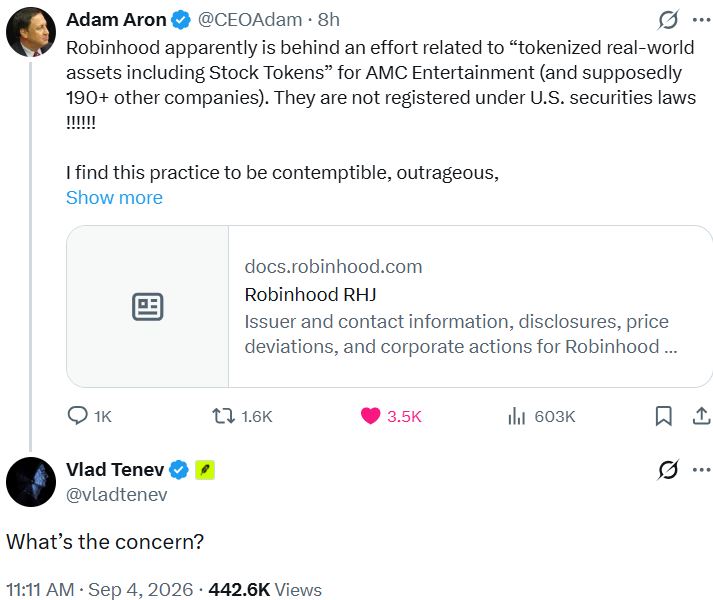
AMC CEO calls Robinhood's unregistered stock tokens 'vile'; Robinhood's Tenev asks 'What's the concern?
Betteridge’s Law in Crypto, Bitcoin, and DeFi Coverage
Crypto journalism provides a near-perfect laboratory for Betteridge’s Law. The asset class is volatile, narratives change daily, and information asymmetries between insiders and retail traders are significant. In that environment, headlines like “Is AI the exit strategy for miners?”, “Altcoin selling tops \$266B: Is altseason extinct?”, or “Bitcoin tops \$67K following peace deal: Is it a bull trap?” are both common and powerful. They shape sentiment and can influence how traders interpret market structure, from BTC spot flows on Coinbase to ETH liquidity in DeFi pools.
Why Crypto Headlines Love Question Marks
Several structural features of crypto markets make question headlines particularly attractive. First, the underlying phenomena—Bitcoin’s long-run trajectory, ETH’s evolving role post-merge, the viability of new AI protocols, the future of real-world asset (RWA) tokenization—are genuinely uncertain. No one can know with certainty whether a specific ETF will be approved, whether a Layer-2 launch will gain sustainable adoption, or whether a new memecoin will retain value beyond its initial hype phase. Framing coverage as a question reflects that uncertainty while still allowing outlets to explore scenarios and edge cases.
Second, crypto coverage thrives on narrative tension. Stories about halving cycles, supply caps (like the 21 million BTC limit), shifts in correlations with tech stocks, or surges in open interest on platforms like Hyperliquid all lend themselves to narrative arcs: is this the start of a new bull run, a dead-cat bounce, or a regime shift? Question headlines foreground those arcs, raising the stakes in a way that a purely descriptive headline—“Bitcoin trades near \$60K amid mixed macro data”—might not.
Third, question headlines are particularly well suited to speculation about extreme outcomes. Readers are drawn to existential queries: “Are we seeing the collapse of stablecoins?”, “Is altseason extinct?”, “Will RWAs and institutions see mass adoption soon?” A Facebook post discussing a newsletter titled “Are We Seeing the Collapse of Stablecoins?” explicitly invoked Betteridge’s Law, suggesting that the answer was “almost certainly no” and using the law to dial down panic in the face of scary headlines. That example shows how Betteridge’s Law has already seeped into crypto discourse as a rhetorical tool both for critiquing and for tempering market narratives.
Finally, crypto news organizations, like all digital media, compete fiercely for attention in feeds and notification streams. They test headlines, monitor engagement, and adjust their style over time. Question headlines enable A/B testing of bold vs cautious framings and can be combined with curiosity gaps to optimize clickthrough. In markets where “Breaking news doesn’t wait for market hours,” question headlines help ensure that breaking stories about BTC, altcoins, or new AI launches are hard to ignore.
Speculation, Volatility, and Narrative Trading
In crypto markets, volatility and speculation amplify the impact of question headlines. Because prices often move in response not only to hard data but also to shifting expectations, headlines can become part of the information that traders act on. A story asking, “Bitcoin metric near ‘low-risk’ zone after holders absorb 125K BTC: Time for a rebound?” implicitly nudges readers toward a bullish interpretation, even if the article itself is cautious. Similarly, a headline like “Bitcoin miner margins fall to record low: Will BTC’s \$60K floor hold?” foregrounds a bearish risk even if the eventual conclusion is that the floor may be resilient.
Narrative-driven trading means that traders often anchor on stories rather than on fundamentals alone. Headlines about AI being “the exit strategy for miners,” for example, can influence how investors think about the long-term viability of proof-of-work mining, GPU repurposing, and energy economics, which in turn may affect valuations of mining equities or related tokens. Question headlines about the adoption of RWAs or the future of DeFi can likewise shape perceptions of structural growth opportunities, thereby affecting capital rotation between Bitcoin, ETH, and altcoins.
Betteridge’s Law does not tell readers that these narratives are always wrong. Instead, it warns that the bolder the implied conclusion in a yes–no question headline, the more likely it is that the article itself will hedge, equivocate, or present mixed evidence. For crypto participants, this is a cue to dig into on-chain data, funding rates, and liquidity conditions rather than assuming that the headline’s implied answer—whether bullish or bearish—has already been established.
Case Study: Stablecoins, Crashes, and “Is This the End?” Headlines
Stablecoins provide a vivid example of how Betteridge’s Law operates in crypto. Periods of stress—de-pegs, rumors about reserves, regulatory warnings—are often accompanied by a wave of headlines asking variations on “Is this the end of [stablecoin X]?” or “Are we seeing the collapse of stablecoins?” In one Facebook post about a crypto newsletter titled “Are We Seeing the Collapse of Stablecoins?”, the author explicitly cited Betteridge’s Law and suggested that the answer was probably “no,” positioning the law as a tool for readers to resist panic.
This use of Betteridge’s Law highlights both its strengths and its limits. On the one hand, many such crisis headlines are indeed overwrought. Stablecoin systems with robust governance, diversified reserves, and transparent audits may weather temporary de-pegs or liquidity shocks; dramatic question headlines in those situations may be more about clicks than about imminent failure. On the other hand, the TerraUSD collapse showed that some stablecoin designs truly can fail catastrophically, and dismissing all “Is this stablecoin in trouble?” headlines as automatically false would be dangerous.
For traders and risk managers, Betteridge’s Law thus becomes part of a two-step process. First, recognize that yes–no question headlines about collapse or systemic risk are invitations to emotional reactions and may be incentivized by engagement metrics rather than by a calm evaluation of on-chain data. Second, step beyond the headline to examine concrete metrics: reserve composition, redemptions, on-chain flows, and market depth. The law encourages skepticism toward panic headlines, but good risk practice requires following that skepticism with analysis rather than complacency.
Case Study: Bitcoin Price Targets and Macro Events
Bitcoin price coverage is probably the single most fertile ground for Betteridge-style headlines. Consider formulations like “Bitcoin decouples from tech stocks: Is \$60K BTC’s next stop?”, “Bitcoin tops \$67K following peace deal: Is it a bull trap?”, or “Bitcoin rises despite inflation hitting a 3-year high: Where will BTC price go?” These headlines package complex interactions between macroeconomics, risk sentiment, derivatives positioning, and on-chain behavior into yes–no or short-answer questions that seem to invite a definitive call.
In reality, the underlying articles often present nuanced views: multiple scenarios, conflicting indicators, and caveats about data limitations. Betteridge’s Law suggests that the more emphatic the implied prediction in the question, the greater the chance that the author’s actual conclusion falls short of fully endorsing it. Readers operating in Bitcoin, ETH, or altcoin markets should therefore treat such headlines as starting points, not as settled theses.
This is especially important for automated or semi-automated trading strategies that incorporate news. While sophisticated bots usually parse article text rather than headline alone, individual traders often do the opposite, skimming headlines during volatile periods and making snap judgments about market direction. In those moments, remembering Betteridge’s Law can help prevent overreacting to a headline that suggests a high-conviction claim but actually rests on modest or ambiguous evidence.
- 01AI agents vs. human trading
The Virtuals AI Council's $100K weekly Hyperliquid competition — highest-clicked headline in the set — crystallizes whether autonomous agents can displace human discretion at scale, a question with nine-figure capital stakes.
- 02Crypto neobanks as primary bank
Explosive crypto card growth forced a concrete personal-finance question: readers want structural assurance these platforms can replace their bank, not merely supplement it.
- 03Audit legitimacy in DeFi↗
'Are Audits Dead?' directly attacks the primary trust mechanism underpinning DeFi safety, resonating because several audited protocols have suffered catastrophic exploits.
- 04Bitcoin self-custody at scale
Stacks' whitepaper paired with $500M payout claims forced readers to test whether non-custodial infrastructure can bear real institutional weight without counterparty risk.
- 05DeFi's existential relevance↗
'Does DeFi even matter anymore?' channels genuine protocol-fatigue and declining TVL cycles, turning a Betteridge question into an earnest community referendum on the sector's purpose.
- 06Opaque protocol motives
The Tether/Drift headline attracted readers suspicious that yield-extraction agendas are concealed behind ostensibly neutral DeFi capital deployment.
Reading Crypto Headlines Like a Pro
Knowing Betteridge’s Law is only useful if it changes how you interact with crypto news. For traders, builders, and long-term investors, the goal is not to cynically dismiss every question headline but to use the law as a sentiment and reliability filter, especially when markets are moving fast.
Using Betteridge’s Law as a Sentiment Filter
One productive way to apply Betteridge’s Law is to treat question headlines as signals of sentiment rather than as statements of fact. A cluster of headlines asking “Is BTC about to break out?”, “Is ETH losing its dominance?”, or “Is altseason extinct?” reveals something about how editors believe readers are feeling and what anxieties or hopes they want to address. Even if the answers inside are cautious, the questions themselves expose underlying narratives about fear, greed, and uncertainty.
In bullish phases, headlines may lean toward optimistic questions: “Is \$80 HYPE next?”, “Is this AI token the next big thing?”, “Can RWAs bring trillions on-chain?” In bearish phases, they may tilt toward existential worry: “Is this a bull trap?”, “Is DeFi’s growth over?”, “Is this exchange solvent?” By tracking these patterns over time, a reader can gauge shifts in sentiment that may not yet be fully reflected in price, especially for thinly traded altcoins. Betteridge’s Law then adds a further adjustment: the more extreme the implication in a yes–no question, the more skeptical you should be about its likelihood, at least on first reading.
Distinguishing Exploration from Clickbait
A critical nuance is that not all question headlines are created equal. Some are genuine invitations to explore uncertain territory: “What happens when Bitcoin reaches 21 million supply?” or “How close are institutions to embracing on-chain RWAs?” These questions are not cleanly answerable with a simple “yes” or “no,” and the resulting articles often engage deeply with technical, regulatory, or economic details. Betteridge’s Law is less applicable here, because the structure of the question itself does not encode a hidden assertion that could be replaced by “no.”
By contrast, headlines like “Is this Layer-2 the next Ethereum?” or “Is AI trading about to replace human traders?” are close to the binary, dramatic propositions Betteridge had in mind. When such headlines appear without strong evidence—robust user metrics, audited code, or long-term performance data—they are more likely to be examples of the phenomenon that Betteridge’s Law critiques. Umbrex’s discussion of the law, for instance, notes that question headlines often signal that the article lacks the concrete evidence needed for a definitive statement.
For crypto readers, a practical distinction emerges. When the question invites exploration of an open-ended topic and the article provides substantial analysis, the question mark is a fair representation of uncertainty. When the question implies a high-stakes, yes–no outcome but the article leans heavily on speculation, the question mark may be functioning primarily as clickbait, and Betteridge’s Law becomes a more reliable guide.
Practical Framework for Bitcoin, ETH, and Altcoin Stories
One way to formalize this mindset is to think of headlines in terms of their form, likely evidence level, and appropriate reader response. The following table offers a simplified schema:
| Headline form | Typical evidence level implied by Betteridge’s Law | How a crypto reader might interpret it |
|---|---|---|
| Declarative: “Bitcoin enters bull market” | Publisher signals high confidence | Assume strong evidence, but still check data and methodology. |
| Open-ended question: “What happens when BTC caps?” | Exploration of scenarios | Expect nuanced analysis; Betteridge’s Law largely inapplicable. |
| Binary yes–no, moderate claim: “Will ETH flip BTC?” | Speculative, mixed evidence | Apply skeptical lens; look for rigorous support in article. |
| Binary yes–no, extreme claim: “Is altseason extinct?” | High drama, likely thin evidence | Treat as sentiment indicator; assume “probably not” at first. |
This framework is not rigid, but it operationalizes Betteridge’s insight for practical use. When a headline about a new token launch asks, “Is this the next Solana?”, the default interpretation is “probably not,” and the burden of proof lies with the article to demonstrate otherwise. When a headline about Coinbase’s latest product asks, “How will this reshape retail access to BTC and ETH?”, the question is less about a binary outcome and more about mapping a complex landscape, and Betteridge’s Law carries less weight.
Hyperliquid Policy Center released report: Perpetual futures as complements to dated futures, raising an important question: do they compete with traditional futures markets, or complement them ?

AI, Automated Content, and the Future of Question Headlines
As AI systems increasingly participate in content creation and curation, Betteridge’s Law may take on new dimensions in crypto media. Language models are already drafting blog posts, exchange updates, and even entire news articles about BTC, ETH, DeFi, and NFT markets. These systems learn from vast corpora of text that include decades of question headlines, clickbait patterns, and journalistic conventions.
AI-Generated Headlines and Conservative Language
AI models often default to cautious or hedged language, especially when trained to avoid false or defamatory statements. That tendency aligns with the logic behind question headlines: they allow a claim to be discussed without being fully endorsed. If AI systems are tasked with generating catchy but “safe” headlines for crypto content—say, for an exchange’s market commentary or a DeFi protocol’s research blog—they may naturally gravitate toward question forms.
Research on headline phrasing indicates that the relationship between headline features and engagement is complex. AI systems tuned on engagement metrics might learn that question headlines, especially those that open curiosity gaps, boost clicks under certain conditions but backfire under others. The large-scale meta-analysis of headline experiments shows that subtle variations such as concreteness can have context-dependent effects on clickthrough, suggesting that AI-optimized headline generation could become quite sophisticated over time. In that world, Betteridge’s Law may serve less as an indictment of human editorial shortcuts and more as a warning about algorithmically amplified sensationalism.
Trading Bots, News Feeds, and Market Microstructure
On the consumption side, AI and automation also shape how crypto news is used in trading. Quantitative funds, high-frequency trading firms, and even sophisticated retail traders increasingly rely on news feeds, sentiment analysis, and natural-language processing to incorporate headlines into their decision-making. While these systems typically parse full-text articles, many still apply weighting based on headline sentiment and framing.
Question headlines present a particular challenge to automated systems. A headline like “Bitcoin rises despite inflation hitting a 3-year high: Where will BTC price go?” encodes both bullish (price rise) and uncertain (open question) signals. Systems that treat any mention of “collapse,” “crash,” or “bull trap” as negative indicators could overreact to question headlines whose articles are more balanced. Betteridge’s Law hints that automated systems, like human readers, should treat yes–no question headlines as ambiguous rather than as straightforward evidence of a predicted outcome.
For market microstructure, this means that spikes of question-based headlines around key events—ETF decisions, sudden moves in BTC dominance, or major protocol launches—may still influence order books and volatility, even if the underlying articles are cautious. Traders who understand Betteridge’s Law can better interpret such flows, distinguishing between fundamental news and headline-induced noise.
Reputational Risk for Exchanges and Protocols
Exchanges, wallets, and DeFi protocols face their own incentives regarding question headlines. Corporate blogs and announcement posts may prefer declarative titles for product launches (“New AI risk engine goes live”) but may resort to question headlines when addressing controversial topics, such as regulatory uncertainty or potential security risks. By saying “Could this upgrade improve ETH staking yields?” instead of “This upgrade will improve ETH staking yields,” a platform can highlight potential benefits without promising specific outcomes.
In the broader media, coverage of platforms like Coinbase or major DeFi protocols often mirrors the balance between engagement and legal risk. Question headlines about solvency, compliance, or user safety can attract attention while stopping short of direct accusations. Betteridge’s Law underscores that these choices are not neutral; they reflect strategic calculations about reputational and regulatory exposure. For crypto readers, recognizing the dynamics behind question headlines can sharpen judgment about both the content and the institutions being covered.
Ian Betteridge coins the law of headlines in Technovia, establishing that any question-mark headline implies its answer is 'no'
Peer-reviewed study in Scientometrics validates Betteridge's Law empirically, finding yes/no question headlines skew heavily toward 'no' answers
Terra/LUNA collapse triggers 'Is DeFi Dead?' discourse, marking first major crypto Betteridge cycle where the implied 'no' answer proved wrong for thousands of investors
- 2022-11regulatory
FTX collapse; 'Will Binance bail out FTX?' becomes a canonical crypto Betteridge moment — the answer was definitively no within 24 hours
Academic reexamination asks whether Betteridge's Law holds across scientific literature, finding domain-dependent validity that maps onto crypto media's sensationalist question framing
- 2025-01launch
Virtuals Protocol launches AI Council with weekly $100K Hyperliquid trading competitions, making 'Can AI agents replace human traders?' the sector's highest-engagement Betteridge question
Limits and Critiques of Betteridge’s Law in Crypto
As useful as Betteridge’s Law can be, over-reliance on it carries its own risks. In crypto, where the line between noise and signal is thin, dismissing every yes–no question as likely false could lead to complacency in the face of real dangers or opportunities.
When the Safest Answer Is “We Don’t Know Yet”
Many of the most important questions in crypto do not have clear yes–no answers at the time they are asked. Consider questions like “Will RWAs and institutions see mass on-chain adoption soon?”, “Is DeFi’s next chapter going to dwarf DeFi Summer?”, or “Is this new privacy-preserving feature compatible with regulatory expectations?” In each case, the honest answer is that the future is uncertain and contingent on multiple technological, regulatory, and market factors.
When such questions appear in headlines, they may not fit neatly into Betteridge’s binary framing. The article might lay out scenarios, discuss trade-offs, and highlight leading indicators, without concluding in the affirmative or the negative. In these cases, the question mark is not a shield for weak evidence but an accurate reflection of open-ended inquiry. Crypto readers should thus distinguish between question headlines that pretend to ask but actually imply a dramatic yes–no proposition, and those that genuinely open up a complex, unresolved issue.
Over-Skepticism and Missing Real Risks
There is also a danger in wielding Betteridge’s Law as a blanket dismissal of all alarming crypto headlines. Before major collapses—whether in centralized lenders, algorithmic stablecoins, or under-collateralized DeFi experiments—there were often early warnings framed as questions: “Is this yield sustainable?”, “Is this protocol one exploit away from disaster?”, “Is this exchange overexposed to risky assets?” If readers had reflexively answered “no” to all such questions, they might have ignored valid concerns and kept capital in harm’s way.
The empirical studies that fail to validate Betteridge’s Law in academic publishing remind us that not all question titles are harbingers of negative answers. Similarly, the use of the law in crypto commentary—such as the stablecoin collapse newsletter that invoked it to argue against panic—shows that it can be used rhetorically to minimize as well as to expose risk. A balanced application of Betteridge’s Law requires pairing skepticism about sensationalism with humility about genuine uncertainty and the possibility of tail risks.
Ethical Newswriting in Volatile Markets
For crypto journalists and editors, Betteridge’s Law poses an ethical challenge. On the one hand, question headlines are effective tools for signaling uncertainty and inviting exploration. On the other hand, overuse of yes–no question headlines for speculative or weakly supported claims can erode trust and contribute to cycles of FUD and FOMO. Responsible newswriting in volatile markets demands careful calibration: when are question headlines truly the best way to reflect incomplete information, and when are they simply a crutch for thin stories?
Some editors have suggested personal rules, such as avoiding yes–no question headlines unless the article is explicitly a debate or a structured exploration of multiple scenarios. Others lean on A/B testing not only to maximize clicks but also to monitor whether certain headline styles correlate with higher bounce rates or reader dissatisfaction, which may indicate that headlines are overpromising relative to content. Whatever the specific policies, Betteridge’s Law can serve as an internal check: if a headline can be cleanly answered “no” without reading the article, perhaps it needs to be revised.
For news consumers in crypto, awareness of these editorial dynamics is empowering. Knowing that headlines sit at the intersection of engagement incentives, legal risk, and ethical considerations helps readers interpret not just what is being reported, but how and why it is being framed in specific ways.
Outlook
Betteridge’s Law of Headlines will not disappear anytime soon. As long as media—crypto or otherwise—rely on headlines to compete for attention in noisy environments, the question mark will remain a tempting tool for editors trying to balance speculation, uncertainty, and engagement. In Bitcoin and crypto markets, where narratives around halving cycles, AI integration, DeFi innovation, and regulatory shifts can move prices rapidly, the ability to decode question headlines is particularly valuable.
For readers, traders, and builders, the most productive stance is neither credulous nor cynical. Betteridge’s Law offers a practical reminder that yes–no question headlines, especially those hinting at dramatic outcomes, often rest on shakier evidence than their framing suggests. Applying that insight, however, should lead not to automatic dismissal but to deeper investigation: checking on-chain data, reading full articles, and comparing multiple sources before acting.
As AI plays a larger role in both generating and analyzing headlines, the patterns that Betteridge identified may evolve, but the underlying tension between attention and accuracy will remain. Crypto participants who understand this tension—and who can read headlines with both skepticism and curiosity—will be better positioned to navigate a landscape where information is abundant, but clarity is scarce.
Latest Betteridge's Law news
From $100M to $1.5B monthly: crypto card spending is booming, but can neobanks become your primary bank?AMC CEO calls Robinhood's unregistered stock tokens 'vile'; Robinhood's Tenev asks 'What's the concern?Hyperliquid Policy Center released report: Perpetual futures as complements to dated futures, raising an important question: do they compete with traditional futures markets, or complement them ?Are circuit breakers the next step for DeFi?Virtuals launches AI Council, pitting agents against each other in weekly $100K Hyperliquid trading competitionsAre Audits Dead?Sources
17 records from 16 domains
hekint.org
en.wikipedia.org
lionswaycontent.com
dl.acm.org
isbweb.org
facebook.com
tiktok.com
thetraumapro.com
umbrex.com
news.ycombinator.com
everydayconcepts.io
nevalalee.wordpress.com
priceonomics.com
pmc.ncbi.nlm.nih.gov
sciencedaily.com
scientistseessquirrel.wordpress.com
Community notes
Spot something off or out of date? Drop a note. Editors review topic notes daily and roll accepted fixes into the explainer — contributors are recognized in the monthly $SQUID drop.
Loading notes…
Help improve this topic
Have a story or tip about this topic? Submit it. See something missing? Leave a note. Editors review daily; accepted submissions and fixes count toward the monthly $SQUID drop.